


 Скачать презентацию European Solar Organizations JOSO CESRA ESPD-EPS EAST Aleš
c46a3c1a0a66103528d1b835d4a5a27d.ppt
- Количество слайдов: 33
 European Solar Organizations: JOSO, CESRA, ESPD-EPS, EAST Aleš Kučera Astronomical Institute Slovak Academy of Sciences, Tatranská Lomnica, Slovakia T: 0527879157, Email: akucera@astro. sk http: //www. ta 3. sk/~akucera/ 2 nd SOLARNET School: Ground- and space- based solar instruments, Tatranská Lomnica, Slovakia, October 5 -16, 2014
 European Solar Organizations: JOSO, CESRA, ESPD-EPS, EAST Organizations: SPD -EPS, Life is like a jazz trumpet, when it is not blowing in, nothing comes out of it. Louis Armstrong
 European Solar Organizations: JOSO, CESRA, ESPD-EPS, EAST Organizations: SPD -EPS, European Solar Organizations are like a jazz trumpet, when it is not blowing in, nothing comes out of it. Aleš Kučera
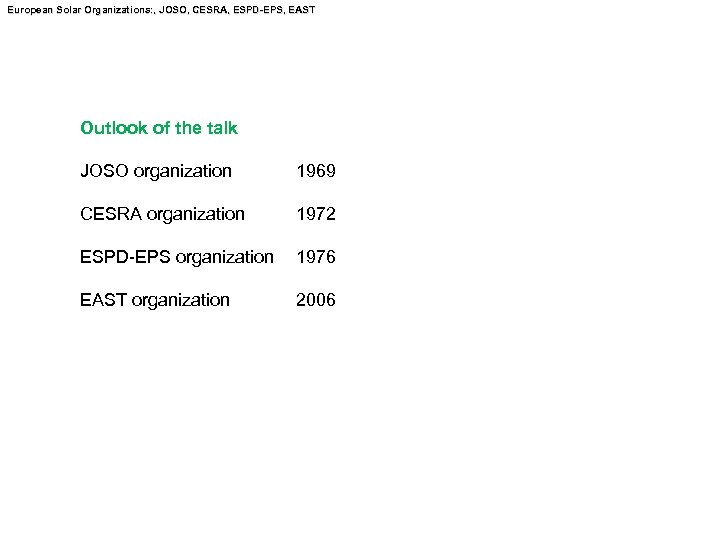 European Solar Organizations: , JOSO, CESRA, ESPD-EPS, EAST Organizations: , SPD -EPS, Outlook of the talk JOSO organization 1969 CESRA organization 1972 ESPD-EPS organization 1976 EAST organization 2006
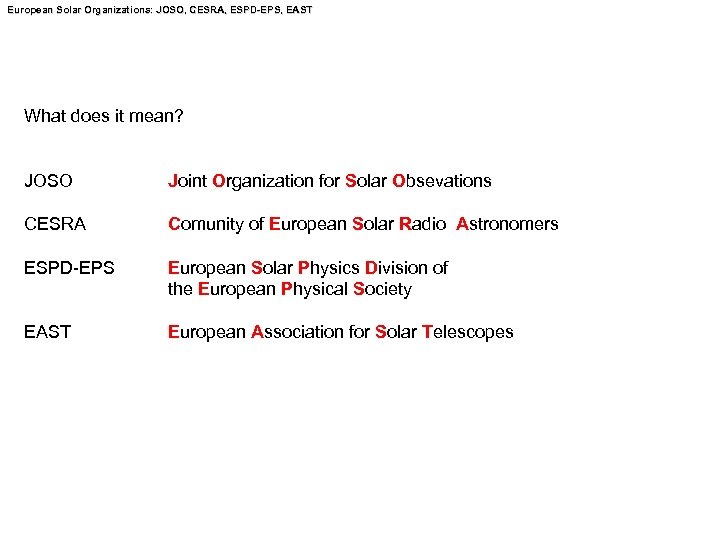 European Solar Organizations: JOSO, CESRA, ESPD-EPS, EAST Organizations: JOSO, SPD -EPS, What does it mean? JOSO Joint Organization for Solar Obsevations CESRA Comunity of European Solar Radio Astronomers ESPD-EPS European Solar Physics Division of the European Physical Society EAST European Association for Solar Telescopes
 European Solar Organizations: JOSO, CESRA, ESPD-EPS, EAST Organizations: SPD -EPS, The Foundation of JOSO: „Karl-Otto Kiepenheuer invited a number of European colleagues to Freiburg in July 1968 and March 1969 to discuss the scientific and organizational aims of a cooperative international organization to be founded. “ There was soon unanimous agreement about the aim to establish a cooperative European solar observatory at good astro-climate location Next meeting held at Catania in December 1969 is now regarded as the foundation of JOSO. „Statement of Intentions“ „ 1) search for an ideal observatory site by means of systematic and coordinated investigations of the meteorological and astronomical properties of a great number of possible sites; 2) installation of medium sized instruments on the chosen site; these instruments could be already existing or new solar telescopes and could be international or national telescopes to be put at the disposal of JOSO; 3) construction of the LEST (at this time the acronym stood for Large European Solar Telescope), an instrument for visible and near infrared solar astronomy that should surpass already existing instruments“.
 European Solar Organizations: JOSO, CESRA, ESPD-EPS, EAST Organizations: SPD -EPS,
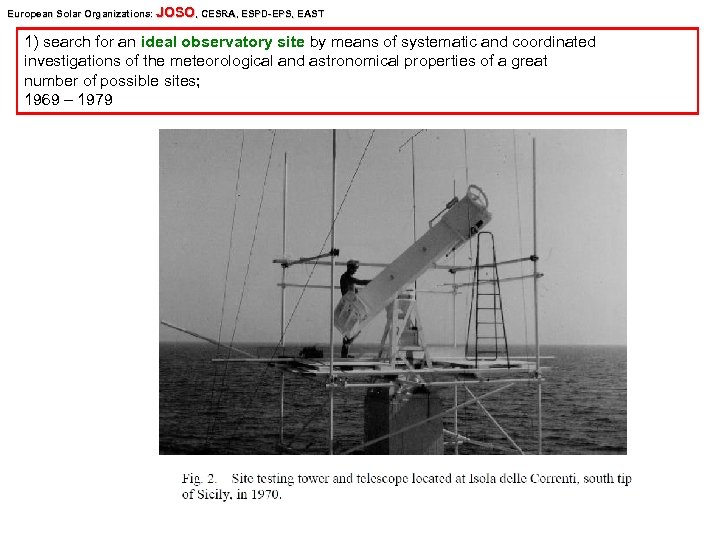 European Solar Organizations: JOSO, CESRA, ESPD-EPS, EAST Organizations: SPD -EPS, 1) search for an ideal observatory site by means of systematic and coordinated investigations of the meteorological and astronomical properties of a great number of possible sites; 1969 – 1979
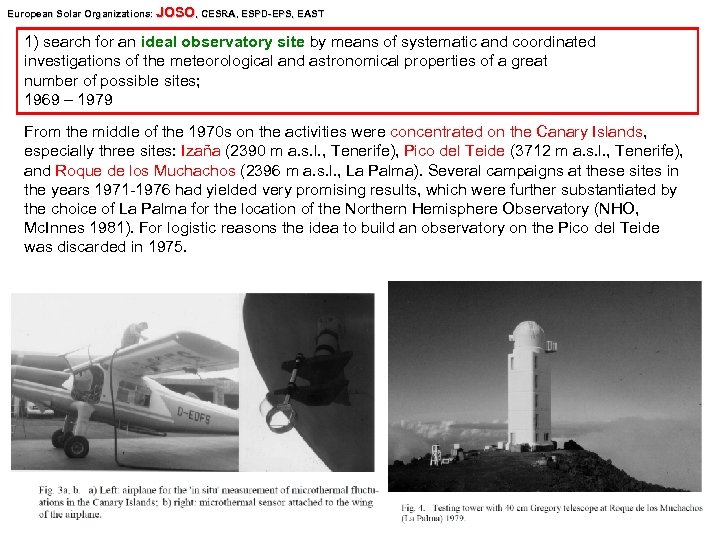 European Solar Organizations: JOSO, CESRA, ESPD-EPS, EAST Organizations: SPD -EPS, 1) search for an ideal observatory site by means of systematic and coordinated investigations of the meteorological and astronomical properties of a great number of possible sites; 1969 – 1979 From the middle of the 1970 s on the activities were concentrated on the Canary Islands, especially three sites: Izaña (2390 m a. s. l. , Tenerife), Pico del Teide (3712 m a. s. l. , Tenerife), and Roque de los Muchachos (2396 m a. s. l. , La Palma). Several campaigns at these sites in the years 1971 -1976 had yielded very promising results, which were further substantiated by the choice of La Palma for the location of the Northern Hemisphere Observatory (NHO, Mc. Innes 1981). For logistic reasons the idea to build an observatory on the Pico del Teide was discarded in 1975.
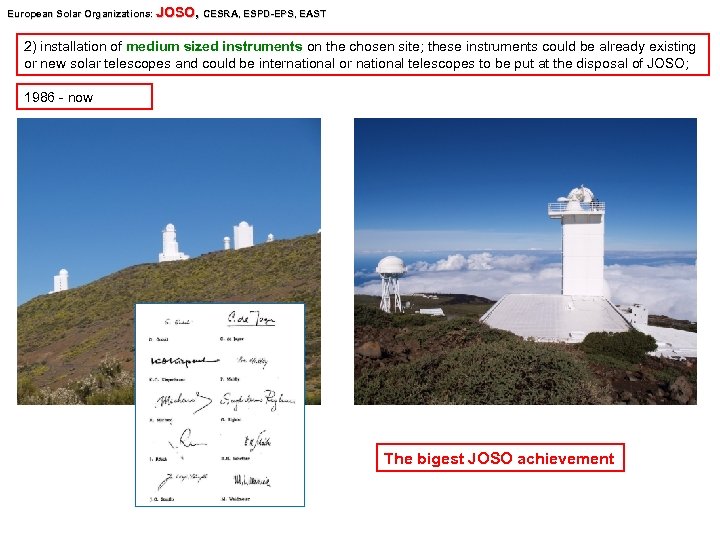 European Solar Organizations: JOSO, CESRA, ESPD-EPS, EAST Organizations: SPD -EPS, 2) installation of medium sized instruments on the chosen site; these instruments could be already existing or new solar telescopes and could be international or national telescopes to be put at the disposal of JOSO; 1986 - now The bigest JOSO achievement
 European Solar Organizations: JOSO, CESRA, ESPD-EPS, EAST Organizations: SPD -EPS, 3) construction of the LEST (at this time the acronym stood for Large European Solar Telescope), an instrument for visible and near infrared solar astronomy that should surpass already existing instruments. Florence in November 1978 the main characteristics for a future LEST were discussed: The basic design characteristics of the LEST were: a) high spatial resolution, i. e. 0. 1 arcsec or 70 km on the Sun; b) high precision pointing and tracking capabilities, i. e. stable tracking of sub-arcsec features for ~1/2 hour; c) low instrumental polarisation, i. e. circular 10 -3 -10 -5 and linear 10 -4 -10 -6; d) low straylight level; e) IR capabilities f) high photon flux. The 1982 design study proposed a 2. 4 -m Gregory telescope with a f/2. 3 primary parabolic mirror.
 European Solar Organizations: JOSO, CESRA, ESPD-EPS, EAST Organizations: SPD -EPS, 3) construction of the LEST (at this time the acronym stood for Large European Solar Telescope), an instrument for visible and near infrared solar astronomy that should surpass already existing instruments. The meeting for the final establishment of the LEST Foundation was held on 26 April 1983 at the Royal Swedish Academy of Sciences in Stockholm. Founding members were institutes or research funding agencies from Israel, Norway, Sweden, and Switzerland; J. O. Stenflo (Zürich) was its first president. In the same year Italy and Germany joined the foundation, followed by Australia (1984), and China, Spain, and USA (1986) Due to financial difficulties in the member countries of the LEST Foundation the instrument could not be built until today, although the technical preparations had reached an advanced stage. The most recent report about LEST was published in the JOSO Annual Report of 1997. LEST 1983 – 1997 The biggest JOSO failure
 European Solar Organizations: JOSO, CESRA, ESPD-EPS, EAST Organizations: SPD -EPS, The new era of JOSO - 1991 -2006 - The Opening to the East During the 21 st meeting of the JOSO Board held in Rome (7 -11 Nov. 1989) the participants were surprised by the news of the opening of the Berlin wall. It was clear to all colleagues that this brought into the bounds of possibilities the integration of the eastern European institutes into the JOSO activities; The meeting of JOSO in 1991 at Berlin was attended by colleagues from Croatia, the Czech and Slovak Federal Republic (CSFR), and of course by colleagues from Potsdam. Two colleagues from the CSFR were officially acknowledged as members of the JOSO Board, which at that time gathered representatives of 17 countries. For the first time the JOSO Annual Report of 1991 contains short accounts of the scientific work in Ondrejov, Tatranska Lomnica, and Potsdam. The invitation to held the next JOSO meeting at Tatranska Lomnica in 1992 was gratefully accept.
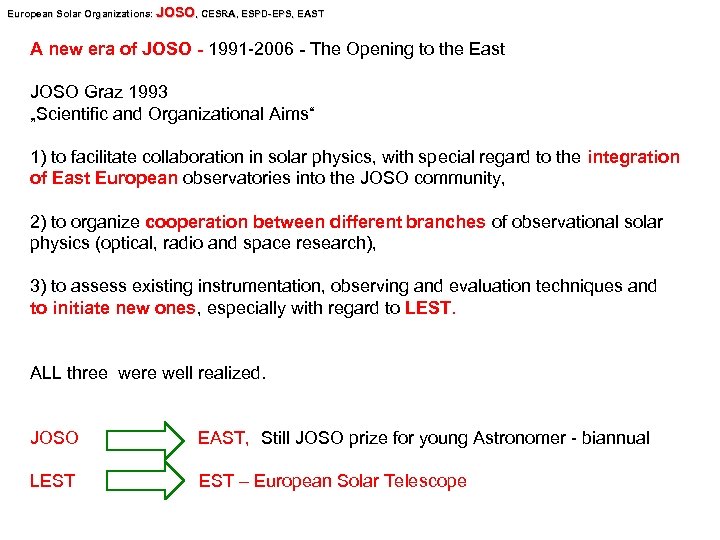 European Solar Organizations: JOSO, CESRA, ESPD-EPS, EAST Organizations: SPD -EPS, A new era of JOSO - 1991 -2006 - The Opening to the East JOSO Graz 1993 „Scientific and Organizational Aims“ 1) to facilitate collaboration in solar physics, with special regard to the integration of East European observatories into the JOSO community, 2) to organize cooperation between different branches of observational solar physics (optical, radio and space research), 3) to assess existing instrumentation, observing and evaluation techniques and to initiate new ones, especially with regard to LEST. ALL three were well realized. JOSO EAST, Still JOSO prize for young Astronomer - biannual LEST – European Solar Telescope
 European Solar Organizations: JOSO, CESRA, ESPD-EPS, EAST Organizations: JOSO, SPD -EPS, http: //www. lesia. obspm. fr/cesra/
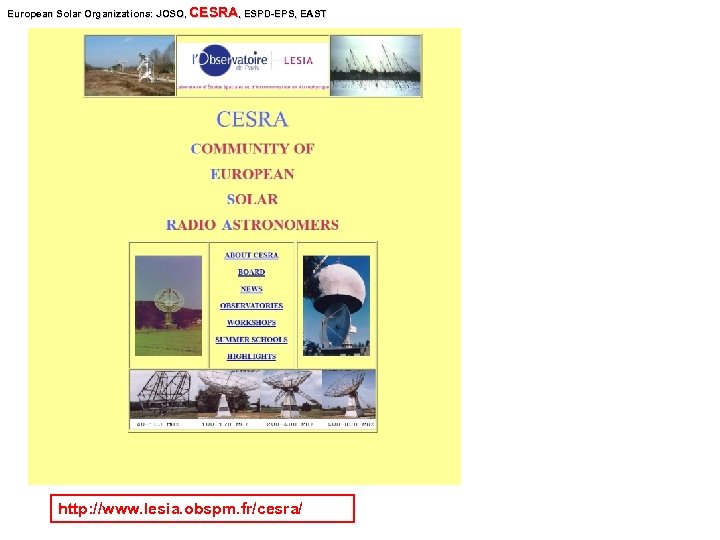
 European Solar Organizations: JOSO, CESRA, ESPD-EPS, EAST Organizations: JOSO, SPD -EPS, Community of European Solar Radio Astronomers (CESRA) is an informal organization of European scientists to stimulate research of the outer solar atmosphere by means of radio waves and any other suitable diagnostics. The aims of CESRA are: 1. to promote studies of the radio emission of the Sun and related topics including solar-like stars, 2. to promote new instrumental developments, to facilitate contacts between observers using different tools (remote sensing from gamma-rays to radio waves, in situ measurements), 3. to stimulate collaboration between observers and theoreticians, solar, heliospheric and stellar physicists, 4. to encourage young scientists in the field of solar radio physics, 5. to maintain contacts with all groups in the field within Europe and other parts of the world. CESRA was founded in Zurich, Switzerland, in 1972. http: //www. lesia. obspm. fr/cesra/
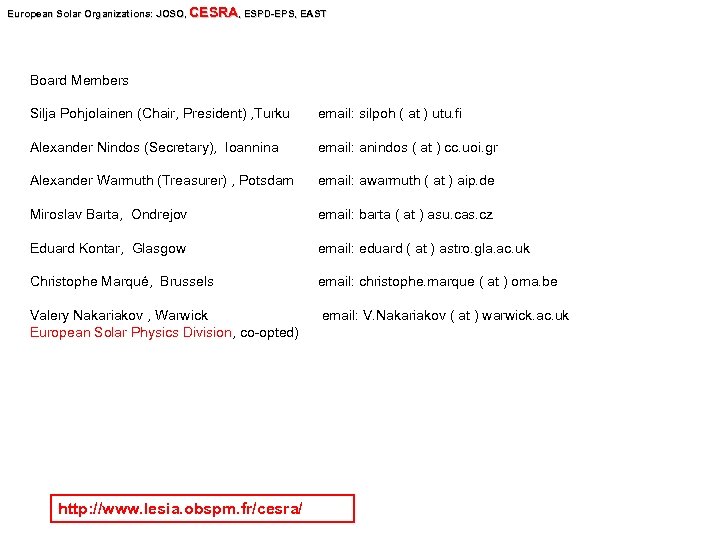 European Solar Organizations: JOSO, CESRA, ESPD-EPS, EAST Organizations: JOSO, SPD -EPS, Board Members Silja Pohjolainen (Chair, President) , Turku email: silpoh ( at ) utu. fi Alexander Nindos (Secretary), Ioannina email: anindos ( at ) cc. uoi. gr Alexander Warmuth (Treasurer) , Potsdam email: awarmuth ( at ) aip. de Miroslav Barta, Ondrejov email: barta ( at ) asu. cas. cz Eduard Kontar, Glasgow email: eduard ( at ) astro. gla. ac. uk Christophe Marqué, Brussels email: christophe. marque ( at ) oma. be Valery Nakariakov , Warwick European Solar Physics Division, co-opted) email: V. Nakariakov ( at ) warwick. ac. uk http: //www. lesia. obspm. fr/cesra/
 European Solar Organizations: JOSO, CESRA, ESPD-EPS, EAST Organizations: JOSO, https: //perswww. kuleuven. be/~u 0002601/ESPD/
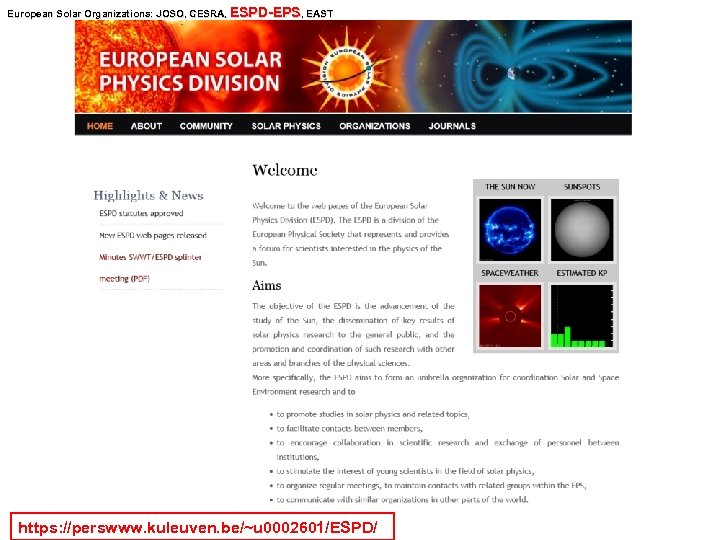
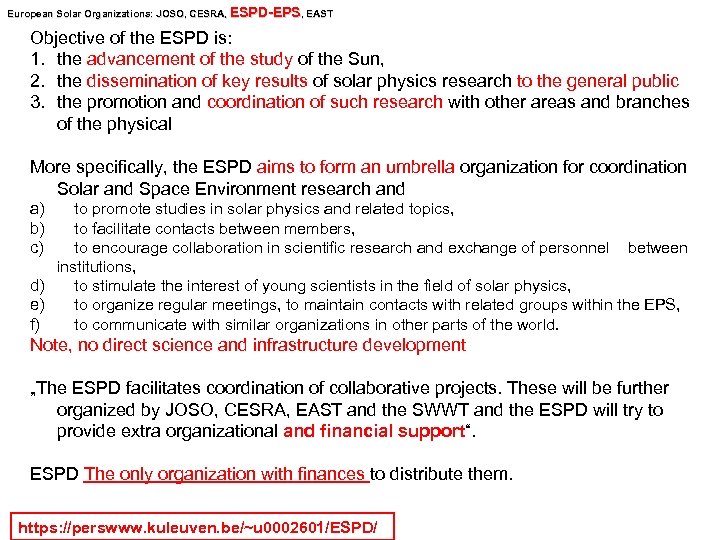 European Solar Organizations: JOSO, CESRA, ESPD-EPS, EAST Organizations: JOSO, Objective of the ESPD is: 1. the advancement of the study of the Sun, 2. the dissemination of key results of solar physics research to the general public 3. the promotion and coordination of such research with other areas and branches of the physical More specifically, the ESPD aims to form an umbrella organization for coordination Solar and Space Environment research and a) b) c) to promote studies in solar physics and related topics, to facilitate contacts between members, to encourage collaboration in scientific research and exchange of personnel between institutions, d) to stimulate the interest of young scientists in the field of solar physics, e) to organize regular meetings, to maintain contacts with related groups within the EPS, f) to communicate with similar organizations in other parts of the world. Note, no direct science and infrastructure development „The ESPD facilitates coordination of collaborative projects. These will be further organized by JOSO, CESRA, EAST and the SWWT and the ESPD will try to provide extra organizational and financial support“. ESPD The only organization with finances to distribute them. https: //perswww. kuleuven. be/~u 0002601/ESPD/
 European Solar Organizations: JOSO, CESRA, ESPD-EPS, EAST Organizations: JOSO, https: //perswww. kuleuven. be/~u 0002601/ESPD/
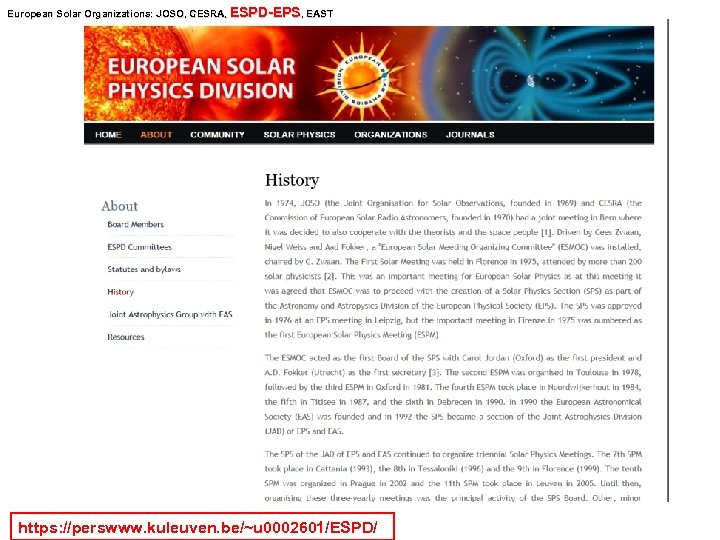
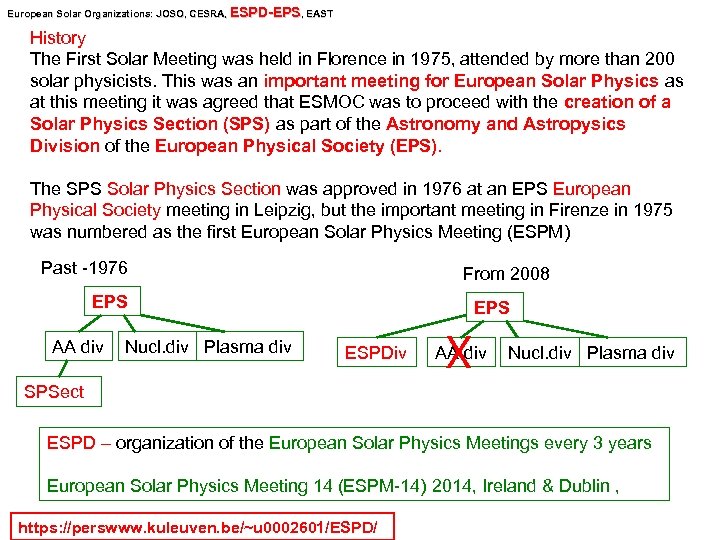 European Solar Organizations: JOSO, CESRA, ESPD-EPS, EAST Organizations: JOSO, History The First Solar Meeting was held in Florence in 1975, attended by more than 200 solar physicists. This was an important meeting for European Solar Physics as at this meeting it was agreed that ESMOC was to proceed with the creation of a Solar Physics Section (SPS) as part of the Astronomy and Astropysics Division of the European Physical Society (EPS). The SPS Solar Physics Section was approved in 1976 at an EPS European Physical Society meeting in Leipzig, but the important meeting in Firenze in 1975 was numbered as the first European Solar Physics Meeting (ESPM) Past -1976 From 2008 EPS AA div Nucl. div Plasma div EPS ESPDiv X AA div Nucl. div Plasma div SPSect ESPD – organization of the European Solar Physics Meetings every 3 years European Solar Physics Meeting 14 (ESPM-14) 2014, Ireland & Dublin , https: //perswww. kuleuven. be/~u 0002601/ESPD/
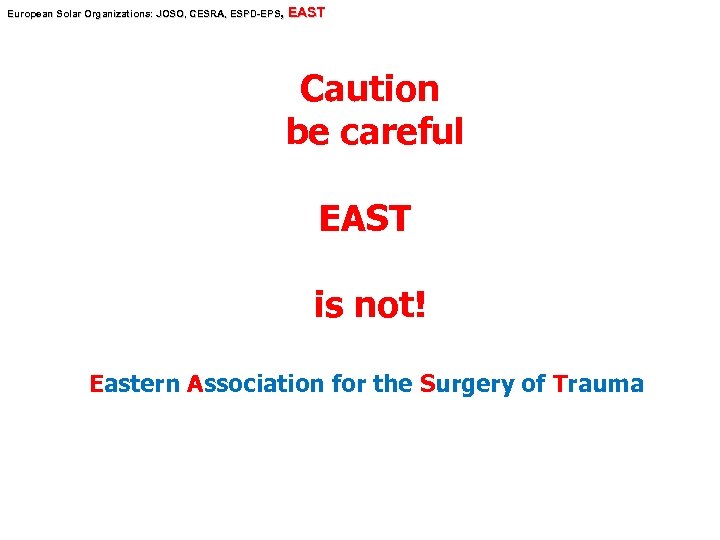 European Solar Organizations: JOSO, CESRA, ESPD-EPS, Organizations: JOSO, SPD EAST Caution be careful EAST is not! Eastern Association for the Surgery of Trauma
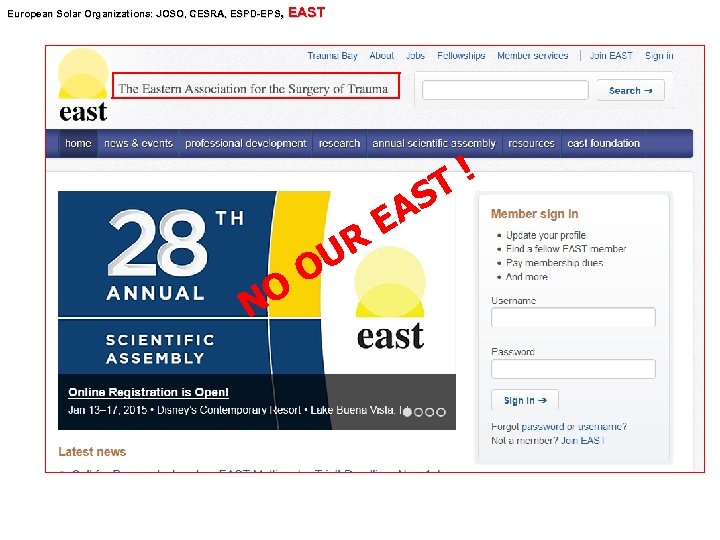 European Solar Organizations: JOSO, CESRA, ESPD-EPS, Organizations: JOSO, SPD EAST NO O R U E S A ! T
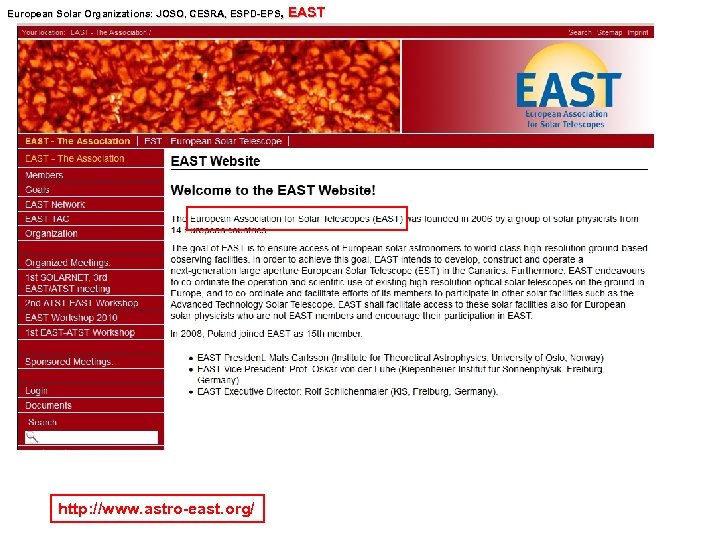 European Solar Organizations: JOSO, CESRA, ESPD-EPS, Organizations: JOSO, SPD http: //www. astro-east. org/ EAST
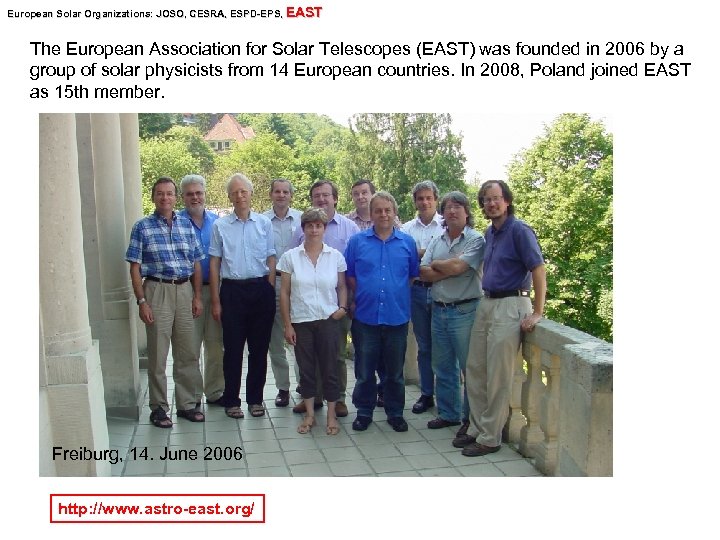 European Solar Organizations: JOSO, CESRA, ESPD-EPS, EAST Organizations: JOSO, SPD -EPS, The European Association for Solar Telescopes (EAST) was founded in 2006 by a group of solar physicists from 14 European countries. In 2008, Poland joined EAST as 15 th member. Freiburg, 14. June 2006 http: //www. astro-east. org/
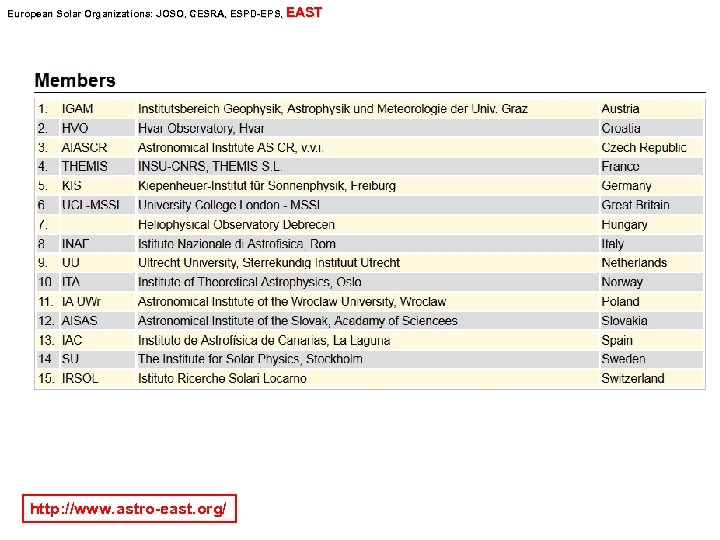 European Solar Organizations: JOSO, CESRA, ESPD-EPS, EAST Organizations: JOSO, SPD -EPS, http: //www. astro-east. org/
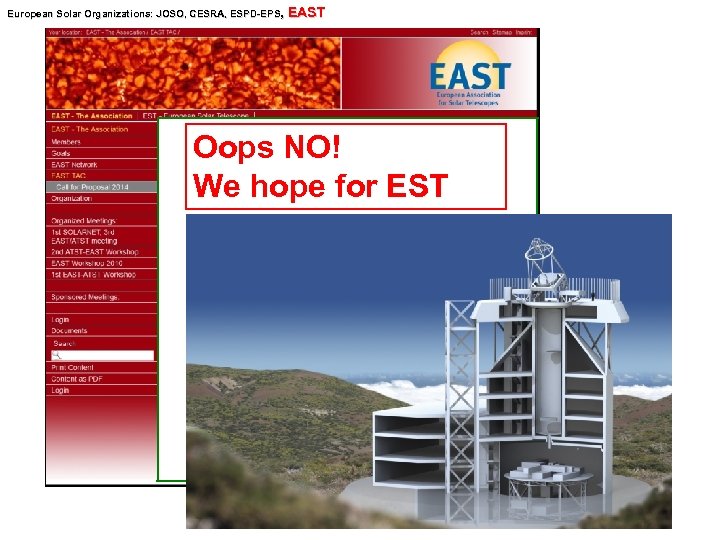
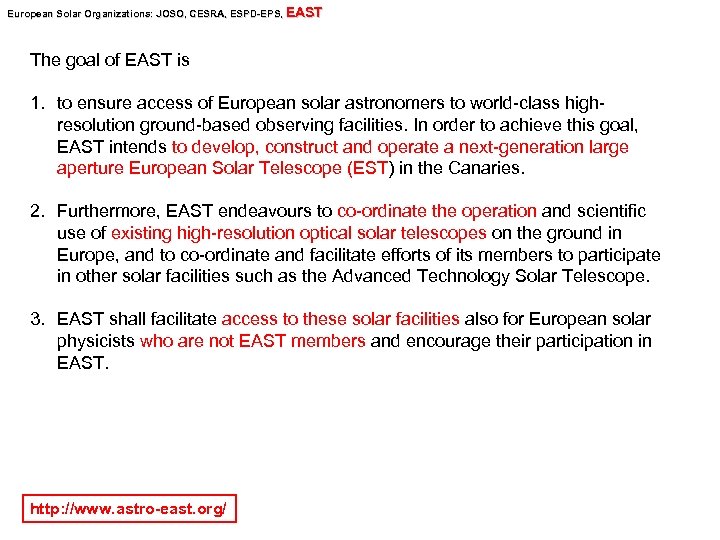 European Solar Organizations: JOSO, CESRA, ESPD-EPS, EAST Organizations: JOSO, SPD -EPS, The goal of EAST is 1. to ensure access of European solar astronomers to world-class highresolution ground-based observing facilities. In order to achieve this goal, EAST intends to develop, construct and operate a next-generation large aperture European Solar Telescope (EST) in the Canaries. 2. Furthermore, EAST endeavours to co-ordinate the operation and scientific use of existing high-resolution optical solar telescopes on the ground in Europe, and to co-ordinate and facilitate efforts of its members to participate in other solar facilities such as the Advanced Technology Solar Telescope. 3. EAST shall facilitate access to these solar facilities also for European solar physicists who are not EAST members and encourage their participation in EAST. http: //www. astro-east. org/
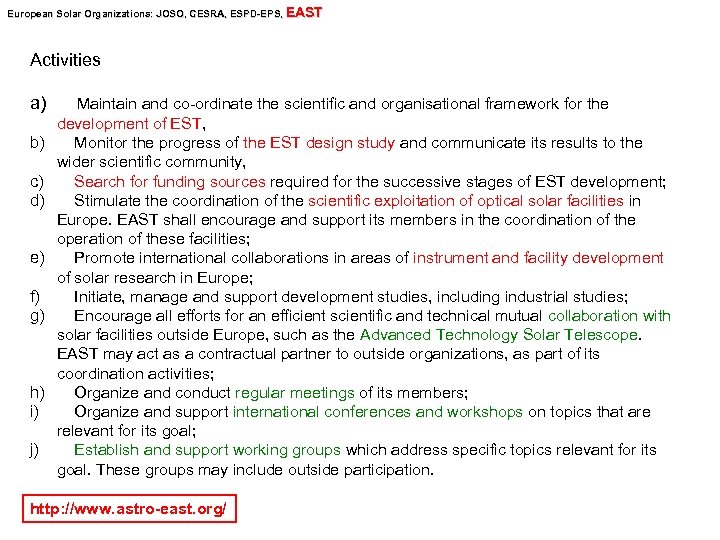 European Solar Organizations: JOSO, CESRA, ESPD-EPS, EAST Organizations: JOSO, SPD -EPS, Activities a) b) c) d) e) f) g) h) i) j) Maintain and co-ordinate the scientific and organisational framework for the development of EST, Monitor the progress of the EST design study and communicate its results to the wider scientific community, Search for funding sources required for the successive stages of EST development; Stimulate the coordination of the scientific exploitation of optical solar facilities in Europe. EAST shall encourage and support its members in the coordination of the operation of these facilities; Promote international collaborations in areas of instrument and facility development of solar research in Europe; Initiate, manage and support development studies, including industrial studies; Encourage all efforts for an efficient scientific and technical mutual collaboration with solar facilities outside Europe, such as the Advanced Technology Solar Telescope. EAST may act as a contractual partner to outside organizations, as part of its coordination activities; Organize and conduct regular meetings of its members; Organize and support international conferences and workshops on topics that are relevant for its goal; Establish and support working groups which address specific topics relevant for its goal. These groups may include outside participation. http: //www. astro-east. org/
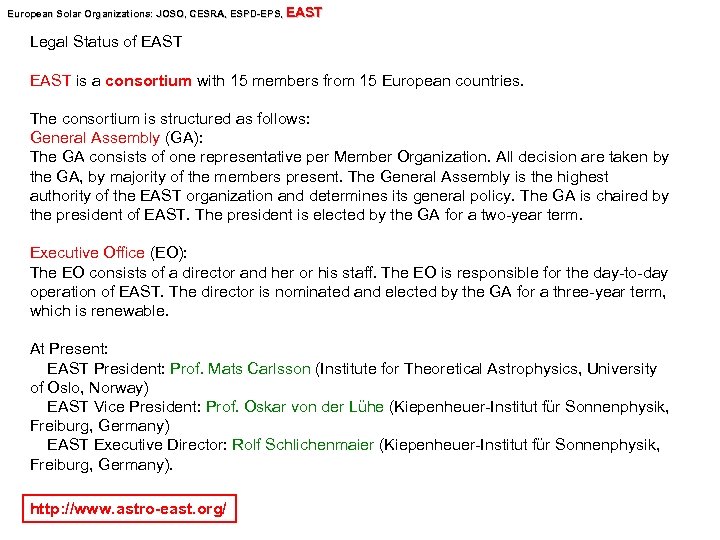 European Solar Organizations: JOSO, CESRA, ESPD-EPS, EAST Organizations: JOSO, SPD -EPS, Legal Status of EAST is a consortium with 15 members from 15 European countries. The consortium is structured as follows: General Assembly (GA): The GA consists of one representative per Member Organization. All decision are taken by the GA, by majority of the members present. The General Assembly is the highest authority of the EAST organization and determines its general policy. The GA is chaired by the president of EAST. The president is elected by the GA for a two-year term. Executive Office (EO): The EO consists of a director and her or his staff. The EO is responsible for the day-to-day operation of EAST. The director is nominated and elected by the GA for a three-year term, which is renewable. At Present: EAST President: Prof. Mats Carlsson (Institute for Theoretical Astrophysics, University of Oslo, Norway) EAST Vice President: Prof. Oskar von der Lühe (Kiepenheuer-Institut für Sonnenphysik, Freiburg, Germany) EAST Executive Director: Rolf Schlichenmaier (Kiepenheuer-Institut für Sonnenphysik, Freiburg, Germany). http: //www. astro-east. org/
 European Solar Organizations: JOSO, CESRA, ESPD-EPS, Organizations: JOSO, SPD http: //www. astro-east. org/ EAST
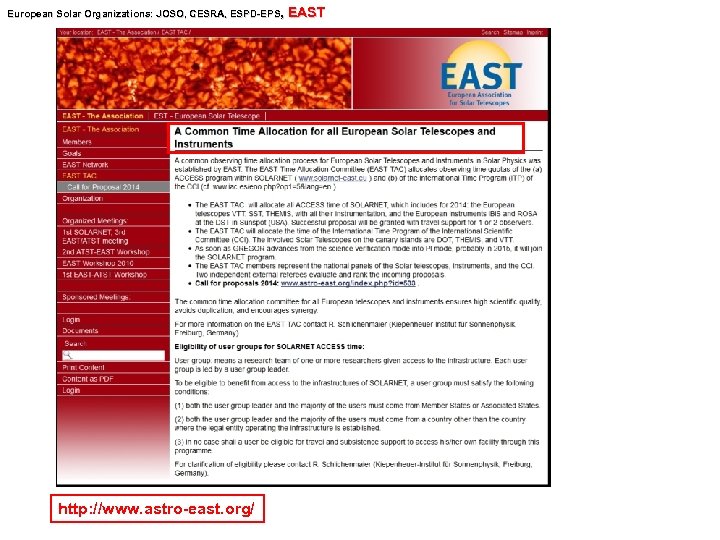
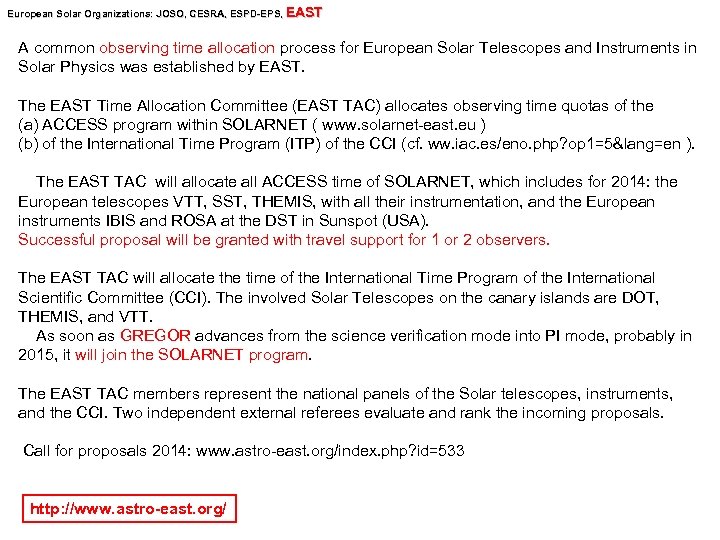 European Solar Organizations: JOSO, CESRA, ESPD-EPS, EAST Organizations: JOSO, SPD -EPS, A common observing time allocation process for European Solar Telescopes and Instruments in Solar Physics was established by EAST. The EAST Time Allocation Committee (EAST TAC) allocates observing time quotas of the (a) ACCESS program within SOLARNET ( www. solarnet-east. eu ) (b) of the International Time Program (ITP) of the CCI (cf. ww. iac. es/eno. php? op 1=5&lang=en ). The EAST TAC will allocate all ACCESS time of SOLARNET, which includes for 2014: the European telescopes VTT, SST, THEMIS, with all their instrumentation, and the European instruments IBIS and ROSA at the DST in Sunspot (USA). Successful proposal will be granted with travel support for 1 or 2 observers. The EAST TAC will allocate the time of the International Time Program of the International Scientific Committee (CCI). The involved Solar Telescopes on the canary islands are DOT, THEMIS, and VTT. As soon as GREGOR advances from the science verification mode into PI mode, probably in 2015, it will join the SOLARNET program. The EAST TAC members represent the national panels of the Solar telescopes, instruments, and the CCI. Two independent external referees evaluate and rank the incoming proposals. Call for proposals 2014: www. astro-east. org/index. php? id=533 http: //www. astro-east. org/
 European Solar Organizations: JOSO, CESRA, ESPD-EPS, Organizations: JOSO, SPD EAST THE END
 European Solar Organizations: JOSO, CESRA, ESPD-EPS, Organizations: JOSO, SPD EAST Oops NO! We hope for EST