


 Скачать презентацию European perspectives on the expected returns from investment
622aa6f74702b01fc070f48cb5333b86.ppt
- Количество слайдов: 18
 European perspectives on the expected returns from investment in university research [incomplete set of slides – 3 more to be added] Costs & Compacts Symposium Canberra 15 th July 2008 Dr Mark Matthews Executive Director Forum for European-Australian Science and Technology cooperation (FEAST) and Research School of Social Sciences The Australian National University mark. matthews@anu. edu. au © Mark Matthews, FEAST
 Overview of talk • Stress the importance of Europe for Australian research and innovation • Brief you on current developments in Brussels • Clarify what the Framework Programme is and is not • Highlight salient aspects of some specific national experiences: – – UK France Finland Netherlands • Draw some conclusions for policy-making in Australia
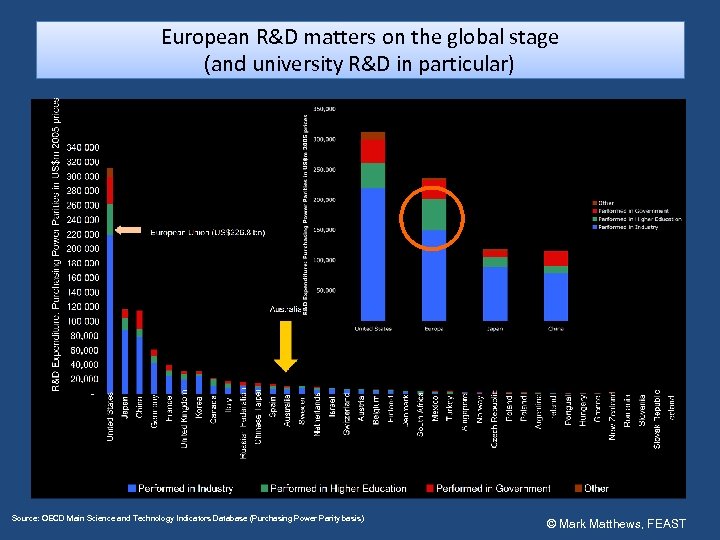 European R&D matters on the global stage (and university R&D in particular) Source: OECD Main Science and Technology Indicators Database (Purchasing Power Parity basis) © Mark Matthews, FEAST
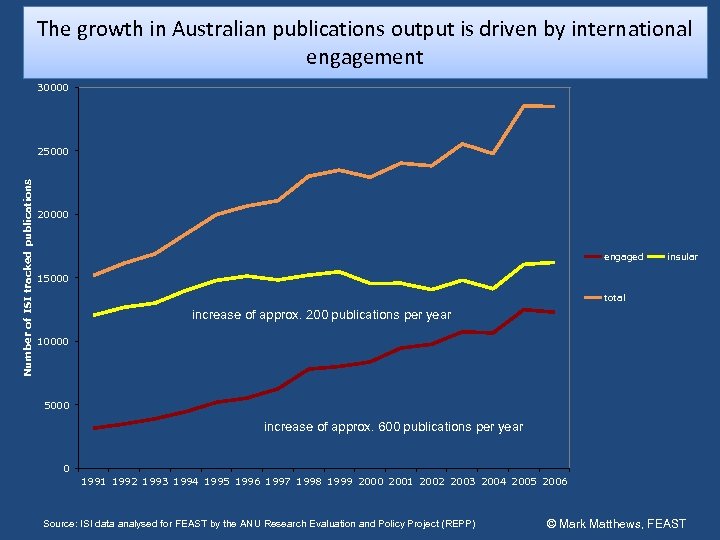 The growth in Australian publications output is driven by international engagement 30000 Number of ISI tracked publications 25000 20000 engaged insular 15000 total increase of approx. 200 publications per year 10000 5000 increase of approx. 600 publications per year 0 1991 1992 1993 1994 1995 1996 1997 1998 1999 2000 2001 2002 2003 2004 2005 2006 Source: ISI data analysed for FEAST by the ANU Research Evaluation and Policy Project (REPP) © Mark Matthews, FEAST
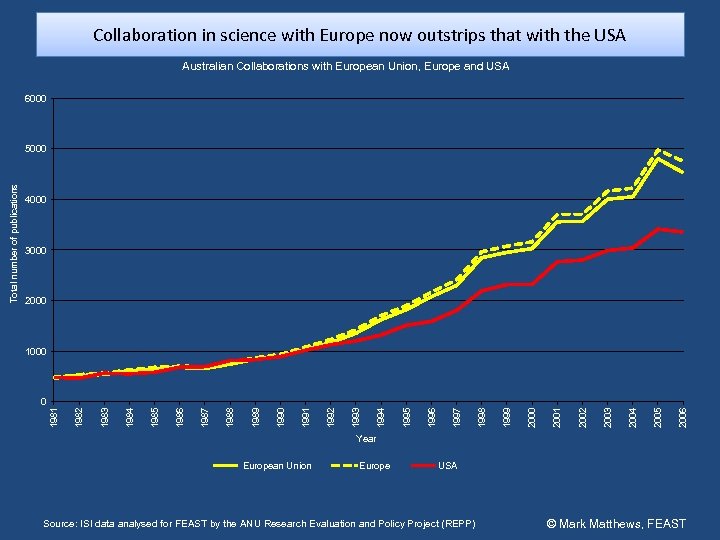 Collaboration in science with Europe now outstrips that with the USA Australian Collaborations with European Union, Europe and USA 6000 4000 3000 2006 2005 2004 2003 2002 2001 2000 1999 1998 1997 1996 1995 1994 1993 1992 1991 1990 1989 1988 1987 1986 1985 1984 1983 0 1982 1000 1981 Total number of publications 5000 Year European Union Europe USA Source: ISI data analysed for FEAST by the ANU Research Evaluation and Policy Project (REPP) © Mark Matthews, FEAST
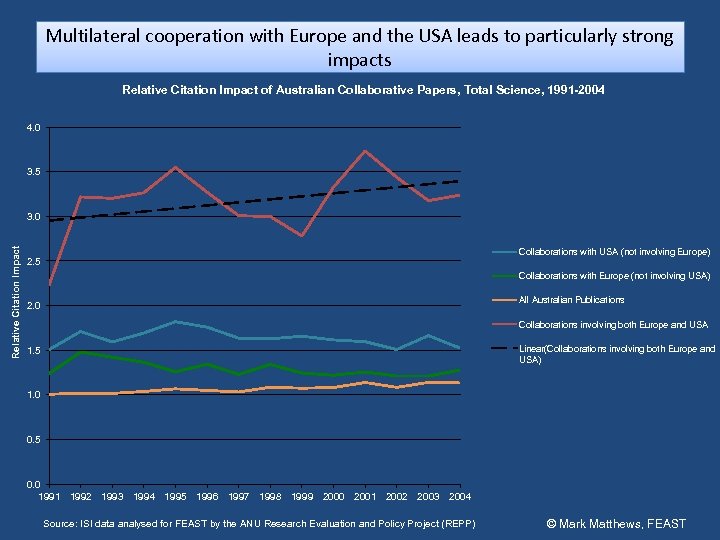 Multilateral cooperation with Europe and the USA leads to particularly strong impacts Relative Citation Impact of Australian Collaborative Papers, Total Science, 1991 -2004 4. 0 3. 5 Relative Citation Impact 3. 0 Collaborations with USA (not involving Europe) 2. 5 Collaborations with Europe (not involving USA) All Australian Publications 2. 0 Collaborations involving both Europe and USA Linear(Collaborations involving both Europe and USA) 1. 5 1. 0 0. 5 0. 0 1991 1992 1993 1994 1995 1996 1997 1998 1999 2000 2001 2002 2003 2004 Source: ISI data analysed for FEAST by the ANU Research Evaluation and Policy Project (REPP) © Mark Matthews, FEAST
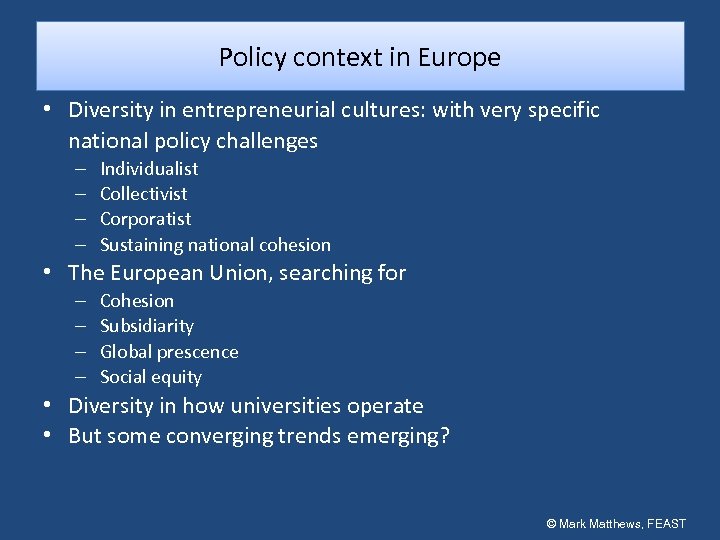 Policy context in Europe • Diversity in entrepreneurial cultures: with very specific national policy challenges – – Individualist Collectivist Corporatist Sustaining national cohesion • The European Union, searching for – – Cohesion Subsidiarity Global prescence Social equity • Diversity in how universities operate • But some converging trends emerging? © Mark Matthews, FEAST
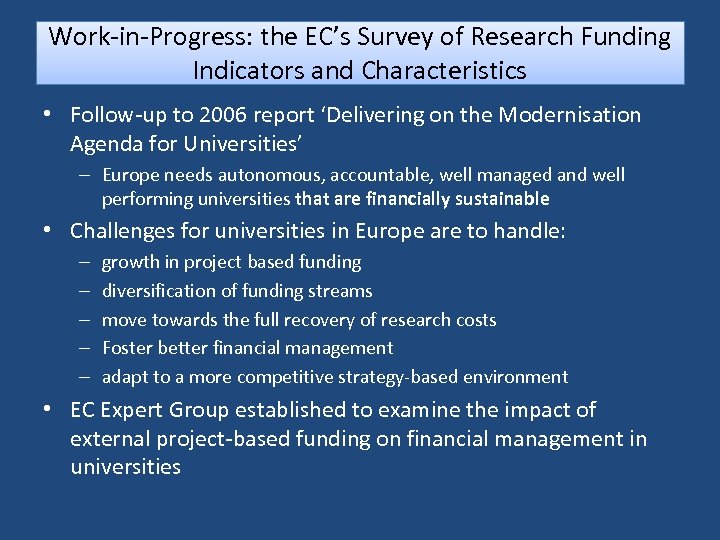 Work-in-Progress: the EC’s Survey of Research Funding Indicators and Characteristics • Follow-up to 2006 report ‘Delivering on the Modernisation Agenda for Universities’ – Europe needs autonomous, accountable, well managed and well performing universities that are financially sustainable • Challenges for universities in Europe are to handle: – – – growth in project based funding diversification of funding streams move towards the full recovery of research costs Foster better financial management adapt to a more competitive strategy-based environment • EC Expert Group established to examine the impact of external project-based funding on financial management in universities
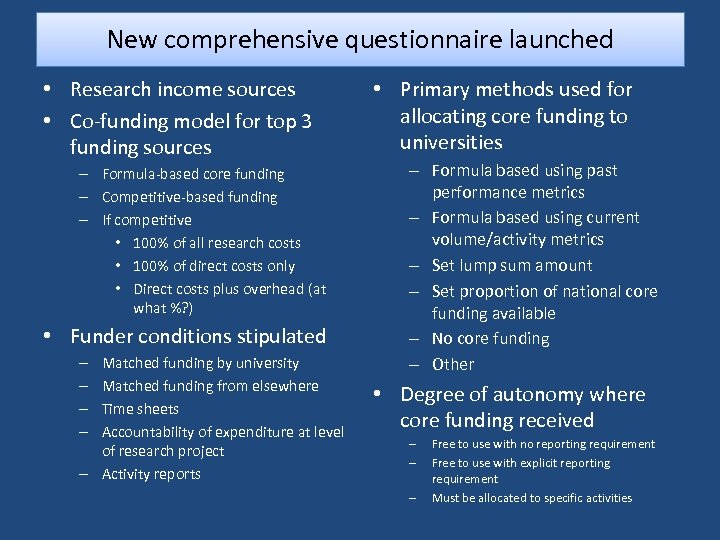 New comprehensive questionnaire launched • Research income sources • Co-funding model for top 3 funding sources – Formula-based core funding – Competitive-based funding – If competitive • 100% of all research costs • 100% of direct costs only • Direct costs plus overhead (at what %? ) • Funder conditions stipulated Matched funding by university Matched funding from elsewhere Time sheets Accountability of expenditure at level of research project – Activity reports – – • Primary methods used for allocating core funding to universities – Formula based using past performance metrics – Formula based using current volume/activity metrics – Set lump sum amount – Set proportion of national core funding available – No core funding – Other • Degree of autonomy where core funding received – – – Free to use with no reporting requirement Free to use with explicit reporting requirement Must be allocated to specific activities
 Findings will be extremely useful • Covers non-European nations (incl. Australia) • Opportunity to drive forward via a major comparative policy analysis • Some “heads up” results already made available to FEAST by the EC – but on a confidential basis at this stage • Important to augment with work on evolving thinking on: – the nature and extent of the expected returns from investment in university research
 New CREST working group: Mutual learning on approaches to improve excellence of research in universities • CREST = Scientific & Technical Research Committee that advises the EC/EU • New study a German suggestion in 2007 • Review the scope, objectives and measures of national policies to improve research performance in universities – excellence, relevance & impact • Review the effect of these policies on universities re – Governance, strategies, performance & good practices • Another opportunity for Australia to conduct a policy dialogue with Europe
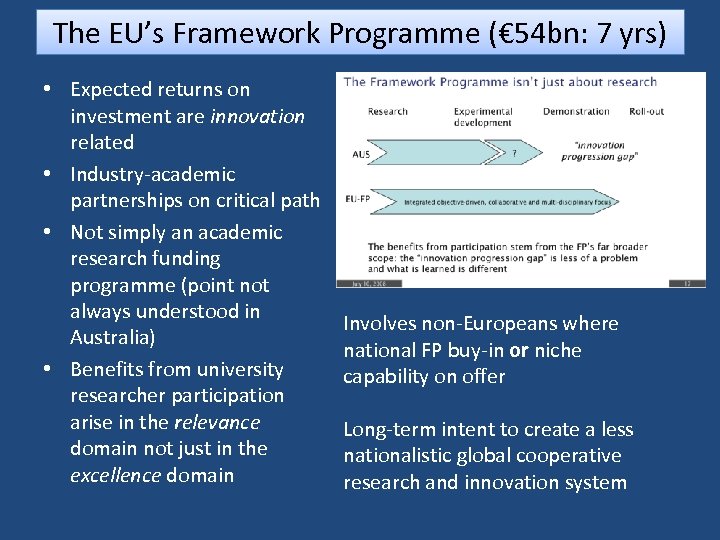 The EU’s Framework Programme (€ 54 bn: 7 yrs) • Expected returns on investment are innovation related • Industry-academic partnerships on critical path • Not simply an academic research funding programme (point not always understood in Australia) • Benefits from university researcher participation arise in the relevance domain not just in the excellence domain Involves non-Europeans where national FP buy-in or niche capability on offer Long-term intent to create a less nationalistic global cooperative research and innovation system
 UK: The evolution of HM Treasury thinking • The HM Treasury move to become more engaged in research and innovation policy – Combined Economic and Finance Ministry profile generated strong incentives to get more engaged (productivity drivers plus spending accountability) – meshed with internal departmental spending advocacy structure: structural incentive to grasp policy issues • Consequences: – Flaws in the ‘linear model’ became apparent – Over emphasis on IP/commercialisation avoided • role of Universities UK/AURIL IP strategy report: driven by Treasury & Cabinet Office – Initial short-termism overcome – Arguably, too great an emphasis on corporatist thinking: not well aligned with robust entrepeneurship
 UK: The evolution of HM Treasury thinking (cont) • Realised that universities can deliver against complete overarching policy framework 1. 2. 3. 4. 5. Create new businesses Improve the performance of existing businesses Improve public policy and public services Delivery highly qualified people to the labour market Attract (overseas) R&D investment from business: “straight to GDP” • Evolving priorities Take much longer term view Deal with backlog of under investment in research infrastructure Identify highest yielding areas Move beyond concern with formal R&D and into service-based innovation/creativity • Define 10 year priorities • •
 Additional slides to be added • Brief country profiles for – France – Finland – Netherlands • Each highlighting a particular policy issue
 Some conclusions • Exploit the potential generated by microeconomic reform in the economy as a whole – engage with Central Economic Ministry priorities more effectively • Foster creativity via greater support for cultures of entrepreneurial risk-taking – move to a more integrative ‘whole of education’ ethos (schools as a locus for nurturing creativity) – learning-by-doing from the creative economy policy narrative • Locating university research capability in this human capital-based policy narrative • Avoid mechanistic policy narratives: focus on agency not structure?
 Some conclusions (cont) • Fairness to future generations – the very long term view of what university research does • Full costing of research is important, but…. . . The capability to develop good effective strategies will be critical to making Compacts work - particularly in getting “bottom up” strategy definition (hence the link with entrepreneurial risk taking/creativity) • In short: trend for the expected returns to move away from ‘mechanistic’ narrowly defined outcomes and toward a more general ‘enlightenment’ ethos with human capital centre stage
 Next steps • FEAST can facilitate a policy dialogue between Australia (via Go 8) and the EC – Brussels keen to be briefed on this Costs & Compacts symposium – Use that meeting to agree a way forward (sharing data, ideas and experiences)?