 Скачать презентацию European Neighbourhood Policy a Tool to Increase
6c1bd5378ea0a006848d3dcb958d1e49.ppt
- Количество слайдов: 36



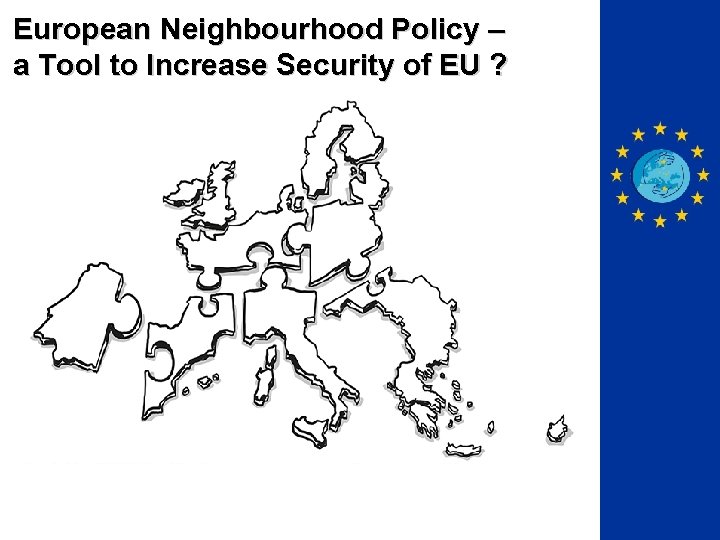
European Neighbourhood Policy – a Tool to Increase Security of EU ?
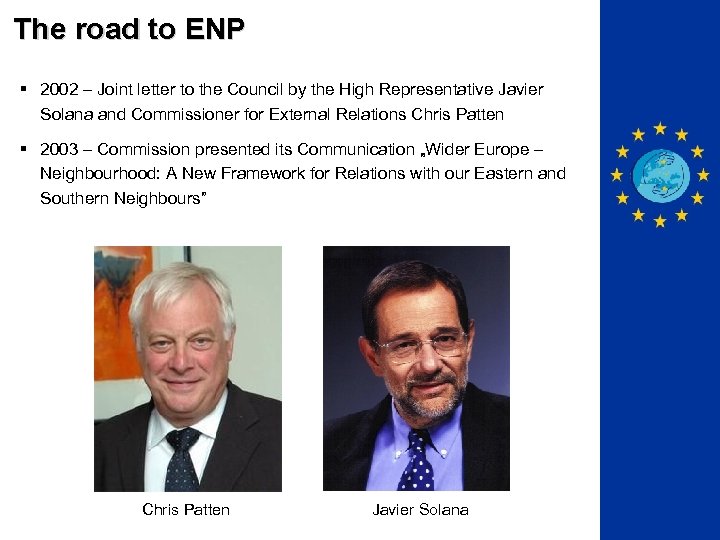
The road to ENP § 2002 – Joint letter to the Council by the High Representative Javier Solana and Commissioner for External Relations Chris Patten § 2003 – Commission presented its Communication „Wider Europe – Neighbourhood: A New Framework for Relations with our Eastern and Southern Neighbours” Chris Patten Javier Solana
The EU’s approach is based on the following incentives: § Extension of the internal market and regulatory structures § Preferential trading relations and market opening § Perspectives for lawful migration and movement of persons § Intensified cooperation to prevent and combat common security treats § Greater EU political involvement in conflict prevention and crisis management § Greater efforts to promote human rights, further cultural cooperation and enhance mutual understanding § Integration into transport, energy and telecommunications networks and the European research area § New instruments for investment promotion and protection § Support for integration into the global trading system § Enhanced assistance, better tailored to needs § New sources of finance
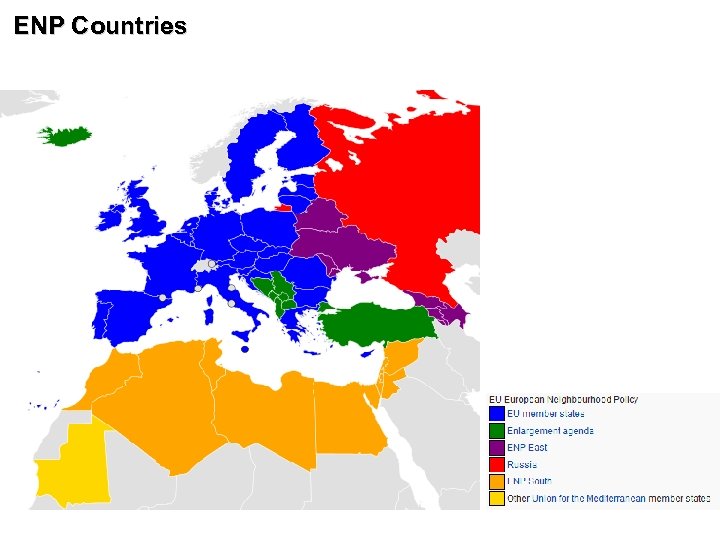
ENP Countries
Key ENP Priorities § Mutual prosperity, stability, security § Privileged relationship, building upon a mutual commitment to common values § Working together (joint ownership). . . §. . . supporting partners’ own reform processes (political, economic, social. . . ) through so called Action Plans § Building upon and strengthening existing relations § Principle of differentiation: progress is rewarded § Providing support for reforms (both political and financial commitment) with the establishment of a dedicated financial instrument, with more resources and more flexible funding of a broader range of activities
A three step process for developing and implementing the Action Plans for each country § Dialogue in the existing frameworks jointly analysing the achievements and failures of reform hitherto. § A document would then be drawn up by the Commission and the Member States, to be agreed in association with each country, setting out common objectives and benchmarks and a timetable for their achievement. § An annual review of progress in implementing the Action Plan.
Eastern Partnership – Eastern Dimension of ENP § Eastern Partnership instruments are used to help the participating countries overcome their transformation obstacles but it also helps to strengthen stability and prosperity of EU neighbourhood which brings direct benefits for both EU and participating countries Milestones and Figures § 2009: Ea. P launch, Summit in Prague § 2011: Summit in Warsaw § 2013: Summit in Vilnius § Budget: € 2, 5 billion available from the EU budget over the period 2010 -2013 (ENPI = European Neighbourhood and Partnership Instrument) § Further € 4, 1 billion leveraged from European Financial Institutions through the Neighbourhood Investment Facility (NIF)
Short-term Goals of Eastern Partnership § Visa facilitation § EU support for reform in accordance with European standards § Student and scholar exchange § Civil society platforms and seminars § Cooperation and exchange of partners Long-term Goals of Eastern Partnership § Visa-free regime § Free Trade Area
Areas of cooperation § Political and security § Borders and trans-border movement § Economic and financial § Environment § Social
Republic of Armenia Main results achieved so far: § 12 Armenian colleges were selected, registered, renovated and equipped as regional multifunctional VET centres § Since 2011, over 1200 teachers, training instructors and directors of VET institutions were trained in the organization and implementation of the learning process, management of VET institutions and business planning § Twice as many students received free education in VET colleges in 2012 in comparison to 2008
Republic of Azerbaijan Main goal achieved: § A dedicated team of lawyers supports the ‘milli mejlis’ (parliament) when law-making requires ‘approximation’ – which means bringing national legislation closer to EU law and standards. § A ‘virtual EU info centre’ accessible from the website of the milli mejlis facilitates access to information on the EU for members of Parliament and the citizens. This result was delivered thanks to collaboration between the milli mejlis and its ‘twin’ institution in Lithuania, the office of the Seimas
Republic of Moldova Main results achieved so far: § Progress in the implementation of the regional development policy: following the creation of the ministry of construction and Regional Development, three Regional Development Agencies (North, centre, and South) have been established § The first general agricultural census was conducted across the entire territory of the Republic of Moldova § The legal framework for business activities has improved, especially as regards the simplification of business registration (licensing) § Five new business incubators have been established hosting up to 15 small businesses each, out of which one third are female-run or female-owned
Ukraine Main results achieved so far: § New laws were developed and adopted, e. g. legislation on general product safety and market surveillance § Technical regulations in line with EU directives were adopted, for instance in the area of low voltage equipment and safety of machinery § 380 market surveillance inspectors and 260 custom officers were trained on how to implement the newly adopted law on market surveillance § The national plan to upgrade the equipment of testing and metrological laboratories was adopted
Georgia Main goal achieved: § The public Service Development agency has set up nine ‘community centres’ in rural areas. Thanks to these centres, Georgian village dwellers can access a broad range ofe-services (including social aid, municipal fees billing, and construction permissions), with no need to travel to a municipal centre or the capital city. This result is a new step in the ongoing process of modernization of the public administration, with broader outreach and easier access to quality services
Belarus Main goal achieved: § The clearing house, an EU initiative implemented by the office for democratic Belarus, encourages networking and exchange of best practices within the civil society in Belarus. It has carried out training sessions for local NGOs on how to apply for EU grants and individual consultations for small NGOs with limited capacity. It has also facilitated four projects implementers meetings in Brussels. Since 2011, 87 civil society organizations and grass-root initiatives have received counseling support on the avail- ability of funding instruments and the preparation of application forms
Prospects for the Future Accompanied with the creation of the new financial instrument for 2014 -2020 (European Neighbourhood Instrument), the EU will continue to introduce necessary reforms in partner countries. Financial assistance and know-how will be provided to ensure that EU cooperation brings about lasting changes. For countries fully committed to political association, economic integration and building deep and sustainable democracies the support will be stepped up.
Little Change in the Eastern Neighbourhood Analysis of the various criteria and indexes describing the change in the areas (stability and regional security, democratic and free-market transformations) since 2004 shows that the growing involvement of the EU and the development of its bureaucratic instruments has failed to bring about and real improvements in the neighbourhood.
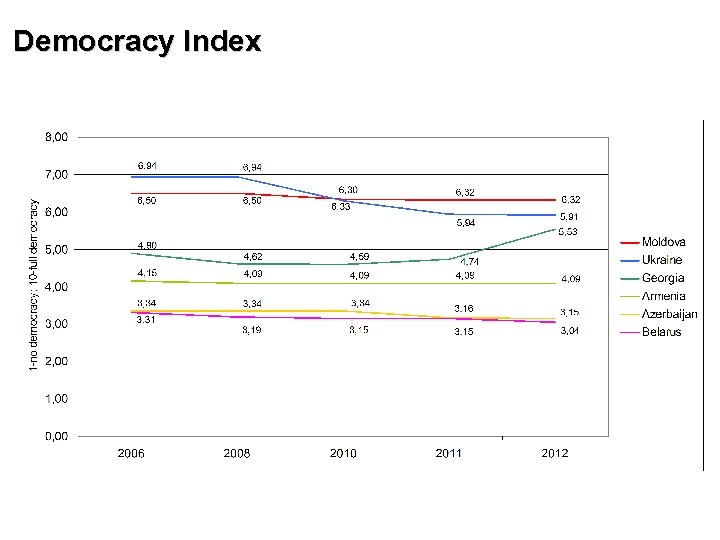
Democracy Index
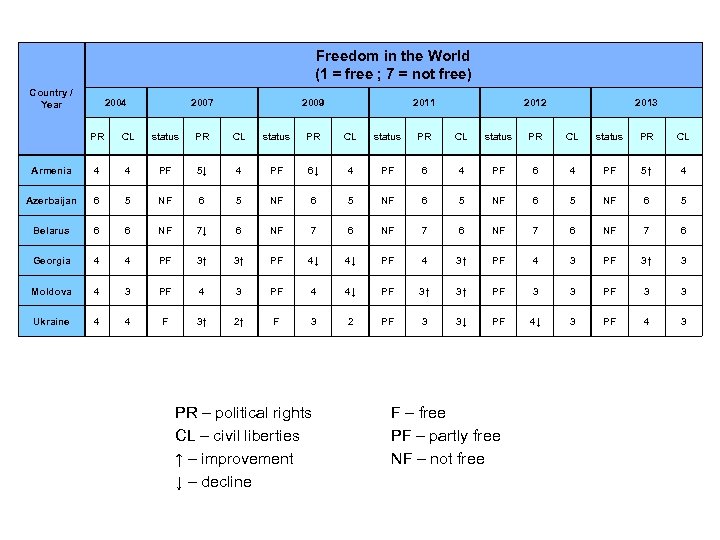
Freedom in the World (1 = free ; 7 = not free) Country / Year 2004 2007 2009 2011 2012 2013 PR CL status PR CL status PR CL Armenia 4 4 PF 5↓ 4 PF 6 4 PF 5↑ 4 Azerbaijan 6 5 NF 6 5 NF 6 5 Belarus 6 6 NF 7↓ 6 NF 7 6 Georgia 4 4 PF 3↑ 3↑ PF 4↓ 4↓ PF 4 3↑ PF 4 3 PF 3↑ 3 Moldova 4 3 PF 4 4↓ PF 3↑ 3↑ PF 3 3 Ukraine 4 4 F 3↑ 2↑ F 3 2 PF 3 3↓ PF 4↓ 3 PF 4 3 PR – political rights CL – civil liberties ↑ – improvement ↓ – decline F – free PF – partly free NF – not free
§ The absence of progress in democratisation is visible in how elections have been held in the region’s countries over recent years. § Elections held in all the Ea. P countries after 2008 were marred by more od less serious infringements of voting procedures. § Positive examples come from Georgia (the parliamentary elections on 1 October 2012), Moldova (the parliamentary elections in) and Armenia.
Free-market transformations and economic development § None of the countries have made the substantial progress which would meet the EU’s expectations. § Transformations of the system of government in the Eastern European countries are slow and have stumbled on many more problems than was the case in the Central European countries which became EU members in 2004 and 2007. § The Bertelsmann Foundation Transformation Index, which measures the condition of democracy and the progress of market economy reforms, points to two positive examples of Moldova and Georgia, the two countries that did make considerable progress between 2003 and 2012. § In the other countries the situation worsened during the same period, most notably in Armenia after 2008 and in Ukraine.
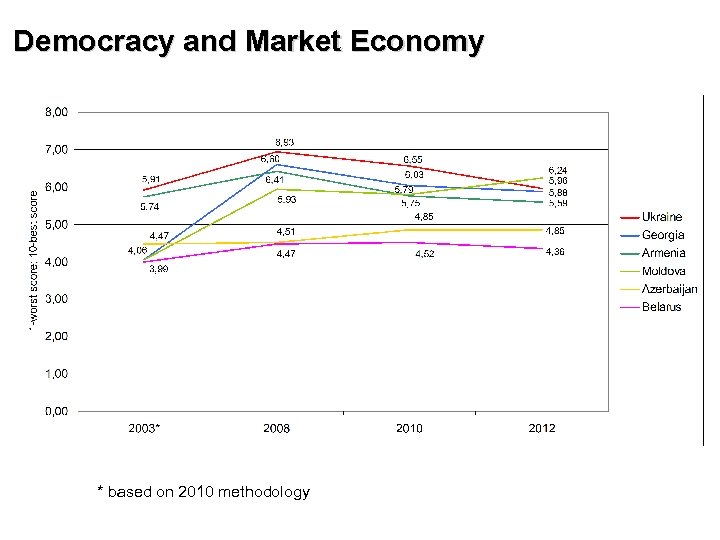
Democracy and Market Economy * based on 2010 methodology
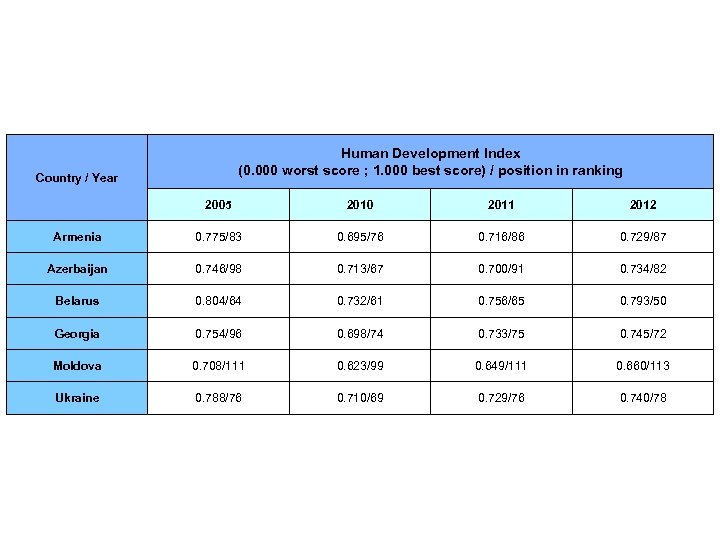
Human Development Index (0. 000 worst score ; 1. 000 best score) / position in ranking Country / Year 2005 2010 2011 2012 Armenia 0. 775/83 0. 695/76 0. 716/86 0. 729/87 Azerbaijan 0. 746/98 0. 713/67 0. 700/91 0. 734/82 Belarus 0. 804/64 0. 732/61 0. 756/65 0. 793/50 Georgia 0. 754/96 0. 698/74 0. 733/75 0. 745/72 Moldova 0. 708/111 0. 623/99 0. 649/111 0. 660/113 Ukraine 0. 788/76 0. 710/69 0. 729/76 0. 740/78
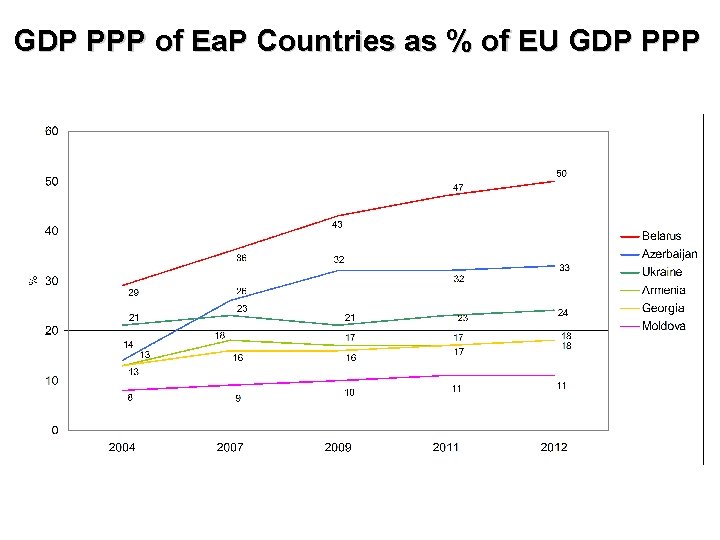
GDP PPP of Ea. P Countries as % of EU GDP PPP
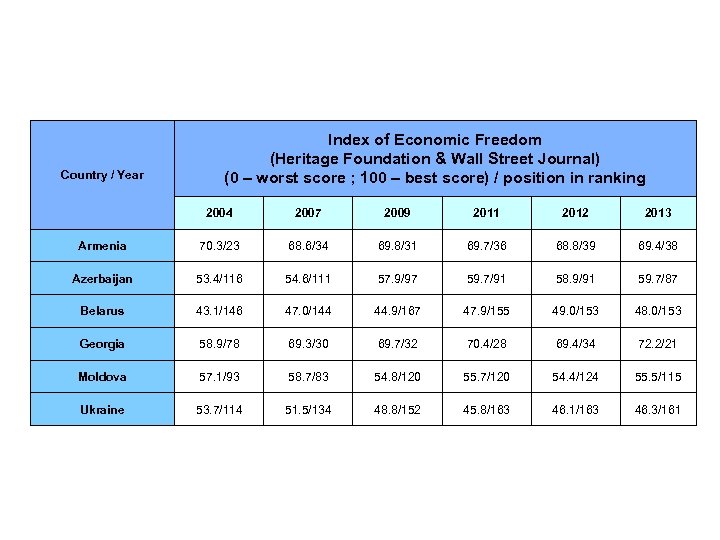
Country / Year Index of Economic Freedom (Heritage Foundation & Wall Street Journal) (0 – worst score ; 100 – best score) / position in ranking 2004 2007 2009 2011 2012 2013 Armenia 70. 3/23 68. 6/34 69. 8/31 69. 7/36 68. 8/39 69. 4/38 Azerbaijan 53. 4/116 54. 6/111 57. 9/97 59. 7/91 58. 9/91 59. 7/87 Belarus 43. 1/146 47. 0/144 44. 9/167 47. 9/155 49. 0/153 48. 0/153 Georgia 58. 9/78 69. 3/30 69. 7/32 70. 4/28 69. 4/34 72. 2/21 Moldova 57. 1/93 58. 7/83 54. 8/120 55. 7/120 54. 4/124 55. 5/115 Ukraine 53. 7/114 51. 5/134 48. 8/152 45. 8/163 46. 1/163 46. 3/161
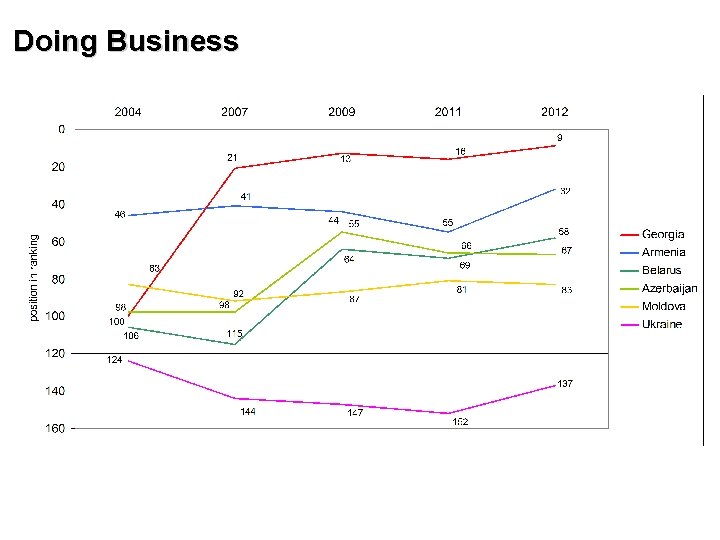
Doing Business
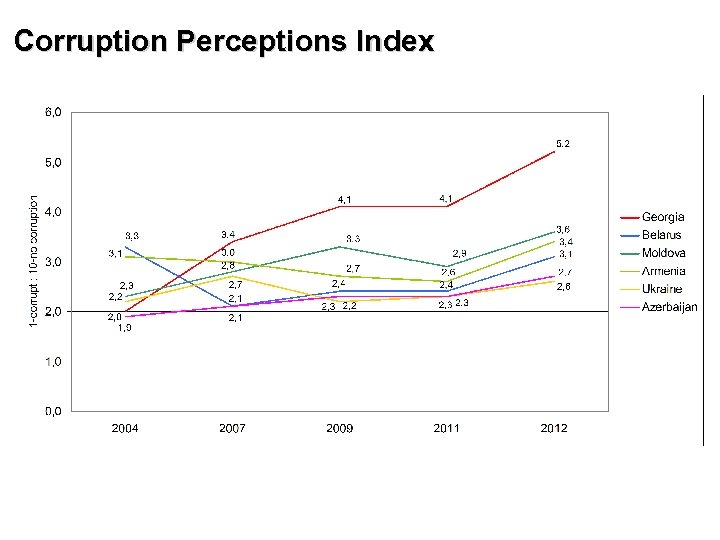
Corruption Perceptions Index
Economic Integration with the EU § The EU’s efforts to develop relations with the eastern neighbourhood have not resulted in closer economic integration either. § Moldova is an exception here: the Union’s share in its trade increased by 11 percent in the period in question (from 43% to 54% for Moldova’s total trade turnover). § The dynamics of trade exchange have mainly been influenced by the economic developments in the European Union and the situation on global markets. § The Union’s first financial crisis in 2009 led to a noticeable decrease in trade with the Eastern Partnership countries, and it was only in 2001 that the volume of trade started to return to the 2008 levels.
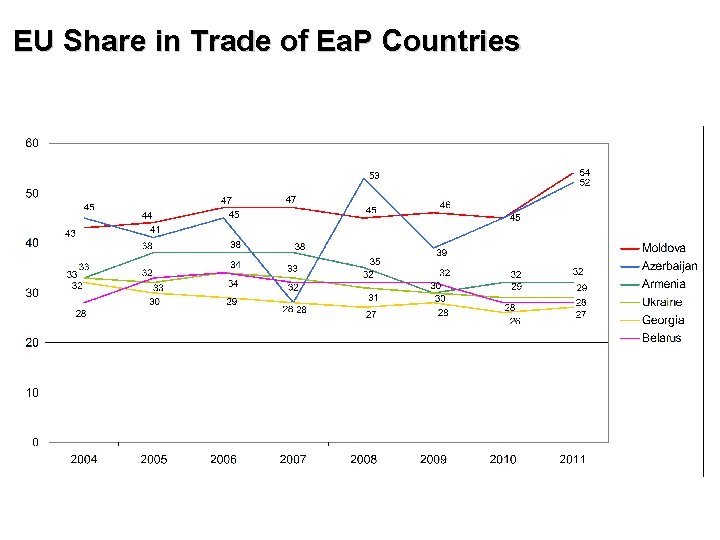
EU Share in Trade of Ea. P Countries
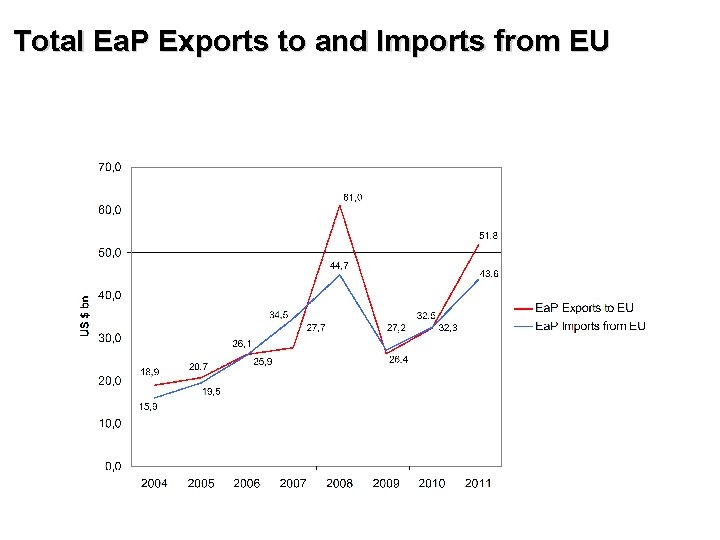
Total Ea. P Exports to and Imports from EU
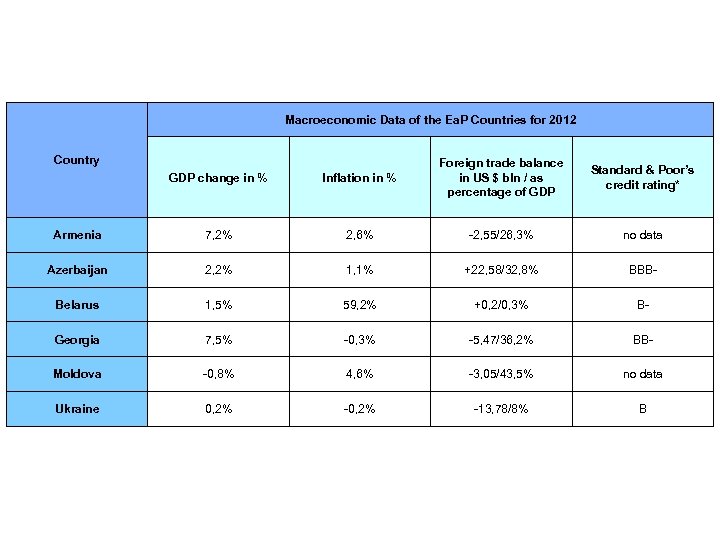
Macroeconomic Data of the Ea. P Countries for 2012 Country GDP change in % Inflation in % Foreign trade balance in US $ bln / as percentage of GDP Armenia 7, 2% 2, 6% -2, 55/26, 3% no data Azerbaijan 2, 2% 1, 1% +22, 58/32, 8% BBB- Belarus 1, 5% 59, 2% +0, 2/0, 3% B- Georgia 7, 5% -0, 3% -5, 47/36, 2% BB- Moldova -0, 8% 4, 6% -3, 05/43, 5% no data Ukraine 0, 2% -13, 78/8% B Standard & Poor’s credit rating*
CONCLUSSIONS
In the current political and economic situation in Europe, three processes will have the greatest impact on the future of the Union’s relations with its Eastern partners: § Economic developments in the EU member countries and in Eastern Europe in the context of the EU’s financial crisis and economic slowdown in the Ea. P countries. § Possible changes to the Union’s decision-making processes and institutional make-up. § Russia’s policy towards the region.
§ Over the last two years, the Ea. P countries have been gradually making up for the losses incurred as a result of the 2009 crisis. § Slower economic growth has been reported everywhere except Armenia and Georgia. § All the partner countries apart from Azerbaijan and Belarus have seen their foreign trade deficits rise, and all have been experiencing mounting budgetary problems.
§ The deteriorating economic situation in the UE will lead to lower dynamics of trade exchange and investment, and will make EU businesses less interested in the eastern markets. § This decline in the European entrepreneurs’ interest in the Ea. P markets may have political consequences and diminish the two side’s political will to sign and implement the Association Agreements and free-trade agreements. § This applies to EU businesses, and consequently EU member states and institutions also. § The financial crisis and economic slowdown in the EU will also make the partner countries less interested in economic integration, and thus less willing to bear the related financial and political costs. § It appears that the economic decline in European markets and in the partner countries may have short- and medium-term consequences for mutual economic relations.
§ The current crisis of the Union’s decision-making processes and the debate on the EU’s future development, the prospective scale of political and economic integration, the potential formation of a multiplespeed Europe and the possible institutional reform, will al affect the EU’s relations with the eastern partners even more than the economic crisis. § The separation of the Euro zone and the potential formation of a multiple-speed European Union will have very serious consequences for the Union’s relations with its eastern neighbours, and may push the region down the EU’s political agenda. § Most of the EU member states interested in the Ea. P region, which hitherto have been actively stimulating EU activities in the eastern neighbourhood, will remain outside the Euro zone for a longer time and this may undermine their influence on the direction of discussions and EU policy.
Скачать презентацию European Neighbourhood Policy a Tool to Increase
6c1bd5378ea0a006848d3dcb958d1e49.ppt