


 Скачать презентацию European Legal Policy on Internet and Intellectual Property
3bf274824d7d289cfc8cecbd07bcda63.ppt
- Количество слайдов: 16
 European Legal Policy on Internet and Intellectual Property Pázmány Péter Catholic University, Faculty of Law Budapest , November 6, 2014
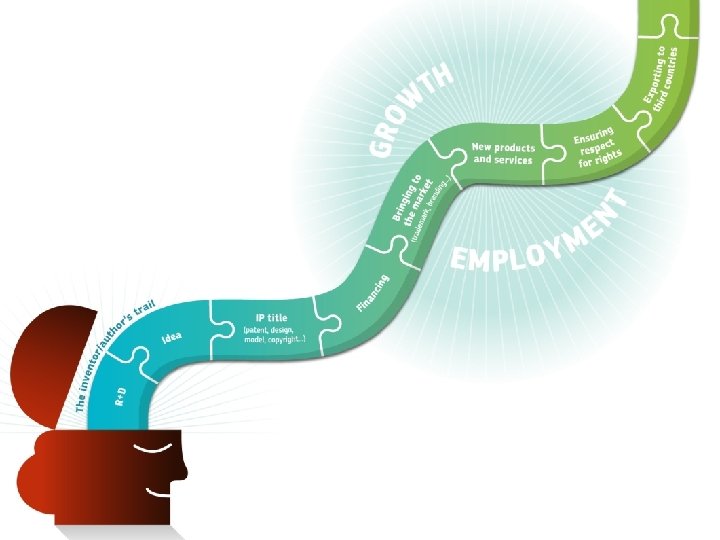
 European Commission's key objective(s) and approach in the field of Intellectual Property 1. Objectives: An efficient and balanced IP infrastructure is necessary for innovation and creation to flourish in the Digital Single Market This infrastructure needs to reflect the “creator’s trail” - the long path that leads from an original idea to its materialisation as a service or product, and finally into its commercialisation and use - IP supports and nourishes this process right through from conception to final use 2. Approach: Idea: - trade secret IP title: - unitary patent - copyright review 2
 European Commission's key objective(s) and approach in the field of Intellectual Property (2) Bringing to the market - trademark reform package New products and services - collective management of copyright - licenses for Europe - orphan works - Mo. U on out of print works Ensuring respect for rights - Mo. U on counterfeited goods on internet - civil redress - unitary jurisdiction - observatory - anti counterfeiting action plan Exporting to third countries - free trade agreements 3
 4
4
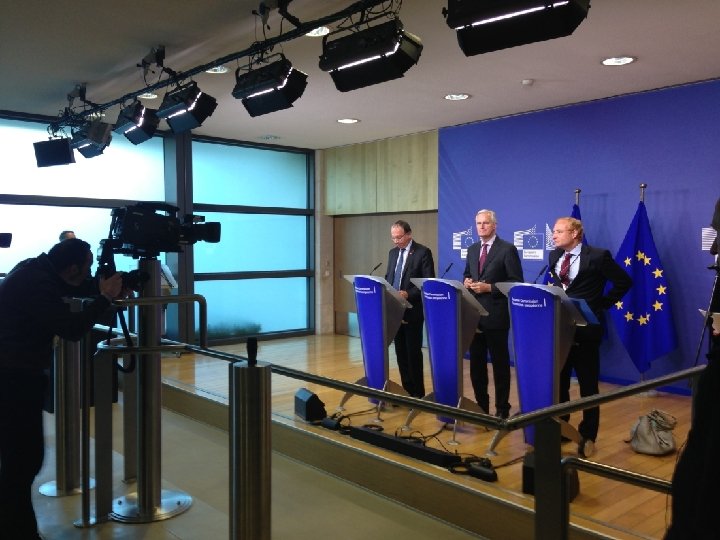
 Societal benefits of IP • On 30 September 2013, Commissioner Barnier hosted a press conference in Brussels launching the first study in Europe on IP-intensive industries • This study, carried out by the Office for Harmonisation in the Internal Market (OHIM) and the European Patent Office (EPO), gives us a clear and objective snapshot of the sectors that use IP most intensively in their day to day activities creating jobs and growth in Europe What this study shows is that • IP rights, whether we speak about copyright, patents, trade marks, or designs, are a bedrock of our economy 5
 6
6
 Key findings More than a third of jobs in Europe (77 million) depend either directly or indirectly on sectors making intensive use of IP. Quality jobs, where remuneration is 40% above other sectors, in copyright intensive sectors even higher, 68%. Another finding of the study is that most operators in these IP-intensive sectors combine different IP right in their services and products, showing that we cannot completely treat each of the various IP rights completely in isolation from each other. In other words, IP rights are a toolbox for creators, working in complementarity with each other, . A second stage of the study is now underway, which will go more into detail year. early next Commissionpolicy currentformulation the upcoming and in work preventive schemes 8
 Copyright review Public consultation ended in March Impact Assessment published in the summer On the basis of the Summary of the Consultation and the IA White Paper to be published 12
 European Commission's key objective(s) and approach in the field of IP enforcement 1. Objectives: Optimise incentives for innovation Maximise growth and sustainable job creation 2. Approach: "Follow the money" with five pillars: i. Tracking and evaluating the societal costs of the problem ii. Awareness raising 1. Harmonised, effective and proportionate civil redress framework and customs framework 2. Facilitate inclusive preventive schemes • Share best practice 14
 Preventive schemes – Based on ensuring that "due diligence" is applied throughout the IP valueadded chain. – Upstream of rights-holders – ensuring that all "input" providers and subcontractors avoid that IP infringing products and services can enter the market. – Downstream- ensuring that advertisers, shippers, distributors and payment service providers prevent IP infringers from making money from selling or promoting their products and services. – These approaches are voluntary but must be inclusive of all players involved including the rights-holders themselves. – Final consumers will have to "buy in" to these schemes that are costly if they are to be successful. 15
 Upstream preventive schemes Know your supplier/contractor Supply chain auditing and track and trace systems: "Know your suppliers and apply fair commercial practices" and "follow your products". If you are selling "quality" , you should be able to defend that "quality" label. Consumers no longer focus on intrinsic quality of a product. They want to ensure that the relevant branded product meets their "values". Makes good business sense to apply such auditing practices but it costs money to do so. 16
 Upstream preventive schemes Actions foreseen in 2015 Workshops with ethical auditors, rights-holders, suppliers, social partners and NGOs to determine best practices including on cost distribution. Evaluate how track and trace systems can be used to ensure chains do not "leak" and to empower consumers to buy in to such systems. Supply chains are international so we wish to engage with trading partners to develop such best practices at international level. 17
 Downstream preventive schemes Due diligence to hinder promotion, distribution of and payment for IP infringing products Right-holders, wholesalers, retailers (off-line and on-line), shippers, payment service providers, consumers and tax-payers all benefit from markets built on trust and fair commercial practices so, in theory everyone has to gain. Stakeholder agreements allowing for the establishment of detection and hindrance of IP infringing offers are therefore possible. 18
 Downstream preventive schemes Actions foreseen in 2015 Extension of existing Memorandum of Understanding (Mo. U) against the on-line sale of counterfeit goods. Launch of stakeholder dialogues with the advertising profession and payment service providers. Discussions on extending Mo. Us at international level. 19
 Conclusions 1. Preventive, voluntary and inclusive schemes are an integral part of the European Commission's IP enforcement policy. 2. Such schemes are costly to implement and so the policy-maker has a role to facilitate the development and diffusion of best practise in this area. 3. All stakeholders including right-holders must be involved and must invest in the process. 4. Consumers and citizens/taxpayers have to be involved from the outset since their "buy in" is essential to the success of such schemes. 20
 Contact details E-mail: kovacs. gyorgy@jak. ppke. hu For information: http: //ec. europa. eu/internal_market/indprop/invent/index_e n. htm 21