


 Скачать презентацию European Language Portfolio A way into developing
81c7cb9e7f5578b6b6f8bade81b6b922.ppt
- Количество слайдов: 57
 European Language Portfolio – A way into developing responsibility and awareness in language learning
 QUESTIONS TO BEGIN WITH Nowadays importance to know different languages is obvious. Which do you think are the most important ones? Why? Do you think that it’s possible to learn L 1, L 2 and L 3 in the stages of Childhood Education and Primary Education? What are the reasons why adults fail to succeed (and most of them do) in learning foreign languages? 2
 THE EUROPEAN LANGUAGE PORTFOLIO Personal document to register one’s experiences of language learning. ◦ Communicative approach ◦ Reflection and self-assessment Developed by the Department of Linguistic Policy of the Council of Europe (1998 -2000) 3
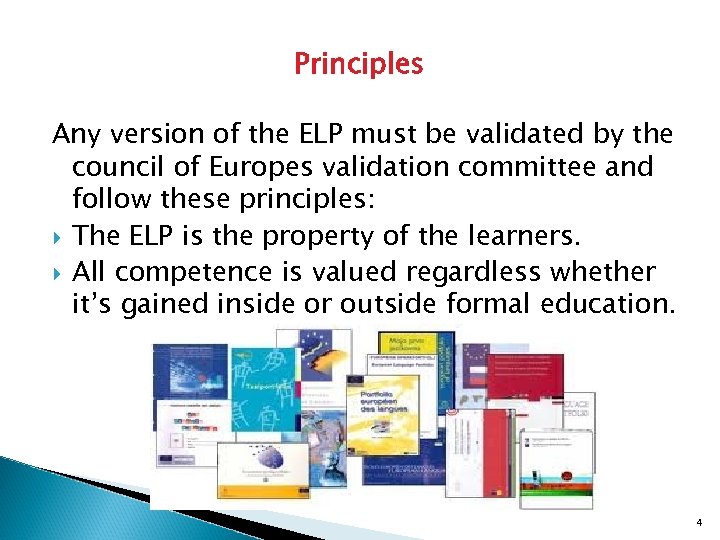 Principles Any version of the ELP must be validated by the council of Europes validation committee and follow these principles: The ELP is the property of the learners. All competence is valued regardless whether it’s gained inside or outside formal education. 4
 Principles It’s linked to the Common European Framework of Reference for Languages. It encourages lifelong language learning as the learner takes responsibility for their own learning, evaluation and assessment. The ELP includes intercultural and personal experiences. 5
 FUNCTIONS OF THE ELP PEDAGOGICAL FUNCTIONS ◦ ◦ More transparent process for students Assumption of responsibility Student’s autonomy Education through life RECORDING FUNCTIONS ◦ Complete official certificates with additional information ◦ International standards. It means that the ELP enables language learners to. . . 6
 ELP enables students to… To write down the advances that each person does in the learning of languages. To orientate motivation, increase self-confidence and promote the development of learning strategies. To take record of the own language and culture learning experiences. To reflect what the holder can do in each of the languages he/she knows. To recognize how and when one learns 7
 PLURILINGUALISM Multilingualism: ◦ Knowledge of languages. ◦ Co-existence of languages in society. ◦ Diversifying the languages on offer. ◦ Encouraging pupils to learn more languages. ◦ Reducing the dominant position of English. Plurilingualism: ◦ Communicative competence to which all knowledge and experience of language contributes and in which languages interrelate and interact. ◦ The aim is to develop a linguistic repertory. ◦ The languages offered in educational institutions should be diversified and students given the opportunity to develop a plurilingual competence. ◦ Motivation, skill and confidence in facing new language experiences. 8
 ELP as a Tool for Learning 1. 2. 3. The ELP is a tool for learning: It´s the property of the learner. Learners discuss and negotiate the aims, content and processes of their work. They develop a reflective approach to language learning and strategies to learn independently. 9
 ELP as a Tool for Assessing and Recording 1. 2. 3. The ELP is a tool for assessing and recording: Learners can show off their competence to others. Learners can record and see at a glance their achievement and progress. Progress can be recorded repeatedly over time with the Languages Ladder. 10
 Content of the ELP The ELP has three main sections: My Language Passport My Language Biography My Dossier 11
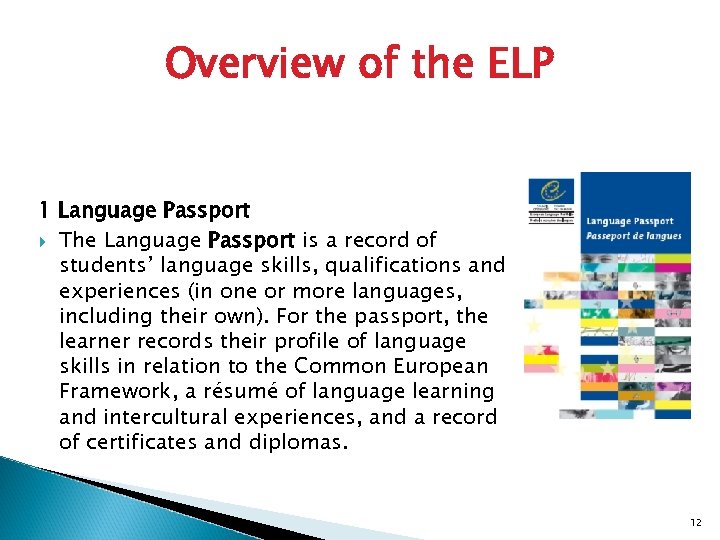 Overview of the ELP 1 Language Passport The Language Passport is a record of students’ language skills, qualifications and experiences (in one or more languages, including their own). For the passport, the learner records their profile of language skills in relation to the Common European Framework, a résumé of language learning and intercultural experiences, and a record of certificates and diplomas. 12
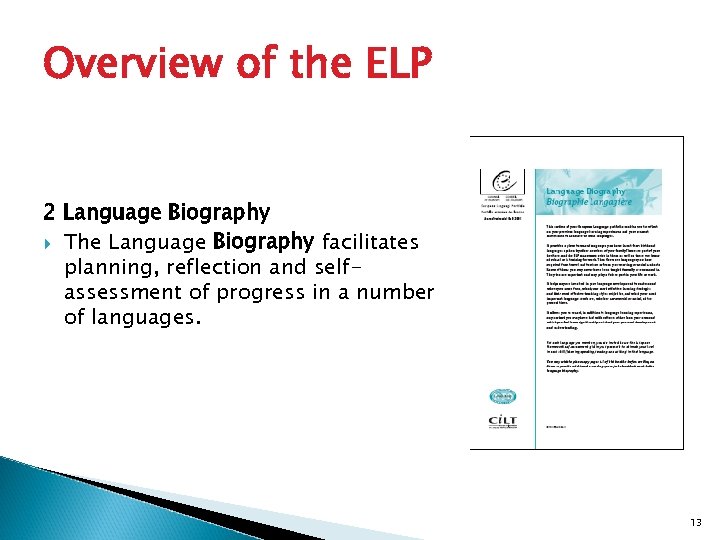 Overview of the ELP 2 Language Biography The Language Biography facilitates planning, reflection and selfassessment of progress in a number of languages. 13
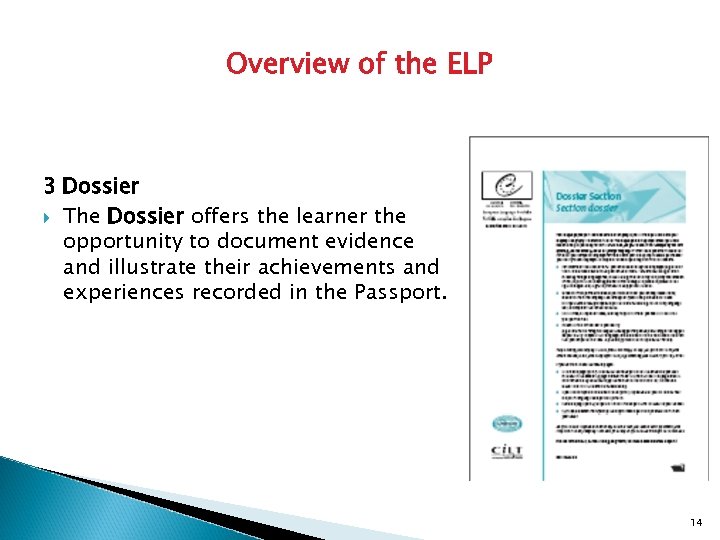 Overview of the ELP 3 Dossier The Dossier offers the learner the opportunity to document evidence and illustrate their achievements and experiences recorded in the Passport. 14
 My Language Passport The Passport is a record of the child´s learning experiences: Languages learnt or heard at home Languages learnt at school / college / university Languages learnt out of school / college / university Contacts and intercultural experiences 15
 COMPONENTS OF THE ELP THE LANGUAGE PASSPORT A summary of the competences acquired In terms of capacities Record of formal qualifications Linguistic competences and linguistic and intercultural experiences ◦ Self-assessment, teacher’s assessment and official examinations commissions assessment. ◦ ◦ 16
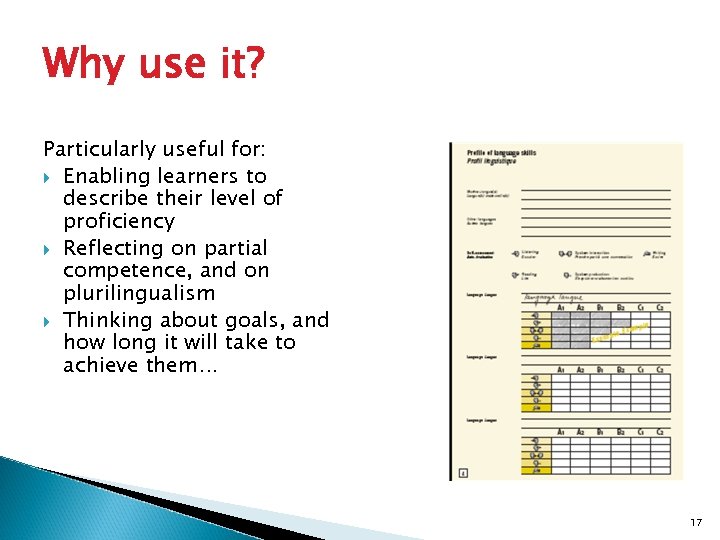 Why use it? Particularly useful for: Enabling learners to describe their level of proficiency Reflecting on partial competence, and on plurilingualism Thinking about goals, and how long it will take to achieve them… 17
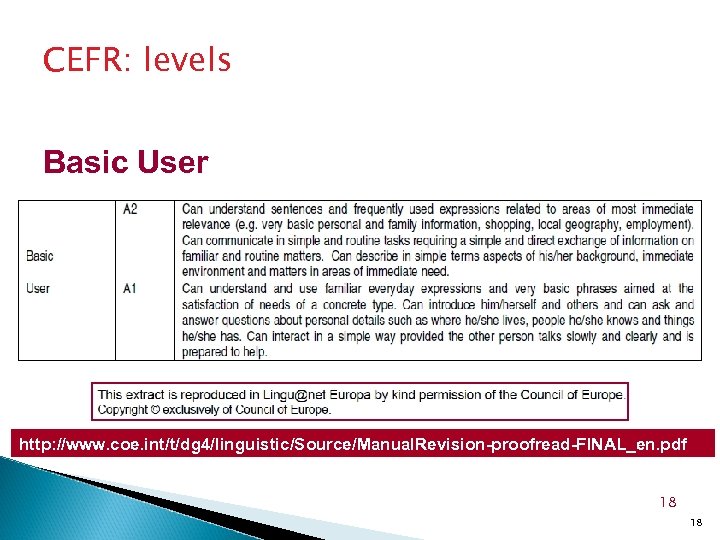 CEFR: levels Basic User http: //www. coe. int/t/dg 4/linguistic/Source/Manual. Revision-proofread-FINAL_en. pdf 18 18
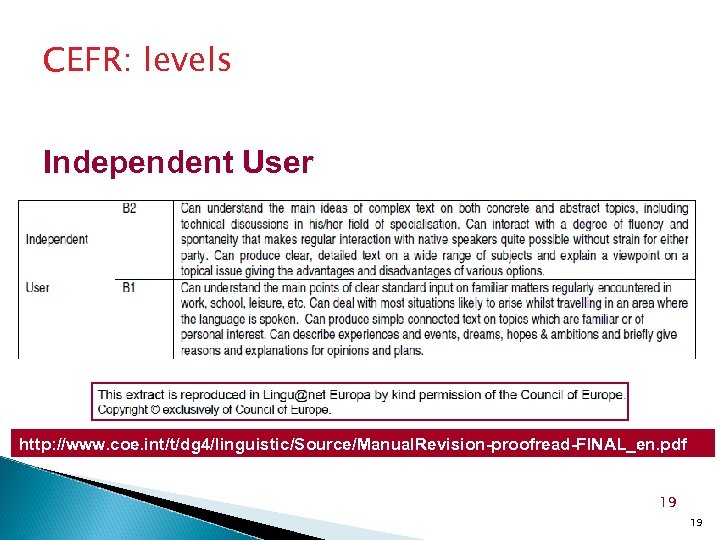 CEFR: levels Independent User http: //www. coe. int/t/dg 4/linguistic/Source/Manual. Revision-proofread-FINAL_en. pdf 19 19
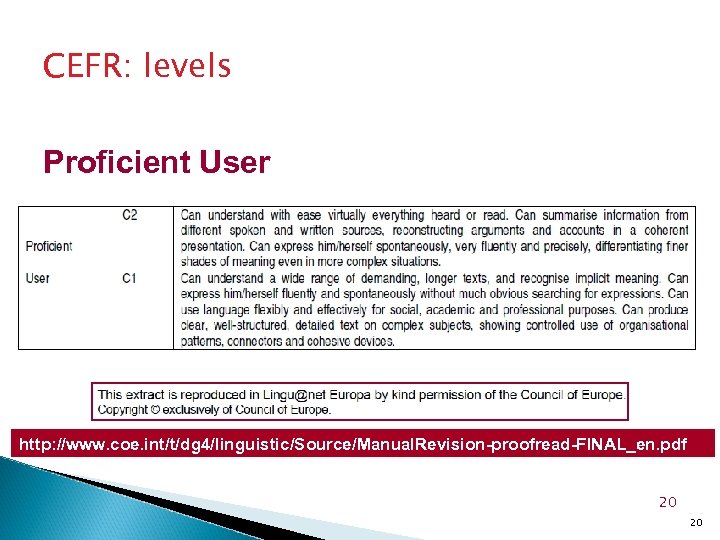 CEFR: levels Proficient User http: //www. coe. int/t/dg 4/linguistic/Source/Manual. Revision-proofread-FINAL_en. pdf 20 20
 COMPONENTS OF THE ELP THE LANGUAGE BIOGRAPHY ◦ Enables the holder to: Get involved in the planning, reflection and assessment of learning process. Encourage the recording of the things he/she can do Encourage the gathering of information about linguistic and cultural experiences outside the formal educative context Foster multilingualism 21
 My Language Biography It´s an ever changing part of the ELP: Learners should revisit and update it at frequent intervals. They reflect upon and record whay they can do and thus become aware of their own progress. Learners can look ahead at new targets and think about how they can learn. 22
 My Language Biography Progress can be recorded on several areas: Listening Speaking Production Speaking Interaction Reading Writing Intercultural undestanding 23
 My Language Biography Repeating the process of reflection about targets and self evaluation gives them responsibility about their own learning. If the students reach the levels in the portfolio, the teacher can set new targets and add them to it. 24
 My Dossier The dossier is a personal collection of the learner´s work: Students file any special pieces of work, pictures or recordings that show their achievement. They must take responsibility for what is included, removed or replaced. Its contents must be reviewed on a regular basis. 25
 My dossier As the dossier grows, it can be divided into different sections. For example: Songs and rhymes My e-pal My pictures and words Meeting people Stories heard Stories read Comics Interesting websites Slideshares created 26
 My Dossier Pictures e-mail messages Selected written work Photos Postcards Audio and video recordings Letters Games Word lists Posters Diagrams Reflections on language learning Blog & web page entries 27
 Dossier – Some Ideas to Use Teachers must encourage reflection on dossier work: Students can discuss what a good dossier looks like. Students can disscuss what work would show best what they have learnt and the level they have achieved. Students must show the dossier to others regularly. 28
 Using ELP in the Classroom The ELP should be used from the beginning of the child’s school life to encourage the development of: Learning language strategies: communicating, practising a new language, memorising, applying prior knowledge, listening and understanding Value and awareness of other cultures. Awareness of self progress. 29
 How to use ELP with HSE students? Language development (e. g. Grammar) Functional language IELTS preparation Speaking production Speaking Interaction Writing Production Others-? ? 30
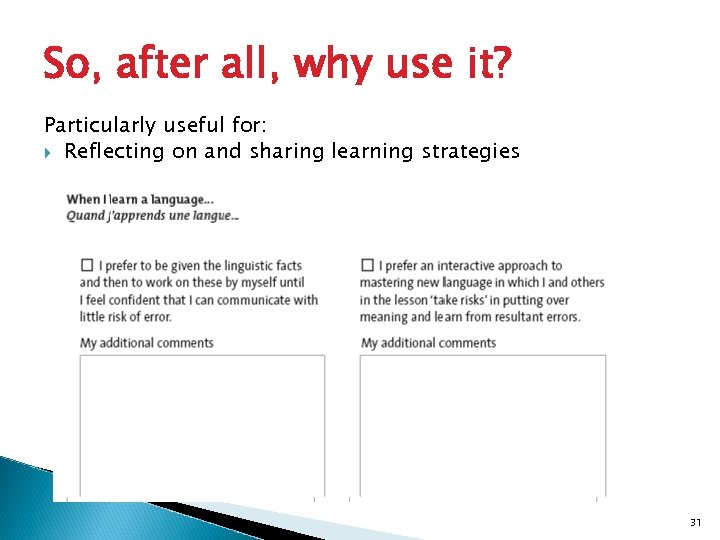 So, after all, why use it? Particularly useful for: Reflecting on and sharing learning strategies 31
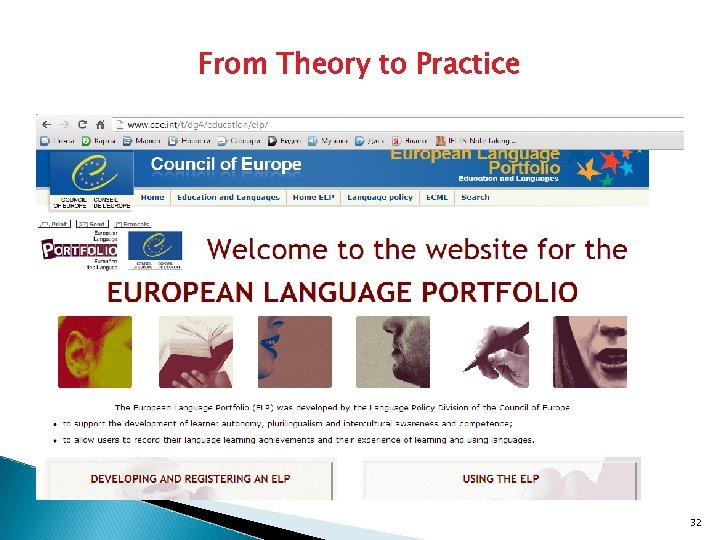 From Theory to Practice 32
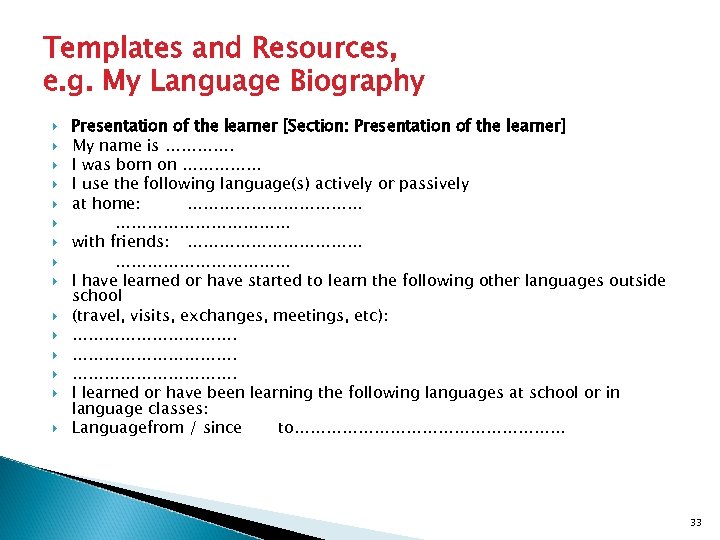 Templates and Resources, e. g. My Language Biography Presentation of the learner [Section: Presentation of the learner] My name is …………. I was born on …………… I use the following language(s) actively or passively at home: …………………………… with friends: …………………………… I have learned or have started to learn the following other languages outside school (travel, visits, exchanges, meetings, etc): …………………………. I learned or have been learning the following languages at school or in language classes: Languagefrom / since to……………………… 33
![Templates and Resources How I use my languages [Section: Presentation of the learner] A.](https://present5.com/presentation/81c7cb9e7f5578b6b6f8bade81b6b922/image-34.jpg "Templates and Resources How I use my languages [Section: Presentation of the learner] A.") Templates and Resources How I use my languages [Section: Presentation of the learner] A. Outside language classes, I use/have used the languages which I am learning or already know in the following situations: in other classes: Date. Language(s)When? Where? With whom? What I think of that and what I gain from it…/…/20…. in my school, my training course or my workplace: Date. Language(s)When? Where? With whom? What I think of that and what I gain from it…/…/20…. round about me in my home area: Date. Language(s)When? Where? With whom? What I think of that and what I gain from it…/…/20…. during regular meetings with other people (sports, with friends, etc): Date. Language(s)When? Where? With whom? What I think of that and what I gain from it…/…/20…. during my leisure activities: Date. Language(s)When? Where? With whom? What I think of that and what I gain from it…/…/20…. 34
Templates and Resources How I use my languages [Section: Presentation of the learner] A. Outside language classes, I use/have used the languages which I am learning or already know in the following situations: in other classes: Date. Language(s)When? Where? With whom? What I think of that and what I gain from it…/…/20…. in my school, my training course or my workplace: Date. Language(s)When? Where? With whom? What I think of that and what I gain from it…/…/20…. round about me in my home area: Date. Language(s)When? Where? With whom? What I think of that and what I gain from it…/…/20…. during regular meetings with other people (sports, with friends, etc): Date. Language(s)When? Where? With whom? What I think of that and what I gain from it…/…/20…. during my leisure activities: Date. Language(s)When? Where? With whom? What I think of that and what I gain from it…/…/20…. 34
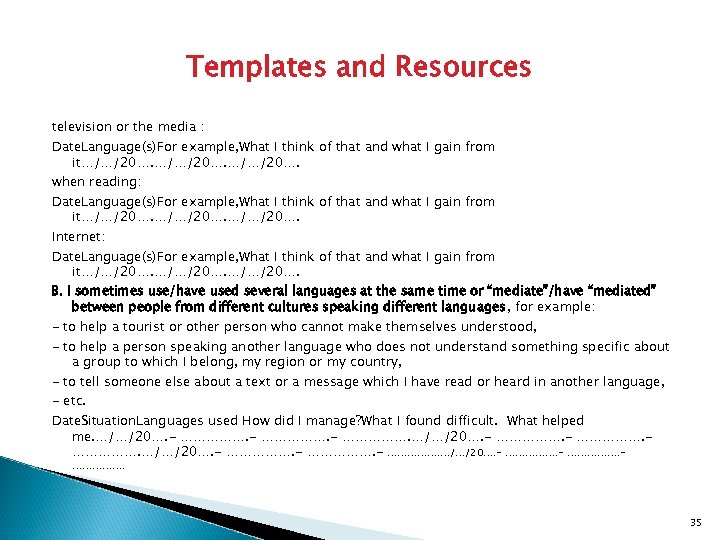 Templates and Resources television or the media : Date. Language(s)For example, What I think of that and what I gain from it…/…/20…. when reading: Date. Language(s)For example, What I think of that and what I gain from it…/…/20…. Internet: Date. Language(s)For example, What I think of that and what I gain from it…/…/20…. B. I sometimes use/have used several languages at the same time or “mediate”/have “mediated” between people from different cultures speaking different languages, for example: - to help a tourist or other person who cannot make themselves understood, - to help a person speaking another language who does not understand something specific about a group to which I belong, my region or my country, - to tell someone else about a text or a message which I have read or heard in another language, - etc. Date. Situation. Languages used How did I manage? What I found difficult. What helped me. …/…/20…. - ……………. 35
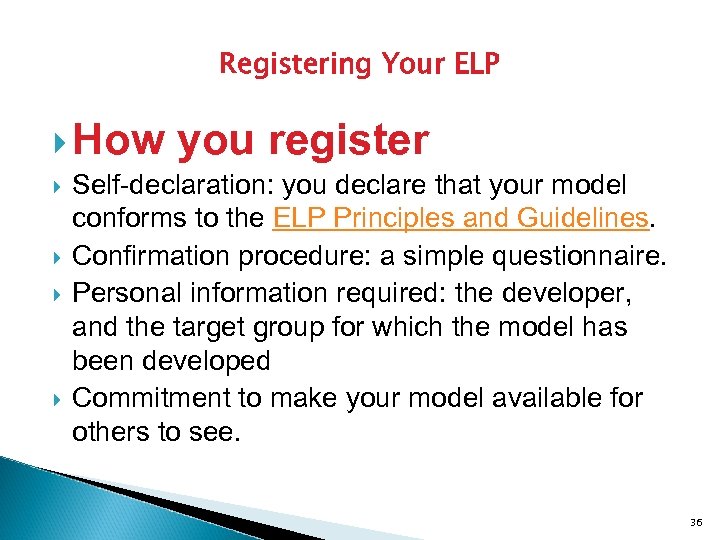 Registering Your ELP How you register Self-declaration: you declare that your model conforms to the ELP Principles and Guidelines. Confirmation procedure: a simple questionnaire. Personal information required: the developer, and the target group for which the model has been developed Commitment to make your model available for others to see. 36
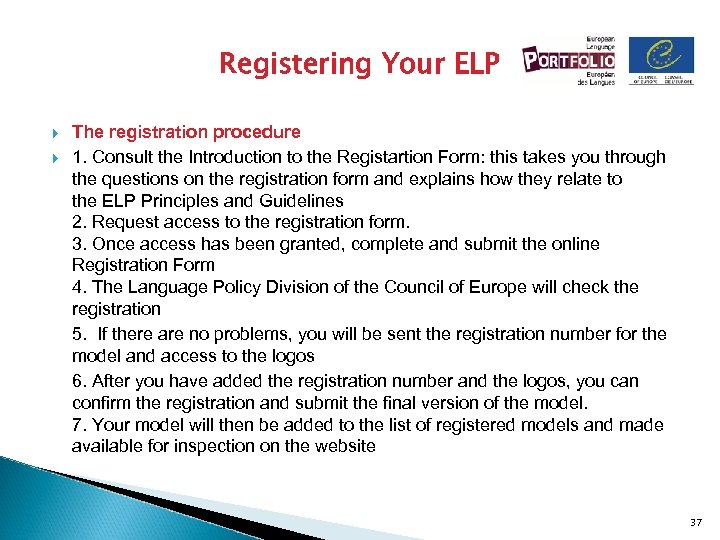 Registering Your ELP The registration procedure 1. Consult the Introduction to the Registartion Form: this takes you through the questions on the registration form and explains how they relate to the ELP Principles and Guidelines 2. Request access to the registration form. 3. Once access has been granted, complete and submit the online Registration Form 4. The Language Policy Division of the Council of Europe will check the registration 5. If there are no problems, you will be sent the registration number for the model and access to the logos 6. After you have added the registration number and the logos, you can confirm the registration and submit the final version of the model. 7. Your model will then be added to the list of registered models and made available for inspection on the website 37
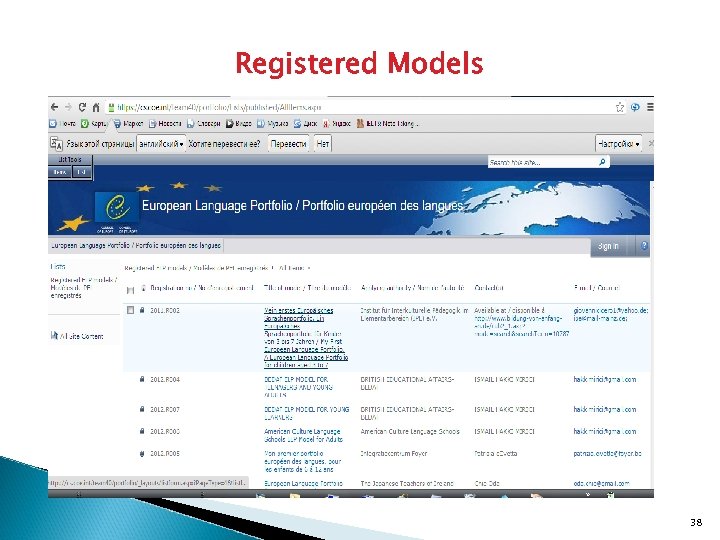 Registered Models 38
 Why register? Why should you consider registering your ELP model? Registration provides visibility for your work in developing and implementing your model. Registration enables you to use the logos of the Council of Europe and the European Language Portfolio, thus giving your model an internationally recognized dimension. Registration can put you in touch with colleagues working in similar contexts. And. . . The online registration procedure is quick and easy. 39
 Validation Committee Comments Areas for change Percentage in relation to the total number of comments (759) Presentation and consistency of the model 23. 58% Self-assessment arrangements 17. 65% Inclusion of the European dimension 17. 65% Consequences of the principle of learner ownership 11. 86% Education in the values of linguistic and cultural diversity 8. 17% Promotion of plurilingualism 5. 93% Intercultural dimension 5. 80% Possibilities for repeated use of the ELP 5. 14% Development of “learning to learn” skills 3. 69% Communication strategies 0. 53% 40
 EPOSTL 41
 Main aims of the EPOSTL to encourage you to reflect on the competences a teacher strives to attain and on the underlying knowledge which feeds this knowledge to help prepare you for your future profession in a variety of teaching contexts to promote discussion between you and your peers and between you and your teacher educators and mentors to facilitate self-assessment of your developing competence to provide an instrument which helps chart progress 42
 The EPOSTL contains the following sections: A personal statement section to help you to reflect on general questions related to teaching. All competence is valued regardless whether it’s gained inside or outside formal education. A self-assessment section, consisting of “can do” descriptors, to facilitate reflection and self-assessment A dossier, in which you can make the outcome of your selfassessment transparent, to provide evidence of progress and to record examples of work relevant to teaching A glossary of the most important terms relating to language learning and teaching used in EPOSTL An index of terms used in the descriptors A user’s guide which gives detailed information about the EPOSTL 43
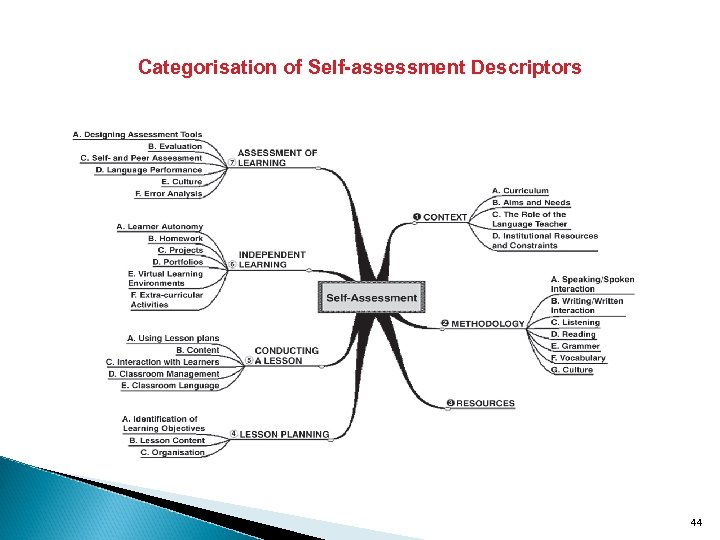 Categorisation of Self-assessment Descriptors 44
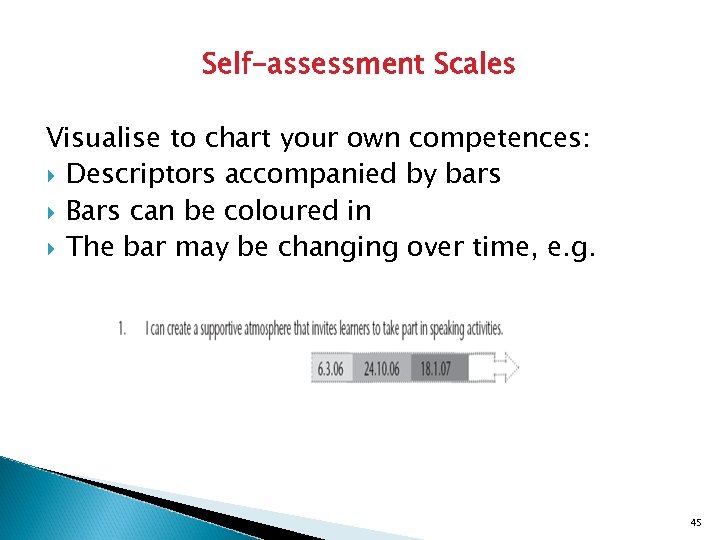 Self-assessment Scales Visualise to chart your own competences: Descriptors accompanied by bars Bars can be coloured in The bar may be changing over time, e. g. 45
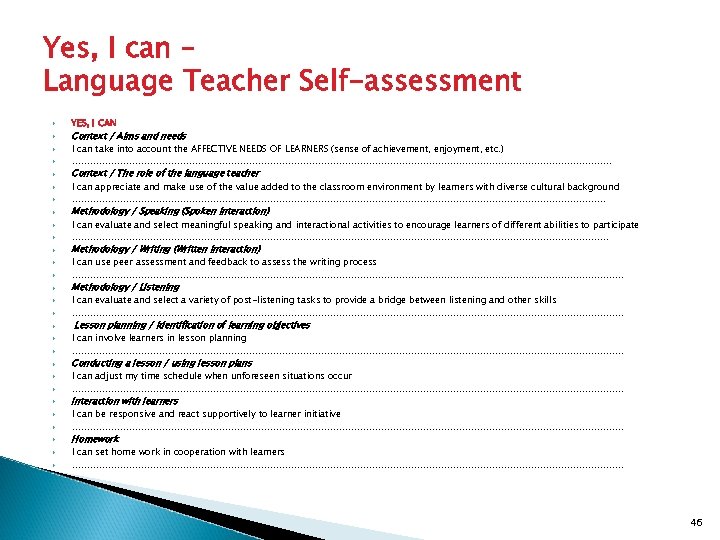 Yes, I can – Language Teacher Self-assessment YES, I CAN Context / Aims and needs I can take into account the AFFECTIVE NEEDS OF LEARNERS (sense of achievement, enjoyment, etc. ) ……………………………………………………………………………… Context / The role of the language teacher I can appreciate and make use of the value added to the classroom environment by learners with diverse cultural background ………………………………………………………………………………. Methodology / Speaking (Spoken Interaction) I can evaluate and select meaningful speaking and interactional activities to encourage learners of different abilities to participate ………………………………………………………………………………. . Methodology / Writing (Written interaction) I can use peer assessment and feedback to assess the writing process …………………………………………………………………………………. Methodology / Listening I can evaluate and select a variety of post-listening tasks to provide a bridge between listening and other skills …………………………………………………………………………………. Lesson planning / Identification of learning objectives I can involve learners in lesson planning …………………………………………………………………………………. Conducting a lesson / using lesson plans I can adjust my time schedule when unforeseen situations occur …………………………………………………………………………………. Interaction with learners I can be responsive and react supportively to learner initiative …………………………………………………………………………………. Homework I can set home work in cooperation with learners …………………………………………………………………………………. 46
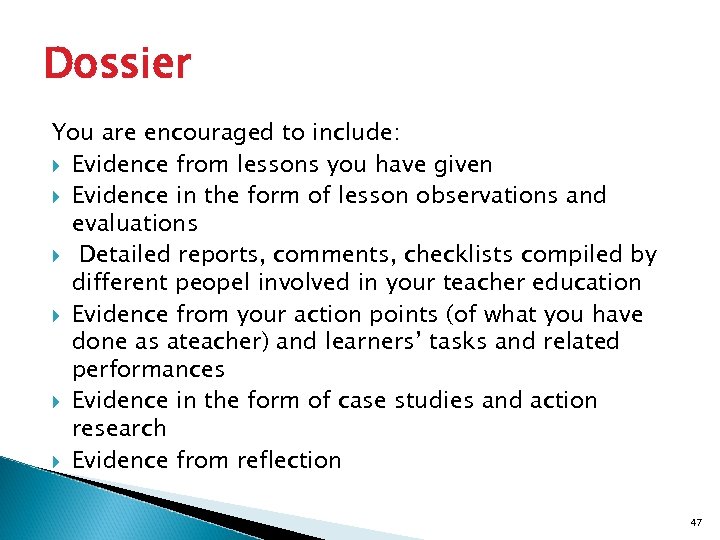 Dossier You are encouraged to include: Evidence from lessons you have given Evidence in the form of lesson observations and evaluations Detailed reports, comments, checklists compiled by different peopel involved in your teacher education Evidence from your action points (of what you have done as ateacher) and learners’ tasks and related performances Evidence in the form of case studies and action research Evidence from reflection 47
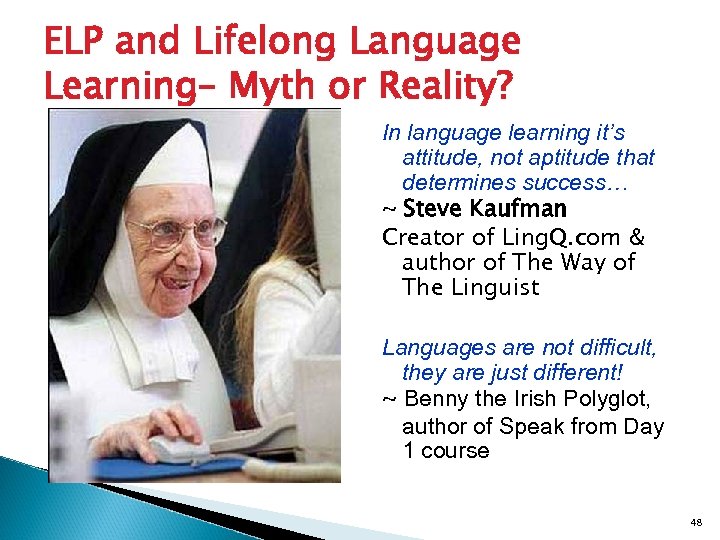 ELP and Lifelong Language Learning– Myth or Reality? In language learning it’s attitude, not aptitude that determines success… ~ Steve Kaufman Creator of Ling. Q. com & author of The Way of The Linguist Languages are not difficult, they are just different! ~ Benny the Irish Polyglot, author of Speak from Day 1 course 48
 Adults Can Learn Faster Contrary to popular belief, adults are actually better, or at least faster, language learners than children. We grown ups have three main advantages over ankle biters: Adults have the power of choice Adults have learned how to learn Adults have big vocabularies to draw upon 49
 The Power of Choice The freedom to choose what you learn, why you learn, and how you learn significantly increases motivation, enjoyment, and retention. Most people develop a hatred foreign languages in school because they have no control over any of these choices. If language courses were optional, both enjoyment and proficiency would significantly rise. 50
 Adults Know How to Learn You have already learned how to drive, operate the printer at work, program the clock on your DVD player, and fix that toilet that keeps running for some reason. You learned all of these things more quickly than any child could because you have already learned so many other things. Every task you learn helps you learn other tasks. And every language you delve into makes the next one that much easier to learn. 51
 Adults Have Big Vocabularies Infants must first develop basic cognitive functions before they can begin acquiring the language around them (what Steven Pinker calls “mentalese”). Assuming you don’t have brain damage, adults already have fully developed mentalese and a massive vocabulary to draw from. You already know the meaning of “photosynthesis”; you need simply learn its equivalent in a foreign language. 52
 Top Tips – Motivating Adult Learners The last and latest – news releases (BBC, CNN, ABC news, PBS news, Russia Today, France 24 etc. ) Different buttons to push – Ladies or gentlemen? Fashion-conscious girls or speculating boys? Culture vultures or career oriented? Rising stars or mature working dogs? 53
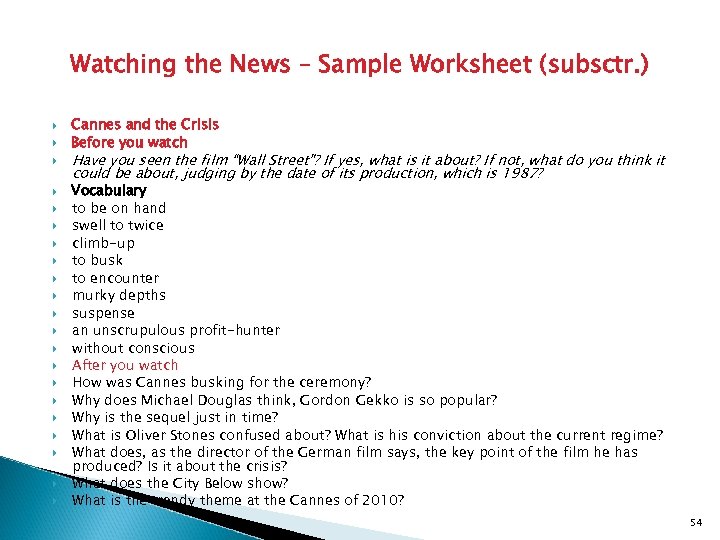 Watching the News – Sample Worksheet (subsctr. ) Cannes and the Crisis Before you watch Have you seen the film “Wall Street”? If yes, what is it about? If not, what do you think it could be about, judging by the date of its production, which is 1987? Vocabulary to be on hand swell to twice climb-up to busk to encounter murky depths suspense an unscrupulous profit-hunter without conscious After you watch How was Cannes busking for the ceremony? Why does Michael Douglas think, Gordon Gekko is so popular? Why is the sequel just in time? What is Oliver Stones confused about? What is his conviction about the current regime? What does, as the director of the German film says, the key point of the film he has produced? Is it about the crisis? What does the City Below show? What is the trendy theme at the Cannes of 2010? 54
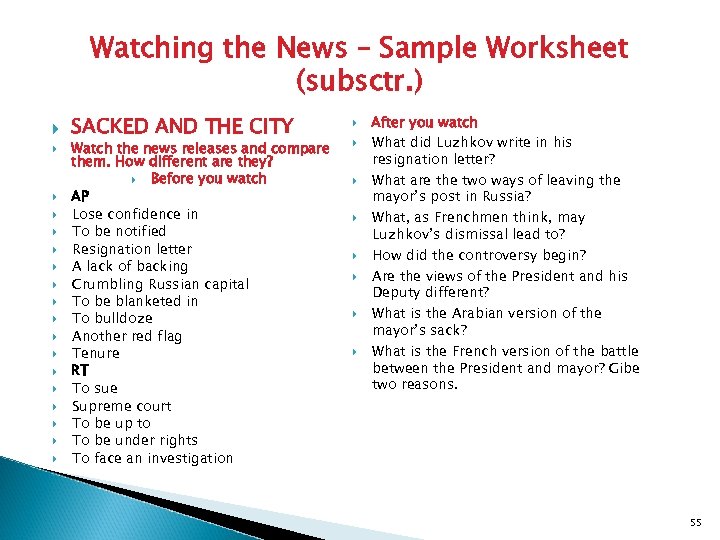 Watching the News – Sample Worksheet (subsctr. ) SACKED AND THE CITY Watch the news releases and compare them. How different are they? Before you watch AP Lose confidence in To be notified Resignation letter A lack of backing Crumbling Russian capital To be blanketed in To bulldoze Another red flag Tenure RT To sue Supreme court To be up to To be under rights To face an investigation After you watch What did Luzhkov write in his resignation letter? What are the two ways of leaving the mayor’s post in Russia? What, as Frenchmen think, may Luzhkov’s dismissal lead to? How did the controversy begin? Are the views of the President and his Deputy different? What is the Arabian version of the mayor’s sack? What is the French version of the battle between the President and mayor? Gibe two reasons. 55
 Now Get Going! Develop your ELP to make the first step toward life -long learning! 56
 Thank you for your attention 57