

European Integration History: Phases, Results and Achievements. Political


 Скачать презентацию European Integration History: Phases, Results and Achievements. Political
h_ch_6.ppt
- Количество слайдов: 21
European Integration History: Phases, Results and Achievements. Political Challenges of the EU Karina Kostiantynivna Barantseva, Ph.D., Associate Professor
3. European Integration Challengers, Achievements and Debates about its Future
Division of Policy Authority Challenge The EU Policy Process Challenge European Citizenship Challenge Social Challenge Economic Challenge Enlargement Challenge Crises and Reforms Dialectics Challenge Development Prospects
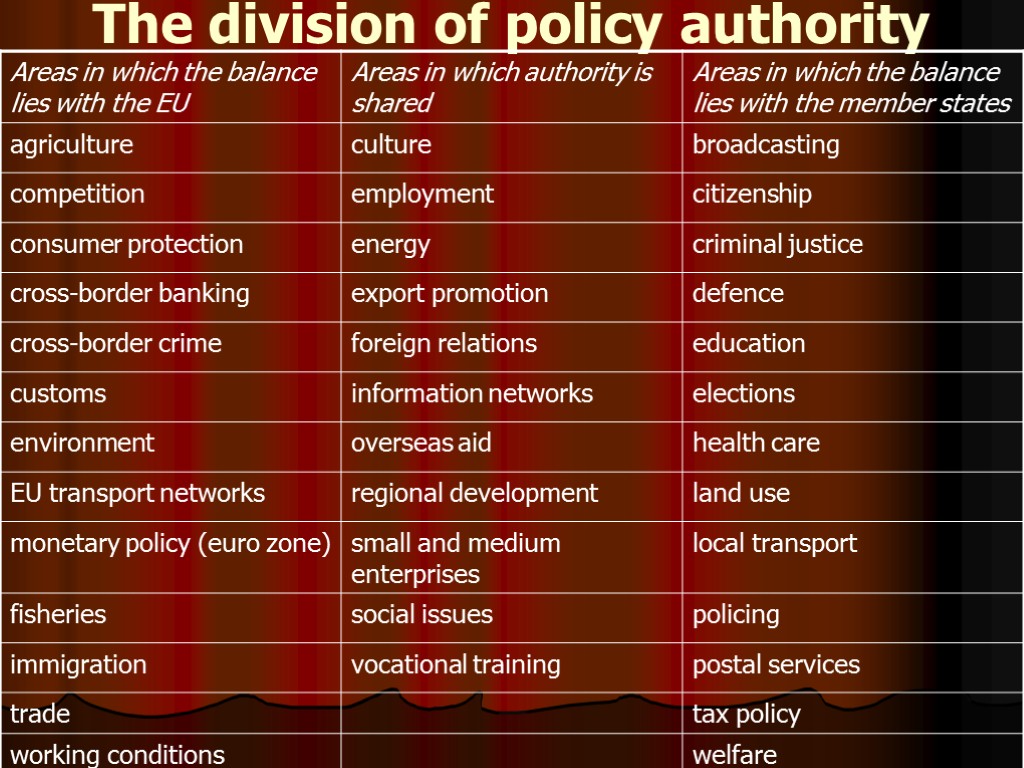
Division of Policy Authority Challenge Subsidiarity - the principle that decisions should be taken at the lowest level possible for effective action. It was first raised in the European context in 1975 when the European Commission argued that the Community should be given responsibility only for those matters that the member states were no longer capable of dealing with efficiently.
TEU Article 5 3. Under the principle of subsidiarity, in areas which do not fall within its exclusive competence, the Union shall act only if and in so far as the objectives of the proposed action cannot be sufficiently achieved by the Member States, either at central level or at regional and local level, but can rather, by reason of the scale or effects of the proposed action, be better achieved at Union level. The institutions of the Union shall apply the principle of subsidiarity as laid down in the Protocol on the application of the principles of subsidiarity and proportionality. National Parliaments ensure compliance with the principle of subsidiarity in accordance with the procedure set out in that Protocol. 4. Under the principle of proportionality, the content and form of Union action shall not exceed what is necessary to achieve the objectives of the Treaties. The institutions of the Union shall apply the principle of proportionality as laid down in the Protocol on the application of the principles of subsidiarity and proportionality.
The division of policy authority
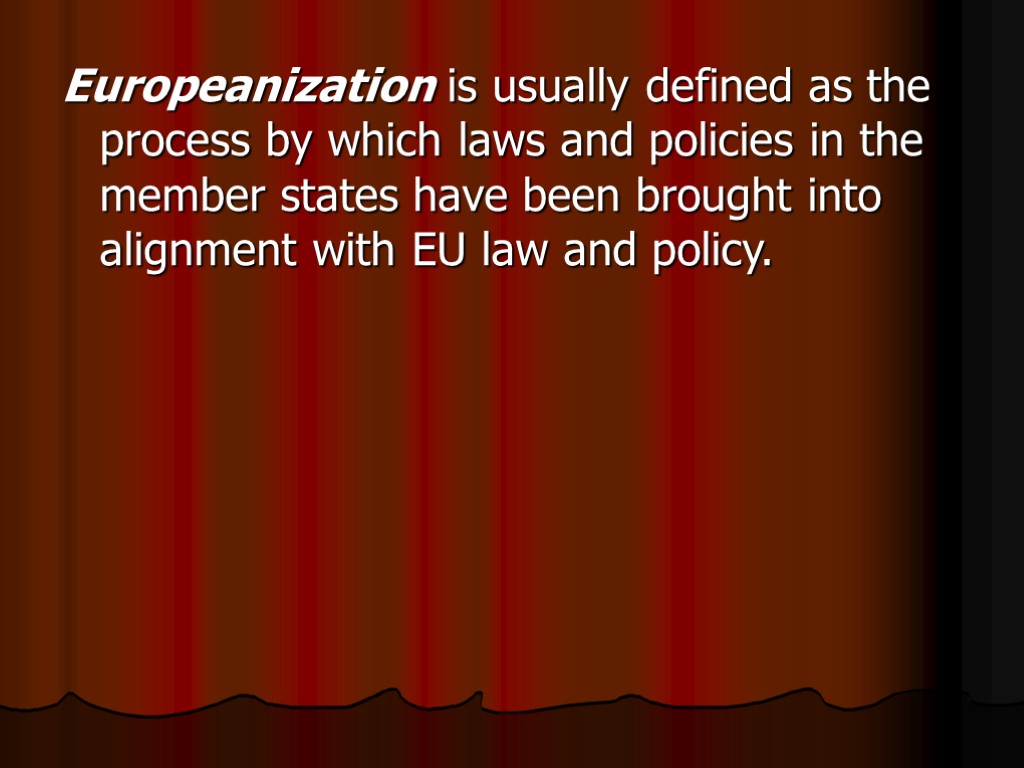
Europeanization is usually defined as the process by which laws and policies in the member states have been brought into alignment with EU law and policy.
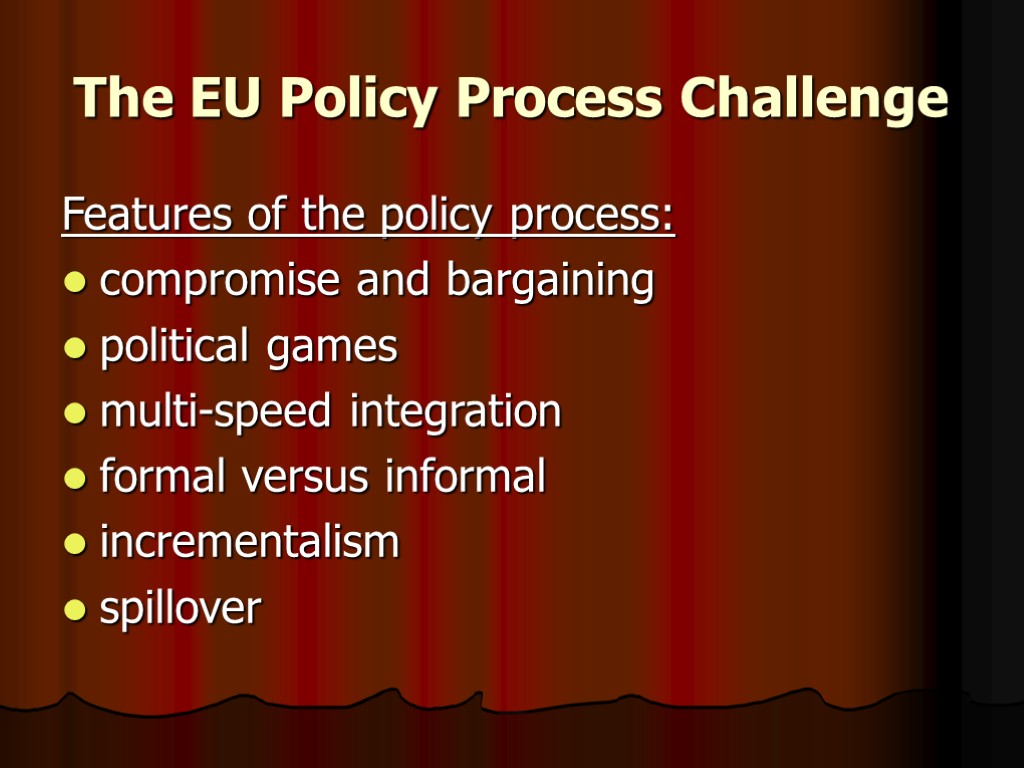
The EU Policy Process Challenge Features of the policy process: compromise and bargaining political games multi-speed integration formal versus informal incrementalism spillover
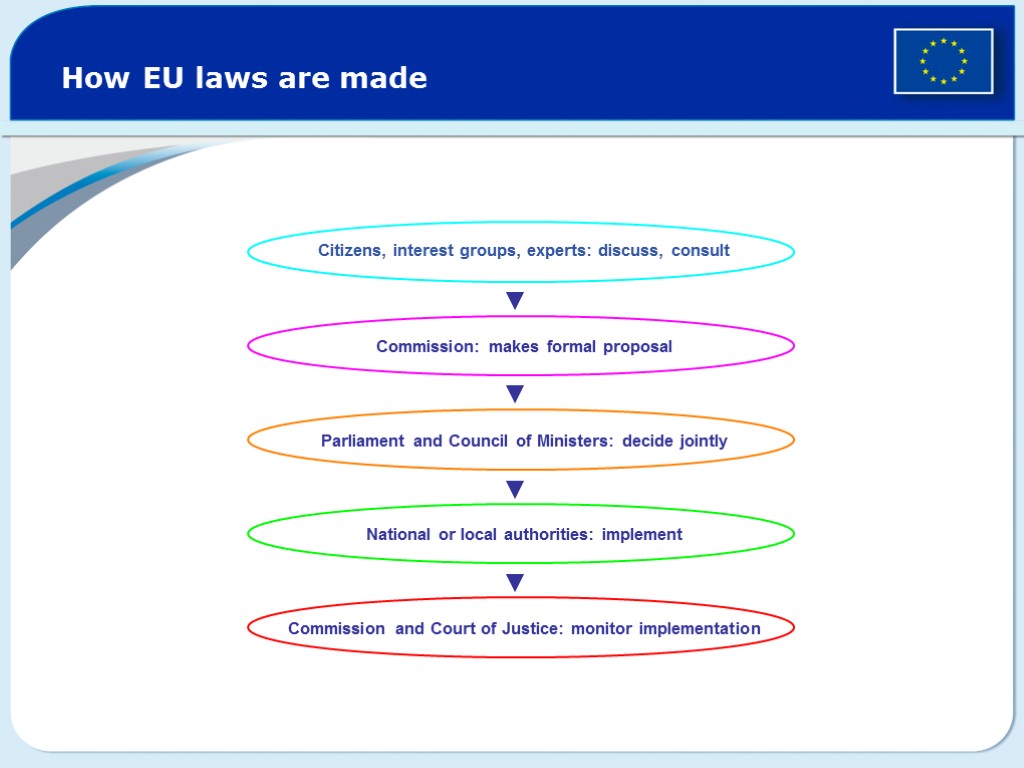
How EU laws are made Citizens, interest groups, experts: discuss, consult Commission: makes formal proposal Parliament and Council of Ministers: decide jointly Commission and Court of Justice: monitor implementation National or local authorities: implement
European Citizenship Challenge communication identity involvement
Social Challenge migration social standards
Economic Challenge The recent economic crisis has no precedent in European generation. The steady gains in economic growth and job creation witnessed over the last decade have been wiped out – the EU GDP fell by 4% in 2009, industrial production dropped back to the levels of the 1990s and 23 million people - or 10% of active population - are now unemployed. The crisis has been a huge shock for millions of citizens and it has exposed some fundamental weaknesses of the EU economy.
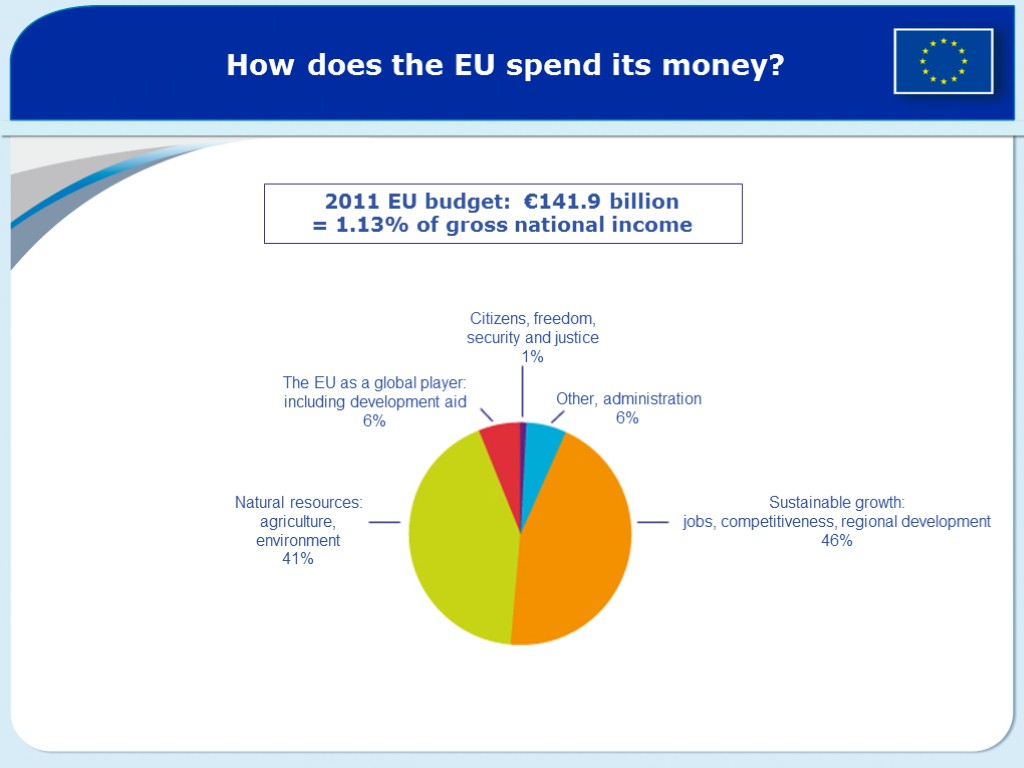
2011 EU budget: €141.9 billion = 1.13% of gross national income Citizens, freedom, security and justice 1% Other, administration 6% Sustainable growth: jobs, competitiveness, regional development 46% The EU as a global player: including development aid 6% Natural resources: agriculture, environment 41% How does the EU spend its money?
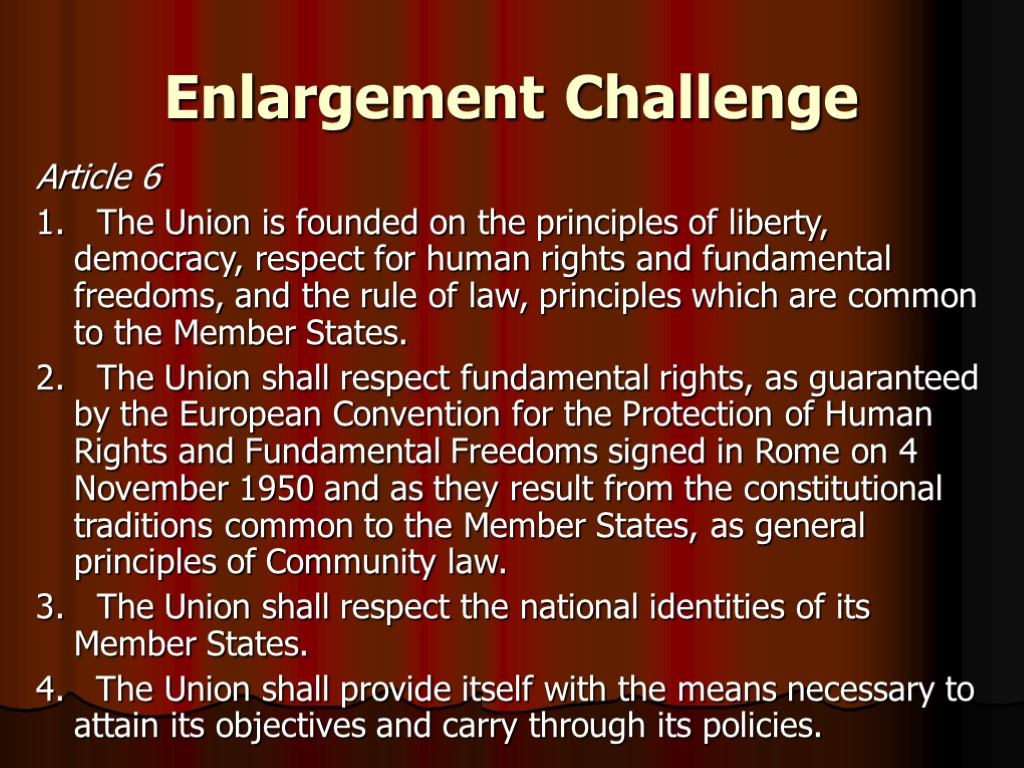
Enlargement Challenge Article 6 1. The Union is founded on the principles of liberty, democracy, respect for human rights and fundamental freedoms, and the rule of law, principles which are common to the Member States. 2. The Union shall respect fundamental rights, as guaranteed by the European Convention for the Protection of Human Rights and Fundamental Freedoms signed in Rome on 4 November 1950 and as they result from the constitutional traditions common to the Member States, as general principles of Community law. 3. The Union shall respect the national identities of its Member States. 4. The Union shall provide itself with the means necessary to attain its objectives and carry through its policies.
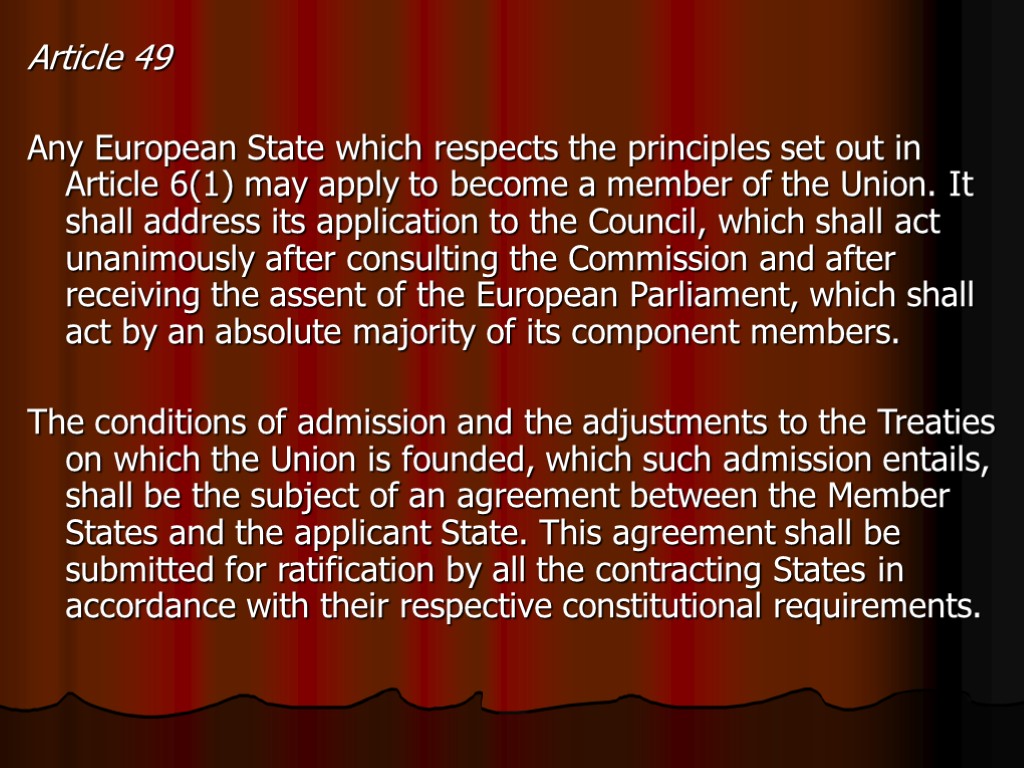
Article 49 Any European State which respects the principles set out in Article 6(1) may apply to become a member of the Union. It shall address its application to the Council, which shall act unanimously after consulting the Commission and after receiving the assent of the European Parliament, which shall act by an absolute majority of its component members. The conditions of admission and the adjustments to the Treaties on which the Union is founded, which such admission entails, shall be the subject of an agreement between the Member States and the applicant State. This agreement shall be submitted for ratification by all the contracting States in accordance with their respective constitutional requirements.
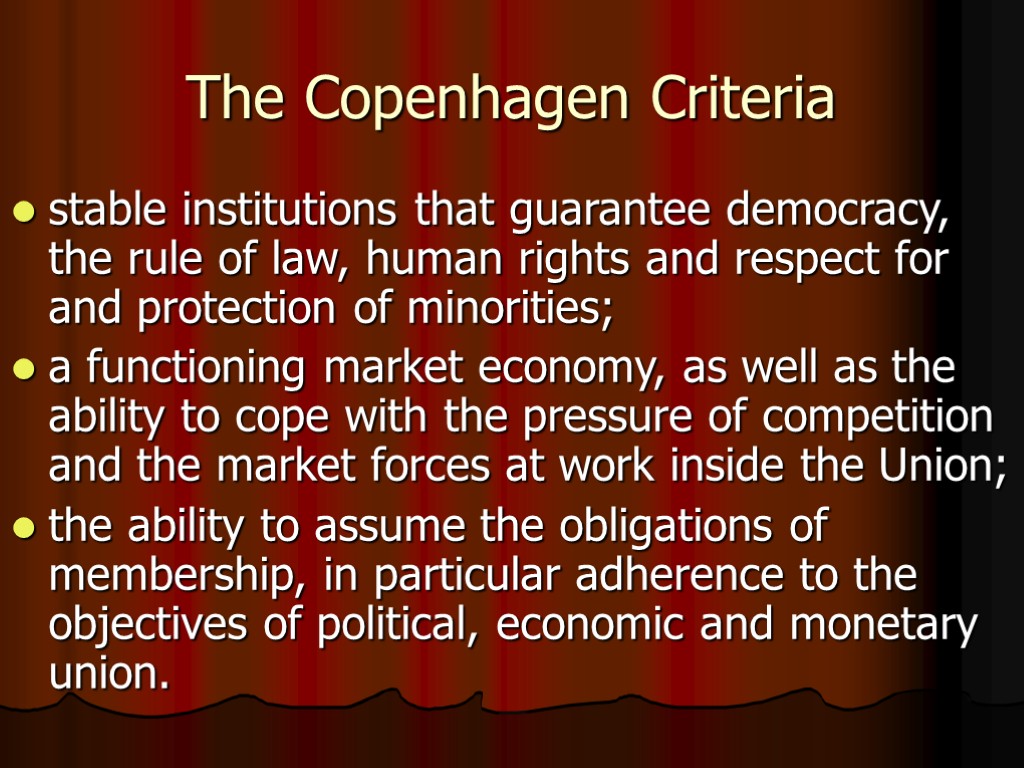
The Copenhagen Criteria stable institutions that guarantee democracy, the rule of law, human rights and respect for and protection of minorities; a functioning market economy, as well as the ability to cope with the pressure of competition and the market forces at work inside the Union; the ability to assume the obligations of membership, in particular adherence to the objectives of political, economic and monetary union.
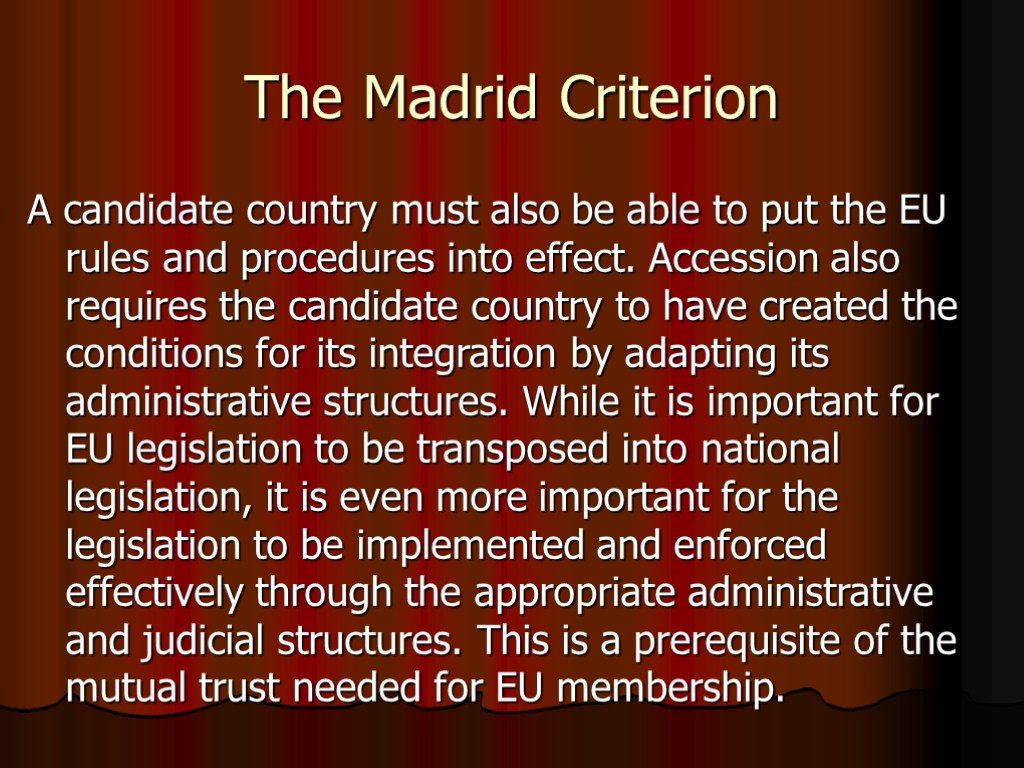
The Madrid Criterion A candidate country must also be able to put the EU rules and procedures into effect. Accession also requires the candidate country to have created the conditions for its integration by adapting its administrative structures. While it is important for EU legislation to be transposed into national legislation, it is even more important for the legislation to be implemented and enforced effectively through the appropriate administrative and judicial structures. This is a prerequisite of the mutual trust needed for EU membership.
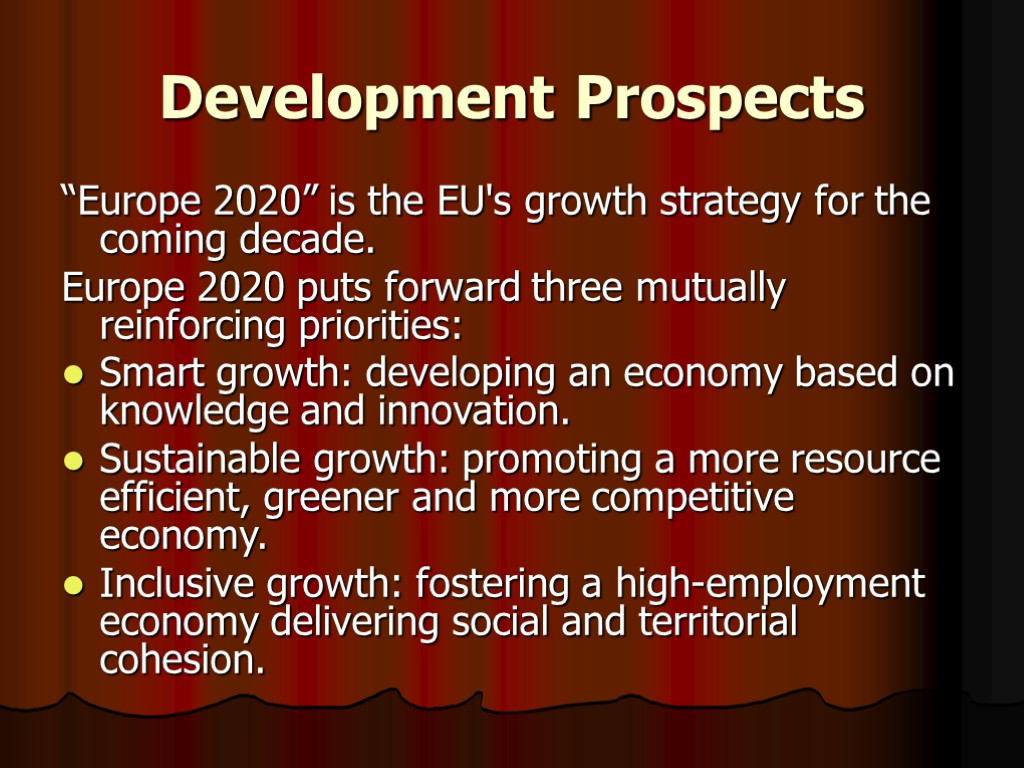
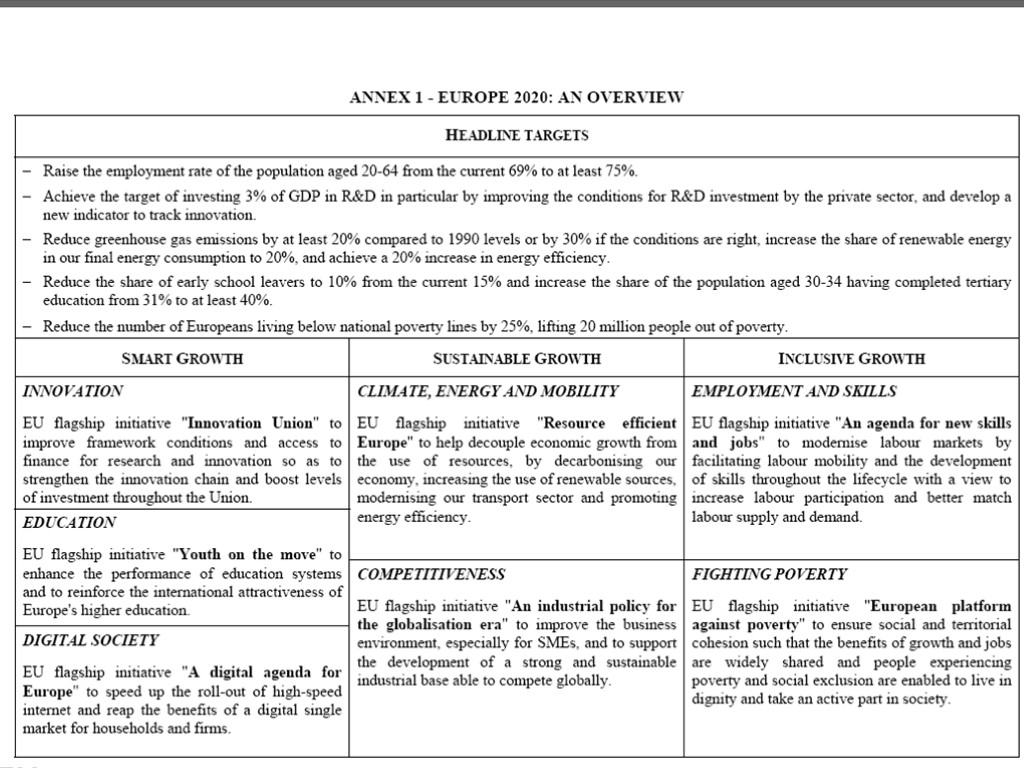
Development Prospects “Europe 2020” is the EU's growth strategy for the coming decade. Europe 2020 puts forward three mutually reinforcing priorities: Smart growth: developing an economy based on knowledge and innovation. Sustainable growth: promoting a more resource efficient, greener and more competitive economy. Inclusive growth: fostering a high-employment economy delivering social and territorial cohesion.