


 Скачать презентацию European Cooperation in the field of Scientific and
296ece82d5413c668f01d1590f46cc00.ppt
- Количество слайдов: 1
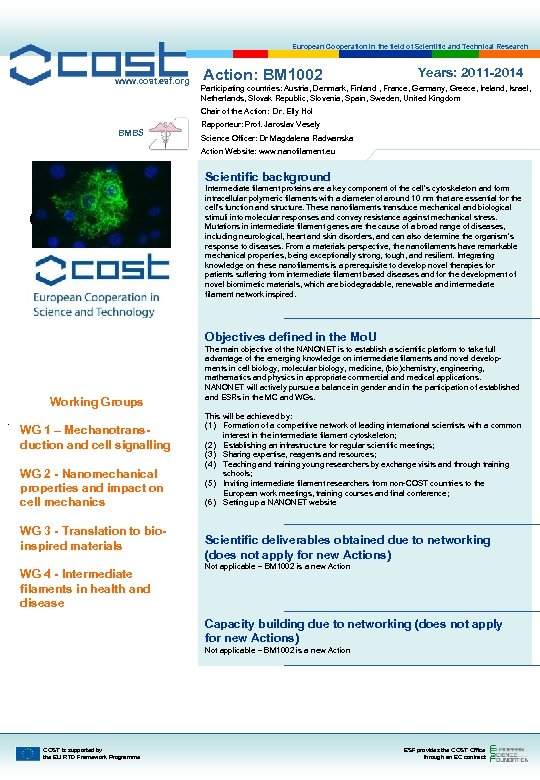 European Cooperation in the field of Scientific and Technical Research www. cost. esf. org Action: BM 1002 Years: 2011 -2014 Participating countries: Austria, Denmark, Finland , France, Germany, Greece, Ireland, Israel, Netherlands, Slovak Republic, Slovenia, Spain, Sweden, United Kingdom Chair of the Action: Dr. Elly Hol BMBS Rapporteur: Prof. Jaroslav Vesely Science Officer: Dr Magdalena Radwanska Action Website: www. nanofilament. eu Scientific background Relevant image (paste a relevant image) Intermediate filament proteins are a key component of the cell’s cytoskeleton and form intracellular polymeric filaments with a diameter of around 10 nm that are essential for the cell's function and structure. These nanofilaments transduce mechanical and biological stimuli into molecular responses and convey resistance against mechanical stress. Mutations in intermediate filament genes are the cause of a broad range of diseases, including neurological, heart and skin disorders, and can also determine the organism’s response to diseases. From a materials perspective, the nanofilaments have remarkable mechanical properties, being exceptionally strong, tough, and resilient. Integrating knowledge on these nanofilaments is a prerequisite to develop novel therapies for patients suffering from intermediate filament based diseases and for the development of novel biomimetic materials, which are biodegradable, renewable and intermediate filament network inspired. Objectives defined in the Mo. U Working Groups. WG 1 – Mechanotransduction and cell signalling WG 2 - Nanomechanical properties and impact on cell mechanics WG 3 - Translation to bioinspired materials WG 4 - Intermediate filaments in health and disease The main objective of the NANONET is to establish a scientific platform to take full advantage of the emerging knowledge on intermediate filaments and novel developments in cell biology, molecular biology, medicine, (bio)chemistry, engineering, mathematics and physics in appropriate commercial and medical applications. NANONET will actively pursue a balance in gender and in the participation of established and ESRs in the MC and WGs. This will be achieved by: (1) Formation of a competitive network of leading international scientists with a common interest in the intermediate filament cytoskeleton; (2) Establishing an infrastructure for regular scientific meetings; (3) Sharing expertise, reagents and resources; (4) Teaching and training young researchers by exchange visits and through training schools; (5) Inviting intermediate filament researchers from non-COST countries to the European work meetings, training courses and final conference; (6) Setting up a NANONET website Scientific deliverables obtained due to networking (does not apply for new Actions) Not applicable – BM 1002 is a new Action Capacity building due to networking (does not apply for new Actions) Not applicable – BM 1002 is a new Action COST is supported by the EU RTD Framework Programme ESF provides the COST Office through an EC contract