


 Скачать презентацию European Cooperation in Science and Technology www cost
60c3fd0bb83e2ae938cf8675448113cd.ppt
- Количество слайдов: 1
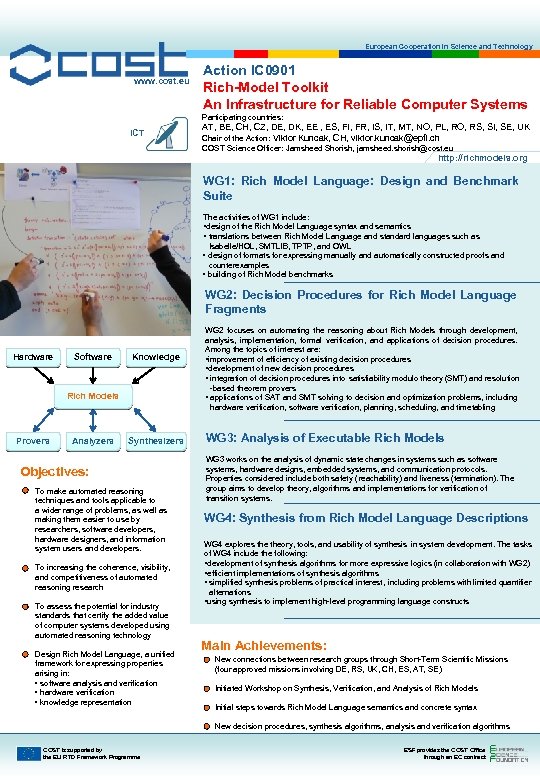 European Cooperation in Science and Technology www. cost. eu Action IC 0901 Rich-Model Toolkit An Infrastructure for Reliable Computer Systems Participating countries: ICT AT, BE, CH, CZ, DE, DK, EE , ES, FI, FR, IS, IT, MT, NO, PL, RO, RS, SI, SE, UK Chair of the Action: Viktor Kuncak, CH, viktor. kuncak@epfl. ch COST Science Officer: Jamsheed Shorish, jamsheed. shorish@cost. eu http: //richmodels. org WG 1: Rich Model Language: Design and Benchmark Suite The activities of WG 1 include: • design of the Rich Model Language syntax and semantics • translations between Rich Model Language and standard languages such as Isabelle/HOL, SMTLIB, TPTP, and OWL • design of formats for expressing manually and automatically constructed proofs and counterexamples • building of Rich Model benchmarks WG 2: Decision Procedures for Rich Model Language Fragments Hardware Software Knowledge Rich Models Provers Analyzers Synthesizers Objectives: To make automated reasoning techniques and tools applicable to a wider range of problems, as well as making them easier to use by researchers, software developers, hardware designers, and information system users and developers. To increasing the coherence, visibility, and competitiveness of automated reasoning research To assess the potential for industry standards that certify the added value of computer systems developed using automated reasoning technology Design Rich Model Language, a unified framework for expressing properties arising in: • software analysis and verification • hardware verification • knowledge representation WG 2 focuses on automating the reasoning about Rich Models through development, analysis, implementation, formal verification, and applications of decision procedures. Among the topics of interest are: • improvement of efficiency of existing decision procedures • development of new decision procedures • integration of decision procedures into satisfiability modulo theory (SMT) and resolution -based theorem provers • applications of SAT and SMT solving to decision and optimization problems, including hardware verification, software verification, planning, scheduling, and timetabling WG 3: Analysis of Executable Rich Models WG 3 works on the analysis of dynamic state changes in systems such as software systems, hardware designs, embedded systems, and communication protocols. Properties considered include both safety ( reachability) and liveness (termination). The group aims to develop theory, algorithms and implementations for verification of transition systems. WG 4: Synthesis from Rich Model Language Descriptions WG 4 explores theory, tools, and usability of synthesis in system development. The tasks of WG 4 include the following: • development of synthesis algorithms for more expressive logics (in collaboration with WG 2) • efficient implementations of synthesis algorithms • simplified synthesis problems of practical interest , including problems with limited quantifier alternations • using synthesis to implement high-level programming language constructs Main Achievements: New connections between research groups through Short-Term Scientific Missions (four approved missions involving DE, RS, UK, CH, ES, AT, SE) Initiated Workshop on Synthesis, Verification, and Analysis of Rich Models Initial steps towards Rich Model Language semantics and concrete syntax New decision procedures, synthesis algorithms, analysis and verification algorithms COST is supported by the EU RTD Framework Programme ESF provides the COST Office through an EC contract