


 Скачать презентацию European Community Course Credit Transfer System
Презентация1.pptx
- Количество слайдов: 7
 European Community Course Credit Transfer System • Based on the combination of modular technology and credits; • Can be used: 1. Within the institution; 2. Between institutions of the same country; 3. Between institutions partners from different countries. • Provides for the implementation of the rules with respect to all of its parts: 1. ECTS-credits; 2. ECTS-assessments; 3. Learning agreement and enrollment credits.
 ECTS in NMU • The organization of academic process due to credit modular system includes 360 ECTS credits; • 1 ECTS credit corresponds to 30 academic hours; • The academic year includes 1, 800 academic hours; • Students are introduced in the first session with rated criteria; • Students are evaluated in the rating scores at the workshops.
 Features of the educational process in NMU • There are no examination sessions; • The following kinds of control are anticipated: 1. Current control at each practical, seminar classes; 2. Final modular control. • Use evaluation scale ECTS (“A”, “B”, “C”, “D”, “E”); • The maximum amount of scores is 200 (academic activity – 120 scores, the results from final modular control – 80 scores); • The mark on discipline is put only to students, who passed through all modules on discipline.
 • The scores on disciplines are independently converted both into ECTS scale and 4 -grade scale; • The scores of ETCS scale are not converted into 4 -grade scale and vice versa. Scores on discipline Mark due to 4 -grade scale From 170 up to 200 scores 5 From 140 up to 169 scores 4 From 139 up to minimum amount of scores, which the student shall obtain 3 Below minimum amount of scores, which the student shall obtain 2 ECTS mark Number of students, awarded with the mark A Best 10% from students B Next 25% from students C Next 30% from students D Next 25% from students E Last 10% from students
 ADVANTAGES of the ECTS in NMU • Continuous monitoring of the students' knowledge; • Active learning of students throughout the term; • Manifestation of the intellectual struggle for the top group; • A deeper study of the students of each discipline; • Ensures transparency and enhances the educational choice for students; • Eases recognition agencies - partners of educational achievements of students through the use of commonly understood assessment system - credits and grades.
 DISADVANTAGES of the ECTS in NMU • Increase students' independent work while reducing the number of hours of lectures and practical classes; • Decrease in the quality of training; • Lack of methodological support of educational process; • Large-scale introduction of the test system leads to a substandard and superficial knowledge.
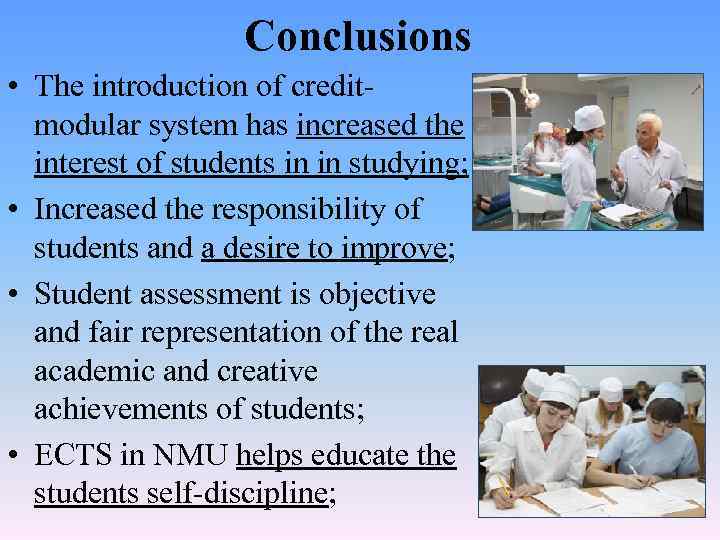 Conclusions • The introduction of creditmodular system has increased the interest of students in in studying; • Increased the responsibility of students and a desire to improve; • Student assessment is objective and fair representation of the real academic and creative achievements of students; • ECTS in NMU helps educate the students self-discipline;