


 Скачать презентацию European Commission Trans-European transport network TEN Policy Sanna
9b9381342b3842a0e5cbd62de7348775.ppt
- Количество слайдов: 17
 European Commission Trans-European transport network (TEN) Policy Sanna KUUKKA 22 November 2006 Directorate general for Energy and Transport
 Content The logic of the extension of the trans. European transport network – 3 phases from 1992 to 2006 Ø Ø Ø European Union of 15 Member states Enlargement of the EU to 27 Member states Extension of the network to countries neighbouring the EU Directorate general for Energy and Transport 2
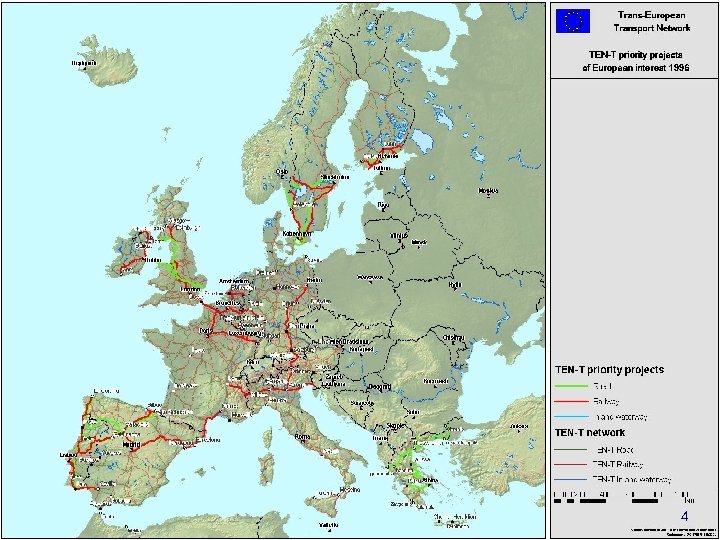
 Trans-European Transport Network (TEN-T) l l l White paper of Jacques Delors - Growth, competitiveness and employment launches the debate in 1992 Chapter on TENs was introduced to EU Treaty in 1993 (Maastricht treaty) The TEN Guidelines were first adopted in 1996 aiming at: u u u l Integrating national networks and modes of transport Linking peripheral regions of the Union to the centre Improving safety and efficiency of the networks 14 priority “Essen” projects identified by the EU Heads of State and Government in 1994 were included in the TEN Guidelines Directorate general for Energy and Transport 3
 Directorate general for Energy and Transport 4
 1 st revision of the Guidelines l Decision 1346/2001/EC of 2/7/2001 l Introduction of seaports, inland ports and intermodal terminals l Defining the characteristics and criteria for specific projects and projects of common interest Directorate general for Energy and Transport 5
 2 nd revision of the Guidelines l Background – the new context was analysed in the White paper on European transport policy 2001 u u u u Forthcoming enlargement in May 2004 Slow progress of priority projects, particularly as regards rail and cross-border sections Scarce EU funds distributed thinly over a vast network Increases in demand imbalanced Slow progress of priority projects particularly regarding rail and border crossings Investments in MSs insufficient (1%→ 0. 8% of GDP) Co-financing of EU budget not sufficiently concentrated on the priorities Directorate general for Energy and Transport 6
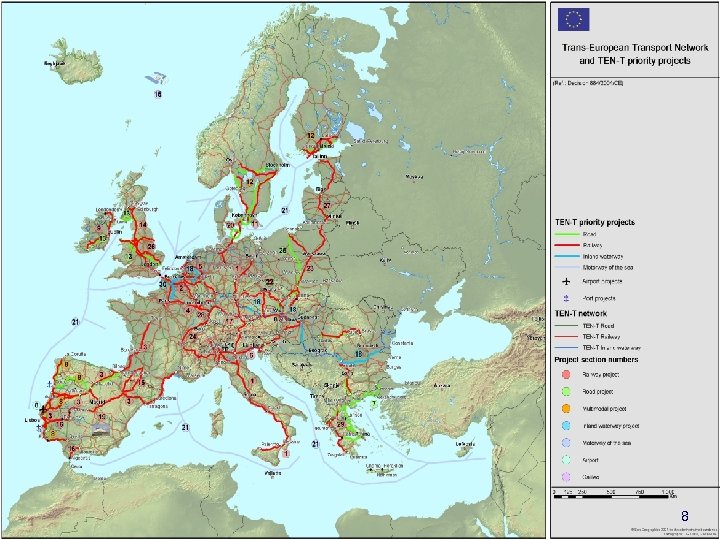
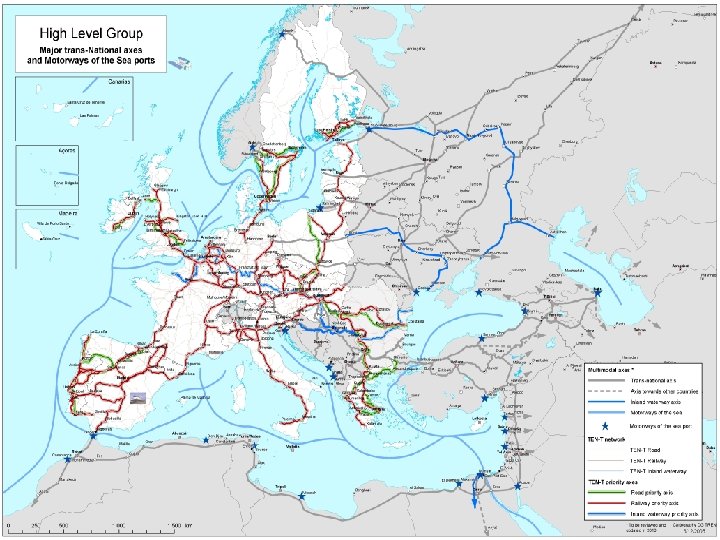
 New elements for the TEN policy l l European priorities targeted by focussing investments on priority projects on 30 major trans-national axes Enlargement facilitated by integrating the networks of the 10 new and 2 future Member countries l Sustainability addressed by giving priority to rail, intermodality and Motorways of the sea l Organisational means improved to facilitate co-ordination of funding and implementation of projects along the major axes l Financial framework adapted to enable concentration and target bottlenecks at border crossings Directorate general for Energy and Transport 7
 Directorate general for Energy and Transport 8
 Extent of the TEN Network l TEN-T network (EU 25, existing and planned) consists approximately of u 90 000 km of roads, u 100 000 km of rail tracks, u 12 000 km of inland waterways, u 400 airports, u 400 international sea ports, u 300 inland ports and u traffic management systems. Directorate general for Energy and Transport 9
 Cost and financing of the TENs l Costs of completing the full network is € 600 billion, of which € 250 billion for the priority projects, by 2020 l Sources of funding: l l l National funding remains crucial European funding (TEN-budget, ERDF, Cohesion Fund, EIB) Private sector, direct user contribution – infrastructure charging (railway packages, Eurovignette) Directorate general for Energy and Transport 10
 Extension of the TENs to the neighbouring countries l Aim: To integrate regional exercises u u Pan-European Corridors TRACECA (Corridor Europe-Caucasus-Asia) Euro Mediterranean regional programme Western Balkan core network l Tool: European Neighbourhood Policy l Methodology: High Level Group chaired by Ms de Palacio and including the EU 27, 26 neighbouring countries and 3 banks Directorate general for Energy and Transport 11
 The High Level Group l Chair of the Group - Ms Loyola de Palacio l Neighbouring countries: Albania, Algeria, Armenia, Azerbaijan, Belarus, Bosnia & Herzegovina, Croatia, Egypt, former Yugoslav Republic of Macedonia, Georgia, Israel, Jordan, Lebanon, Libya (as observer), Morocco, Moldova, Norway, Palestinian Authority, Russia, Serbia & Montenegro, Kosovo, Switzerland, Syria, Tunisia, Turkey and Ukraine l EU Member States as well as Bulgaria and Romania (EU 27) l EIB, EBRD and World Bank Directorate general for Energy and Transport 12
 The Group’s methodology Key for success: agreement upon a clear and rigorous methodology from the outset of the work l Step 1: Criteria for identifying major axes International trade and traffic flows, existing international agreements, regional cooperation and integration l Step 2: Criteria for selecting priority projects Political and financial commitment of country, economic profitability and environmental sustainability Directorate general for Energy and Transport 13
 Liste of horizontal measures The Group analysed in detail 10 horizontal and cross-cutting themes: l l l l l Border control and customs procedures Satellite radio navigation systems Maritime transport and Motorways of the Seas Rail transport and interoperability Inland waterways Road safety and vehicle dimensions Air transport Security Environment Financing and public private partnerships (PPP) Directorate general for Energy and Transport 14
 Directorate general for Energy and Transport
 3 rd revision in 2010? Ø Need to integrate the regional exercises into a coherent framework Ø Ø Ø l l TEN of EU 27, motorways of the sea Croatia, Turkey, etc? Euro-Med Commission is preparing a Communication to the Council and the European Parliament before end 2006 Tool: TEN Guidelines Directorate general for Energy and Transport 16
 Further information l DG Energy and Transport http: //ec. europa. eu/dgs/energy_transport/index_ en. html l Trans-European Transport Networks http: //ec. europa. eu/ten/index_en. html l sanna. kuukka@ec. europa. eu Directorate general for Energy and Transport 17