


 Скачать презентацию European Commission GALILEO The European project on satellite
efd774fec1b7e2d0998f20da58f11be2.ppt
- Количество слайдов: 27
 European Commission GALILEO The European project on satellite navigation September 2002 Directorate-General for Energy and Transport 1
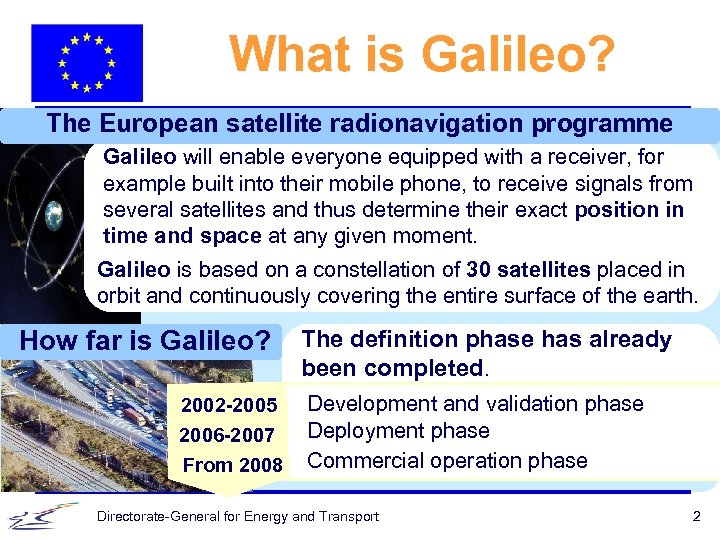 What is Galileo? The European satellite radionavigation programme Galileo will enable everyone equipped with a receiver, for example built into their mobile phone, to receive signals from several satellites and thus determine their exact position in time and space at any given moment. Galileo is based on a constellation of 30 satellites placed in orbit and continuously covering the entire surface of the earth. How far is Galileo? 2002 -2005 2006 -2007 From 2008 The definition phase has already been completed. Development and validation phase Deployment phase Commercial operation phase Directorate-General for Energy and Transport 2
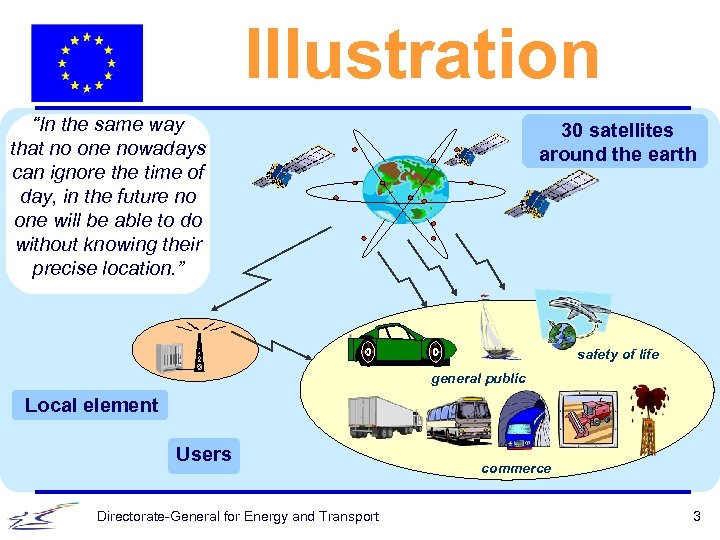 Illustration “In the same way that no one nowadays can ignore the time of day, in the future no one will be able to do without knowing their precise location. ” 30 satellites around the earth safety of life general public Local element Users Directorate-General for Energy and Transport commerce 3
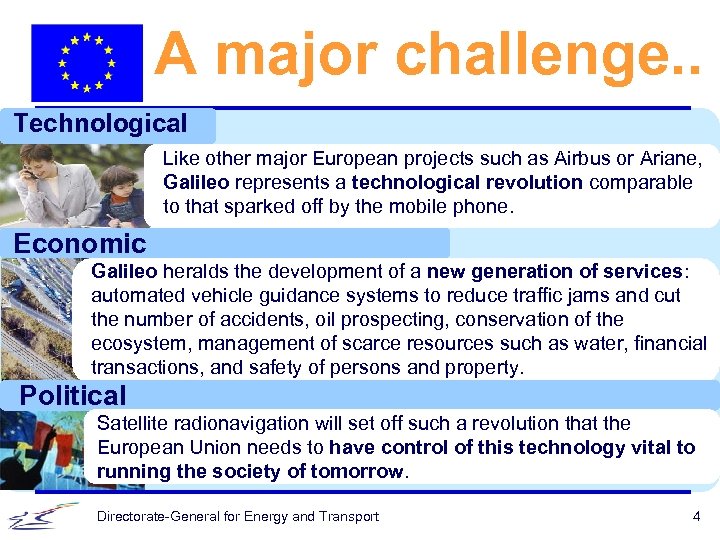 A major challenge. . Technological Like other major European projects such as Airbus or Ariane, Galileo represents a technological revolution comparable to that sparked off by the mobile phone. Economic Galileo heralds the development of a new generation of services: automated vehicle guidance systems to reduce traffic jams and cut the number of accidents, oil prospecting, conservation of the ecosystem, management of scarce resources such as water, financial transactions, and safety of persons and property. Political Satellite radionavigation will set off such a revolution that the European Union needs to have control of this technology vital to running the society of tomorrow. Directorate-General for Energy and Transport 4
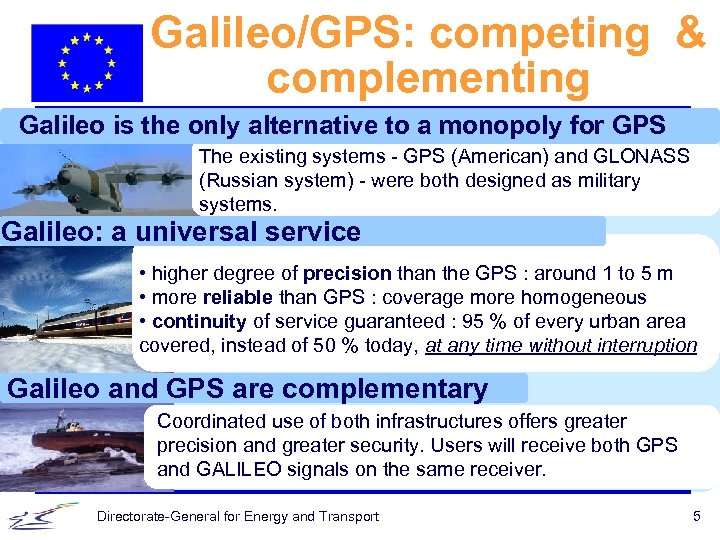 Galileo/GPS: competing & complementing Galileo is the only alternative to a monopoly for GPS The existing systems - GPS (American) and GLONASS (Russian system) - were both designed as military systems. Galileo: a universal service • higher degree of precision than the GPS : around 1 to 5 m • more reliable than GPS : coverage more homogeneous • continuity of service guaranteed : 95 % of every urban area covered, instead of 50 % today, at any time without interruption Galileo and GPS are complementary Coordinated use of both infrastructures offers greater precision and greater security. Users will receive both GPS and GALILEO signals on the same receiver. Directorate-General for Energy and Transport 5
 Galileo: the criticism is unfounded GPS is free, but Galileo has to be paid for? Like GPS, Galileo will be free of charge to basic users. Some applications will have to be paid for - those requiring a quality of service which GPS is unable to provide. The GPS of the future could perhaps offer such services too, but there is no guarantee that they will be free, least of all if GPS holds a monopoly! Galileo: the security conditions are satisfactory An appropriate security framework is specifically required. All services provided by Galileo will be monitored by the authorities. U. S. concerns that Galileo could cause interference with the military GPS have been taken into consideration in the form of flexible solutions on use of the radiofrequency spectrum. Directorate-General for Energy and Transport 6
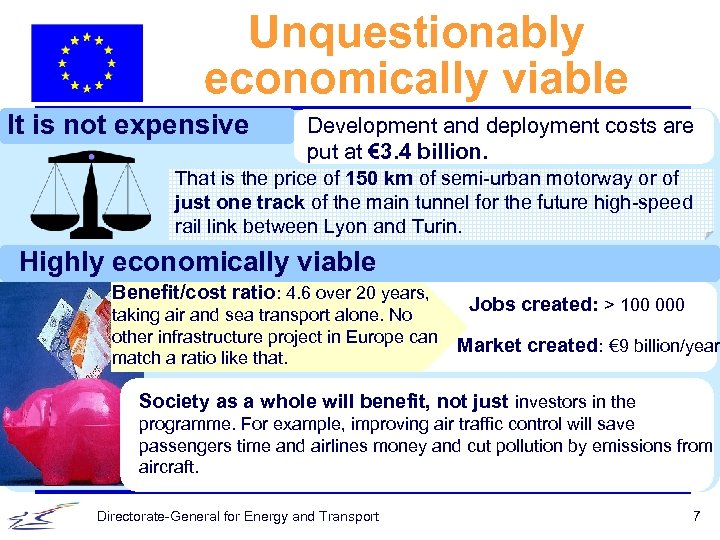 Unquestionably economically viable It is not expensive Development and deployment costs are put at € 3. 4 billion. That is the price of 150 km of semi-urban motorway or of just one track of the main tunnel for the future high-speed rail link between Lyon and Turin. Highly economically viable Benefit/cost ratio: 4. 6 over 20 years, taking air and sea transport alone. No other infrastructure project in Europe can match a ratio like that. Jobs created: > 100 000 Market created: € 9 billion/year Society as a whole will benefit, not just investors in the programme. For example, improving air traffic control will save passengers time and airlines money and cut pollution by emissions from aircraft. Directorate-General for Energy and Transport 7
 No need for contributions from national budgets Development phase (2002 -2005) The € 1. 1 billion needed has already been set aside in the Community and the European Space Agency budgets (each will pay equal amounts). Deployment phase (2006 -2007) Funding will be provided for in the next forward plan for the Union’s budget. Allowance will be made for a financial contribution from private-sector participants in the project. Operation phase (starting in 2008) Public participation will gradually decrease until 2015 and will be covered by the Community budget. During this commercial phase this public funding will be offset by revenues to the operator ranging from value-added services to the exploitation of intellectual property rights on chipsets. Directorate-General for Energy and Transport 8
 The development phase has finally been launched On 26 March, the Transport Council agreed on the Regulation governing the statutes of the Joint Undertaking. . . • Commission to establish the Joint Undertaking in the coming weeks together with ESA • Private sector participation possible at a later stage …and on the release of the remaining € 450 m to fund the development phase • € 450 m as Trans-European Network project with the Joint Undertaking as beneficiary (in addition to € 100 m already released and € 550 m ESA contribution) • annual payments from 2002 to 2005 Directorate-General for Energy and Transport 9
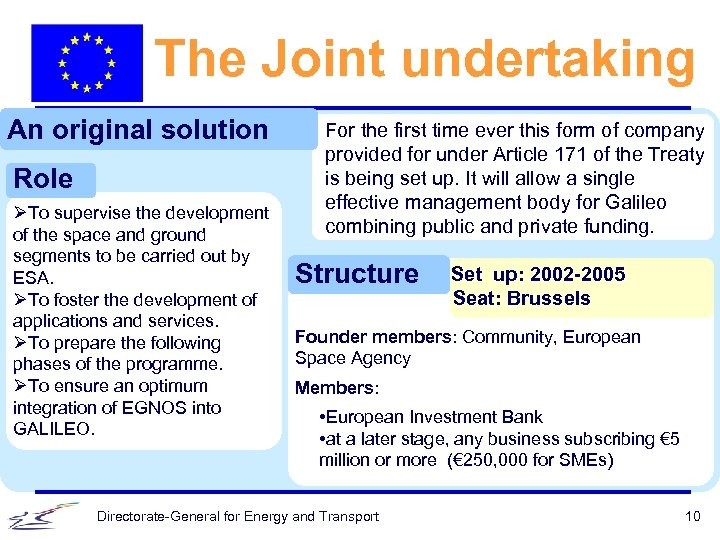 The Joint undertaking An original solution Role ØTo supervise the development of the space and ground segments to be carried out by ESA. ØTo foster the development of applications and services. ØTo prepare the following phases of the programme. ØTo ensure an optimum integration of EGNOS into GALILEO. For the first time ever this form of company provided for under Article 171 of the Treaty is being set up. It will allow a single effective management body for Galileo combining public and private funding. Structure Set up: 2002 -2005 Seat: Brussels Founder members: Community, European Space Agency Members: • European Investment Bank • at a later stage, any business subscribing € 5 million or more (€ 250, 000 for SMEs) Directorate-General for Energy and Transport 10
 Private sector participation welcome The Joint undertaking provides the opportunity to enlist private sector support for the project This is a business oriented programme. Private sector involvement ensures proper market approach and serviceoriented infrastructure development. Conflicts of interest to be avoided Private sector can become Member of the Joint Undertaking once the call for tenders with a view to selecting the future operator has been finalised (at the latest by end of 2003). Directorate-General for Energy and Transport 11
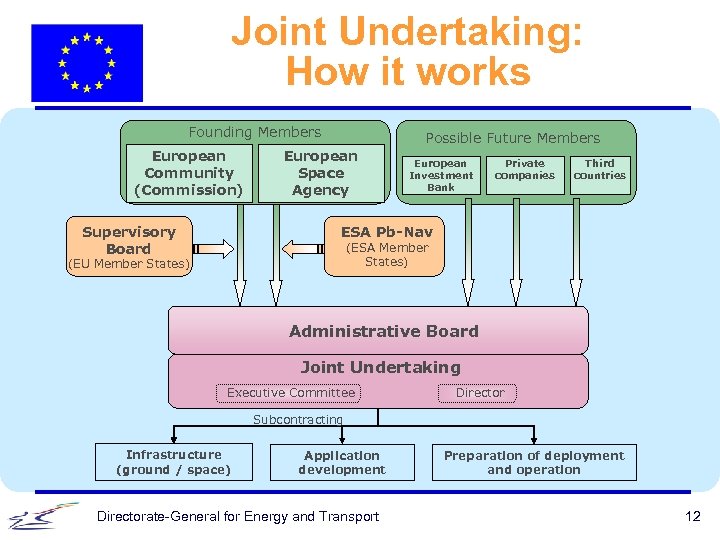 Joint Undertaking: How it works Founding Members European Community (Commission) Supervisory Board Possible Future Members European Space Agency European Investment Bank Private companies Third countries ESA Pb-Nav (ESA Member States) (EU Member States) Administrative Board Joint Undertaking Executive Committee Director Subcontracting Infrastructure (ground / space) Application development Directorate-General for Energy and Transport Preparation of deployment and operation 12
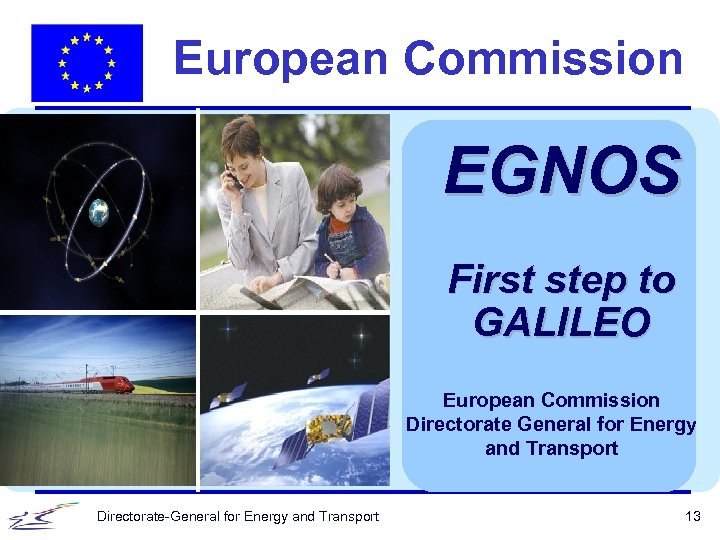 European Commission EGNOS First step to GALILEO European Commission Directorate General for Energy and Transport Directorate-General for Energy and Transport 13
 Role of EGNOS in GALILEO üEGNOS is the first step to Galileo and part of the European Satellite Navigation Strategy. It will become operational in early 2004 and is partially funded by air traffic services providers. üEGNOS will pave the way and reduce the risks for GALILEO in different domains: ØTechnical aspects (i. e. integrity). ØOperational experience. ØCertification process. ØInstitutional framework…. . Directorate-General for Energy and Transport 14
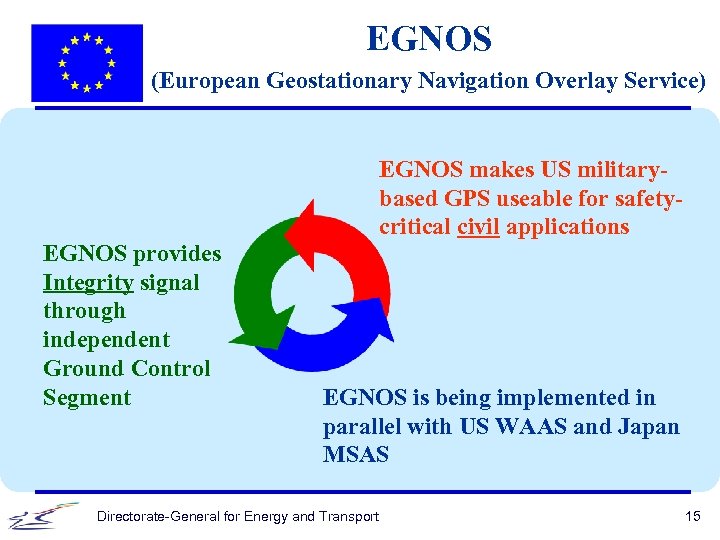 EGNOS (European Geostationary Navigation Overlay Service) EGNOS provides Integrity signal through independent Ground Control Segment EGNOS makes US militarybased GPS useable for safetycritical civil applications EGNOS is being implemented in parallel with US WAAS and Japan MSAS Directorate-General for Energy and Transport 15
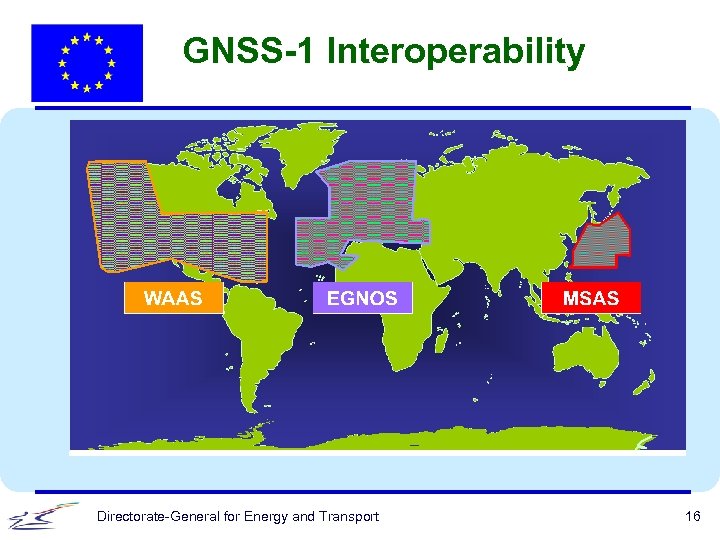 GNSS-1 Interoperability Directorate-General for Energy and Transport 16
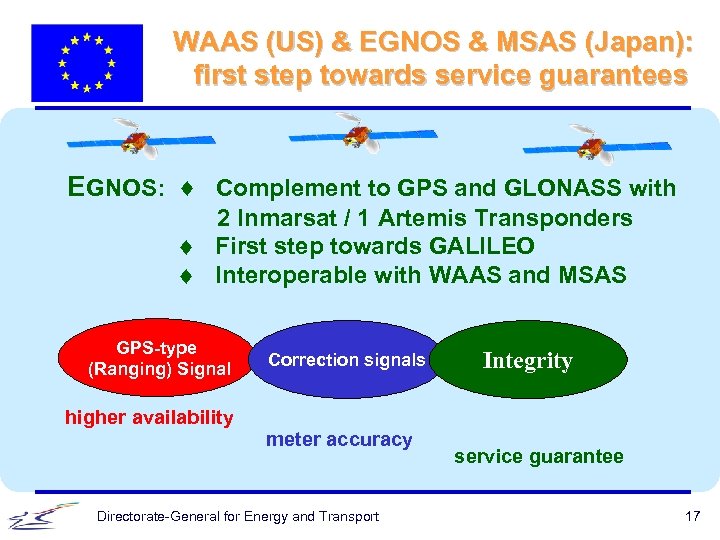 WAAS (US) & EGNOS & MSAS (Japan): first step towards service guarantees EGNOS: Complement to GPS and GLONASS with 2 Inmarsat / 1 Artemis Transponders First step towards GALILEO Interoperable with WAAS and MSAS GPS-type (Ranging) Signal Correction signals Integrity higher availability meter accuracy Directorate-General for Energy and Transport service guarantee 17
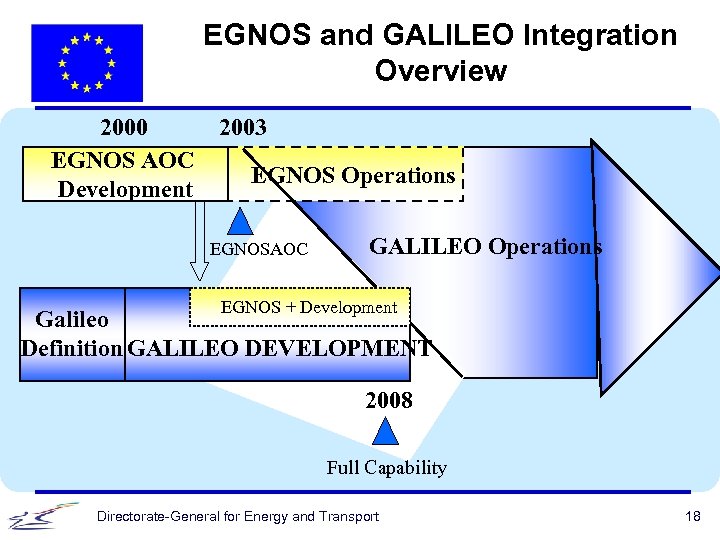 EGNOS and GALILEO Integration Overview 2000 EGNOS AOC Development 2003 EGNOS Operations EGNOSAOC GALILEO Operations EGNOS + Development Galileo Definition GALILEO DEVELOPMENT 2008 Full Capability Directorate-General for Energy and Transport 18
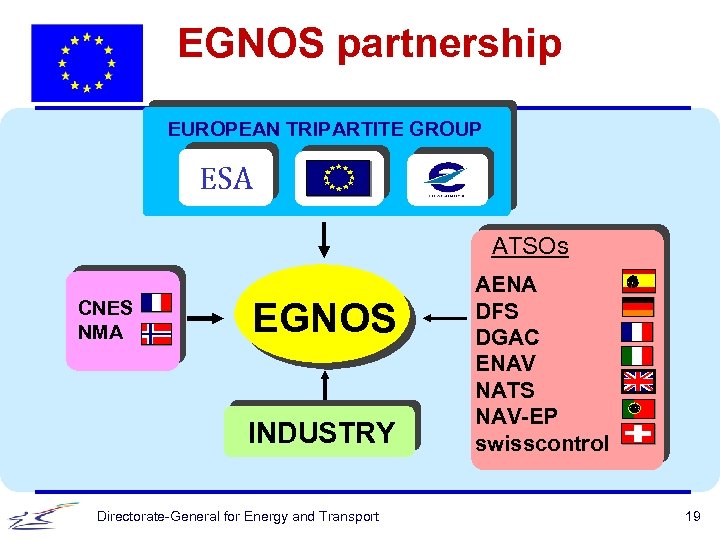 EGNOS partnership EUROPEAN TRIPARTITE GROUP ESA ATSOs CNES NMA EGNOS INDUSTRY Directorate-General for Energy and Transport AENA DFS DGAC ENAV NATS NAV-EP swisscontrol LS PV R LA VT 19
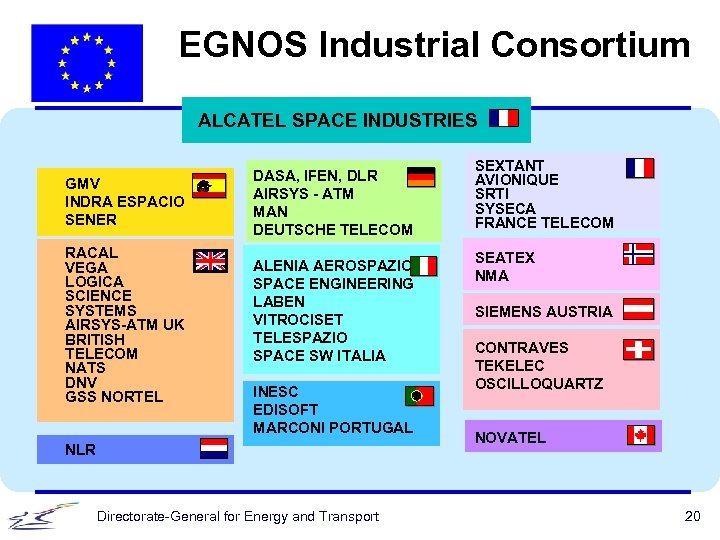 EGNOS Industrial Consortium ALCATEL SPACE INDUSTRIES GMV INDRA ESPACIO SENER RACAL VEGA LOGICA SCIENCE SYSTEMS AIRSYS-ATM UK BRITISH TELECOM NATS DNV GSS NORTEL LS PV R LA VT DASA, IFEN, DLR AIRSYS - ATM MAN DEUTSCHE TELECOM ALENIA AEROSPAZIO SPACE ENGINEERING LABEN VITROCISET TELESPAZIO SPACE SW ITALIA INESC EDISOFT MARCONI PORTUGAL NLR Directorate-General for Energy and Transport SEXTANT AVIONIQUE SRTI SYSECA FRANCE TELECOM SEATEX NMA SIEMENS AUSTRIA CONTRAVES TEKELEC OSCILLOQUARTZ NOVATEL 20
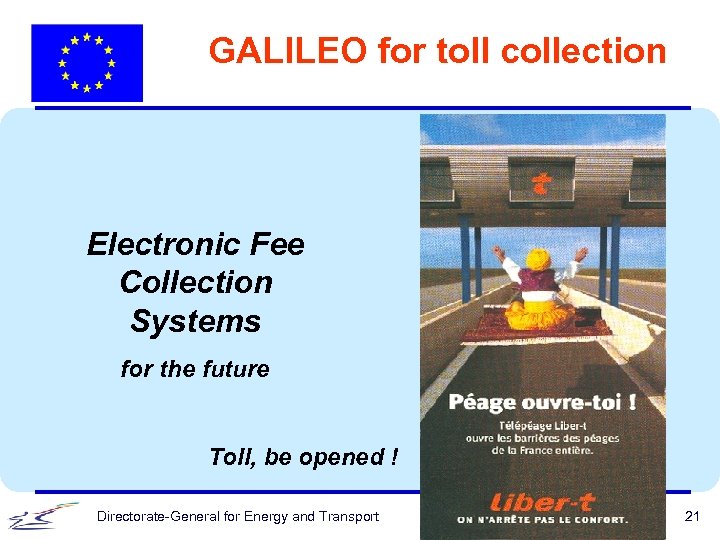 GALILEO for toll collection Electronic Fee Collection Systems for the future Toll, be opened ! Directorate-General for Energy and Transport 21
 GALILEO for toll collection l l New charging policy under definition in the EC New requirements from the Member States and at local level : u fight against traffic congestion u better demand management u internalize external costs l the result : new charges proportional to kilometers driven on primary road network are in the air Directorate-General for Energy and Transport 22
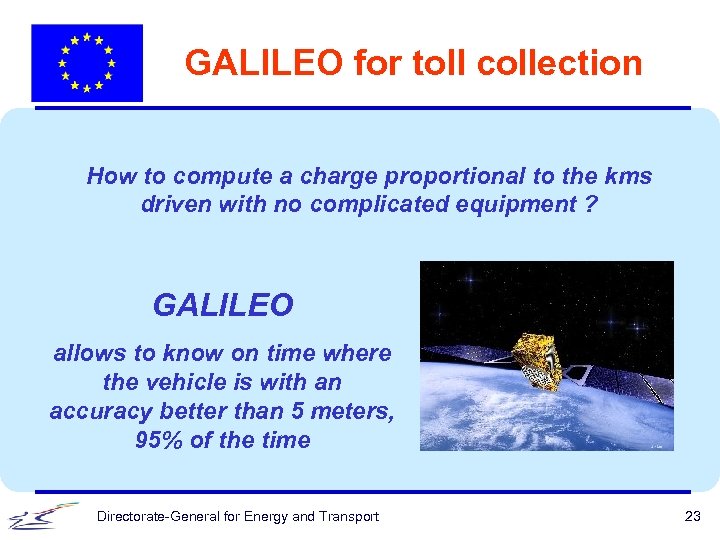 GALILEO for toll collection How to compute a charge proportional to the kms driven with no complicated equipment ? GALILEO allows to know on time where the vehicle is with an accuracy better than 5 meters, 95% of the time Directorate-General for Energy and Transport 23
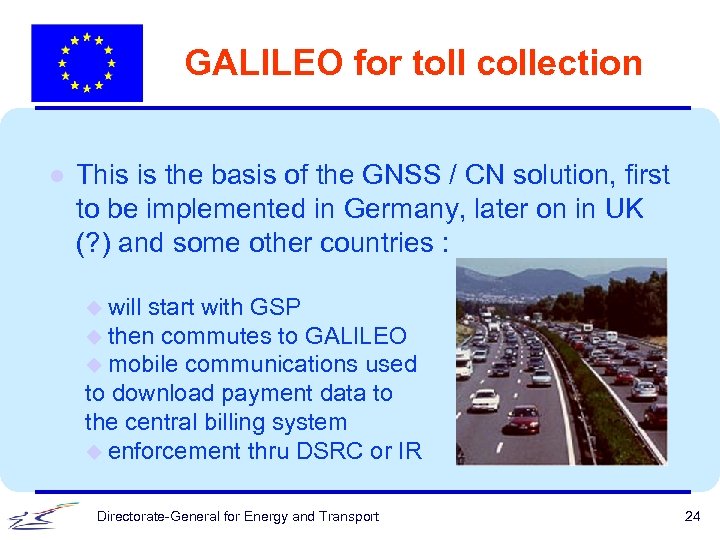 GALILEO for toll collection l This is the basis of the GNSS / CN solution, first to be implemented in Germany, later on in UK (? ) and some other countries : u will start with GSP u then commutes to GALILEO u mobile communications used to download payment data to the central billing system u enforcement thru DSRC or IR Directorate-General for Energy and Transport 24
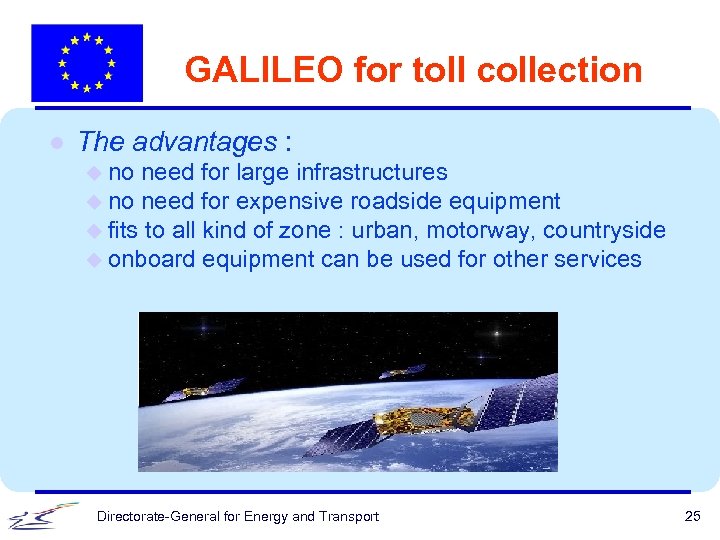 GALILEO for toll collection l The advantages : u no need for large infrastructures u no need for expensive roadside equipment u fits to all kind of zone : urban, motorway, countryside u onboard equipment can be used for other services Directorate-General for Energy and Transport 25
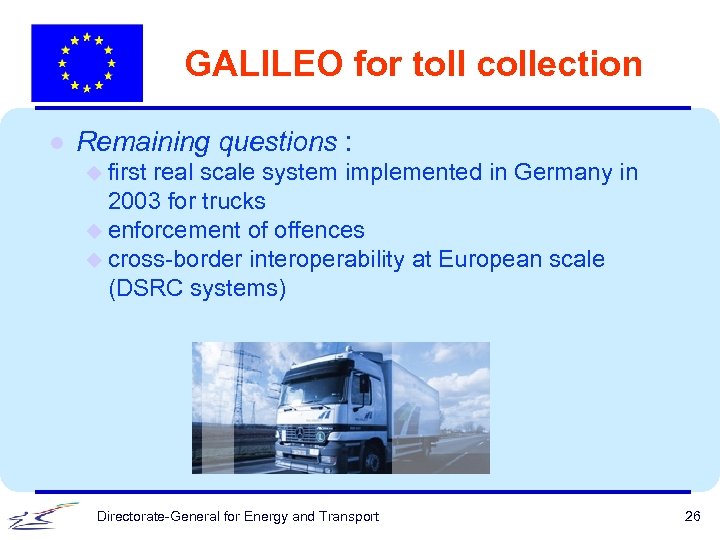 GALILEO for toll collection l Remaining questions : u first real scale system implemented in Germany in 2003 for trucks u enforcement of offences u cross-border interoperability at European scale (DSRC systems) Directorate-General for Energy and Transport 26
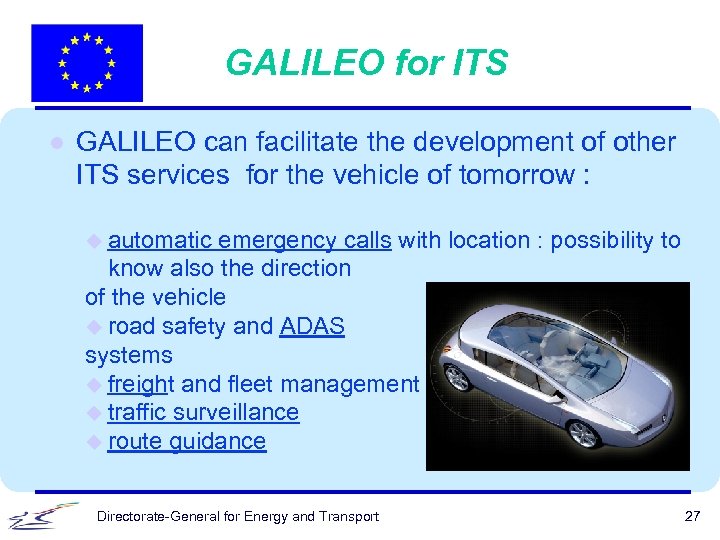 GALILEO for ITS l GALILEO can facilitate the development of other ITS services for the vehicle of tomorrow : u automatic emergency calls with location : possibility to know also the direction of the vehicle u road safety and ADAS systems u freight and fleet management u traffic surveillance u route guidance Directorate-General for Energy and Transport 27