


 Скачать презентацию EUROPEAN COMMISSION CLIMATE CHANGE UNIT EU GHG Monitoring
380db135bc4ccf01002c774d10c3d6fc.ppt
- Количество слайдов: 40
 EUROPEAN COMMISSION CLIMATE CHANGE UNIT EU GHG Monitoring Mechanism Lars Müller European Commission DG ENV. C. 2, Brussels André Jol European Environment Agency Copenhagen 1
 EUROPEAN COMMISSION CLIMATE CHANGE UNIT Questions to be answered: • What is our legal basis? • What are we doing? Who does it? And what happens by when? Institutional arrangements and working procedure • What are the products? • Where do we stand today? Where do we expect to go? Actual and projected progress • European Climate Change Programme 2
 EUROPEAN COMMISSION Legal basis CLIMATE CHANGE UNIT • UNFCCC (in future KP) – Guidelines on National Communications and annual inventories (FCCC/CP/1999/7, decision 3/CP. 5) and IPCC Good Practice Guidance – Marrakech Accords and revised guidelines for inventories, from April 2004 (FCCC/CP/2002/8, decision 18/CP. 8) • EU – Council Decision on GHG Monitoring (Decision 389/93/EEC as amended by decision 296/99/EC) – (internal) guidelines 3
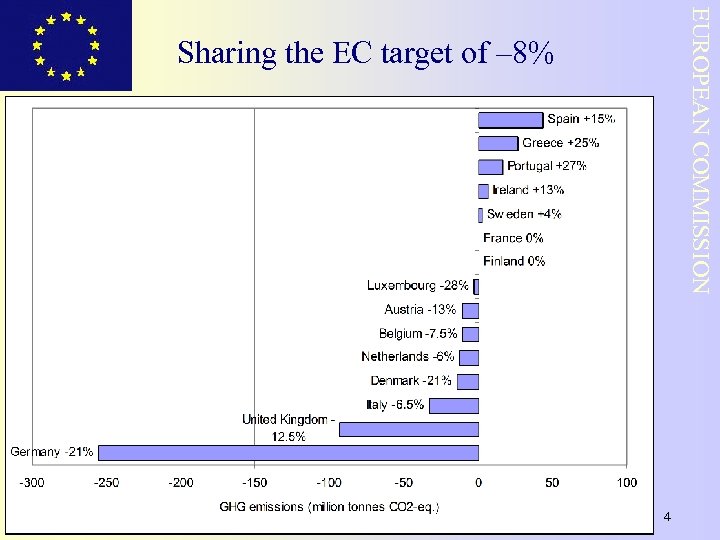 EUROPEAN COMMISSION CLIMATE CHANGE UNIT Sharing the EC target of – 8% 4
 CLIMATE CHANGE UNIT EUROPEAN COMMISSION Summary of current Monitoring Mechanism • Monitoring the emissions of the six Kyoto greenhouse gases and removals by sinks, • Annual GHG inventory reporting by MS to the European Commission • EC inventory is the Sum of 15 Member States • Member States report their respective data to UNFCCC • Implementation and annual reporting of national programmes (including policies and measures) and emission projections to the Commission and • Evaluation of progress and reporting to the European Parliament and Council by the Commission 5
 CLIMATE CHANGE UNIT EUROPEAN COMMISSION EC GHG inventory institutional arrangements • Member states prepare inventory according to UNFCCC Guidelines and participate in EC Monitoring mechanism committee, assisted by three working groups • Working group I promotes improvement of all GHG inventory quality aspects (transparency, consistency, comparability, completeness, accuracy and use of good practices) • Working group II promotes improvement of quality of reporting on GHG emission projections (transparency, consistency, comparability, completeness) • Working Group III promotes implementation of EC emissions trading scheme • European Commission (DG ENV) responsible for submission to UNFCCC, assisted by EEA (and European Topic Centre Air and Climate Change, ETC/ACC) and Eurostat and JRC • EC “National Inventory Report” follows UNFCCC Guidelines 6
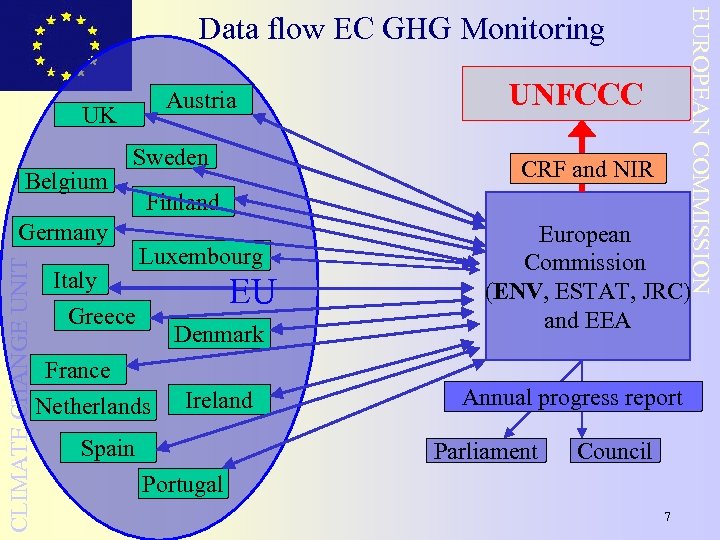 EUROPEAN COMMISSION Data flow EC GHG Monitoring Austria UK Belgium Sweden CLIMATE CHANGE UNIT Germany Italy Greece UNFCCC CRF and NIR Finland Luxembourg EU Denmark France Netherlands Ireland Spain European Commission (ENV, ESTAT, JRC) and EEA Annual progress report Parliament Council Portugal 7
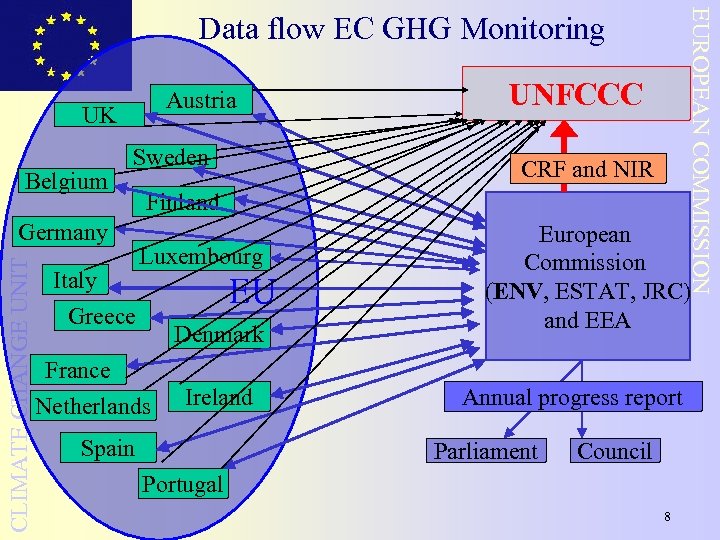 EUROPEAN COMMISSION Data flow EC GHG Monitoring Austria UK Belgium Sweden CLIMATE CHANGE UNIT Germany Italy Greece UNFCCC CRF and NIR Finland Luxembourg EU Denmark France Netherlands Ireland Spain European Commission (ENV, ESTAT, JRC) and EEA Annual progress report Parliament Council Portugal 8
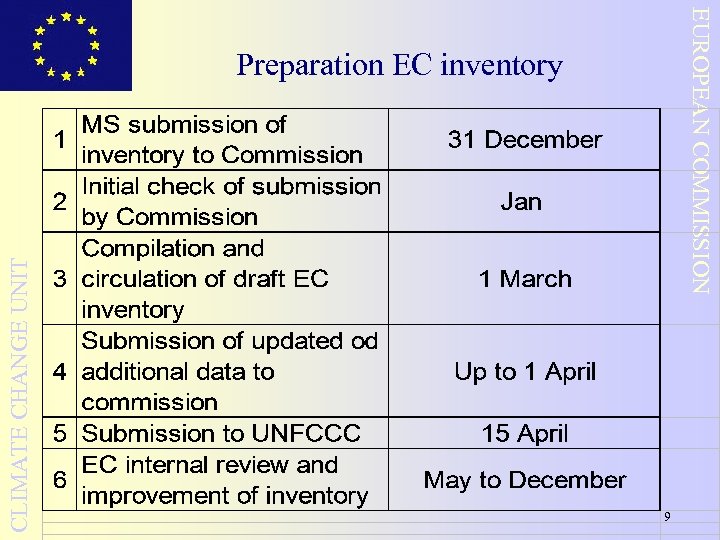 EUROPEAN COMMISSION CLIMATE CHANGE UNIT Preparation EC inventory 9
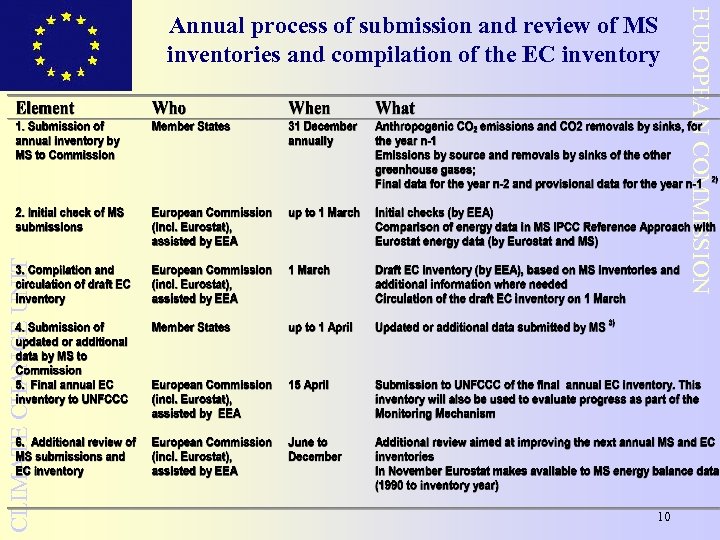 CLIMATE CHANGE UNIT 10 EUROPEAN COMMISSION Annual process of submission and review of MS inventories and compilation of the EC inventory
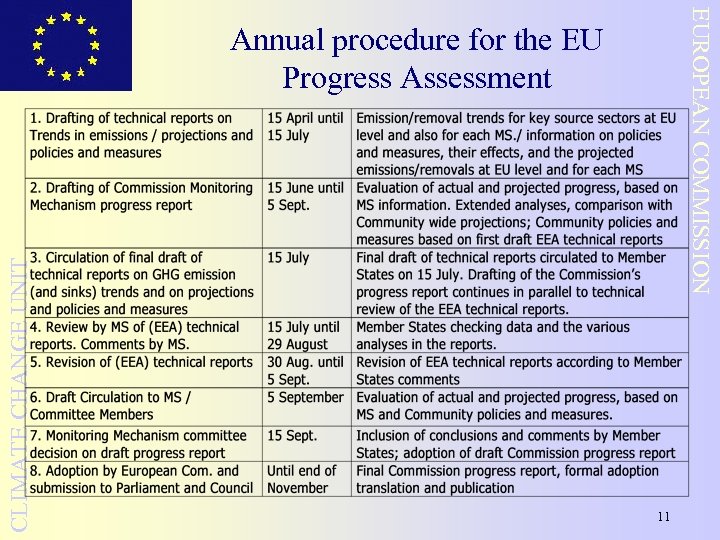 EUROPEAN COMMISSION CLIMATE CHANGE UNIT Annual procedure for the EU Progress Assessment 11
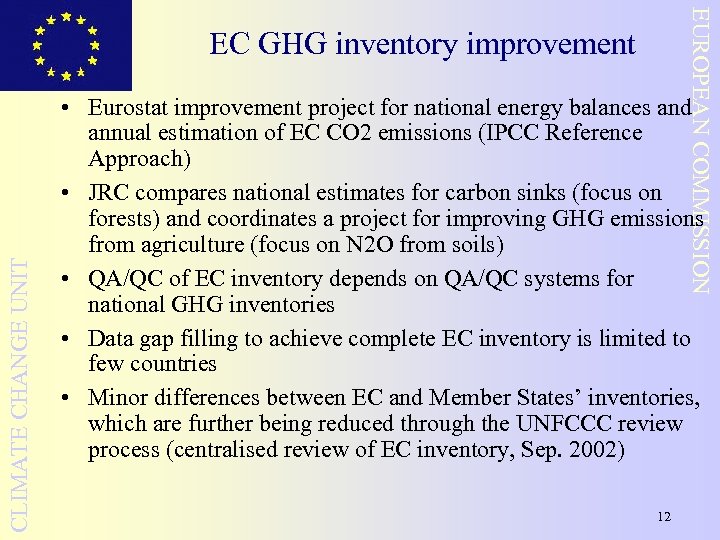 EUROPEAN COMMISSION CLIMATE CHANGE UNIT EC GHG inventory improvement • Eurostat improvement project for national energy balances and annual estimation of EC CO 2 emissions (IPCC Reference Approach) • JRC compares national estimates for carbon sinks (focus on forests) and coordinates a project for improving GHG emissions from agriculture (focus on N 2 O from soils) • QA/QC of EC inventory depends on QA/QC systems for national GHG inventories • Data gap filling to achieve complete EC inventory is limited to few countries • Minor differences between EC and Member States’ inventories, which are further being reduced through the UNFCCC review process (centralised review of EC inventory, Sep. 2002) 12
 CLIMATE CHANGE UNIT • CO-decision Procedure • Basic requirements in decision - further technical details in “implementing provisions” to be adopted • Establishment of EC greenhouse gas inventory system (KP Art. 5. 1) • Internal procedures for the review process and adjustments (KP Art. 5. 2 and Art. 8) • Reporting on accounting of assigned amounts and national registries (KP Art. 7. 1, 7. 2 and 7. 4) • Supplementary information to be incorporated in the periodic communications to the UNFCCC • Policies and measures and Projections • details yet to be decided (ongoing procedure in Council and Parliament) 13 EUROPEAN COMMISSION New Monitoring decision (Proposal COM(2003) 51 final)
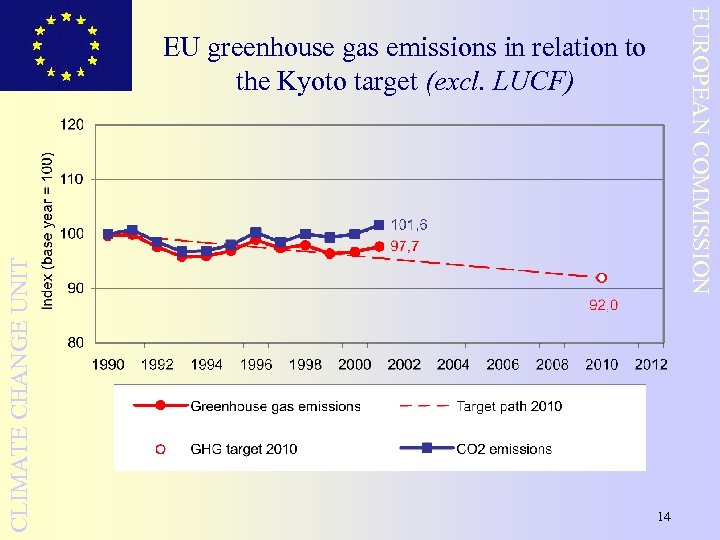 EUROPEAN COMMISSION CLIMATE CHANGE UNIT EU greenhouse gas emissions in relation to the Kyoto target (excl. LUCF) 14
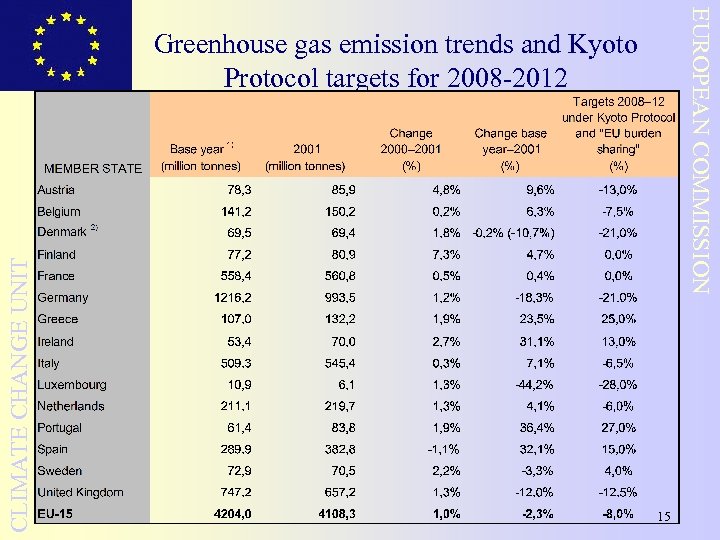 EUROPEAN COMMISSION CLIMATE CHANGE UNIT Greenhouse gas emission trends and Kyoto Protocol targets for 2008 -2012 15
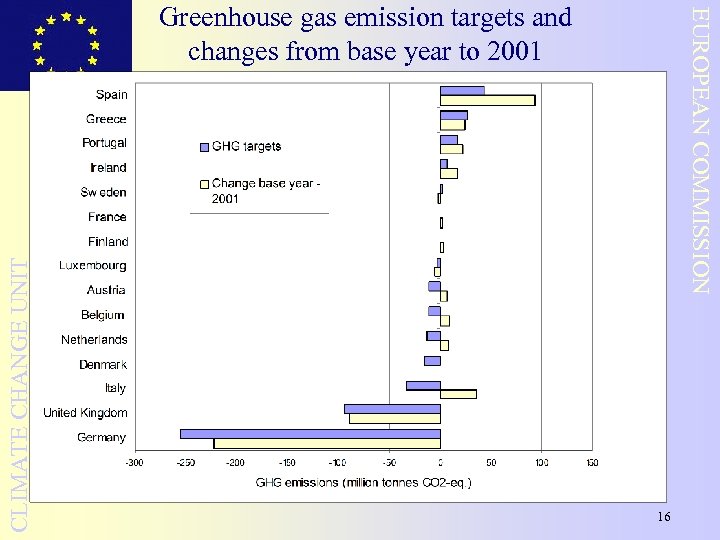 CLIMATE CHANGE UNIT EUROPEAN COMMISSION Greenhouse gas emission targets and changes from base year to 2001 16
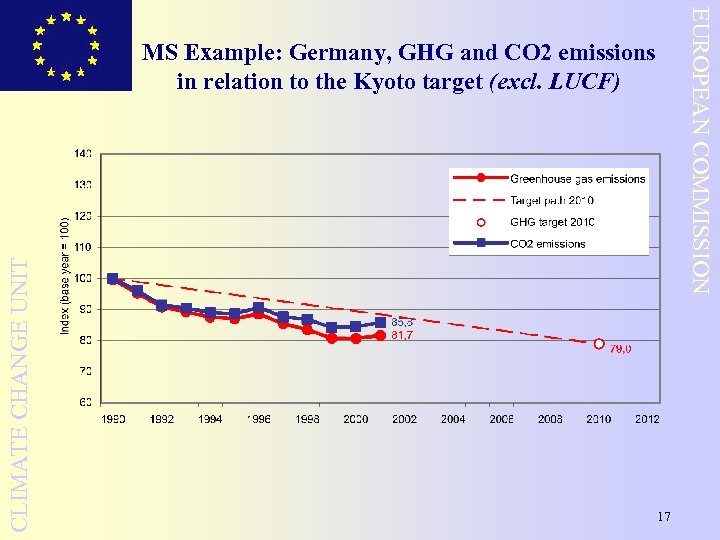 EUROPEAN COMMISSION CLIMATE CHANGE UNIT MS Example: Germany, GHG and CO 2 emissions in relation to the Kyoto target (excl. LUCF) 17
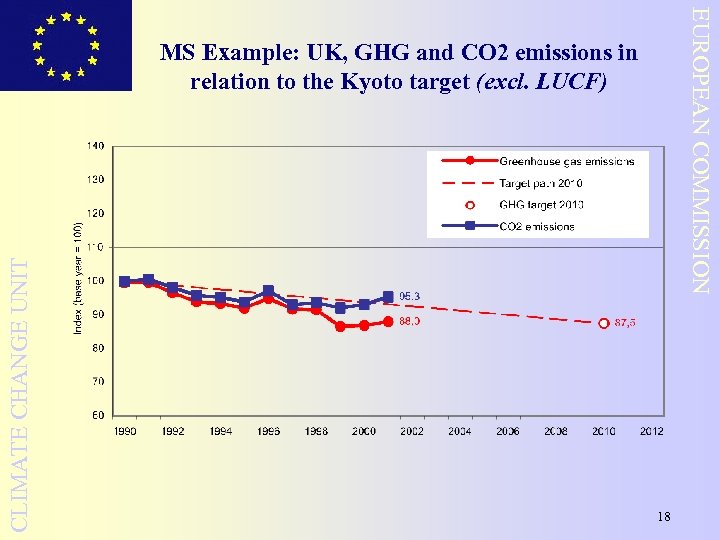 EUROPEAN COMMISSION CLIMATE CHANGE UNIT MS Example: UK, GHG and CO 2 emissions in relation to the Kyoto target (excl. LUCF) 18
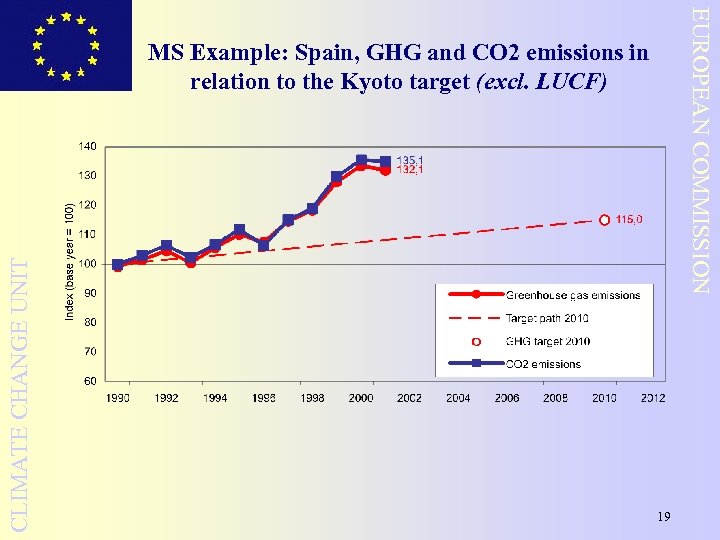 EUROPEAN COMMISSION CLIMATE CHANGE UNIT MS Example: Spain, GHG and CO 2 emissions in relation to the Kyoto target (excl. LUCF) 19
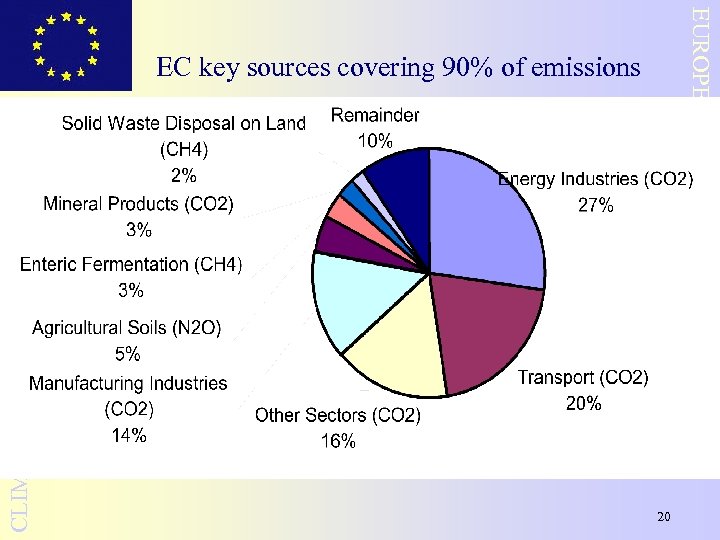 EUROPEAN COMMISSION CLIMATE CHANGE UNIT EC key sources covering 90% of emissions 20
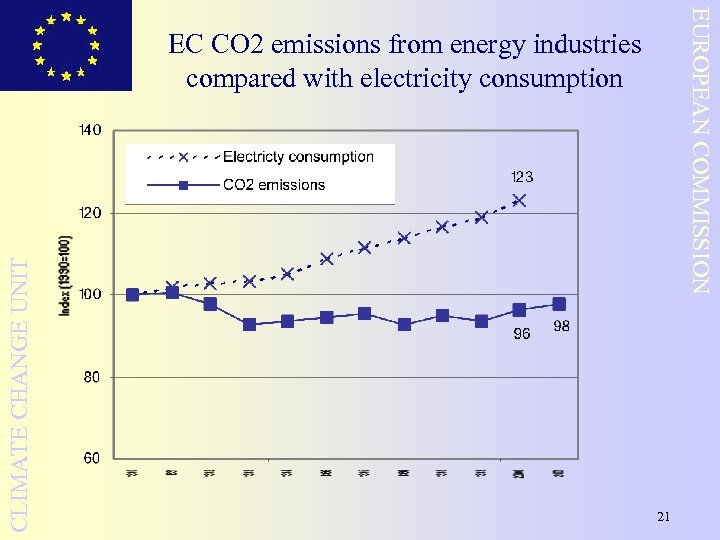 EUROPEAN COMMISSION CLIMATE CHANGE UNIT EC CO 2 emissions from energy industries compared with electricity consumption 21
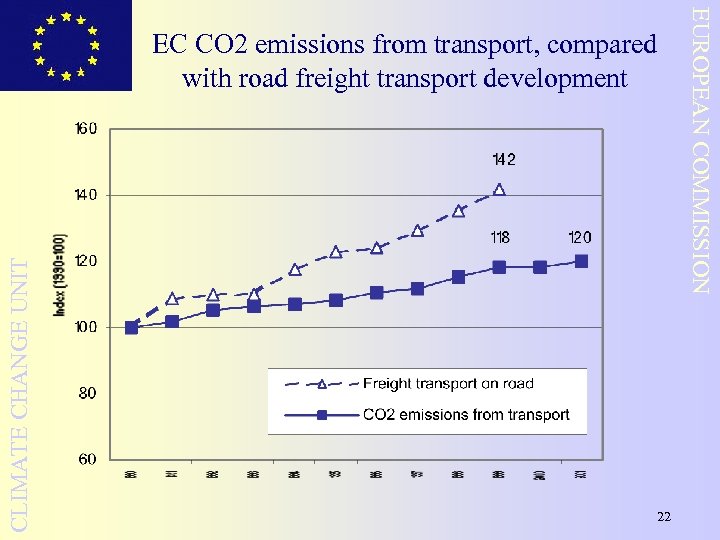 CLIMATE CHANGE UNIT 22 EUROPEAN COMMISSION EC CO 2 emissions from transport, compared with road freight transport development
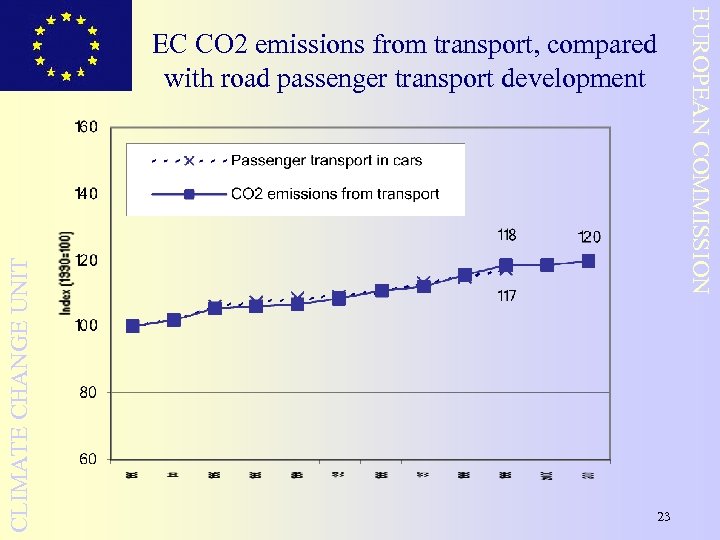 CLIMATE CHANGE UNIT 23 EUROPEAN COMMISSION EC CO 2 emissions from transport, compared with road passenger transport development
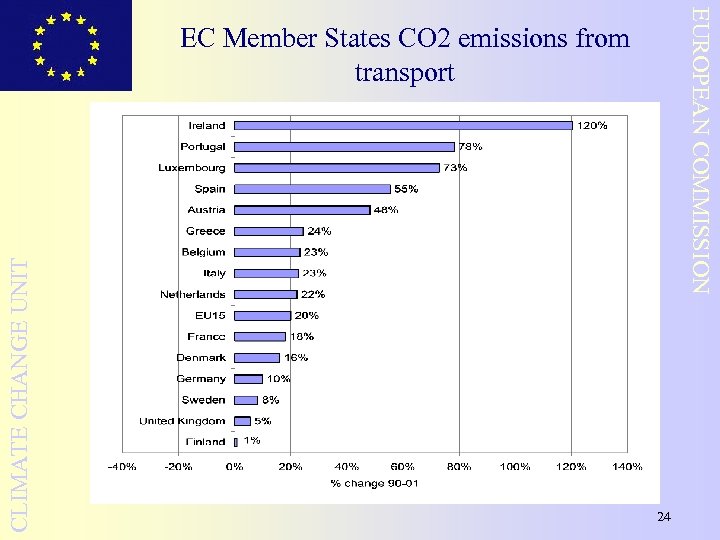 EUROPEAN COMMISSION CLIMATE CHANGE UNIT EC Member States CO 2 emissions from transport 24
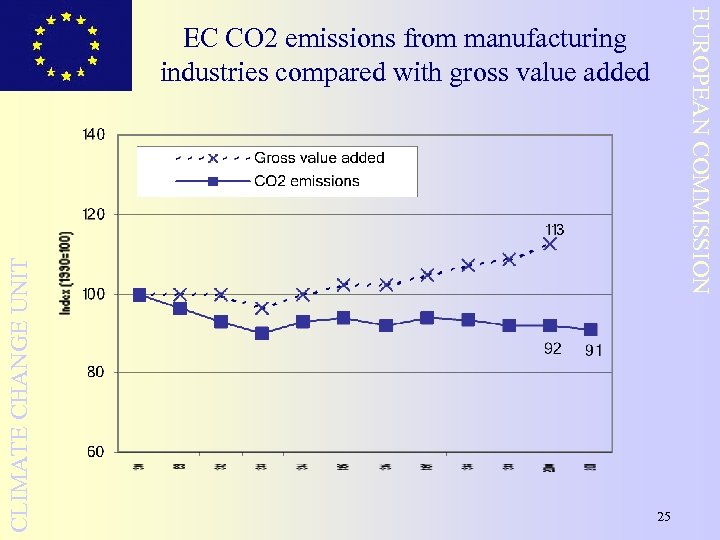 EUROPEAN COMMISSION CLIMATE CHANGE UNIT EC CO 2 emissions from manufacturing industries compared with gross value added 25
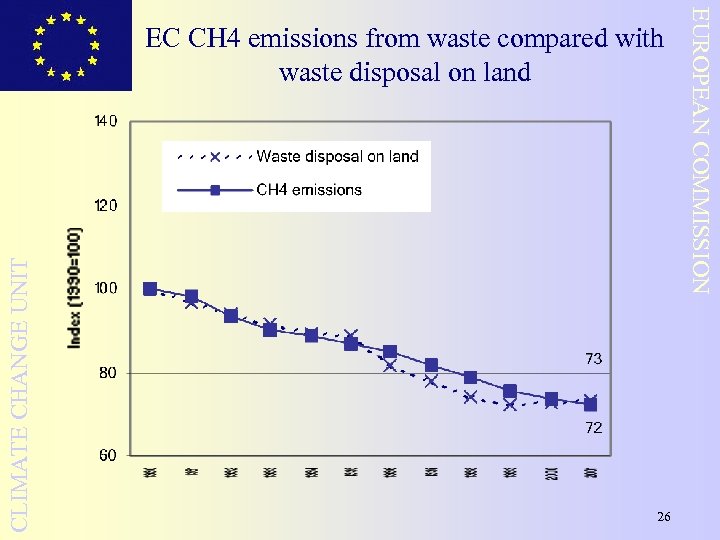 CLIMATE CHANGE UNIT 26 EUROPEAN COMMISSION EC CH 4 emissions from waste compared with waste disposal on land
 CLIMATE CHANGE UNIT EUROPEAN COMMISSION EC GHG projections for 2010, information basis • Information provided to the European Commission until mid 2002 and reported in December 2002 (Commission Communication) • Third national communication for Au, Be, Fi, Fr, Nl, Sp, Sw, UK • Additional information under the EU GHG Monitoring mechanism for Be, Dk, Fi, Fr, Ge, Gr, It, Nl, Pt, Sw, UK • All projections for 2010 are excluding carbon sinks and only include domestic policies and measures (no inclusion of Kyoto mechanisms) • Updated information being incorporated in Commission communication due end of 2003 27
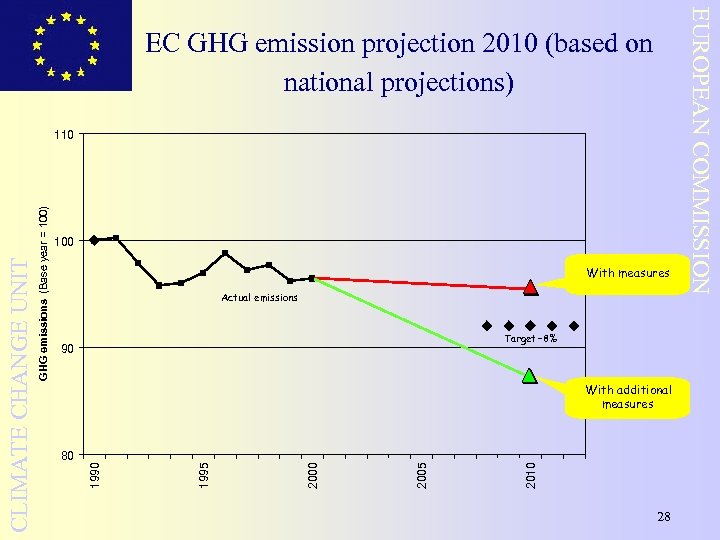 100 With measures Actual emissions Target – 8% 90 2010 2005 2000 80 1995 With additional measures 1990 GHG emissions (Base year = 100) CLIMATE CHANGE UNIT 110 28 EUROPEAN COMMISSION EC GHG emission projection 2010 (based on national projections)
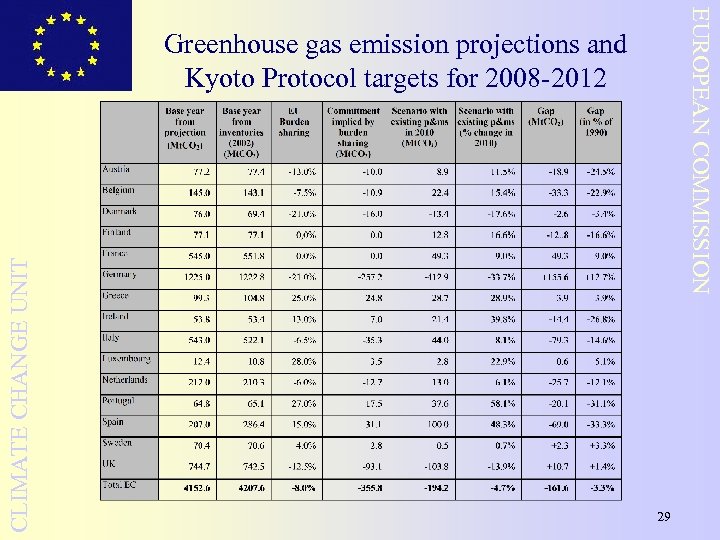 EUROPEAN COMMISSION CLIMATE CHANGE UNIT Greenhouse gas emission projections and Kyoto Protocol targets for 2008 -2012 29
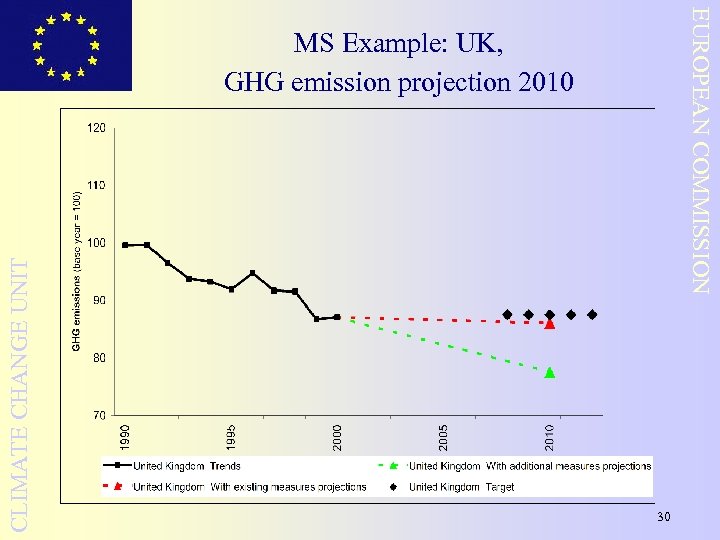 EUROPEAN COMMISSION CLIMATE CHANGE UNIT MS Example: UK, GHG emission projection 2010 30
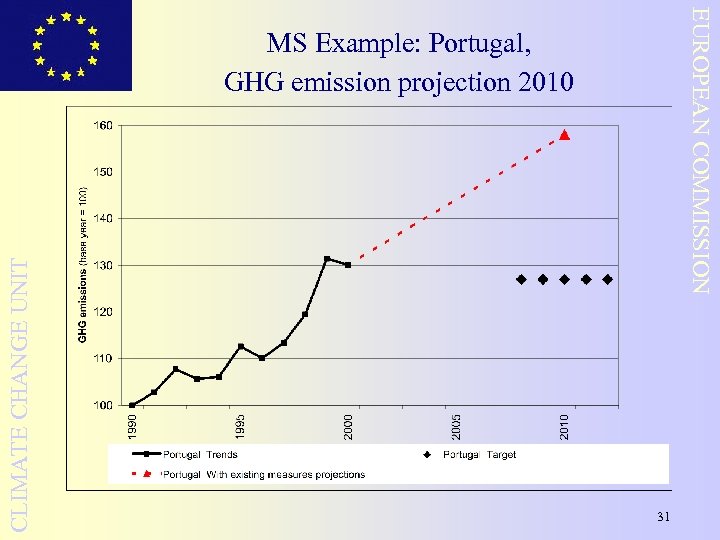 EUROPEAN COMMISSION CLIMATE CHANGE UNIT MS Example: Portugal, GHG emission projection 2010 31
 • National programmes CLIMATE CHANGE UNIT – Reported to UNFCCC and European Commission – National responsibility • EU common and coordinated policies and measures – Central part of EU climate strategy to complement national programmes – Often EU Directive or other legal instrument, to be implemented by Member States – European Climate Change Programme is key 32 EUROPEAN COMMISSION EU policies and measures
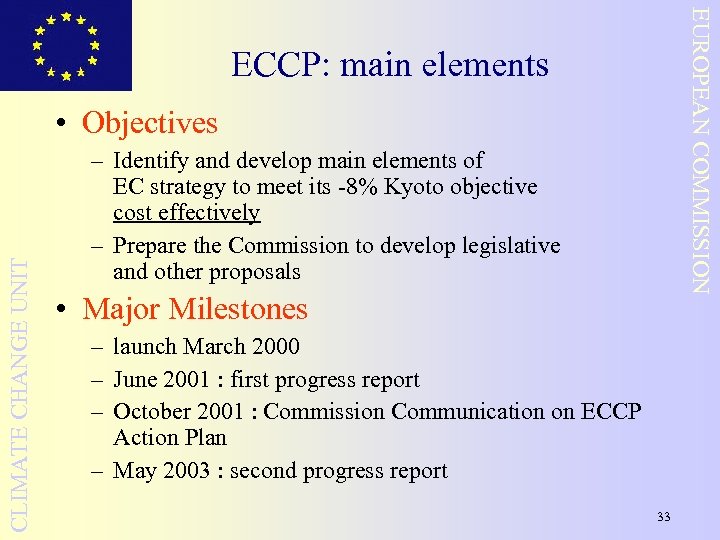 EUROPEAN COMMISSION ECCP: main elements CLIMATE CHANGE UNIT • Objectives – Identify and develop main elements of EC strategy to meet its -8% Kyoto objective cost effectively – Prepare the Commission to develop legislative and other proposals • Major Milestones – launch March 2000 – June 2001 : first progress report – October 2001 : Commission Communication on ECCP Action Plan – May 2003 : second progress report 33
 • National programmes CLIMATE CHANGE UNIT – Reported to UNFCCC and European Commission – National responsibility • EU common and coordinated policies and measures – Central part of EU climate strategy to complement national programmes – Often EU Directive or other legal instrument, to be implemented by Member States – European Climate Change Programme is key 34 EUROPEAN COMMISSION EU policies and measures
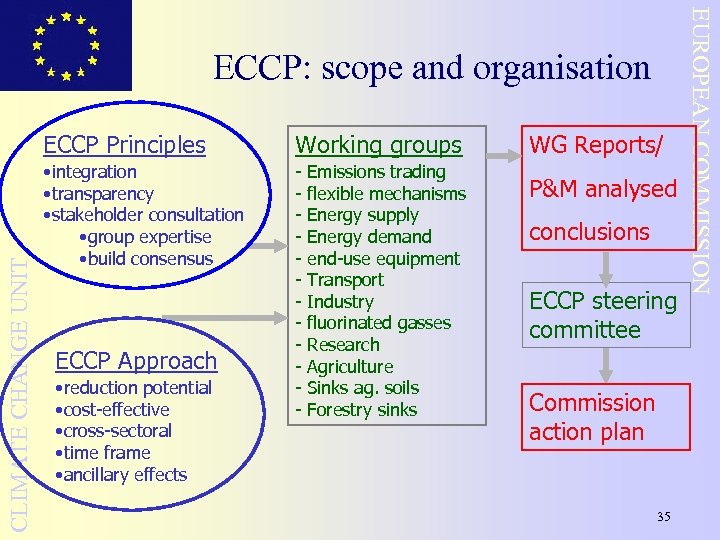 CLIMATE CHANGE UNIT ECCP Principles Working groups • integration • transparency • stakeholder consultation • group expertise • build consensus - ECCP Approach • reduction potential • cost-effective • cross-sectoral • time frame • ancillary effects Emissions trading flexible mechanisms Energy supply Energy demand end-use equipment Transport Industry fluorinated gasses Research Agriculture Sinks ag. soils Forestry sinks WG Reports/ P&M analysed conclusions ECCP steering committee Commission action plan 35 EUROPEAN COMMISSION ECCP: scope and organisation
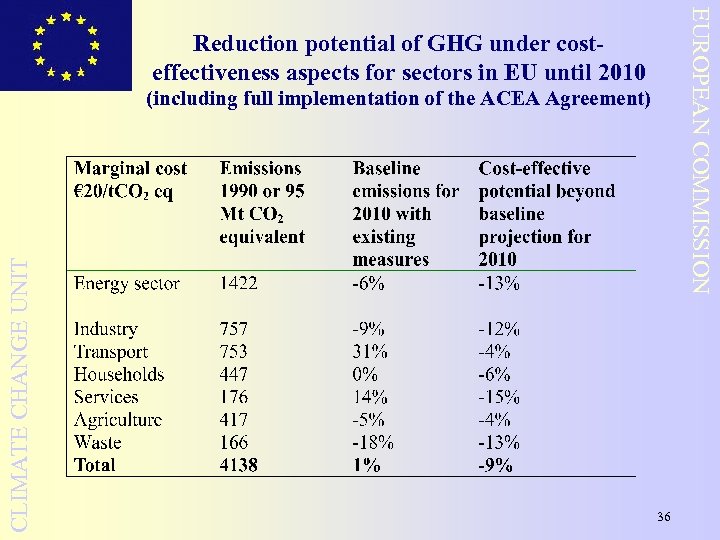 EUROPEAN COMMISSION Reduction potential of GHG under costeffectiveness aspects for sectors in EU until 2010 CLIMATE CHANGE UNIT (including full implementation of the ACEA Agreement) 36
 • Total reduction potential of 40 identified measures : CLIMATE CHANGE UNIT 578 -696 Mt CO 2 eq. = twice Kyoto ‘-8%’ • EU Measures currently “in implementation” potential of 276 -316 Mt CO 2 eq. … but need for monitoring of effectiveness and review • measures in 2003 Commission work program : proposals on Energy Efficiency of Products, energy services, HFCs & Mobile Air condition, link ET - flexible mechanisms • preparations for new measures or on-going. . . 37 EUROPEAN COMMISSION ECCP : main results
 CLIMATE CHANGE UNIT • • • • EU wide emissions trading Link JI/CDM to ET containment / monitoring of fluorinated gases (incl. MAC) revision of Monitoring Decision (implement Marrakech) renewable energy sources (Electricity / Biofuels) energy-efficiency standards for equipment energy demand-side management combined heat and power generation modal shift in transport Transport infrastructure use & charging Energy performance buildings Review voluntary agreement car industr. Energy taxation 38 EUROPEAN COMMISSION Measures included in Commission 2002 -2004 Work Programme
 CLIMATE CHANGE UNIT EUROPEAN COMMISSION ECCP : outlook and future challenges • Update and strengthening of Commission ECCP action plan • transport emissions rising concern • renewables : accelerated progress is required • integration CC in CAP , structural funds 39
 EUROPEAN COMMISSION For further information you may look at: CLIMATE CHANGE UNIT www. europa. eu. int/comm/environment/climate/home_en. htm and themes. eea. eu. int/Environmental_issues/climate THANK YOU ! 40