


 Скачать презентацию Eurooppaoikeus I EU ja Euroopan neuvosta EU-historiaa EU
c6863e0fb7e199a1d059fa1c86d4c49e.ppt
- Количество слайдов: 52
 Eurooppaoikeus I EU ja Euroopan neuvosta EU-historiaa EU: n instituutiot EU-oikeuden lähteet
 Kurssimateriaali • Borchardt, K-D: The Abc of community law. Office for official Publications of the European Communities. Löytyy internetistä • Diat • Luennot
 Eurooppaoikeuden käsite • Euroopan neuvosto (The Council of Europe) ja Euroopan ihmisoikeussopimus lisäpöytäkirjoineen • 47 jäsenvaltiota • perustettiin 1949 • Suomi täysjäseneksi -89 • Ihmisoikeustuomioistuin (European Court of Human Rights) • Euroopan yhteisöt (50 luvulta) EU (1992 -2007) • 28 jäsenvaltiota • perussopimukset joista viimeisin Lissabonin sopimus 2007 • instituutiot muodostavat lakia säätävän, osittain toimeenpanevan ja valvovan sekä tuomiovaltaa käyttävän poliittisen järjestelmän
 EU: n historia lyhyesti • hiili- ja teräsyhteisö (-51), atomienergiayhteisö ja talousyhteisö (EEC) (-57), joista EEC -92 Maastrichtin sopimuksella • EC ja lisäksi perustettiin EU: founded on the European Communities, supplemented by the policies and forms of co-operation established by the Treaty on European Union (yhteinen ulko- ja turvallisuuspolitiikka ja yhteistyö oikeuden ja sisäasiain sektoreilla)
 A brief history of the EU: A background • two world wars in the European continent during the 20 th century and especially the wars between Germany and France • the cold war • a prospect of lasting peace by means of economic cooperation • integration through spill over
 Communities • the European Coal and Steel Community (1951) • the European Atomic Energy Community, Euratom (1957) • the European Economic Community, EEC (1957) • the European Union (EEC EC) • ECSC has not existed since 2002
 Founding Treaties of the Communities • • the treaties on the ECSC, EEC and Euratom the treaty on the EU (Maastricht) the amendments a Constitution for Europe? Treaty of Lisbon 13 December 2007
 Institutions • the Council (Brussels) • the Commission (Brussels) • the Assembly the Parliament of the EU (Strasbourg and Brussels) • the Court of Justice (Luxembourg) • the European Council (since 1974, legal recognition in 1986) • the Court of Auditors
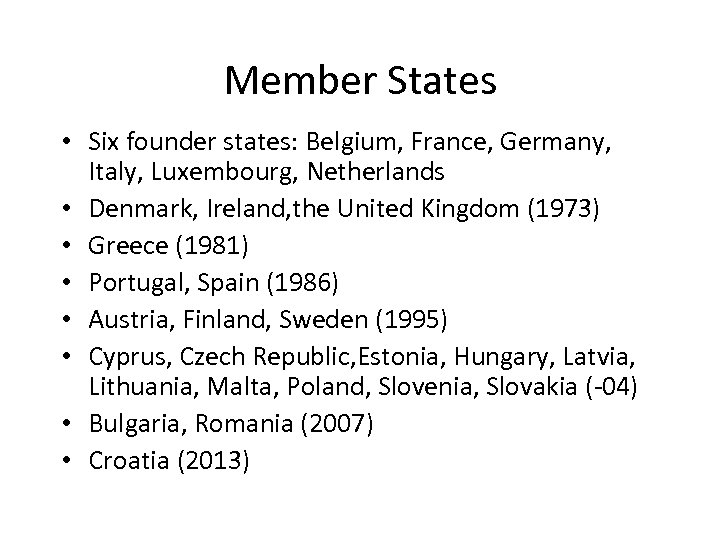 Member States • Six founder states: Belgium, France, Germany, Italy, Luxembourg, Netherlands • Denmark, Ireland, the United Kingdom (1973) • Greece (1981) • Portugal, Spain (1986) • Austria, Finland, Sweden (1995) • Cyprus, Czech Republic, Estonia, Hungary, Latvia, Lithuania, Malta, Poland, Slovenia, Slovakia (-04) • Bulgaria, Romania (2007) • Croatia (2013)
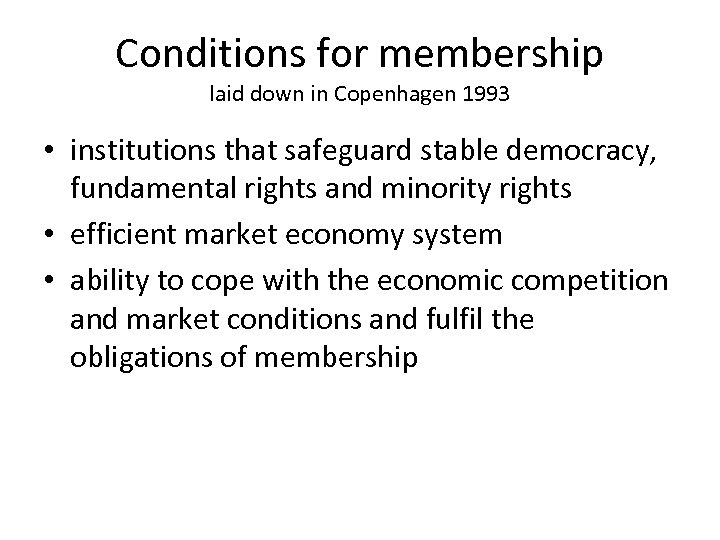 Conditions for membership laid down in Copenhagen 1993 • institutions that safeguard stable democracy, fundamental rights and minority rights • efficient market economy system • ability to cope with the economic competition and market conditions and fulfil the obligations of membership
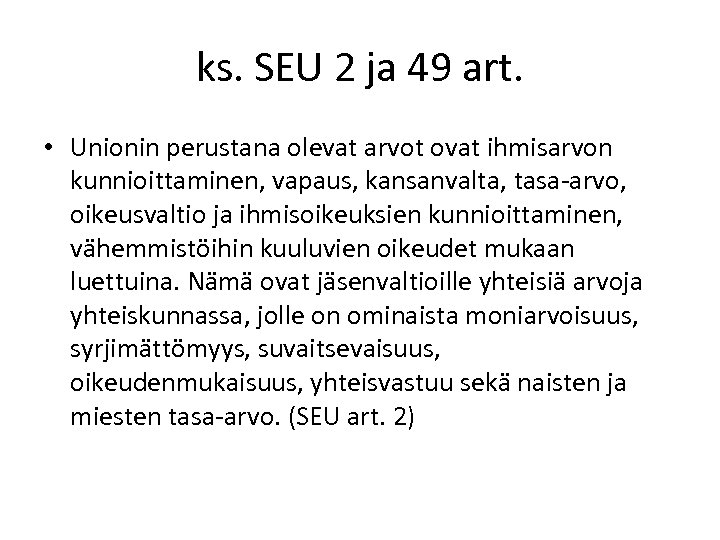 ks. SEU 2 ja 49 art. • Unionin perustana olevat arvot ovat ihmisarvon kunnioittaminen, vapaus, kansanvalta, tasa-arvo, oikeusvaltio ja ihmisoikeuksien kunnioittaminen, vähemmistöihin kuuluvien oikeudet mukaan luettuina. Nämä ovat jäsenvaltioille yhteisiä arvoja yhteiskunnassa, jolle on ominaista moniarvoisuus, syrjimättömyys, suvaitsevaisuus, oikeudenmukaisuus, yhteisvastuu sekä naisten ja miesten tasa-arvo. (SEU art. 2)
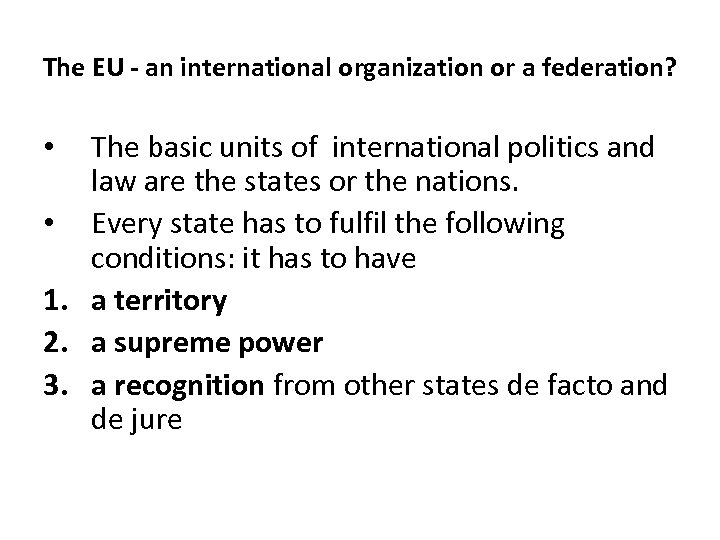 The EU - an international organization or a federation? The basic units of international politics and law are the states or the nations. • Every state has to fulfil the following conditions: it has to have 1. a territory 2. a supreme power 3. a recognition from other states de facto and de jure •
 International organizations • instruments of mutual cooperation • the scope of decision making is narrow • their power to control the member states is extremely limited: no real executive bodies
 The EU has supranational powers • in some issues the founding treaties give legislative competence to the EU institutions • unanimity is not usually needed in the decision making • some executive powers
 …but is not yet a federation? • foreign and security policy only on the ground of unanimity • principle of parliamentarism and the role of the European Parliament in the - legislation procedure - nomination of the Commission members - decision-making on the budget • right of taxation • enforcement of EU laws through the national authorities • a member state is free to withdraw
 Institutions 1. 2. 3. 4. 5. 6. 7. the European Parliament the European Council the European Commission the Court of Justice of the European Union the European Central Bank the Court of Auditors
 The European Parliament • jointly with the Council legislative and budgetary power • functions of political control and consultation • composed of representatives of the Union’s citizens • degressively proportional, with a minimum threshold of six members per Member State
 The European Council • defines the general political directions and priorities • dosn´t exercise legislative functions • consists of the Heads of State or Government, its President and the President of the Commission; the High Representative of the Union for Foreign Affairs and Security Policy shall take part in its work • decisions shall be taken by consensus
 the Council • consists of a representative of each Member State at ministerial level; expresses the interests of the MSs most directly • legislative power • acting jointly with the EP • concludes agreements with foreign (non-member) countries • decides with the EP on the Community budget
 The Council meetings • take place in different configurations depending on what matters are to be decided upon • a representative of the Commission always takes part in these meetings • a Secretary General as the head of the secretariat • one of the MSs holds the Presidency of the Council on the basis of equal rotation
 • • • The Presidency includes the responsibility to keep things going on in the Council the MS in charge provides the President for all meetings of the Council and the preparatory committees and working groups President of the Council represents the Council in dealing with the other EU institutions the President functions as a representative for the EU/EC in international organisations and in relations with non-member countries rotates in six-month terms has the key role in searching for agreement among the MSs in controversial issues
 Preparatory bodies • the Committee of the Permanent Representatives of the MSs (COREPER) • is working at two levels - COREPER II deals with important political questions - COREPER I, which consists of the deputies of the ambassadors dealing with more technical questions
 Three types of vote depending on the Treaty provisions for the subject being dealt with 1) qualified majority, double majority 1. 11. 20141. 4. 2017 • is reached if two conditions are met: • 55% of the MS vote in favour • the proposal is supported by member states representing at least 65% of the total EU population • blocking minority: 4 /35 %
 Three types of vote … 2) simple majority • is reached if at least 15 Council members vote in favour • in procedural matters, such as the adoption of its own rules of procedure • to request the Commission to undertake studies or submit proposals
 Three types of vote … 3) unanimity on sensitive matters; for • common foreign and security policy • harmonization of national legislation on indirect taxation • EU finances (own resources, the multiannual financial framework) • certain provisions in the field of justice and home affairs (the European prosecutor, family law, operational police cooperation, etc. ) • EU membership
 The European Parliament: Composition • direct elections every five years • the seats of the EP are allocated to the MSs proportionally • smaller states are overrepresented like in the Council • each MS is free to choose its own electoral system • e. g. Finland has only one constituency
 The EP: Status of MEPs • 1. 2. 3. 4. MEPs are entitled to certain privileges and immunities eg. freedom of movement from and to the meeting place of the EP immunity from legal proceedings in respect of opinions expressed in performance of their duties freedom to cast a vote any way they like freedom from detention in other MSs
 The salary of the MEP • from 2009 members´ monthly salaries will be set at 7. 000 € • only the actual costs will be reimbursed when they travel from and to their home countries • the salaries will be paid by the EU and not the MSs
 The EP: party groups • MPs are usually members of some party group and they sit according to their party and not their country • officially recognised in the EP • without being backed by a party group to get one´s own ideas through is quite impossible
 The EP: the committees • before matters are discussed on the floor of the House (all MPs present) they are usually considered first in the appropriate committee • the committee works out a report and discussion is based on that • the influence of a single MP is based on the party standing and committee membership • the party groups select the members of the Committees
 The tasks of the EP • participating in the election of the President and Members of the Commission • participating in legislative work in the EU • participating in the budget procedure of the EU • accepting new member states to the EU • making questions to the Commission and the Council
 The EP`s role as a legislator: three alternative procedures 1 2 3 4 - consultation procedure delivers non-binding opinions assent procedure has a veto right (e. g. Art. 7 TEU) co-operating procedure (Art. 252 TEC) unanimity of the Council, if the EP opposes co-deciding procedure the EP´s assent on the final text indispensable
 The Commission • 28 commissioners • a motor in the legislative process of the EU formulating proposals to other political institutions of the EU • the EU rules of competition: the supervising body in controlling the MSs and the companies • a coordinator among the MSs trying to find support for EU policies
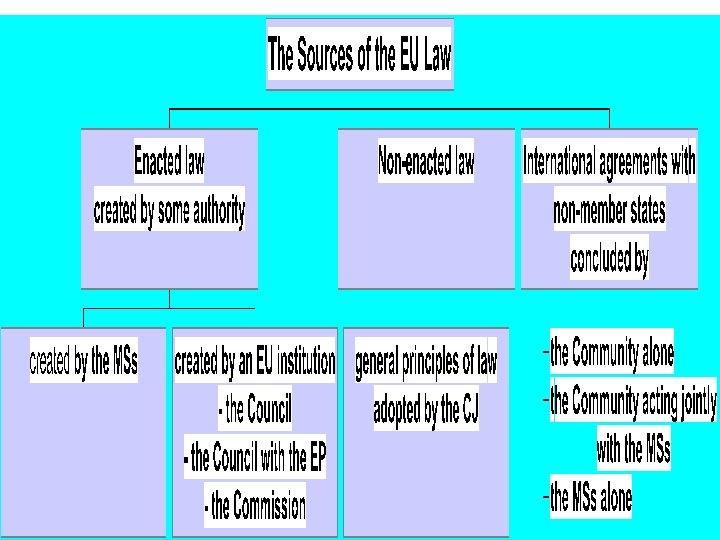
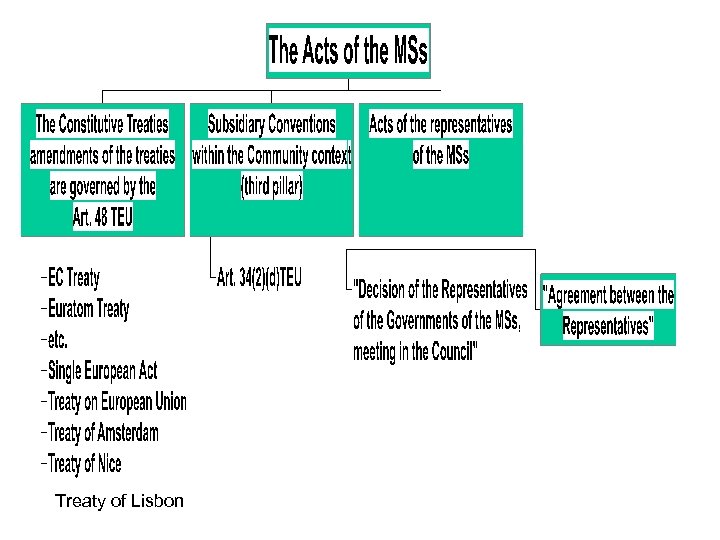 Treaty of Lisbon
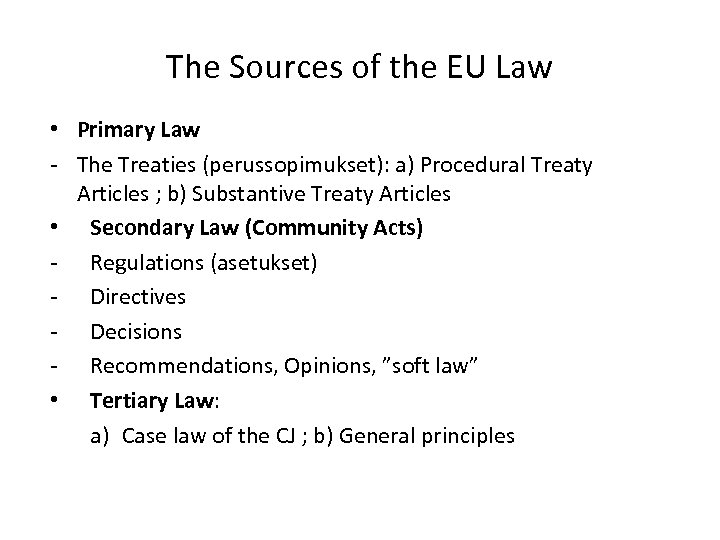 The Sources of the EU Law • Primary Law - The Treaties (perussopimukset): a) Procedural Treaty Articles ; b) Substantive Treaty Articles • Secondary Law (Community Acts) - Regulations (asetukset) - Directives - Decisions - Recommendations, Opinions, ”soft law” • Tertiary Law: a) Case law of the CJ ; b) General principles
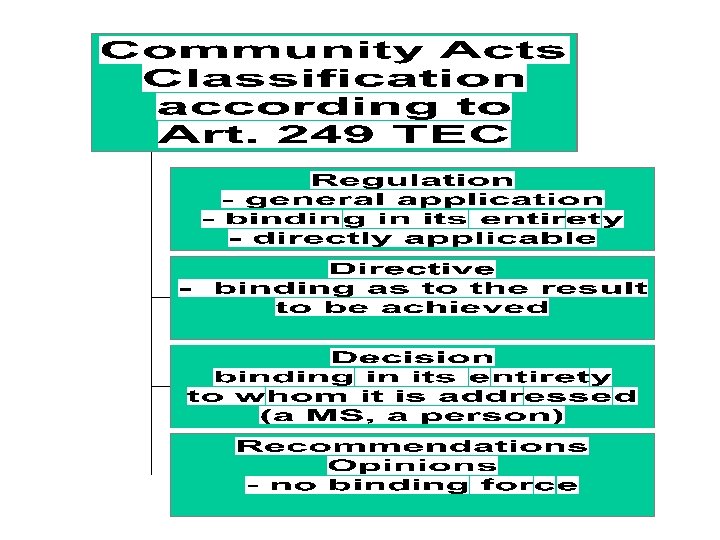
 Regulation/Asetus • A regulation shall have general application. It shall be binding in its entirety and directly applicable in all MSs. (Art. 288(2))
 Directive • A directive shall be binding, as to the result to be achieved, upon each Member State to which it is addressed, but shall leave to the national authorities the choice of form and methods. (Art. 288(3))
 Decision • A decision shall be binding in its entirety. A decision which specifies those to whom it is addressed shall be binding only on them.
 A regulation: an example 6/2002/EC 1. The procedure and legal basis of the regulation: Art. 308 TEC; also 253 2. The grounds or reasons: ”The substantial differences between MSs´ design laws prevent and distort Community-wide competition. ” 3. The actual provisions
 A directive: an example 77/187/EEC • The legal basis: The Council of the EC, having regard to the TEC and in particular Art. 94 thereof, having regard to … • The grounds: Whereas economic trends are bringing in their wake, at both national and Community level, changes in the structure of undertakings, through transfers of undertakings, businesses or parts of businesses to other employers as a result of legal transfers or mergers; Whereas it is necessary to provide for the protection of employees in the event of a change of employer, in particular, to ensure that their rights are safeguarded
 Directive 77/187/EEC: the actual provisions • • This Directive shall apply to the transfer of an undertaking, business or part of a business to another employer as a result of a legal transfer or merger. The transferor's rights and obligations arising from a contract of employment or from an employment relationship existing on the date of a transfer within the meaning of Article 1 (1) shall, by reason of such transfer, be transferred to the transferee. Member States may provide that, after the date of transfer within the meaning of Article 1 (1) and in addition to the transferee, the transferor shall continue to be liable in respect of obligations which arose from a contract of employment or an employment relationship. • Following the transfer within the meaning of Article 1 (1), the transferee shall continue to observe the terms and conditions agreed in any collective agreement on the same terms applicable to the transferor under that agreement, until the date of termination or expiry of the collective agreement or the entry into force or application of another collective agreement. Member States may limit the period for observing such terms and conditions, with the provision that it shall not be less than one year.
 A decision: e. g. Germany v. the Commission • • • Brennwein, an alcoholic drink, was distilled from wine, which was imported from outside the Community. With the external tariff and a substantial increase in the duty on this wine, the German government considered that there was a threat to that industry. Asked the Commission for a quota of 450. 000 hectolitres at the old rate. The Commission granted only 100. 000 hectolitres reasoning: The production of wine within the Community is amply sufficient. The asked volume might therefore lead to serious disturbances of the market in the products of the question. The CJ: The Commission should have been more specific and given an indication of an evolution and size of the surpluses within the Community; secondly it should have specified “serious disturbances” and why they would have resulted. The decision was quashed (declared invalid)
 Complications • theory of implied powers • open-ended powers in Art. 308 (now 352)
 Germany v. Commission CJ Case 81/85 • Art. 137 TEC (at the time): “the Commission shall have the task of promoting close cooperation between Member States in the social field, particularly in matters relating to …” The provision gave a task, but did not confer any legislative power.
 The decision of the Commission • The Member States are obliged to consult with the Commission regarding certain matters, and inform it of draft measures and agreements concerning the topic in question.
 Challenging the decision • The decision was brought before the CJ • Germany submitted in its action: the Commission had not competence to make such a decision
 The decision was upheld by the CJ that stated • Whenever a provision of the EC Treaty confers a specific task on the Commission, that provision must also be regarded as impliedly conferring on the Commission the powers which are indispensable in order to carry out that task. = theory of implied powers v. limited powers
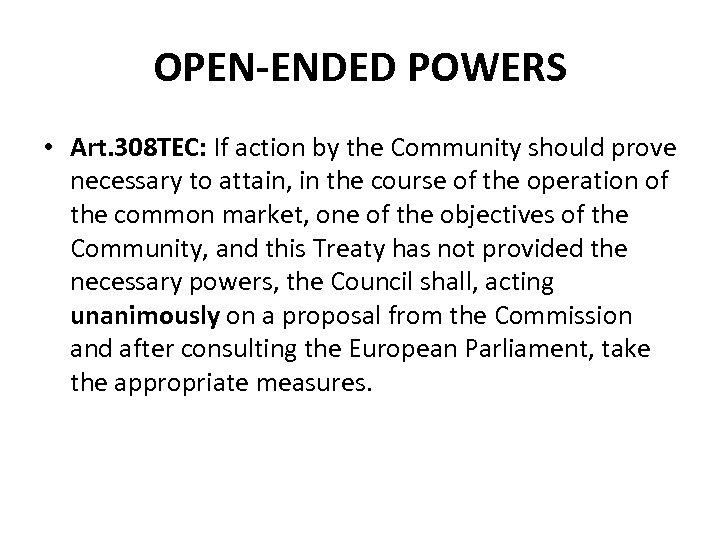 OPEN-ENDED POWERS • Art. 308 TEC: If action by the Community should prove necessary to attain, in the course of the operation of the common market, one of the objectives of the Community, and this Treaty has not provided the necessary powers, the Council shall, acting unanimously on a proposal from the Commission and after consulting the European Parliament, take the appropriate measures.
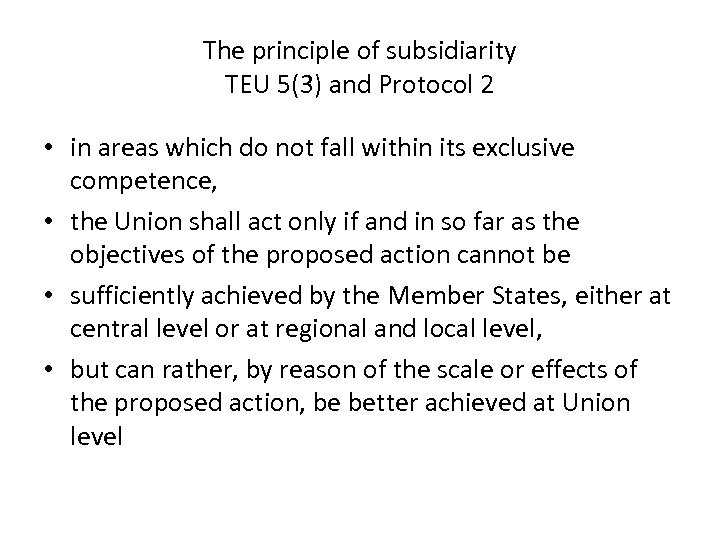 The principle of subsidiarity TEU 5(3) and Protocol 2 • in areas which do not fall within its exclusive competence, • the Union shall act only if and in so far as the objectives of the proposed action cannot be • sufficiently achieved by the Member States, either at central level or at regional and local level, • but can rather, by reason of the scale or effects of the proposed action, be better achieved at Union level
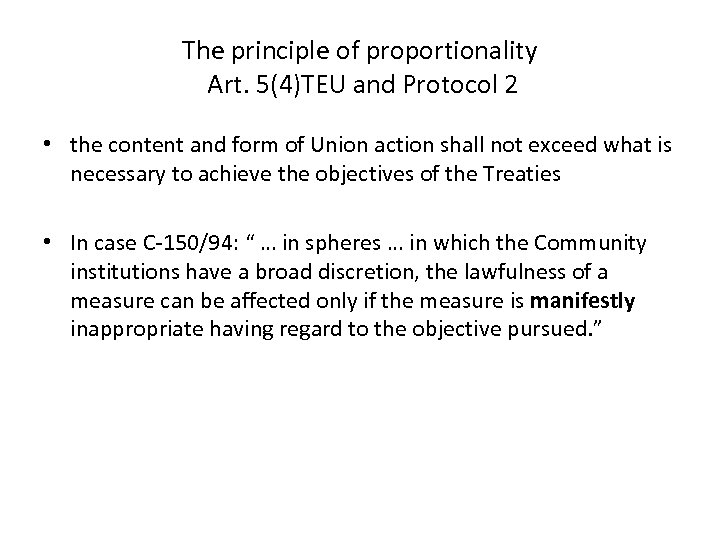 The principle of proportionality Art. 5(4)TEU and Protocol 2 • the content and form of Union action shall not exceed what is necessary to achieve the objectives of the Treaties • In case C-150/94: “ … in spheres … in which the Community institutions have a broad discretion, the lawfulness of a measure can be affected only if the measure is manifestly inappropriate having regard to the objective pursued. ”