 Скачать презентацию Euro-Mediterranean Industrial Cooperation Paris November 2008 Marie Corman
23858fc9b327f87359fd34754fe737af.ppt
- Количество слайдов: 28



Euro-Mediterranean Industrial Cooperation Paris, November 2008 Marie Corman
Euro-Mediterranean Industrial Cooperation Policy Framework ØBarcelona Process ØEuropean Neighbourhood Policy ØUnion for the Mediterranean
Ministerial conference in Nice November 2008 ØTo take stock of progress ØTo fix priorities for the 2 years ahead ØEuro-Mediterranean Charter for Enterprise
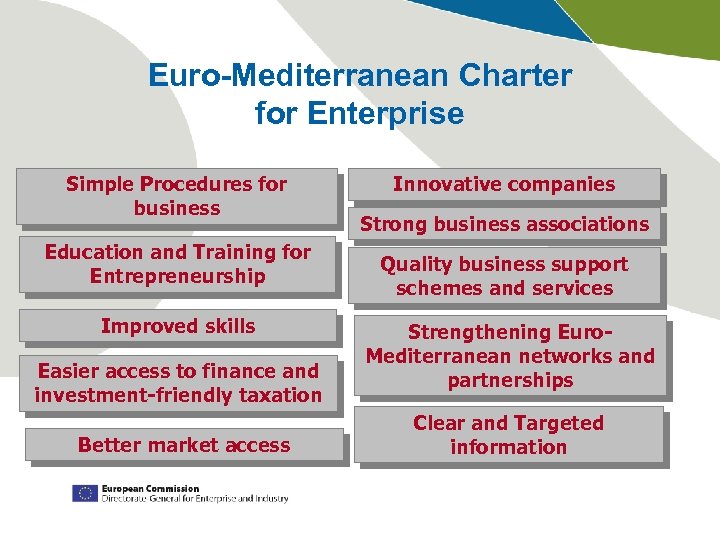
Euro-Mediterranean Charter for Enterprise Simple Procedures for business Education and Training for Entrepreneurship Improved skills Easier access to finance and investment-friendly taxation Better market access Innovative companies Strong business associations Quality business support schemes and services Strengthening Euro. Mediterranean networks and partnerships Clear and Targeted information
Scope, objective, nature and focus Scope: 9 Mediterranean partner countries and their stakeholders 4 organisations : Commission, OECD, ETF, and EIB Objective: Conduct a thorough enterprise policy assessment covering 77 policy indicators in 10 key policy areas affecting the life-cycle of a company, from birth to maturity Nature: Pilot project Focus: Policies developed and delivered mainly by central government institutions
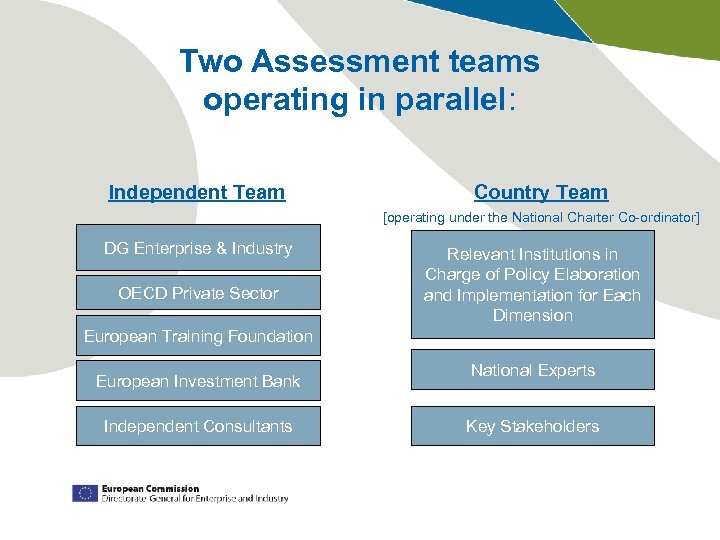
Two Assessment teams operating in parallel: Independent Team Country Team [operating under the National Charter Co-ordinator] DG Enterprise & Industry OECD Private Sector Relevant Institutions in Charge of Policy Elaboration and Implementation for Each Dimension European Training Foundation European Investment Bank Independent Consultants National Experts Key Stakeholders
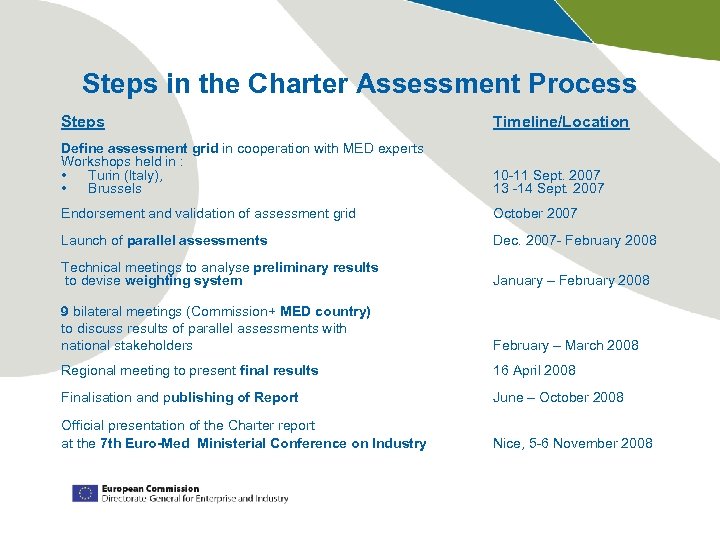
Steps in the Charter Assessment Process Steps Timeline/Location Define assessment grid in cooperation with MED experts Workshops held in : • Turin (Italy), • Brussels 10 -11 Sept. 2007 13 -14 Sept. 2007 Endorsement and validation of assessment grid October 2007 Launch of parallel assessments Dec. 2007 - February 2008 Technical meetings to analyse preliminary results to devise weighting system January – February 2008 9 bilateral meetings (Commission+ MED country) to discuss results of parallel assessments with national stakeholders February – March 2008 Regional meeting to present final results 16 April 2008 Finalisation and publishing of Report June – October 2008 Official presentation of the Charter report at the 7 th Euro-Med Ministerial Conference on Industry Nice, 5 -6 November 2008
Key Results – Overall Assessment • Convergence towards policy guidelines of Charter progressing in MED region, but at different paces across the region • Progress most noticeable in : Egypt, Jordan, Morocco and Tunisia • Transition towards horizontal enterprise policy at early stage: Algeria and Syria • Progress hindered by conflicts and political instability: Lebanon and Palestinian Authority • Well-developed enterprise policy: Israel
Dimension 1 Simple procedures for enterprises In most MED countries building blocks for enterprise policy in place. However: • No comprehensive enterprise development strategy • Inter-ministerial policy co-ordination is generally weak • Clear assignment of tasks and competencies in enterprise policy elaboration and implementation among ministries and implementing agencies needs improvement • Regulatory reform initial stage (except Egypt and Israel) • Improvements to company registration. OSS in place (Egypt, Jordan, Lebanon, Morocco, Tunisia)
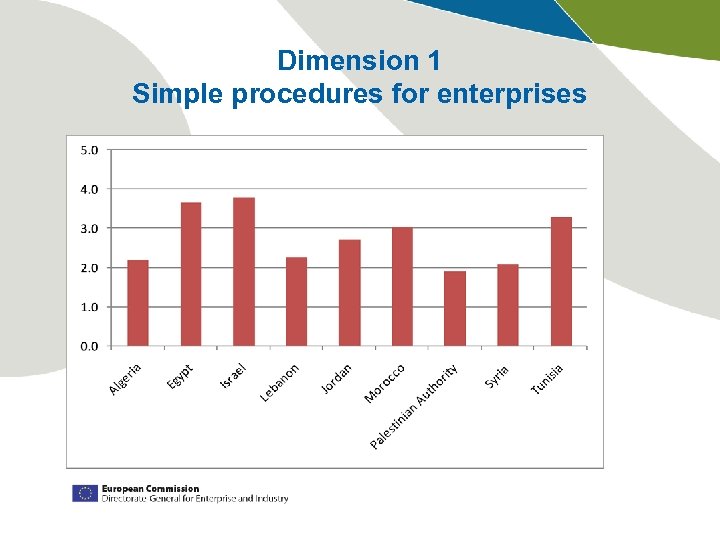
Dimension 1 Simple procedures for enterprises
Dimensions 2 and 3 Education and Training for Entrepreneurship and Improved Skills • Education systems currently do not promote entrepreneurial attitudes (except Tunisia) • Lack of lifelong learning perspective as a central pillar to competitive economy • Lack of regular surveys of enterprise community to track skills and training needs and to improve policy • Well-developed practice on training for expanding enterprises (Egypt, Israel, Jordan, Morocco and Tunisia), but need for developing knowledge sharing networks
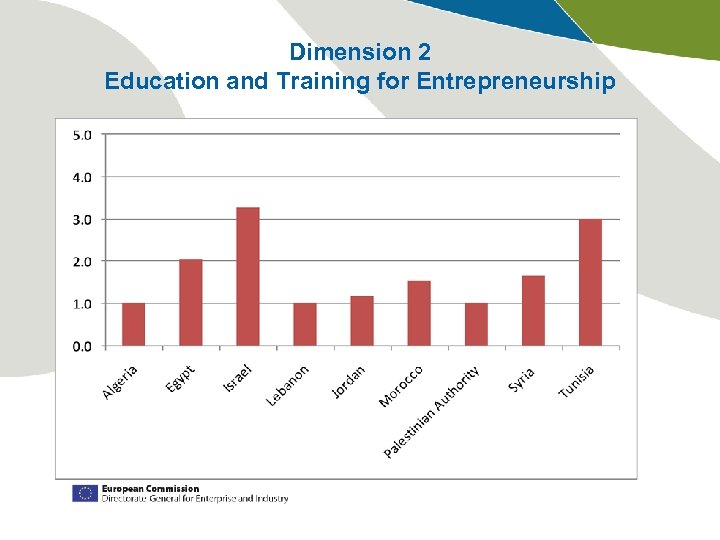
Dimension 2 Education and Training for Entrepreneurship
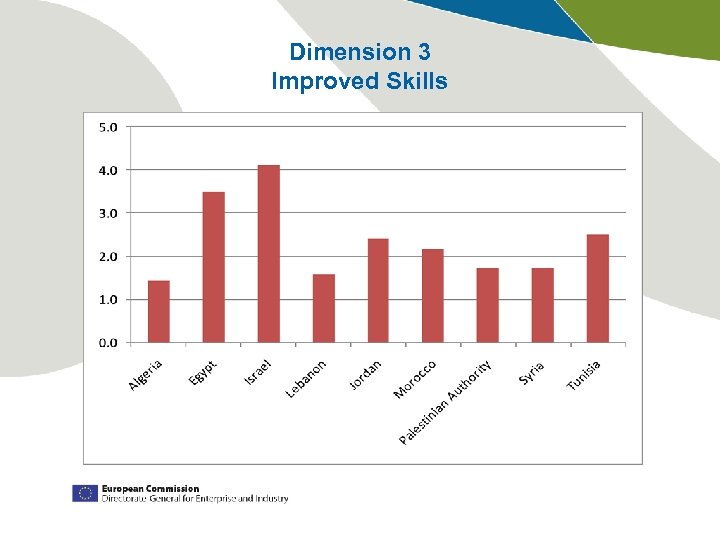
Dimension 3 Improved Skills
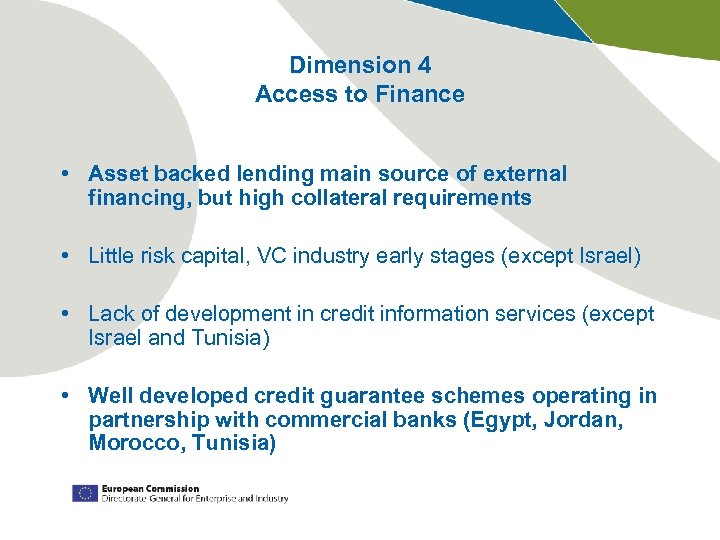
Dimension 4 Access to Finance • Asset backed lending main source of external financing, but high collateral requirements • Little risk capital, VC industry early stages (except Israel) • Lack of development in credit information services (except Israel and Tunisia) • Well developed credit guarantee schemes operating in partnership with commercial banks (Egypt, Jordan, Morocco, Tunisia)
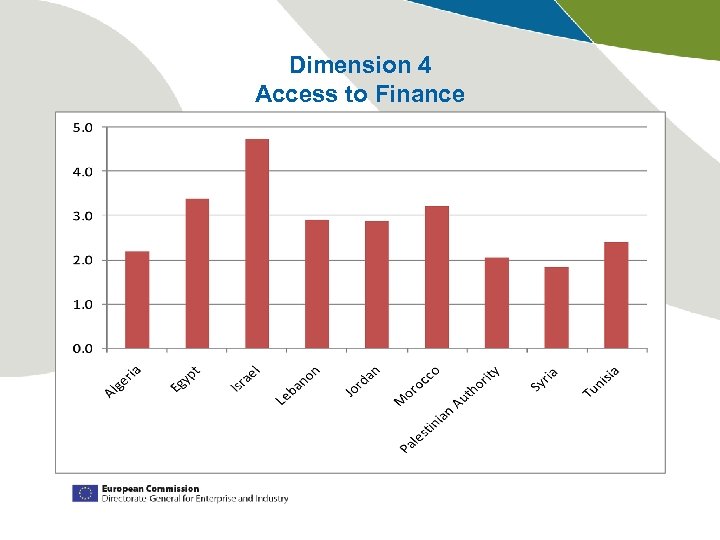
Dimension 4 Access to Finance
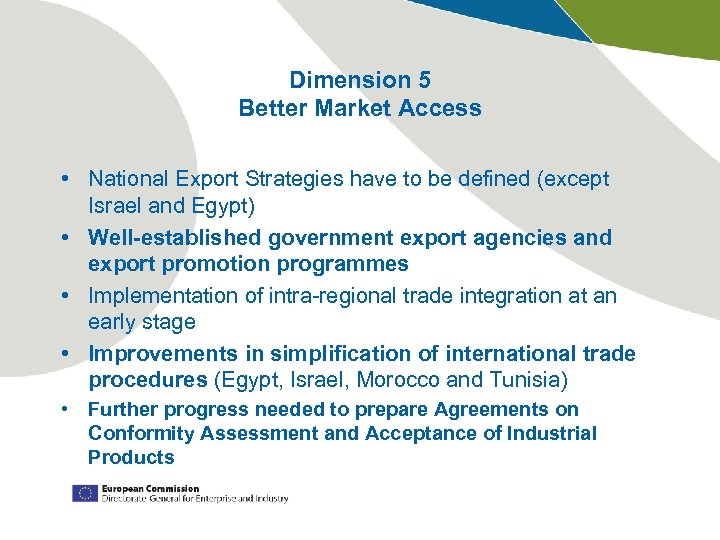
Dimension 5 Better Market Access • National Export Strategies have to be defined (except Israel and Egypt) • Well-established government export agencies and export promotion programmes • Implementation of intra-regional trade integration at an early stage • Improvements in simplification of international trade procedures (Egypt, Israel, Morocco and Tunisia) • Further progress needed to prepare Agreements on Conformity Assessment and Acceptance of Industrial Products
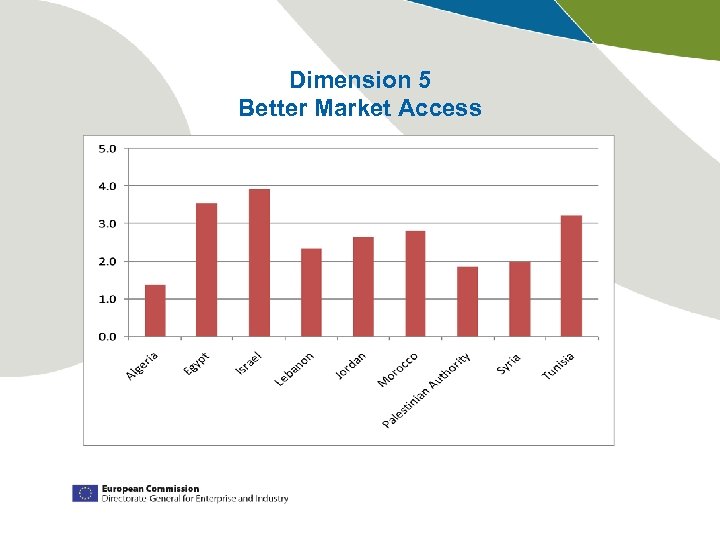
Dimension 5 Better Market Access
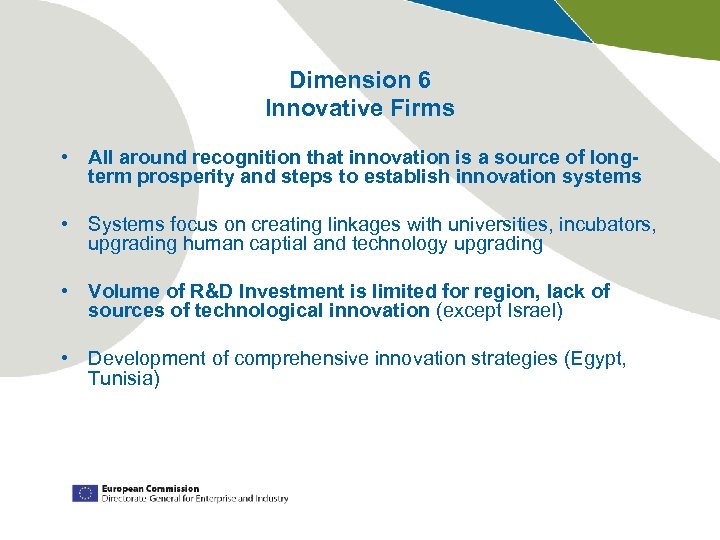
Dimension 6 Innovative Firms • All around recognition that innovation is a source of longterm prosperity and steps to establish innovation systems • Systems focus on creating linkages with universities, incubators, upgrading human captial and technology upgrading • Volume of R&D Investment is limited for region, lack of sources of technological innovation (except Israel) • Development of comprehensive innovation strategies (Egypt, Tunisia)
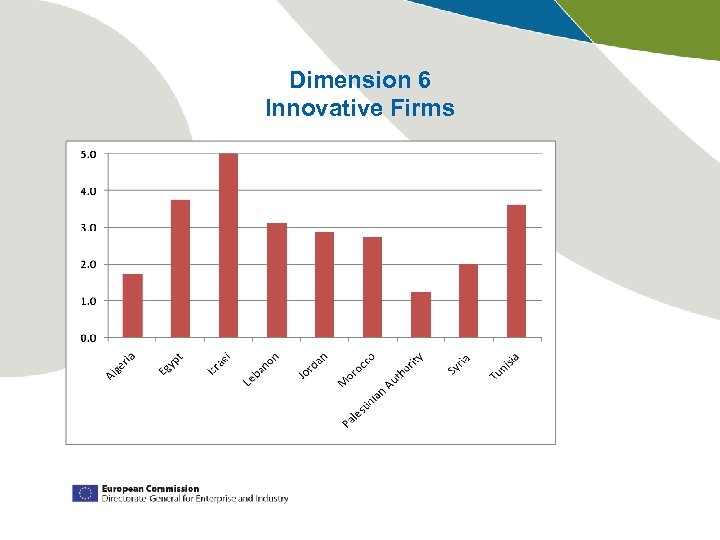
Dimension 6 Innovative Firms
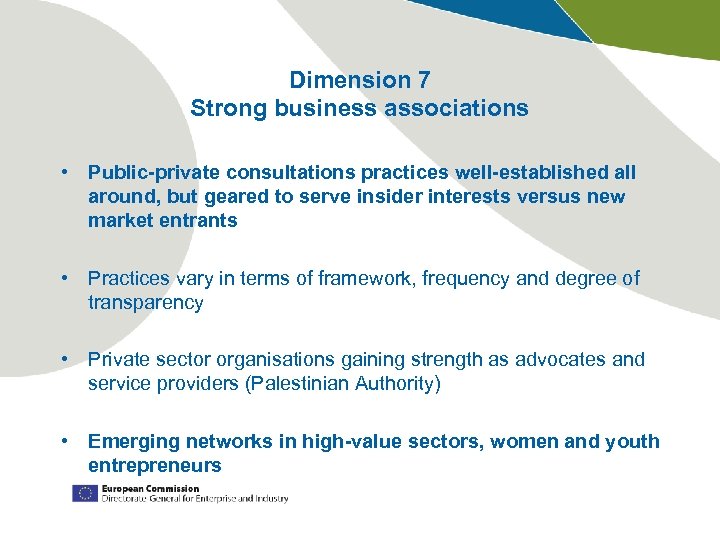
Dimension 7 Strong business associations • Public-private consultations practices well-established all around, but geared to serve insider interests versus new market entrants • Practices vary in terms of framework, frequency and degree of transparency • Private sector organisations gaining strength as advocates and service providers (Palestinian Authority) • Emerging networks in high-value sectors, women and youth entrepreneurs
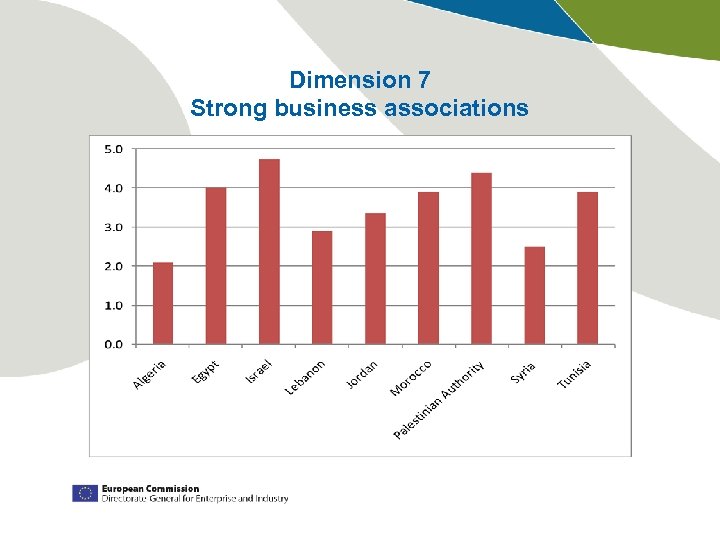
Dimension 7 Strong business associations
Dimension 8 Quality of business support services • In all countries programmes (services, targeted groups) to support small firms to overcome market failures (Enterprise Upgrading/Mise à niveau) • Business establishment support centers (industrial parks and zones) are well-established in most countries • Information gap about availability of programmes • Lack of monitoring and evaluation tools to evaluate effectiveness of programmes using sizeable resources
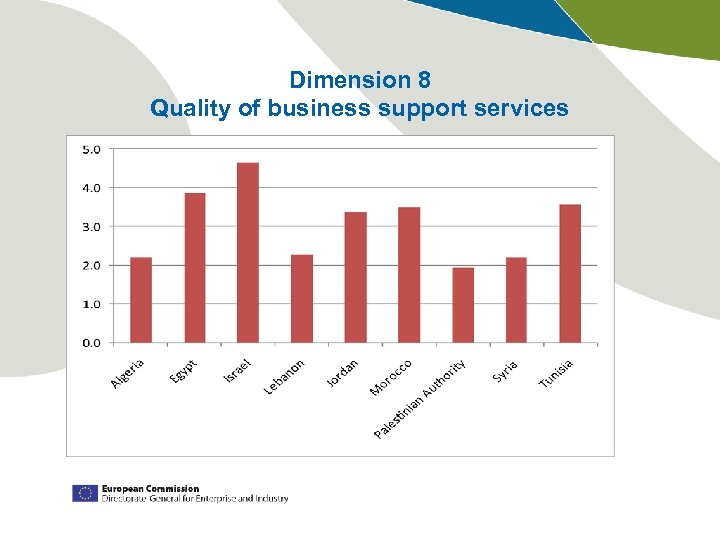
Dimension 8 Quality of business support services
Dimension 9 and 10 Euro. Med partnerships and networks, Clear and targeted information • Experience in networking and partnerships between firms and between business support services at Euro-Med level but often donor funded pilot projects • Significant needs to improve quality of information, especially online • Development of interactive websites, portals and networks of information centres (Egypt, Israel, Morocco and Tunisia)
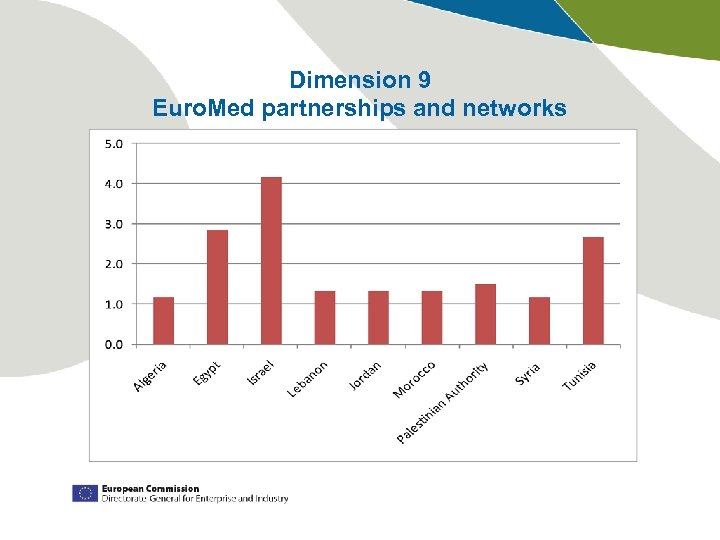
Dimension 9 Euro. Med partnerships and networks
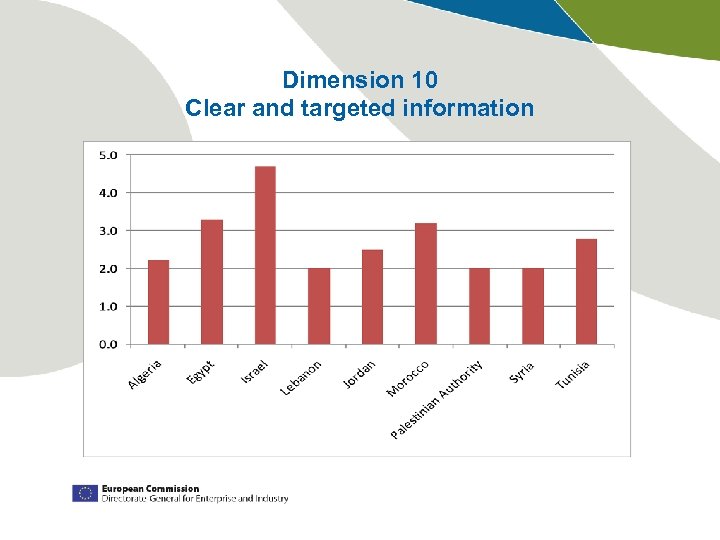
Dimension 10 Clear and targeted information
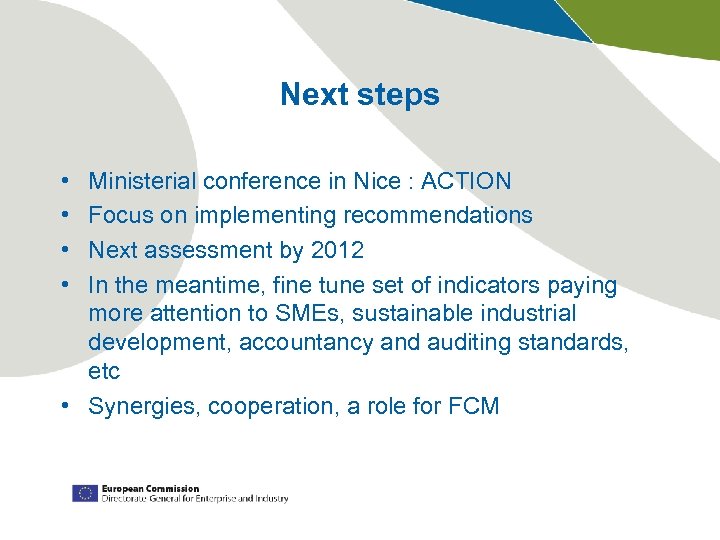
Next steps • • Ministerial conference in Nice : ACTION Focus on implementing recommendations Next assessment by 2012 In the meantime, fine tune set of indicators paying more attention to SMEs, sustainable industrial development, accountancy and auditing standards, etc • Synergies, cooperation, a role for FCM
Euro-Mediterranean Industrial Cooperation http: //ec. europa. eu/enterprise/international_relations/docs/me diterranean/2008_report_charter_en. pdf Marie. Corman@ec. europa. eu
Скачать презентацию Euro-Mediterranean Industrial Cooperation Paris November 2008 Marie Corman
23858fc9b327f87359fd34754fe737af.ppt