


 Скачать презентацию EUCOS Relevance of impact studies for EUCOS and
aabade883221fc04e037e9b2e196f74e.ppt
- Количество слайдов: 21
 EUCOS Relevance of impact studies for EUCOS and EUCOS requirements in future studies Fourth WMO Workshop on the Impact of Various Observing Systems on Numerical Weather Prediction 19 -21 May 2008, WMO, Geneva, Switzerland Stefan Klink, Jochen Dibbern and Tanja Kleinert EUCOS Team 1
 Content • About EUMETNET and EUCOS • EUCOS objectives • The current EUCOS network • Motivation for impact studies • Space-Terrestrial study and recommendations derived from it • EUCOS upper-air network redesign • Future plans for OSEs 4 th WMO OSE/OSSE Workshop 19 -21 May 2008, WMO, Geneva, Switzerland 2
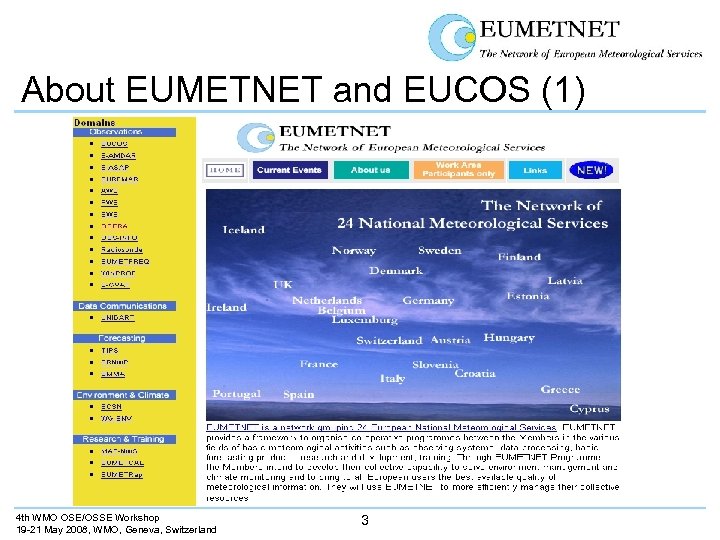 About EUMETNET and EUCOS (1) 4 th WMO OSE/OSSE Workshop 19 -21 May 2008, WMO, Geneva, Switzerland 3
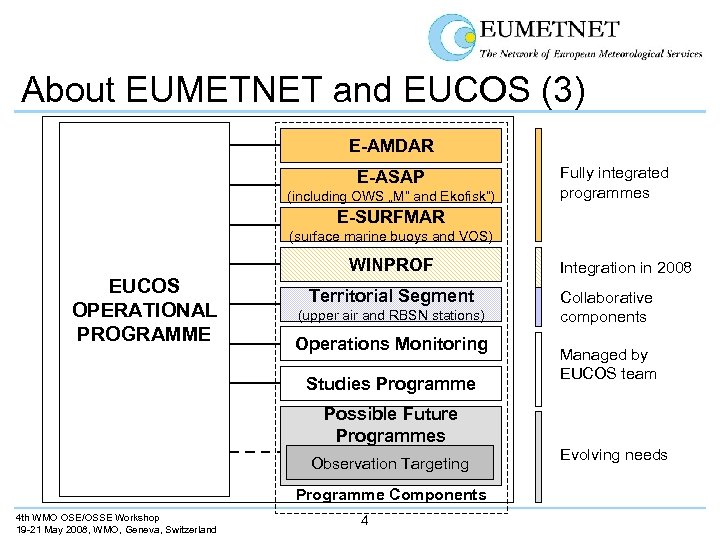 About EUMETNET and EUCOS (3) E-AMDAR E-ASAP (including OWS „M“ and Ekofisk“) Fully integrated programmes E-SURFMAR (surface marine buoys and VOS) WINPROF EUCOS OPERATIONAL PROGRAMME Territorial Segment (upper air and RBSN stations) Operations Monitoring Studies Programme Integration in 2008 Collaborative components Managed by EUCOS team Possible Future Programmes Observation Targeting Programme Components 4 th WMO OSE/OSSE Workshop 19 -21 May 2008, WMO, Geneva, Switzerland 4 Evolving needs
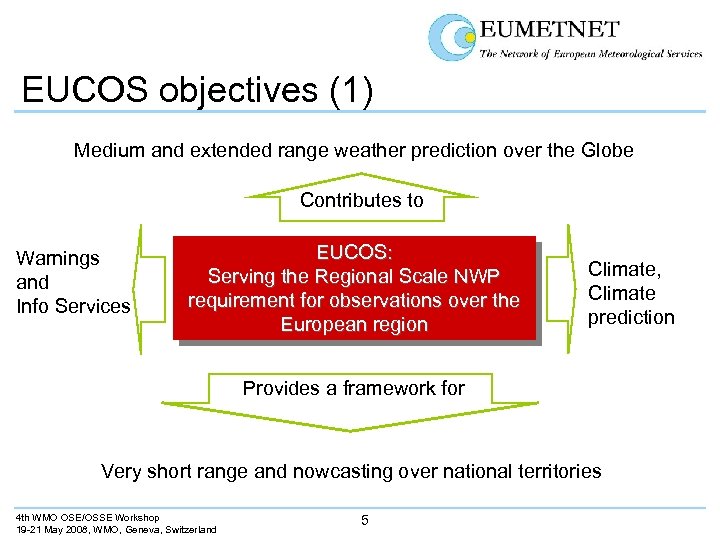 EUCOS objectives (1) Medium and extended range weather prediction over the Globe Contributes to Warnings and Info Services EUCOS: Serving the Regional Scale NWP requirement for observations over the European region Climate, Climate prediction Provides a framework for Very short range and nowcasting over national territories 4 th WMO OSE/OSSE Workshop 19 -21 May 2008, WMO, Geneva, Switzerland 5
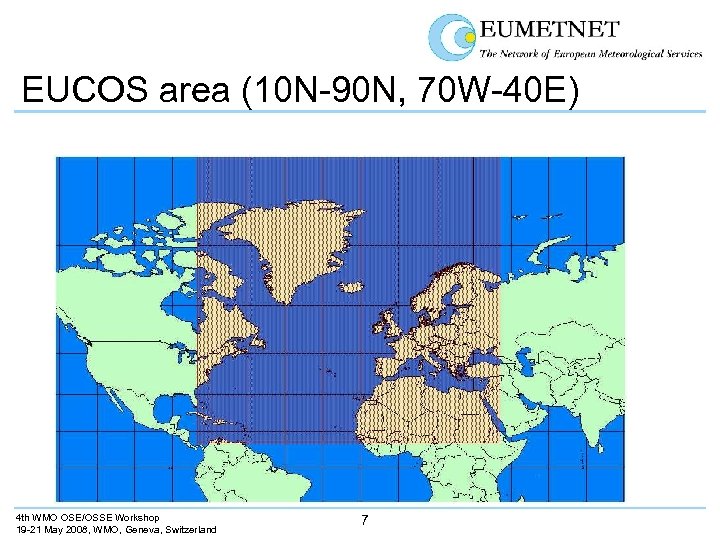 EUCOS area (10 N-90 N, 70 W-40 E) 4 th WMO OSE/OSSE Workshop 19 -21 May 2008, WMO, Geneva, Switzerland 7
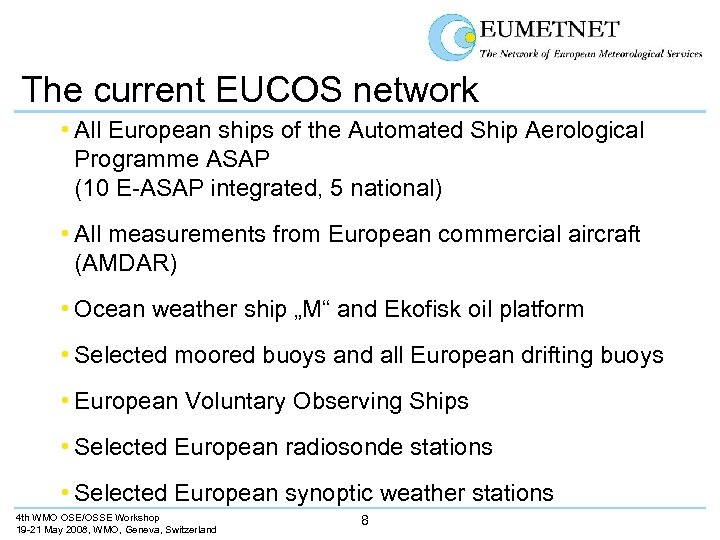 The current EUCOS network • All European ships of the Automated Ship Aerological Programme ASAP (10 E-ASAP integrated, 5 national) • All measurements from European commercial aircraft (AMDAR) • Ocean weather ship „M“ and Ekofisk oil platform • Selected moored buoys and all European drifting buoys • European Voluntary Observing Ships • Selected European radiosonde stations • Selected European synoptic weather stations 4 th WMO OSE/OSSE Workshop 19 -21 May 2008, WMO, Geneva, Switzerland 8
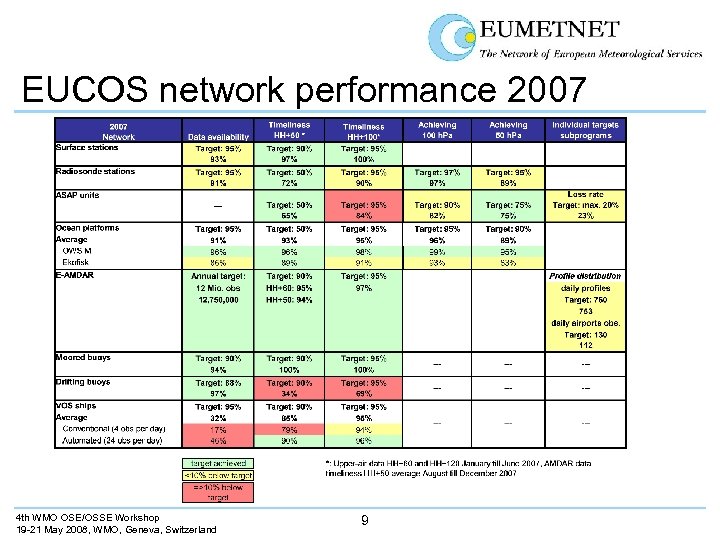 EUCOS network performance 2007 4 th WMO OSE/OSSE Workshop 19 -21 May 2008, WMO, Geneva, Switzerland 9
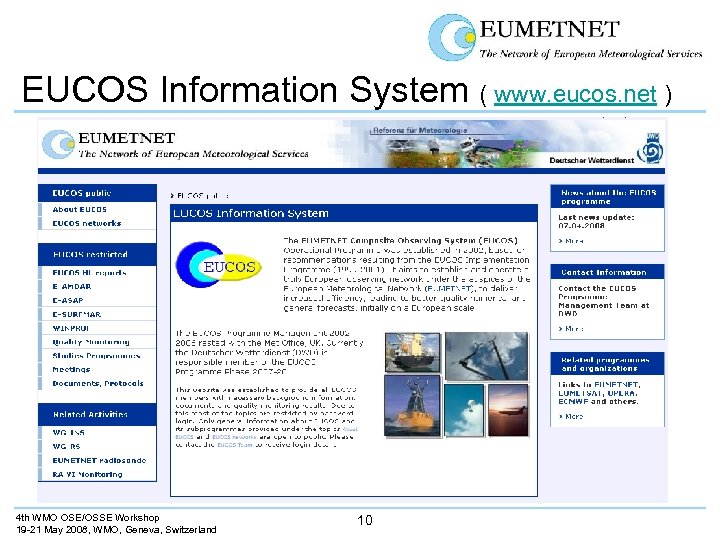 EUCOS Information System ( www. eucos. net ) 4 th WMO OSE/OSSE Workshop 19 -21 May 2008, WMO, Geneva, Switzerland 10
 Motivation for impact studies (External) drivers and developments: • Different observation networks evolve differently (e. g. regarding availability, accuracy, cost, . . . ) • Data assimilation algorithms improve and can make use of more data EUCOS objective: • Design and coordinate the evolution of the ground based EUMETNET composite observing system (EUCOS) to be optimized at European scale with a view to improve short range forecast. . . → A modification of the meteorological observing network might become necessary EUCOS needs approval for network changes or modifications from PB-OBS and EUMETNET Council respectively In order to get the 24 Members convinced of such changes it was decided to base them on scientific analyses (e. g. impact studies) 4 th WMO OSE/OSSE Workshop 19 -21 May 2008, WMO, Geneva, Switzerland 11
 Space-Terrestrial Study and recommendations derived from it (1) From kick-off meeting: • There is a need to better understand the relative contribution of both components so that the total system may be progressively optimised; • There is also a need in particular to define the impact of the additional data from the EUCOS Programme at this point of implementation; Starting point: • EUMETSAT funded ECWMF to consider the space contribution; • EUCOS funded ECMWF, Met Office, DMI, met. no and OMSZ to study the terrestrial components. 4 th WMO OSE/OSSE Workshop 19 -21 May 2008, WMO, Geneva, Switzerland 12
 Space-Terrestrial Study and recommendations derived from it (2) The five NWP centres: ECMWF, Met Office, DMI, met. no and OMSZ agreed on common OSE scenarios, time periods, verification procedures and presentation styles. The experimental set-up for the OSEs was: • Two periods were selected: • Winter: 14 th December 2004 to 27 th January 2005 (44 days); • Summer: 15 th July 2005 to 15 th September 2005 (63 days). • Forecast runs were started at 00 UTC and 12 UTC. • The following scenarios were defined: • Baseline: all current satellite observations used in NWP (radiances, clouddrift winds, scatt winds) + GUAN radiosonde network + hourly GSN surface land data + hourly buoys (no ship data); • Control: full combined observing system; • And different additions to the Baseline (radiosondes, wind profiler, aircraft measurements). 4 th WMO OSE/OSSE Workshop 19 -21 May 2008, WMO, Geneva, Switzerland 13
 Space-Terrestrial Study and recommendations derived from it (3) The studies lead to the following general conclusions, compiled at the 2007 E-SAT meeting: • Compared to Baseline all additional ground based observing systems have a positive impact on the forecast skill. On top of the additional available satellite data further improvements of the ground based observing system are important. • The radiosonde network is still the most important component of the ground based upper-air observing network. • NMSs are encouraged to move to BUFR for Radiosonde messages and make full use of increased vertical resolution profile data. 4 th WMO OSE/OSSE Workshop 19 -21 May 2008, WMO, Geneva, Switzerland 14
 Space-Terrestrial Study and recommendations derived from it (4) • E-ASAP shows a positive impact on the forecast. A compilation of studies made 10 years ago showed that a minimum of 10 -15 systems are needed in the Atlantic Ocean to show any significant impact in NWP. ESAT proposes reactivating of the existing 2 French and 1 Danish units. • The 6 remote island Radiosonde stations (Heraklion (Crete), Lajes (Azores), Funchal (Madeira), Tenerife, Jan Mayen and Torshavn (Faroe Islands)) are seen as important part of the EUCOS Radiosonde network, as long as no 3 -hourly aircraft measurements are available at those locations. 4 th WMO OSE/OSSE Workshop 19 -21 May 2008, WMO, Geneva, Switzerland 15
 Space-Terrestrial Study and recommendations derived from it (5) • The impact of aircraft measurements is significant and second largest. The E-AMDAR optimisation systems should be developed further to get a more homogenous distribution of profiles in space and time. More airlines should be incorporated to get 3 -hourly observations from more European airports. • AMDAR humidity is seen as a high priority project. • Having now more than 15 wind profiler systems being assimilated in NWP models the impact on regional forecast models should be evaluated again. (E-SAT 2008 special wind profiler meeting recommendation: improve central monitoring and maintenance of profilers) • Weather Radar wind profiles are available from more than 80 sites. NWP centres are encouraged to monitor the data and work towards operational assimilation. 4 th WMO OSE/OSSE Workshop 19 -21 May 2008, WMO, Geneva, Switzerland 16
 Redesign of the EUCOS upper-air network (1) Motivation for the redesign: • The significant evolution of the European AMDAR network; • Members were not able to install the proposed EUCOS radiosonde network design with 4 ascents per day at most of the sites; • Results from the Space Terrestrial Studies are available with recommendations for the network design; • Data assimilation of NWP models has improved significantly with advanced capability to make use of high time resolution data; • A subset of the wind profiler network has achieved operational status and the data are used operationally in different NWP models; • Wind measurements from Doppler weather radars are available which are used in the data assimilation of the Met Office numerical model, and monitored at other NWP centers; • Measurements from the GPS water vapour networks are available. 4 th WMO OSE/OSSE Workshop 19 -21 May 2008, WMO, Geneva, Switzerland 17
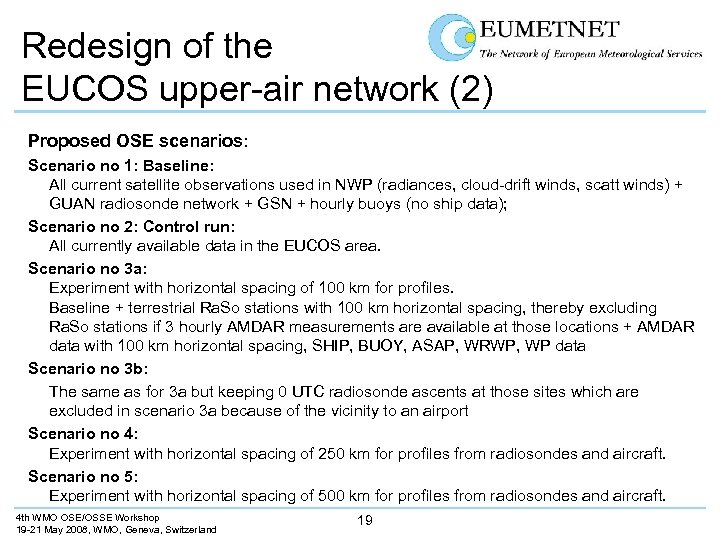 Redesign of the EUCOS upper-air network (2) Proposed OSE scenarios: Scenario no 1: Baseline: All current satellite observations used in NWP (radiances, cloud-drift winds, scatt winds) + GUAN radiosonde network + GSN + hourly buoys (no ship data); Scenario no 2: Control run: All currently available data in the EUCOS area. Scenario no 3 a: Experiment with horizontal spacing of 100 km for profiles. Baseline + terrestrial Ra. So stations with 100 km horizontal spacing, thereby excluding Ra. So stations if 3 hourly AMDAR measurements are available at those locations + AMDAR data with 100 km horizontal spacing, SHIP, BUOY, ASAP, WRWP, WP data Scenario no 3 b: The same as for 3 a but keeping 0 UTC radiosonde ascents at those sites which are excluded in scenario 3 a because of the vicinity to an airport Scenario no 4: Experiment with horizontal spacing of 250 km for profiles from radiosondes and aircraft. Scenario no 5: Experiment with horizontal spacing of 500 km for profiles from radiosondes and aircraft. 4 th WMO OSE/OSSE Workshop 19 -21 May 2008, WMO, Geneva, Switzerland 19
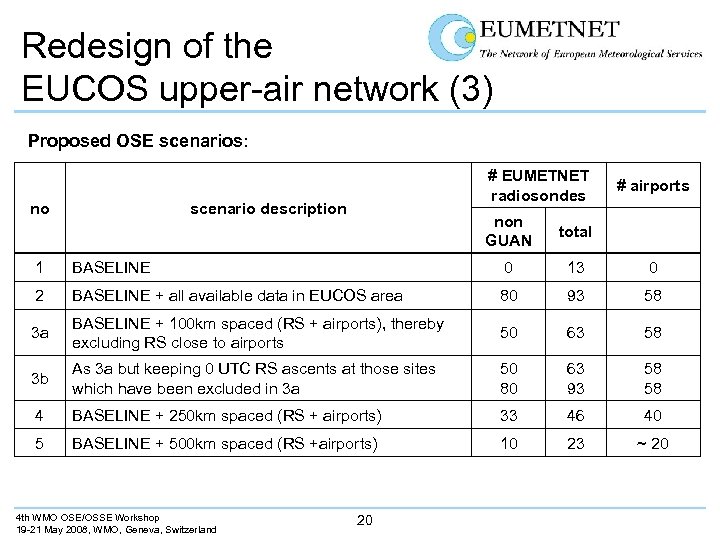 Redesign of the EUCOS upper-air network (3) Proposed OSE scenarios: no # EUMETNET radiosondes scenario description # airports non GUAN total 1 BASELINE 0 13 0 2 BASELINE + all available data in EUCOS area 80 93 58 3 a BASELINE + 100 km spaced (RS + airports), thereby excluding RS close to airports 50 63 58 3 b As 3 a but keeping 0 UTC RS ascents at those sites which have been excluded in 3 a 50 80 63 93 58 58 4 BASELINE + 250 km spaced (RS + airports) 33 46 40 5 BASELINE + 500 km spaced (RS +airports) 10 23 ~ 20 4 th WMO OSE/OSSE Workshop 19 -21 May 2008, WMO, Geneva, Switzerland 20
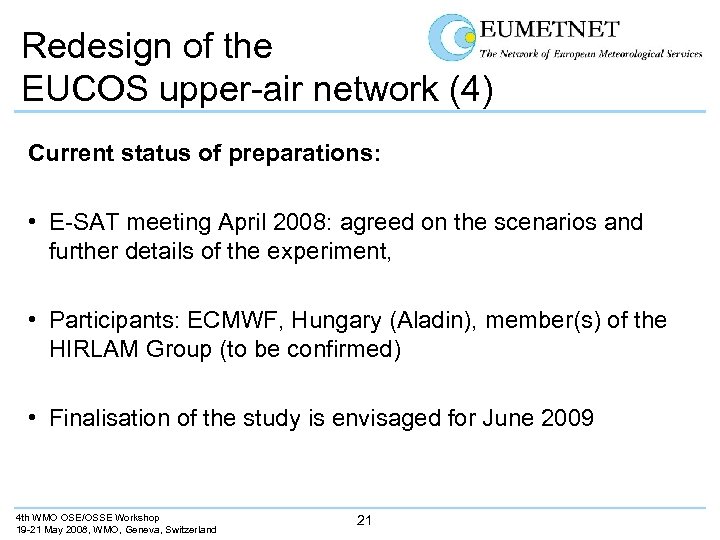 Redesign of the EUCOS upper-air network (4) Current status of preparations: • E-SAT meeting April 2008: agreed on the scenarios and further details of the experiment, • Participants: ECMWF, Hungary (Aladin), member(s) of the HIRLAM Group (to be confirmed) • Finalisation of the study is envisaged for June 2009 4 th WMO OSE/OSSE Workshop 19 -21 May 2008, WMO, Geneva, Switzerland 21
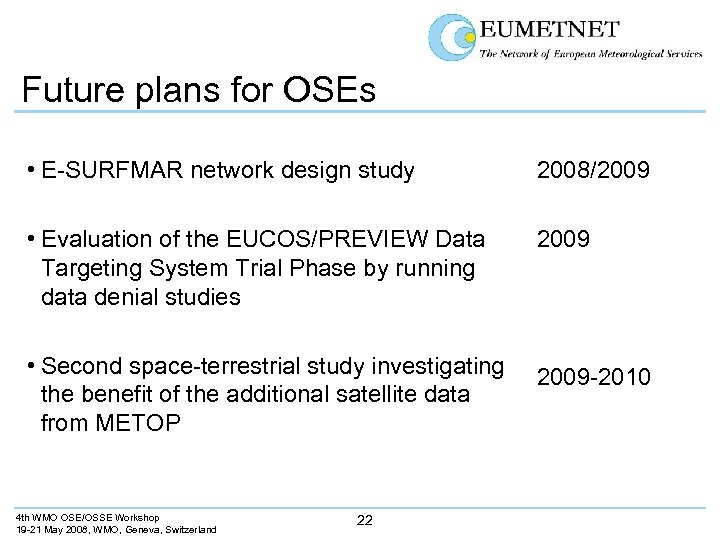 Future plans for OSEs • E-SURFMAR network design study 2008/2009 • Evaluation of the EUCOS/PREVIEW Data Targeting System Trial Phase by running data denial studies 2009 • Second space-terrestrial study investigating the benefit of the additional satellite data from METOP 2009 -2010 4 th WMO OSE/OSSE Workshop 19 -21 May 2008, WMO, Geneva, Switzerland 22
 Questions and Comments? 4 th WMO OSE/OSSE Workshop 19 -21 May 2008, WMO, Geneva, Switzerland 23