 Скачать презентацию EUA Leadership Seminar Lausanne June 12 2006 Building
37c72065bd4a89f8b2cc8e82dc5bd03f.ppt
- Количество слайдов: 15



EUA Leadership Seminar Lausanne, June 12, 2006 Building an International Strategy for the Academic Institution – Role of the Rector/President Dr. Peter Lorange, President, IMD The Nestlé Professor Copyright 2006 © by IMD International, Lausanne, Switzerland Not be used or reproduced without permission
A very competitive world for academic institutions, when they aspire to be on top internationally: • Thought leadership is needed today for global success – provided through research! • From: Supply-driven philosophy • • • Shaped after the tradition of A. Von Humboldt's University, 1800 Axiomatic; discipline-based To: Demand-driven philosophy • The demands of the customer* – eclectic, cross-disciplinary! Student – Executive – Companies – Society – * An intentional error: It is Learning Partner, not customer. The two-way relationship among equals is key! Dr. Peter Lorange, President 2 PL-EUA Leadership Seminar
In my comments, I shall draw on IMD, a leading graduate business school located in Lausanne • We were ranked #2 worldwide in executive education (FT, 15 May, 2006), and #1 worldwide in MBA (FT, 20 January, 2006 – based on FT, WSJ, Forbes and Economist) • Self owning foundation. Not-for-profit • Independent; not part of a university • Annual turnover (2006 estimate): Sfr. 105 Million • No debt; no financial allocations from federal, cantonal or local governments • 55 professors (full-time, 28 nationalities); 250 support staff employees (25 nationalities) Dr. Peter Lorange, President 3 PL-EUA Leadership Seminar
IMD is very international • 51% from Europe • 19% from the Americas • 26% from Asia • 4% from Australia / Africa • From 76 nationalities! Dr. Peter Lorange, President 4 PL-EUA Leadership Seminar
Our strategy – to achieve global leadership – is highly focused – based on 4 pillars 1. Real World – Real Learning • Practical focus for learning • Based on thought leadership – 26. 9% of IMD’s expenses go into Research and Program development • A clear business trend: More facts-based! More “minimalistic”! – The teaching programs must reflect this • To speed up the transformation from research to program delivery is key! • Pedagogical focus – very strong • Our Faculty must be of top quality-world class! Dr. Peter Lorange, President 5 PL-EUA Leadership Seminar
And, this means : to be successful internationally, one must integrate new research insights fast. How? International success thus implies: • Flexibility of smaller programs • • Risk – taking by faculty • • e. g. One-section programs – with no coordination across sections? Avoid mechanistic student feedback – no “popularity competition”! Faculty reviews • Research and Teaching progress / outputs (as opposed to “plans”!) Dr. Peter Lorange, President 6 PL-EUA Leadership Seminar
And, international focus means a shift towards more action – learning and action – research! • Urgency! • Real strategic issues • Direct impact on strategies • A consequence: Different dissemination channels for research to get global reach – the process with the refereed journals takes too long! • Research monographs • Edited books • Web-casts (our weekly webcast is “seen” by 23000 executives, worldwide) Dr. Peter Lorange, President 7 PL-EUA Leadership Seminar
Our strategy – continued: 2. The Global Meeting Place • Executives from all over the world learn side-by-side at IMD • Focus on dilemmas, not “right/wrong” answers • Cross-cultural insights are thus key! • A clear business trend: Growth of Asia • New Research Centres – – • Growth in Americas – Dr. Peter Lorange, President 8 PL-EUA Leadership Seminar Shanghai Mumbai – under establishment Latin American Research Center under planning
Our strategy – continued: 3. All learning is lifelong learning • IMD’s learning network • 175 companies, plus all alumni • Wednesday Webcasts, 4 PM Lausanne time – – – Live Interactive – Q&A Professors with thought leadership Guest CEOs and top executives with ideas to share across the Network Pragmatic Learning More than 21 thousand executives now accessing – – Dr. Peter Lorange, President 9 PL-EUA Leadership Seminar Directly from their PCs Or in team-based learning environments In corporate university settings Clear business trend: Lifelong Learning must go on at work-place
Our strategy – continued: 4. A minimalistic internal organizational structure, and customer – focused processes • No academic departments – no silos • No title / seniority hierarchy • No tenure • Market-driven internal processes: – • Clear trend: The large, diverse business schools are not doing as well as the smaller, focused schools. Power of “boutiques” / elite! Dr. Peter Lorange, President 10 PL-EUA Leadership Seminar Bonus
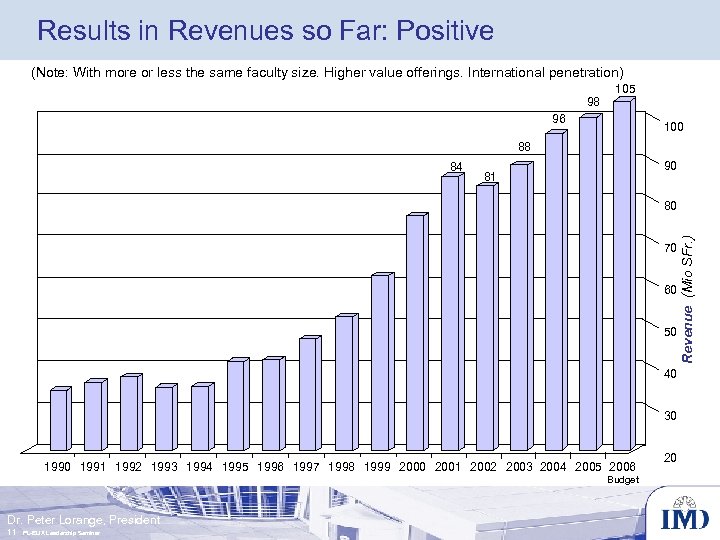
Results in Revenues so Far: Positive (Note: With more or less the same faculty size. Higher value offerings. International penetration) 98 105 96 100 88 84 90 81 70 60 50 40 30 1991 1992 1993 1994 1995 1996 1997 1998 1999 2000 2001 2002 2003 2004 2005 2006 Budget Dr. Peter Lorange, President 11 PL-EUA Leadership Seminar 20 Revenue (Mio SFr. ) 80
Global Marketing is key! • IMD has a full time marketing field force of 12 – – – – Latin America/Iberia North America Africa/ME/India SE Asia/Australia China Japan France/Italy/Belgium Netherlands (part time) Germany/Austria UK/E. Europe Nordic Switzerland Also, global data bases Global alumni activities – 44 clubs, worldwide Dr. Peter Lorange, President 12 PL-EUA Leadership Seminar
Question 1: What about if your business school is part of a university – and there is a conflict between the actions of the university and the preferred actions of the business school? A. The leadership teams of the university and the business school should sit down – say, over a week – a retreat – and work it out. Get the facts out! Stress the suboptimal consequences of treating the business school with too much constraint re. appointments, promotion, maintain jurisdiction over its funds, etc. Dr. Peter Lorange, President 13 PL-EUA Leadership Seminar
Question 2: How can Strong Research Commitment be achieved today? A. Based on thought leadership • A high proportion of an institution’s expenses must go into Research and Program development • And, practical enough to have a link to learning • The R&D must rapidly – and continuously – go into teaching programs – to ensure cutting edge/relevance • The teaching side then also gives valuable feedback, that further refine the research agenda • Grounded rationality! Dr. Peter Lorange, President 14 PL-EUA Leadership Seminar
Question 3: How to achieve more cross-functional research, with more speedy dissemination of the research results? A. Many business schools have large structural challenges, which make it difficult for them to live up to the modern challenges they are facing today. I recommend, therefore, a “minimalistic” structure: • no (or a few only) academic departments • no professional title hierarchy • no tenure Dr. Peter Lorange, President 15 PL-EUA Leadership Seminar
Скачать презентацию EUA Leadership Seminar Lausanne June 12 2006 Building
37c72065bd4a89f8b2cc8e82dc5bd03f.ppt