 Скачать презентацию EU LAW AND BIOETHICS 1 EU LAW OF
7a5e3d995cbf59248bb6d66cc8d3cc52.ppt
- Количество слайдов: 35



EU LAW AND BIOETHICS 1. EU LAW OF BIOETHICS? SOLVING THE PUZZLE 2. EU LAW OF BIOETHICS: FRAMES OR CONTENT? 3. EU LAW OF BIOETHICS: UPCOMING DIFFICULTIES
A counter-intuitive object “Diane Blood relies on free movement of rights in Community law to seek fertility treatment in Belgium. A Community body –the Committee for Proprietary Medicinal Products- recommends that Viagra be approved for marketing across Europe. The European Commission responds tofood-related threats to public health, such as BSE, by proposing a new European Food Agency. The Commission proposes the prohibition of tobacco advertising across the EU. These events, along with many others of a less high profile, illustrate how the European Union is playing an increasing role in the determination of both individual and collective health entitlements. It might be said that the EU is developing a health policy”: T. Hervey, “Mapping the contours of EU Health law and Policy”, European Public Law, 2002, vol. 8, p. 69.
A body of EU biomedical law - Directive 98/44 of 6 July 1998 on the protection of biomedical inventions - Directive 2011/20 of 4 April 2001 on clinical trials - Directive 2002/98 of 27 Jan. 2003 on Blood - Directive 2004/23 of 31 March 2004 on Tissue - Directive 2010/45 of 7 July 2010 on Organs - Regulation (EU) 1394/2007 of the European Parliament and the Council, OJ L 2007 324/121
A body of EU biomedical law (cont’d) And also: EP Res. on in vitro embryos (16 Mar. 1989) EP Res. on artificial insemination in vivo and in vitro (16 Mar. 1989) EP Res. on cloning (7 Sep. 2000) EP Res. on trade in oocytes (10 Mar. 2005) And also: Art. 182 decisions And also: ECJ case law
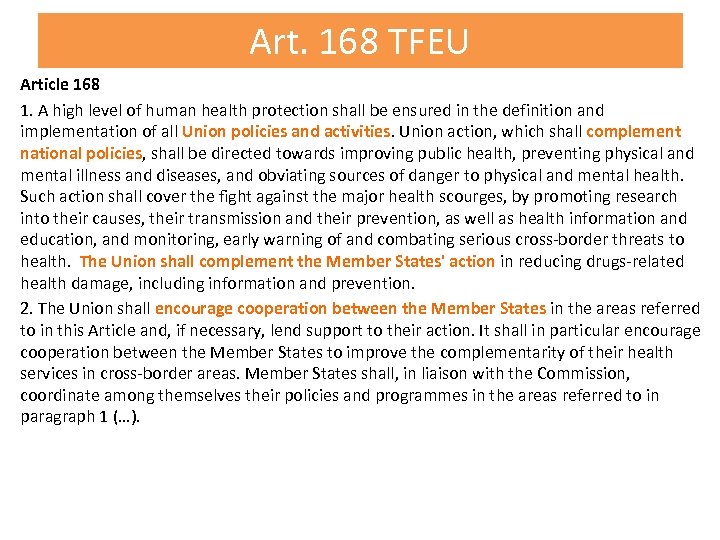
Art. 168 TFEU Article 168 1. A high level of human health protection shall be ensured in the definition and implementation of all Union policies and activities. Union action, which shall complement national policies, shall be directed towards improving public health, preventing physical and mental illness and diseases, and obviating sources of danger to physical and mental health. Such action shall cover the fight against the major health scourges, by promoting research into their causes, their transmission and their prevention, as well as health information and education, and monitoring, early warning of and combating serious cross-border threats to health. The Union shall complement the Member States' action in reducing drugs-related health damage, including information and prevention. 2. The Union shall encourage cooperation between the Member States in the areas referred to in this Article and, if necessary, lend support to their action. It shall in particular encourage cooperation between the Member States to improve the complementarity of their health services in cross-border areas. Member States shall, in liaison with the Commission, coordinate among themselves their policies and programmes in the areas referred to in paragraph 1 (…).
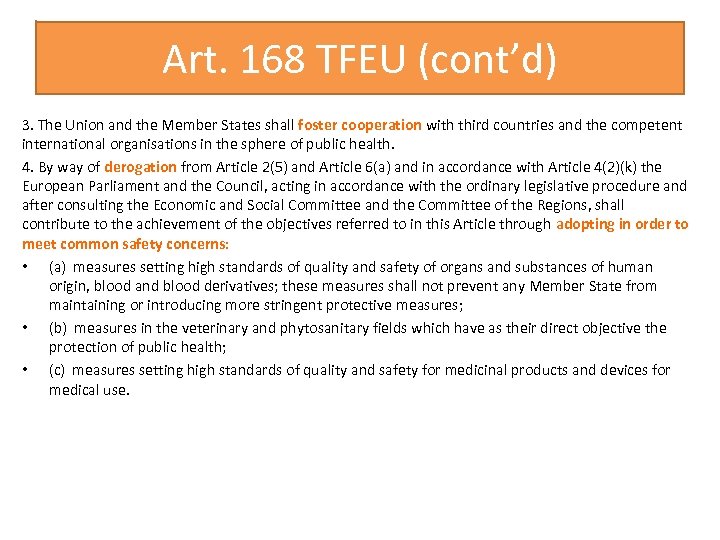
Art. 168 TFEU (cont’d) 3. The Union and the Member States shall foster cooperation with third countries and the competent international organisations in the sphere of public health. 4. By way of derogation from Article 2(5) and Article 6(a) and in accordance with Article 4(2)(k) the European Parliament and the Council, acting in accordance with the ordinary legislative procedure and after consulting the Economic and Social Committee and the Committee of the Regions, shall contribute to the achievement of the objectives referred to in this Article through adopting in order to meet common safety concerns: • (a) measures setting high standards of quality and safety of organs and substances of human origin, blood and blood derivatives; these measures shall not prevent any Member State from maintaining or introducing more stringent protective measures; • (b) measures in the veterinary and phytosanitary fields which have as their direct objective the protection of public health; • (c) measures setting high standards of quality and safety for medicinal products and devices for medical use.
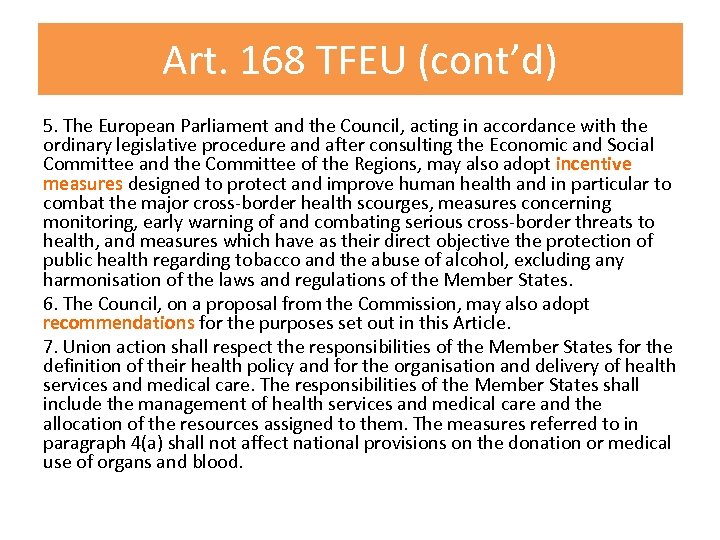
Art. 168 TFEU (cont’d) 5. The European Parliament and the Council, acting in accordance with the ordinary legislative procedure and after consulting the Economic and Social Committee and the Committee of the Regions, may also adopt incentive measures designed to protect and improve human health and in particular to combat the major cross-border health scourges, measures concerning monitoring, early warning of and combating serious cross-border threats to health, and measures which have as their direct objective the protection of public health regarding tobacco and the abuse of alcohol, excluding any harmonisation of the laws and regulations of the Member States. 6. The Council, on a proposal from the Commission, may also adopt recommendations for the purposes set out in this Article. 7. Union action shall respect the responsibilities of the Member States for the definition of their health policy and for the organisation and delivery of health services and medical care. The responsibilities of the Member States shall include the management of health services and medical care and the allocation of the resources assigned to them. The measures referred to in paragraph 4(a) shall not affect national provisions on the donation or medical use of organs and blood.
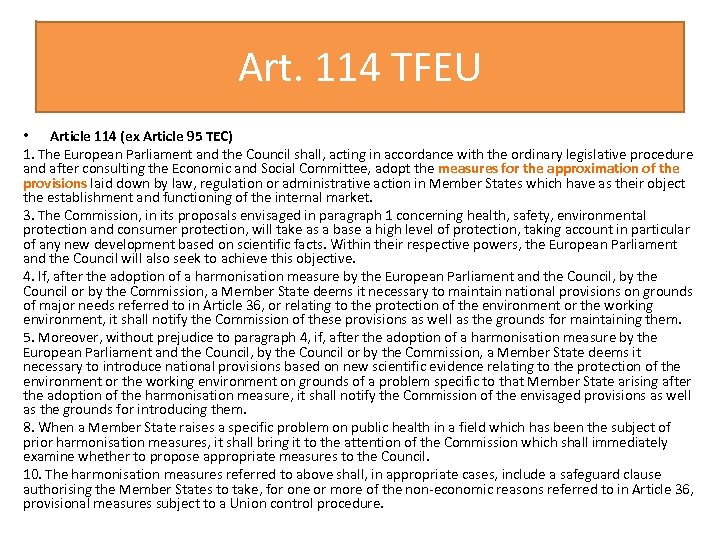
Art. 114 TFEU • Article 114 (ex Article 95 TEC) 1. The European Parliament and the Council shall, acting in accordance with the ordinary legislative procedure and after consulting the Economic and Social Committee, adopt the measures for the approximation of the provisions laid down by law, regulation or administrative action in Member States which have as their object the establishment and functioning of the internal market. 3. The Commission, in its proposals envisaged in paragraph 1 concerning health, safety, environmental protection and consumer protection, will take as a base a high level of protection, taking account in particular of any new development based on scientific facts. Within their respective powers, the European Parliament and the Council will also seek to achieve this objective. 4. If, after the adoption of a harmonisation measure by the European Parliament and the Council, by the Council or by the Commission, a Member State deems it necessary to maintain national provisions on grounds of major needs referred to in Article 36, or relating to the protection of the environment or the working environment, it shall notify the Commission of these provisions as well as the grounds for maintaining them. 5. Moreover, without prejudice to paragraph 4, if, after the adoption of a harmonisation measure by the European Parliament and the Council, by the Council or by the Commission, a Member State deems it necessary to introduce national provisions based on new scientific evidence relating to the protection of the environment or the working environment on grounds of a problem specific to that Member State arising after the adoption of the harmonisation measure, it shall notify the Commission of the envisaged provisions as well as the grounds for introducing them. 8. When a Member State raises a specific problem on public health in a field which has been the subject of prior harmonisation measures, it shall bring it to the attention of the Commission which shall immediately examine whether to propose appropriate measures to the Council. 10. The harmonisation measures referred to above shall, in appropriate cases, include a safeguard clause authorising the Member States to take, for one or more of the non-economic reasons referred to in Article 36, provisional measures subject to a Union control procedure.
Art. 114 and regulation in the field of biomedicine • Disparities in national legislations as impediments to the internal market the economy of biomedicine • ECJ case law: – A technical understanding of legal categories: « services » : ECJ 1984 Luisi and Carbone to ECJ 1991 Grogan v. SPUC – ECJ 2006 Germany v. EP and Council (Tobaccco Advertising): provided that the conditions for recourse to Article 114 as a legal basis are fulfilled, the Community legislature cannot be prevented from relying on that legal basis on the ground that public health protection is a decisive factor in the choices to be made
Legitimacy • H. Nys, European Journal of Health Law, 2001: “there undoubtedly are some vexed themes in medical law –such as abortion and euthanasia- where the ideas of various MS –but also within the States- are so far apart due to religious, philosophical, ethical and other reasons that a common European regulation would simply be unthinkable”. Insistance on pluralism
FR: Art. 3 Charter of FR of the EU • Right to integrity of the person : 1. Everyone has the right to respect for his or her physical and mental integrity. 2. In the fields of medicine and biology, the following must be respected in particular: • - the free and informed consent of the person concerned, according to the procedures laid down by law, • - the prohibition of eugenic practices, in particular those aiming at the selection of persons, • - the prohibition on making the human body and its parts as such a source of financial gain, • - the prohibition of the reproductive cloning of human beings.
The structure of biomedical issues: from ontology to technology • Bioethics in the 1970 s/1980 s: finding (discovering, elaborating) true permanent and possibly universal ‘founding principles’ (see the seminal books of H. T. Engelhardt, The Foundations of Bioethics, Oxford UP, 1986; and T. L. Beauchamp & J. F. Childress, Principles of Biomedical Ethics, Oxford UP, 1979) • 1990 s: farewell to consensus; return to majoritarian law making processes
Art. 18 of the Oviedo Convention of 1997 • Article 18 – Research on embryos in vitro Where the law allows research on embryos in vitro, it shall ensure adequate protection of the embryo. The creation of human embryos for research purposes is prohibited. Comp. UN Declaration 2005 calling on all the States to adopt ‘all measures necessary to prohibit all forms of human cloning inasmuch as they are incompatible with human dignity’.
Bioethics: the pragmatic turn • A Tissue Economy (C. Waldby, R. Mitchell, Tissue Economies: Blood, organs and cell lines in late capitalism, 2006) • Challenge to principled (FR) approaches to the regulation of biomedical issues A context propitious to the development of EU (market-oriented) approach?
The 1998 Patents directive 1995 rejection by EP EGE opinion New text adopted 1998 Challenge before the ECJ (ECJ, 2001, Netherlands v. EP and Council) • Relunctance to transposition; failure to act procedure • •
Patents: between ethics and competitiveness • SCOTUS, 1980, Chakrabarty: patent delivered to cover a genetically modified bacteria • Harvard oncomouse: initial divergence between USPTO and EPO; patent eventually agreed in both systems • Craig Venter’s express sequenced tags • EPO, Howard Florey Institute case (1994): although genes and DNA sequences may not be invented by humankind, they can, if properly isolated and understood as far as their function, be called ‘inventions’ for the sake of patent law • SCOTUS 2013, Myriad Genetics: no patents on (human) genes)
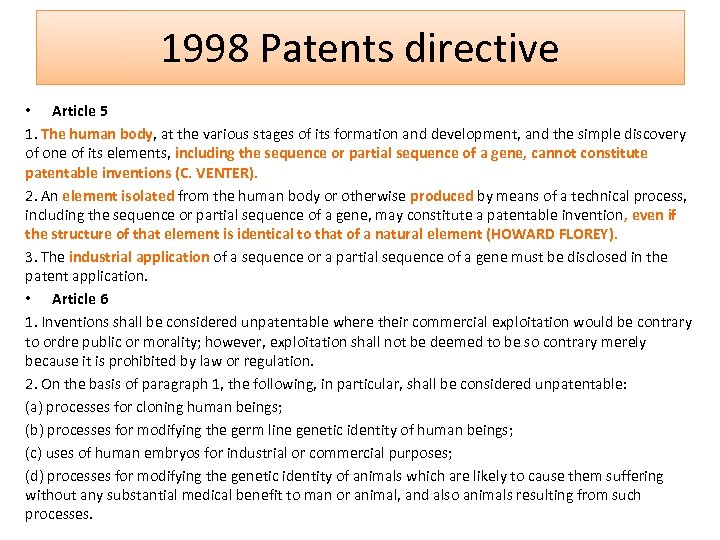
1998 Patents directive • Article 5 1. The human body, at the various stages of its formation and development, and the simple discovery of one of its elements, including the sequence or partial sequence of a gene, cannot constitute patentable inventions (C. VENTER). 2. An element isolated from the human body or otherwise produced by means of a technical process, including the sequence or partial sequence of a gene, may constitute a patentable invention, even if the structure of that element is identical to that of a natural element (HOWARD FLOREY). 3. The industrial application of a sequence or a partial sequence of a gene must be disclosed in the patent application. • Article 6 1. Inventions shall be considered unpatentable where their commercial exploitation would be contrary to ordre public or morality; however, exploitation shall not be deemed to be so contrary merely because it is prohibited by law or regulation. 2. On the basis of paragraph 1, the following, in particular, shall be considered unpatentable: (a) processes for cloning human beings; (b) processes for modifying the germ line genetic identity of human beings; (c) uses of human embryos for industrial or commercial purposes; (d) processes for modifying the genetic identity of animals which are likely to cause them suffering without any substantial medical benefit to man or animal, and also animals resulting from such processes.
‘Ethics’ in EU biomedical law • Ethics can be said to alternatively operate one of the three following tasks: (i) transform vague and open-ended notions in possible common grounds between opposing views and thus enable compromise; (ii) act as a mode of deliberation external to the lawmaking process itself and thus either postpone or distract the heat of political conflict (and thus enable compromise); (iii) justify a renewed approach to lawmaking such as the recourse to new modes of governance (and thus enable a higher likelihood of compromise).
Direct incorporation of ethics in EU legal acts • Patents directive • FP for research – exclusion of ‘research aiming at human cloning for reproductive purposes’ and ‘research activities intended to create human embryos solely for the purpose of research or for the purpose of stem cell procurement’ [therapeutic cloning]. (Decision 1513/2002/EU of the European Parliament and of the Council of 27 Jun. 2002 concerning FP 6). Moral integration v. pluralism?
Ethics as a Means of Externalizing Political Conflict during EU Lawmaking Processes • Chronological overlap between negotiations over the Tissue directive and those over FP 6 – Should embryonic research be authorized? Becomes: should embryonic research be funded? • EGE opinions
Ethics and NMGs • Organs directive / OMC: – First communication announces OMC. Consultation meetings did take place involving a variety of stakeholders and led to the publication of a second communication that very much reflected this NMG approach, for the Commission presented the upcoming actions to be taken as aiming at the ‘identification and development of common objectives and guidelines, jointly agreed indicators and benchmarks, and identification and sharing of best practices’. Soon after, a proper directive proposal was published and eventually adopted. • NMGs: soft(er) normativity? more diversity? trump cards for silencing (or at least watering down) foreseeable political conflict (over such issues as presumed consent of the dead to donation, limitative definitions of living donors, etc. )?
ECJ 2011, Brüstle • A legal definition of the embryo: « Accordingly, any human ovum must, as soon as fertilised, be regarded as a ‘human embryo’ within the meaning and for the purposes of the application of Article 6(2)(c) of the Directive, since that fertilisation is such as to commence the process of development of a human being » (§ 35).
ECJ 2011 Brüstle • Patent covers the use of h. ESC for the production of neural cells for transplantation (regenerative medicine / Parkinson disease) • Greenpeace challenges the patent: the use of h. ESC is prohibited by the German Patent law and the directive. Referral: interpration of art. 6 of the Patents dir of 1998 / embryos and h. ESCs.
ECJ 2011, Brüstle • Article 6(2)(c) of Directive 98/44/EC of the European Parliament and of the Council of 6 July 1998 on the legal protection of biotechnological inventions must be interpreted as meaning that: • – any human ovum after fertilisation, any non-fertilised human ovum into which the cell nucleus from a mature human cell has been transplanted, and any non-fertilised human ovum whose division and further development have been stimulated by parthenogenesis constitute a ‘human embryo’; • – it is for the referring court to ascertain, in the light of scientific developments, whether a stem cell obtained from a human embryo at the blastocyst stage constitutes a ‘human embryo’ within the meaning of Article 6(2)(c) of Directive 98/44.
ECJ 2011 Brüstle / autonomous notion § 21 According to the referring court, having regard to the fact that. Article 6(2) of the Directive does not allow the Member States any discretion as regards the fact that the processes and uses listed therein are not patentable (see Case C‑ 377/98 Netherlands v Parliament and Council [2001] ECR I‑ 7079, paragraph 39, and Case C‑ 456/03 Commission v Italy [2005] ECR I‑ 5335, paragraph 78 et seq. ), the reference made in the second sentence of Paragraph 2(2) of the Pat. G to the ESch. G, particularly to the definition of an embryo which Paragraph 8(1) of that Law gives, cannot be regarded as the fruit of the task left to Member States to put Article 6(2)(c) of the Directive into concrete terms in that regard, even though the Directive did not expressly define the concept of embryo. The only possible interpretation of that concept is European and unified. In other words, the second sentence of Paragraph 2(2) of the Pat. G and, in particular, the concept of embryo which it uses cannot be interpreted differently from that of the corresponding concept in Article 6(2)(c) of the Directive.
ECJ 2011 Brüstle / autonomous notion • ECJ Summary of the case: 1. For the purposes of application of Directive 98/44 on the legal protection of biotechnological inventions, the term ‘human embryo’ in Article 6(2) of that directive, must be regarded as designating an autonomous concept of European Union law which must be interpreted in a uniform manner throughout the territory of the Union. That conclusion is supported by the object and the aim of the directive. The lack of a uniform definition of the concept of human embryo would create a risk of the authors of certain biotechnological inventions being tempted to seek their patentability in the Member States which have the narrowest concept of human embryo and are accordingly the most liberal as regards possible patentability, because those inventions would not be patentable in the other Member States. Such a situation would adversely affect the smooth functioning of the internal market which is the aim of the directive. (see paras 26, 28)
ECJ 2001, Netherlands v. EP and Council § 37: « as regards… art. 6 of the directive, which rules out the patentability of inventions whose commercial exploitation would be contrary to ordre public or morality, it is common ground taht this provision allows the administrative authorities and courts of the MS a wide scope for manœuvre in applying this exclusion » . § 38: « that scope for manœuvre is necessary to take account of the particular difficulties to which the use of certain patents may give rise in the social and cultural context of each MS, a context which the national legislative, adminsitrative and court authorities are better placed to understand than are the Cty authorities » .
Law & Science: epistemology § 85: Consequently, in my view totipotent cells represent the first stage of the human body which they will become. They must therefore be legally categorised as embryos. § 94: One of the first stages attained when the totipotent cells have given way to pluripotent cells is called the blastocyst. Does it also constitute an embryo from a legal point of view? A reminder of the development process, even if it is clumsy and partial like the one above, clearly shows that the thing to which the totipotent cells have given way is the product of their own special nature, the thing for which they exist. Whilst, in themselves, totipotent cells hold the capacity to develop a complete human body, the blastocyst is the product of this capacity for development at a certain moment. It is therefore one of the aspects of the development of the human body and constitutes one of the stages.
Law & Science: epistemology (cont’d) 86. The question whether that categorisation must be recognised from before or only after nidation is irrelevant here, in my view, even though I fully appreciate its utilitarian aspect. 87. How can we justify the legal categorisation being different after this particular event? Because the future of the fertilised ovum is uncertain as long as nidation does not take place? Is it not also uncertain after that? Does all nidation result in a birth? It is clear that the answer is no. On the other hand, I cannot see why categorisation would be refused on the pretext of a possible dangerous event before nidation and would not be afterwards, when the same danger exists, but materialises less frequently. Would probability be a source of law in that case? 88. For the sake of consistency, I also do not see why legal categorisation as an embryo would be refused in the case of in vitro fertilisation, unless it is to enable a couple to bring children into their family. 89. Here, the distinguishing legal criterion would be psychological and would hinge on the intention preceding gamete fusion. Such a criterion cannot be universally accepted in the Member States. There would immediately be objections directly relating to ethics, with repercussions for the assessment of ordre public and morality, to use the expressions employed in Directive 98/44 and the abovementioned international conventions.
Law & Science: stakes ECJ definition of the embryo: - any human ovum after fertilisation (in vivo and in vitro), - any non-fertilised human ovum into which the cell nucleus from a mature human cell has been transplanted (therapeutic cloning) - and any non-fertilised human ovum whose division and further development have been stimulated by parthenogenesis constitute a ‘human embryo’ (therapeutic cloning) many different realities subsumed under a single legal category
ECHR / EU in the field of bioethics • ECHR: Pretty v. UK 2002 (assisted suicide) Odièvre v. France, 2003 and Godelli v. Italy 2012 (anonymity of women upon delivery) I. and Christine Goodwin v. UK 2002 GC (transgender identity & right to marriage) Tysiac v. Poland, 2007 and A, B and C v. ireland 2010 GC (abortion) S. and H. v. Austria, 2012 (assisted reproduction) Costa and Pavan v. Italy 2012 (prenatal / preimplantatory diagnosis) …
ECHR proceduralization of subst. rights / subtantialization of proc. rights ECHR, Tysiac v. Poland, 2007: 113. Finally, the Court reiterates that in the assessment of the present case it should be borne in mind that the Convention is intended to guarantee not rights that are theoretical or illusory but rights that are practical and effective (see Airey v. Ireland, 9 October 1979, § 24, Series A no. 32). While Article 8 contains no explicit procedural requirements, it is important for the effective enjoyment of the rights guaranteed by this provision that the relevant decision‑making process is fair and such as to afford due respect to the interests safeguarded by it. 123. In this connection, the Court notes that in certain State Parties various procedural and institutional mechanisms have been put in place in connection with the implementation of legislation specifying the conditions governing access to a lawful abortion (see paragraphs 86‑ 87 above). 124. The Court concludes that it has not been demonstrated that Polish law as applied to the applicant’s case contained any effective mechanisms capable of determining whether the conditions for obtaining a lawful abortion had been met in her case. (…) 125. The Court is further of the opinion that the provisions of the civil law on tort as applied by the Polish courts did not afford the applicant a procedural instrument by which she could have vindicated her right to respect for her private life. The civil-law remedy was solely of a retroactive and compensatory character. It could only, if the applicant had been successful, have resulted in the courts granting damages to cover the irreparable damage to her health which had come to light after the delivery.
Procedural aspects of art. 8 • Koch v. Germany, 2012: 65. The Court will start its examination under the procedural aspect of Article 8 of the Convention. (and finds a violation): refusal to access delivery of a lethal dose of medication (end of life issue) • RR v. Poland, 2011: § 200: In particular, the State is under a positive obligation to create a procedural framework enabling a pregnant woman to exercise her right of access to lawful abortion (Tysiąc v. Poland, no. 5410/03, §§ 116 - 124, ECHR 2007‑IV). In other words, if the domestic law allows for abortion in cases of foetal malformation, there must be an adequate legal and procedural framework to guarantee that relevant, full and reliable information on the foetus’ health is available to pregnant women. • P and S v. Poland 2012: procedural aspects of art. 8 (access to decision making of mother of raped teenager) (plus art. 3 violation)
EF/FR • ECHR, GC, 2010, A, B and C v. Ireland: § 241. Accordingly, having regard to the right to lawfully travel abroad for an abortion with access to appropriate information and medical care in Ireland, the Court does not consider that the prohibition in Ireland of abortion for health and wellbeing reasons, based as it is on the profound moral views of the Irish people as to the nature of life (paragraphs 222227 above) and as to the consequent protection to be accorded to the right to life of the unborn, exceeds the margin of appreciation accorded in that respect to the Irish State. In such circumstances, the Court finds that the impugned prohibition in Ireland struck a fair balance between the right of the first and second applicants to respect for their private lives and the rights invoked on behalf of the unborn.
EF/FR (cont’d) ECHR, GC, 2011, SH v. Austria § 114. The fact that the Austrian legislature, when enacting the law on artificial procreation which enshrined the decision not to allow the donation of sperm or ova for in vitro fertilisation, did not at the same time prohibit sperm donation for in vivo fertilisation – a technique which had been tolerated for a considerable period beforehand had become accepted by society – is a matter that is of significance in the balancing of the respective interests and cannot be considered solely in the context of the efficient policing of the prohibitions. It shows rather the careful and cautious approach adopted by the Austrian legislature in seeking to reconcile social realities with its approach of principle in this field. In this connection the Court also observes that there is no prohibition under Austrian law on going abroad to seek treatment of infertility that uses artificial procreation techniques not allowed in Austria and that in the event of a successful treatment the Civil Code contains clear rules on paternity and maternity that respect the wishes of the parents (see, mutatis mutandis, A. B. and C. v. Ireland, cited above, § 239).
Скачать презентацию EU LAW AND BIOETHICS 1 EU LAW OF
7a5e3d995cbf59248bb6d66cc8d3cc52.ppt