 Скачать презентацию EU Green Public Procurement Policy EU-Taiwan Seminar on
b766dbcc90a252210b652cf952015fb0.ppt
- Количество слайдов: 20



EU Green Public Procurement Policy EU-Taiwan Seminar on Green Public Procurement 11 December 2012, Taipei European Commission Environment Directorate-General Robert Kaukewitsch
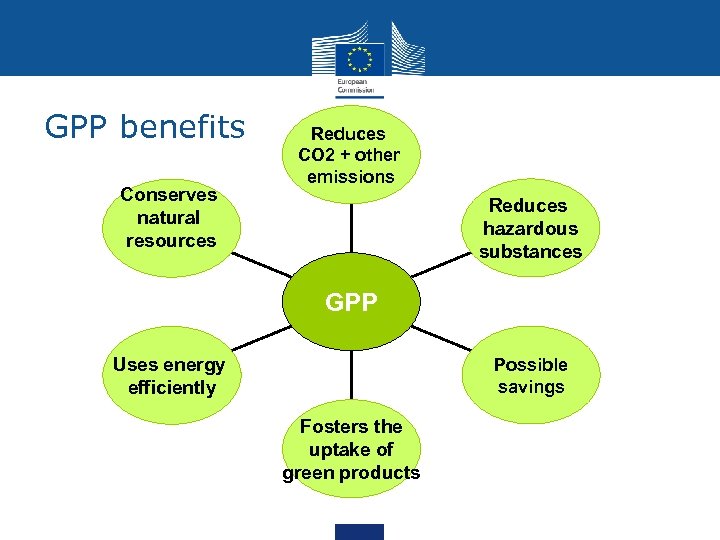
GPP benefits Conserves natural resources Reduces CO 2 + other emissions Reduces hazardous substances GPP Uses energy efficiently Possible savings Fosters the uptake of green products
Achieving different objectives at a time • - by purchasing less polluting buses, you can buy public transport and clean air • - by purchasing renewables, you buy electricity and reduce CO 2 emissions • - by purchasing organic produce, you buy food and reduce pollution and improve animal welfare
So why don’t we do it all? Obstacles to GPP • • Lack of political support Green products are perceived to cost more Lack of knowledge on how to verify green criteria Lack of awareness of the benefits of green products • Lack of legal expertise • Lack of training, practical tools and information • Limited established environmental criteria for products/services Commission support to overcome these obstacles
Communication (2008) Public Procurement for a Better Environment Political target: 50% of tendering procedures to be green by 2010 Common EU GPP criteria for priority products / services Legal/ Operational guidance: GPP Training Toolkit GPP National Action Plans
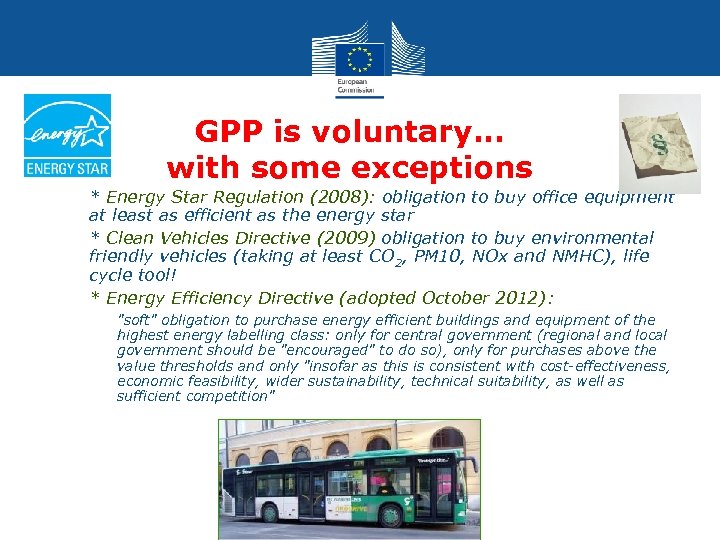
GPP is voluntary… with some exceptions * Energy Star Regulation (2008): obligation to buy office equipment at least as efficient as the energy star * Clean Vehicles Directive (2009) obligation to buy environmental friendly vehicles (taking at least CO 2, PM 10, NOx and NMHC), life cycle tool! * Energy Efficiency Directive (adopted October 2012): "soft" obligation to purchase energy efficient buildings and equipment of the highest energy labelling class: only for central government (regional and local government should be "encouraged" to do so), only for purchases above the value thresholds and only "insofar as this is consistent with cost-effectiveness, economic feasibility, wider sustainability, technical suitability, as well as sufficient competition" -
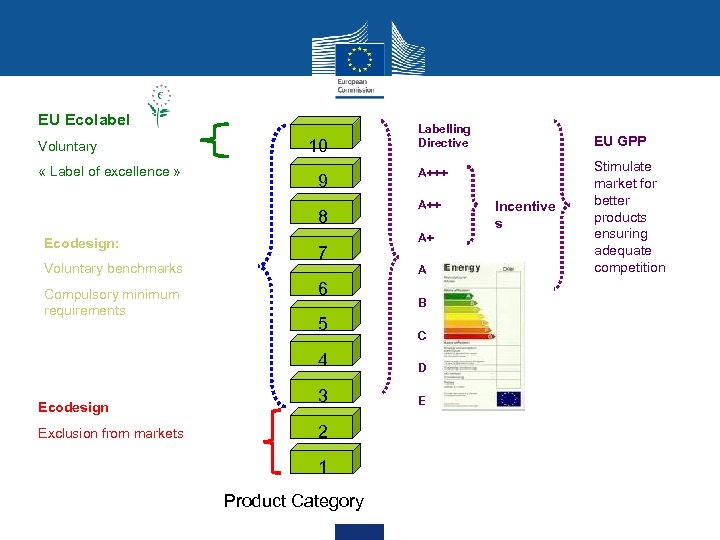
EU Ecolabel Voluntary « Label of excellence » 10 9 8 Ecodesign: Voluntary benchmarks Compulsory minimum requirements 7 Labelling Directive A+++ A+ A 6 5 B C 4 Ecodesign Exclusion from markets D 3 E 2 1 Product Category EU GPP Incentive s Stimulate market for better products ensuring adequate competition
18+ EU GPP Criteria • • Construction, Electricity, Cleaning Products and Services, Textiles, Food and Catering services, Furniture, Office IT equipment, Paper, Gardening Products and Devices, Transport Windows, Thermal insulation, Wall Panels, Hard floor coverings, Cogenerations (CHP), Street lighting and traffic signals, Mobile phones New in 2012: Indoor Lighting Criteria also under development for Imaging Equipment, Buildings, Heating Systems, Taps and Showerheads, Toilets, Electrical Medical Equipment (SEMCo), Paints and Varnishes, Roads and Waste Water Treatment Plants
Choice of Product Groups for the Development of EU GPP Criteria • Does the product group have a bigger environmental impact? • Is there a substantial environmental improvement potential? • Do public authorities purchase the product in higher quantities?
Two levels of criteria Core criteria: address the key environmental impacts, designed to be used with minimum additional verification effort or cost increases. Comprehensive criteria: to purchase the best environmental products available on the market, possibly requiring additional verification efforts or a slight increase in cost compared to other products with the same functionality. GPP criteria are largely based on standard Type I ecolabels It is however not allowed to ask for products to have a specific label.
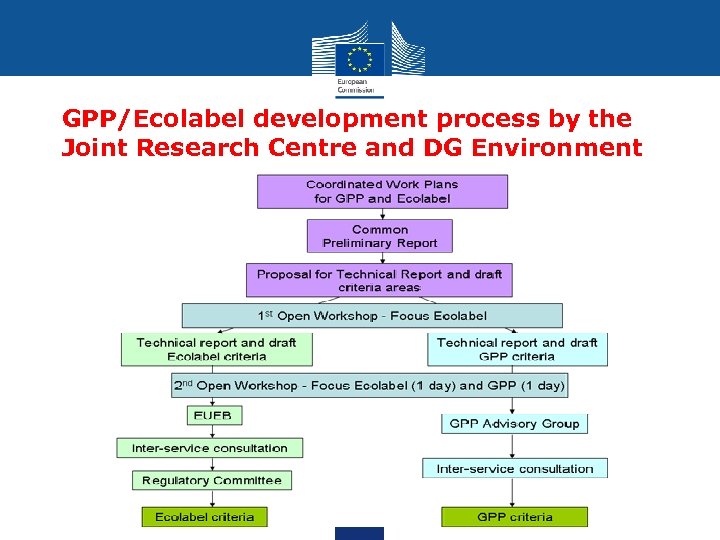
GPP/Ecolabel development process by the Joint Research Centre and DG Environment
Main elements of the criteria development process • - definition of scope of the product group • - detection of main environmental impacts on life cycle assessment basis • - drafting of criteria for the main environmental impacts • - making sure that criteria can be understood by procurers and suppliers • - making sure that there are sufficient products that meet the requirements in order to ensure competition • - providing verification method • All this is being done in the framework of a broad stakeholder dialogue (business, NGOs, Member States)
How much GPP is being done in the EU? - - 2008 study: 50% target more or less achieved in the 7 most advanced Member States for 10 product and service groups - - Netherlands 2011: 99. 8% of public procurement at national level in 2010 was green (target: 100%), provinces: 96% (target: 50%), municipalities 86 to 90% (target: 75%) - - 2011 Study: 50% target not met across the whole of the EU, but more than 50% of public authorities are doing some sort of green procurement
Influence of EU GPP policies on Member States • - almost all do have National Action Plans in place • - MS often refer to EU GPP criteria in their national policies: 53% of procurers and 50% of policy makers use or recommend criteria which are the same or very similar to the EU GPP criteria (public consultation in 2012)
Some examples o The City of Vienna saved € 44. 4 million and over 100, 000 tonnes of CO 2 between 2004 and 2007, through its Eco. Buy programme. o £ 40. 7 million could be saved in the UK if proposed GPP furniture criteria are applied according to a cost-benefit analysis which monetarised the potential impacts.
The Forerunner Countries • Large differences between good and bad performers: • The four top performing countries applied GPP in 4060% of the cases • In twelve countries: less than 20% • Top performers according to different studies: Belgium, Denmark, Netherlands, Sweden, UK • Forerunner countries are usually characterised by: • • - long tradition in GPP - targets for achieving certain GPP levels, - existence of hard or soft obligations, - developed and institutionalized, proactive capacitybuilding efforts
GPP information sources • HELP DESK : gpp-helpdesk@iclei. org (in EN, FR, DE only) • Newsletter (please sign up!) - GPP website of the European Commission: * Buying Green Handbook * The full sets of EU GPP criteria and background reports, as well as information on the criteria-setting process * GPP Examples * Information on National Action Plans for GPP * A list of FAQs and glossary of key term * News and upcoming events
Future development of GPP Further implementation of the existing GPP policy ► Objective is to assist contracting authorities on what and how to procure to improve resource efficiency and reduce environmental impacts of their activities ► Gradual update and development of GPP criteria ► Focus on criteria that are demanded by procurers in MS ► Support implementation of EU Structural Funds, i. e. GPP criteria for infrastructure projects ► Promote LCC in public procurement ► Development of practical LCC tools ► Explore possibilities to integrate GPP and social elements of sustainable procurement
Thank you! • Questions? • • Please contact GPP HELP DESK gpp-helpdesk@iclei. org or robert. kaukewitsch@ec. europa. eu • GPP webpage: http: //ec. europa. eu/environment/gpp/index_en. htm
Скачать презентацию EU Green Public Procurement Policy EU-Taiwan Seminar on
b766dbcc90a252210b652cf952015fb0.ppt