


 Скачать презентацию EU Code Implementation Programme Place your chosen image
1caa95fbe5aa82a88977c7a201f627a5.ppt
- Количество слайдов: 104
 EU Code Implementation Programme Place your chosen image here. The four corners must just cover the arrow tips. For covers, the three pictures should be the same size and in a straight line. Transmission Workgroup 9 th January 2014
 EU Code Implementation Programme - Agenda (1) 1. Introduction ¾ Engagement approach ¾ Challenges – parallel working, etc. 2. Challenges ahead and approach to implementation - Ofgem 3. Challenges ahead and approach to implementation from a shipper perspective – Gas Forum 4. Phase 1 ¾ CMP - LTUIOLI 5. Phase 2 ¾ CAM ¾ Balancing ¾ Interoperability ¾ Gas Day
 EU Code Implementation Programme - Agenda (2) 6. Phase 3 and 4 ¾ Tariffs and Incremental Capacity 7. Systems Development 8. UNC Modification Plans ¾ Approach ¾ Draft Plans 9. Next Steps ¾ NG Website ¾ Future EU process 3
 Introduction Chris Logue
 Aims for today § To provide an overview of the breadth of the EU code implementation work for this year. § To seek views about the best ways to engage and take this work forwards. § Provide an opportunity to discuss some of the likely changes that are necessary because of the EU codes. 5
 Engagement to date § Dedicated NG workshops held to lay out the implications of the 3 rd package and outline code concepts & developments. Led to: § Ofgem/DECC EU Stakeholder Group § Concept of a dedicated JESG type group was suggested. § Consensus view was that Trans WG updates were sufficient. § Standing agenda item for the past 3 years 6
 EU Updates to GB Stakeholders ¾ Regular updates are provided by NG NTS to GB stakeholders via DECC/OFGEM meetings, Transmission Workgroup Updates (monthly), Gas Forum, NG open meetings (adhoc), Bilateral meetings, etc. ¾ The updates have covered the following: ¾ Development of the European Framework Guidelines or Code – highlighting emerging concepts, rules, encouraging involvement in and detailing EU engagement opportunities, phase completion dates and implementation dates ¾ National Grid Impact Assessments (IAs) – highlighting areas of change for GB regime ¾ Comitology Updates – highlighting changes made by the EC following discussion with member states ¾ Pre Modification Updates – providing further detail on the changes identified and/or how they maybe implemented ¾ Details on initial high level implementation roadmap are now being communicated
 Code Status Update Code Current Status Implementation date Congestion Management (CMP) Implemented 1 st October 2013 (Fixed) Capacity Allocation Mechanism (CAM) CAM approved for EU Wide Implementation at relevant EU IPs 1 st November 2015. 1 November 2015 (Fixed) ACER approved the code on 20 th March 2013 and comitology started in July 2013. Oct 2015/Oct 2016 Code approved by EC at the comitology meeting on the 2 nd October. (subject to NRA approval for additional 12 months to implement) (Fixed) Q 4 2015 (Estimated) Interoperability ACER's Reasoned Opinion was published on 22 nd November 2013. ENTSOG submitted a revised version of the Code to ACER on 18 th December 2013. A ‘pre-comitology’ meeting for Member State representatives has been scheduled for 21 st January 2014. Final FGs extended until Q 4 2013 to allow more consideration of Cost Allocation Estimated earliest mid Tariffs methodology. ACER consultation on Cost Allocation methodology section of Tariff January 2017 FG and Tariffs for Incremental Capacity closed 17 th September. Publication of FG expected by 30 th November. Gas Balancing Incremental Capacity ACER consultation closed 17 th September. Incremental Capacity expected to be introduced via combination of new articles in CAM Network Code and via Tariffs Network Code. TBC
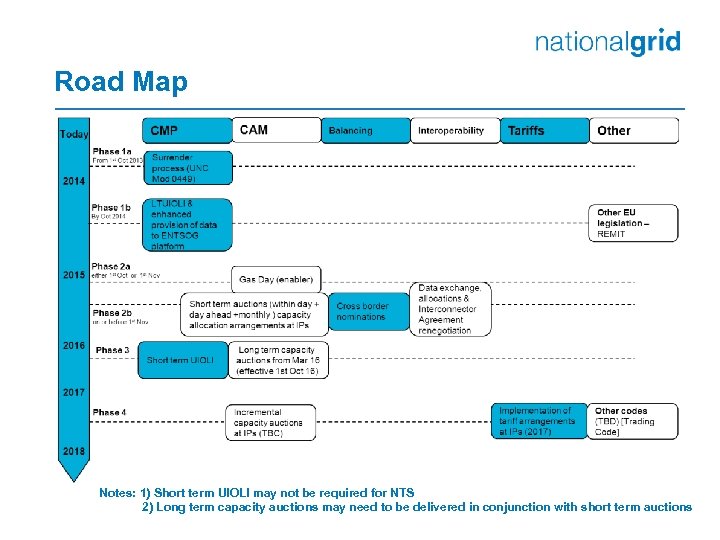 Road Map Notes: 1) Short term UIOLI may not be required for NTS 2) Long term capacity auctions may need to be delivered in conjunction with short term auctions
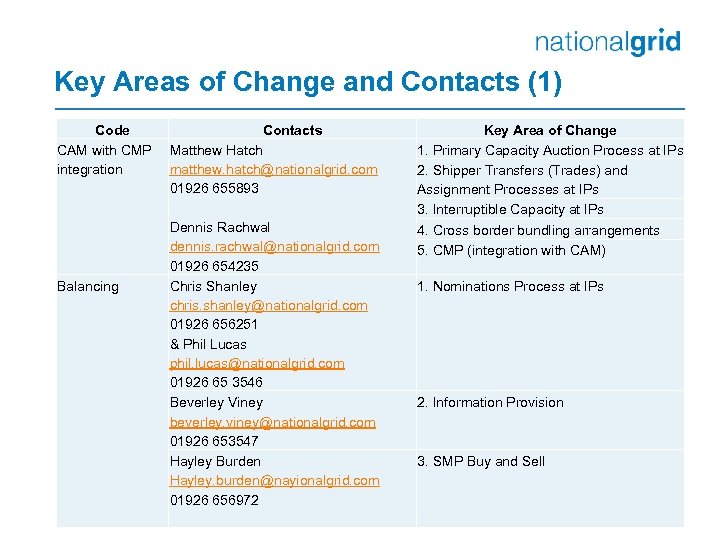 Key Areas of Change and Contacts (1) Code CAM with CMP integration Balancing Contacts Matthew Hatch matthew. hatch@nationalgrid. com 01926 655893 Dennis Rachwal dennis. rachwal@nationalgrid. com 01926 654235 Chris Shanley chris. shanley@nationalgrid. com 01926 656251 & Phil Lucas phil. lucas@nationalgrid. com 01926 65 3546 Beverley Viney beverley. viney@nationalgrid. com 01926 653547 Hayley Burden Hayley. burden@nayionalgrid. com 01926 656972 Key Area of Change 1. Primary Capacity Auction Process at IPs 2. Shipper Transfers (Trades) and Assignment Processes at IPs 3. Interruptible Capacity at IPs 4. Cross border bundling arrangements 5. CMP (integration with CAM) 1. Nominations Process at IPs 2. Information Provision 3. SMP Buy and Sell
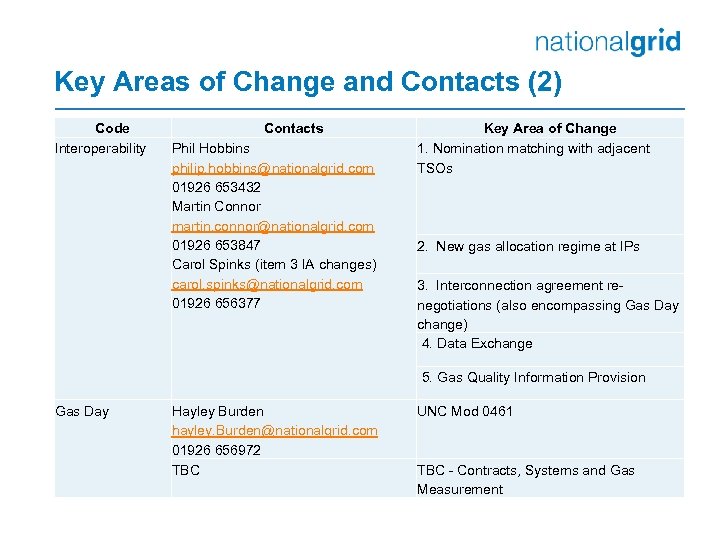 Key Areas of Change and Contacts (2) Code Interoperability Contacts Phil Hobbins philip. hobbins@nationalgrid. com 01926 653432 Martin Connor martin. connor@nationalgrid. com 01926 653847 Carol Spinks (item 3 IA changes) carol. spinks@nationalgrid. com 01926 656377 Key Area of Change 1. Nomination matching with adjacent TSOs 2. New gas allocation regime at IPs 3. Interconnection agreement renegotiations (also encompassing Gas Day change) 4. Data Exchange 5. Gas Quality Information Provision Gas Day Hayley Burden hayley. Burden@nationalgrid. com 01926 656972 TBC UNC Mod 0461 TBC - Contracts, Systems and Gas Measurement
 Challenges ¾ In order to facilitate the implementation of the EU regulations on CAM at GB IPs, the Regulators have requested that the adjacent TSOs develop a ‘Concept Document’ ¾ Concept document will outline the key principles all the TSOs need to adopt in order for the EU Codes to be successfully implemented, so that stakeholders can acquire ‘bundled’ capacity products ¾ Concept document expected to be produced by April 2014 – sign off by Regulators expected in Sept 2014 ¾ Therefore an element of parallel working is required…. .
 Challenges ahead and approach to implementation Ofgem
 Challenges ahead and approach to implementation from shipper perspective Gas Forum
 Phase 1 Colin Hamilton
 CMP – LTUIOLI: Interim Solution 9 January 2014
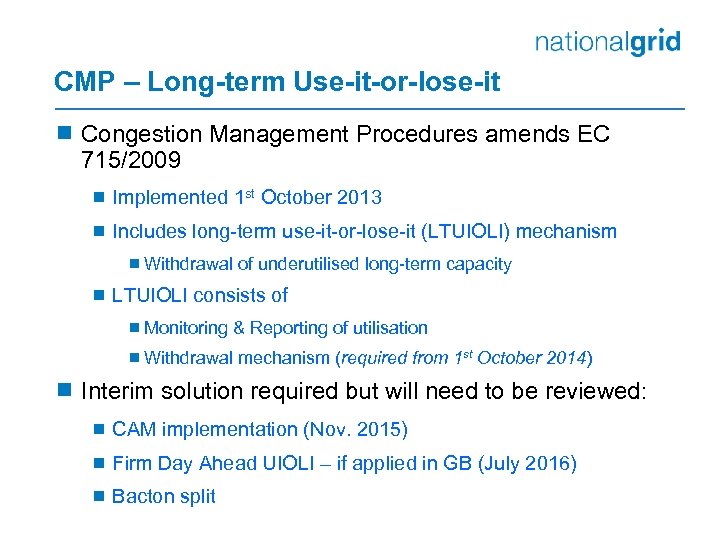 CMP – Long-term Use-it-or-lose-it ¾ Congestion Management Procedures amends EC 715/2009 ¾ Implemented 1 st October 2013 ¾ Includes long-term use-it-or-lose-it (LTUIOLI) mechanism ¾ Withdrawal of underutilised long-term capacity ¾ LTUIOLI consists of ¾ Monitoring & Reporting of utilisation ¾ Withdrawal mechanism (required from 1 st October 2014) ¾ Interim solution required but will need to be reviewed: ¾ CAM implementation (Nov. 2015) ¾ Firm Day Ahead UIOLI – if applied in GB (July 2016) ¾ Bacton split
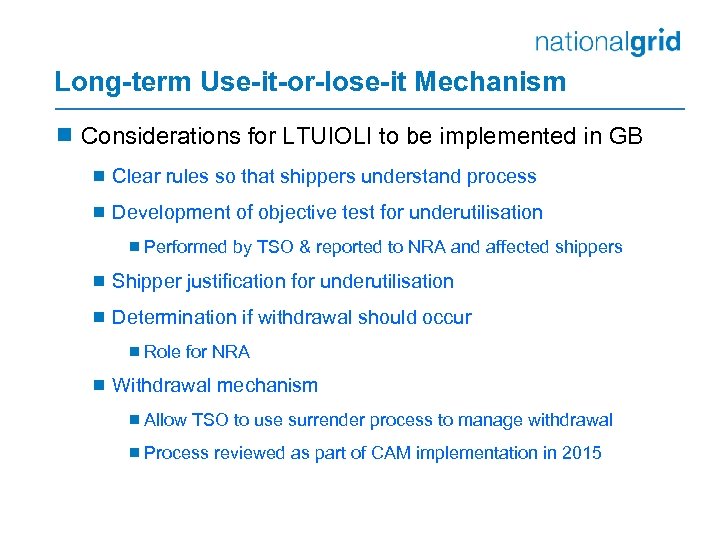 Long-term Use-it-or-lose-it Mechanism ¾ Considerations for LTUIOLI to be implemented in GB ¾ Clear rules so that shippers understand process ¾ Development of objective test for underutilisation ¾ Performed by TSO & reported to NRA and affected shippers ¾ Shipper justification for underutilisation ¾ Determination if withdrawal should occur ¾ Role for NRA ¾ Withdrawal mechanism ¾ Allow TSO to use surrender process to manage withdrawal ¾ Process reviewed as part of CAM implementation in 2015
 Long-term Use-it-or-lose-it Mechanism ¾Monitoring of Utilisation ¾Withdrawal Mechanism ¾Mod for interim solution
 Long-term Use-it-or-lose-it Mechanism ¾Monitoring of Utilisation ¾Withdrawal Mechanism ¾Mod for interim solution
 Monitoring of Utilisation ¾ Underutilisation of capacity “with an effective contract duration of more than one year” ¾ CMP defines relevant capacity as “only contracts with duration of more than one year or recurring quarters covering at least two years, for bundled and unbundled capacity, are effected by this CMP. ” ¾ With this interpretation then in current GB system underutilisation shall have to occur for ¾ Entry, where shippers underutilise 4 consecutive quarters and hold 8 consecutive quarters (e. g. Bacton QSEC Oct 13 -Sep 15) ¾ Exit, underutilisation for exit shall have to occur for a year where shipper holds ESEC or 2 consecutive years of ASEC at BBL, IUK or Moffat.
 Monitoring of Utilisation ¾ What is underutilisation according to CMP? ¾ “the network user uses less than on average 80 % of its contracted capacity both from 1 April until 30 September and from 1 October until 31 March with an effective contract duration of more than one year for which no proper justification could be provided” ¾ Key issue is what to monitor. ¾ For GB regime should monitor utilisation of entitlement rather than holding. ¾ Why choose net entitlement over specific holdings? ¾ In GB system shippers flow against entitlements not specific capacity contracts ¾ Entitlement takes account of capacity trades ¾ This approach is “best fit” to GB regime
 Shipper Justification ¾ To trigger LTUIOLI mechanism also requires: ¾ “where that user has not sold or offered under reasonable conditions its unused capacity and where other network users request firm capacity. ” ¾ Justifications could include: ¾ Capacity offered for surrender for monitoring period ¾ Capacity offered in forward buyback? ¾ Capacity offered in option contracts? ¾ Trades? ¾ ……
 Reporting and Assessment ¾ Utilisation Monitoring Report produced for NRA every 6 months ¾ The report shall include ¾ the average utilisation values for each shipper at each IP ¾ “Traffic light” status ¾ Any shipper “justification” submissions ¾ Data file showing how all derived values were calculated ¾ Ofgem determines if conditions for withdrawal have been met and direct NGG to initiate any withdrawal
 Long-term Use-it-or-lose-it Mechanism ¾Monitoring of Utilisation ¾Withdrawal Mechanism ¾Mod for interim solution
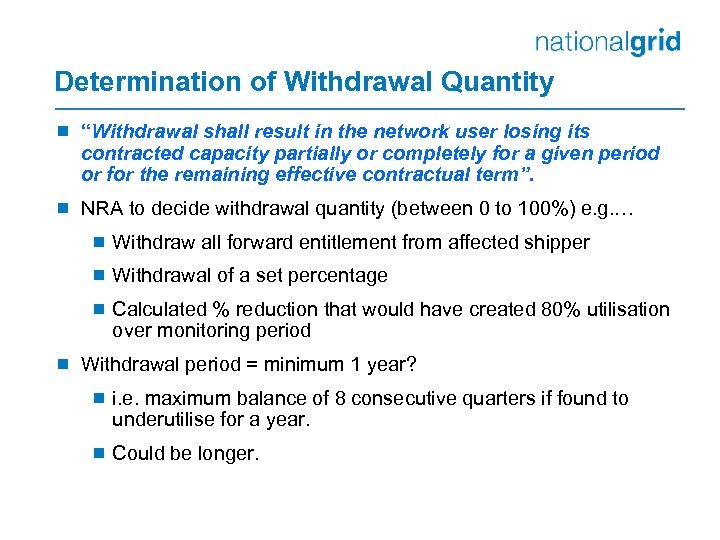 Determination of Withdrawal Quantity ¾ “Withdrawal shall result in the network user losing its contracted capacity partially or completely for a given period or for the remaining effective contractual term”. ¾ NRA to decide withdrawal quantity (between 0 to 100%) e. g. … ¾ Withdraw all forward entitlement from affected shipper ¾ Withdrawal of a set percentage ¾ Calculated % reduction that would have created 80% utilisation over monitoring period ¾ Withdrawal period = minimum 1 year? ¾ i. e. maximum balance of 8 consecutive quarters if found to underutilise for a year. ¾ Could be longer.
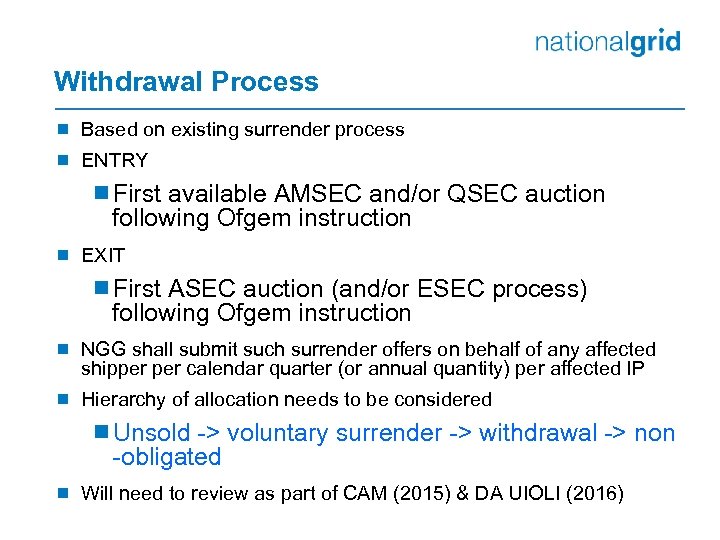 Withdrawal Process ¾ Based on existing surrender process ¾ ENTRY ¾First available AMSEC and/or QSEC auction following Ofgem instruction ¾ EXIT ¾First ASEC auction (and/or ESEC process) following Ofgem instruction ¾ NGG shall submit such surrender offers on behalf of any affected shipper calendar quarter (or annual quantity) per affected IP ¾ Hierarchy of allocation needs to be considered ¾Unsold -> voluntary surrender -> withdrawal -> non -obligated ¾ Will need to review as part of CAM (2015) & DA UIOLI (2016)
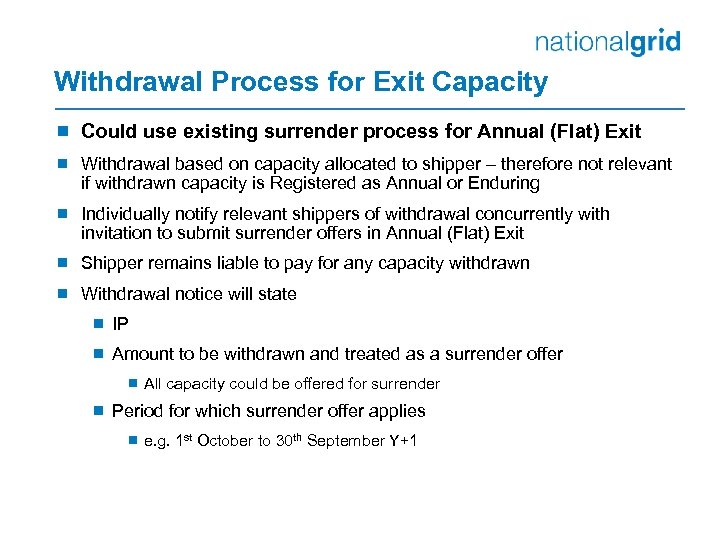 Withdrawal Process for Exit Capacity ¾ Could use existing surrender process for Annual (Flat) Exit ¾ Withdrawal based on capacity allocated to shipper – therefore not relevant if withdrawn capacity is Registered as Annual or Enduring ¾ Individually notify relevant shippers of withdrawal concurrently with invitation to submit surrender offers in Annual (Flat) Exit ¾ Shipper remains liable to pay for any capacity withdrawn ¾ Withdrawal notice will state ¾ IP ¾ Amount to be withdrawn and treated as a surrender offer ¾ All capacity could be offered for surrender ¾ Period for which surrender offer applies ¾ e. g. 1 st October to 30 th September Y+1
 Long-term Use-it-or-lose-it Mechanism ¾Monitoring of Utilisation ¾Withdrawal Mechanism ¾Mod for interim solution
 What could Mod contain ¾ Proposed approach for discussion: ¾ CMP: “Transmission system operators shall regularly provide national regulatory authorities with all the data necessary to monitor the extent to which contracted capacities with effective contract duration of more than one year or recurring quarters covering at least two years are used. ” ¾In Licence? : Describe basic monitoring requirement and obligation for TSO to supply NRA with necessary data (CMP reg. ) ¾Detailed monitoring methodology published on NG website not in UNC ¾In UNC? : record that relevant shippers will be individually notified of underutilisation and given opportunity to justify utilisation
 What could Mod contain ¾ Proposed approach for discussion: ¾ Withdrawal process based on existing surrender process ¾ Amend text in UNC Section B as required ¾ UNC will not specify quantity and duration of withdrawal but simply record that the NRA shall require transmission system operators to partially or fully withdraw systematically underutilised contracted capacity on an interconnection point by a network user where not properly justified by user for a given period or for the remaining effective contractual term (i. e. aligned to CMP reg. )
 Long-term Use-it-or-lose-it ¾ Aim to minimise changes to systems and look to utilise existing functionality ¾ Uses transparent utilisation test ¾ Allow shipper to “justify” utilisation ¾ Withdrawal based on existing surrender processes (arising from Mod 449) ¾ Utilisation monitoring from 1 st October 2013 ¾ First report ~April 2014 ¾ LTUIOLI withdrawal instruction from Ofgem could occur post. October 2014 ¾ First withdrawal could be Feb 2015 AMSEC or March 2015 QSEC auction for entry and July 2015 for annual enduring exit
 Phase 2
 CAM Code Matthew Hatch
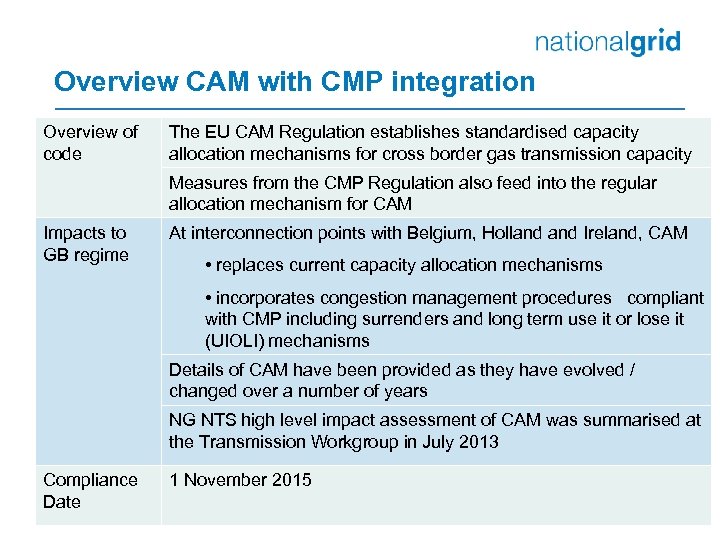 Overview CAM with CMP integration Overview of code The EU CAM Regulation establishes standardised capacity allocation mechanisms for cross border gas transmission capacity Measures from the CMP Regulation also feed into the regular allocation mechanism for CAM Impacts to GB regime At interconnection points with Belgium, Holland Ireland, CAM • replaces current capacity allocation mechanisms • incorporates congestion management procedures compliant with CMP including surrenders and long term use it or lose it (UIOLI) mechanisms Details of CAM have been provided as they have evolved / changed over a number of years NG NTS high level impact assessment of CAM was summarised at the Transmission Workgroup in July 2013 Compliance Date 1 November 2015
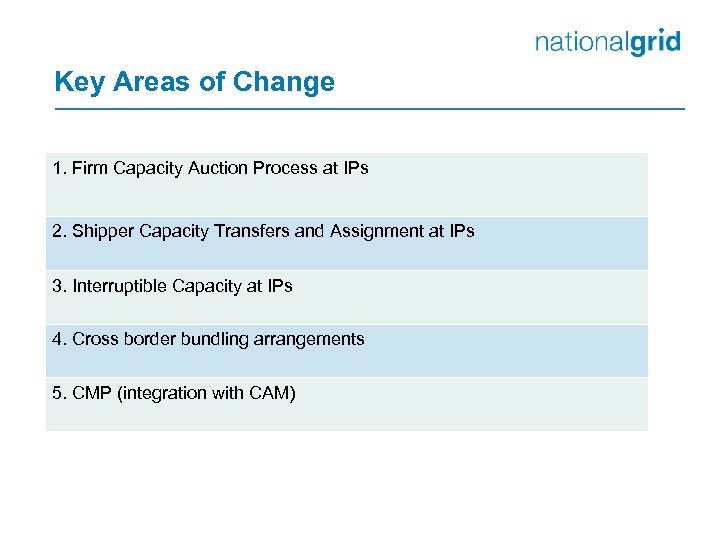 Key Areas of Change 1. Firm Capacity Auction Process at IPs 2. Shipper Capacity Transfers and Assignment at IPs 3. Interruptible Capacity at IPs 4. Cross border bundling arrangements 5. CMP (integration with CAM)
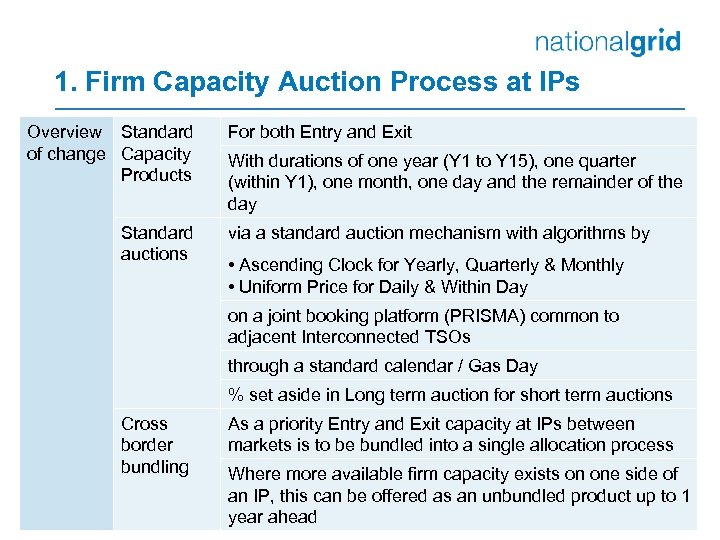 1. Firm Capacity Auction Process at IPs Overview Standard of change Capacity Products Standard auctions For both Entry and Exit With durations of one year (Y 1 to Y 15), one quarter (within Y 1), one month, one day and the remainder of the day via a standard auction mechanism with algorithms by • Ascending Clock for Yearly, Quarterly & Monthly • Uniform Price for Daily & Within Day on a joint booking platform (PRISMA) common to adjacent Interconnected TSOs through a standard calendar / Gas Day % set aside in Long term auction for short term auctions Cross border bundling As a priority Entry and Exit capacity at IPs between markets is to be bundled into a single allocation process Where more available firm capacity exists on one side of an IP, this can be offered as an unbundled product up to 1 year ahead
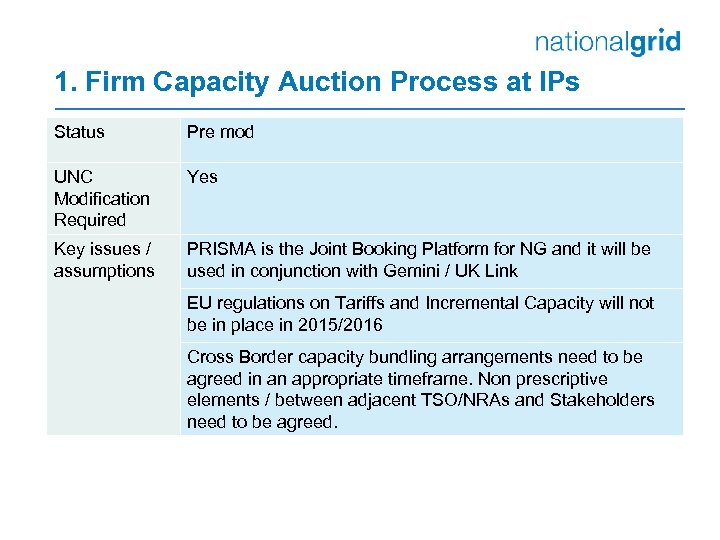 1. Firm Capacity Auction Process at IPs Status Pre mod UNC Modification Required Yes Key issues / assumptions PRISMA is the Joint Booking Platform for NG and it will be used in conjunction with Gemini / UK Link EU regulations on Tariffs and Incremental Capacity will not be in place in 2015/2016 Cross Border capacity bundling arrangements need to be agreed in an appropriate timeframe. Non prescriptive elements / between adjacent TSO/NRAs and Stakeholders need to be agreed.
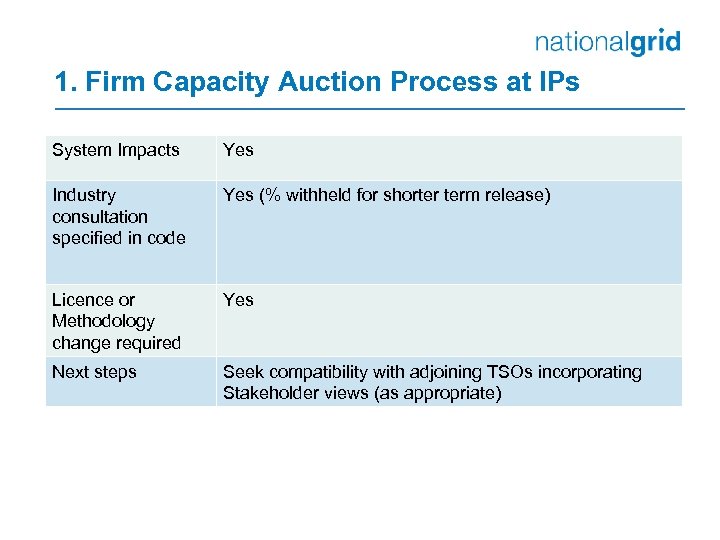 1. Firm Capacity Auction Process at IPs System Impacts Yes Industry consultation specified in code Yes (% withheld for shorter term release) Licence or Methodology change required Yes Next steps Seek compatibility with adjoining TSOs incorporating Stakeholder views (as appropriate)
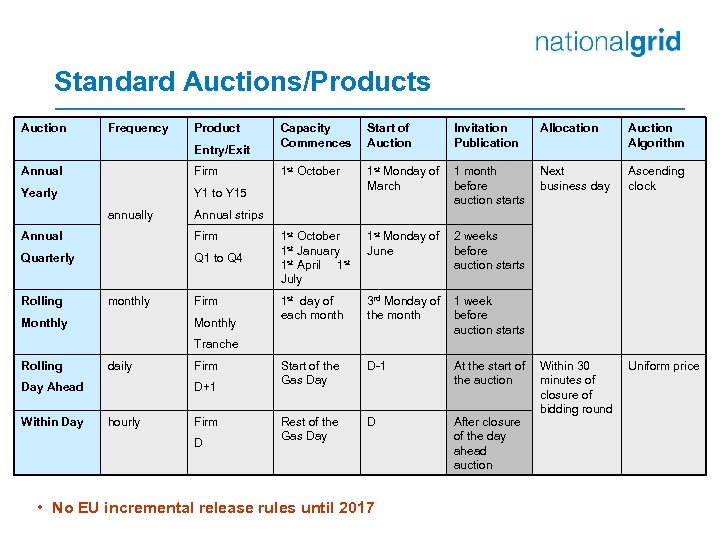 Standard Auctions/Products Auction Frequency Product Entry/Exit Annual Firm Yearly Capacity Commences Start of Auction 1 st October 1 st Monday of 1 month March before auction starts 1 st October 1 st January 1 st April 1 st July 1 st Monday of 2 weeks June before auction starts 1 st day of each month 3 rd Monday of 1 week the month before auction starts Start of the Gas Day D-1 Rest of the Gas Day D Y 1 to Y 15 annually Firm Quarterly Q 1 to Q 4 monthly Monthly Allocation Auction Algorithm Next business day Ascending clock Annual strips Annual Rolling Invitation Publication Firm Monthly Tranche Rolling daily Day Ahead Within Day Firm D+1 hourly Firm D • No EU incremental release rules until 2017 At the start of Within 30 the auction minutes of closure of bidding round After closure of the day ahead auction Uniform price
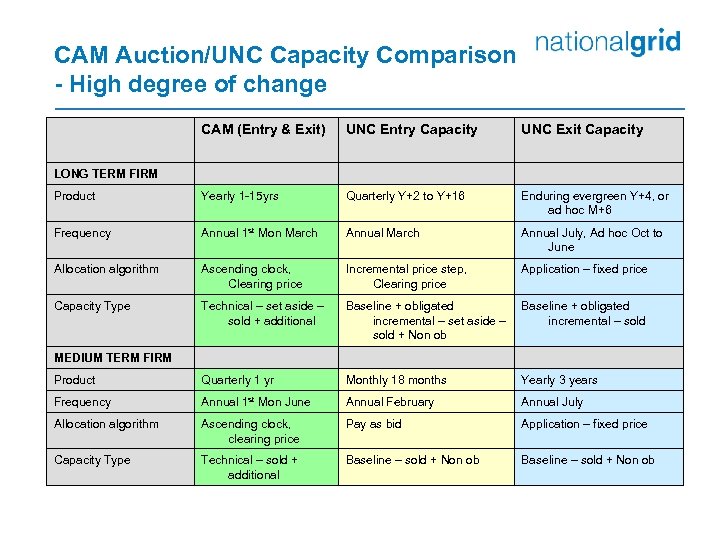 CAM Auction/UNC Capacity Comparison - High degree of change CAM (Entry & Exit) UNC Entry Capacity UNC Exit Capacity Product Yearly 1 -15 yrs Quarterly Y+2 to Y+16 Enduring evergreen Y+4, or ad hoc M+6 Frequency Annual 1 st Mon March Annual July, Ad hoc Oct to June Allocation algorithm Ascending clock, Clearing price Incremental price step, Clearing price Application – fixed price Capacity Type Technical – set aside – sold + additional Baseline + obligated incremental – set aside – incremental – sold + Non ob Product Quarterly 1 yr Monthly 18 months Yearly 3 years Frequency Annual 1 st Mon June Annual February Annual July Allocation algorithm Ascending clock, clearing price Pay as bid Application – fixed price Capacity Type Technical – sold + additional Baseline – sold + Non ob LONG TERM FIRM MEDIUM TERM FIRM
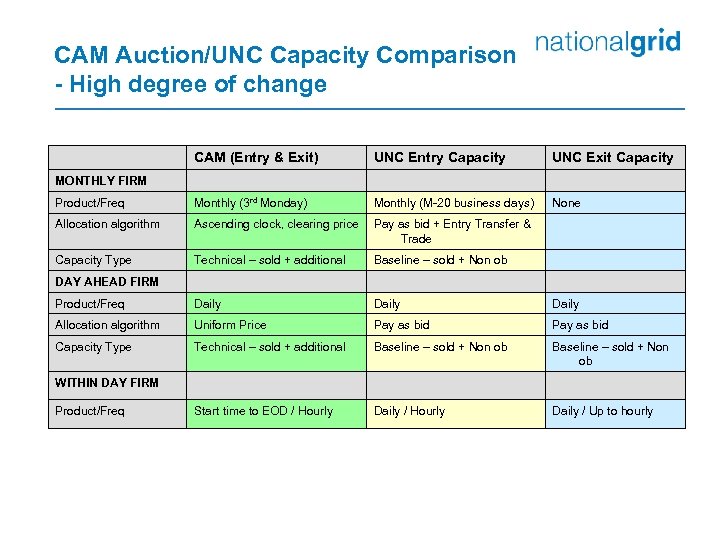 CAM Auction/UNC Capacity Comparison - High degree of change CAM (Entry & Exit) UNC Entry Capacity UNC Exit Capacity Product/Freq Monthly (3 rd Monday) Monthly (M-20 business days) None Allocation algorithm Ascending clock, clearing price Pay as bid + Entry Transfer & Trade Capacity Type Technical – sold + additional Baseline – sold + Non ob Product/Freq Daily Allocation algorithm Uniform Price Pay as bid Capacity Type Technical – sold + additional Baseline – sold + Non ob Start time to EOD / Hourly Daily / Up to hourly MONTHLY FIRM DAY AHEAD FIRM WITHIN DAY FIRM Product/Freq
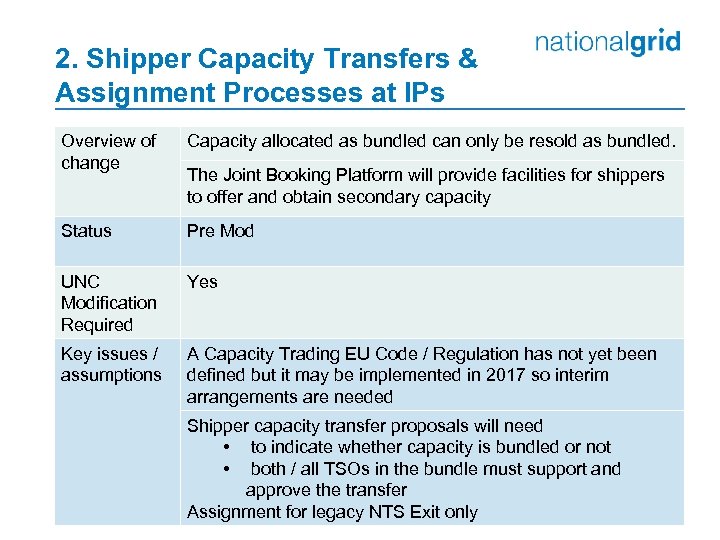 2. Shipper Capacity Transfers & Assignment Processes at IPs Overview of change Capacity allocated as bundled can only be resold as bundled. Status Pre Mod UNC Modification Required Yes Key issues / assumptions A Capacity Trading EU Code / Regulation has not yet been defined but it may be implemented in 2017 so interim arrangements are needed The Joint Booking Platform will provide facilities for shippers to offer and obtain secondary capacity Shipper capacity transfer proposals will need • to indicate whether capacity is bundled or not • both / all TSOs in the bundle must support and approve the transfer Assignment for legacy NTS Exit only
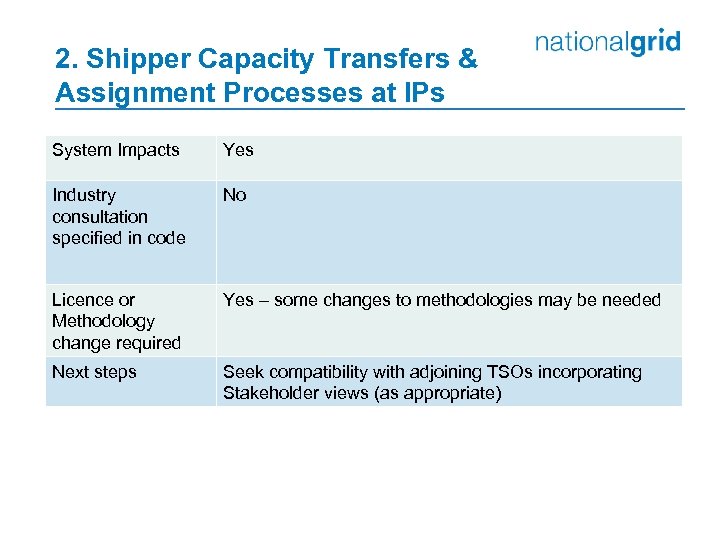 2. Shipper Capacity Transfers & Assignment Processes at IPs System Impacts Yes Industry consultation specified in code No Licence or Methodology change required Yes – some changes to methodologies may be needed Next steps Seek compatibility with adjoining TSOs incorporating Stakeholder views (as appropriate)
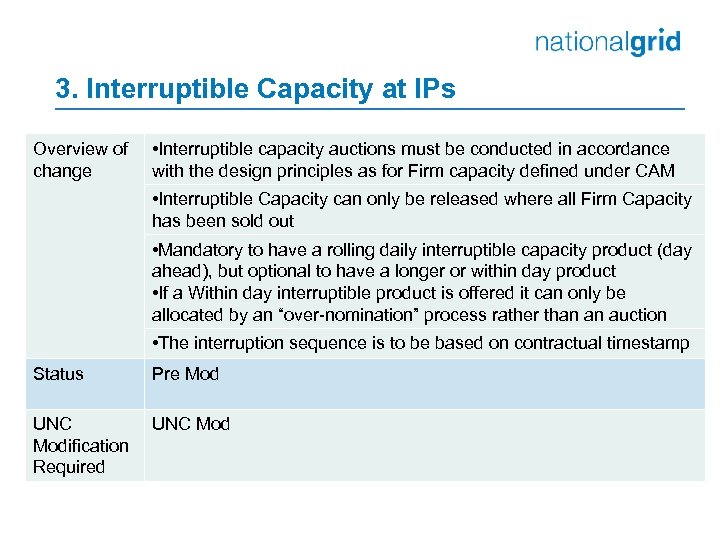 3. Interruptible Capacity at IPs Overview of change • Interruptible capacity auctions must be conducted in accordance with the design principles as for Firm capacity defined under CAM • Interruptible Capacity can only be released where all Firm Capacity has been sold out • Mandatory to have a rolling daily interruptible capacity product (day ahead), but optional to have a longer or within day product • If a Within day interruptible product is offered it can only be allocated by an “over-nomination” process rather than an auction • The interruption sequence is to be based on contractual timestamp Status Pre Mod UNC Modification Required UNC Mod
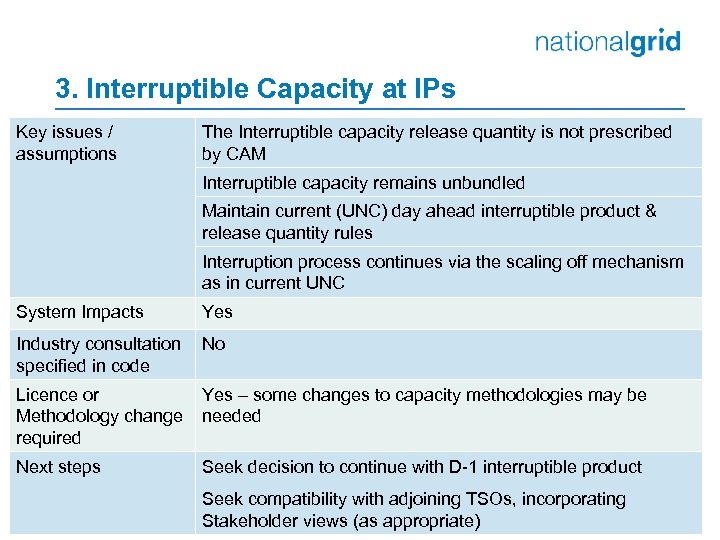 3. Interruptible Capacity at IPs Key issues / assumptions The Interruptible capacity release quantity is not prescribed by CAM Interruptible capacity remains unbundled Maintain current (UNC) day ahead interruptible product & release quantity rules Interruption process continues via the scaling off mechanism as in current UNC System Impacts Yes Industry consultation No specified in code Licence or Yes – some changes to capacity methodologies may be Methodology change needed required Next steps Seek decision to continue with D-1 interruptible product Seek compatibility with adjoining TSOs, incorporating Stakeholder views (as appropriate)
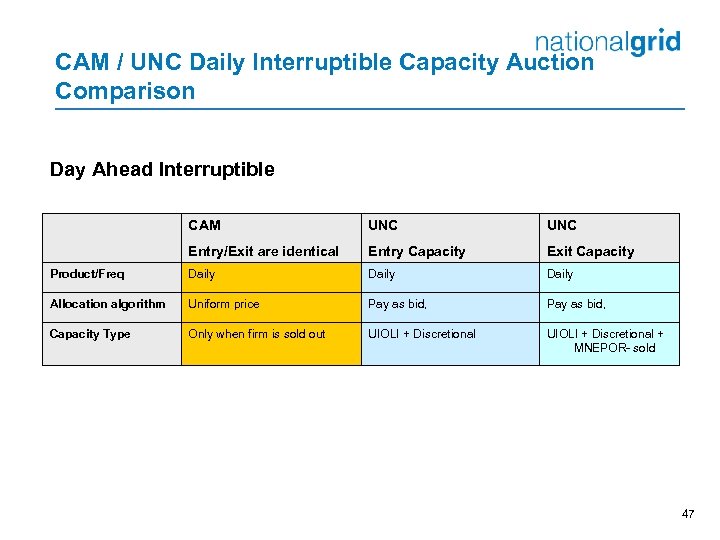 CAM / UNC Daily Interruptible Capacity Auction Comparison Day Ahead Interruptible CAM UNC Entry/Exit are identical Entry Capacity Exit Capacity Product/Freq Daily Allocation algorithm Uniform price Pay as bid, Capacity Type Only when firm is sold out UIOLI + Discretional + MNEPOR- sold 47
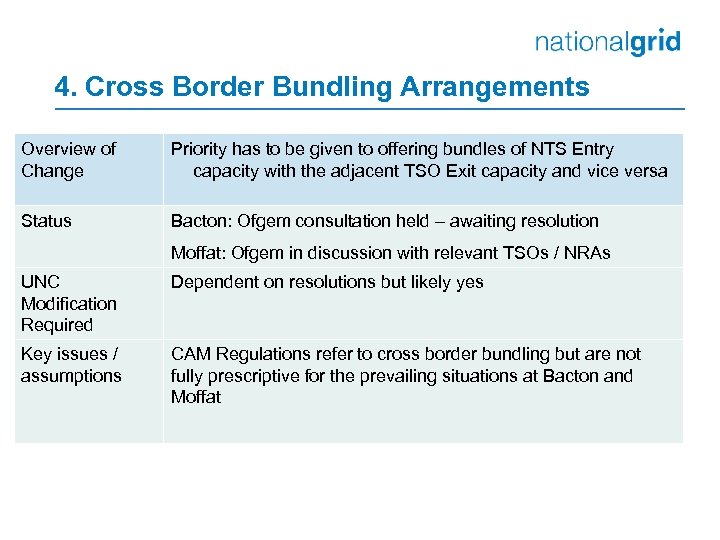 4. Cross Border Bundling Arrangements Overview of Change Priority has to be given to offering bundles of NTS Entry capacity with the adjacent TSO Exit capacity and vice versa Status Bacton: Ofgem consultation held – awaiting resolution Moffat: Ofgem in discussion with relevant TSOs / NRAs UNC Modification Required Dependent on resolutions but likely yes Key issues / assumptions CAM Regulations refer to cross border bundling but are not fully prescriptive for the prevailing situations at Bacton and Moffat
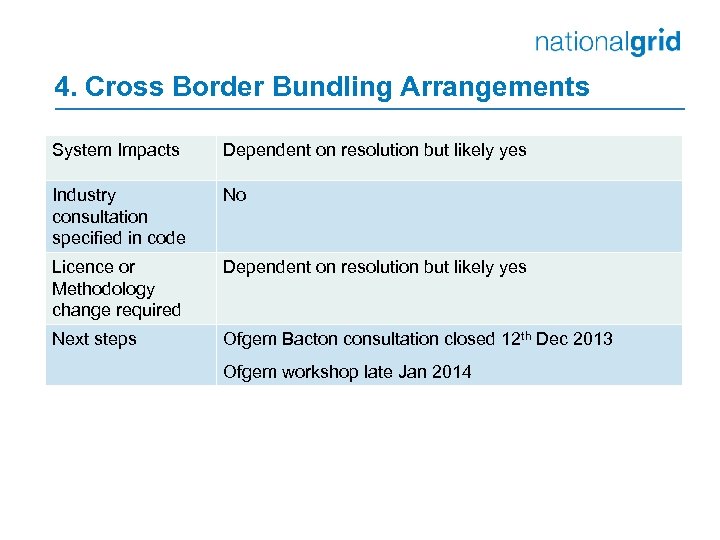 4. Cross Border Bundling Arrangements System Impacts Dependent on resolution but likely yes Industry consultation specified in code No Licence or Methodology change required Dependent on resolution but likely yes Next steps Ofgem Bacton consultation closed 12 th Dec 2013 Ofgem workshop late Jan 2014
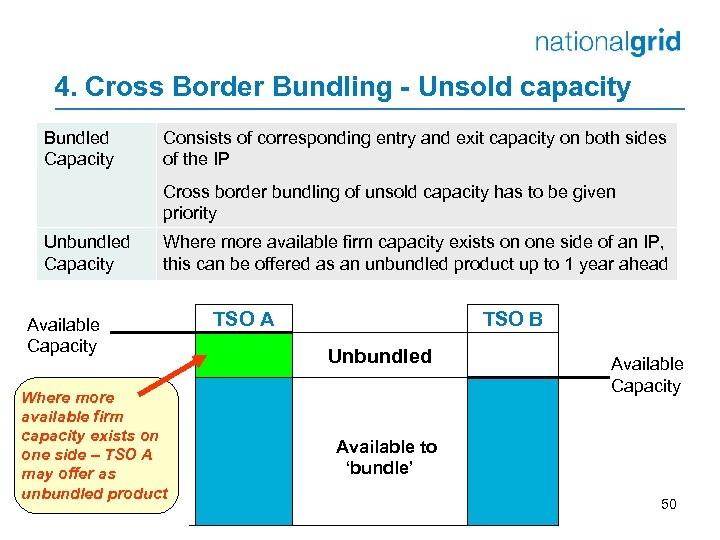 4. Cross Border Bundling - Unsold capacity Bundled Capacity Consists of corresponding entry and exit capacity on both sides of the IP Cross border bundling of unsold capacity has to be given priority Unbundled Capacity Where more available firm capacity exists on one side of an IP, this can be offered as an unbundled product up to 1 year ahead Available Capacity Where more available firm capacity exists on one side – TSO A may offer as unbundled product TSO A TSO B Unbundled Available Capacity Available to ‘bundle’ 50
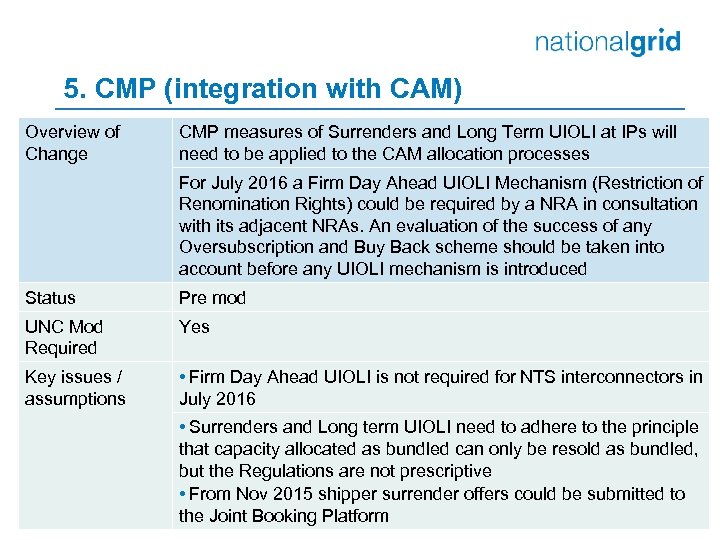 5. CMP (integration with CAM) Overview of Change CMP measures of Surrenders and Long Term UIOLI at IPs will need to be applied to the CAM allocation processes For July 2016 a Firm Day Ahead UIOLI Mechanism (Restriction of Renomination Rights) could be required by a NRA in consultation with its adjacent NRAs. An evaluation of the success of any Oversubscription and Buy Back scheme should be taken into account before any UIOLI mechanism is introduced Status Pre mod UNC Mod Required Yes Key issues / assumptions • Firm Day Ahead UIOLI is not required for NTS interconnectors in July 2016 • Surrenders and Long term UIOLI need to adhere to the principle that capacity allocated as bundled can only be resold as bundled, but the Regulations are not prescriptive • From Nov 2015 shipper surrender offers could be submitted to the Joint Booking Platform
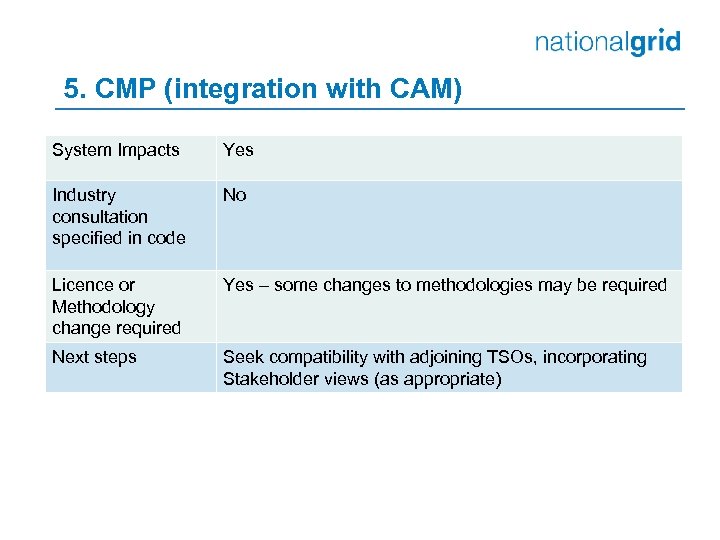 5. CMP (integration with CAM) System Impacts Yes Industry consultation specified in code No Licence or Methodology change required Yes – some changes to methodologies may be required Next steps Seek compatibility with adjoining TSOs, incorporating Stakeholder views (as appropriate)
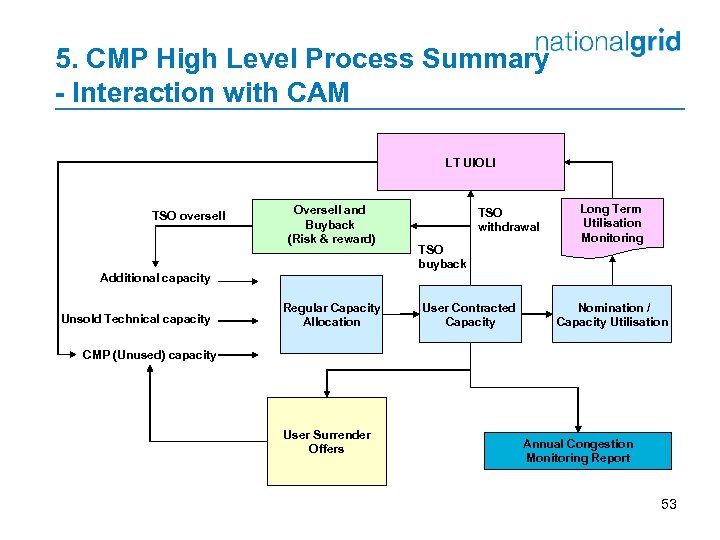 5. CMP High Level Process Summary - Interaction with CAM LT UIOLI TSO oversell Oversell and Buyback (Risk & reward) TSO withdrawal TSO buyback Long Term Utilisation Monitoring Additional capacity Unsold Technical capacity Regular Capacity Allocation User Contracted Capacity Nomination / Capacity Utilisation CMP (Unused) capacity User Surrender Offers Annual Congestion Monitoring Report 53
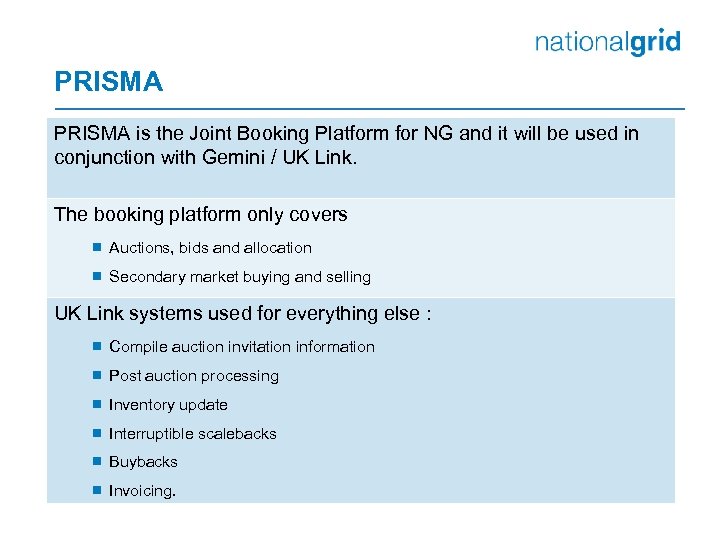 PRISMA is the Joint Booking Platform for NG and it will be used in conjunction with Gemini / UK Link. The booking platform only covers ¾ Auctions, bids and allocation ¾ Secondary market buying and selling UK Link systems used for everything else : ¾ Compile auction invitation information ¾ Post auction processing ¾ Inventory update ¾ Interruptible scalebacks ¾ Buybacks ¾ Invoicing.
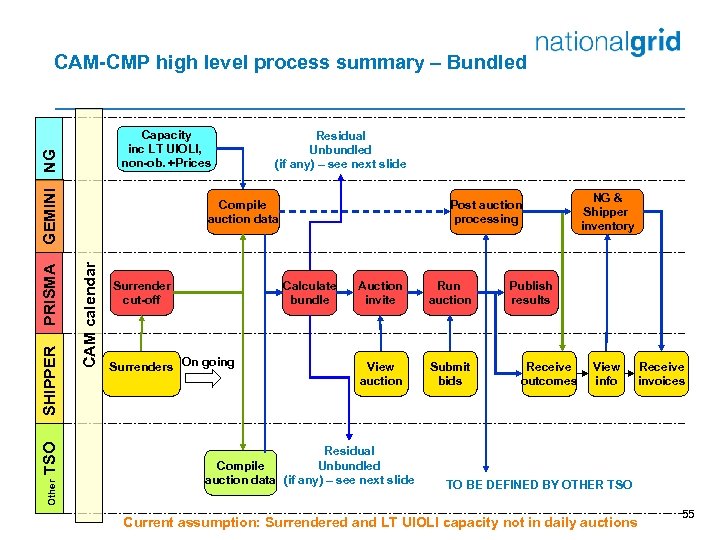 CAM-CMP high level process summary – Bundled Other TSO Residual Unbundled (if any) – see next slide Compile auction data CAM calendar SHIPPER PRISMA GEMINI NG Capacity inc LT UIOLI, non-ob. +Prices Surrender cut-off Post auction processing Calculate bundle Surrenders On going Auction invite Run auction View auction Submit bids Residual Compile Unbundled auction data (if any) – see next slide NG & Shipper inventory Publish results Receive outcomes View info Receive invoices TO BE DEFINED BY OTHER TSO Current assumption: Surrendered and LT UIOLI capacity not in daily auctions 55
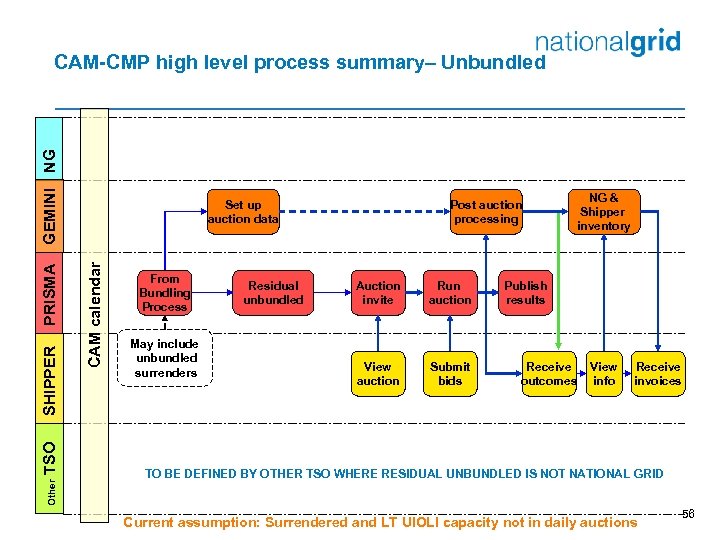 Other TSO Set up auction data CAM calendar SHIPPER PRISMA GEMINI NG CAM-CMP high level process summary– Unbundled From Bundling Process May include unbundled surrenders Residual unbundled Post auction processing Auction invite Run auction View auction Submit bids NG & Shipper inventory Publish results Receive outcomes View info Receive invoices TO BE DEFINED BY OTHER TSO WHERE RESIDUAL UNBUNDLED IS NOT NATIONAL GRID Current assumption: Surrendered and LT UIOLI capacity not in daily auctions 56
 Balancing Code Chris Shanley
 Balancing Code Overview ¾ Includes rules on nomination procedures, imbalance charges and operational balancing between Transmission System Operators (TSOs) systems ¾ Compliance date - October 2015 (October 2016 subject to NRA approval for a 12 month extension) ¾ The code is closely aligned with the gas balancing arrangements in GB but there are still a number of areas that impact on the current GB arrangements ¾ NG NTS Impact assessments - shared with the Industry via the Transmission Workgroup (May 12, May 13 and Nov 13)
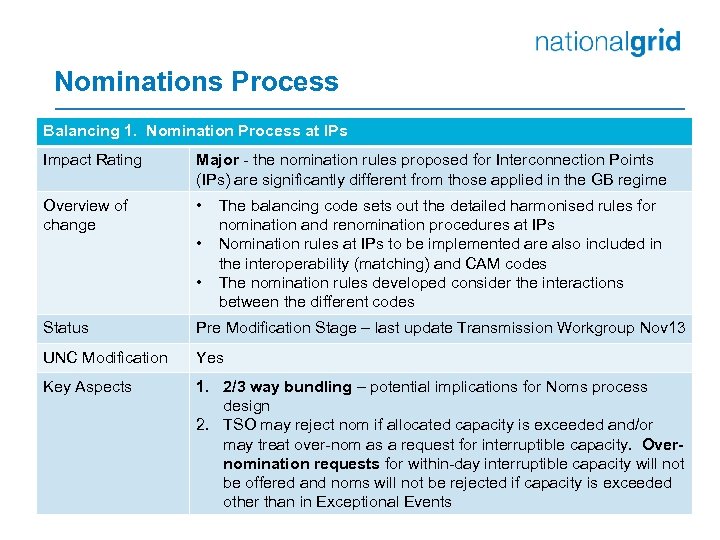 Nominations Process Balancing 1. Nomination Process at IPs Impact Rating Major - the nomination rules proposed for Interconnection Points (IPs) are significantly different from those applied in the GB regime Overview of change • • • The balancing code sets out the detailed harmonised rules for nomination and renomination procedures at IPs Nomination rules at IPs to be implemented are also included in the interoperability (matching) and CAM codes The nomination rules developed consider the interactions between the different codes Status Pre Modification Stage – last update Transmission Workgroup Nov 13 UNC Modification Yes Key Aspects 1. 2/3 way bundling – potential implications for Noms process design 2. TSO may reject nom if allocated capacity is exceeded and/or may treat over-nom as a request for interruptible capacity. Overnomination requests for within-day interruptible capacity will not be offered and noms will not be rejected if capacity is exceeded other than in Exceptional Events
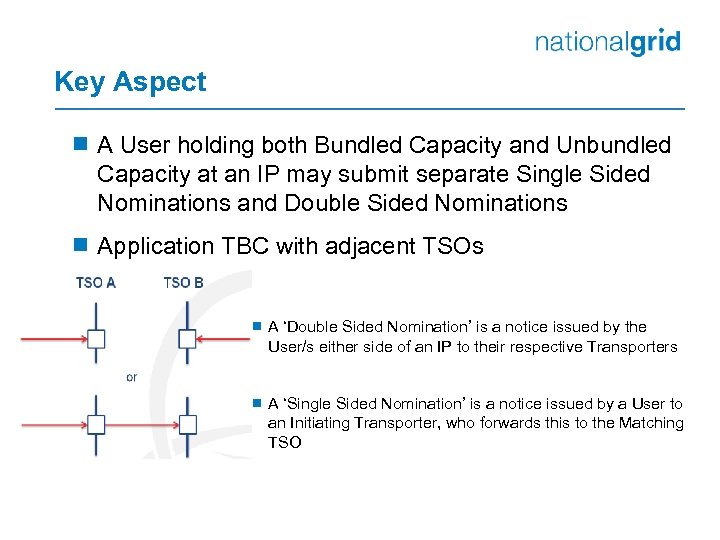 Key Aspect ¾ A User holding both Bundled Capacity and Unbundled Capacity at an IP may submit separate Single Sided Nominations and Double Sided Nominations ¾ Application TBC with adjacent TSOs ¾ A ‘Double Sided Nomination’ is a notice issued by the User/s either side of an IP to their respective Transporters ¾ A ‘Single Sided Nomination’ is a notice issued by a User to an Initiating Transporter, who forwards this to the Matching TSO
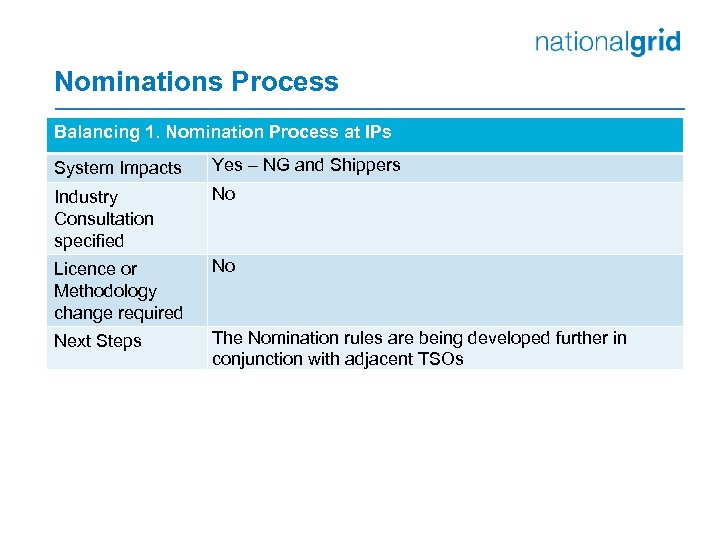 Nominations Process Balancing 1. Nomination Process at IPs System Impacts Yes – NG and Shippers Industry Consultation specified No Licence or Methodology change required No Next Steps The Nomination rules are being developed further in conjunction with adjacent TSOs
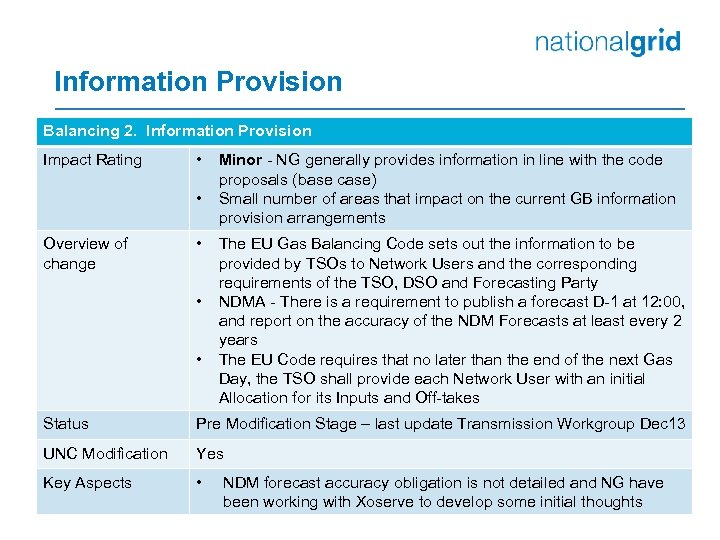 Information Provision Balancing 2. Information Provision Impact Rating • • Overview of change • • • Minor - NG generally provides information in line with the code proposals (base case) Small number of areas that impact on the current GB information provision arrangements The EU Gas Balancing Code sets out the information to be provided by TSOs to Network Users and the corresponding requirements of the TSO, DSO and Forecasting Party NDMA - There is a requirement to publish a forecast D-1 at 12: 00, and report on the accuracy of the NDM Forecasts at least every 2 years The EU Code requires that no later than the end of the next Gas Day, the TSO shall provide each Network User with an initial Allocation for its Inputs and Off-takes Status Pre Modification Stage – last update Transmission Workgroup Dec 13 UNC Modification Yes Key Aspects • NDM forecast accuracy obligation is not detailed and NG have been working with Xoserve to develop some initial thoughts
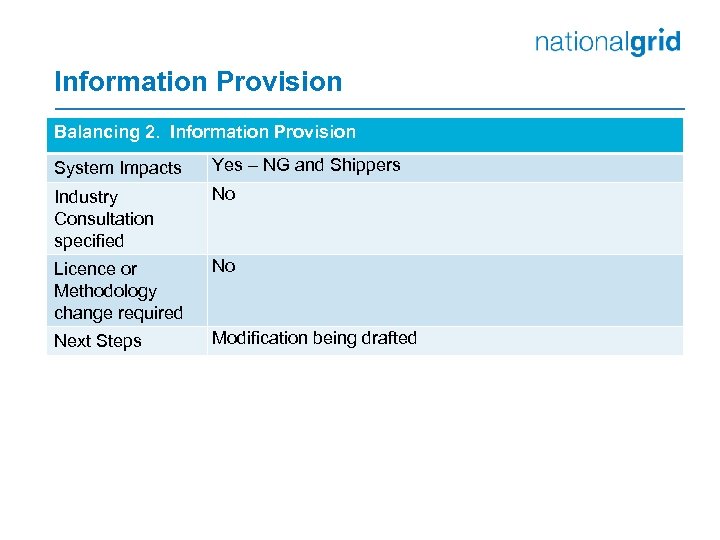 Information Provision Balancing 2. Information Provision System Impacts Yes – NG and Shippers Industry Consultation specified No Licence or Methodology change required No Next Steps Modification being drafted
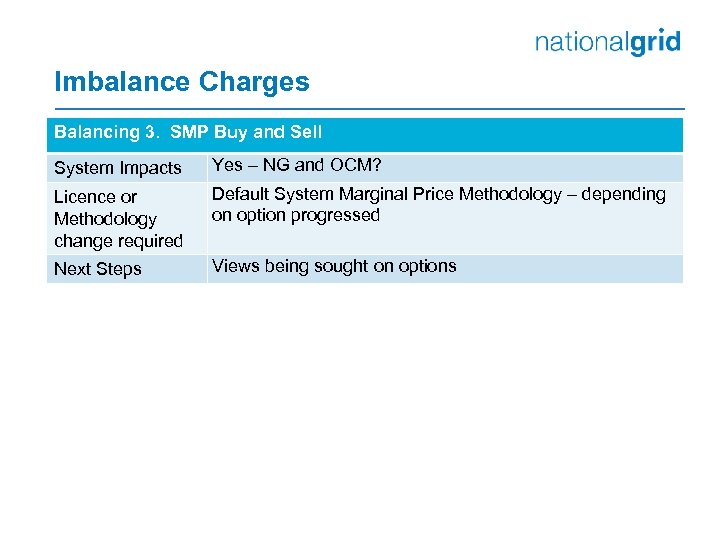
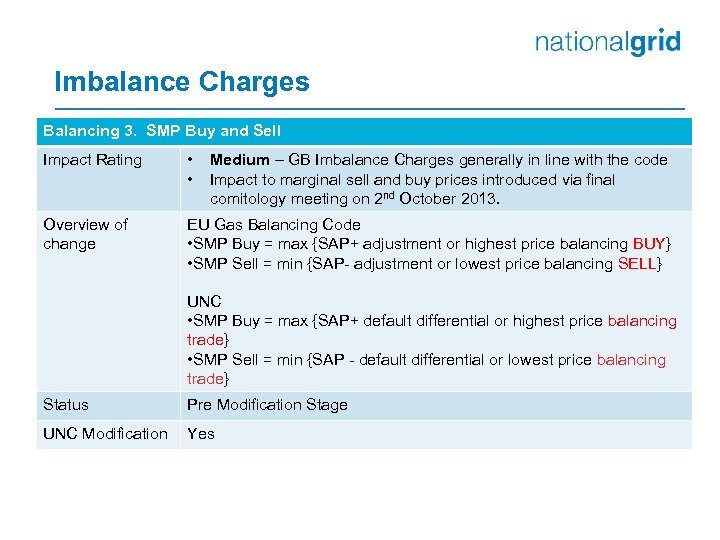 Imbalance Charges Balancing 3. SMP Buy and Sell Impact Rating • • Overview of change EU Gas Balancing Code • SMP Buy = max {SAP+ adjustment or highest price balancing BUY} • SMP Sell = min {SAP- adjustment or lowest price balancing SELL} Medium – GB Imbalance Charges generally in line with the code Impact to marginal sell and buy prices introduced via final comitology meeting on 2 nd October 2013. UNC • SMP Buy = max {SAP+ default differential or highest price balancing trade} • SMP Sell = min {SAP - default differential or lowest price balancing trade} Status Pre Modification Stage UNC Modification Yes
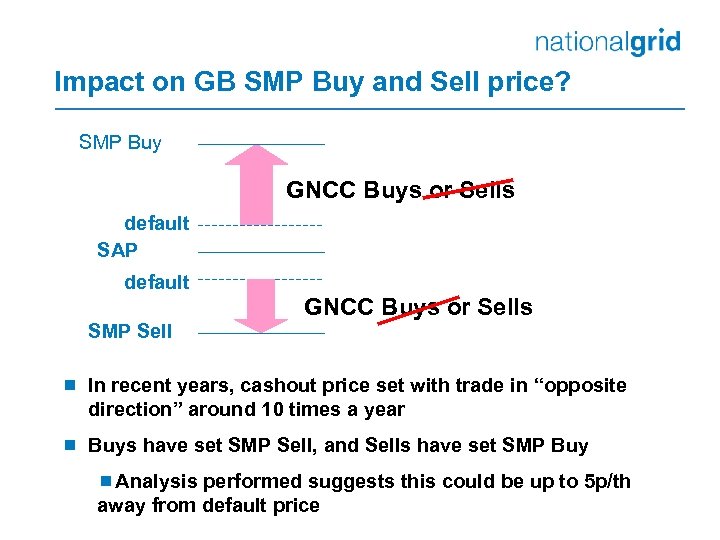 Impact on GB SMP Buy and Sell price? SMP Buy GNCC Buys or Sells default SAP default SMP Sell GNCC Buys or Sells ¾ In recent years, cashout price set with trade in “opposite direction” around 10 times a year ¾ Buys have set SMP Sell, and Sells have set SMP Buy ¾Analysis performed suggests this could be up to 5 p/th away from default price
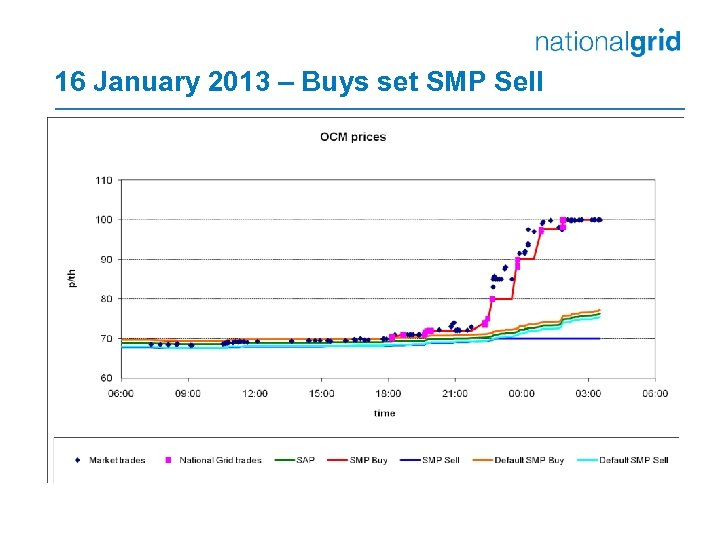 16 January 2013 – Buys set SMP Sell
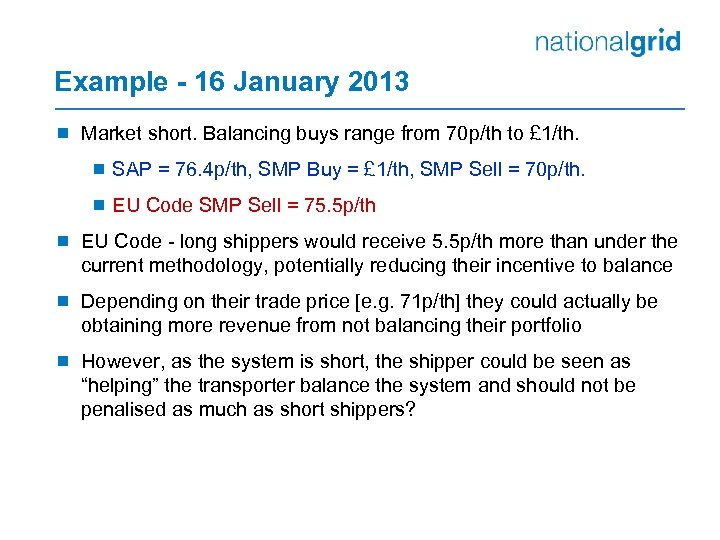 Example - 16 January 2013 ¾ Market short. Balancing buys range from 70 p/th to £ 1/th. ¾ SAP = 76. 4 p/th, SMP Buy = £ 1/th, SMP Sell = 70 p/th. ¾ EU Code SMP Sell = 75. 5 p/th ¾ EU Code - long shippers would receive 5. 5 p/th more than under the current methodology, potentially reducing their incentive to balance ¾ Depending on their trade price [e. g. 71 p/th] they could actually be obtaining more revenue from not balancing their portfolio ¾ However, as the system is short, the shipper could be seen as “helping” the transporter balance the system and should not be penalised as much as short shippers?
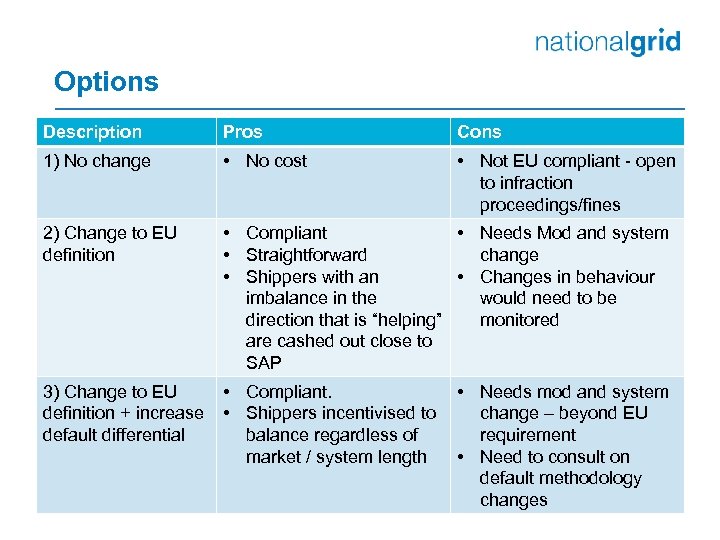 Options Description Pros Cons 1) No change • No cost • Not EU compliant - open to infraction proceedings/fines 2) Change to EU definition • Compliant • Needs Mod and system • Straightforward change • Shippers with an • Changes in behaviour imbalance in the would need to be direction that is “helping” monitored are cashed out close to SAP 3) Change to EU • Compliant. • Needs mod and system definition + increase • Shippers incentivised to change – beyond EU default differential balance regardless of requirement market / system length • Need to consult on default methodology changes
 Imbalance Charges Balancing 3. SMP Buy and Sell System Impacts Yes – NG and OCM? Licence or Methodology change required Default System Marginal Price Methodology – depending on option progressed Next Steps Views being sought on options
 Interoperability & Data Exchange Code Martin Connor
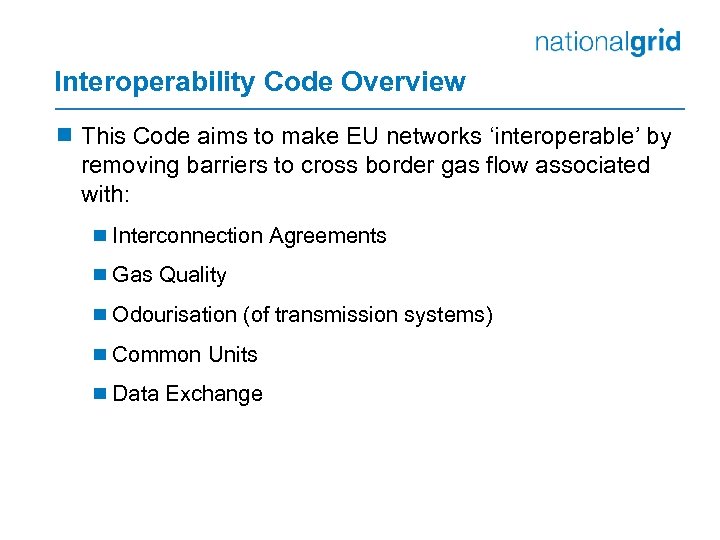 Interoperability Code Overview ¾ This Code aims to make EU networks ‘interoperable’ by removing barriers to cross border gas flow associated with: ¾ Interconnection Agreements ¾ Gas Quality ¾ Odourisation (of transmission systems) ¾ Common Units ¾ Data Exchange
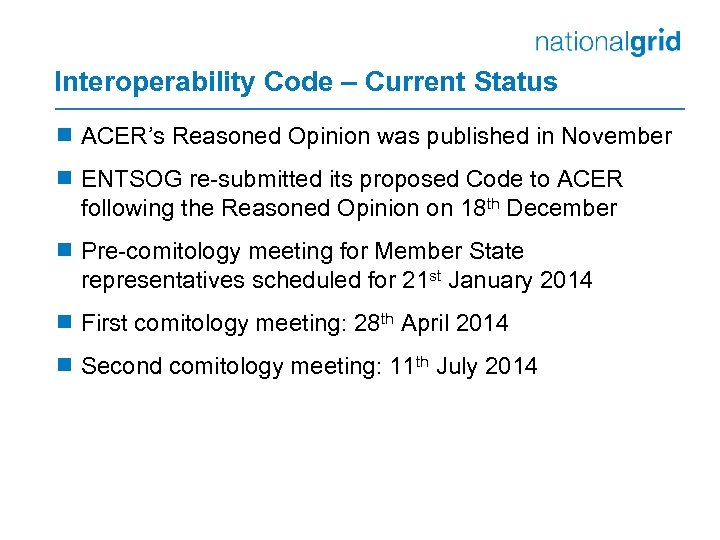 Interoperability Code – Current Status ¾ ACER’s Reasoned Opinion was published in November ¾ ENTSOG re-submitted its proposed Code to ACER following the Reasoned Opinion on 18 th December ¾ Pre-comitology meeting for Member State representatives scheduled for 21 st January 2014 ¾ First comitology meeting: 28 th April 2014 ¾ Second comitology meeting: 11 th July 2014
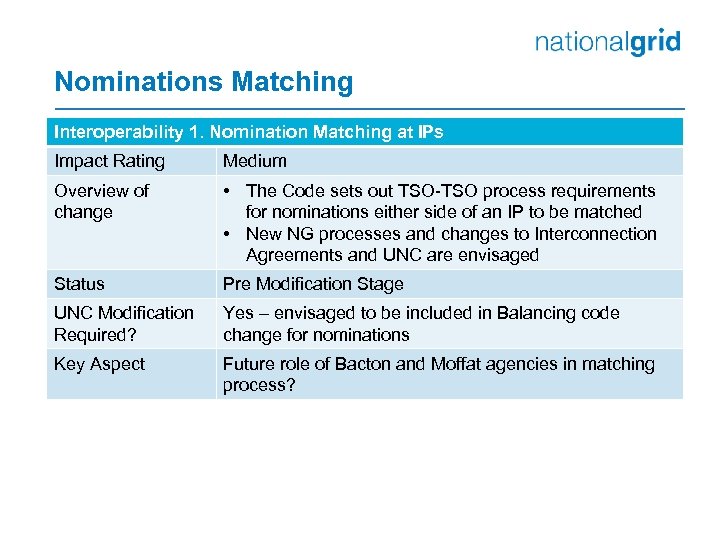 Nominations Matching Interoperability 1. Nomination Matching at IPs Impact Rating Medium Overview of change • The Code sets out TSO-TSO process requirements for nominations either side of an IP to be matched • New NG processes and changes to Interconnection Agreements and UNC are envisaged Status Pre Modification Stage UNC Modification Required? Yes – envisaged to be included in Balancing code change for nominations Key Aspect Future role of Bacton and Moffat agencies in matching process?
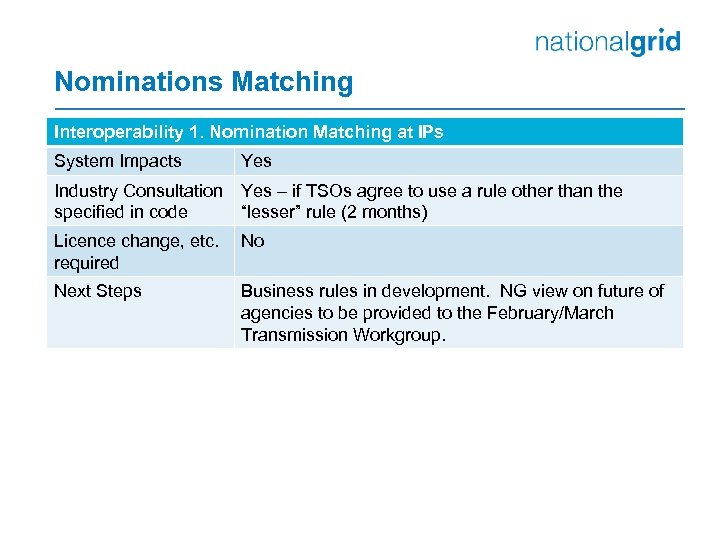 Nominations Matching Interoperability 1. Nomination Matching at IPs System Impacts Yes Industry Consultation Yes – if TSOs agree to use a rule other than the specified in code “lesser” rule (2 months) Licence change, etc. No required Next Steps Business rules in development. NG view on future of agencies to be provided to the February/March Transmission Workgroup.
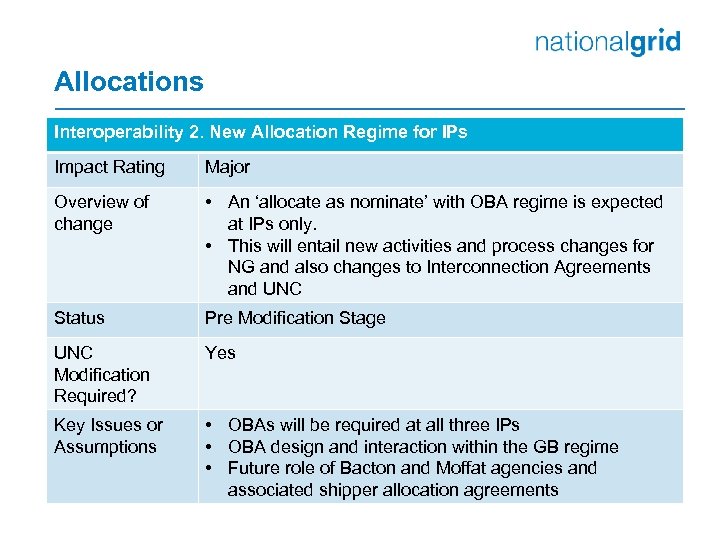 Allocations Interoperability 2. New Allocation Regime for IPs Impact Rating Major Overview of change • An ‘allocate as nominate’ with OBA regime is expected at IPs only. • This will entail new activities and process changes for NG and also changes to Interconnection Agreements and UNC Status Pre Modification Stage UNC Modification Required? Yes Key Issues or Assumptions • OBAs will be required at all three IPs • OBA design and interaction within the GB regime • Future role of Bacton and Moffat agencies and associated shipper allocation agreements
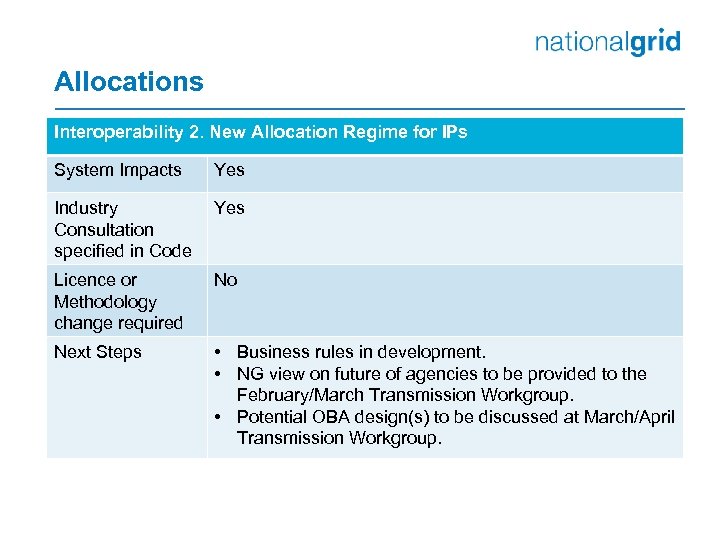 Allocations Interoperability 2. New Allocation Regime for IPs System Impacts Yes Industry Consultation specified in Code Yes Licence or Methodology change required No Next Steps • Business rules in development. • NG view on future of agencies to be provided to the February/March Transmission Workgroup. • Potential OBA design(s) to be discussed at March/April Transmission Workgroup.
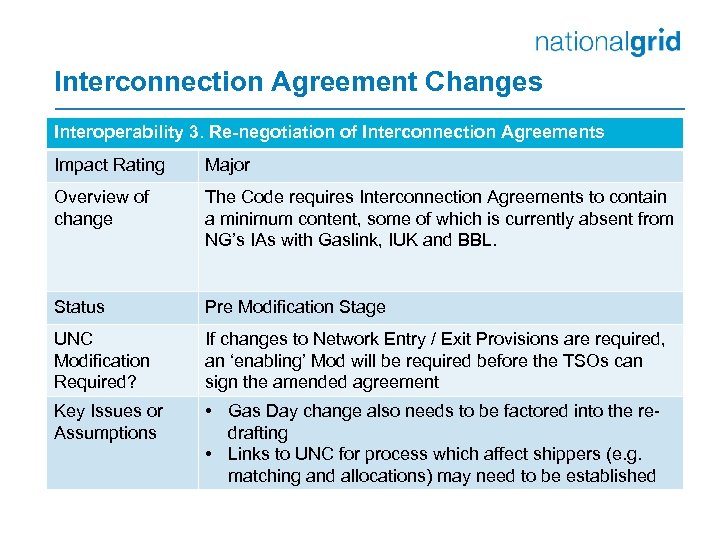 Interconnection Agreement Changes Interoperability 3. Re-negotiation of Interconnection Agreements Impact Rating Major Overview of change The Code requires Interconnection Agreements to contain a minimum content, some of which is currently absent from NG’s IAs with Gaslink, IUK and BBL. Status Pre Modification Stage UNC Modification Required? If changes to Network Entry / Exit Provisions are required, an ‘enabling’ Mod will be required before the TSOs can sign the amended agreement Key Issues or Assumptions • Gas Day change also needs to be factored into the redrafting • Links to UNC for process which affect shippers (e. g. matching and allocations) may need to be established
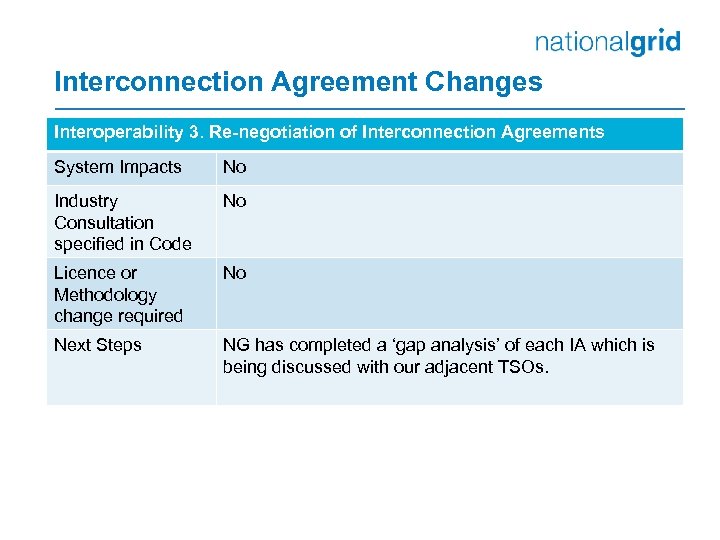 Interconnection Agreement Changes Interoperability 3. Re-negotiation of Interconnection Agreements System Impacts No Industry Consultation specified in Code No Licence or Methodology change required No Next Steps NG has completed a ‘gap analysis’ of each IA which is being discussed with our adjacent TSOs.
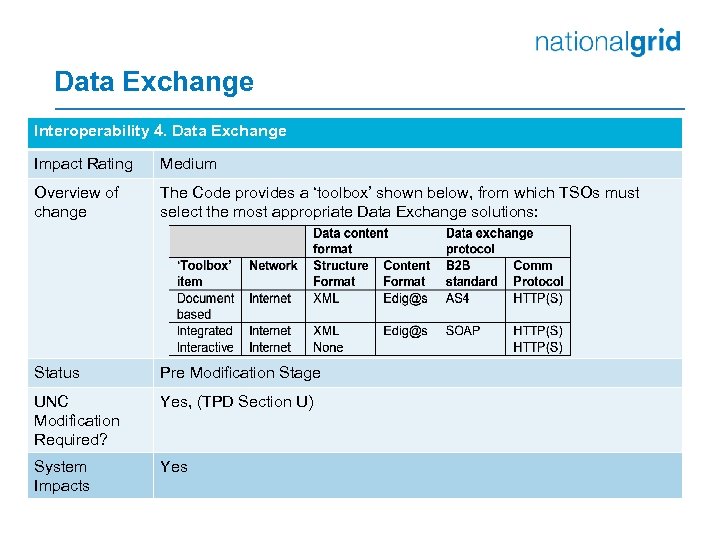 Data Exchange Interoperability 4. Data Exchange Impact Rating Medium Overview of change The Code provides a ‘toolbox’ shown below, from which TSOs must select the most appropriate Data Exchange solutions: Status Pre Modification Stage UNC Modification Required? Yes, (TPD Section U) System Impacts Yes
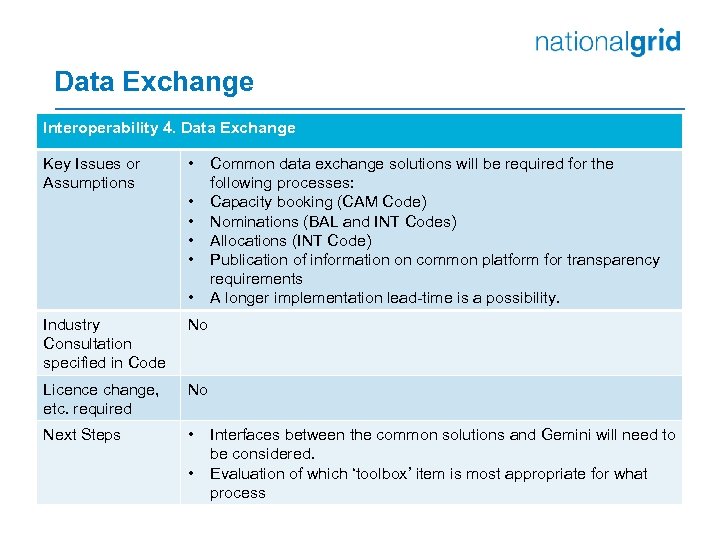 Data Exchange Interoperability 4. Data Exchange Key Issues or Assumptions • • • Industry Consultation specified in Code No Licence change, etc. required No Next Steps • Common data exchange solutions will be required for the following processes: Capacity booking (CAM Code) Nominations (BAL and INT Codes) Allocations (INT Code) Publication of information on common platform for transparency requirements A longer implementation lead-time is a possibility. • Interfaces between the common solutions and Gemini will need to be considered. Evaluation of which ‘toolbox’ item is most appropriate for what process
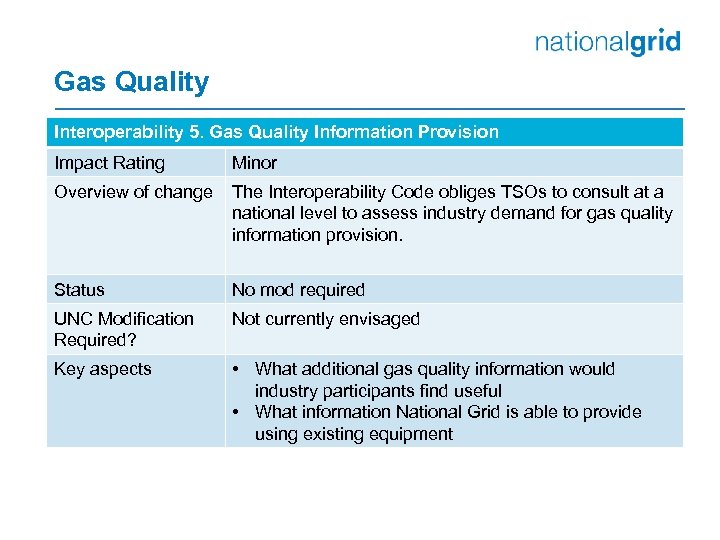 Gas Quality Interoperability 5. Gas Quality Information Provision Impact Rating Minor Overview of change The Interoperability Code obliges TSOs to consult at a national level to assess industry demand for gas quality information provision. Status No mod required UNC Modification Required? Not currently envisaged Key aspects • What additional gas quality information would industry participants find useful • What information National Grid is able to provide using existing equipment
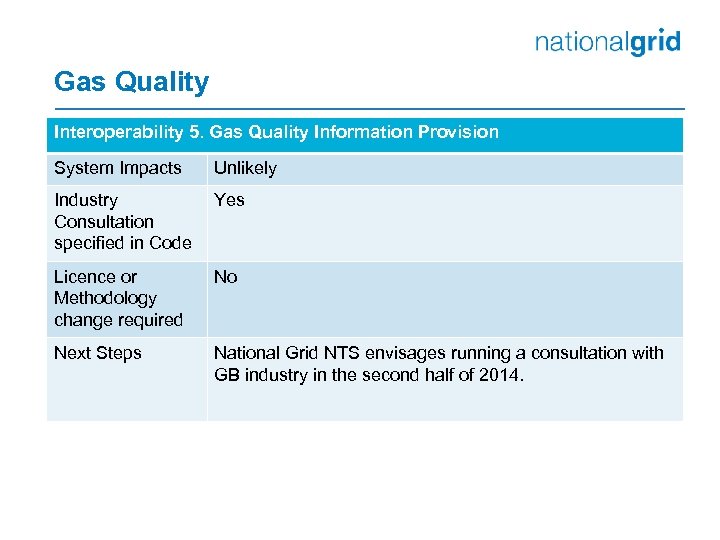 Gas Quality Interoperability 5. Gas Quality Information Provision System Impacts Unlikely Industry Consultation specified in Code Yes Licence or Methodology change required No Next Steps National Grid NTS envisages running a consultation with GB industry in the second half of 2014.
 Gas Day Chris Shanley
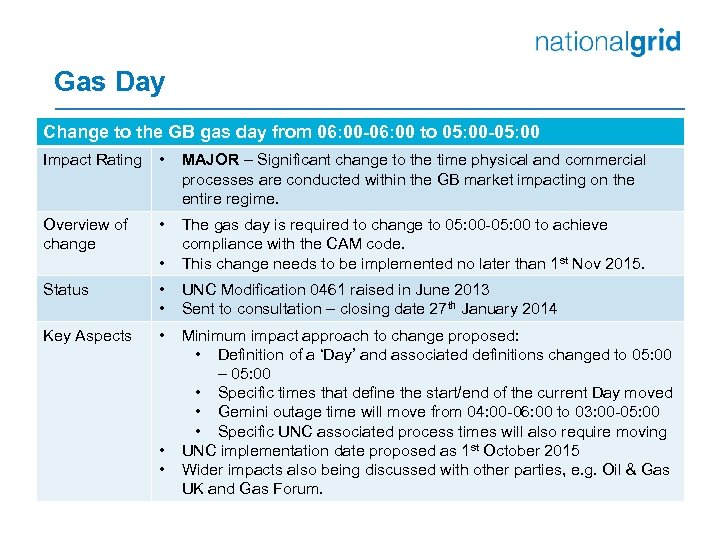 Gas Day Change to the GB gas day from 06: 00 -06: 00 to 05: 00 -05: 00 Impact Rating • MAJOR – Significant change to the time physical and commercial processes are conducted within the GB market impacting on the entire regime. Overview of change • • The gas day is required to change to 05: 00 -05: 00 to achieve compliance with the CAM code. This change needs to be implemented no later than 1 st Nov 2015. Status • • UNC Modification 0461 raised in June 2013 Sent to consultation – closing date 27 th January 2014 Key Aspects • Minimum impact approach to change proposed: • Definition of a ‘Day’ and associated definitions changed to 05: 00 – 05: 00 • Specific times that define the start/end of the current Day moved • Gemini outage time will move from 04: 00 -06: 00 to 03: 00 -05: 00 • Specific UNC associated process times will also require moving UNC implementation date proposed as 1 st October 2015 Wider impacts also being discussed with other parties, e. g. Oil & Gas UK and Gas Forum. • •
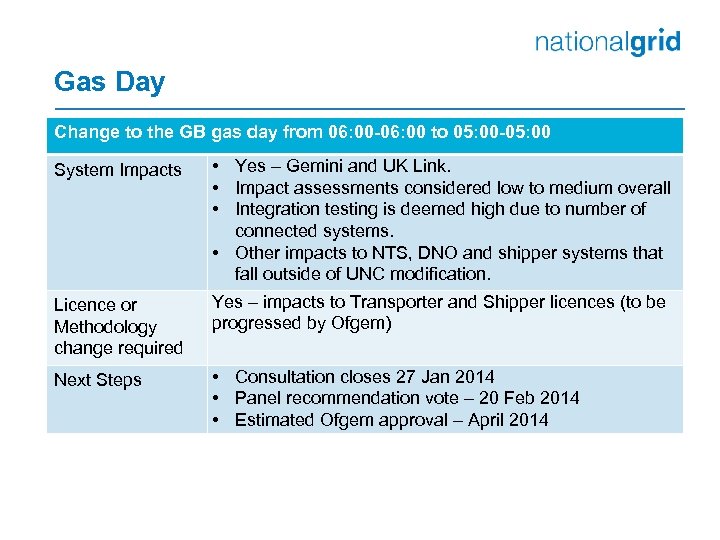 Gas Day Change to the GB gas day from 06: 00 -06: 00 to 05: 00 -05: 00 System Impacts Licence or Methodology change required Next Steps • Yes – Gemini and UK Link. • Impact assessments considered low to medium overall • Integration testing is deemed high due to number of connected systems. • Other impacts to NTS, DNO and shipper systems that fall outside of UNC modification. Yes – impacts to Transporter and Shipper licences (to be progressed by Ofgem) • Consultation closes 27 Jan 2014 • Panel recommendation vote – 20 Feb 2014 • Estimated Ofgem approval – April 2014
 Phase 3 & 4
 Tariff Code & Incremental Capacity Amendment Colin Hamilton
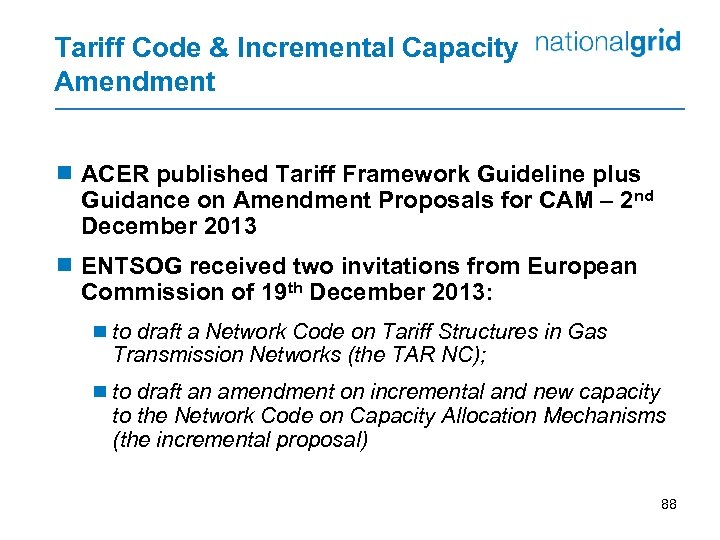 Tariff Code & Incremental Capacity Amendment ¾ ACER published Tariff Framework Guideline plus Guidance on Amendment Proposals for CAM – 2 nd December 2013 ¾ ENTSOG received two invitations from European Commission of 19 th December 2013: ¾ to draft a Network Code on Tariff Structures in Gas Transmission Networks (the TAR NC); ¾ to draft an amendment on incremental and new capacity to the Network Code on Capacity Allocation Mechanisms (the incremental proposal) 88
 Tariff Network Code - Objective ¾ “to elaborate on the TAR FG and develop a TAR NC that contributes to the European objective of further development of the internal market for energy. In order to achieve this objective, the TAR NC will promote harmonisation of transmission tariff structures in relation to those items outlined in the scope below”. 89
 Tariff Network Code Project - Scope ¾ General Provisions – impact assessment to consider the validity of harmonising the tariff setting year. ¾ Publication Requirements –by TSOs and national regulatory authorities to enable third parties to make reasonable tariff estimations. ¾ Cost Allocation and Determination of the Reference Price – limited number of cost allocation methodologies with a methodology counterfactual and a complementary test to avoid discrimination. ¾ Incremental Capacity –economic test for the offer of incremental and new capacity. ¾ Revenue Reconciliation –rules to ensure the recovery of efficiently-incurred costs by TSOs, financial stability for efficient TSOs, and tariff stability for network users 90
 Tariff Network Code Project - Scope ¾ Reserve Price – shall develop methodologies for the pricing of short-term products, using multipliers and seasonal factors, and for bi/unidirectional interruptible capacity, using discounts. ¾ Virtual Interconnection Points (VIPs) – elaborate on a combination method for pricing capacity at VIPs. ¾ Bundled Capacity Products – specify the pricing of bundled capacity. ¾ Payable Price – specify the components of the payable price for auctions. In addition to the above scope, the Commission has requested that ENTSOG provide an impact assessment on the policy choices made during the development process for the network code. 91
 Incremental Capacity Proposal The Incremental Proposal will consist of two parts: ¾ An amendment proposal to the CAM NC ¾ Chapter of the Tariff NC 92
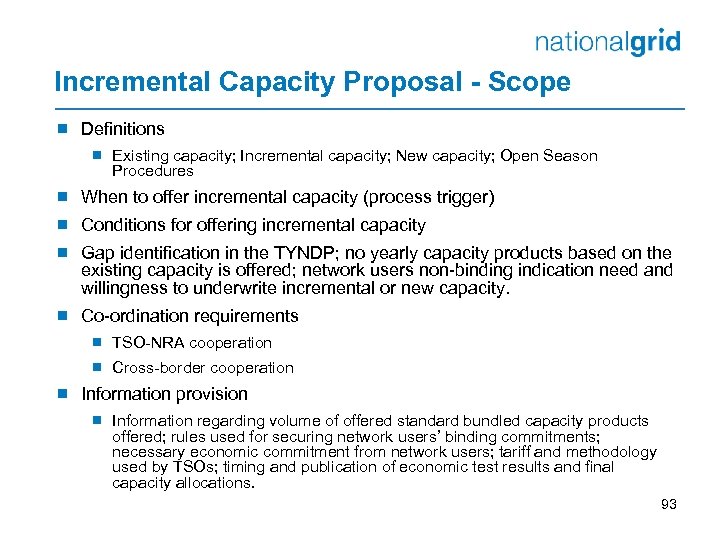 Incremental Capacity Proposal - Scope ¾ Definitions ¾ Existing capacity; Incremental capacity; New capacity; Open Season Procedures ¾ When to offer incremental capacity (process trigger) ¾ Conditions for offering incremental capacity ¾ Gap identification in the TYNDP; no yearly capacity products based on the existing capacity is offered; network users non-binding indication need and willingness to underwrite incremental or new capacity. ¾ Co-ordination requirements ¾ TSO-NRA cooperation ¾ Cross-border cooperation ¾ Information provision ¾ Information regarding volume of offered standard bundled capacity products offered; rules used for securing network users’ binding commitments; necessary economic commitment from network users; tariff and methodology used by TSOs; timing and publication of economic test results and final capacity allocations. 93
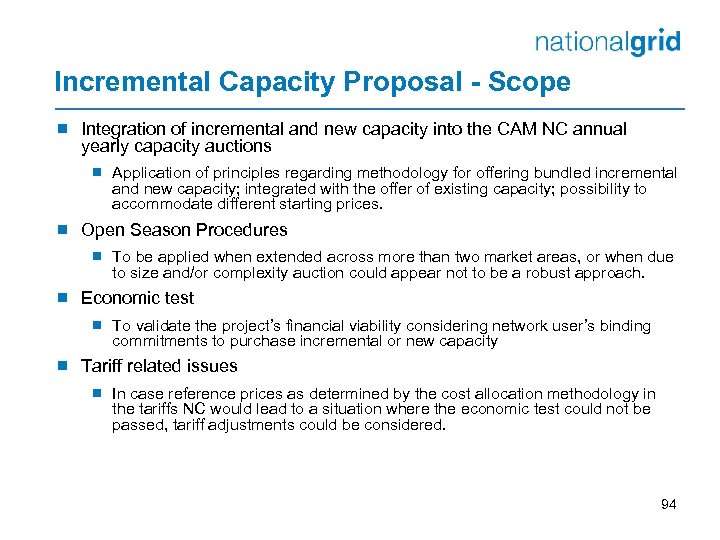 Incremental Capacity Proposal - Scope ¾ Integration of incremental and new capacity into the CAM NC annual yearly capacity auctions ¾ Application of principles regarding methodology for offering bundled incremental and new capacity; integrated with the offer of existing capacity; possibility to accommodate different starting prices. ¾ Open Season Procedures ¾ To be applied when extended across more than two market areas, or when due to size and/or complexity auction could appear not to be a robust approach. ¾ Economic test ¾ To validate the project’s financial viability considering network user’s binding commitments to purchase incremental or new capacity ¾ Tariff related issues ¾ In case reference prices as determined by the cost allocation methodology in the tariffs NC would lead to a situation where the economic test could not be passed, tariff adjustments could be considered. 94
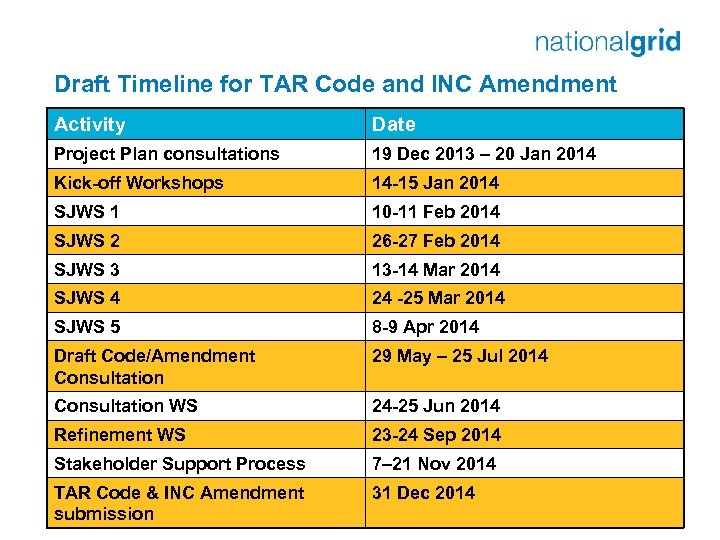 Draft Timeline for TAR Code and INC Amendment Activity Date Project Plan consultations 19 Dec 2013 – 20 Jan 2014 Kick-off Workshops 14 -15 Jan 2014 SJWS 1 10 -11 Feb 2014 SJWS 2 26 -27 Feb 2014 SJWS 3 13 -14 Mar 2014 SJWS 4 24 -25 Mar 2014 SJWS 5 8 -9 Apr 2014 Draft Code/Amendment Consultation 29 May – 25 Jul 2014 Consultation WS 24 -25 Jun 2014 Refinement WS 23 -24 Sep 2014 Stakeholder Support Process 7– 21 Nov 2014 TAR Code & INC Amendment submission 31 Dec 2014 95
 Tariff Code & Incremental Capacity Amendment ¾ Key documents: ¾ Tariffs: ¾http: //www. entsog. eu/publications/tariffs#TARFRAMEWORK-GUIDELINE-AND-EC-INVITATION- ¾ Incremental Capacity: ¾http: //www. entsog. eu/publications/incrementalcapacity#INCREMENTAL-PROPOSAL-PROJECT-PLAN 96
 Systems Development
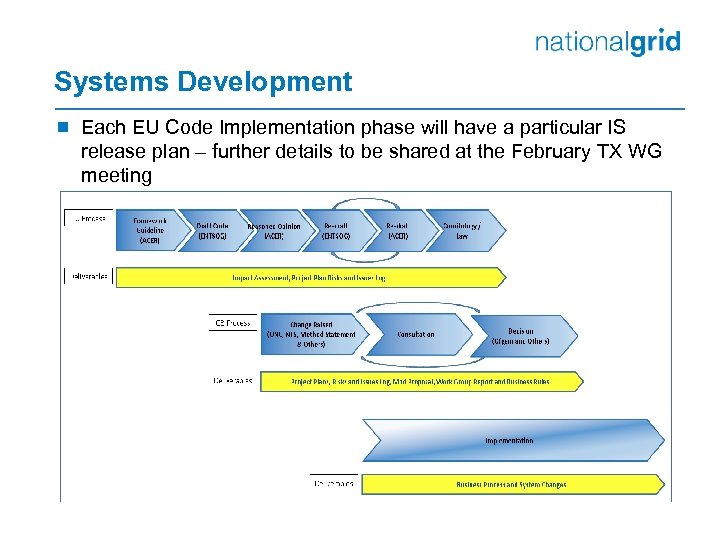 Systems Development ¾ Each EU Code Implementation phase will have a particular IS release plan – further details to be shared at the February TX WG meeting
 UNC Modification Plans
 Approach ¾ Aim of this section is to: ¾ Provide NG NTS initial views on the number and types of Mods required to deliver the phase 2 changes ¾ Obtain stakeholder views on these initial plans ¾ NG NTS believe that it is not appropriate to raise one “super” Mod, as this is likely to be very complex and delay matters ¾ Do stakeholders concur? ¾ Modifications will propose that they go to Workgroup for development/discussion with UNC parties and not straight to consultation ¾ Small proposals should take up to 6 months to develop ¾ Larger proposals could take around 6 -9 months to develop
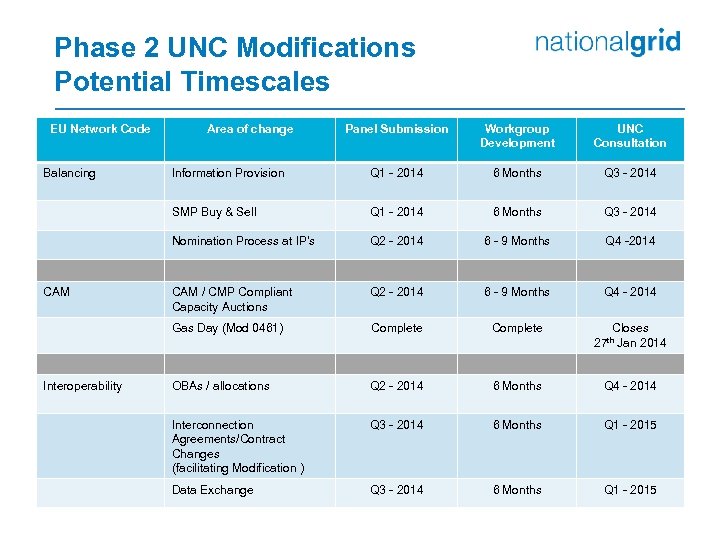 Phase 2 UNC Modifications Potential Timescales EU Network Code UNC Consultation Information Provision Q 1 - 2014 6 Months Q 3 - 2014 Q 2 - 2014 6 - 9 Months Q 4 -2014 CAM / CMP Compliant Capacity Auctions Q 2 - 2014 6 - 9 Months Q 4 - 2014 Gas Day (Mod 0461) Interoperability Workgroup Development Nomination Process at IP’s CAM Panel Submission SMP Buy & Sell Balancing Area of change Complete Closes 27 th Jan 2014 OBAs / allocations Q 2 - 2014 6 Months Q 4 - 2014 Interconnection Agreements/Contract Changes (facilitating Modification ) Q 3 - 2014 6 Months Q 1 - 2015 Data Exchange Q 3 - 2014 6 Months Q 1 - 2015
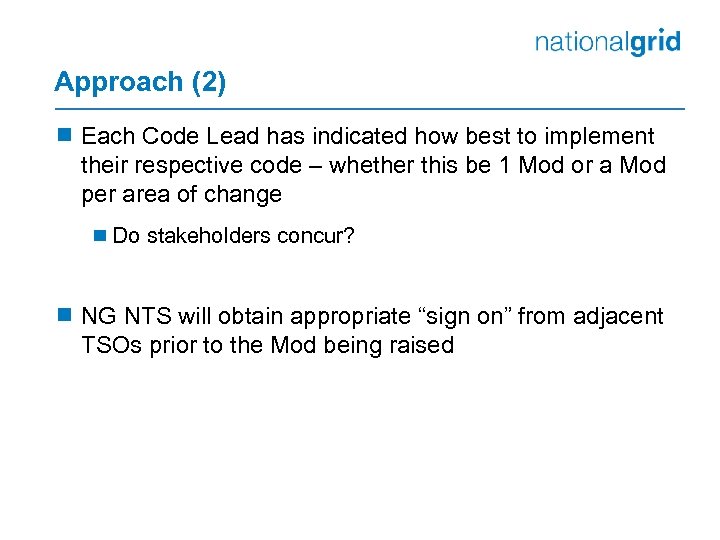 Approach (2) ¾ Each Code Lead has indicated how best to implement their respective code – whether this be 1 Mod or a Mod per area of change ¾ Do stakeholders concur? ¾ NG NTS will obtain appropriate “sign on” from adjacent TSOs prior to the Mod being raised
 Next Steps Chris Logue
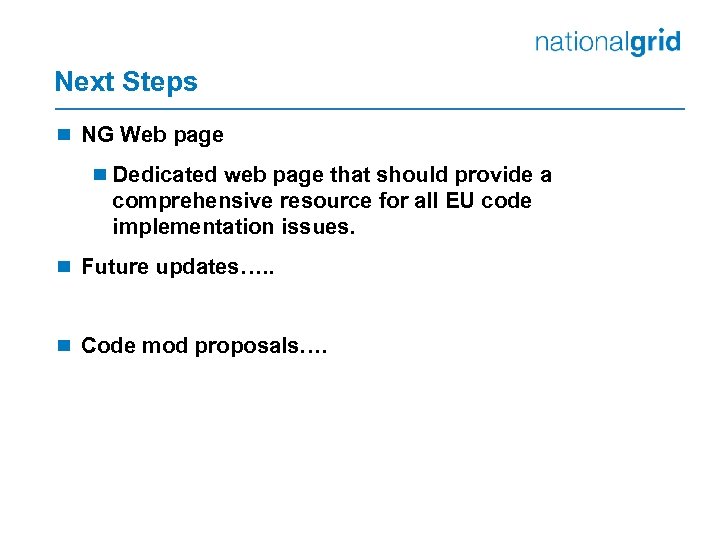 Next Steps ¾ NG Web page ¾ Dedicated web page that should provide a comprehensive resource for all EU code implementation issues. ¾ Future updates…. . ¾ Code mod proposals….