 Скачать презентацию EU Climate policies Bio-energy Estonian conference on
fedd4573e7d28484993d9f7b61033e94.ppt
- Количество слайдов: 31



EU Climate policies & Bio-energy Estonian conference on “The contribution of agriculture to energy production” Talinn, 7 Ocotber 2005 Erik Tang Climate Change & energy DG Environment European Commission: Environment Directorate General Slide: 1
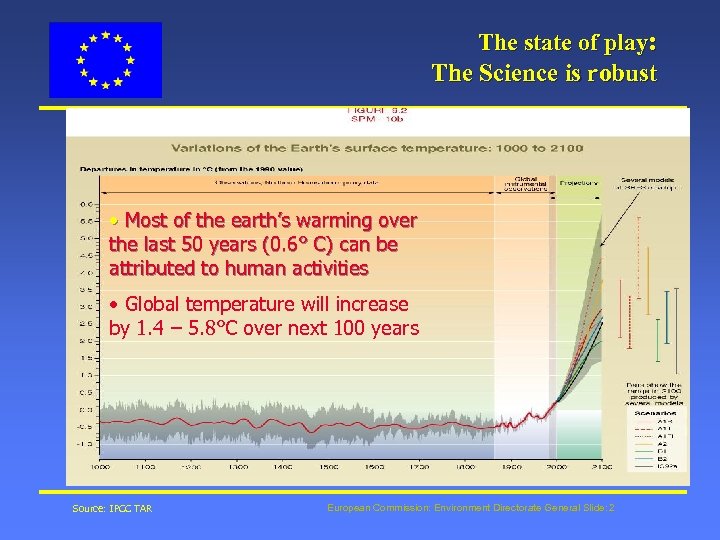
The state of play: The Science is robust • Most of the earth’s warming over the last 50 years (0. 6° C) can be attributed to human activities • Global temperature will increase by 1. 4 – 5. 8°C over next 100 years Source: IPCC TAR European Commission: Environment Directorate General Slide: 2
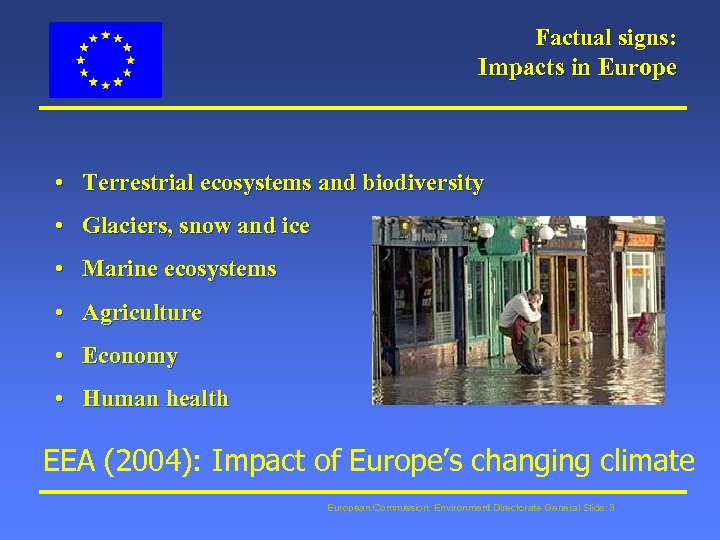
Factual signs: Impacts in Europe • Terrestrial ecosystems and biodiversity • Glaciers, snow and ice • Marine ecosystems • Agriculture • Economy • Human health EEA (2004): Impact of Europe’s changing climate European Commission: Environment Directorate General Slide: 3
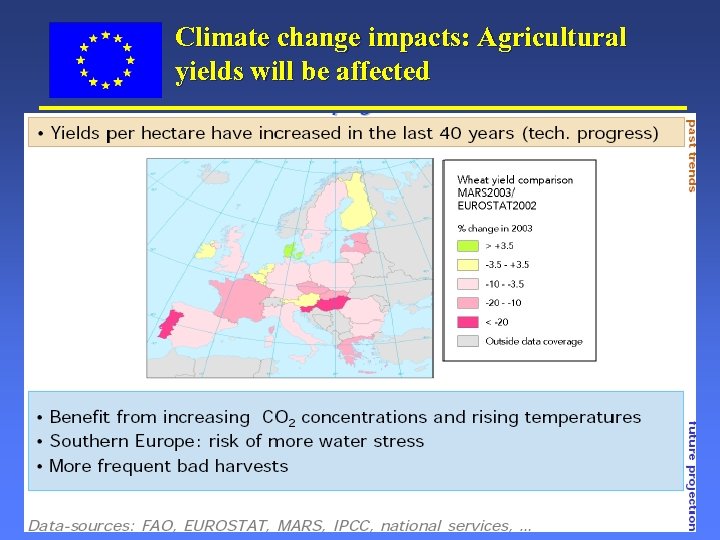
Climate change impacts: Agricultural yields will be affected European Commission: Environment Directorate General Slide: 4
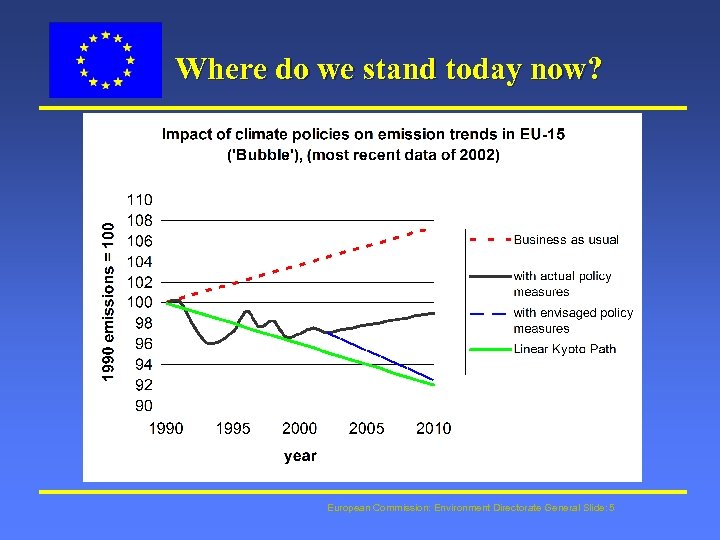
Where do we stand today now? European Commission: Environment Directorate General Slide: 5
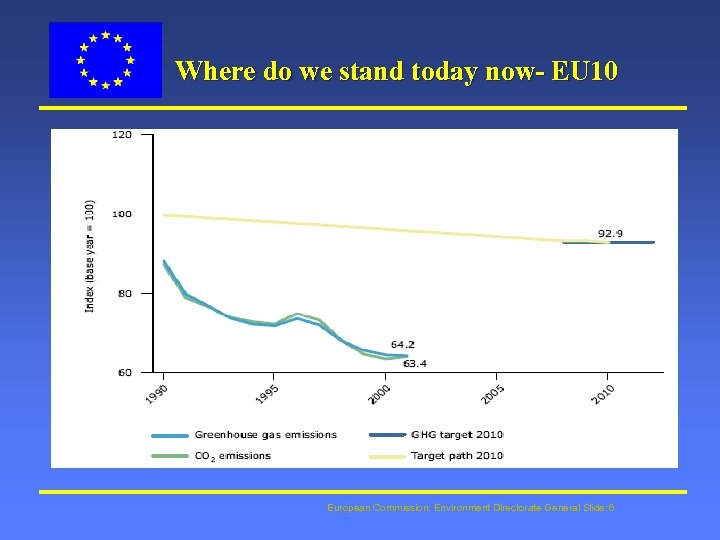
Where do we stand today now- EU 10 European Commission: Environment Directorate General Slide: 6
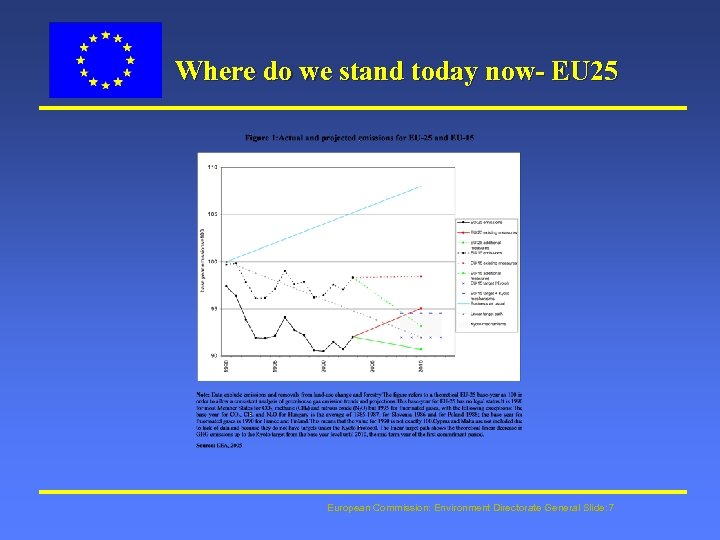
Where do we stand today now- EU 25 European Commission: Environment Directorate General Slide: 7
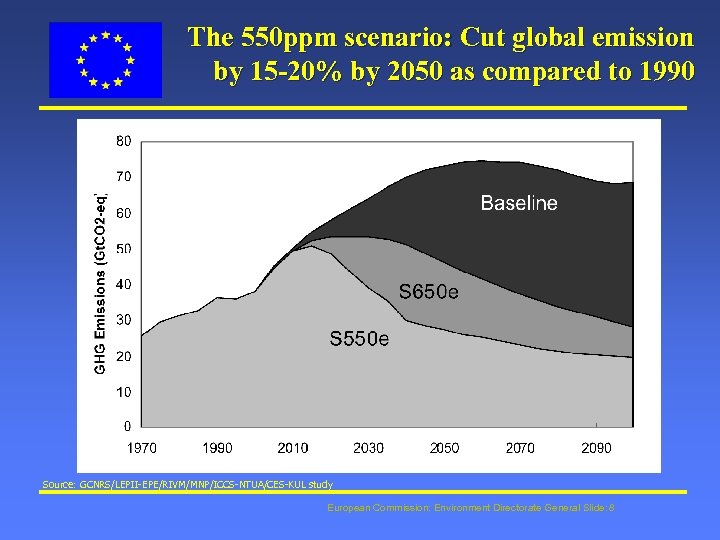
The 550 ppm scenario: Cut global emission by 15 -20% by 2050 as compared to 1990 Source: GCNRS/LEPII-EPE/RIVM/MNP/ICCS-NTUA/CES-KUL study European Commission: Environment Directorate General Slide: 8
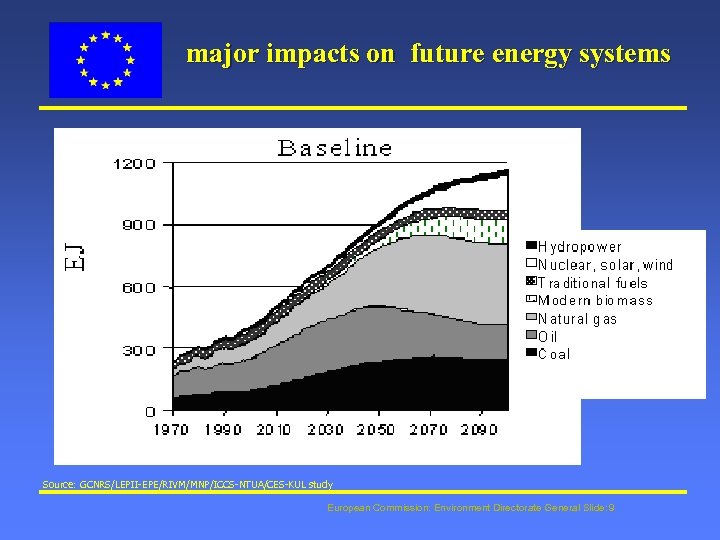
major impacts on future energy systems Source: GCNRS/LEPII-EPE/RIVM/MNP/ICCS-NTUA/CES-KUL study European Commission: Environment Directorate General Slide: 9
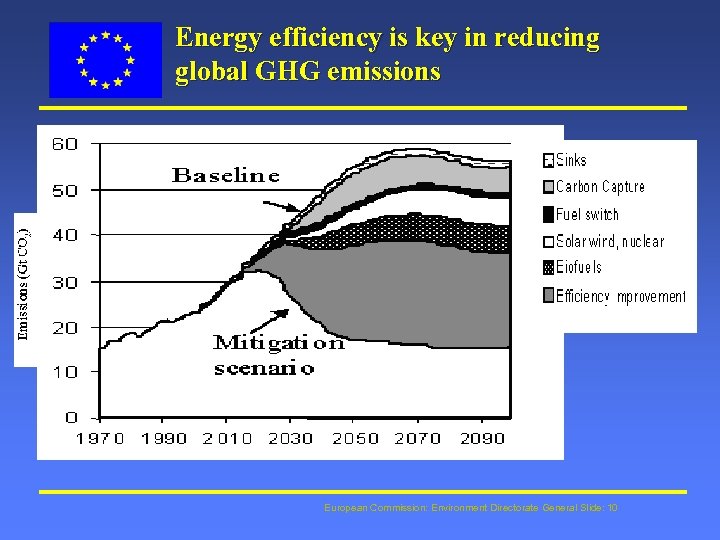
Energy efficiency is key in reducing global GHG emissions European Commission: Environment Directorate General Slide: 10
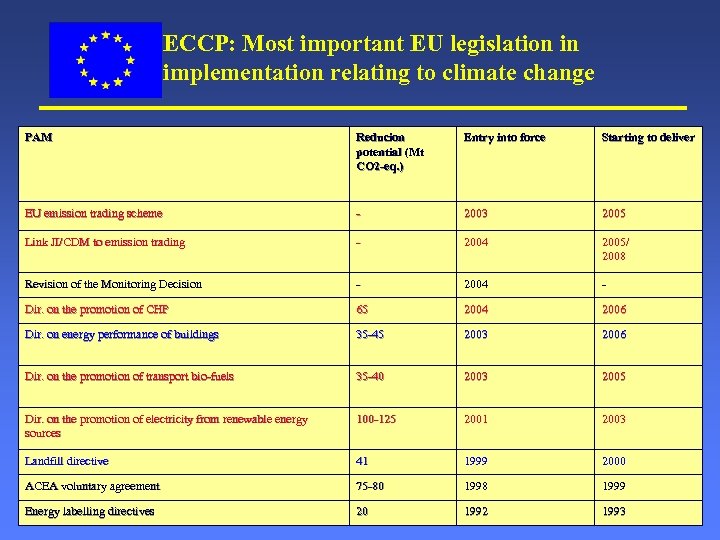
ECCP: Most important EU legislation in implementation relating to climate change PAM Reducion potential (Mt CO 2 -eq. ) Entry into force Starting to deliver EU emission trading scheme - 2003 2005 Link JI/CDM to emission trading - 2004 2005/ 2008 Revision of the Monitoring Decision - 2004 - Dir. on the promotion of CHP 65 2004 2006 Dir. on energy performance of buildings 35 -45 2003 2006 Dir. on the promotion of transport bio-fuels 35 -40 2003 2005 Dir. on the promotion of electricity from renewable energy sources 100 -125 2001 2003 Landfill directive 41 1999 2000 ACEA voluntary agreement 75 -80 1998 1999 Energy labelling directives European Commission: Environment Directorate General Slide: 11 20 1992 1993
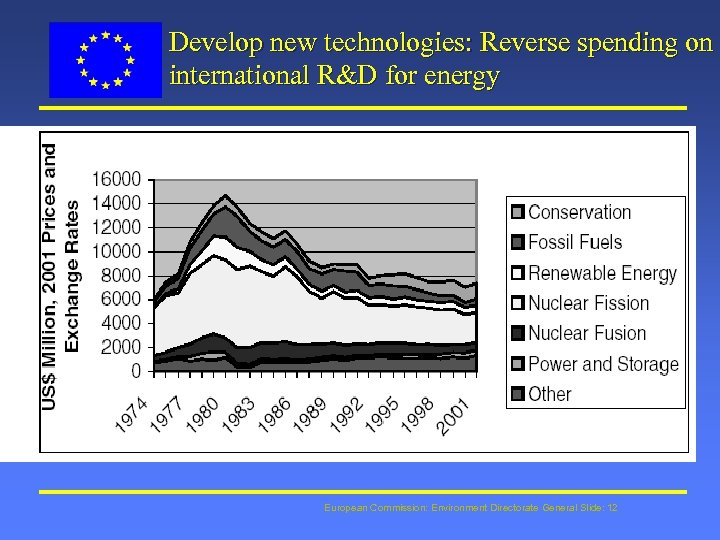
Develop new technologies: Reverse spending on international R&D for energy European Commission: Environment Directorate General Slide: 12
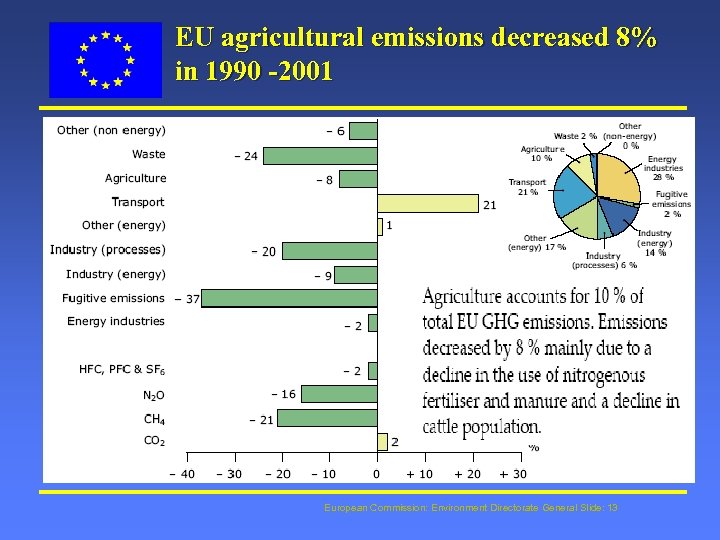
EU agricultural emissions decreased 8% in 1990 -2001 European Commission: Environment Directorate General Slide: 13
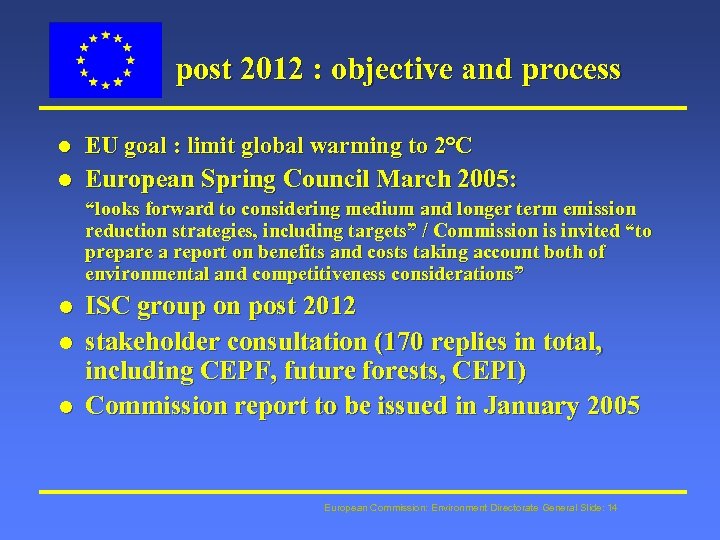
post 2012 : objective and process l EU goal : limit global warming to 2°C l European Spring Council March 2005: “looks forward to considering medium and longer term emission reduction strategies, including targets” / Commission is invited “to prepare a report on benefits and costs taking account both of environmental and competitiveness considerations” l l l ISC group on post 2012 stakeholder consultation (170 replies in total, including CEPF, future forests, CEPI) Commission report to be issued in January 2005 European Commission: Environment Directorate General Slide: 14
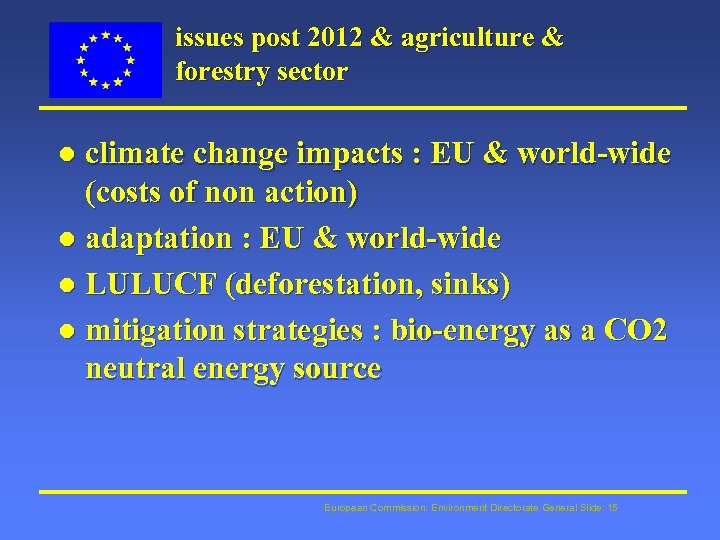
issues post 2012 & agriculture & forestry sector climate change impacts : EU & world-wide (costs of non action) l adaptation : EU & world-wide l LULUCF (deforestation, sinks) l mitigation strategies : bio-energy as a CO 2 neutral energy source l European Commission: Environment Directorate General Slide: 15
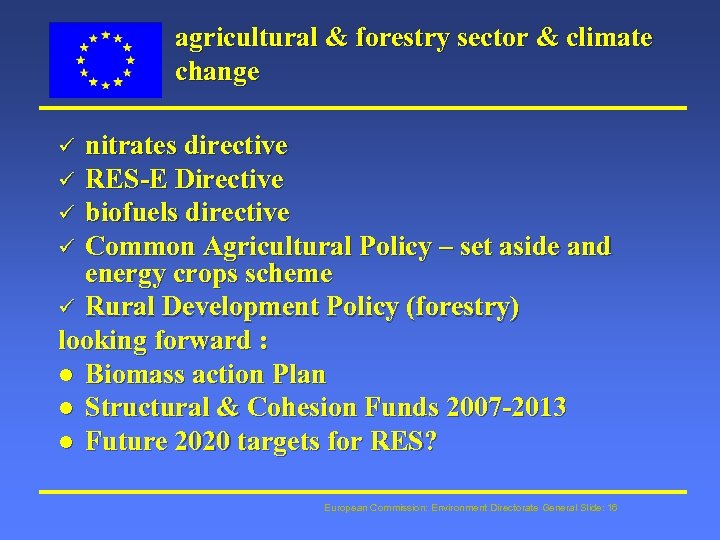
agricultural & forestry sector & climate change nitrates directive ü RES-E Directive ü biofuels directive ü Common Agricultural Policy – set aside and energy crops scheme ü Rural Development Policy (forestry) looking forward : l Biomass action Plan l Structural & Cohesion Funds 2007 -2013 l Future 2020 targets for RES? ü European Commission: Environment Directorate General Slide: 16
ETS & (biomass) renewables one uniform price/ EU market for CO 2 allowances… l affecting the competitive situation of the various primary energy sources l renewables get cost advantage as they do not need to surrender CO 2 allowances l liberalisation opens market for innovative suppliers, eg. renewables l European Commission: Environment Directorate General Slide: 17
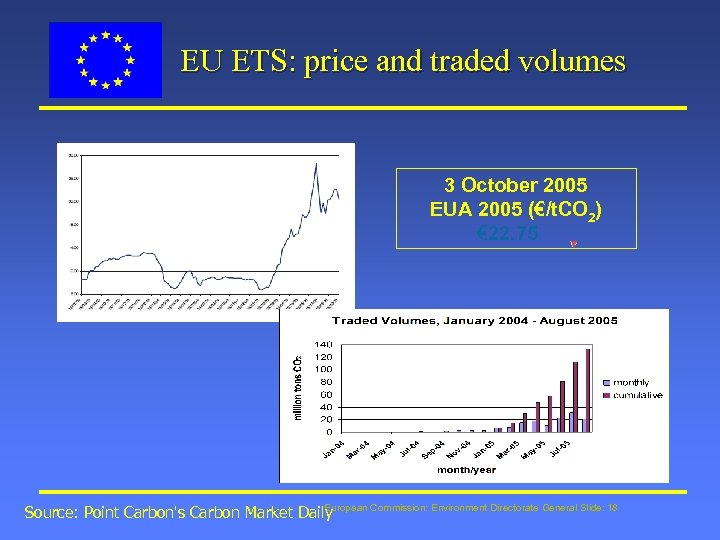
EU ETS: price and traded volumes 3 October 2005 EUA 2005 (€/t. CO 2) € 22. 75 European Commission: Environment Directorate General Slide: 18 Source: Point Carbon's Carbon Market Daily
ETS & (biomass) renewables l l impact on improved competitiveness of bioenergy depends on allowance price (scarcity) expected moderate prices in first trial period will bring limited incentives, but : m can tip the balance for near competitive applications m raises awareness of carbon constraint and search for alternatives to fossil fuels m comes on top of other dedicated instruments (eg. RESE) … m and high oil prices European Commission: Environment Directorate General Slide: 19
ETS & (biomass) renewables l short term direct impacts: m increased use of co-firing in coal power plants m increased use of biomass in pulp&paper l longer term : allowance price impacts on m investments decisions; m make or buy decision for energy users m emergence of new “low carbon energy” suppliers European Commission: Environment Directorate General Slide: 20
JI/CDM link to ETS An indirect link exists as of 2008 through international emissions trading l Linking proposal: to provide more flexibility and certainty to legal entities l In concrete terms, linking means that JI/CDM credits can be used by operators to fulfil their domestic obligation l Linking implies the recognition of JI/CDM credits as equivalent to allowances l European Commission: Environment Directorate General Slide: 21
JI/CDM link to ETS l l l avoiding double counting : no ERUs for installations covered by the Directive Baseline takes into account environmental acquis in EU and accession countries provisions for control of MS which projects “come in” European Commission: Environment Directorate General Slide: 22
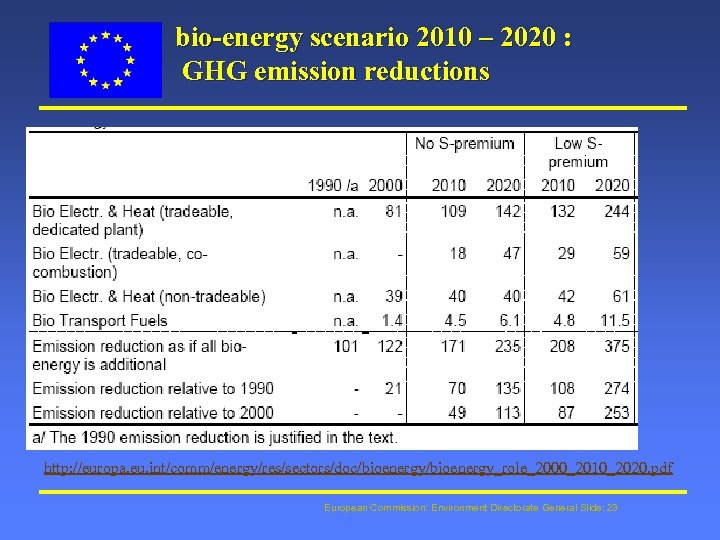
bio-energy scenario 2010 – 2020 : GHG emission reductions http: //europa. eu. int/comm/energy/res/sectors/doc/bioenergy_role_2000_2010_2020. pdf European Commission: Environment Directorate General Slide: 23
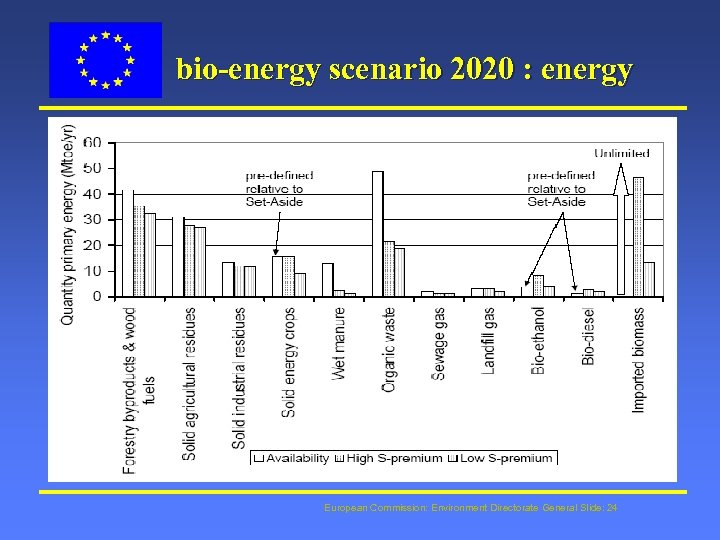
bio-energy scenario 2020 : energy European Commission: Environment Directorate General Slide: 24
outlook for bio-energy Review RES-E Directive l Biomass action Plan l Common Agricultural Policy & Rural Development Policy l Structural&Cohesion Funds 2007 -2013 l Future 2020 targets for RES l European Commission: Environment Directorate General Slide: 25
Well-to-Wheels analysis of future automotive fuels and powertrains in the European context 09/2005 A joint study by EUCAR / JRC / CONCAWE Overview of Results Slide 26
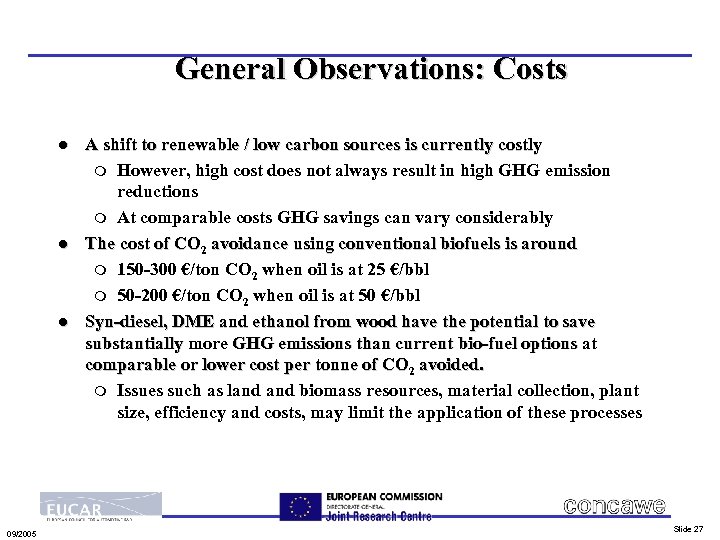
General Observations: Costs l l l 09/2005 A shift to renewable / low carbon sources is currently costly m However, high cost does not always result in high GHG emission reductions m At comparable costs GHG savings can vary considerably The cost of CO 2 avoidance using conventional biofuels is around m 150 -300 €/ton CO 2 when oil is at 25 €/bbl m 50 -200 €/ton CO 2 when oil is at 50 €/bbl Syn-diesel, DME and ethanol from wood have the potential to save substantially more GHG emissions than current bio-fuel options at comparable or lower cost per tonne of CO 2 avoided. m Issues such as land biomass resources, material collection, plant size, efficiency and costs, may limit the application of these processes Slide 27
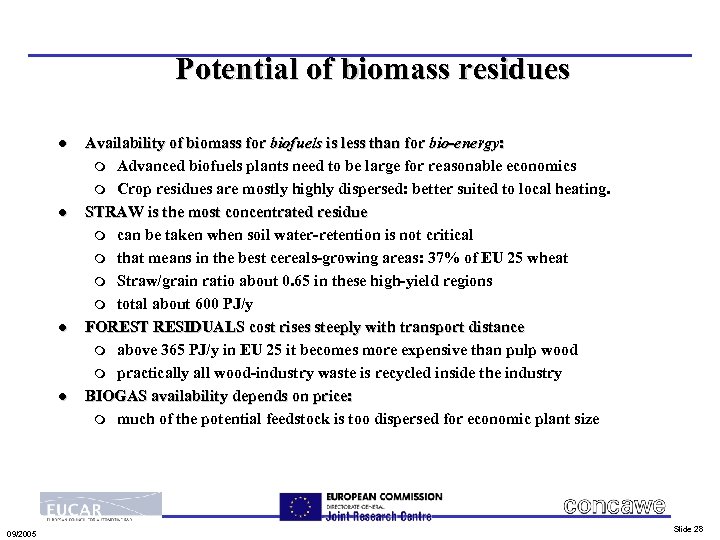
Potential of biomass residues l l 09/2005 Availability of biomass for biofuels is less than for bio-energy: m Advanced biofuels plants need to be large for reasonable economics m Crop residues are mostly highly dispersed: better suited to local heating. STRAW is the most concentrated residue m can be taken when soil water-retention is not critical m that means in the best cereals-growing areas: 37% of EU 25 wheat m Straw/grain ratio about 0. 65 in these high-yield regions m total about 600 PJ/y FOREST RESIDUALS cost rises steeply with transport distance m above 365 PJ/y in EU 25 it becomes more expensive than pulp wood m practically all wood-industry waste is recycled inside the industry BIOGAS availability depends on price: m much of the potential feedstock is too dispersed for economic plant size Slide 28
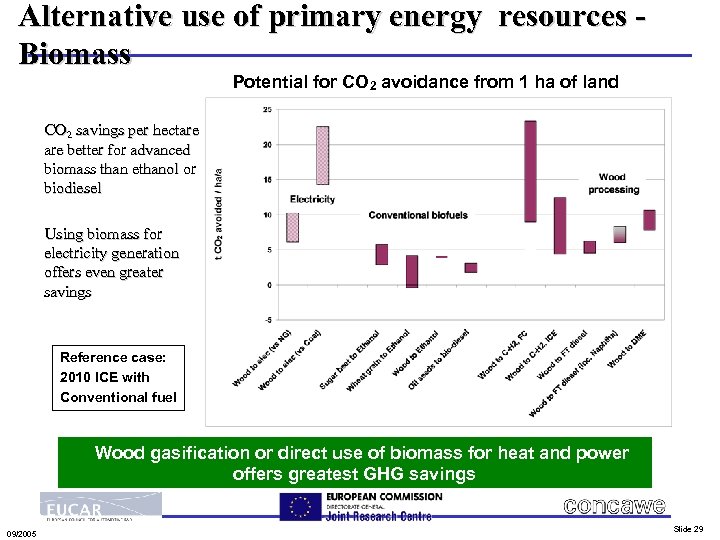
Alternative use of primary energy resources Biomass Potential for CO 2 avoidance from 1 ha of land CO 2 savings per hectare better for advanced biomass than ethanol or biodiesel Using biomass for electricity generation offers even greater savings Reference case: 2010 ICE with Conventional fuel Wood gasification or direct use of biomass for heat and power offers greatest GHG savings 09/2005 Slide 29
Conclusions l l 09/2005 A shift to renewable/low fossil carbon routes may offer a significant GHG reduction potential but generally requires more energy. The specific pathway is critical No single fuel pathway offers a short term route to high volumes of “low carbon” fuel. m Contributions from a number of technologies/routes will be needed. m A wider variety of fuels may be expected in the market m Blends with conventional fuels and niche applications should be considered if they can produce significant GHG reductions at reasonable cost Transport applications may not maximize the GHG reduction potential of renewable energies Optimum use of renewable energy sources such as biomass and wind requires consideration of the overall energy demand including stationary applications m More efficient use of renewables may be achieved through direct use as electricity rather than road fuels applications Slide 30
Well-to-Wheels analysis of future automotive fuels and powertrains in the European context The study report will be available on the WEB: http: //ies. jrc. cec. eu. int/WTW For questions / inquiries / requests / notes to the consortium, please use the centralised mail address: info. WTW@jrc. it 09/2005 Slide 31
Скачать презентацию EU Climate policies Bio-energy Estonian conference on
fedd4573e7d28484993d9f7b61033e94.ppt