


 Скачать презентацию EU CHINA Patent Training Program Case analysis
7c5cd81af26d8330f157c0427366bf35.ppt
- Количество слайдов: 84
 EU – CHINA Patent Training Program Case analysis on key issues of patent law practice Prof. Dr. Christian Osterrieth, attorney at law, Düsseldorf Mr. Gisbert Steinacker, former presiding judge of the patent senate of the court of appeal, Düsseldorf Overseas Exchange Center of Beijing University, March 2010
 Content I. Decision “Spannschraube” II. Decisions “Olanzapin” III. Decision “Simvastatin” IV. Decision “Orange Book” V. Decision “Pipettensystem” VI. Decision “Custodiol” VII. Decision “MP 3 Player Import” VIII. Decision “Schmiermittel für Posaunen” Priviledged and Confidential 2
 SPANNSCHRAUBE DECISION OF 2 MARCH 1999 CASE NUMBER X ZR 85/96 PUBLISHED GRUR 1999, 909, IIC 1999, 932 Priviledged and Confidential 3
 I. Decision “Spannschraube” • Facts: EP 0 319 521 claiming pipe clamp • Technical problem: providing a pipe clamp of the known kind which is easy to operate and can be easily closed with a very short clamping screw. • Solution: claim 1 of EP‘ 521 Priviledged and Confidential 4
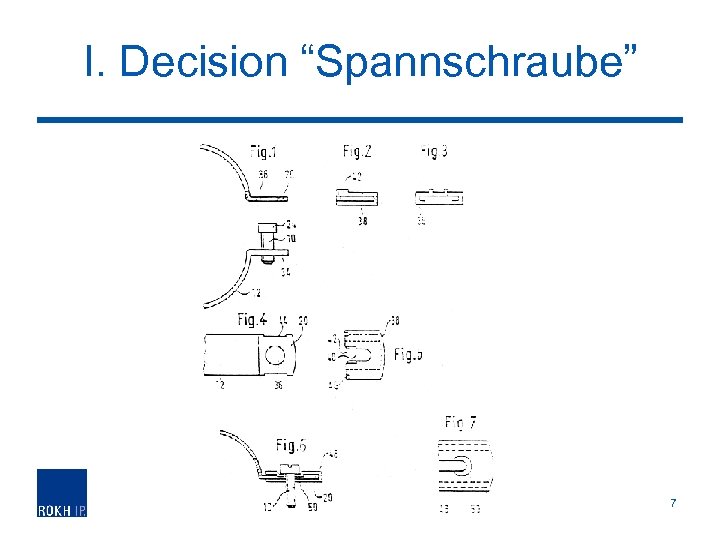
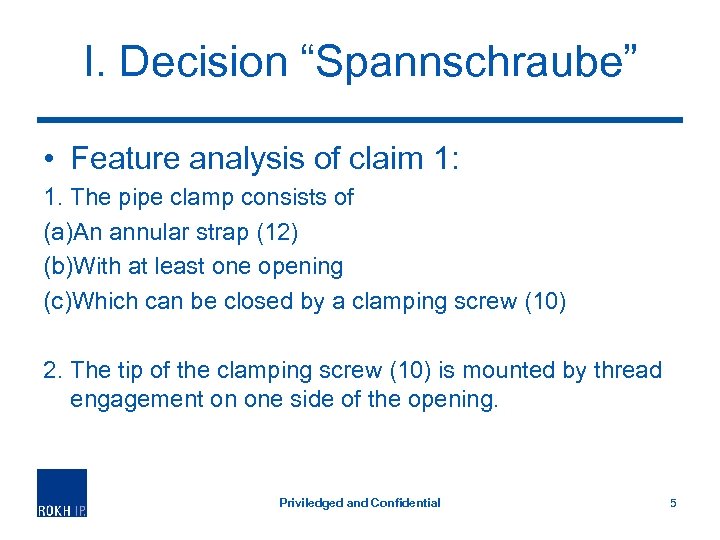 I. Decision “Spannschraube” • Feature analysis of claim 1: 1. The pipe clamp consists of (a)An annular strap (12) (b)With at least one opening (c)Which can be closed by a clamping screw (10) 2. The tip of the clamping screw (10) is mounted by thread engagement on one side of the opening. Priviledged and Confidential 5
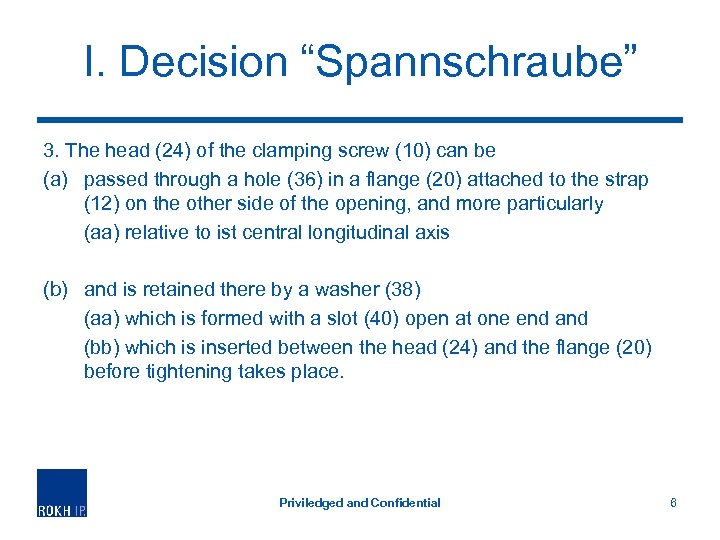 I. Decision “Spannschraube” 3. The head (24) of the clamping screw (10) can be (a) passed through a hole (36) in a flange (20) attached to the strap (12) on the other side of the opening, and more particularly (aa) relative to ist central longitudinal axis (b) and is retained there by a washer (38) (aa) which is formed with a slot (40) open at one end and (bb) which is inserted between the head (24) and the flange (20) before tightening takes place. Priviledged and Confidential 6
 I. Decision “Spannschraube” Priviledged and Confidential 7
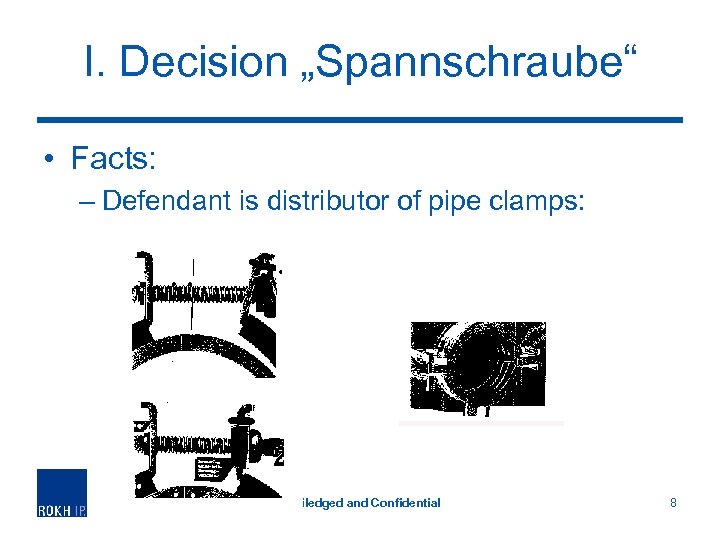 I. Decision „Spannschraube“ • Facts: – Defendant is distributor of pipe clamps: Priviledged and Confidential 8
 I. Decision „Spannschraube“ • EP 0 471 989 was granted for Defendant‘s pipe clamps after consideration of the contested patent. • With these pipe clamps, a tension screw with its foot located on one side of the opening can, as in the teaching of the contested patent, be inserted with its head through a hole in the opposing flange. There, it can be fixed in place by means of a plate with an open elongated hole, which can swivel into the space between the screw head and the flange if this space is sufficient. Priviledged and Confidential 9
 I. Decision „Spannschraube“ • The only critical and disputed feature: Feature 3 b, bb: (3 b) and is retained there by a washer (38) (bb) which is inserted between the head (24) and the flange (20) before tightening takes place. Priviledged and Confidential 10
 I. Decision „Spannschraube“ • Question in dispute: – What a person skilled in the art would understand is determined by what is sought to be achieved with the feature „inserted washer“? Priviledged and Confidential 11
 I. Decision „Spannschraube“ • Regional Court found in favour of Plaintiff • Higher Regional Court found in favour of Defendant • Other European courts: – Switzerland: 1 st and 2 nd instance: infringement (+) – France: 1 st instance: (-), 2 nd instance (+), 3 rd instance (-) Priviledged and Confidential 12
 I. Decision „Spannschraube“ • Decision: – The interpretation of a European patent should not be bound by the wording, but be based on the overall technical context com-municated by the contents of the patent speci-fication to the person skilled in the art. The decisive factor is not the linguistic or logical determination of the terms used in the patent specification, but rather the unprejudiced expert's interpretation. Priviledged and Confidential 13
 I. Decision „Spannschraube“ – With respect to the terms used therein, patent specifications virtually represent their own lexicon. If these terms differ from general (technical) linguistic use, it is ultimately only the contents of the terms resulting from the patent specification that apply. Priviledged and Confidential 14
 I. Decision „Spannschraube“ – The scope of protection of a European patent cannot be extended to embodiments that use substitute means that in their entirety make no use of the success achieved by the patent, or use them only to a practically no longer relevant extent. Priviledged and Confidential 15
 I. Decision „Spannschraube“ • Reasoning: – Starting point: Art. 69 para 1 EPC: • The scope of protection of the patent is determined by the content of the patent claims, for which purpose the description and the drawings are to be used for construing the patent claims. • Content does not refer to the wording but the meaning. • The decisive factor is the disclosure in the patent claims and, supplementarily, as an aid to construction, the disclosure in the patent specification, to the extent that these are reflected in the claims Priviledged and Confidential 16
 I. Decision „Spannschraube“ – Relevant criterion for the assessment: • View of the person skilled in the particular specialist field. • Terms in the patent claims and description are to be interpreted as they would be understood by the expert of average skills in question on the basis of the total contents of the patent specification, and taking into account the problem and solution in the invention. Priviledged and Confidential 17
 I. Decision „Spannschraube“ • Analysis of the decision: – The skilled person in the art will only take into consideration an interpretation of te feature which is not only technically feasible but which helps to solve the technical problem. – The critical feature in dispute is to be analysed in view of the problem to be solved. Priviledged and Confidential 18
 I. Decision „Spannschraube“ • Therefore, it is necessary to analyse in more detail the technical problem. This can be identified by an analysis of the prior art as criticized in the patent. • With respect to all three pieces of prior art, the patent is criticizing that long screws are required. Priviledged and Confidential 19
 I. Decision „Spannschraube“ – This criticism will invite the person skilled in the art to recognize that the technical problem to be solved by the invention is that long screws and screw distances used in the prior art are consequences of an unfavourable movement between the head of the clamping screw and the clamping flange. Priviledged and Confidential 20
 I. Decision „Spannschraube“ – Person skilled in the art will understand the long screws are required because the head of the screw is turned and moved into the clamping position on an orbital path with the access of its rotation near the flange. Priviledged and Confidential 21
 I. Decision „Spannschraube“ – Hence, the person skilled in the art will understand the teaching of feature 3 b bb „state of insertion“ has to contribute to solve the problem, i. e. to avoid the necessity to use screws for longer length, i. e. to insert the washer in a way that short screws can be used. Priviledged and Confidential 22
 I. Decision „Spannschraube“ • Person skilled in art will recognize that the use of relatively long screws in the prior art is due to the fact that the head of the screws are – either moved into the clamping position on on orbital path with the axes of ist rotation near the flange – or long screws are required because the head of the screw and the flange surface are brought together into the clamping position on an almost cycloid or a volute-shaped path • Person skilled in the art will then come to the conclusion that „state of insertion“ may also refer to the path on which, or the type of the movement with which the washer was brought into the clamping position. Priviledged and Confidential 23
 I. Decision „Spannschraube“ – Decisive question: Is it admissable to interpret the scope of a technical feature – „state of insertion“ – to a state of insertion which is gained or achieved by a specific movement? – Can a patent feature which may have a larger – unspecified – meaning in ist purely linguistic interpretation be reduced and limited to an understanding which may be more narrow but describes the technical soluation in the way of the thinking of the patent? Priviledged and Confidential 24
 I. Decision „Spannschraube“ – Answer: Yes, because: • A patent is granted because it discloses a solution to a specific technical problem • Hence, the technical terms in patent claims are to be interpreted in view of the patent specification • Insofar, it is correct to say that the terms used in patent specifications can constitute their own kind of glossary. Priviledged and Confidential 25
 I. Decision „Spannschraube“ • Consequence for patent infringement: – Catch plate is pivotable away from the locking flange about a pivot axis against the force of an elastic member. – Scrw has to be sufficiently long to push a catch plate away. – Long screw required since screw has to allow pivotable movement of the catch plate. Priviledged and Confidential 26
 I. Decision „Spannschraube“ – Same technical problem as in prior art, where, due to pivotable movements, a relatively long screw was techically required. – Therefore: pivotable catch plate cannot be regarded as an element comparable to the washer which is inserted by a linear movement. The attacked embodiment follows prior art phlisophy, based on turning movement requiring a long screw – Result: No literal infringement Priviledged and Confidential 27
 I. Decision „Spannschraube“ • No infringement under doctrine of equivalency either: – Equivalency requires that the problem and the techical achievement of the attacked embodiments are the same, but the means used to solve the problem and thus to achieve the same success are different Priviledged and Confidential 28
 I. Decision „Spannschraube“ – Here: • the catch plate is brought into ist final position by a turning movement requiring a longer screw, • the intended success of the patent is not achieved – Result: No patent infringement under the doctrine of equivalency Priviledged and Confidential 29
 OLANZAPIN OLG DÜSSELDORF DECISION OF 29 MAY 2008 CASE NUMBER I-2 W 47/07 MITT. 2008, 327 Priviledged and Confidential 30
 II. “Olanzapin” – OLG Düsseldorf • Facts: – Claimant was owner of EP 454 436 regarding a pharmaceutical containing the active ingredient Olanzapine – The German Patent Court had declared the patent invalid in first instance – A manufacturer of generics intended to market a generic pharmaceutical containing Olanzapine as active ingredient Priviledged and Confidential 31
 II. “Olanzapin” – OLG Düsseldorf • Facts (cont‘d) – Claimant requested grant of a preliminary injunction against the manufacturer of generics – Regional Court Düsseldorf refused to grant a preliminary injunction because the patent has been declared invalid in first instance – Claimant appealed to the Higher Regional Court Düsseldorf Priviledged and Confidential 32
 II. “Olanzapin” – OLG Düsseldorf • Decision: – The Higher Regional Court (Oberlandesgericht, OLG) Düsseldorf granted the preliminary injunction because the revocation of the patent by the German Patent Court was evidently wrong. Priviledged and Confidential 33
 II. “Olanzapin” – OLG Düsseldorf • Reasoning: – As a matter of principle, a premliminary injunction is not granted if there any doubts with respect to the validity of the patent – which is usually the case if the patent has been declared invalid in first instance – However, for constitutional reasons (efficient protection of property), an exception has to be made if the revocation is evidently wrong. Priviledged and Confidential 34
 II. “Olanzapin” – OLG Düsseldorf • Reasoning (cont‘d): – The lifetime of a patent is limited. Hence, as long as infringement proceedings are stayed and preliminary injunctions are not granted because of pending nullity proceedings in 2 nd instance after revocation in 1 st instance, the patent owner would irretrievably be deprived to enforce his injunctive claims. Priviledged and Confidential 35
 II. “Olanzapin” – OLG Düsseldorf • Reasoning (cont‘d): – This is to a lesser extent acceptable if a decision in 2 nd instance is not expected within the lifetime of the patent. – In particular at the end of the lifetime of a patent, the evidently wrong revocation of the patent in 1 st instance will provoke competitors to commit infringing acts. Priviledged and Confidential 36
 II. “Olanzapin” – OLG Düsseldorf • It is a rather exceptional case because the OLG Düsseldorf had good reasons to find the 1 st instance revocation of the patent by the German Patent Court evidently wrong. • At the end of the same year, the Federal Supreme Court (BGH) in 2 nd instance nullity proceedings annulled the decision of the German Patent Court and dismissed the nullity action: Priviledged and Confidential 37
 OLANZAPIN GERMAN FEDERAL SUPREME COURT (BGH) DECISION OF 16 DECEMBER 2008 CASE NO. X ZR 89/07 PUBLISHED IIC 2009, 596 Priviledged and Confidential 38
 II. “Olanzapin” – BGH • Facts: – European Patent EP 454 436, comprising 22 claims, of which claims 2, 6, 8, 20, and 21 read as follows: (2)2 -Methyl-10 -(4 -methyl-1 -piperazinyl)-4 H-thieno[2, 3 b][1, 5]benzodiazepine or a pharamceutically acceptable acid addition salt thereof. (6)The use of a compound according to claim 2 or 3 for the manufacture of a medicament for the treatment of schizophrenia. (8)The use of a compound according to claim 2 or 3 for the manufacture of a medicament for the treatment of acute mania. Priviledged and Confidential 39
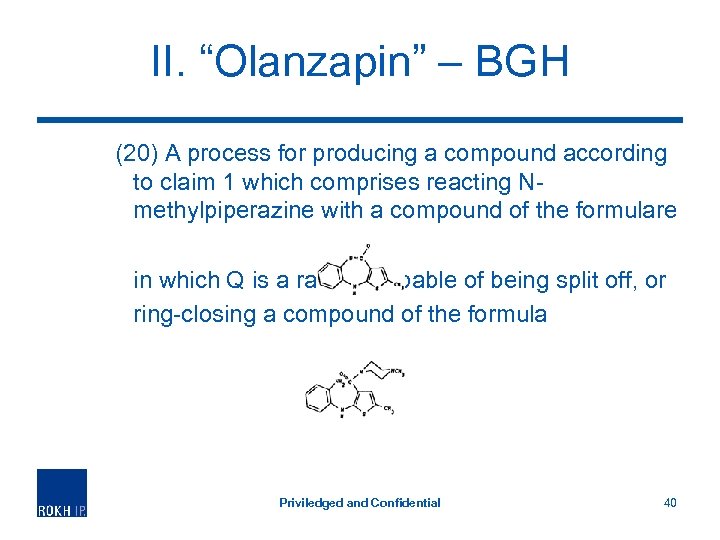 II. “Olanzapin” – BGH (20) A process for producing a compound according to claim 1 which comprises reacting Nmethylpiperazine with a compound of the formulare in which Q is a radical capable of being split off, or ring-closing a compound of the formula Priviledged and Confidential 40
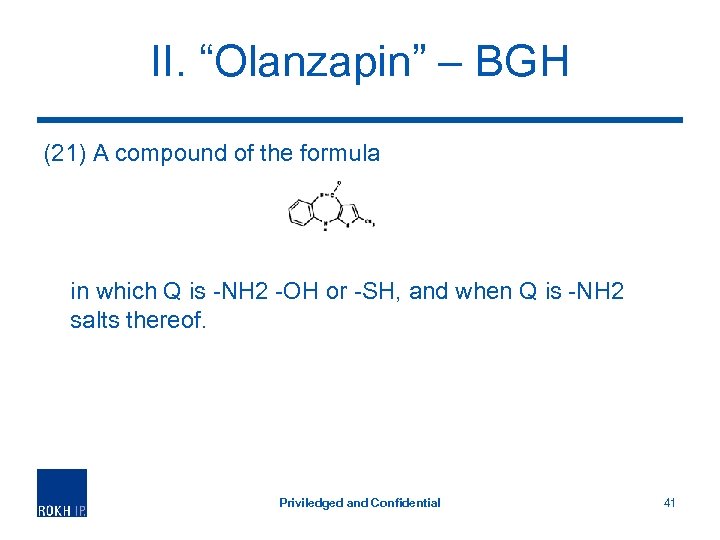 II. “Olanzapin” – BGH (21) A compound of the formula in which Q is -NH 2 -OH or -SH, and when Q is -NH 2 salts thereof. Priviledged and Confidential 41
 II. “Olanzapin” – BGH • Facts (cont‘d) – Plaintiff filed nullity action for revocation of the patent and claims that the subject matter of the patent in suit is not patentable. – The Patent Court had declared the patent in suit to be null and void with effect for Germany. – The Defendant's appeal requests the rejection of the complaint. Priviledged and Confidential 42
 II. “Olanzapin” – BGH • Decision – The patent was found novel and inventive. Priviledged and Confidential 43
 II. “Olanzapin” – BGH • Reasoning: – The assessment as to whether the object of a patent lacks novelty, due to a prior publication, requires a determination of the entire content of the prior publication. The decisive factor is what technical information is disclosed to a person skilled in the art. In this connection, the concept of disclosure is no different than what is otherwise the basis in patent law. Priviledged and Confidential 44
 II. “Olanzapin” – BGH • Reasoning (cont’d): – The disclosure can also include what is not explicitly mentioned in the claim and in the specification, but is obvious from the point of view of a person skilled in the art, in order to implement the protected teaching, and therefore does not require any separate disclosure, but rather is “read along”. However, the inclusion of the obvious does not allow supplementing the disclosure with technical knowledge, but merely serves for a complete determination of the sense of a claim Priviledged and Confidential 45
 II. “Olanzapin” – BGH • Reasoning (cont‘d) – With the disclosure of a chemical structural formula, the individual compounds covered by this formula are, in principle, not yet disclosed. Priviledged and Confidential 46
 SIMVASTATIN DECISION OF 5 DECEMBER 2006 CASE NUMBER X ZR 76/05 PUBLISHED GRUR 2007, 221 Priviledged and Confidential 47
 III. Decision “Simvastatin” • Facts: – European Patent EP 0 033 583 and Supplementary Protection Certificate: pharmaceutical patent concerning cholesterollowering active ingredient known as Simvastatin. – Claimant was marketing a pharmaceutical containing Simvastatin and it had also granted a number of licenses, including two “early entry” licenses. Priviledged and Confidential 48
 III. Decision “Simvastatin” – Defendant company: producer of generics in Germany. – Shortly before the expiry of the claimant’s SPC, the defendant marketed a cholesterol-reducing pharmaceutical containing Simvastatin – Although sales would only commence after the expiry of the SPC, the defendant had announced its intention to sell the product through adverts published in the medical press prior to the expiration of the SPC Priviledged and Confidential 49
 III. Decision “Simvastatin” – Defendant also entered its pharmaceutical into the IFA database prior to the expiration of the SPC, the ffect of which was to inform doctors, pharmacists and the pharmaceutical trade of the availability and prices of its pharmaceutical through the pharmaceutical information system known as the “Lauer Taxe” Priviledged and Confidential 50
 III. Decision “Simvastatin” • Arguments of the parties: – Claimant: advertisement as an infringing offer to supply a generic medicament. – Defendant: advertisements neither explicitly referred to the protected substance "Simvastatin", nor there was a patent infringement due to the fact that supply of the medicament only took place after expiry of the SPC. Priviledged and Confidential 51
 III. Decision “Simvastatin” • Question in Dispute: – Did the advertisement with an offer to sell a Simvastatin-containing pharmaceutical at a date after the relevant patent protection had expired constitute an offer for sale and amount to patent infringement where this intention had been published during the life of the SPC? Priviledged and Confidential 52
 III. Decision “Simvastatin” • Decision: – Even though the advertisement did not explicitly refer to the relevant features of the patent and did not mention the active ingredient ("Simvastatin") of the patented active substance, the patent was infringed. Priviledged and Confidential 53
 III. Decision “Simvastatin” • Reasoning: – The relevant consumers to whom the advertisement was addressed to knew from the circumstances that only Simvastatin was the subject of the advertisement – The fact that the supply had been announced for a time after expiration of the SPC only did not prevent the advertisement from amounting to patent infringement. Priviledged and Confidential 54
 III. Decision “Simvastatin” • Reasoning (cont‘d) – The Court held that an offer in the sense of sec. 9 phrase 2 no. 1 German Patent Act constitutes an independent infringing act with own scope, namely differing from the infringing act of putting onto the market. – Hence, it is not necessary that the offer lead to any real sales. Priviledged and Confidential 55
 Orange Book Decision of 06 May 2009, case Number K ZR 39/06 published NJW-RR 2009, 1047 Priviledged and Confidential 56
 IV. Decision “Orange Book” Facts: - Claimant was the owner of the European patent EP 325 330 concerning an optically readable record carrier of the inscribable type - Defendant distributes optical data media in Europe. Priviledged and Confidential 57
 IV. Decision “Orange Book” Arguments of the Parties: - Claimant: distribution of said optical data media as an infringement of the patent. - Defendant: claims that the patentee cannot ask for injunction since he is entitled to a license on FRAND terms Priviledged and Confidential 58
 IV. Decision “Orange Book” Question in Dispute: Can the defendant in patent injunction proceedings bring forward as a defense that he is entitled to a license on FRAND terms under antitrust law? Priviledged and Confidential 59
 IV. Decision “Orange Book” Decision: The Federal Court of Justice affirms the question in dispute. He furthermore gives two main preconditions for such a defense: 1. The potential licensee is required to make a binding and unconditional offer to license under FRAND terms which could not be rejected by proprietor without committing abusive conduct under Art. 82 EC Priviledged and Confidential 60
 IV. Decision “Orange Book” 2. The potential licensee must pay reasonable fee to hypothetical licensor or deposit in escrow for time he uses or used technology without license Priviledged and Confidential 61
 IV. Decision “Orange Book” Reasoning: - even though a user of the patent – who is in demand of a license – acts unlawfully by using the patent without the patentee‘s approval, the patentee has no right to ask for injunction, since he would have the obligation to return immediatly what he is asking for. Priviledged and Confidential 62
 IV. Decision “Orange Book” - Therefore, the claim for injunction would go against good faith – „dolo petit, qui petit quod statim redditurus est“. Priviledged and Confidential 63
 PIPETTE SYSTEM DECISION OF 27 FEBRUARY 2007, CASE NUMBER X ZR 38/06 PUBLISHED GRUR 2007, 769 Priviledged and Confidential 64
 V. Decision “Pipettensystem” Facts: - The claimant was the owner of European patent EP 656 229. The patent claimed a manual pipette system including a syringe. - The Defendant distributed syringes for pipette systems which were suitable for the claimant‘s manual pipette systems to which the defendant advised his customers. Priviledged and Confidential 65
 V. Decision “Pipettensystem” Arguments of the Parties: - Claimant: sale of the syringes as a contributory infringement of the patent Priviledged and Confidential 66
 V. Decision “Pipettensystem” Question in Dispute: Requirements for contributory infringement – distinction between intended use of a product in accordance with the invention and the prohibited reconstruction if the replacement is customary in device. Priviledged and Confidential 67
 V. Decision “Pipettensystem” Decision: The sale of the syringes was found to be not infringing. Priviledged and Confidential 68
 V. Decision “Pipettensystem” Reasoning: - Altough the defendant‘s syringes were means relating to an essential element of the invention pursuant to Sec. 10 (1) of the Patents Act the replaement of the syringes belonged to the intended use of the pipette system. Priviledged and Confidential 69
 V. Decision “Pipettensystem” - The user was permitted to expect to use the pipette system not only in combination with the provided syringe; otherwise he could have used it only as a disposable. - Concerning the claimant‘s commercial interest in extending his exclusive rights to the replacement parts market the court ruled that such an interest was not legitimate because it would exceed the reasonable interest in the exploitation of the invention. Priviledged and Confidential 70
 CUSTODIOL Decision of 12 March 2002, case Number X ZB 12/00 published GRUR 2002, 523 Priviledged and Confidential 71
 VI. Decision “Custodiol” Facts: - Claimant was owner of the EP 0 054 635 concerning a protective solution for preventing ischaemia damage to the heart and kidneys during surgery. - The claimant applied for a Supplementary Protection Certificate (SPC) - The German Patent and Trademark Office refused to grant the SPC Priviledged and Confidential 72
 VI. Decision “Custodiol” Arguments of the Parties: - Claimant: the pharmaceutical product „Custidiol“ which had been granted marketing approval in Germany was protected by the basic patent. - German Patent and Trademark Office: refuses to grant the SPC since it‘s requirements are not given. Priviledged and Confidential 73
 VI. Decision “Custodiol” Question in Dispute: Determination of extent of protection of a patent when a specific range of figures and dimensoins is claimed. Priviledged and Confidential 74
 VI. Decision “Custodiol” Decision: The German Patent and Trademark justly refused to grant the SPC since the requiered qualifications are not given. The pharmaceutical product „Custodiol“ is not protected by the basic patent. Priviledged and Confidential 75
 VI. Decision “Custodiol” Reasoning: - In contrast to general descriptive concepts formulated in linguistic terms, numeric figures as such are unambiguous. - As a general principle and to maintain legal certainty, the meaning of patent claims does not only constitute the starting point but rather is the essential basis of the determination of the extent of protection conferred by a patent. Priviledged and Confidential 76
 MP 3 -PLAYER IMPORT Decision of 17 September 2009, case Number X ZR 02/08 published MMR 2009, 798 Priviledged and Confidential 77
 VII. Decision “MP 3 Player Import” Facts: - Claimant was the owner of an exclusive licence of European Patent EP 402 973 regarding a digital transmission system. - The Claimant requested from the defendants – inter alia a forwarder – the agreement to destroy the carried MP 3 player due to the infringement of the patent. Priviledged and Confidential 78
 VII. Decision “MP 3 Player Import” Arguments of the Parties: - Claimant: infringing of the patent due to the transportation of the infringing goods. - Defendant: pleas ignorance concerning the infringement. Priviledged and Confidential 79
 VII. Decision “MP 3 Player Import” Question in Dispute: To which extent can a forwarder be claimed for transported goods which infringe a patent? Priviledged and Confidential 80
 VII. Decision “MP 3 Player Import” Decision and reasoning: The Federal Court of Justice referred the case back to the Higher Regional Court. Furthermore, the court stated: - A forwarder has no procedural obligation to provide essential information for an eligible denial; therefore, a forwarder can plea ignorance concerning the accordance with technical teaching of the claimed invention Priviledged and Confidential 81
 VII. Decision “MP 3 Player Import” - Infringer of an injunctive relief and an elimination claim are […] also who enable or advance third parties the implementation of the matters of fact, although they could get knowledge by the use of reasonable effort that their supporting activity infringes the absolute right of the patentee. - A forwarder has no general auditing duty concerning infringements of industrial property rights by transported goods. Priviledged and Confidential 82
 VII. Decision “MP 3 Player Import” - A forwarder can have the duty of gathering information and if necessary testing the goods, if there are precise indications for infringements of industrial property rights. Priviledged and Confidential 83
 Steinstraße 20 Tel. +49 (0)211 550 22 0 40212 Düsseldorf Fax +49 (0)211 550 22 550 Christian. Osterieth@rokh-ip. com Gisbert. Steinacker@rokh-ip. com www. rokh-ip. com 84