


ETON COLLEGE Made by Sergij Silivanov
v Eton College, often referred to simply as Eton, is a British independent school for boys aged 13 to 18. It was founded in 1440 by King Henry VI as "The King's College of Our Lady of Eton besides Wyndsor". It is located in Eton, near Windsor in England, and is one of the original nine English public schools as defined by the Public Schools Act 1868.
Eton has a long list of distinguished former pupils. David Cameron is the nineteenth British Prime Minister to have attended Eton has traditionally been referred to as "the chief nurse of England's statesmen", and has been described as the most famous public school in the world. Early in the 20 th century, a historian of Eton wrote, "No other school can claim to have sent forth such a cohort of distinguished figures to make their mark on the world".
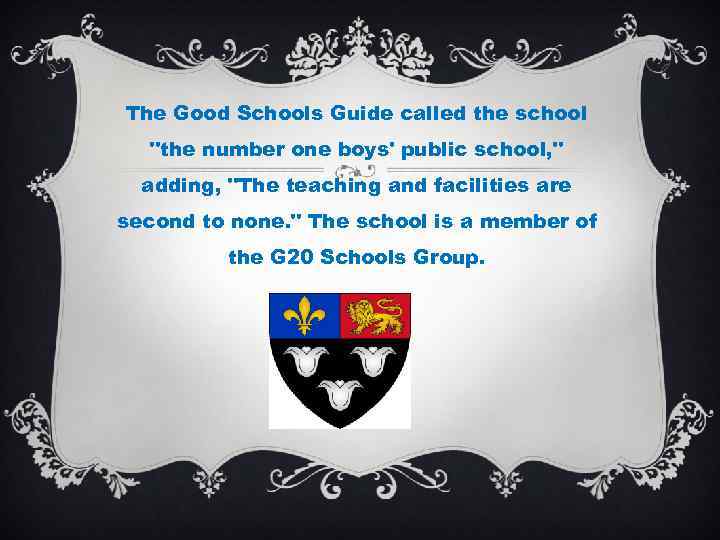
The Good Schools Guide called the school "the number one boys' public school, " adding, "The teaching and facilities are second to none. " The school is a member of the G 20 Schools Group.
The school is headed by a Provost and Fellows (Board of Governors), who appoint the Head Master. It contains 25 boys' houses, each headed by a housemaster, selected from the more senior members of the teaching staff, who number some 160. [citation needed] Almost all the school's pupils go on to universities, about a third of them to Oxford or Cambridge. The present Head Master, Anthony Little MA, is a member of the Headmasters' and Headmistresses' Conference and the school is a member of the Eton Group of independent schools in the United Kingdom. Eton today is a larger school than it has been for much of its history. In 1678, there were 207 boys. In the late 18 th century, there were about 300 boys, while in the modern era, the total has risen to over 1, 300.
There are three academic terms (known as halves) in the year, v The Michaelmas Half, from early September to mid December. New boys are now admitted only at the start of the Michaelmas Half, unless in exceptional circumstances. v The Lent Half, from mid-January to late March. v The Summer Half, from late April to late June or early July. They are called halves because the school year was once split into two halves, between which the boys went home.
Uniform Prince Henry, Duke of Gloucester in Eton dress in 1914 The school is known for its traditions, including a uniform of black tailcoat (or morning coat) and waistcoat, false-collar and pinstriped trousers. Most pupils wear a white tie that is effectively a strip of cloth folded over into a starched, detachable collar, but some senior boys are entitled to wear a white bow tie and winged collar ("Stick-Ups"). There are some variations in the school dress worn by boys in authority, see School Prefects and King's scholars sections.
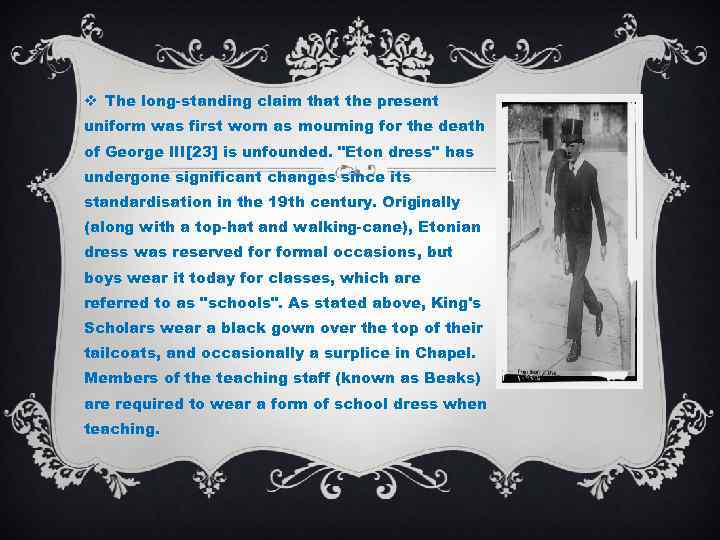
v The long-standing claim that the present uniform was first worn as mourning for the death of George III[23] is unfounded. "Eton dress" has undergone significant changes since its standardisation in the 19 th century. Originally (along with a top-hat and walking-cane), Etonian dress was reserved formal occasions, but boys wear it today for classes, which are referred to as "schools". As stated above, King's Scholars wear a black gown over the top of their tailcoats, and occasionally a surplice in Chapel. Members of the teaching staff (known as Beaks) are required to wear a form of school dress when teaching.
THE END
