


 Скачать презентацию Ethylene-vinylacetate Intravaginal Rings for Zero-order Release of an
d5d658655416cee7c04aca226e401ca8.ppt
- Количество слайдов: 2
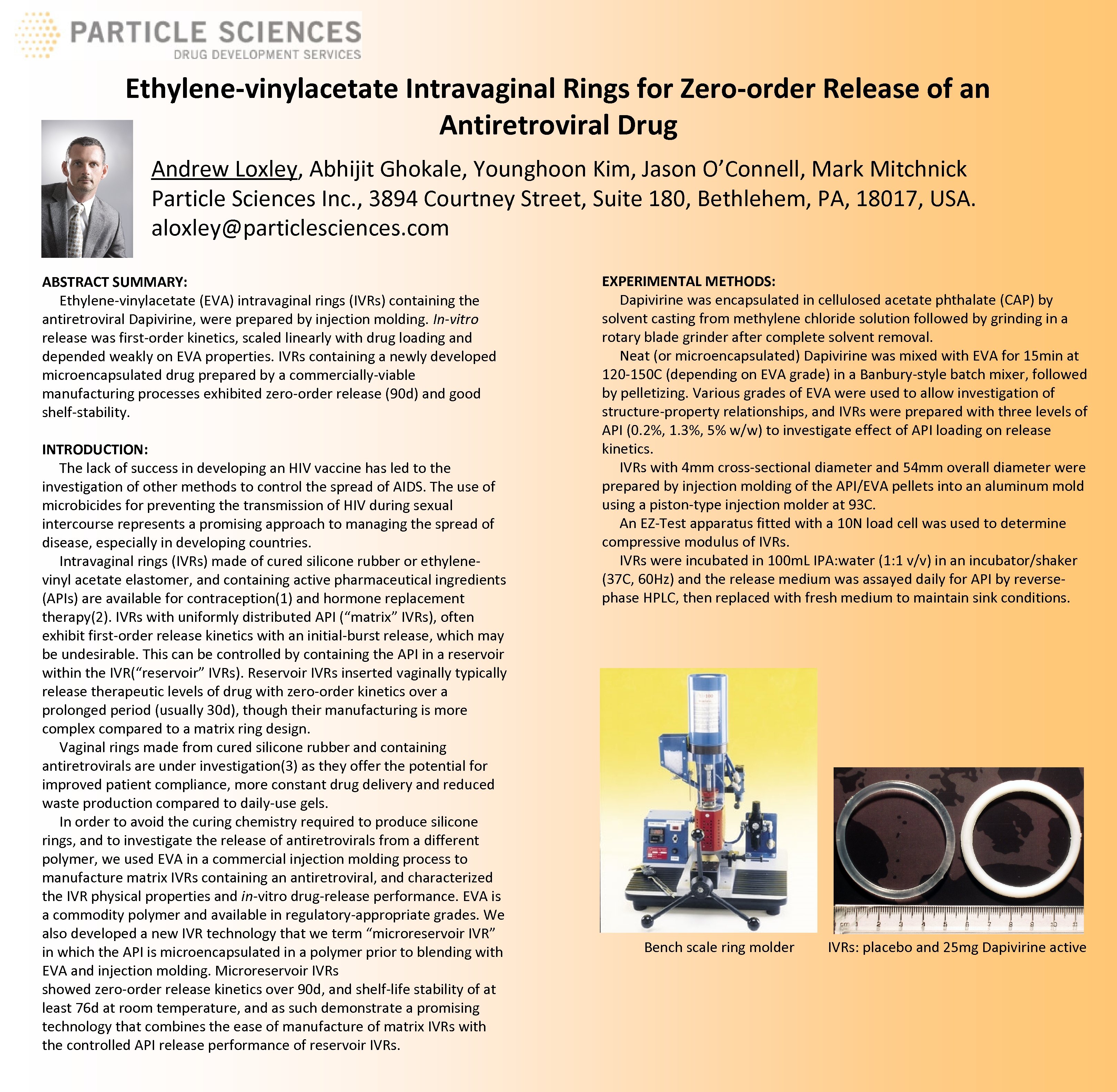 Ethylene-vinylacetate Intravaginal Rings for Zero-order Release of an Antiretroviral Drug Andrew Loxley, Abhijit Ghokale, Younghoon Kim, Jason O’Connell, Mark Mitchnick Particle Sciences Inc. , 3894 Courtney Street, Suite 180, Bethlehem, PA, 18017, USA. aloxley@particlesciences. com ABSTRACT SUMMARY: Ethylene-vinylacetate (EVA) intravaginal rings (IVRs) containing the antiretroviral Dapivirine, were prepared by injection molding. In-vitro release was first-order kinetics, scaled linearly with drug loading and depended weakly on EVA properties. IVRs containing a newly developed microencapsulated drug prepared by a commercially-viable manufacturing processes exhibited zero-order release (90 d) and good shelf-stability. INTRODUCTION: The lack of success in developing an HIV vaccine has led to the investigation of other methods to control the spread of AIDS. The use of microbicides for preventing the transmission of HIV during sexual intercourse represents a promising approach to managing the spread of disease, especially in developing countries. Intravaginal rings (IVRs) made of cured silicone rubber or ethylenevinyl acetate elastomer, and containing active pharmaceutical ingredients (APIs) are available for contraception(1) and hormone replacement therapy(2). IVRs with uniformly distributed API (“matrix” IVRs), often exhibit first-order release kinetics with an initial-burst release, which may be undesirable. This can be controlled by containing the API in a reservoir within the IVR(“reservoir” IVRs). Reservoir IVRs inserted vaginally typically release therapeutic levels of drug with zero-order kinetics over a prolonged period (usually 30 d), though their manufacturing is more complex compared to a matrix ring design. Vaginal rings made from cured silicone rubber and containing antiretrovirals are under investigation(3) as they offer the potential for improved patient compliance, more constant drug delivery and reduced waste production compared to daily-use gels. In order to avoid the curing chemistry required to produce silicone rings, and to investigate the release of antiretrovirals from a different polymer, we used EVA in a commercial injection molding process to manufacture matrix IVRs containing an antiretroviral, and characterized the IVR physical properties and in-vitro drug-release performance. EVA is a commodity polymer and available in regulatory-appropriate grades. We also developed a new IVR technology that we term “microreservoir IVR” in which the API is microencapsulated in a polymer prior to blending with EVA and injection molding. Microreservoir IVRs showed zero-order release kinetics over 90 d, and shelf-life stability of at least 76 d at room temperature, and as such demonstrate a promising technology that combines the ease of manufacture of matrix IVRs with the controlled API release performance of reservoir IVRs. EXPERIMENTAL METHODS: Dapivirine was encapsulated in cellulosed acetate phthalate (CAP) by solvent casting from methylene chloride solution followed by grinding in a rotary blade grinder after complete solvent removal. Neat (or microencapsulated) Dapivirine was mixed with EVA for 15 min at 120 -150 C (depending on EVA grade) in a Banbury-style batch mixer, followed by pelletizing. Various grades of EVA were used to allow investigation of structure-property relationships, and IVRs were prepared with three levels of API (0. 2%, 1. 3%, 5% w/w) to investigate effect of API loading on release kinetics. IVRs with 4 mm cross-sectional diameter and 54 mm overall diameter were prepared by injection molding of the API/EVA pellets into an aluminum mold using a piston-type injection molder at 93 C. An EZ-Test apparatus fitted with a 10 N load cell was used to determine compressive modulus of IVRs were incubated in 100 m. L IPA: water (1: 1 v/v) in an incubator/shaker (37 C, 60 Hz) and the release medium was assayed daily for API by reversephase HPLC, then replaced with fresh medium to maintain sink conditions. Bench scale ring molder IVRs: placebo and 25 mg Dapivirine active
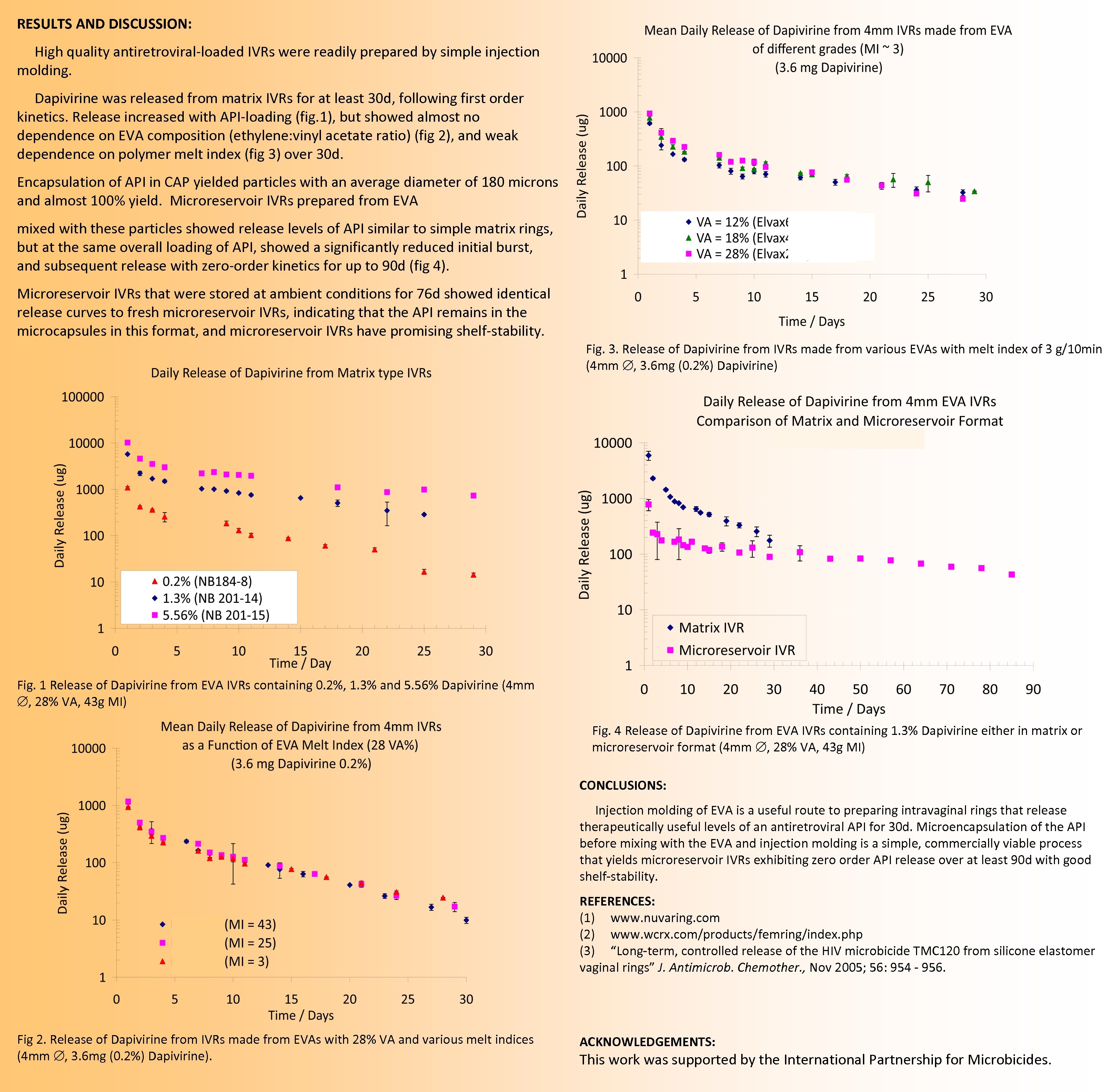 RESULTS AND DISCUSSION: High quality antiretroviral-loaded IVRs were readily prepared by simple injection molding. Dapivirine was released from matrix IVRs for at least 30 d, following first order kinetics. Release increased with API-loading (fig. 1), but showed almost no dependence on EVA composition (ethylene: vinyl acetate ratio) (fig 2), and weak dependence on polymer melt index (fig 3) over 30 d. Encapsulation of API in CAP yielded particles with an average diameter of 180 microns and almost 100% yield. Microreservoir IVRs prepared from EVA mixed with these particles showed release levels of API similar to simple matrix rings, but at the same overall loading of API, showed a significantly reduced initial burst, and subsequent release with zero-order kinetics for up to 90 d (fig 4). Microreservoir IVRs that were stored at ambient conditions for 76 d showed identical release curves to fresh microreservoir IVRs, indicating that the API remains in the microcapsules in this format, and microreservoir IVRs have promising shelf-stability. Fig. 3. Release of Dapivirine from IVRs made from various EVAs with melt index of 3 g/10 min (4 mm , 3. 6 mg (0. 2%) Dapivirine) Fig. 1 Release of Dapivirine from EVA IVRs containing 0. 2%, 1. 3% and 5. 56% Dapivirine (4 mm , 28% VA, 43 g MI) Fig. 4 Release of Dapivirine from EVA IVRs containing 1. 3% Dapivirine either in matrix or microreservoir format (4 mm , 28% VA, 43 g MI) CONCLUSIONS: Injection molding of EVA is a useful route to preparing intravaginal rings that release therapeutically useful levels of an antiretroviral API for 30 d. Microencapsulation of the API before mixing with the EVA and injection molding is a simple, commercially viable process that yields microreservoir IVRs exhibiting zero order API release over at least 90 d with good shelf-stability. REFERENCES: (1) www. nuvaring. com (2) www. wcrx. com/products/femring/index. php (3) “Long-term, controlled release of the HIV microbicide TMC 120 from silicone elastomer vaginal rings” J. Antimicrob. Chemother. , Nov 2005; 56: 954 - 956. Fig 2. Release of Dapivirine from IVRs made from EVAs with 28% VA and various melt indices (4 mm , 3. 6 mg (0. 2%) Dapivirine). ACKNOWLEDGEMENTS: This work was supported by the International Partnership for Microbicides.