 Скачать презентацию Ethnographic Interviews Describing Culture from a Native s Point
a87c33d94c04eb4a6dc5f889a0266cfe.ppt
- Количество слайдов: 133



Ethnographic Interviews Describing Culture from a Native’s Point of View
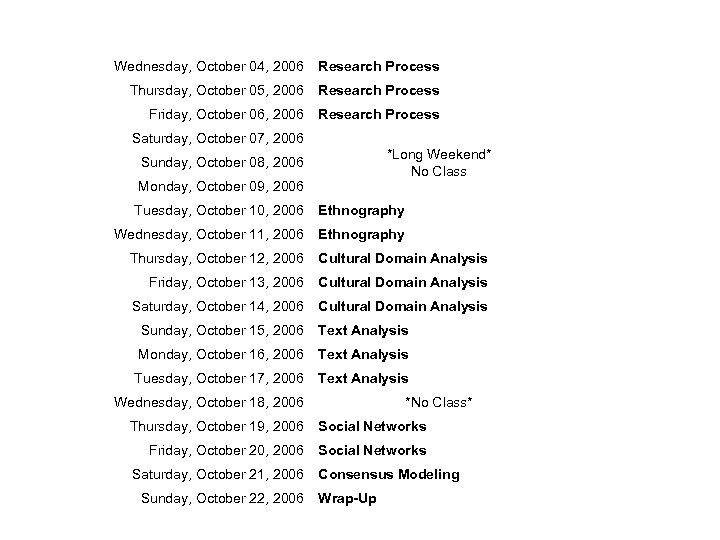
Date Module Presenter Wednesday, October 04, 2006 Research Process Jeff Thursday, October 05, 2006 Research Process Jeff Friday, October 06, 2006 Research Process Jeff Saturday, October 07, 2006 *Long Weekend* No Class Sunday, October 08, 2006 Monday, October 09, 2006 Tuesday, October 10, 2006 Ethnography Jeff Wednesday, October 11, 2006 Ethnography Jeff Thursday, October 12, 2006 Cultural Domain Analysis Steve Friday, October 13, 2006 Cultural Domain Analysis Steve Saturday, October 14, 2006 Cultural Domain Analysis Steve Sunday, October 15, 2006 Text Analysis Steve Monday, October 16, 2006 Text Analysis Steve Tuesday, October 17, 2006 Text Analysis Steve Wednesday, October 18, 2006 *No Class* Thursday, October 19, 2006 Social Networks Jeff Friday, October 20, 2006 Social Networks Jeff Consensus Modeling Jeff Wrap-Up Jeff Saturday, October 21, 2006 Sunday, October 22, 2006
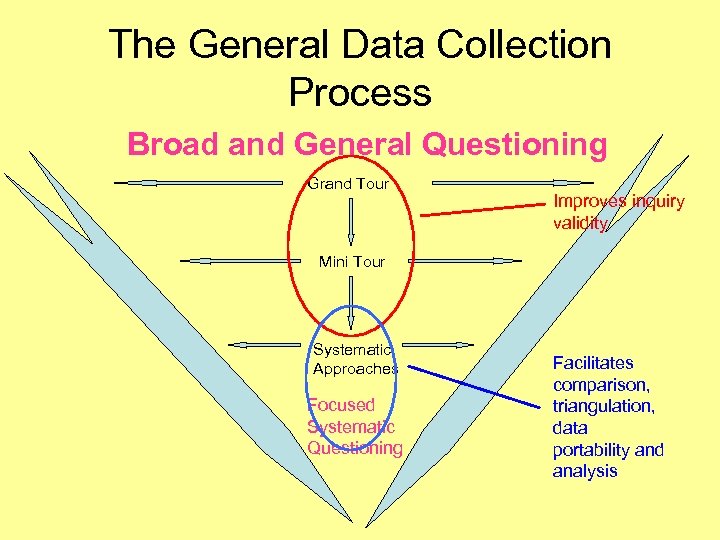
The General Data Collection Process Broad and General Questioning Grand Tour Improves inquiry validity Mini Tour Systematic Approaches Focused Systematic Questioning Facilitates comparison, triangulation, data portability and analysis
Three Types of Interviews • Unstructured • Semistructured • Structured
Understanding complex systems of meaning • We can represent these complex systems of meanings (culture) as cognitive maps • What we do may also be called ethnographic semantics in which we focus on the understanding of cultural meaning systems • Culture can not be observed directly
Ethnographic Inference • From what people say • From the way people behave • From the artifacts people use • Much of what we will learn concentrates on the first
Explicit and Tacit Knowledge • Explicit Cultural Knowledge—Readily expressed cultural knowledge – More easily expressed through language and easy to infer (e. g. , “starve a cold and feed a fever”) – The world of South Pole crews being culturally conceived of in terms of “beaker” vs. trades crew
Tacit Cultural Knowledge • Much of culture consists of knowledge that may not be expressed directly—taken for granted and outside our awareness • Ethnographers must make inferences about knowledge from careful attention to what people say, do and use. • Both tacit and explicit knowledge is revealed through speech • Language is the means for transmitting culture from generation to generation
Culture is Encoded in Linguistic Form • The ethnographic interview approach focuses on what people say—apt for the HTT context • It is a strategy for getting people to talk about what they know • “It seeks to build a systematic understanding of all human cultures from the perspective of those who have learned them. ” • What we want to do is describe and discover the regularities, patterns and variations in human behavior, but through interviewing.
Describing Culture in Its Own Terms • Translation Competence—refers not simply to the ability to speak a language but to understand translate the subtleties of a native language • Even if one is a native speaker different native peoples talk about their worlds in subtle ways that might not be correctly interpreted—e. g. , Spradley’s “making a flop” • Need to acquire linguistic competence that has an impact on ethnographic discovery • Need to learn another language within a language
Ethnographic Descriptions are a Form of Translation • Combines native terms and their meaning along with ethnographers inferences and interpretations • “The ethnographer wants to discover patterns of meaning in what the informant says. ” • Finding patterns both within and between informants
Advantage—You are studying a culture that you are not familiar with —You lack a natives take it for granted type of cultural knowledge. Things will stand out to you that would not to a native.
The ethnographic Interview • It is a speech event and it can appear to some degree like a friendly conversation • You ultimately want to incorporate ethnographic elements into the interview but must be concerned to not go too quickly • You do not want this to seem like a “formal interrogation” • You want rapport with the informant and you want to maintain the informant’s cooperation • “A few minutes of easygoing talk interspersed throughout the interview will pay enormous dividends in rapport. ” • The HTT context generally requires the establishment of rapport to take place almost exclusively within the interview itself (we usually get to know informants informally before going into the more formal interview process)
Ethnographic Elements • Explicit Purpose – The ethnographer must make the purpose of the interview clear to the informant. – Ethnographic interviews have purpose and direction and therefore can come off as too formal---you need to minimize this formal feel. – The interview moves from the informal friendly (to build rapport) to the more formal as the interview proceeds
Ethnographic Elements • Ethnographic Explanations • You must always make the purpose of the interview clear (even in the informant has been interviewed before) since you are attempting to get the informant to become your teacher.
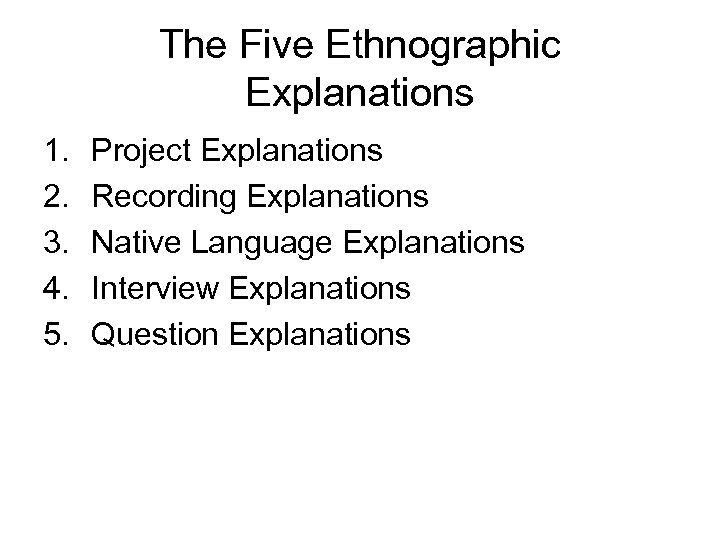
The Five Ethnographic Explanations 1. 2. 3. 4. 5. Project Explanations Recording Explanations Native Language Explanations Interview Explanations Question Explanations
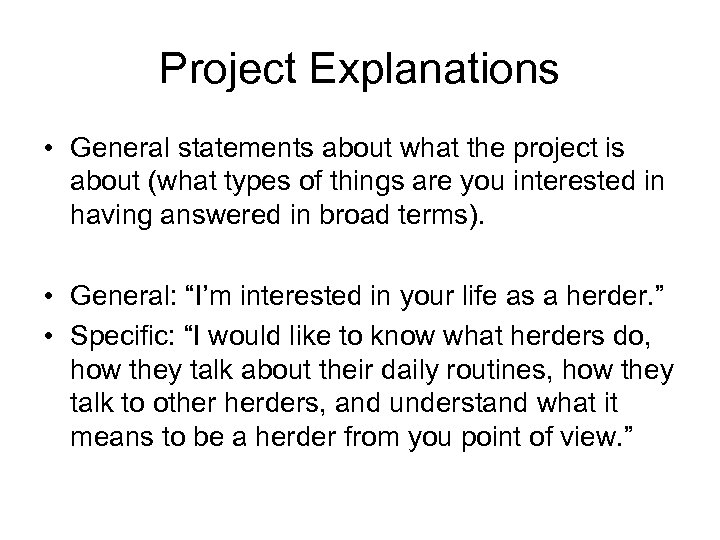
Project Explanations • General statements about what the project is about (what types of things are you interested in having answered in broad terms). • General: “I’m interested in your life as a herder. ” • Specific: “I would like to know what herders do, how they talk about their daily routines, how they talk to other herders, and understand what it means to be a herder from you point of view. ”
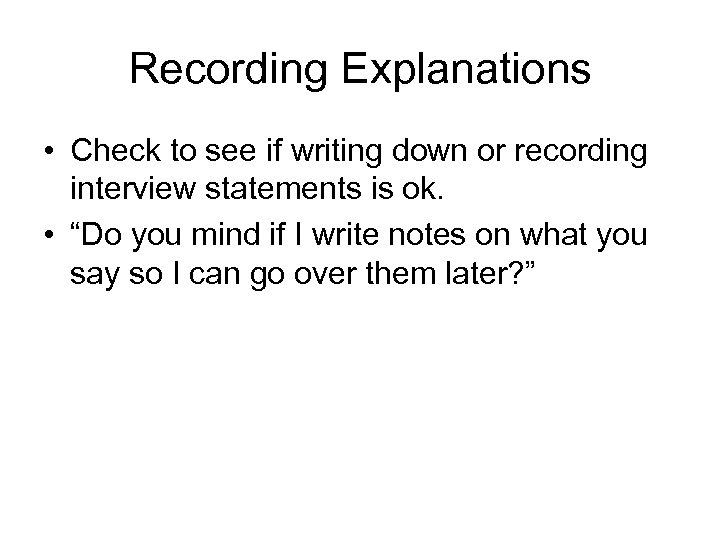
Recording Explanations • Check to see if writing down or recording interview statements is ok. • “Do you mind if I write notes on what you say so I can go over them later? ”
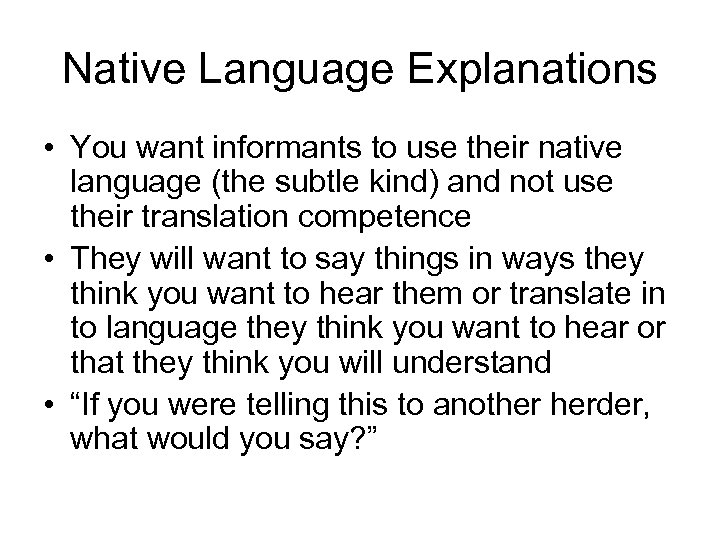
Native Language Explanations • You want informants to use their native language (the subtle kind) and not use their translation competence • They will want to say things in ways they think you want to hear them or translate in to language they think you want to hear or that they think you will understand • “If you were telling this to another herder, what would you say? ”
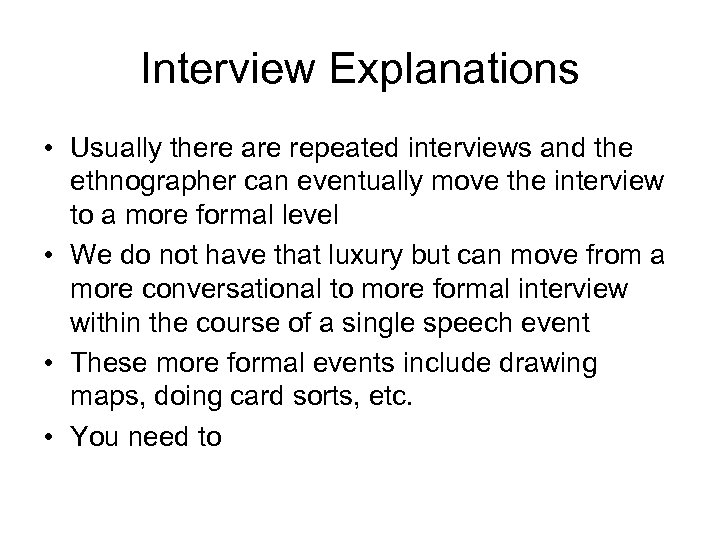
Interview Explanations • Usually there are repeated interviews and the ethnographer can eventually move the interview to a more formal level • We do not have that luxury but can move from a more conversational to more formal interview within the course of a single speech event • These more formal events include drawing maps, doing card sorts, etc. • You need to
Question Explanations • Need to explain when changing the ethnographic question or from one topic to another • “I want to ask you a different type of question. ”
Ethnographic Questions • Spradley identifies more than 30 types of questions. The three main types are: – Descriptive questions – Structural question – Contrast questions
Descriptive Questions • Helping to collect samples of an informant’s language or use of words. • Easiest to ask and used in all interviews, particularly in the beginning. • “Could you describe a typical day of herding you stock? ”
Structural Questions • Allow for the discovery of information about domains, the basic units of informants’ cultural knowledge • Help in discovering how informants organize cultural knowledge • “What are the kinds of animals you hunted on your last hunting trip? ” • “Can you think of any other activities you do while herding your stocks? ” (Always important to probe and repeat)
Contrast Questions • Need to find out what informant’s terms mean • Allows for the discovery of dimensions of meaning used to distinguish between objects and events • “You mentioned caribou and moose, what’s the difference between a caribou and a moose? ”
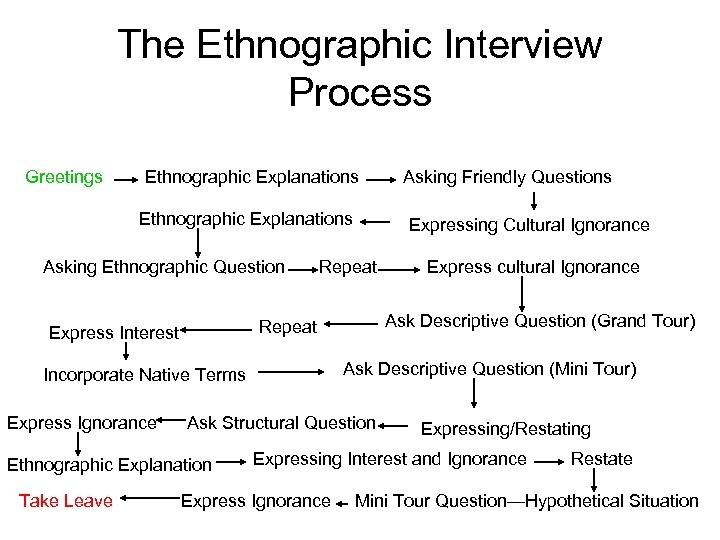
The Ethnographic Interview Process Greetings Ethnographic Explanations Asking Ethnographic Question Repeat Take Leave Ask Descriptive Question (Grand Tour) Ask Structural Question Ethnographic Explanation Express cultural Ignorance Ask Descriptive Question (Mini Tour) Incorporate Native Terms Express Ignorance Expressing Cultural Ignorance Repeat Express Interest Asking Friendly Questions Expressing/Restating Expressing Interest and Ignorance Express Ignorance Restate Mini Tour Question—Hypothetical Situation
• Lack of balance in taking turns—informants talk more • Repetition instead of avoidance of repetition • Expressing interest and ignorance is almost all on the part of the ethnographer (remember you are the student) • Instead of brevity the ethnographer encourages the informant to expand at every step • This process requires much practice to acquire
Problem Traditionally ethnographers have weeks or even months to move from the more general and open to the more focused and systematic within an informant You may only have 1 interview before having to ask more systematic type questions or you may have to become more systematic within the same interview
The Ethnographic Record • The native’s language • The ethnographer’s language • Best to have verbatim record of what people say • Distinguish between native terms and observer terms in any field notes or written record
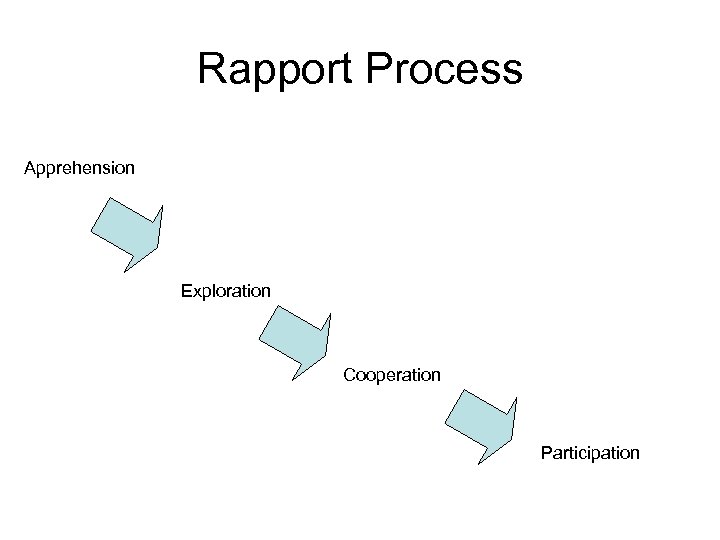
Rapport Process Apprehension Exploration Cooperation Participation
The Rapport Problem is Particularly Problematic Here • Apprehension – Descriptive questions are particularly good for starting the conversation and keeping the informant talking Apprehension hopefully gives way to exploration
Exploration • Figuring out the relationship – May have to set aside prepared questions to talk of something of interest to the informant – Need to judge the reaction of informants to your actions – Make repeated explanations – Restate what informants say —demonstrates interest – Don’t ask for meaning, ask for use---You learn meaning not by asking why but by asking how people use ordinary language
Participation • Informants begin to take on a more assertive role helping you more easily achieve your interview goals • Not all get to this stage particularly for this context
Ethnographic Questions • Assumes the question-answer sequence is a single element of human thinking. • “Thus, the task of the ethnographer is to discover questions that seek the relationship among entities that are conceptually meaningful to the people under investigation (Black and Metzger, 1965: 144). ”
Discovering Questions • Record the questions people ask in everyday life. • Can inquire directly about questions used by people in some cultural scene or context. • Or, ask informant to talk about a particular cultural scene
Direct Inquiry (Black and Metzger) • “What is an interesting question about_____? ” • What is a question to which the answer is____? ” • Ask an informant to write a text in question and answer form.
Descriptive Questions Talking About a Particular Cultural Scene • “advantage of the power of language to construe settings (Frake)”. • “Could you describe a typical day in the village square? ” • “What do you do as a herder? ”
• Expanding the length of the question expands the length of the response • “Could you tell me what the mosque is like? ” • I have never been in a mosque here in _____, so I don’t have much of an idea of what it is like. Could you kind of take me through the mosque and tell me what it’s like, what I would see if I went into the mosque and walked around? • Trying to get the informants to tell you as much as they can in greater detail.
Five Types of Descriptive Questions • • • Grand Tour Questions Mini-Tour Questions Example Questions Experience Questions Native-Language Questions
Grand Tour Questions • Typical grand-tour questions – “Could you describe to me a typical day in the olive grove? ” – “Could you describe to me how you typically set your salmon net? ” – Ask informants to talk and generalize about a pattern of events
Grand Tour Questions • Specific Grand Tour Questions – “Could you describe to me what happened the last time you had an empty soda can? ” – “Tell me what you did yesterday, from the time you got up til the time you went to sleep? ” – Often hard to describe the typical event but may be easier to anchor on a real event
Grand Tour Questions • Guided Grand Tour Questions – “Could you take me around the farm? ” – “Next time you go out to set a fishing net can I come along a so you can explain to me how you do it? ” – An actual tour of something
Grand Tour Questions • Task-Related Grand Tour – “Can you draw a map of the village and describe to me the places where men typically socialize with one another in the evenings? ” – “Could you play a game of ______ and explain to me what you are doing? ” – A simple task that aids in the description
Mini-Tour Questions • Breaking events into their constituent parts – “Could you describe what you are doing with the hydraulic roller while setting the net? ” – “Could you describe to me what you do for the mid day meal when herding your flock? ” – There are typical, specific, guided, and taskrelated mini-tour questions
Example Questions • Even more specific and ask the informant to provide an example – Informant: “I was shoulder hopped by this guy. ” – Ethnographer: “Could you give me an example of shoulder hopping? ” – May lead to interesting stories of actual events
Experience Questions • Asking for informant’s actual experiences with something – “You have probably had some interesting experiences while out fishing; can you recall any of them? ” – “Can you tell me about some interesting experiences you’ve had while commuting to work in Kabul? ” – Often elicit atypical events
Native-Language Questions • Designed to minimize the influence of informant’s translation competence— encourages terms and phrases most commonly used in the cultural scene • Three Types: Direct-Language Questions Hypothetical-Interaction Questions Typical-Sentence Questions
Direct-Language Questions • “How do you refer to this? ” • “What would you call this? ” • “Would you say ____? ” – Surfer: “When I take off I try to get inside the wave. ” – Ethnographer: “How would you refer to the inside of the wave? ” – Surfer: “Oh, it is called the tube. ”
Hypothetical-Interaction Questions • Since roles and identities are important in what people might say to one another, you can create a hypothetical interaction. – “If you were talking to another surfer (herder, cab driver) what would you say? ” – “If I was sitting at a table next to men who were drinking tea in the café what would they typically say to each other? ” – Discover how people talk to one another depending on their roles
Typical-Sentence Questions • Provide the informant with one or more native terms to use in a sentence – “What are some sentences I would hear that include the phrase getting some air? ”
Descriptive questions are basis of all ethnographic interviewing Lead to utterances expressed as language used by the informants themselves in the cultural scene of interest Can be phrased in cultural and personal terms Valid elicitation depends on phrasing questions in cultural terms
Relational Theory of Meaning • People order their lives in terms of the meaning of things • How we react in a given situation depends on the meaning we attribute to that situation (and the things or symbols in it) • How we react in a new situation is dependent on the meaning attributed to similar experiences • “People behave similarly towards things they perceive as being similar. ” Volney Stefflre • Cultural Schemas--models of and for behavior (e. g. , the living room schema--it can be confirmed or violated)
Symbols: any object or event that refers to something • • • Meaning is conveyed through symbols Words are symbols Mannerisms are symbols Dress is a symbol The triad of symbolic meaning – The symbol itself – One or more referents – The relationship between the symbol and the referent
The Symbol • Anything that can be perceived or experienced • They are expressed as folk terms by informants • Fear, excitement, etc. can be expressed as symbols (clenched teeth, wink of the eye)
The Referent • A thing the symbol refers to • We can refer to stars and trees or to mythical beings (shape shifters) that don’t really exist
The Relationship • The referent becomes encoded in the symbol • The symbol becomes the focus of attention (the word as opposed to the thing itself) – House is a symbol for a place to live – But a house is also a place to eat, sleep, relax, entertain, etc. – Has many referents (maybe hundreds) – We want to know the differences among the many referents
Meaning Systems The system of symbols that constitute culture • Cultural knowledge is an intricately patterned system of symbols • The meaning of any symbol is it relationship to other symbols – The meaning of house in relation to all the other symbols (sleeping, relaxing) – The meaning of salmon as it relates to other symbols (both other fish and attributes of a fish)
Categories • When symbols are related by inclusion they are called categories • They are an array of things that can be treated as equivalent – Different kinds of trees – Different kinds of fish – Different kinds of insurgents
Categories • They can vary dramatically in size • Some categories subsume others – Fish includes pelagic fish which includes tuna, swordfish, marlin, wahoo, etc. – Symbols linked in sequence--an Islamic wedding ceremony and it’s components
“The task of ethnography is to decode cultural symbols and identify the underlying coding rules. This can be accomplished by discovering the relationship among cultural symbols. ” (Spradley)
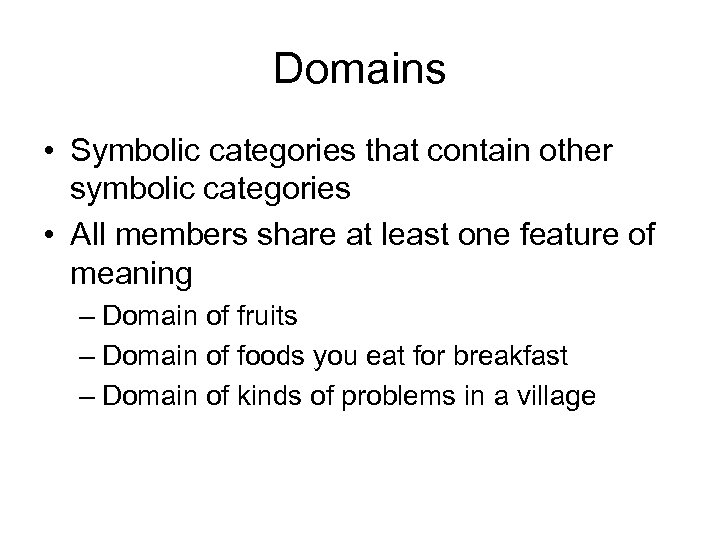
Domains • Symbolic categories that contain other symbolic categories • All members share at least one feature of meaning – Domain of fruits – Domain of foods you eat for breakfast – Domain of kinds of problems in a village
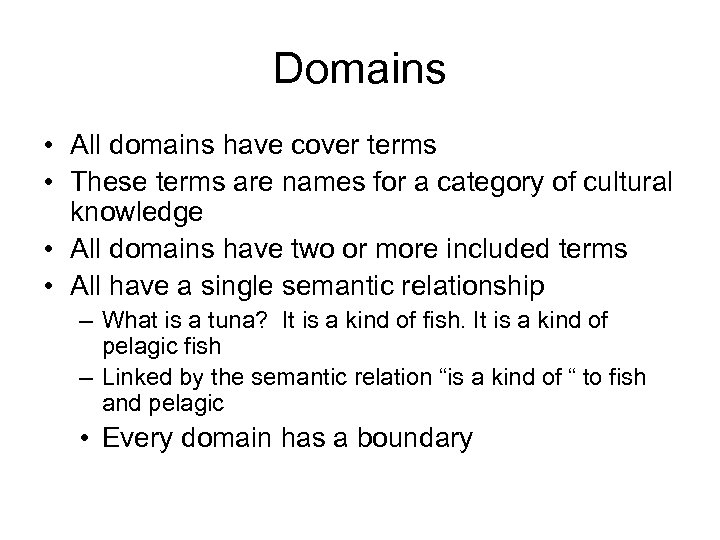
Domains • All domains have cover terms • These terms are names for a category of cultural knowledge • All domains have two or more included terms • All have a single semantic relationship – What is a tuna? It is a kind of fish. It is a kind of pelagic fish – Linked by the semantic relation “is a kind of “ to fish and pelagic • Every domain has a boundary
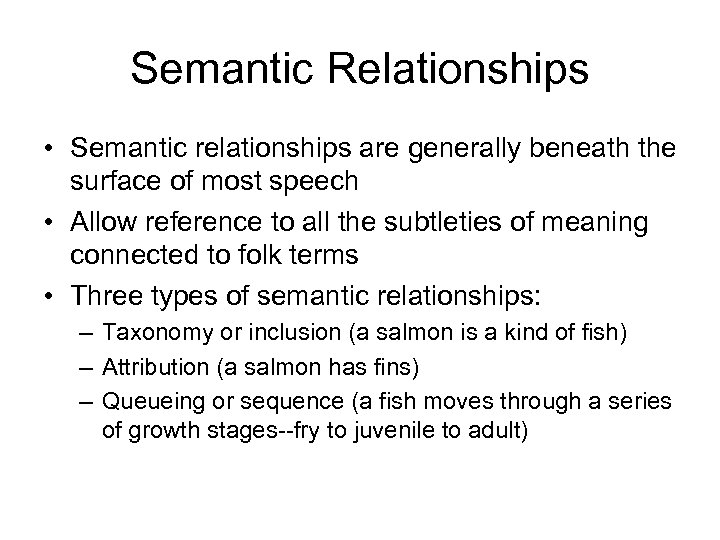
Semantic Relationships • Semantic relationships are generally beneath the surface of most speech • Allow reference to all the subtleties of meaning connected to folk terms • Three types of semantic relationships: – Taxonomy or inclusion (a salmon is a kind of fish) – Attribution (a salmon has fins) – Queueing or sequence (a fish moves through a series of growth stages--fry to juvenile to adult)
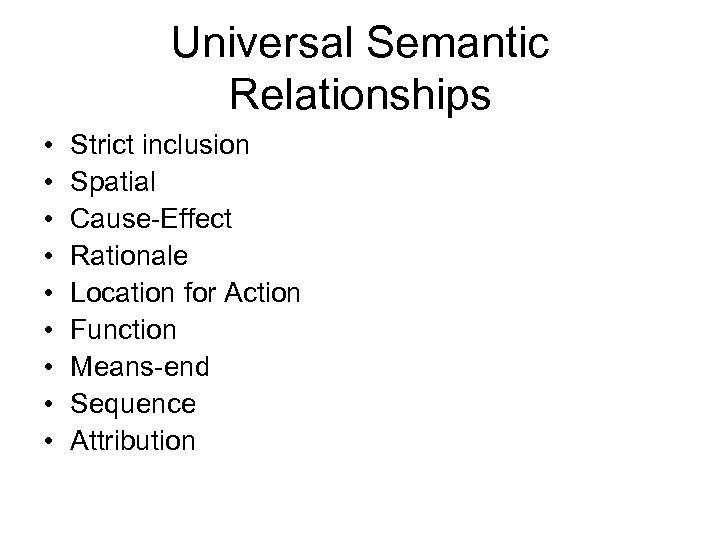
Universal Semantic Relationships • • • Strict inclusion Spatial Cause-Effect Rationale Location for Action Function Means-end Sequence Attribution
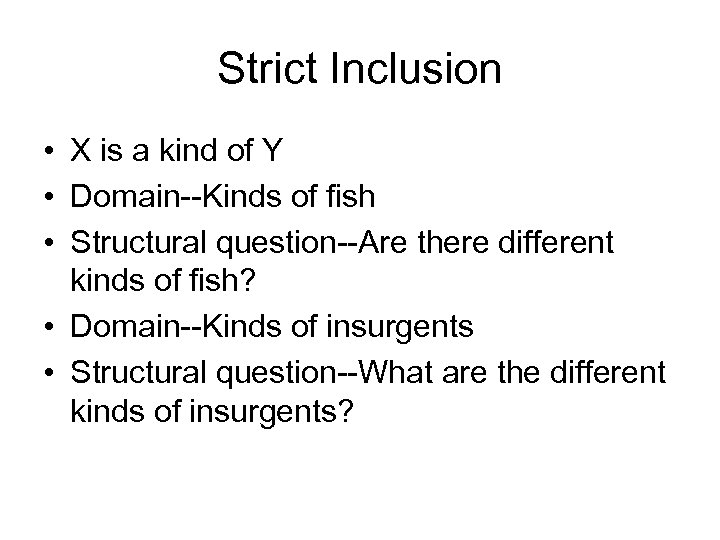
Strict Inclusion • X is a kind of Y • Domain--Kinds of fish • Structural question--Are there different kinds of fish? • Domain--Kinds of insurgents • Structural question--What are the different kinds of insurgents?
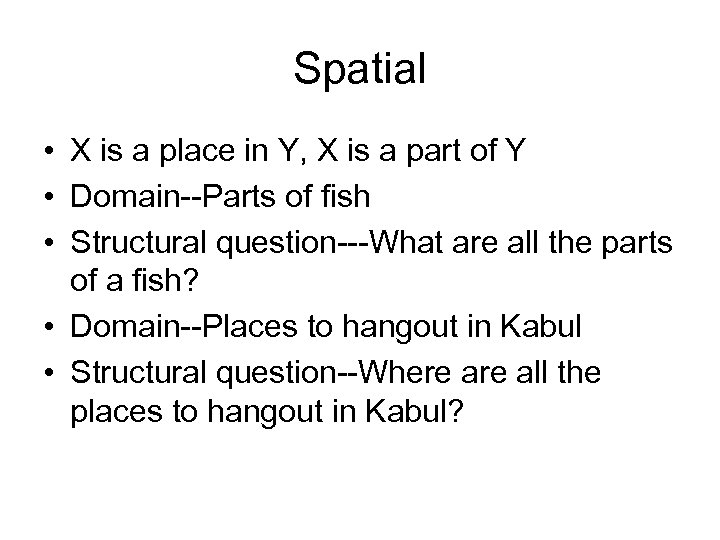
Spatial • X is a place in Y, X is a part of Y • Domain--Parts of fish • Structural question---What are all the parts of a fish? • Domain--Places to hangout in Kabul • Structural question--Where all the places to hangout in Kabul?
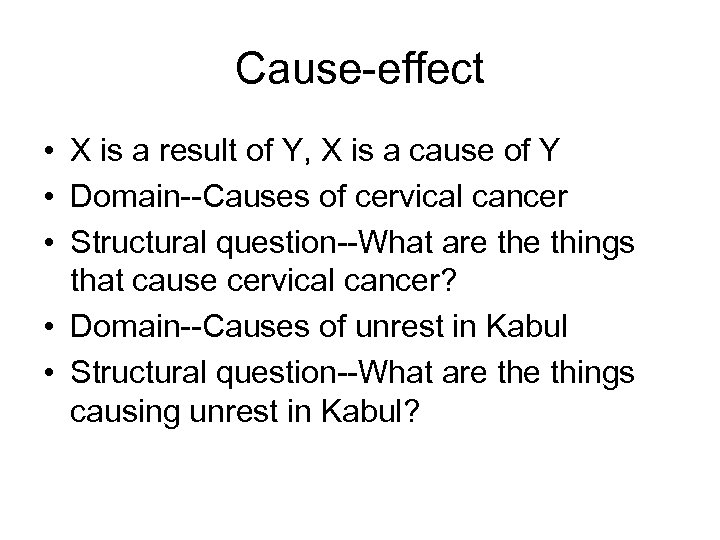
Cause-effect • X is a result of Y, X is a cause of Y • Domain--Causes of cervical cancer • Structural question--What are things that cause cervical cancer? • Domain--Causes of unrest in Kabul • Structural question--What are things causing unrest in Kabul?
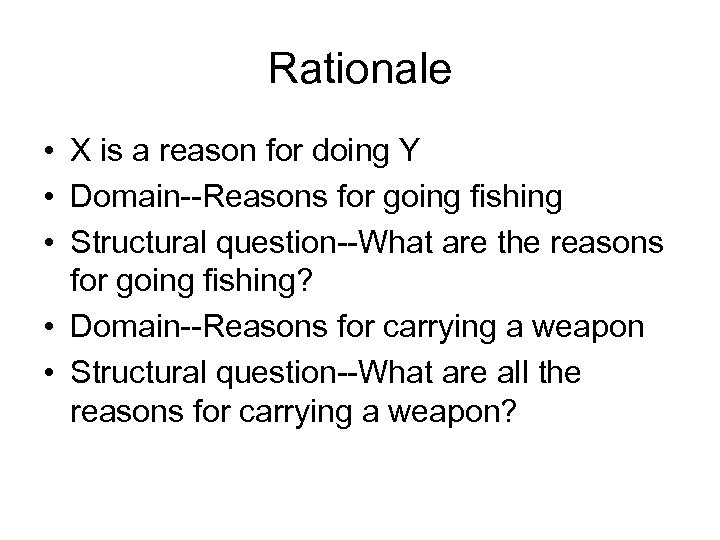
Rationale • X is a reason for doing Y • Domain--Reasons for going fishing • Structural question--What are the reasons for going fishing? • Domain--Reasons for carrying a weapon • Structural question--What are all the reasons for carrying a weapon?
Location for Action • X is a place for doing Y • Domain--All the places to trawl for shrimp • Structural question --What are all the places to trawl for shrimp? • Domain--All the places to fly a kite • Structural question--What are all the places to fly a kite?
Function • X is used for Y • Domain--Uses for a dining room • Structural question--What are all the uses for a dining room? • Domain--Uses for goat • Structural question--What are all the uses for a goat?
Means-end • X is a way to do Y • Domain--Ways to make your mother mad • Structural question--What are all the ways to make your mother mad? • Domain--Ways to avoid checkpoints • Structural question--What are all the ways to avoid a checkpoint?
Sequence • X is a step (stage) IN y • Domain--Steps in setting a salmon set net • Structural question--What are the steps in setting a salmon set net? • Domain--Steps in getting olives to market • Structural question--What are the steps in getting olives to market?
Attribution • X is an attribute (characteristic) of Y • Domain--Attributes of fish • Structural question--What are the attributes of fish? • Domain--Characteristics of a Sunni wedding • Structural question--What are all the characteristics of a Sunni wedding?
Elicitation • Can be elicited from informants directly • Can be coded from in-depth interviews – SEARCH FOR FOLK TERMS IN INTERVIEWS
Structural Questions • When asking – Do them concurrently with descriptive questions Ethnographer: You said young men in the village hang out in different places in the village. What are some of these places? (structural) Informant: Well there is the square, the park, the bridge, and the local school yard. Ethnographer: Can you describe what they do when hanging out at the bridge? (descriptive) – Also helps with the boredom often created from asking structural questions
Structural Questions • Provide explanation – “We have been talking about problems in the village and you have mentioned a few. Now I want to ask you something slightly different. I’m interested in getting a list of all the types of problems in the village or at least the ones that have emerged since the Americans arrived. This might take a while but I would like you to name all the problems. ”
Structural Questions • Don’t be afraid to repeat • Structural questions must be repeated many times to elicit an exhaustive list of items – “You said X, are there any more you can think of? ”
Structural Questions • Context is important • Put it in context with what other informants have said or in the context where the terms are most often used – “I’ve learned from other village elders that one of the most important things is sharing the various parts of the whale. Is that right? Is sharing the different parts of the whale common among the villages? ”
Structural Questions • Phrase things in cultural as well as personal terms – “What are all the types of refreshments you serve to guests at home? ” (personal) – “What are all the kinds of drinks served to guests in a home? ” (cultural)
Kinds of Structural Questions • • • Verification Questions Cover Term Questions Included Term Questions Substitution Frame Questions Card Sorting Structural Questions
I. Verification Questions • The purpose is to confirm or disconfirm some hypothesis on the part of the ethnographer – “Is a whale a kind of fish? ” – “Is a Sufi a type of Muslim? ”
II. Domain Verification • Seeks to confirm the existence of a domain – “Are there different kinds of Y’s? ” – “Are there different kinds of Muslims? ”
III. Included Term Verification • Seeks to determine if terms are included in a domain – Are Muslims a kind of group in Afghanistan? – Are Pashtuns a kind of group in Afghanistan?
IV. Semantic Relationship Verification • Test the appropriateness of the way a semantic relationship is expressed – Would Afghans say Muslims are a kind of group in Afghanistan? – Would Inupiat hunters say that ugruk is a kind of subsistence product?
V. Native -Language Verification • To test for informant translation – Would a Pashtun say _____ when talking to other Pastuns? – Making sure that the terms used by natives when talking to other natives is what is being used
Cover Term Questions • Most common type of structural question – Kinds of Afghans – Ways to make fast money in Kabul – Steps in getting poppies to market – Ways to be an observant Muslim
Included Term Questions • Probing if things belong to a domain – Are needles, cottons, spoons, and syringes all things you share with others when shooting up? – This would then constitute the domain of things shared by IV drug users
Substitution Frame Questions • Removing a term from a statement to see what other things fit the sentence – Carrying a gun is a way to keep safe – ______ is a way to keep safe • Staying in at night is a way to keep safe • Traveling with friends is a way to keep safe
Card Sorting Structural Questions • Understanding and verifying domains with the use of cards • In the informal way allows people to discuss relationships among things that might be more difficult in simple interview contexts • Formal way allows for quantification and comparison across informants
Probing: Stimulating informants to provide as much information as possible without interjecting yourself into the data • The Silent Probe – Pausing and waiting for an informant to continue • The Echo Probe – A neutral repetition that shows understanding fo what the informant just said • The Uh-Huh Probe – Uh-Huh; Yes, I see--help in obtaining longer responses • The Tell-Me-More Probe – Could you tell me more about X? ; Why exactly do you feel that way? • The Long Question Probe – Using long questions may get longer responses
The Leading Probe You should lead the informant as little as possible, but sometimes it is necessary. “OK, I see. The father of the bride has to pay a dowry. But what happens if the father does not pay? ”
Elicitation Techniques for Interviewing
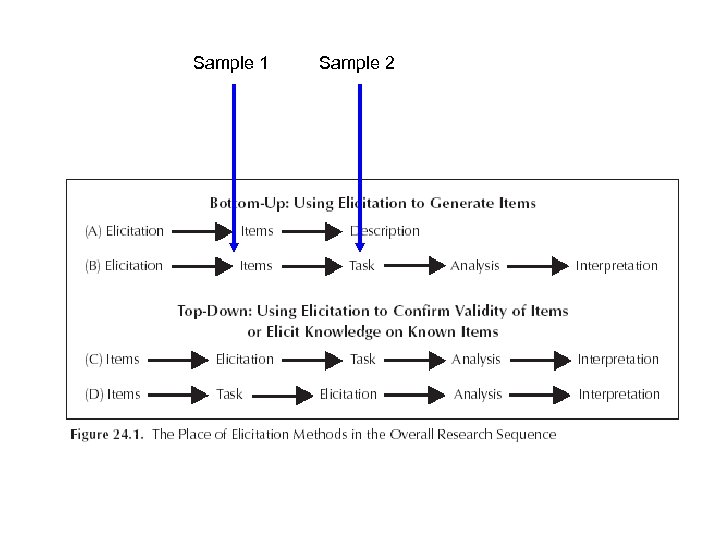
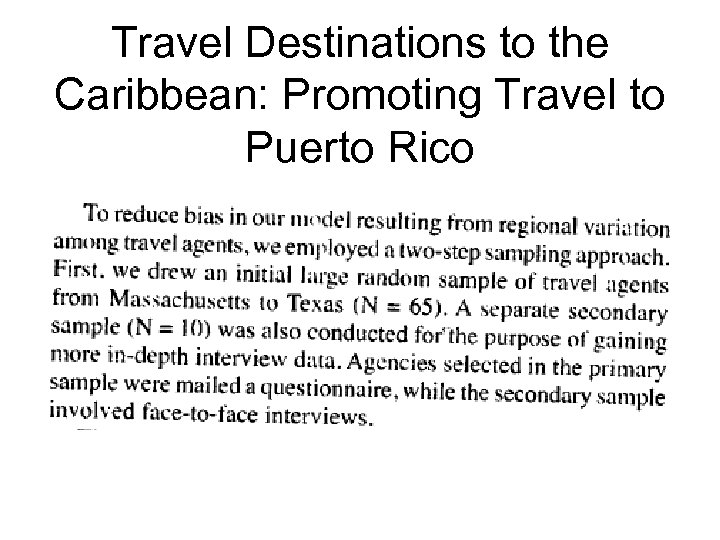
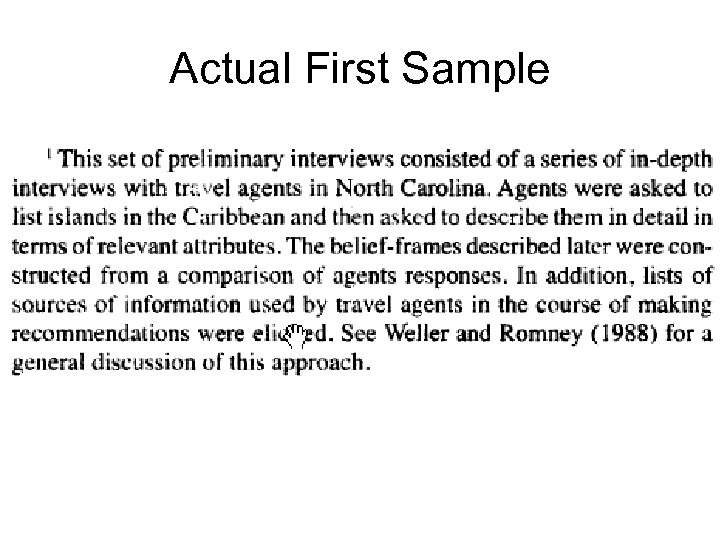
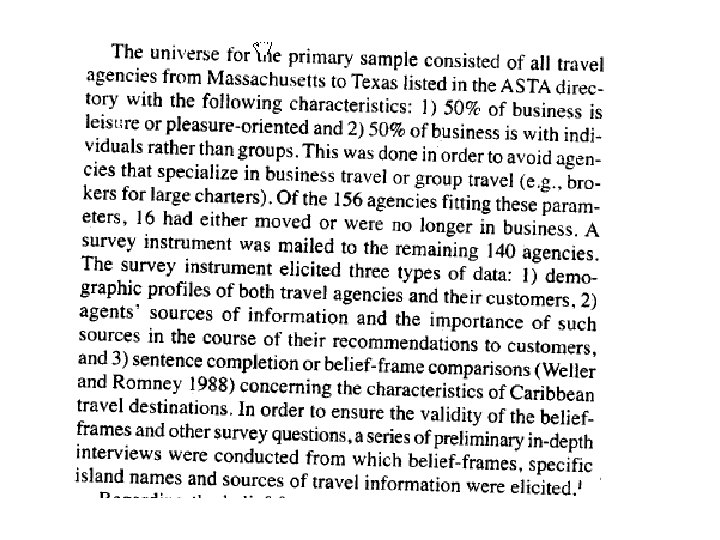
The Sample 2 Process Sample 1
Depersonalize—Remove the query away from ego • Sometimes it is easier for informants to refer to others rather than themselves • More range of possibilities • Example--Concepts of success and failure – Asked informants to name all the successful people they knew of – Asked informants to name all the unsuccessful people they knew of – Elicited all the things that made people both successful and not successful
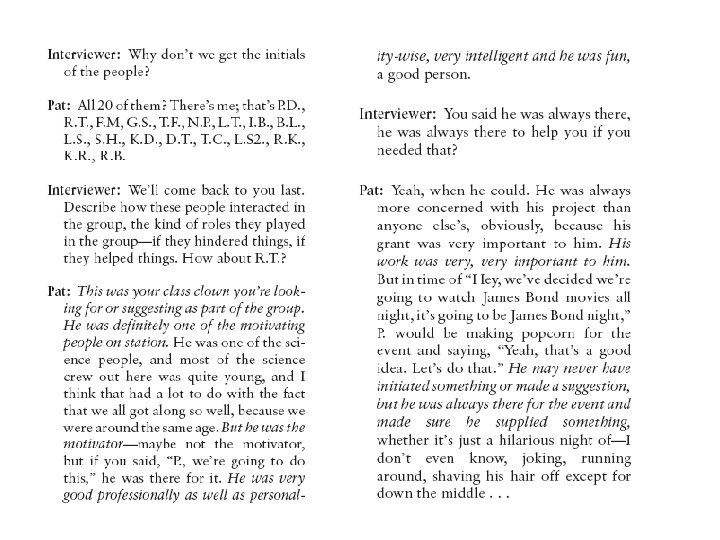
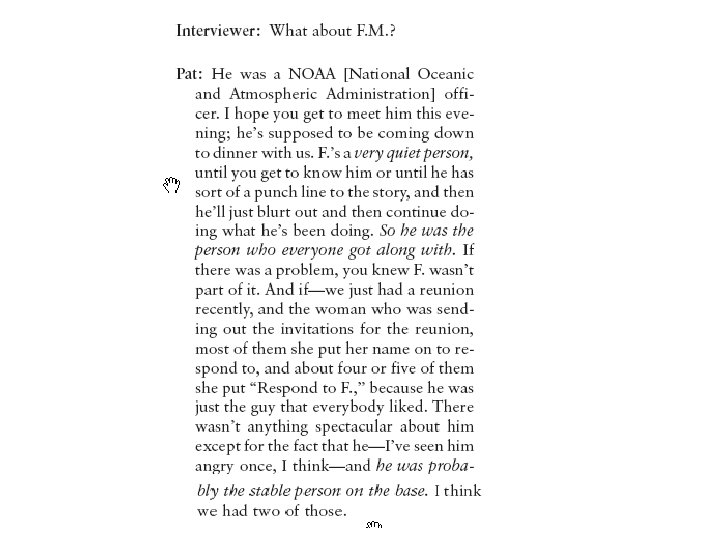
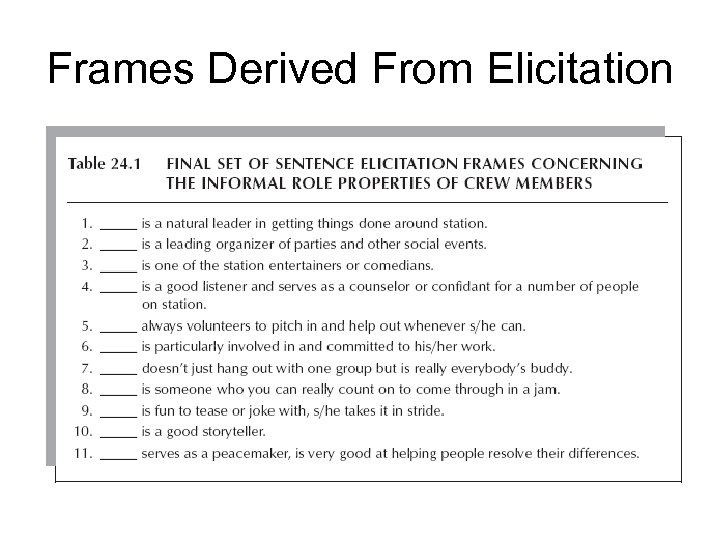
Frames Derived From Elicitation
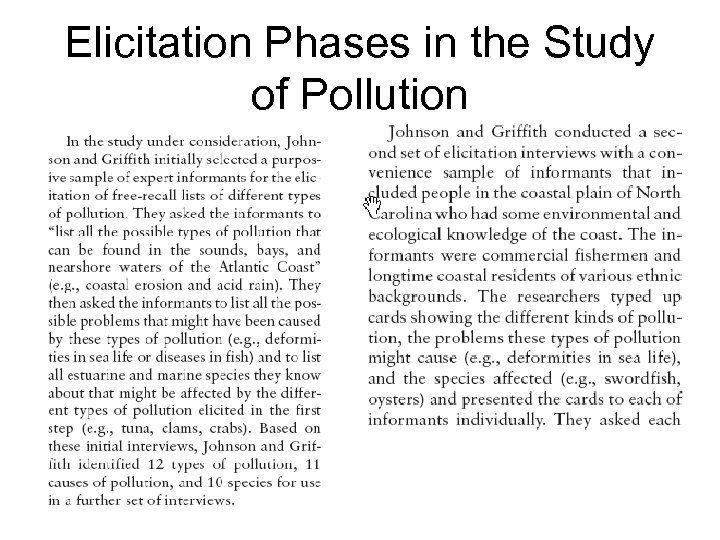
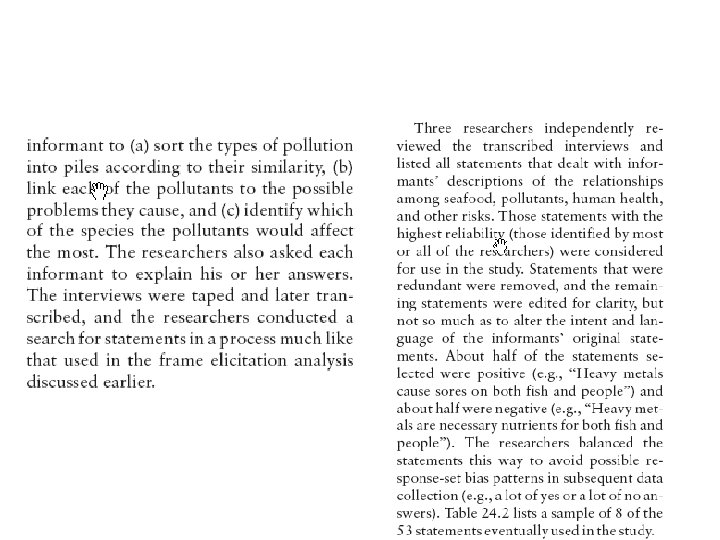
Elicitation Phases in the Study of Pollution
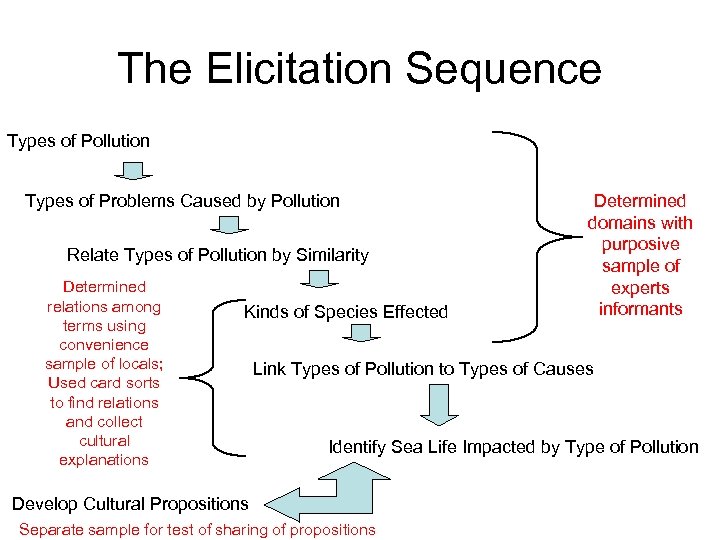
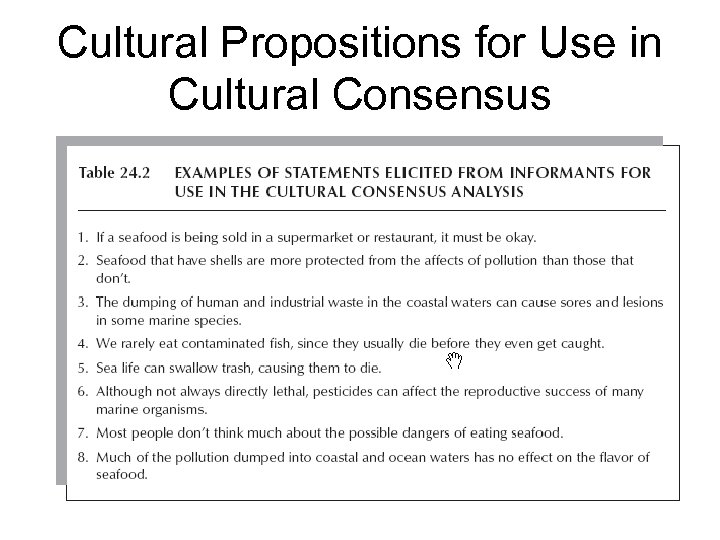
The Elicitation Sequence Types of Pollution Types of Problems Caused by Pollution Relate Types of Pollution by Similarity Determined relations among terms using convenience sample of locals; Used card sorts to find relations and collect cultural explanations Kinds of Species Effected Determined domains with purposive sample of experts informants Link Types of Pollution to Types of Causes Identify Sea Life Impacted by Type of Pollution Develop Cultural Propositions Separate sample for test of sharing of propositions
Cultural Propositions for Use in Cultural Consensus
Travel Destinations to the Caribbean: Promoting Travel to Puerto Rico
Actual First Sample
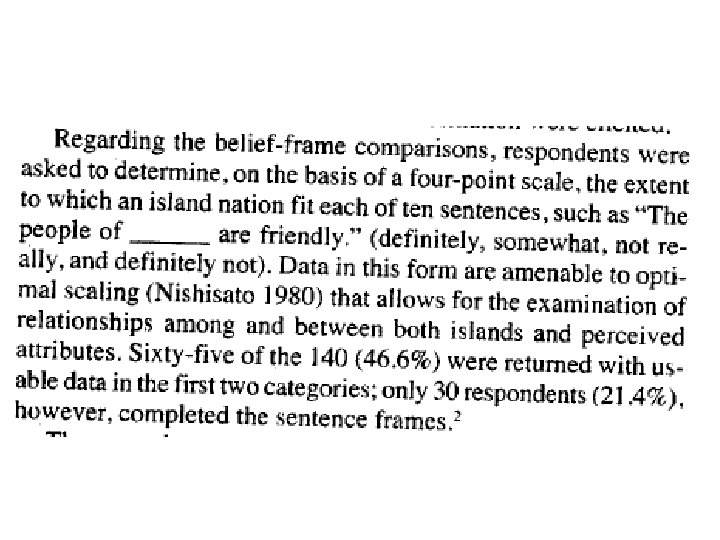
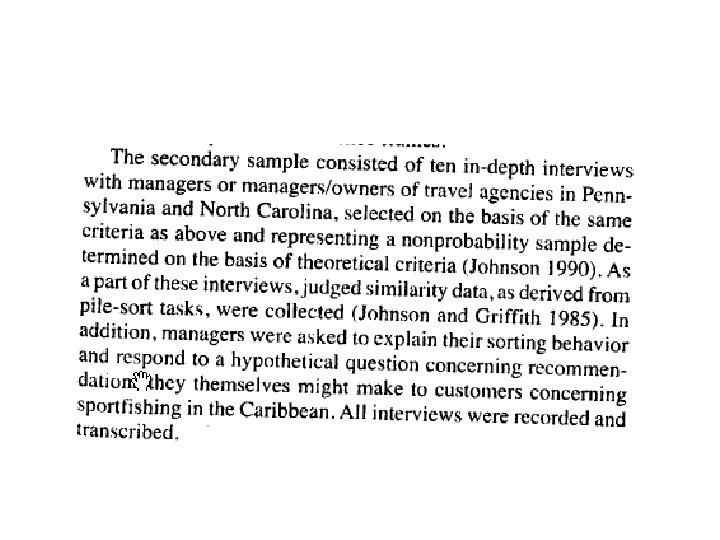
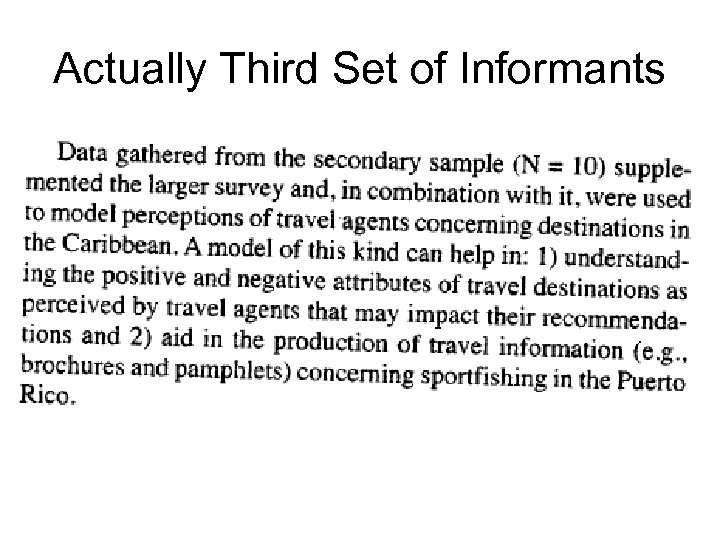
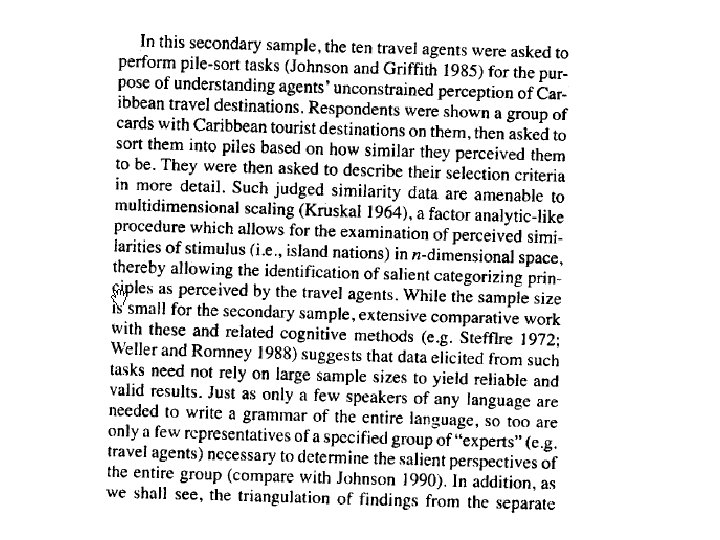
Actually Third Set of Informants
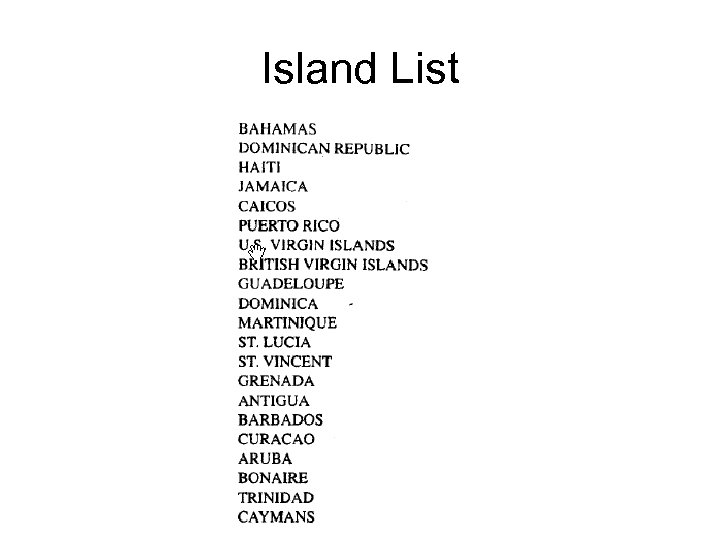
Island List
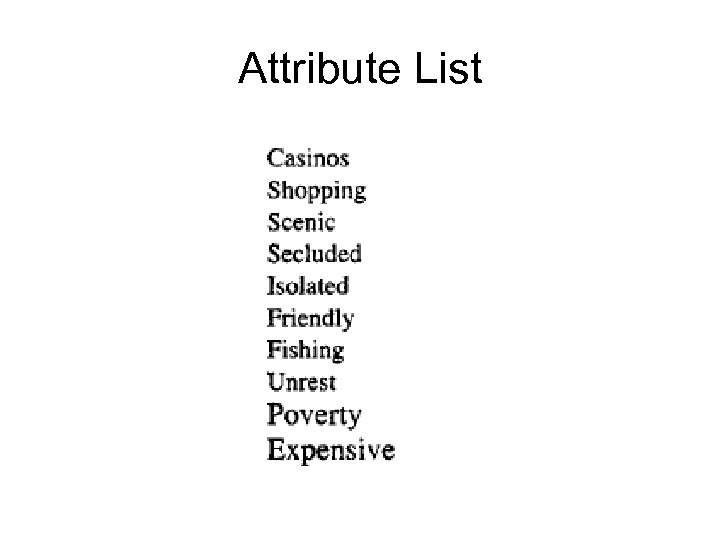
Attribute List
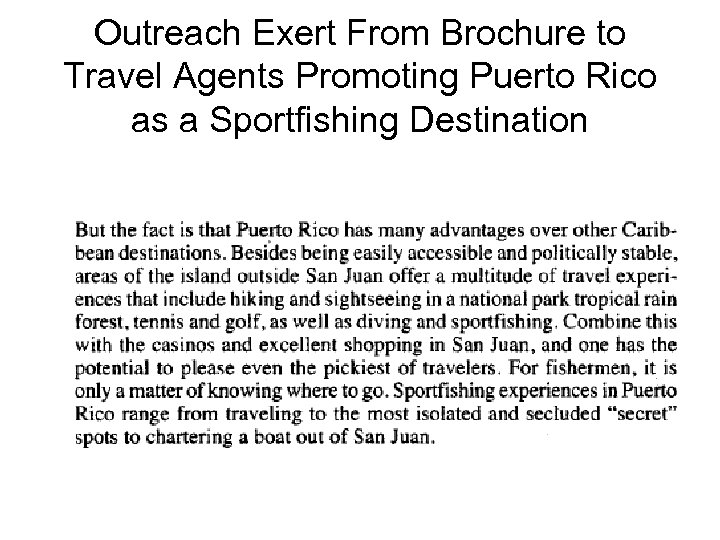
Outreach Exert From Brochure to Travel Agents Promoting Puerto Rico as a Sportfishing Destination
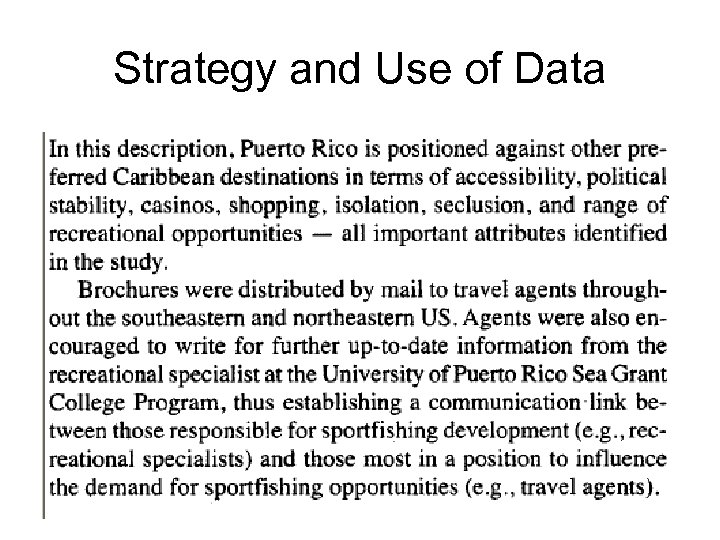
Strategy and Use of Data
EXAMPLE 1: PERCEPTION OF ILLNESSES (Weller 1984) To compare the perception of urban Guatemalan women with urban women from the U. S. • Disease terms were first elicited with free-listing (20 Women in each country) • Names of the illnesses were printed on 3 x 5 index cards (29 in English and 27 in Spanish). • To understand the perceptual categories of illnesses, an additional 24 women in each country were asked to sort the cards into piles according to their similarity, making as few or as many piles as they wished.
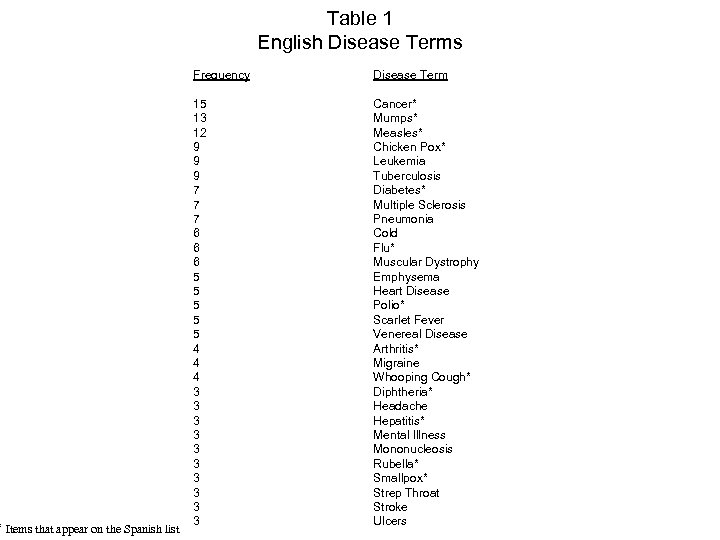
* Items that appear on the Spanish list Table 1 English Disease Terms Frequency Disease Term 15 13 12 9 9 9 7 7 7 6 6 6 5 5 5 4 4 4 3 3 3 3 3 Cancer* Mumps* Measles* Chicken Pox* Leukemia Tuberculosis Diabetes* Multiple Sclerosis Pneumonia Cold Flu* Muscular Dystrophy Emphysema Heart Disease Polio* Scarlet Fever Venereal Disease Arthritis* Migraine Whooping Cough* Diphtheria* Headache Hepatitis* Mental Illness Mononucleosis Rubella* Smallpox* Strep Throat Stroke Ulcers
TO UNDERSTAND THE PREFERENCES OF ANGLO AND HISPANIC WOMEN FOR BREAST OR BOTTLEFEEDING (Weller & Dungy) Much evidence has accumulated regarding the advantages of breast milk: • Anti-infective properties • Inhibits ovulation • More economical Given the advantages of breast milk, why do so many women choose to bottle feed? • Choose breast feeding for their infant because it is the best for their baby • Choose breast feeding because they are too embarrassed to breast feed or because they wish to work.
Unfortunately, prior projects have either • Recorded the responses to open-ended questions, or • Recorded whether or not women agree or disagree to a series of statements These approaches used singly are limited by: • Memory bias (in open-ended questions) • People “recall” less than they “recognize” • Some give short and others long lists • By using a standardized set of statements the problem of obtaining inconsistent or non-comparable data across respondents can be avoided. However, if the list is researcher generated it is subject to personal biases A preferable approach is to combine both: • Use open-ended questions to generate items and statements, and • Use those statements to collect data systematically
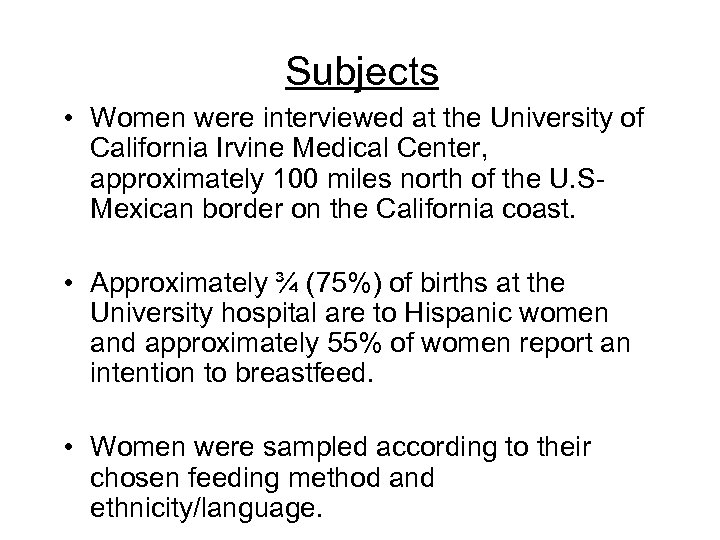
Subjects • Women were interviewed at the University of California Irvine Medical Center, approximately 100 miles north of the U. SMexican border on the California coast. • Approximately ¾ (75%) of births at the University hospital are to Hispanic women and approximately 55% of women report an intention to breastfeed. • Women were sampled according to their chosen feeding method and ethnicity/language.
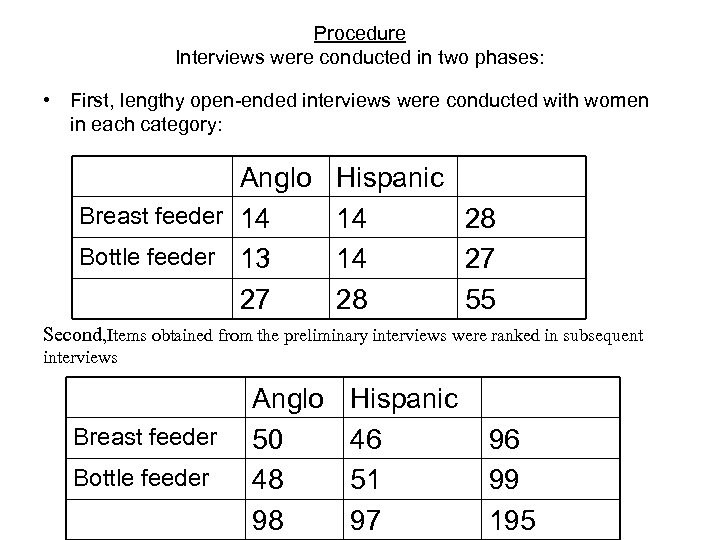
Procedure Interviews were conducted in two phases: • First, lengthy open-ended interviews were conducted with women in each category: Anglo Breast feeder 14 Bottle feeder 13 27 Hispanic 14 28 14 27 28 55 Second, Items obtained from the preliminary interviews were ranked in subsequent interviews Breast feeder Bottle feeder Anglo 50 48 98 Hispanic 46 51 97 96 99 195
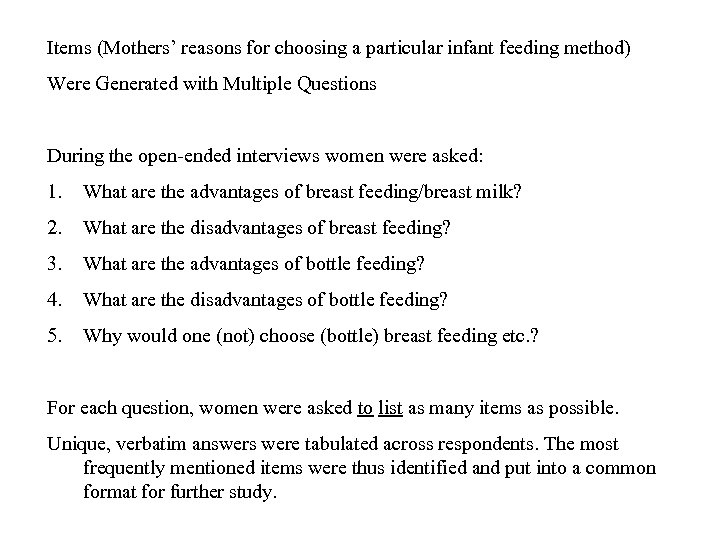
Items (Mothers’ reasons for choosing a particular infant feeding method) Were Generated with Multiple Questions During the open-ended interviews women were asked: 1. What are the advantages of breast feeding/breast milk? 2. What are the disadvantages of breast feeding? 3. What are the advantages of bottle feeding? 4. What are the disadvantages of bottle feeding? 5. Why would one (not) choose (bottle) breast feeding etc. ? For each question, women were asked to list as many items as possible. Unique, verbatim answers were tabulated across respondents. The most frequently mentioned items were thus identified and put into a common format for further study.
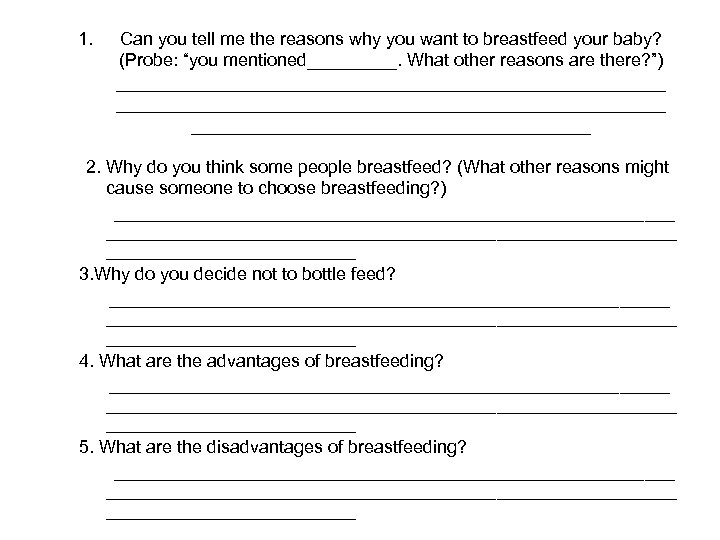
1. Can you tell me the reasons why you want to breastfeed your baby? (Probe: “you mentioned_____. What other reasons are there? ”) _______________________________________________________ 2. Why do you think some people breastfeed? (What other reasons might cause someone to choose breastfeeding? ) _________________________________________________________ 3. Why do you decide not to bottle feed? _________________________________________________________ 4. What are the advantages of breastfeeding? _________________________________________________________ 5. What are the disadvantages of breastfeeding? _________________________________________________________
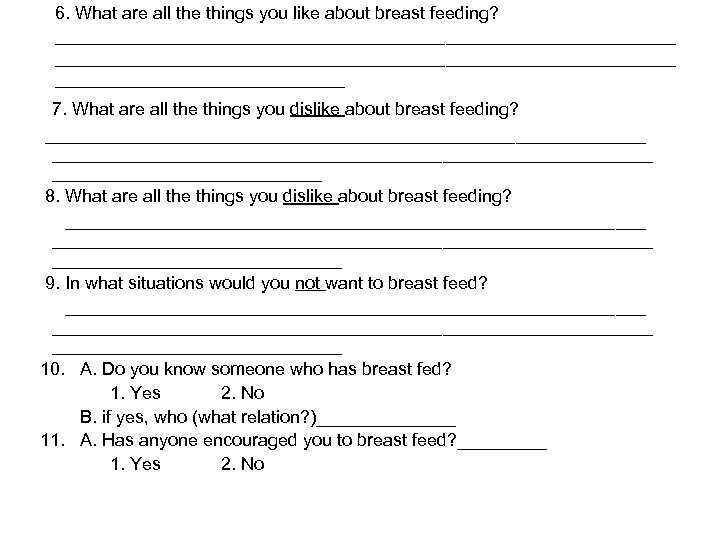
6. What are all the things you like about breast feeding? ______________________________________________________________ 7. What are all the things you dislike about breast feeding? ____________________________________________________________ 8. What are all the things you dislike about breast feeding? ____________________________________________________________ 9. In what situations would you not want to breast feed? ____________________________________________________________ 10. A. Do you know someone who has breast fed? 1. Yes 2. No B. if yes, who (what relation? )_______ 11. A. Has anyone encouraged you to breast feed? _____ 1. Yes 2. No
Item Selection The 26 most frequently mentioned statements for both English-speaking Anglos and Spanish-speaking Hispanics appear as Appendices A and B in the Weller & Dungy (1986) article. The 18 most frequently mentioned items from each list were chosen for further study. The statements were changed to a neutral form “A way to feed your baby that…” Half of the statements contained “positive” attributes and half were “negative” “Breastfeeding” and “Bottle feeding” were added to the list to create 20 statements. (Table 2 in Weller & Dungy)
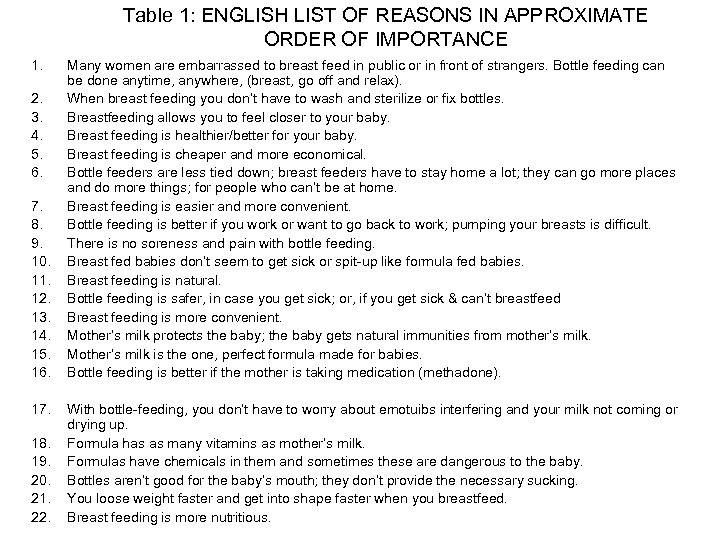
Table 1: ENGLISH LIST OF REASONS IN APPROXIMATE ORDER OF IMPORTANCE 1. 2. 3. 4. 5. 6. 7. 8. 9. 10. 11. 12. 13. 14. 15. 16. 17. 18. 19. 20. 21. 22. Many women are embarrassed to breast feed in public or in front of strangers. Bottle feeding can be done anytime, anywhere, (breast, go off and relax). When breast feeding you don’t have to wash and sterilize or fix bottles. Breastfeeding allows you to feel closer to your baby. Breast feeding is healthier/better for your baby. Breast feeding is cheaper and more economical. Bottle feeders are less tied down; breast feeders have to stay home a lot; they can go more places and do more things; for people who can’t be at home. Breast feeding is easier and more convenient. Bottle feeding is better if you work or want to go back to work; pumping your breasts is difficult. There is no soreness and pain with bottle feeding. Breast fed babies don’t seem to get sick or spit-up like formula fed babies. Breast feeding is natural. Bottle feeding is safer, in case you get sick; or, if you get sick & can’t breastfeed Breast feeding is more convenient. Mother’s milk protects the baby; the baby gets natural immunities from mother’s milk. Mother’s milk is the one, perfect formula made for babies. Bottle feeding is better if the mother is taking medication (methadone). With bottle-feeding, you don’t have to worry about emotuibs interfering and your milk not coming or drying up. Formula has as many vitamins as mother’s milk. Formulas have chemicals in them and sometimes these are dangerous to the baby. Bottles aren’t good for the baby’s mouth; they don’t provide the necessary sucking. You loose weight faster and get into shape faster when you breastfeed. Breast feeding is more nutritious.
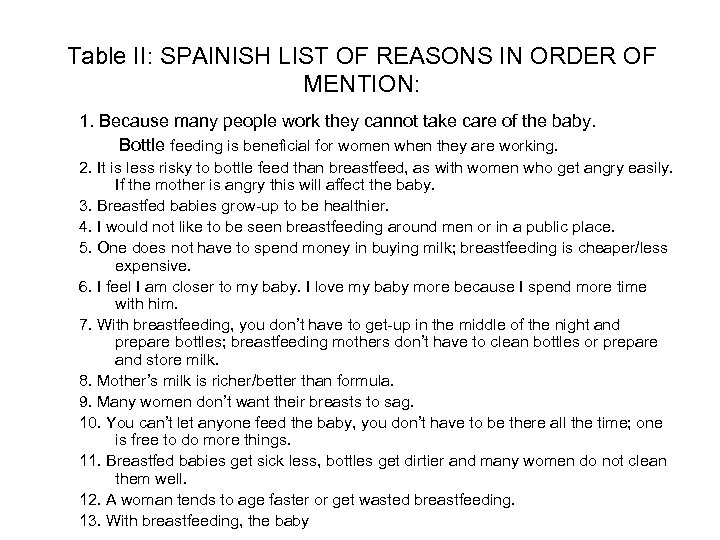
Table II: SPAINISH LIST OF REASONS IN ORDER OF MENTION: 1. Because many people work they cannot take care of the baby. Bottle feeding is beneficial for women when they are working. 2. It is less risky to bottle feed than breastfeed, as with women who get angry easily. If the mother is angry this will affect the baby. 3. Breastfed babies grow-up to be healthier. 4. I would not like to be seen breastfeeding around men or in a public place. 5. One does not have to spend money in buying milk; breastfeeding is cheaper/less expensive. 6. I feel I am closer to my baby. I love my baby more because I spend more time with him. 7. With breastfeeding, you don’t have to get-up in the middle of the night and prepare bottles; breastfeeding mothers don’t have to clean bottles or prepare and store milk. 8. Mother’s milk is richer/better than formula. 9. Many women don’t want their breasts to sag. 10. You can’t let anyone feed the baby, you don’t have to be there all the time; one is free to do more things. 11. Breastfed babies get sick less, bottles get dirtier and many women do not clean them well. 12. A woman tends to age faster or get wasted breastfeeding. 13. With breastfeeding, the baby
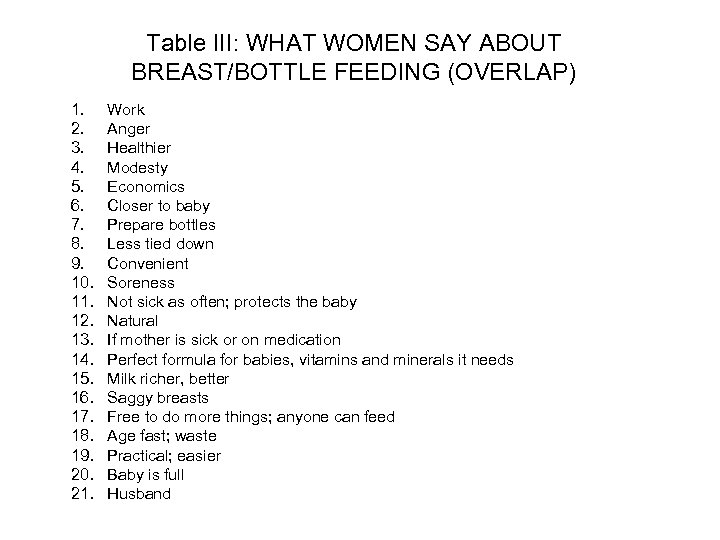
Table III: WHAT WOMEN SAY ABOUT BREAST/BOTTLE FEEDING (OVERLAP) 1. 2. 3. 4. 5. 6. 7. 8. 9. 10. 11. 12. 13. 14. 15. 16. 17. 18. 19. 20. 21. Work Anger Healthier Modesty Economics Closer to baby Prepare bottles Less tied down Convenient Soreness Not sick as often; protects the baby Natural If mother is sick or on medication Perfect formula for babies, vitamins and minerals it needs Milk richer, better Saggy breasts Free to do more things; anyone can feed Age fast; waste Practical; easier Baby is full Husband
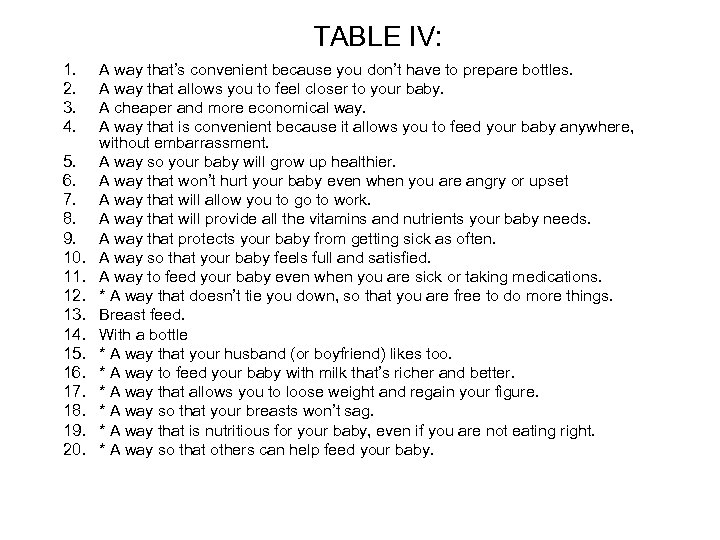
TABLE IV: 1. 2. 3. 4. 5. 6. 7. 8. 9. 10. 11. 12. 13. 14. 15. 16. 17. 18. 19. 20. A way that’s convenient because you don’t have to prepare bottles. A way that allows you to feel closer to your baby. A cheaper and more economical way. A way that is convenient because it allows you to feed your baby anywhere, without embarrassment. A way so your baby will grow up healthier. A way that won’t hurt your baby even when you are angry or upset A way that will allow you to go to work. A way that will provide all the vitamins and nutrients your baby needs. A way that protects your baby from getting sick as often. A way so that your baby feels full and satisfied. A way to feed your baby even when you are sick or taking medications. * A way that doesn’t tie you down, so that you are free to do more things. Breast feed. With a bottle * A way that your husband (or boyfriend) likes too. * A way to feed your baby with milk that’s richer and better. * A way that allows you to loose weight and regain your figure. * A way so that your breasts won’t sag. * A way that is nutritious for your baby, even if you are not eating right. * A way so that others can help feed your baby.
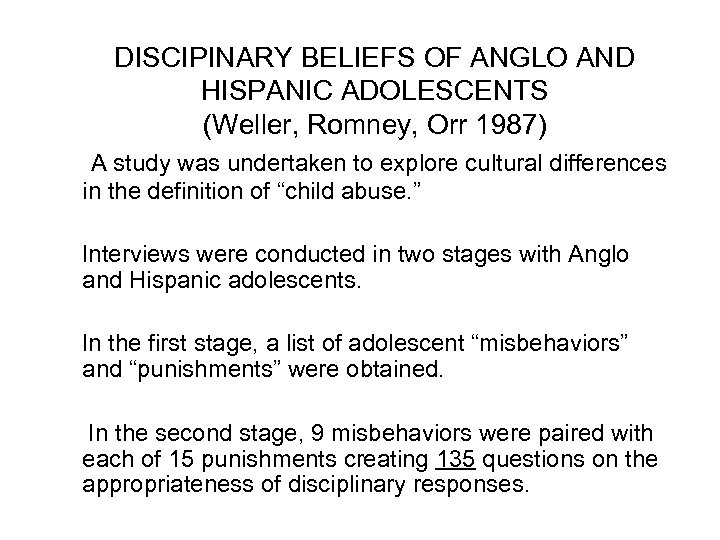
DISCIPINARY BELIEFS OF ANGLO AND HISPANIC ADOLESCENTS (Weller, Romney, Orr 1987) A study was undertaken to explore cultural differences in the definition of “child abuse. ” Interviews were conducted in two stages with Anglo and Hispanic adolescents. In the first stage, a list of adolescent “misbehaviors” and “punishments” were obtained. In the second stage, 9 misbehaviors were paired with each of 15 punishments creating 135 questions on the appropriateness of disciplinary responses.
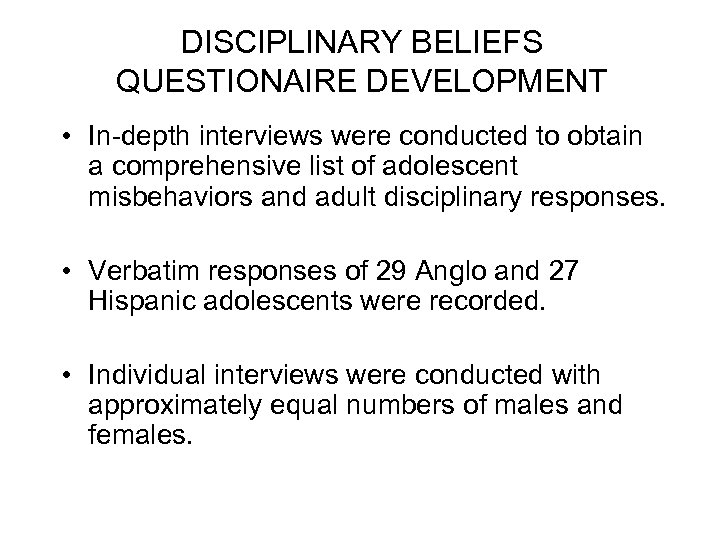
DISCIPLINARY BELIEFS QUESTIONAIRE DEVELOPMENT • In-depth interviews were conducted to obtain a comprehensive list of adolescent misbehaviors and adult disciplinary responses. • Verbatim responses of 29 Anglo and 27 Hispanic adolescents were recorded. • Individual interviews were conducted with approximately equal numbers of males and females.
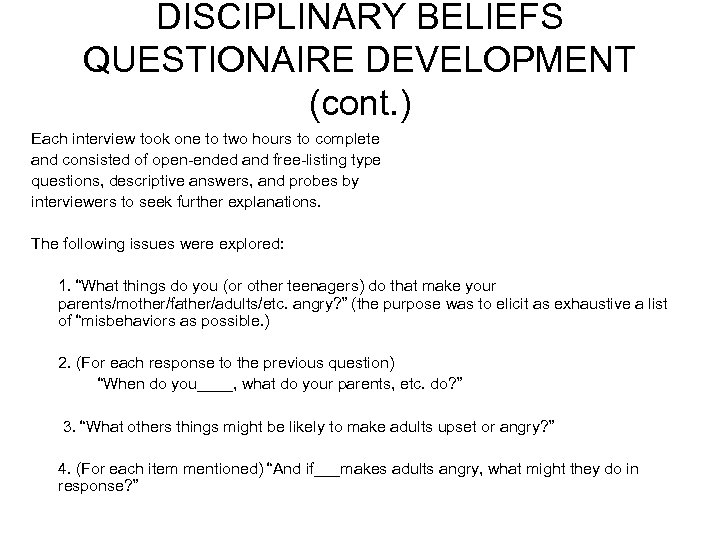
DISCIPLINARY BELIEFS QUESTIONAIRE DEVELOPMENT (cont. ) Each interview took one to two hours to complete and consisted of open-ended and free-listing type questions, descriptive answers, and probes by interviewers to seek further explanations. The following issues were explored: 1. “What things do you (or other teenagers) do that make your parents/mother/father/adults/etc. angry? ” (the purpose was to elicit as exhaustive a list of “misbehaviors as possible. ) 2. (For each response to the previous question) “When do you____, what do your parents, etc. do? ” 3. “What others things might be likely to make adults upset or angry? ” 4. (For each item mentioned) “And if___makes adults angry, what might they do in response? ”
DISCIPLINARY BELIEFS QUESTIONAIRE DEVELPMENT • Responses were tabulated from the 56 adolescents. • In addition, because extreme forms of “punishment” and child abuse are relatively rare, a list of “punishments” reported most frequently by abused adolescents in the University Hospital Emergency Department were included. • A final list of 9 adolescent behaviors and 15 adult responses was chosen.
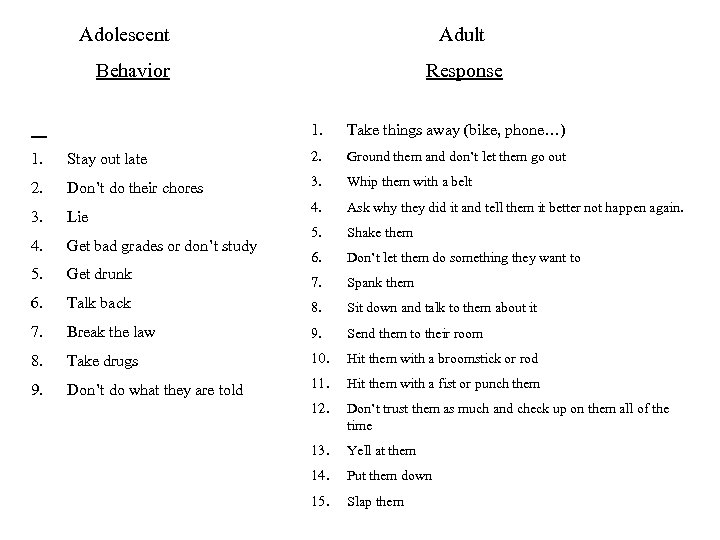
Adolescent Adult Behavior Response 1. Take things away (bike, phone…) 1. Stay out late 2. Ground them and don’t let them go out 2. Don’t do their chores 3. Whip them with a belt 3. Lie 4. Ask why they did it and tell them it better not happen again. 4. Get bad grades or don’t study 5. Shake them 5. 6. Don’t let them do something they want to Get drunk 7. Spank them 6. Talk back 8. Sit down and talk to them about it 7. Break the law 9. Send them to their room 8. Take drugs 10. Hit them with a broomstick or rod 9. Don’t do what they are told 11. Hit them with a fist or punch them 12. Don’t trust them as much and check up on them all of the time 13. Yell at them 14. Put them down 15. Slap them
CLASS EXAMPLES
Скачать презентацию Ethnographic Interviews Describing Culture from a Native s Point
a87c33d94c04eb4a6dc5f889a0266cfe.ppt