


 Скачать презентацию Ethnic Religions Hinduism Largest Ethnic religion
c12968db61b24f15549c877b72eb8d08.ppt
- Количество слайдов: 31
 Ethnic Religions
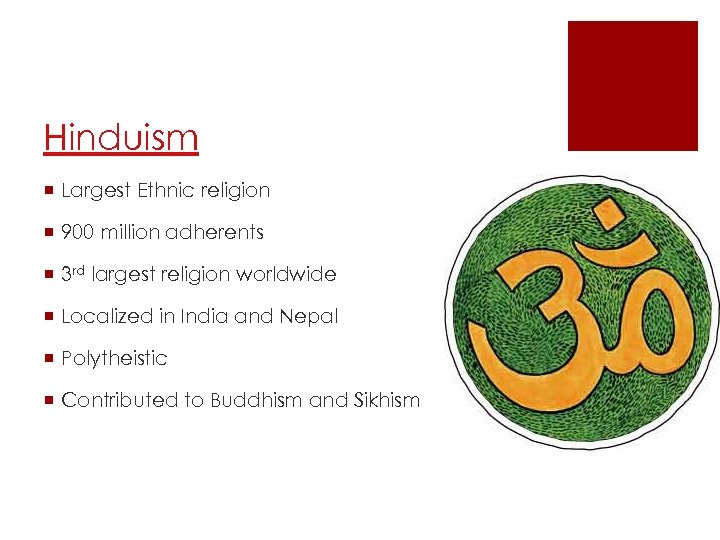 Hinduism ¡ Largest Ethnic religion ¡ 900 million adherents ¡ 3 rd largest religion worldwide ¡ Localized in India and Nepal ¡ Polytheistic ¡ Contributed to Buddhism and Sikhism
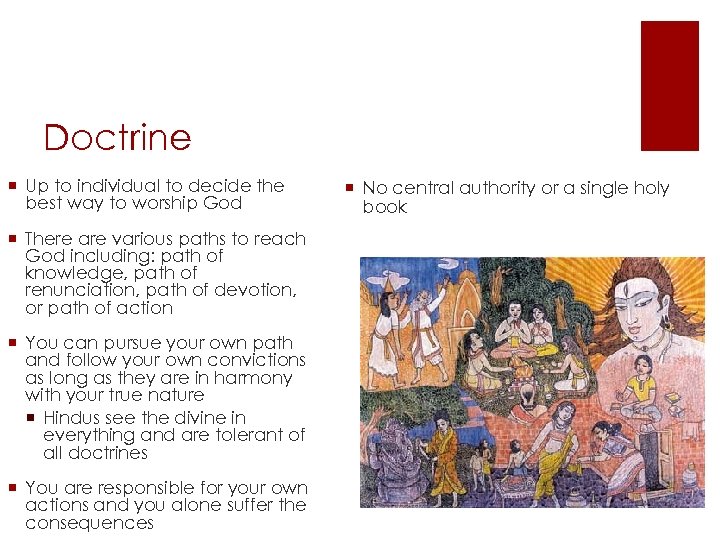 Doctrine ¡ Up to individual to decide the best way to worship God ¡ There are various paths to reach God including: path of knowledge, path of renunciation, path of devotion, or path of action ¡ You can pursue your own path and follow your own convictions as long as they are in harmony with your true nature ¡ Hindus see the divine in everything and are tolerant of all doctrines ¡ You are responsible for your own actions and you alone suffer the consequences ¡ No central authority or a single holy book
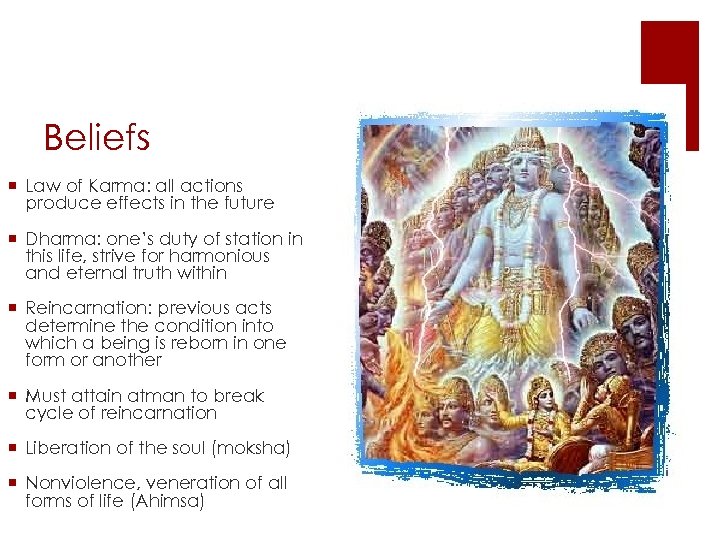 Beliefs ¡ Law of Karma: all actions produce effects in the future ¡ Dharma: one’s duty of station in this life, strive for harmonious and eternal truth within ¡ Reincarnation: previous acts determine the condition into which a being is reborn in one form or another ¡ Must attain atman to break cycle of reincarnation ¡ Liberation of the soul (moksha) ¡ Nonviolence, veneration of all forms of life (Ahimsa)
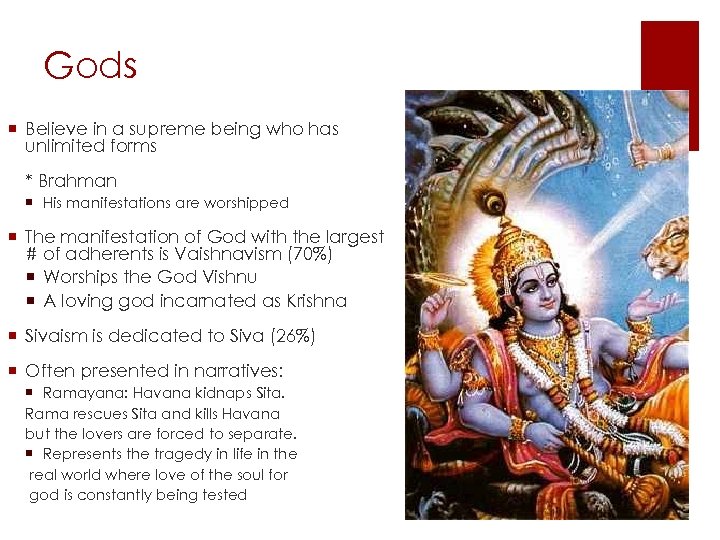 Gods ¡ Believe in a supreme being who has unlimited forms * Brahman ¡ His manifestations are worshipped ¡ The manifestation of God with the largest # of adherents is Vaishnavism (70%) ¡ Worships the God Vishnu ¡ A loving god incarnated as Krishna ¡ Sivaism is dedicated to Siva (26%) ¡ Often presented in narratives: ¡ Ramayana: Havana kidnaps Sita. Rama rescues Sita and kills Havana but the lovers are forced to separate. ¡ Represents the tragedy in life in the real world where love of the soul for god is constantly being tested
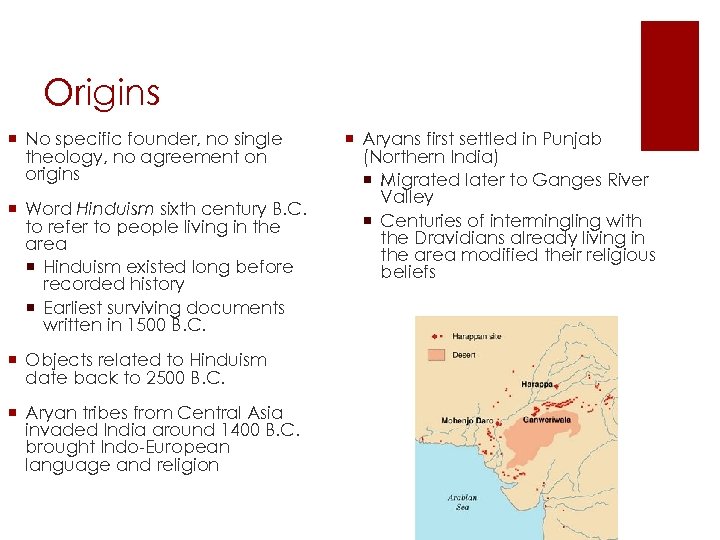 Origins ¡ No specific founder, no single theology, no agreement on origins ¡ Word Hinduism sixth century B. C. to refer to people living in the area ¡ Hinduism existed long before recorded history ¡ Earliest surviving documents written in 1500 B. C. ¡ Objects related to Hinduism date back to 2500 B. C. ¡ Aryan tribes from Central Asia invaded India around 1400 B. C. brought Indo-European language and religion ¡ Aryans first settled in Punjab (Northern India) ¡ Migrated later to Ganges River Valley ¡ Centuries of intermingling with the Dravidians already living in the area modified their religious beliefs
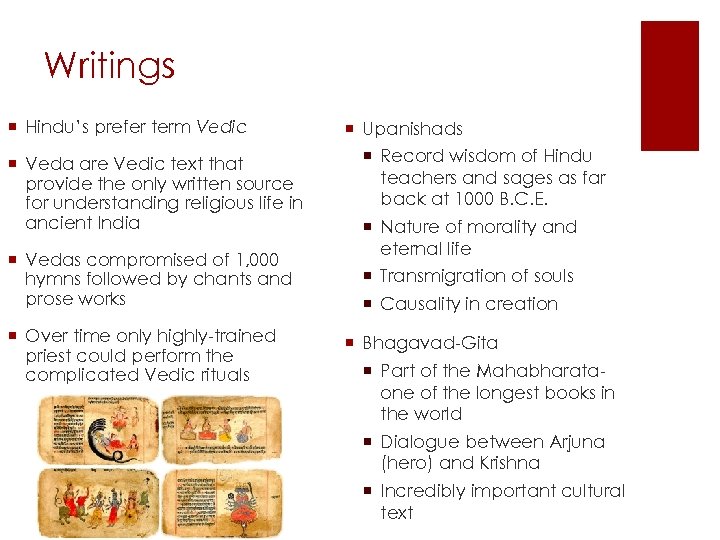 Writings ¡ Hindu’s prefer term Vedic ¡ Veda are Vedic text that provide the only written source for understanding religious life in ancient India ¡ Vedas compromised of 1, 000 hymns followed by chants and prose works ¡ Over time only highly-trained priest could perform the complicated Vedic rituals ¡ Upanishads ¡ Record wisdom of Hindu teachers and sages as far back at 1000 B. C. E. ¡ Nature of morality and eternal life ¡ Transmigration of souls ¡ Causality in creation ¡ Bhagavad-Gita ¡ Part of the Mahabharataone of the longest books in the world ¡ Dialogue between Arjuna (hero) and Krishna ¡ Incredibly important cultural text
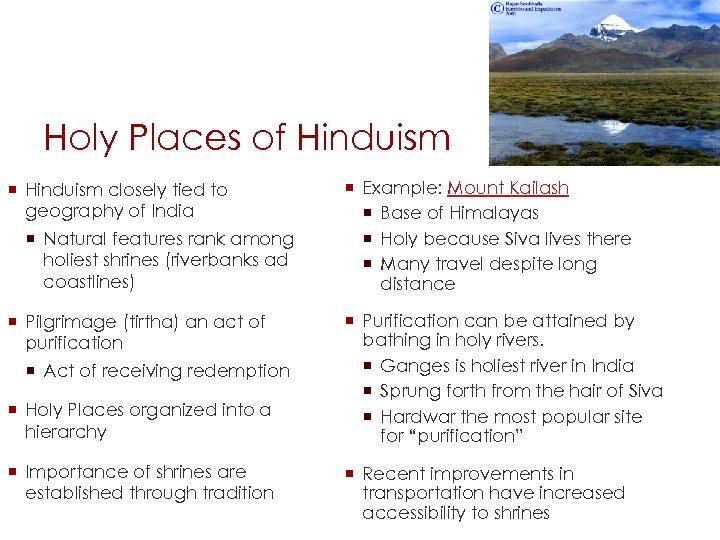 Holy Places of Hinduism ¡ Hinduism closely tied to geography of India ¡ Natural features rank among holiest shrines (riverbanks ad coastlines) ¡ Example: Mount Kailash ¡ Base of Himalayas ¡ Holy because Siva lives there ¡ Many travel despite long distance ¡ Pilgrimage (tirtha) an act of purification ¡ Act of receiving redemption ¡ Purification can be attained by bathing in holy rivers. ¡ Ganges is holiest river in India ¡ Sprung forth from the hair of Siva ¡ Hardwar the most popular site for “purification” ¡ Holy Places organized into a hierarchy ¡ Importance of shrines are established through tradition ¡ Recent improvements in transportation have increased accessibility to shrines
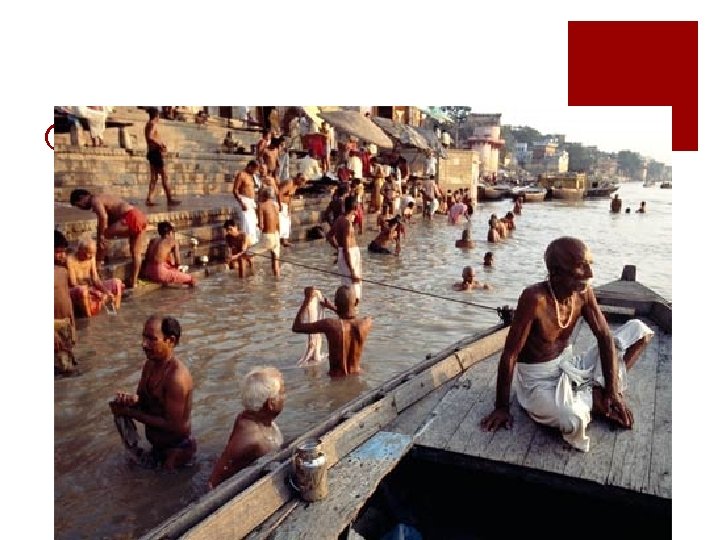 Ganges River
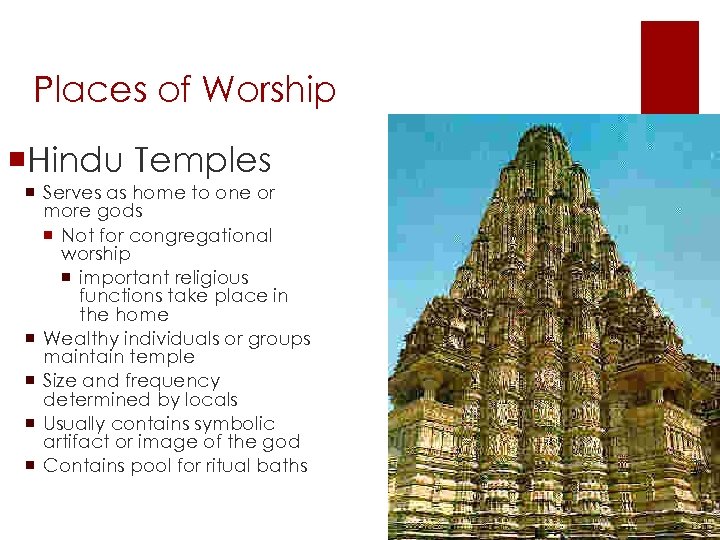 Places of Worship ¡Hindu Temples ¡ Serves as home to one or more gods ¡ Not for congregational worship ¡ important religious functions take place in the home ¡ Wealthy individuals or groups maintain temple ¡ Size and frequency determined by locals ¡ Usually contains symbolic artifact or image of the god ¡ Contains pool for ritual baths
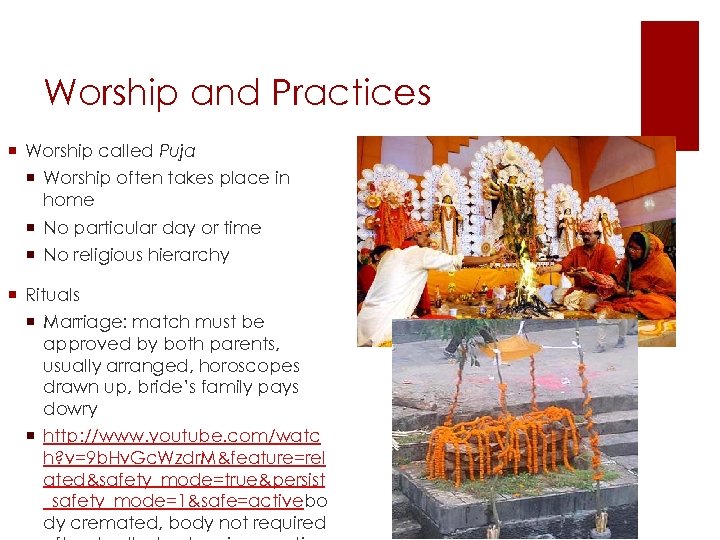 Worship and Practices ¡ Worship called Puja ¡ Worship often takes place in home ¡ No particular day or time ¡ No religious hierarchy ¡ Rituals ¡ Marriage: match must be approved by both parents, usually arranged, horoscopes drawn up, bride’s family pays dowry ¡ http: //www. youtube. com/watc h? v=9 b. Hv. Gc. Wzdr. M&feature=rel ated&safety_mode=true&persist _safety_mode=1&safe=activebo dy cremated, body not required
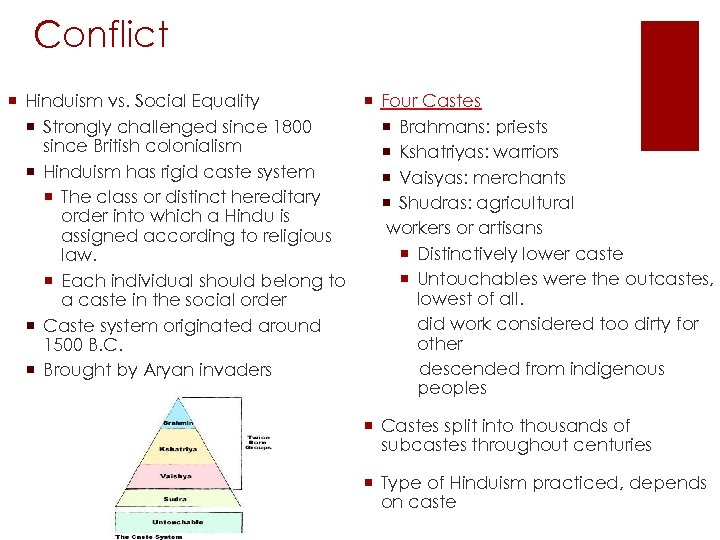 Conflict ¡ Hinduism vs. Social Equality ¡ Four Castes ¡ Strongly challenged since 1800 ¡ Brahmans: priests since British colonialism ¡ Kshatriyas: warriors ¡ Hinduism has rigid caste system ¡ Vaisyas: merchants ¡ The class or distinct hereditary ¡ Shudras: agricultural order into which a Hindu is workers or artisans assigned according to religious ¡ Distinctively lower caste law. ¡ Untouchables were the outcastes, ¡ Each individual should belong to lowest of all. a caste in the social order did work considered too dirty for ¡ Caste system originated around other 1500 B. C. descended from indigenous ¡ Brought by Aryan invaders peoples ¡ Castes split into thousands of subcastes throughout centuries ¡ Type of Hinduism practiced, depends on caste
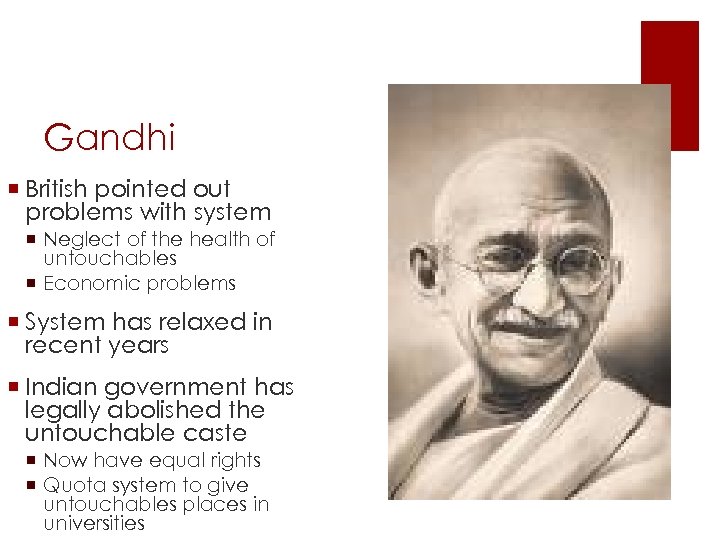 Gandhi ¡ British pointed out problems with system ¡ Neglect of the health of untouchables ¡ Economic problems ¡ System has relaxed in recent years ¡ Indian government has legally abolished the untouchable caste ¡ Now have equal rights ¡ Quota system to give untouchables places in universities
 Judaism ¡ Some believe it’s the first monotheistic religion ¡ 14 million Jews today ¡ - Considered “parent” religion of Christianity and related to Islam ¡ Unique ethnic religion because it’s not clustered geographically
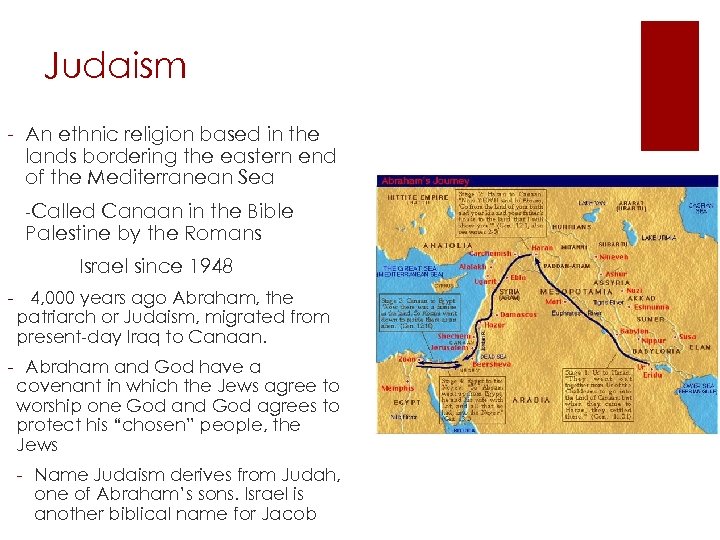 Judaism - An ethnic religion based in the lands bordering the eastern end of the Mediterranean Sea -Called Canaan in the Bible Palestine by the Romans Israel since 1948 - 4, 000 years ago Abraham, the patriarch or Judaism, migrated from present-day Iraq to Canaan. - Abraham and God have a covenant in which the Jews agree to worship one God and God agrees to protect his “chosen” people, the Jews - Name Judaism derives from Judah, one of Abraham’s sons. Israel is another biblical name for Jacob
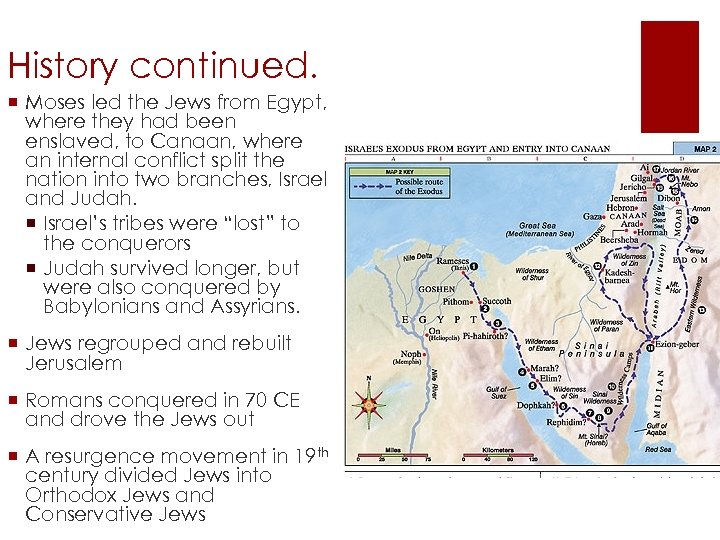 History continued. ¡ Moses led the Jews from Egypt, where they had been enslaved, to Canaan, where an internal conflict split the nation into two branches, Israel and Judah. ¡ Israel’s tribes were “lost” to the conquerors ¡ Judah survived longer, but were also conquered by Babylonians and Assyrians. ¡ Jews regrouped and rebuilt Jerusalem ¡ Romans conquered in 70 CE and drove the Jews out ¡ A resurgence movement in 19 th century divided Jews into Orthodox Jews and Conservative Jews
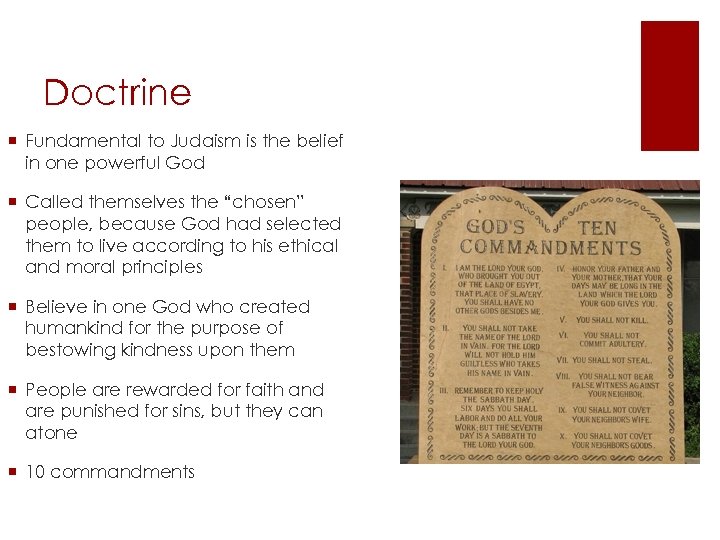 Doctrine ¡ Fundamental to Judaism is the belief in one powerful God ¡ Called themselves the “chosen” people, because God had selected them to live according to his ethical and moral principles ¡ Believe in one God who created humankind for the purpose of bestowing kindness upon them ¡ People are rewarded for faith and are punished for sins, but they can atone ¡ 10 commandments
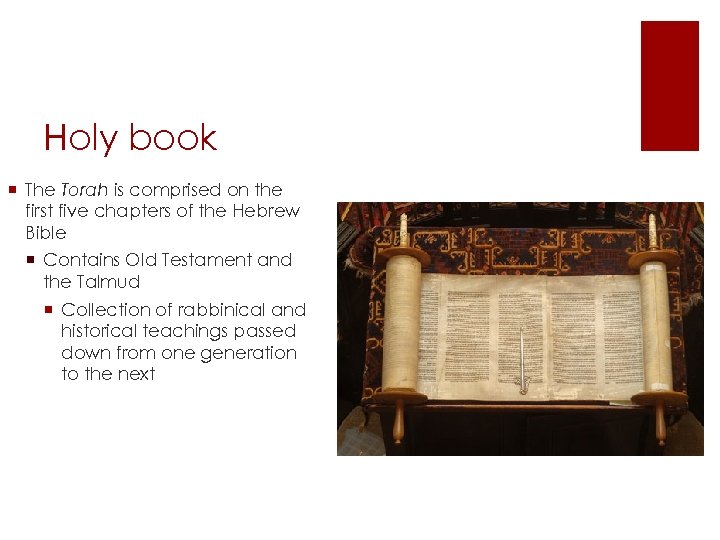 Holy book ¡ The Torah is comprised on the first five chapters of the Hebrew Bible ¡ Contains Old Testament and the Talmud ¡ Collection of rabbinical and historical teachings passed down from one generation to the next
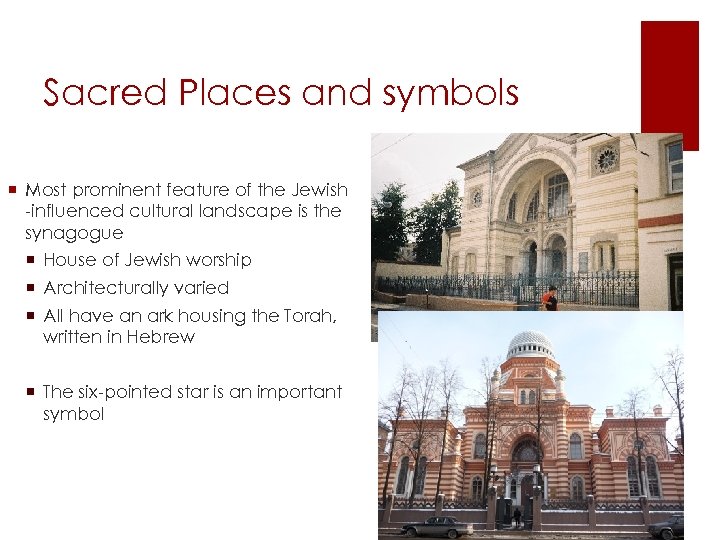 Sacred Places and symbols ¡ Most prominent feature of the Jewish -influenced cultural landscape is the synagogue ¡ House of Jewish worship ¡ Architecturally varied ¡ All have an ark housing the Torah, written in Hebrew ¡ The six-pointed star is an important symbol
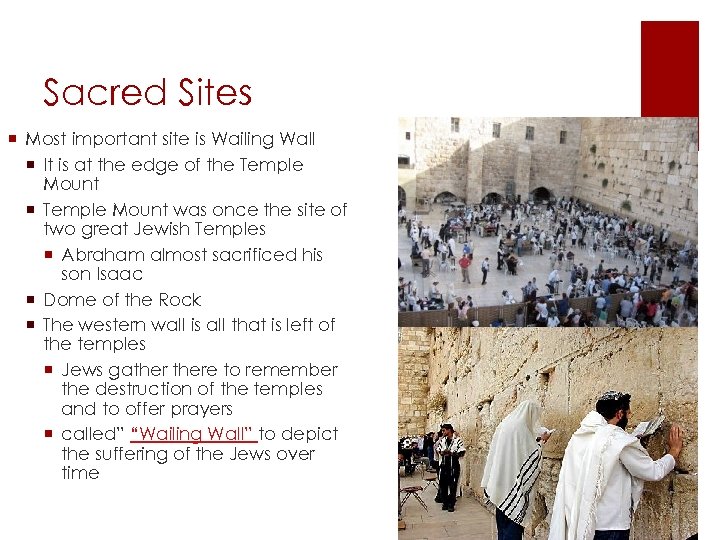 Sacred Sites ¡ Most important site is Wailing Wall ¡ It is at the edge of the Temple Mount ¡ Temple Mount was once the site of two great Jewish Temples ¡ Abraham almost sacrificed his son Isaac ¡ Dome of the Rock ¡ The western wall is all that is left of the temples ¡ Jews gathere to remember the destruction of the temples and to offer prayers ¡ called” “Wailing Wall” to depict the suffering of the Jews over time
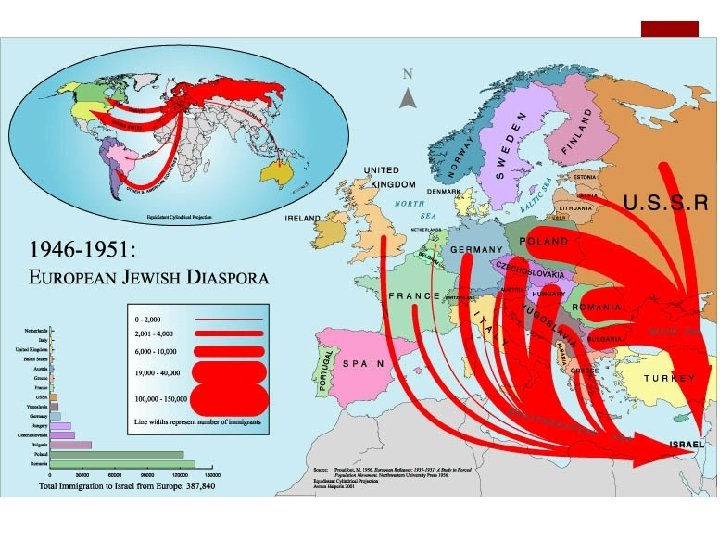
 Diffusion ¡ Different from other ethnic religions ¡ it is practiced in places other than just the place of origin ¡ Most Jews do not live in Israel due to the forced Diaspora of the Jews by the Romans in A. D. 70 ¡ Most migrated to Europe ¡ Into Iberian peninsula ¡ Often Jews were persecuted by other nationalities ¡ Example: Holocaust ¡ Forced to live in Ghettos ¡ Most Jews now live in Israel ¡ Largest population of Jews live in the U. S. ¡ Northeast, NY ¡ Prominent in major cities in Western Europe
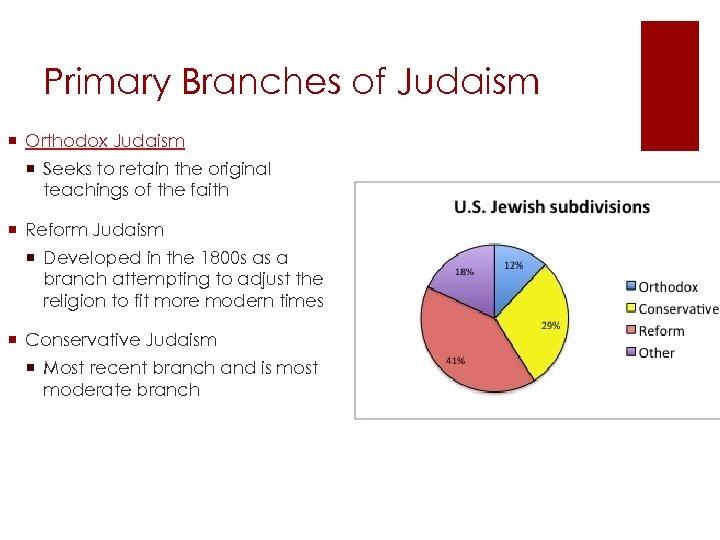 Primary Branches of Judaism ¡ Orthodox Judaism ¡ Seeks to retain the original teachings of the faith ¡ Reform Judaism ¡ Developed in the 1800 s as a branch attempting to adjust the religion to fit more modern times ¡ Conservative Judaism ¡ Most recent branch and is most moderate branch
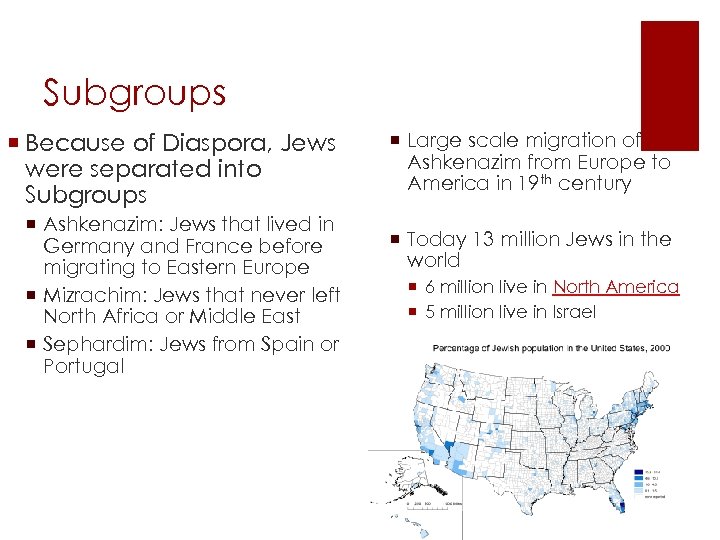 Subgroups ¡ Because of Diaspora, Jews were separated into Subgroups ¡ Ashkenazim: Jews that lived in Germany and France before migrating to Eastern Europe ¡ Mizrachim: Jews that never left North Africa or Middle East ¡ Sephardim: Jews from Spain or Portugal ¡ Large scale migration of Ashkenazim from Europe to America in 19 th century ¡ Today 13 million Jews in the world ¡ 6 million live in North America ¡ 5 million live in Israel
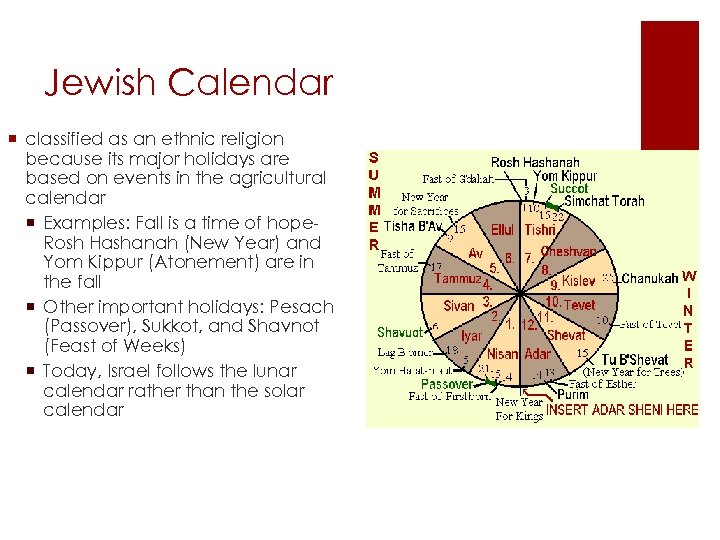 Jewish Calendar ¡ classified as an ethnic religion because its major holidays are based on events in the agricultural calendar ¡ Examples: Fall is a time of hope. Rosh Hashanah (New Year) and Yom Kippur (Atonement) are in the fall ¡ Other important holidays: Pesach (Passover), Sukkot, and Shavnot (Feast of Weeks) ¡ Today, Israel follows the lunar calendar rather than the solar calendar
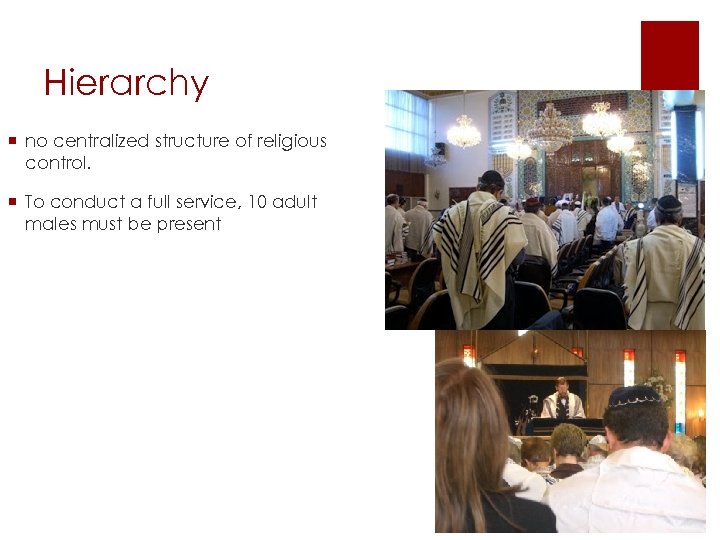 Hierarchy ¡ no centralized structure of religious control. ¡ To conduct a full service, 10 adult males must be present
 Other Ethnic Religions
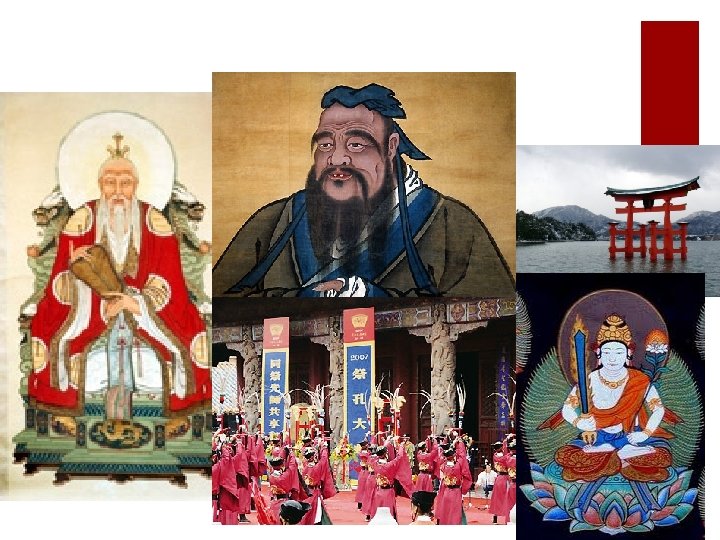
 East Asian Ethnic Religions ¡ Taoism (Daoism) ¡ Linked to philosopher Laozi, lived around 6 th century C. E. ¡ Laozi taught that people should live in harmony with nature and all aspects of their lives ¡ Seek the “way” ¡ Yin and yang ¡ Created feng shui ¡ Confucianism ¡ Linked to Confucius, lived around 6 th century C. E. ¡ Built system of morals and a way of life for the Chinese ¡ Focuses more on the worldly life than rather the ideas of heaven and hell ¡ Shintoism ¡ Syncretic, ethnic religion ¡ Blends principles of Buddhism with a local religion of Japan ¡ Forces of nature considered divine ¡ Emperors become deities ¡ From the 1800 s until after WWII, Shintoism was the state religion of Japan ¡ Emperor forced to renounce his divinity
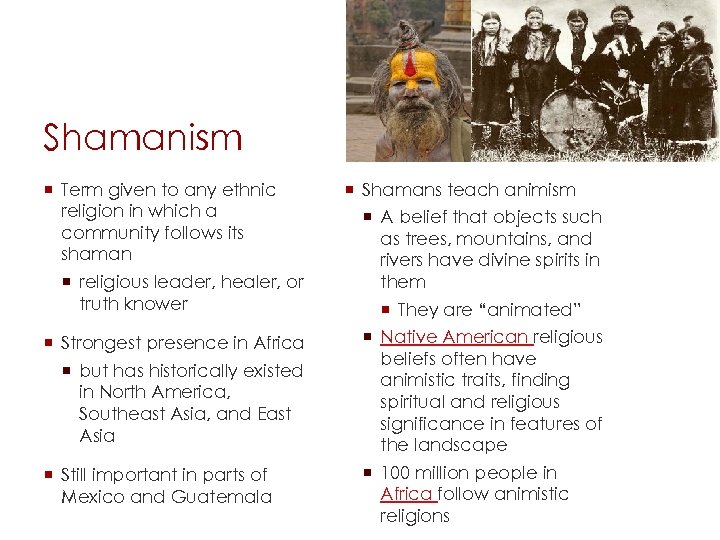 Shamanism ¡ Term given to any ethnic religion in which a community follows its shaman ¡ religious leader, healer, or truth knower ¡ Strongest presence in Africa ¡ but has historically existed in North America, Southeast Asia, and East Asia ¡ Still important in parts of Mexico and Guatemala ¡ Shamans teach animism ¡ A belief that objects such as trees, mountains, and rivers have divine spirits in them ¡ They are “animated” ¡ Native American religious beliefs often have animistic traits, finding spiritual and religious significance in features of the landscape ¡ 100 million people in Africa follow animistic religions
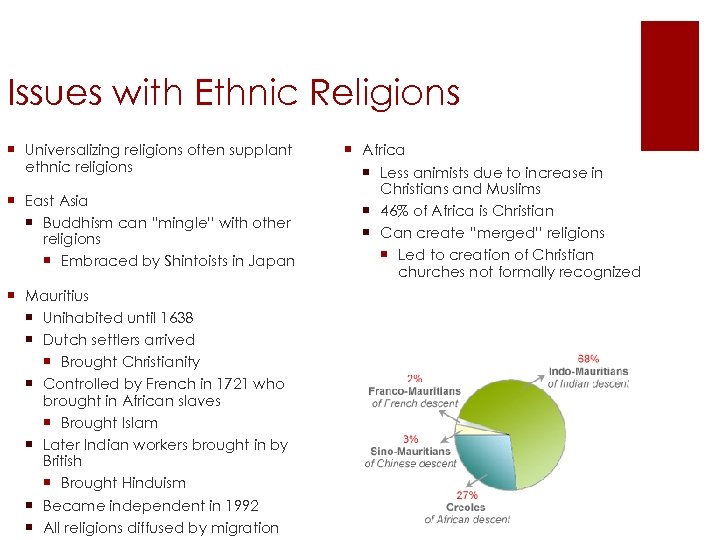 Issues with Ethnic Religions ¡ Universalizing religions often supplant ethnic religions ¡ East Asia ¡ Buddhism can “mingle” with other religions ¡ Embraced by Shintoists in Japan ¡ Mauritius ¡ Unihabited until 1638 ¡ Dutch settlers arrived ¡ Brought Christianity ¡ Controlled by French in 1721 who brought in African slaves ¡ Brought Islam ¡ Later Indian workers brought in by British ¡ Brought Hinduism ¡ Became independent in 1992 ¡ All religions diffused by migration ¡ Africa ¡ Less animists due to increase in Christians and Muslims ¡ 46% of Africa is Christian ¡ Can create “merged” religions ¡ Led to creation of Christian churches not formally recognized