 Скачать презентацию Ethical Issues and Debates some approaches Ron Anderson
4ed53950231740775dd6822aec27d390.ppt
- Количество слайдов: 31



‘Ethical Issues and Debates: some approaches’ Ron Anderson 12 June 2013
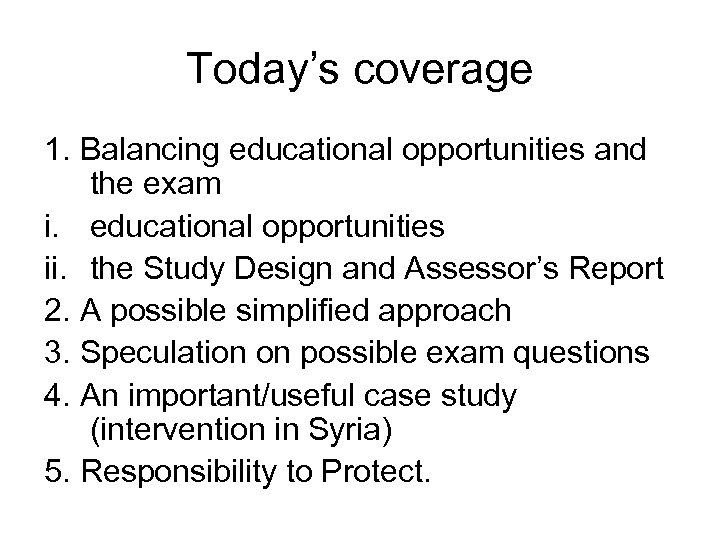
Today’s coverage 1. Balancing educational opportunities and the exam i. educational opportunities ii. the Study Design and Assessor’s Report 2. A possible simplified approach 3. Speculation on possible exam questions 4. An important/useful case study (intervention in Syria) 5. Responsibility to Protect.
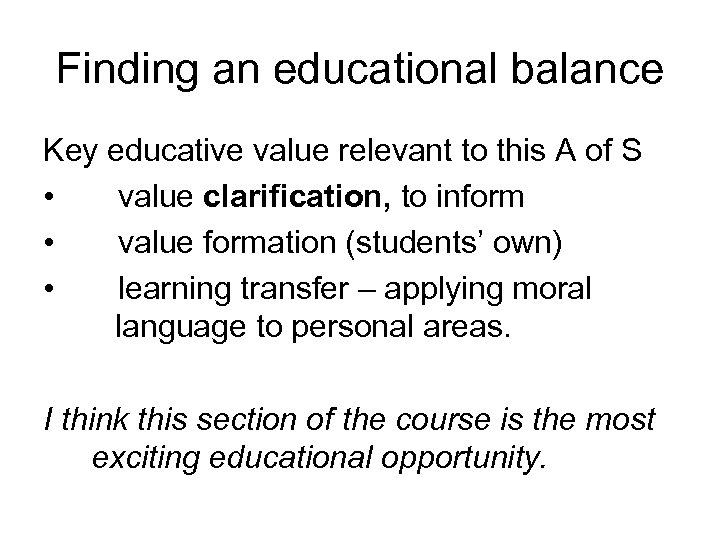
Finding an educational balance Key educative value relevant to this A of S • value clarification, to inform • value formation (students’ own) • learning transfer – applying moral language to personal areas. I think this section of the course is the most exciting educational opportunity.
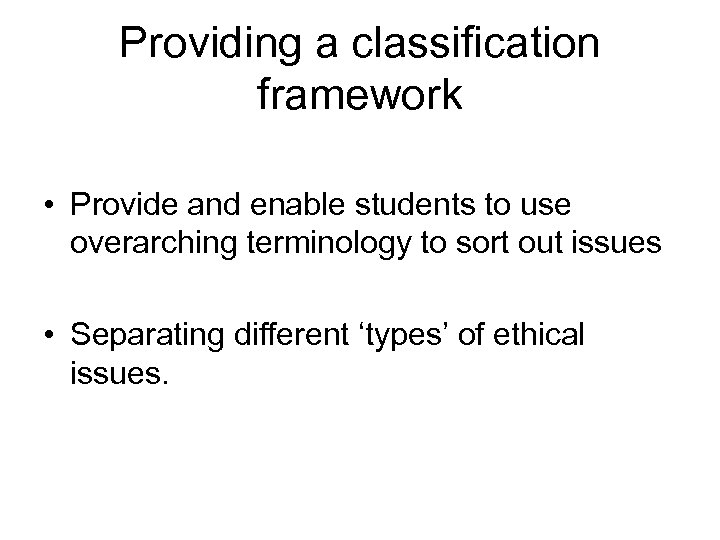
Providing a classification framework • Provide and enable students to use overarching terminology to sort out issues • Separating different ‘types’ of ethical issues.
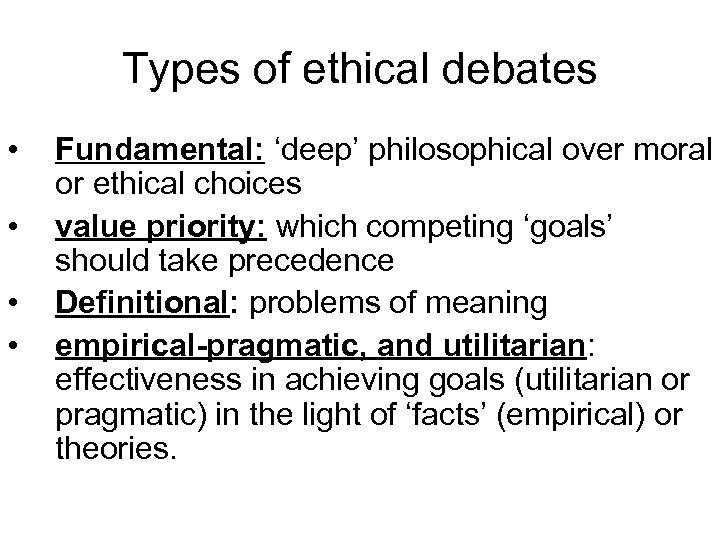
Types of ethical debates • • Fundamental: ‘deep’ philosophical over moral or ethical choices value priority: which competing ‘goals’ should take precedence Definitional: problems of meaning empirical-pragmatic, and utilitarian: effectiveness in achieving goals (utilitarian or pragmatic) in the light of ‘facts’ (empirical) or theories.
Applying this classification • Refer to Handout • Table attempts to (i) identify range of ethical issues – not comprehensive (ii) classify ethical issues into different types (iii) suggest some examples/case studies
Interpreting Study Design 1 (considering Assessor’s Report) 1. Coverage ‘Two issues’ of the four main issues to be covered - But coverage of all ‘sub-issues’ within each main ‘issue’? - My view No!! Based on (i) 2012 exam allowed choices of ‘ethical issue’ (ii) Assessor’s report re page. 11: ‘The ethical debate chosen from the lists on page 41 of the study design, but it did not have to be. If it is not listed, it needed to be specific and well explored. ’ Meaning? freedom to choose – even beyond what’s listed – but may create other problems.
Study Design -2 Different issues 2. Formulating the ‘issues’ differently? Implication of above – teachers and students can use different ways to formulate an ‘ethical issue’? Potentially important given some repetition and overlap This seems dangerous but possible e. g does the issue of ‘child soldiers’ fit the Study Design?
Study Design 3 Overlap/repetition 3. Overlap (and repetition) Some ‘issues’ can be used in different parts Eg Iran, Nth Korea & nuclear proliferation can apply in Arms control and disarmament – ‘challenge of state proliferation’ Or/and Human rights – ‘justification for intervention’
Study Design 4 - ‘opposing sides’ 4. Defining opposing sides- important but slightly different both for both: • theoretical issues – more theoretical – differing viewpoints need to be covered • practical case studies - more empirical – different sides to be covered.
Study Design 5 - Case Studies 5. Case Studies or examples are important – for at least one of the chosen issues This is how the 2012 exam was structured (see handout) • Q 9 & 10 specific issues related to laws/treaties and global actor • Q 11 more theoretical issues possible (didn’t have to relate to laws/treaties, or global actors).
My View - Simplify Choose 4 ? (or 2? ) ‘subtopics’ from across the 4 main ‘issues” Cover 2 of the main ‘issues’. Each subtopic chosen to allow: 2 specific case studies – and bring in laws/treaties global actors 2 theoretical issues. If 2013 exam is similar, students will have choice in the exam room.
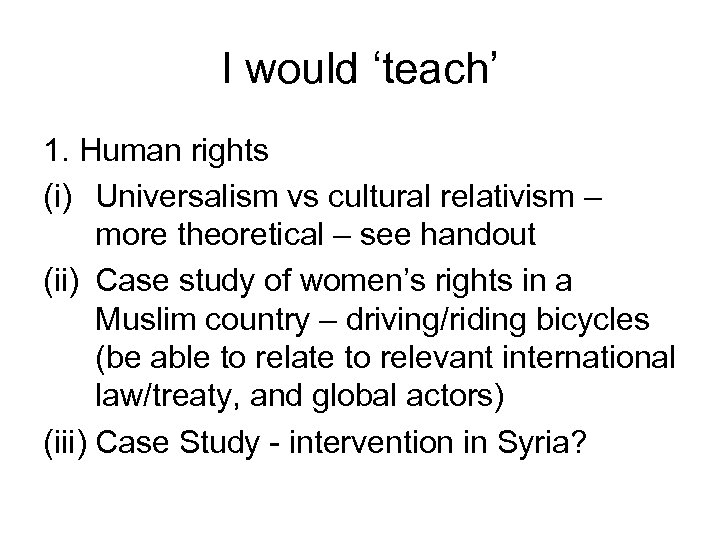
I would ‘teach’ 1. Human rights (i) Universalism vs cultural relativism – more theoretical – see handout (ii) Case study of women’s rights in a Muslim country – driving/riding bicycles (be able to relate to relevant international law/treaty, and global actors) (iii) Case Study - intervention in Syria?
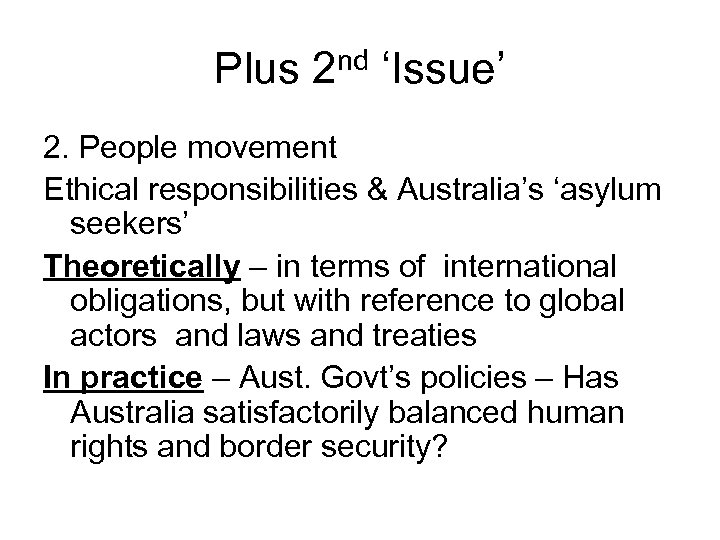
Plus 2 nd ‘Issue’ 2. People movement Ethical responsibilities & Australia’s ‘asylum seekers’ Theoretically – in terms of international obligations, but with reference to global actors and laws and treaties In practice – Aust. Govt’s policies – Has Australia satisfactorily balanced human rights and border security?
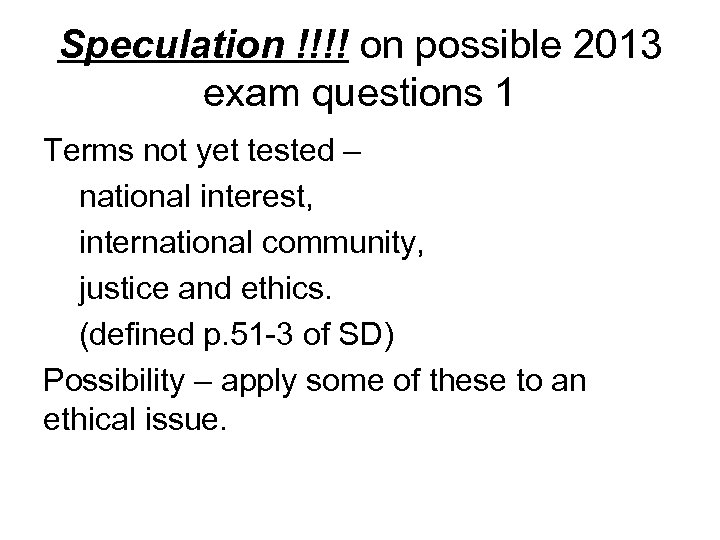
Speculation !!!! on possible 2013 exam questions 1 Terms not yet tested – national interest, international community, justice and ethics. (defined p. 51 -3 of SD) Possibility – apply some of these to an ethical issue.
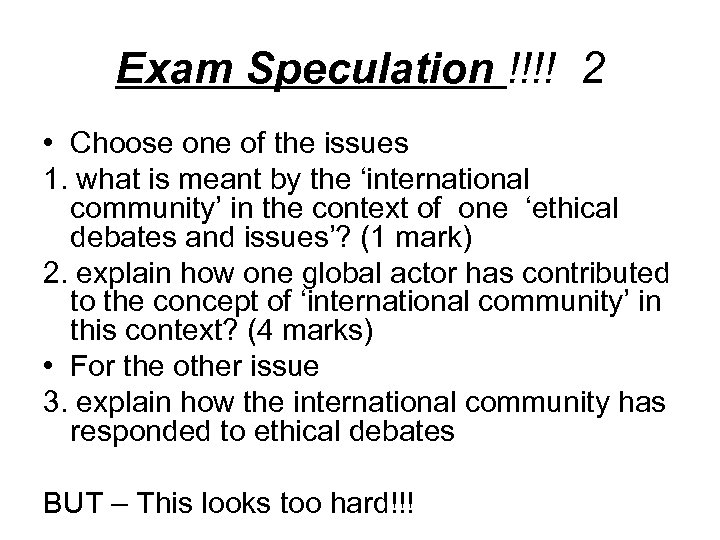
Exam Speculation !!!! 2 • Choose one of the issues 1. what is meant by the ‘international community’ in the context of one ‘ethical debates and issues’? (1 mark) 2. explain how one global actor has contributed to the concept of ‘international community’ in this context? (4 marks) • For the other issue 3. explain how the international community has responded to ethical debates BUT – This looks too hard!!!
A useful Case Study? Should there be intervention in Syria? • See • Dexter Filkins, ‘The Thin Red Line’, New Yorker 13 May 2013 (in your PD pack) and available at: http: //www. newyorker. com/reporting/2013/ 05/13/130513 fa_fact_filkins
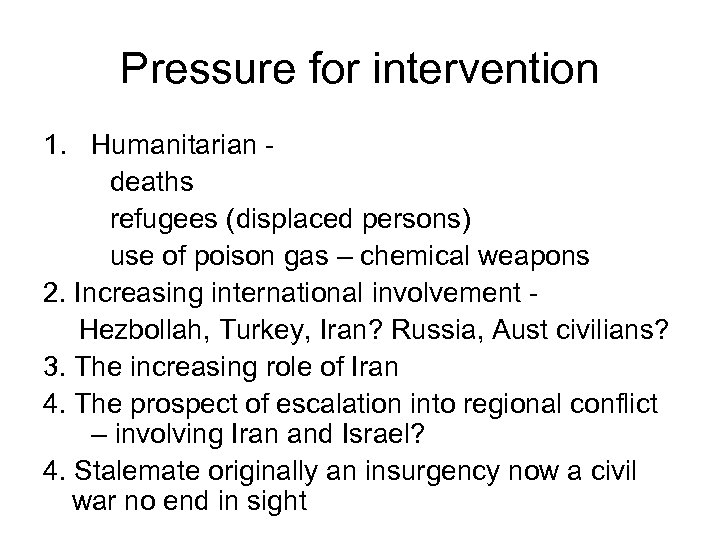
Pressure for intervention 1. Humanitarian deaths refugees (displaced persons) use of poison gas – chemical weapons 2. Increasing international involvement Hezbollah, Turkey, Iran? Russia, Aust civilians? 3. The increasing role of Iran 4. The prospect of escalation into regional conflict – involving Iran and Israel? 4. Stalemate originally an insurgency now a civil war no end in sight
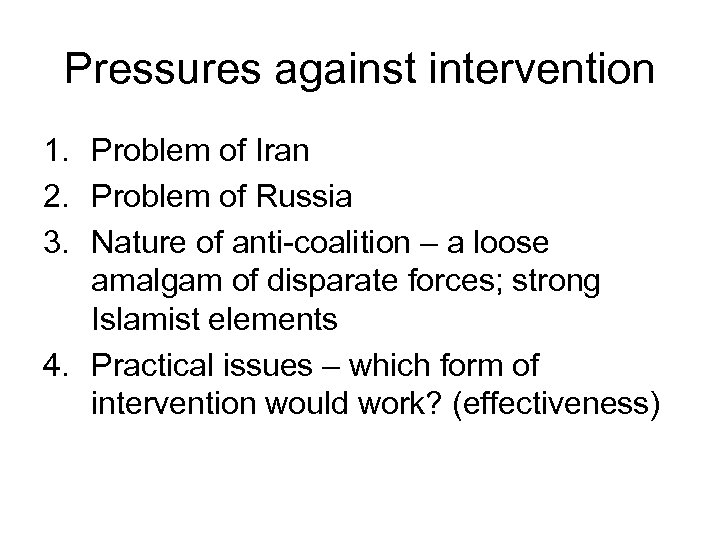
Pressures against intervention 1. Problem of Iran 2. Problem of Russia 3. Nature of anti-coalition – a loose amalgam of disparate forces; strong Islamist elements 4. Practical issues – which form of intervention would work? (effectiveness)
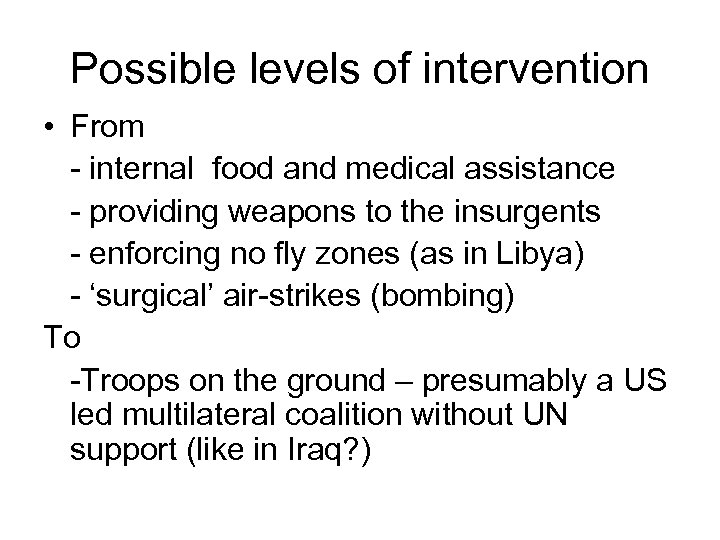
Possible levels of intervention • From - internal food and medical assistance - providing weapons to the insurgents - enforcing no fly zones (as in Libya) - ‘surgical’ air-strikes (bombing) To -Troops on the ground – presumably a US led multilateral coalition without UN support (like in Iraq? )
The problems of intervention 1. UN intervention unlikely given Russia’s position – naval base; arms to govt. 2. US reluctant withdrawing from Afghanistan problem of involving Iran and Israel 3. Practical (pragmatic) problems – see Filkins article.
Responsibility to Protect • How is this an ‘ethical issue’? • Value Priority – the intention is to prioritise internal human rights over State sovereignty. • This will further compromise significant UN principle since 1945 – right of state sovereignty.
R 2 P (i) • An extension of ‘Right to intervene’ • Made necessary because of mass atrocities since 1970 s - Cambodia, Bosnia, Rwanda – mainly civilians • Thus need to shift the debate from security of the state (the original basis of the UN) to security of the community and the individual
R 2 P (ii) Why failure of international community? • Fundamental original UN assumptions importance of the state and maintenance of state sovereignty • Institutional weaknesses of UN – GA and SC
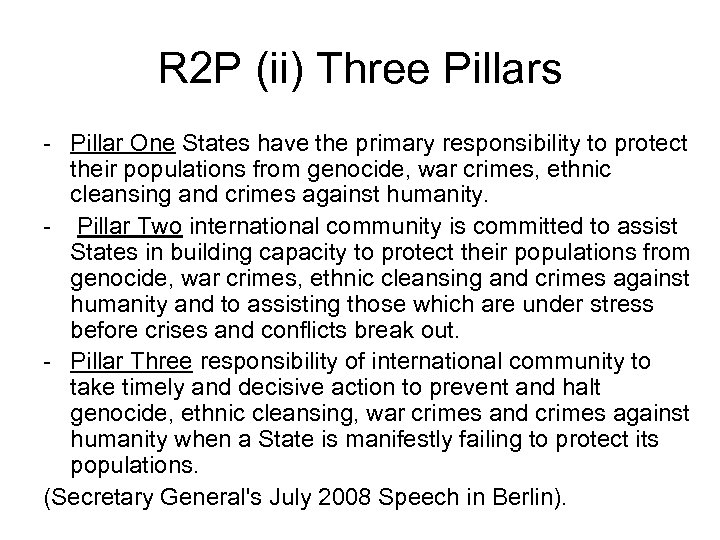
R 2 P (ii) Three Pillars - Pillar One States have the primary responsibility to protect their populations from genocide, war crimes, ethnic cleansing and crimes against humanity. - Pillar Two international community is committed to assist States in building capacity to protect their populations from genocide, war crimes, ethnic cleansing and crimes against humanity and to assisting those which are under stress before crises and conflicts break out. - Pillar Three responsibility of international community to take timely and decisive action to prevent and halt genocide, ethnic cleansing, war crimes and crimes against humanity when a State is manifestly failing to protect its populations. (Secretary General's July 2008 Speech in Berlin).
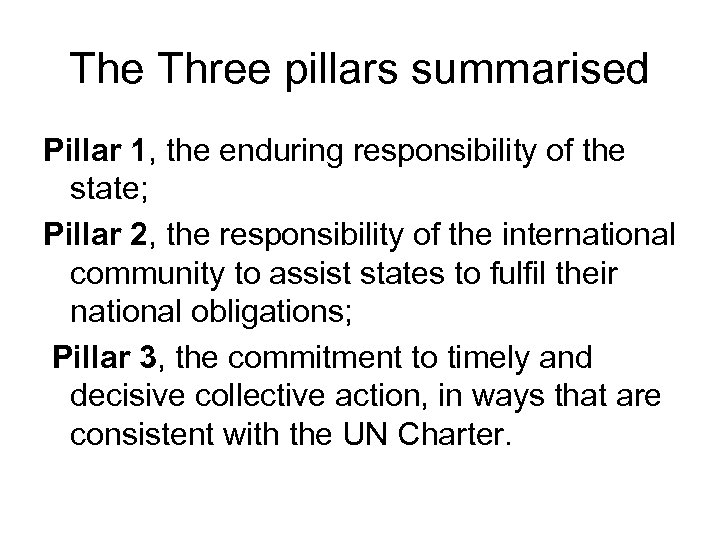
The Three pillars summarised Pillar 1, the enduring responsibility of the state; Pillar 2, the responsibility of the international community to assist states to fulfil their national obligations; Pillar 3, the commitment to timely and decisive collective action, in ways that are consistent with the UN Charter.
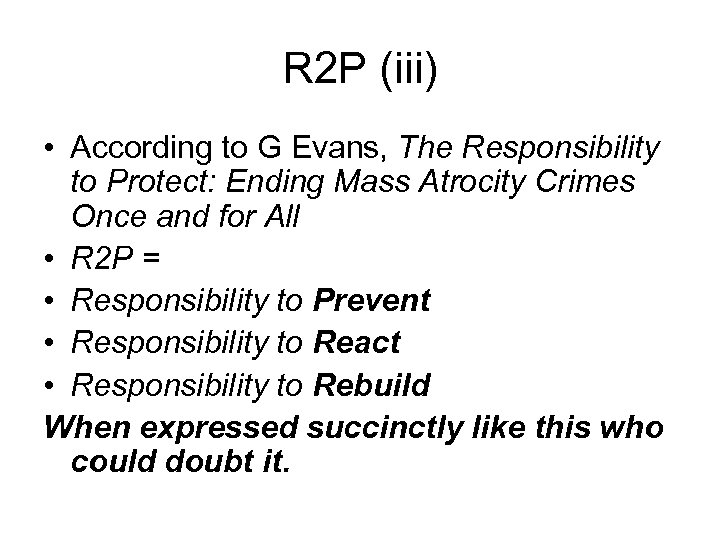
R 2 P (iii) • According to G Evans, The Responsibility to Protect: Ending Mass Atrocity Crimes Once and for All • R 2 P = • Responsibility to Prevent • Responsibility to React • Responsibility to Rebuild When expressed succinctly like this who could doubt it.
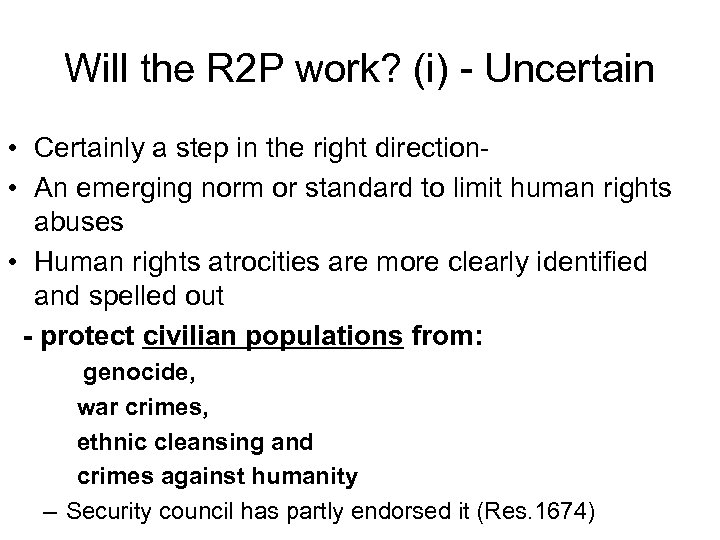
Will the R 2 P work? (i) - Uncertain • Certainly a step in the right direction • An emerging norm or standard to limit human rights abuses • Human rights atrocities are more clearly identified and spelled out - protect civilian populations from: genocide, war crimes, ethnic cleansing and crimes against humanity – Security council has partly endorsed it (Res. 1674)
Responsibility to Protect • Security Council Resolution 1674, adopted on 28 April 2006, "reaffirms the provisions of paragraphs 138 and 139 of the 2005 World Summit Outcome Document regarding the responsibility to protect populations from genocide, war crimes, ethnic cleansing and crimes against humanity". [15] The resolution commits the Council to take action to protect civilians in an armed conflict. The Security Council's role in implementing the responsibility to protect is not limited to taking collective action against mass atrocities (pillar three of the responsibility to protect), but it can also make important contributions to structural and operational prevention of genocide, war, crimes, ethnic cleansing, and crimes against humanity (pillar two of the responsibility to protect). [16]
Will the R 2 P work? (ii) BUT (i) Only an evolving doctrine lacking full secure and accepted legal status – eg Jan. 2007, China and Russia vetoed a resolution on Burma * didn’t pose a threat to international peace and security in the region, * the internal affairs of the state did not have a place within the Security Council * problems in Burma should be taken up by the Human Rights Council.
Will the R 2 P work? (iii) No agreement on ‘when a State is manifestly failing to protect its populations. ’ and no way to secure consensus on this (iv) Implementation of action by SC still limited by willingness of states to commit troops and resources – ie by political factors (v) Still controversial.
Скачать презентацию Ethical Issues and Debates some approaches Ron Anderson
4ed53950231740775dd6822aec27d390.ppt