


 Скачать презентацию Ethanol the local fuel green and clean
00ee2d612f8277882197d8b5ab2d7d19.ppt
- Количество слайдов: 25
 Ethanol – the local fuel…. green and clean BIOFUELS: LEGAL AND POLICY DIMENSIONS WORKSHOP June 17, 2010 Ken Field, Chairman, Green. Field Ethanol www. greenfieldethanol. com
 Overview 1. Why do we need an alternative to gasoline? 2. What is Canada doing? 3. Why do solar and wind have nothing to do with solving our challenges with fossil fuels in the transportation sector? If you want to replace gasoline you need ethanol and biodiesel. 4. Why ethanol? 1. Understanding that ethanol reduces every tailpipe emission compared to gasoline 2. Understanding that ethanol reduces GHG emissions by 62% 3. Energy security in Canada 4. Farmer prosperity from ethanol production 5. Economic studies showing the jobs and economic activity created by ethanol. 6. Understanding that ethanol does not interfere with our food supply 7. Understanding that ethanol has a positive energy balance 5. The future. Canada already has two world leaders in cellulosic ethanol – IOGEN and Green. Field. What are they doing? · Commercial scale and demonstration cellulosic ethanol plants · Biorefineries 6. Will biofuels really make a difference? 7. What are the obstacles for success. What policy mechanisms are needed to realize biofuel’s full potential? 1
 Considering fuels for a balanced Energy Strategy must address the impact on…. • Health • Environment • Economy • Security 2
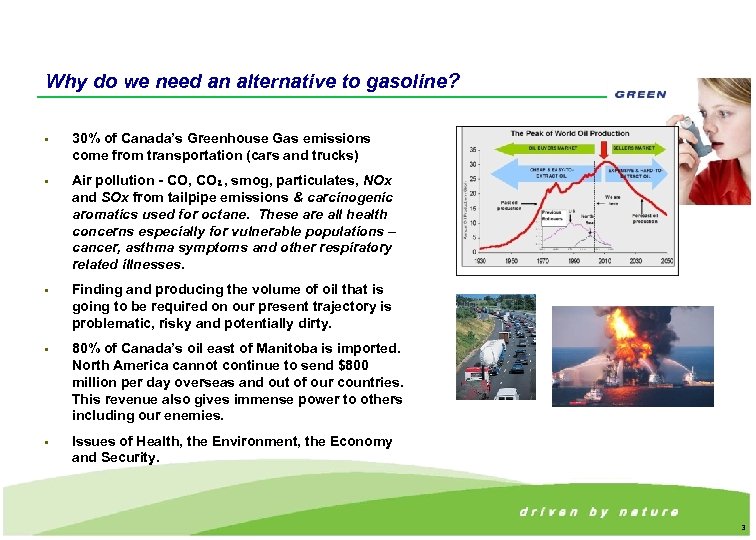 Why do we need an alternative to gasoline? • 30% of Canada’s Greenhouse Gas emissions come from transportation (cars and trucks) • Air pollution - CO, CO₂, smog, particulates, NOx and SOx from tailpipe emissions & carcinogenic aromatics used for octane. These are all health concerns especially for vulnerable populations – cancer, asthma symptoms and other respiratory related illnesses. • Finding and producing the volume of oil that is going to be required on our present trajectory is problematic, risky and potentially dirty. • 80% of Canada’s oil east of Manitoba is imported. North America cannot continue to send $800 million per day overseas and out of our countries. This revenue also gives immense power to others including our enemies. • Issues of Health, the Environment, the Economy and Security. 3
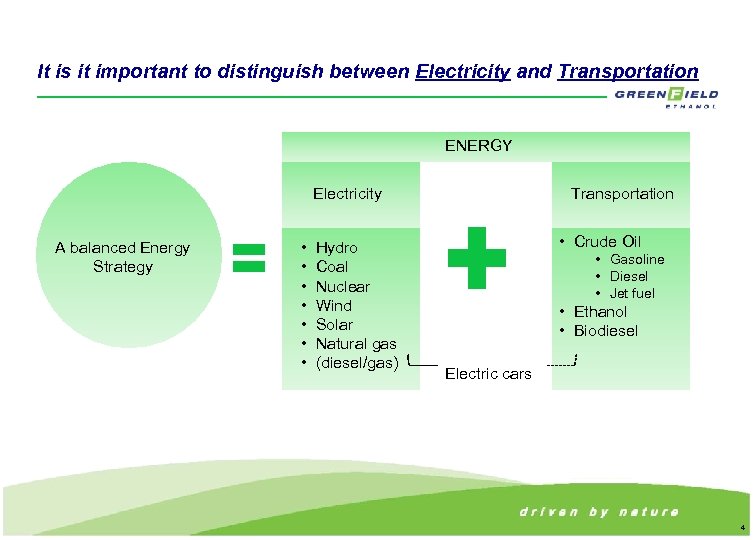 It is it important to distinguish between Electricity and Transportation ENERGY Electricity A balanced Energy Strategy • • Hydro Coal Nuclear Wind Solar Natural gas (diesel/gas) Transportation • Crude Oil • Gasoline • Diesel • Jet fuel • Ethanol • Biodiesel Electric cars 4
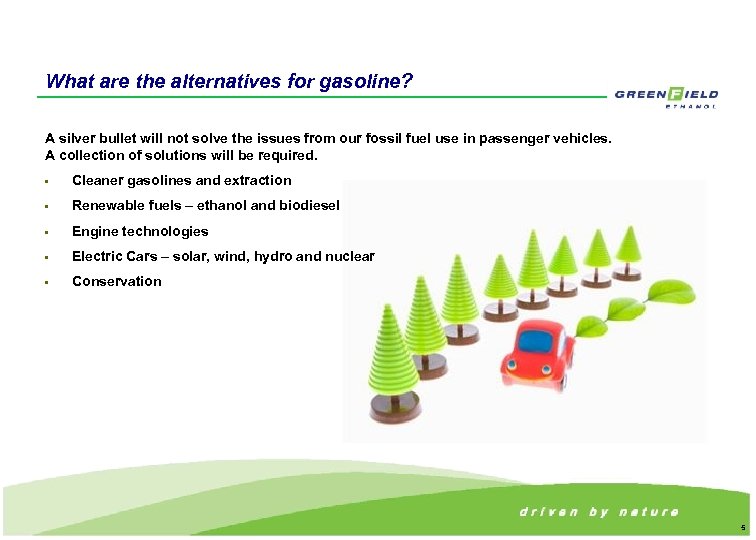 What are the alternatives for gasoline? A silver bullet will not solve the issues from our fossil fuel use in passenger vehicles. A collection of solutions will be required. • Cleaner gasolines and extraction • Renewable fuels – ethanol and biodiesel • Engine technologies • Electric Cars – solar, wind, hydro and nuclear • Conservation 5
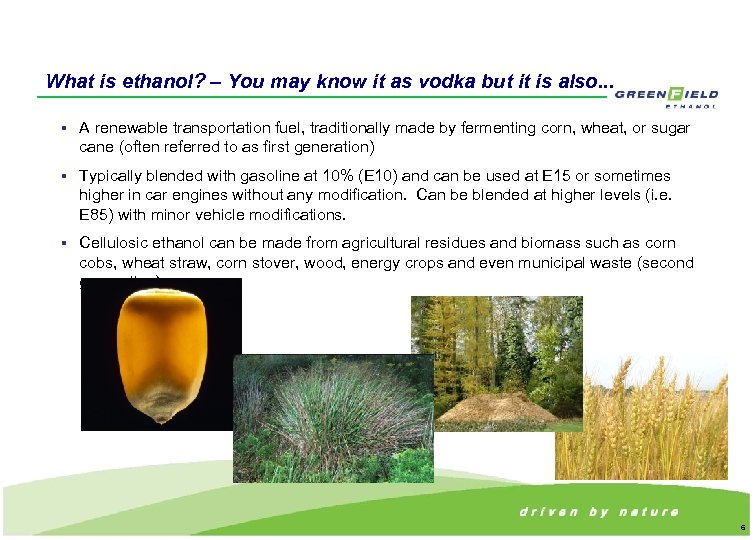 What is ethanol? – You may know it as vodka but it is also. . . § A renewable transportation fuel, traditionally made by fermenting corn, wheat, or sugar cane (often referred to as first generation) § Typically blended with gasoline at 10% (E 10) and can be used at E 15 or sometimes higher in car engines without any modification. Can be blended at higher levels (i. e. E 85) with minor vehicle modifications. § Cellulosic ethanol can be made from agricultural residues and biomass such as corn cobs, wheat straw, corn stover, wood, energy crops and even municipal waste (second generation). 6
 Ethanol’s benefits and qualities for Ontario 1. Green House Gas (GHG) reduction & lower environmental impact 2. Pollution reduction & clean octane enhancement 3. Energy Security 4. Farmer prosperity • • 5. Boost farm gate income A year round industrial market for domestic corn growers Jobs, economic activity, and economic benefit to the Ontario 7
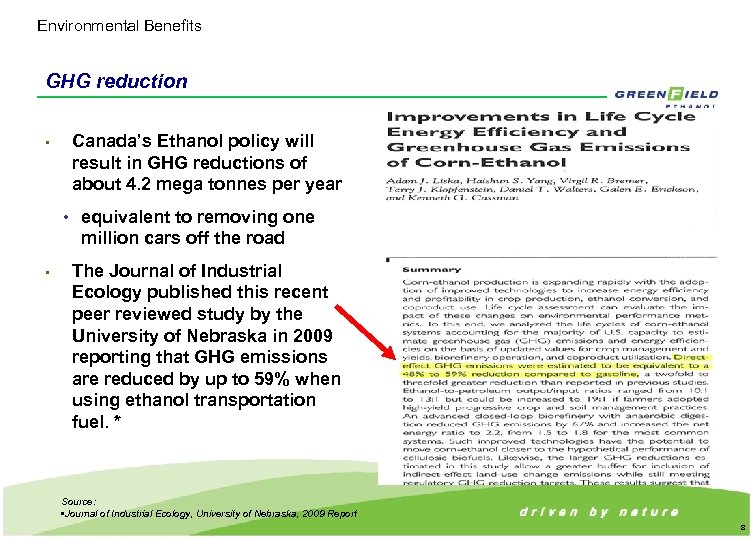 Environmental Benefits GHG reduction • Canada’s Ethanol policy will result in GHG reductions of about 4. 2 mega tonnes per year • equivalent to removing one million cars off the road • The Journal of Industrial Ecology published this recent peer reviewed study by the University of Nebraska in 2009 reporting that GHG emissions are reduced by up to 59% when using ethanol transportation fuel. * Source: • Journal of Industrial Ecology, University of Nebraska, 2009 Report 8
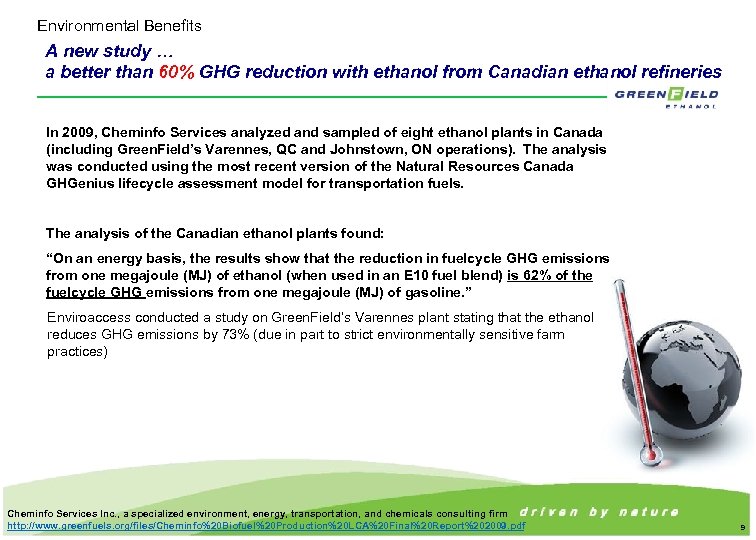 Environmental Benefits A new study … a better than 60% GHG reduction with ethanol from Canadian ethanol refineries In 2009, Cheminfo Services analyzed and sampled of eight ethanol plants in Canada (including Green. Field’s Varennes, QC and Johnstown, ON operations). The analysis was conducted using the most recent version of the Natural Resources Canada GHGenius lifecycle assessment model for transportation fuels. The analysis of the Canadian ethanol plants found: “On an energy basis, the results show that the reduction in fuelcycle GHG emissions from one megajoule (MJ) of ethanol (when used in an E 10 fuel blend) is 62% of the fuelcycle GHG emissions from one megajoule (MJ) of gasoline. ” Enviroaccess conducted a study on Green. Field’s Varennes plant stating that the ethanol reduces GHG emissions by 73% (due in part to strict environmentally sensitive farm practices) Cheminfo Services Inc. , a specialized environment, energy, transportation, and chemicals consulting firm http: //www. greenfuels. org/files/Cheminfo%20 Biofuel%20 Production%20 LCA%20 Final%20 Report%202009. pdf 9
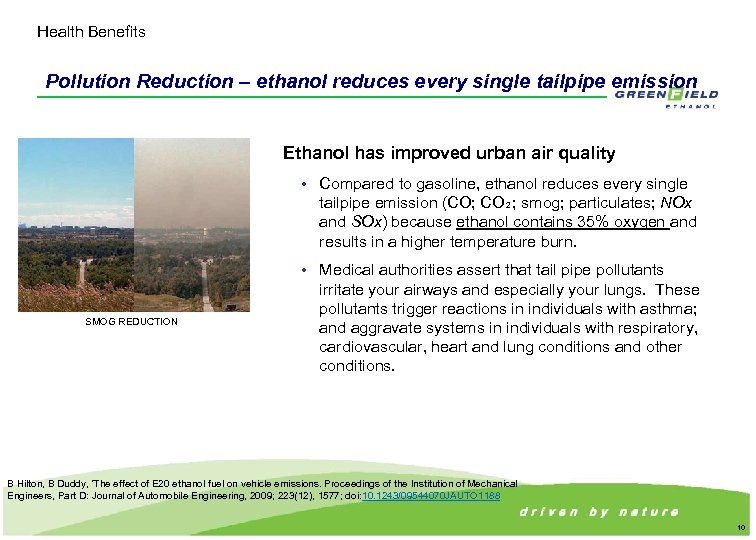 Health Benefits Pollution Reduction – ethanol reduces every single tailpipe emission Ethanol has improved urban air quality • Compared to gasoline, ethanol reduces every single tailpipe emission (CO; CO₂; smog; particulates; NOx and SOx) because ethanol contains 35% oxygen and results in a higher temperature burn. • Medical authorities assert that tail pipe pollutants irritate your airways and especially your lungs. These pollutants trigger reactions in individuals with asthma; and aggravate systems in individuals with respiratory, cardiovascular, heart and lung conditions and other conditions. SMOG REDUCTION B Hilton, B Duddy, 'The effect of E 20 ethanol fuel on vehicle emissions. Proceedings of the Institution of Mechanical Engineers, Part D: Journal of Automobile Engineering, 2009; 223(12), 1577; doi: 0. 1243/09544070 JAUTO 1188 1 10
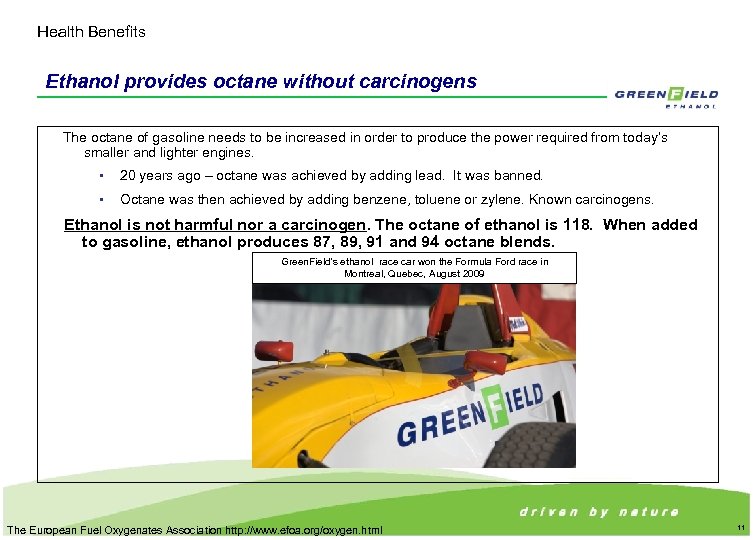 Health Benefits Ethanol provides octane without carcinogens The octane of gasoline needs to be increased in order to produce the power required from today’s smaller and lighter engines. • 20 years ago – octane was achieved by adding lead. It was banned. • Octane was then achieved by adding benzene, toluene or zylene. Known carcinogens. Ethanol is not harmful nor a carcinogen. The octane of ethanol is 118. When added to gasoline, ethanol produces 87, 89, 91 and 94 octane blends. Green. Field’s ethanol race car won the Formula Ford race in Montreal, Quebec, August 2009 The European Fuel Oxygenates Association http: //www. efoa. org/oxygen. html 11
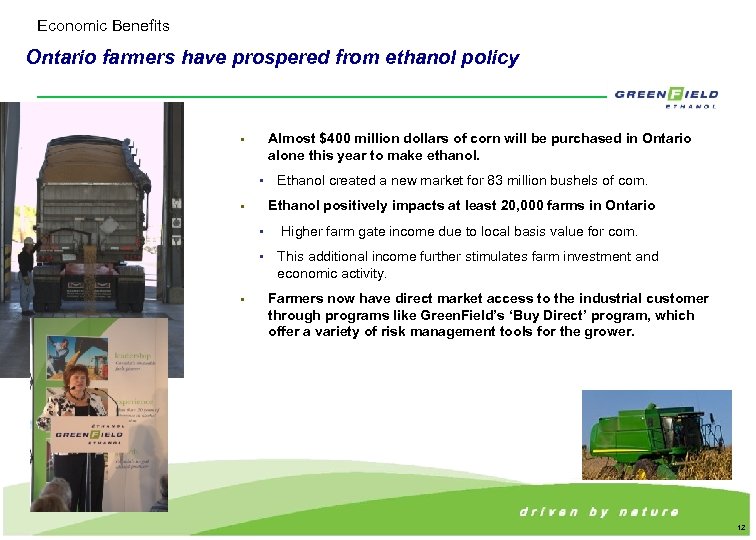 Economic Benefits Ontario farmers have prospered from ethanol policy Almost $400 million dollars of corn will be purchased in Ontario alone this year to make ethanol. • • Ethanol created a new market for 83 million bushels of corn. Ethanol positively impacts at least 20, 000 farms in Ontario • • Higher farm gate income due to local basis value for corn. This additional income further stimulates farm investment and economic activity. Farmers now have direct market access to the industrial customer through programs like Green. Field’s ‘Buy Direct’ program, which offer a variety of risk management tools for the grower. 12
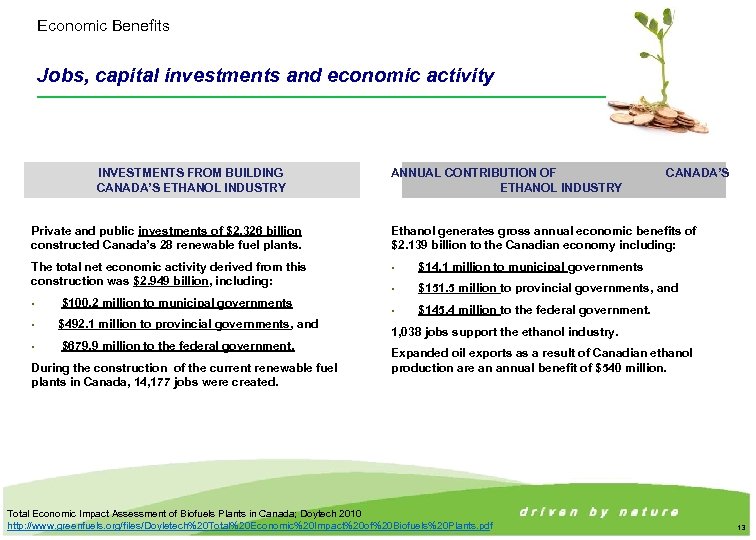 Economic Benefits Jobs, capital investments and economic activity INVESTMENTS FROM BUILDING CANADA’S ETHANOL INDUSTRY ANNUAL CONTRIBUTION OF ETHANOL INDUSTRY CANADA’S Private and public investments of $2. 326 billion constructed Canada’s 28 renewable fuel plants. Ethanol generates gross annual economic benefits of $2. 139 billion to the Canadian economy including: The total net economic activity derived from this construction was $2. 949 billion, including: • $14. 1 million to municipal governments • $151. 5 million to provincial governments, and • $145. 4 million to the federal government. • • • $100. 2 million to municipal governments $492. 1 million to provincial governments, and $679. 9 million to the federal government. During the construction of the current renewable fuel plants in Canada, 14, 177 jobs were created. 1, 038 jobs support the ethanol industry. Expanded oil exports as a result of Canadian ethanol production are an annual benefit of $540 million. Total Economic Impact Assessment of Biofuels Plants in Canada; Doytech 2010 http: //www. greenfuels. org/files/Doyletech%20 Total%20 Economic%20 Impact%20 of%20 Biofuels%20 Plants. pdf 13
 Economic Benefits An example Green. Field’s Johnstown, Ontario ethanol refinery …. creating economic activity In 2010, Doyletech* conducted an economic impact assessment on a Green. Field’s Ethanol refinery in Johnstown with a capacity to produce 200 million litres per year. The annual economic results are as follows: • A total of 69 person-years of employment is created each year from a refinery. • There is an annual increase in net economic spending in the local community of $162 million coming from the plant’s operations. This is over and above the net revenues, after costs, obtained by the plant for its ethanol and DDG production and includes the increase in local corn basis. • There is an annual benefit to the Municipal government of $771, 680 from the plant’s property taxes and other improved Municipal tax collections, lower welfare costs, and indirect employment benefits. • There is an annual benefit to the Provincial government of $ 8, 179, 720 from enhanced PST collections and income tax, lower welfare costs, and indirect spending. • There is an annual benefit to the Federal government of $ 6, 657, 530 from improved GST collection and income tax, lower EI spending and corporate tax. *Doyletech is a recognized leader in economic impact assessment across industries and programs. 14
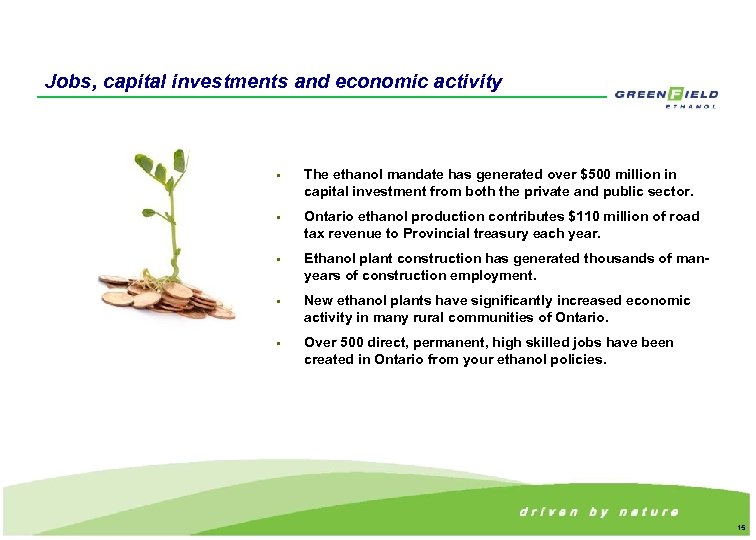 Jobs, capital investments and economic activity • The ethanol mandate has generated over $500 million in capital investment from both the private and public sector. • Ontario ethanol production contributes $110 million of road tax revenue to Provincial treasury each year. • Ethanol plant construction has generated thousands of manyears of construction employment. • New ethanol plants have significantly increased economic activity in many rural communities of Ontario. • Over 500 direct, permanent, high skilled jobs have been created in Ontario from your ethanol policies. 15
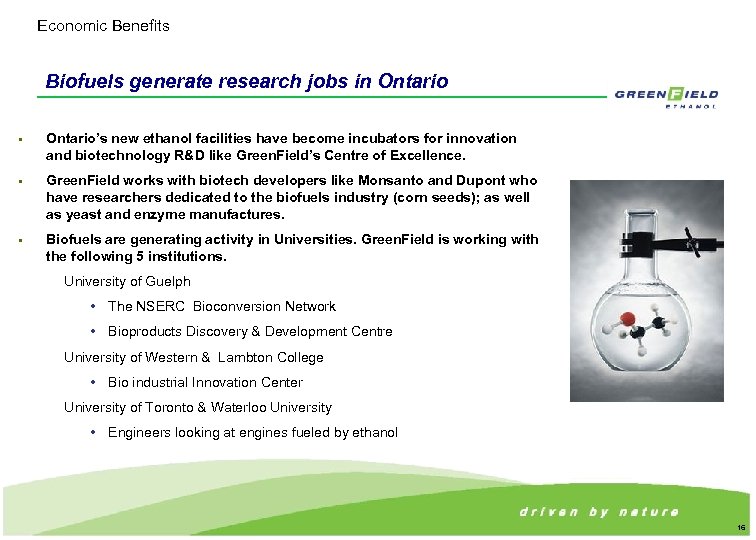 Economic Benefits Biofuels generate research jobs in Ontario • Ontario’s new ethanol facilities have become incubators for innovation and biotechnology R&D like Green. Field’s Centre of Excellence. • Green. Field works with biotech developers like Monsanto and Dupont who have researchers dedicated to the biofuels industry (corn seeds); as well as yeast and enzyme manufactures. • Biofuels are generating activity in Universities. Green. Field is working with the following 5 institutions. University of Guelph • The NSERC Bioconversion Network • Bioproducts Discovery & Development Centre University of Western & Lambton College • Bio industrial Innovation Center University of Toronto & Waterloo University • Engineers looking at engines fueled by ethanol 16
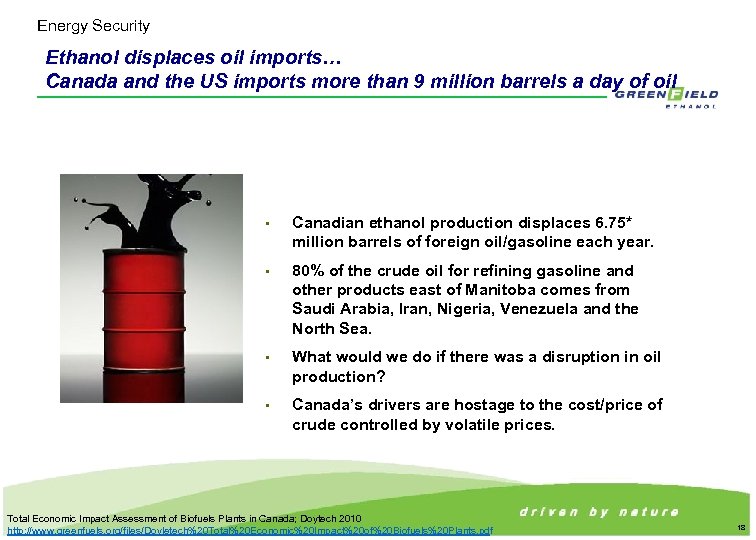 Energy Security Ethanol displaces oil imports… Canada and the US imports more than 9 million barrels a day of oil • Canadian ethanol production displaces 6. 75* million barrels of foreign oil/gasoline each year. • 80% of the crude oil for refining gasoline and other products east of Manitoba comes from Saudi Arabia, Iran, Nigeria, Venezuela and the North Sea. • What would we do if there was a disruption in oil production? • Canada’s drivers are hostage to the cost/price of crude controlled by volatile prices. Total Economic Impact Assessment of Biofuels Plants in Canada; Doytech 2010 http: //www. greenfuels. org/files/Doyletech%20 Total%20 Economic%20 Impact%20 of%20 Biofuels%20 Plants. pdf 18
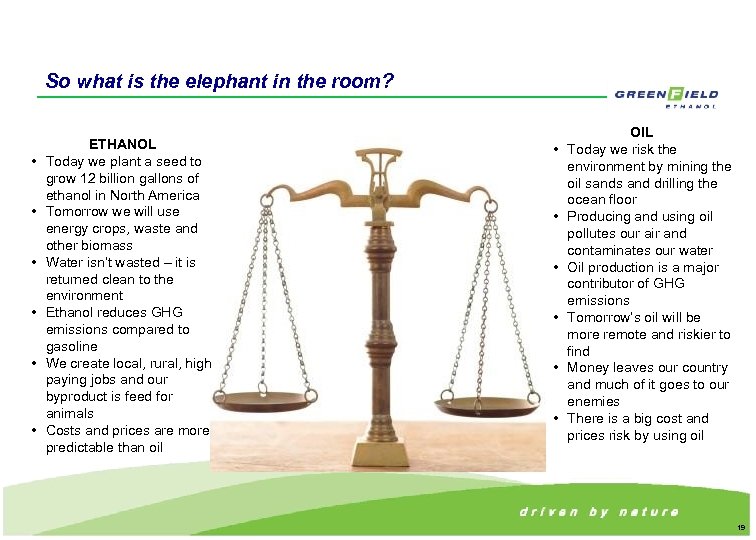 So what is the elephant in the room? • • • ETHANOL Today we plant a seed to grow 12 billion gallons of ethanol in North America Tomorrow we will use energy crops, waste and other biomass Water isn’t wasted – it is returned clean to the environment Ethanol reduces GHG emissions compared to gasoline We create local, rural, high paying jobs and our byproduct is feed for animals Costs and prices are more predictable than oil • • • OIL Today we risk the environment by mining the oil sands and drilling the ocean floor Producing and using oil pollutes our air and contaminates our water Oil production is a major contributor of GHG emissions Tomorrow’s oil will be more remote and riskier to find Money leaves our country and much of it goes to our enemies There is a big cost and prices risk by using oil 19
 14 billion gallons of ethanol will be produced in Canada and the US in 2010 – This will grow to 36 billon gallons by 2020 20
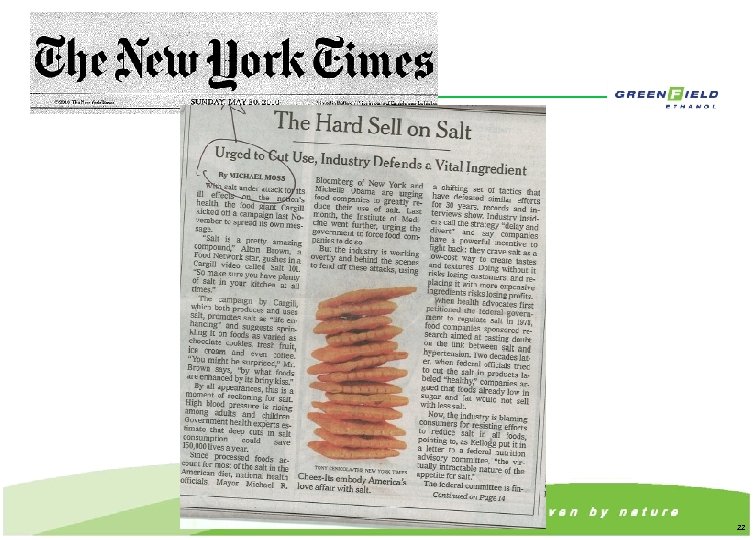
 So, lets deal with the bad things you have heard about ethanol 1. Food versus Fuel 2. Energy Balance 21
 22
22
 Food for Fuel is a myth. What’s the TRUTH? Facts: • The corn used in the production of ethanol is not corn for human consumption; it is industrial corn. • Industrial corn production in North America is now slightly less than 14 billion bushels per year. • After growing and manufacturing 12 billion gallons of ethanol; making tonnes of high fructose corn syrup; feeding cows, chickens, turkeys and fish -- 1. 9 billion bushels of corn are expected to be exported in 2010, leaving a surplus of 1. 8 billion bushels of corn. • There is no shortage of corn (If you did not make ethanol, what would you do with all that corn? ) • In 2010, the UK government conducted a study and found: “[All] available evidence suggests that biofuels had a relatively small contribution to the 2008 spike in agricultural commodity prices. Whilst commodity prices have fallen steeply from their peaks in 2008 biofuel demand has remained steady – indicating that the causal link from biofuel demand to shortterm crop prices is still relatively weak. ” Sources: • Ethanol Across America White Paper, Rethinking the Value of Con Ethanol Co-Products in Lifecycle Assessments, ICM Inc. • Acreage, NASS, USDA, June, 2009 • World Agriculture Supply and Demand Estimates, USDA, July 10, 2009 23
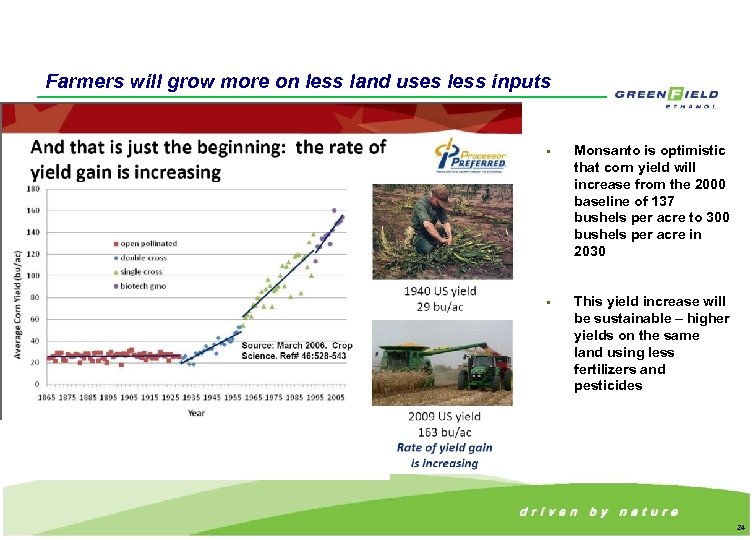 Farmers will grow more on less land uses less inputs • Monsanto is optimistic that corn yield will increase from the 2000 baseline of 137 bushels per acre to 300 bushels per acre in 2030 • This yield increase will be sustainable – higher yields on the same land using less fertilizers and pesticides 24
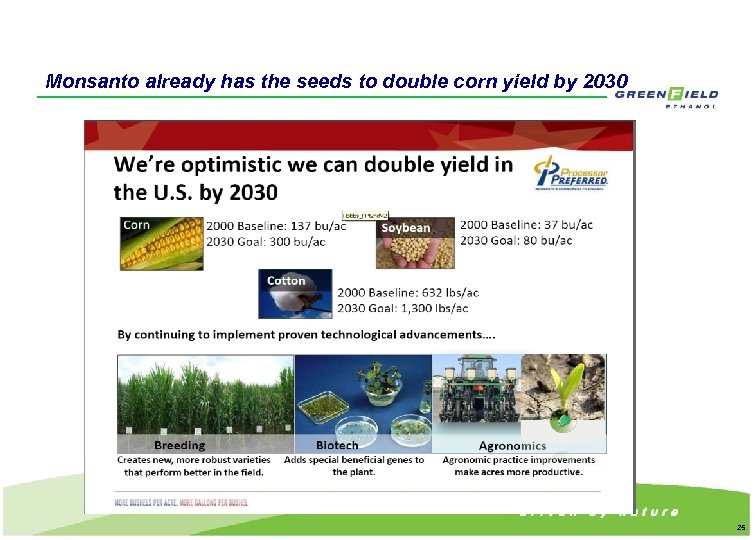 Monsanto already has the seeds to double corn yield by 2030 25