


 Скачать презентацию eteorology v Meteorology is the study of the
36dc2c0ed26654becf2fb790b92dee5f.ppt
- Количество слайдов: 22
 eteorology v Meteorology is the study of the atmosphere and the interaction between the atmosphere and the land, ocean, and life Ø The physics, chemistry, and unique processes of Earth’s atmosphere are explored in great detail by meteorologists • Meteorologists try to completely understand the atmosphere, so they can predict how it is going to behave
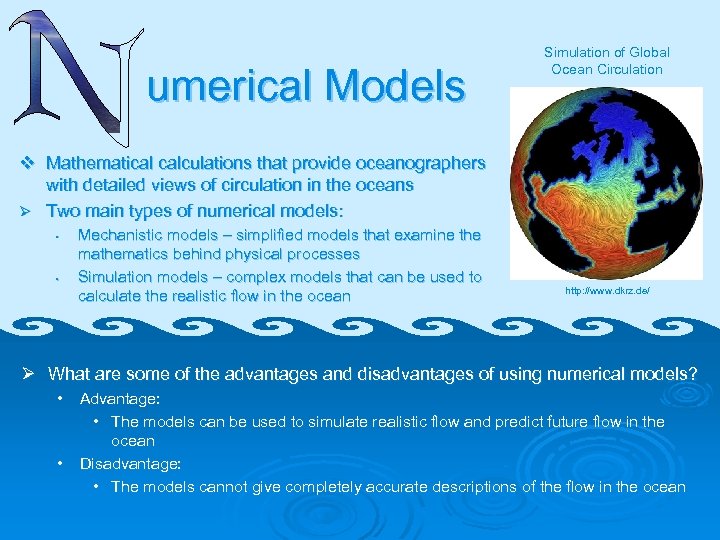 umerical Models Simulation of Global Ocean Circulation v Mathematical calculations that provide oceanographers with detailed views of circulation in the oceans Ø Two main types of numerical models: • • Mechanistic models – simplified models that examine the mathematics behind physical processes Simulation models – complex models that can be used to calculate the realistic flow in the ocean http: //www. dkrz. de/ Ø What are some of the advantages and disadvantages of using numerical models? • Advantage: • The models can be used to simulate realistic flow and predict future flow in the ocean • Disadvantage: • The models cannot give completely accurate descriptions of the flow in the ocean
 cean Fast Fact: The average depth of the ocean is 3. 7 km (about 2 miles) http: //www. ngdc. noaa. gov/ v A large body of salt water Ø Millions of years ago Earth’s surface was very hot and all the water boiled away • Volcanoes released large amounts of steam into the atmosphere • As Earth cooled, the steam changed to water vapor, and condensed to raindrops • Rain fell thousands of years filling all the cracks on Earth with ocean water Ø What impact does air-sea interaction have on Earth? Did you know? The pressure at the deepest point in the ocean is equivalent to 1 person trying to hold 50 jumbo jets • The ocean constantly interacts with the atmosphere, exchanging heat, moisture, and carbon dioxide (CO 2) • The air-sea interaction drives our weather Fast Fact: patterns and influences the slowly 71% of Earth’s occurring but dramatic changes in surface is our climate covered by oceans
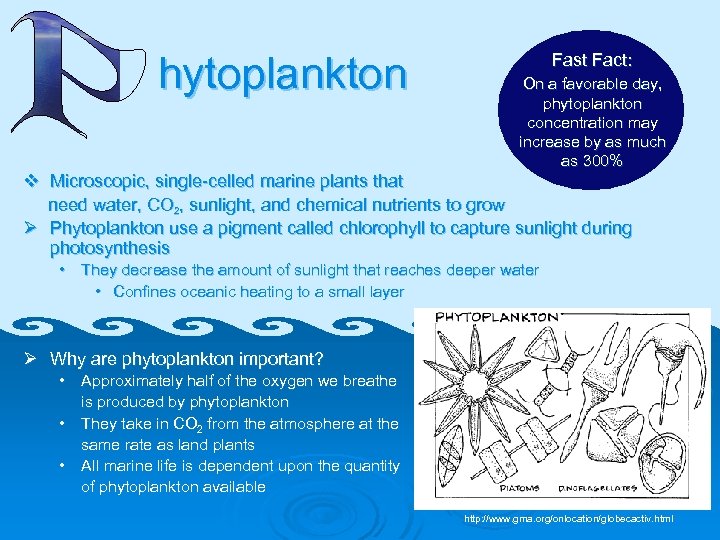 hytoplankton Fast Fact: On a favorable day, phytoplankton concentration may increase by as much as 300% v Microscopic, single-celled marine plants that need water, CO 2, sunlight, and chemical nutrients to grow Ø Phytoplankton use a pigment called chlorophyll to capture sunlight during photosynthesis • They decrease the amount of sunlight that reaches deeper water • Confines oceanic heating to a small layer Ø Why are phytoplankton important? • Approximately half of the oxygen we breathe is produced by phytoplankton • They take in CO 2 from the atmosphere at the same rate as land plants • All marine life is dependent upon the quantity of phytoplankton available http: //www. gma. org/onlocation/globecactiv. html
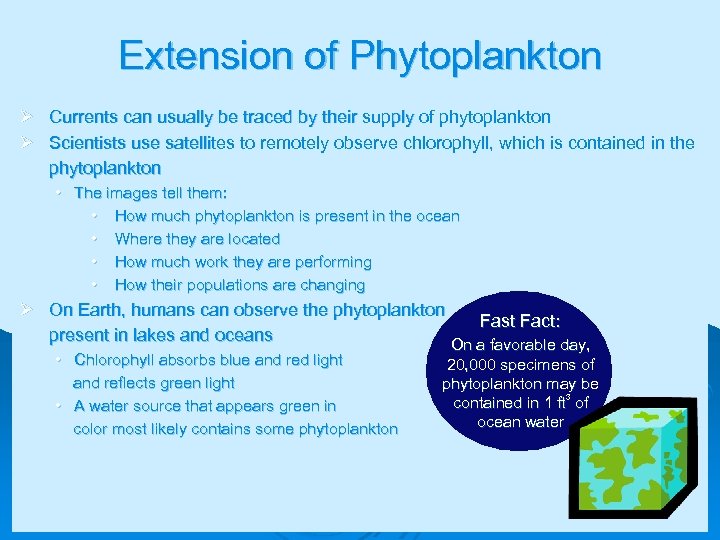 Extension of Phytoplankton Ø Currents can usually be traced by their supply of phytoplankton Ø Scientists use satellites to remotely observe chlorophyll, which is contained in the phytoplankton • The images tell them: • How much phytoplankton is present in the ocean • Where they are located • How much work they are performing • How their populations are changing Ø On Earth, humans can observe the phytoplankton Fast Fact: present in lakes and oceans On a favorable day, • Chlorophyll absorbs blue and red light and reflects green light • A water source that appears green in color most likely contains some phytoplankton 20, 000 specimens of phytoplankton may be 3 contained in 1 ft of ocean water
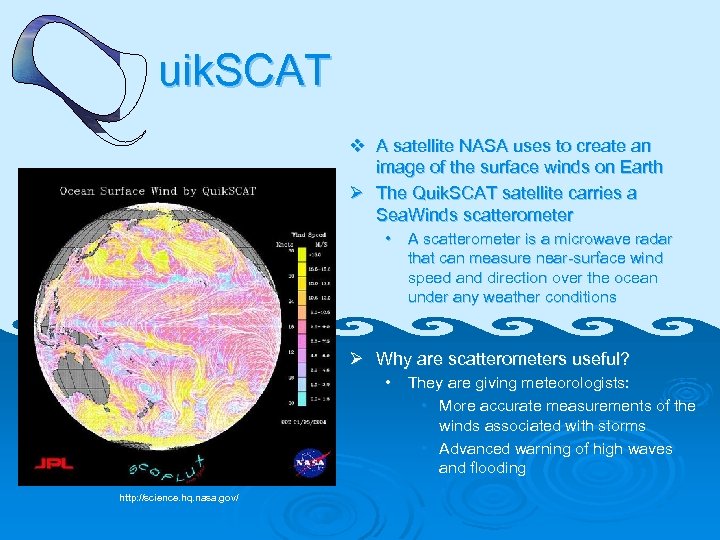 uik. SCAT v A satellite NASA uses to create an image of the surface winds on Earth Ø The Quik. SCAT satellite carries a Sea. Winds scatterometer • A scatterometer is a microwave radar that can measure near-surface wind speed and direction over the ocean under any weather conditions Ø Why are scatterometers useful? • They are giving meteorologists: • More accurate measurements of the winds associated with storms • Advanced warning of high waves and flooding http: //science. hq. nasa. gov/
 ain http: //lennthompson. typepad. com/lenndevours/miscellaneous_sips/index. html v Precipitation that falls from clouds toward Earth’s surface Ø Rain is an important part of the climate • The latent heat released into the atmosphere upon the formation of raindrops is a significant form of energy that drives circulation in the atmosphere Ø Why do meteorologists, oceanographers, and climate scientists find it important to measure rainfall patterns? • Scientists suspect that after rainfall the layers of fresh water at the surface of the ocean affect circulation in the ocean Did you know? • Rainfall appears to calm the seas Falling drops of • Scientists question impact of rainfall on ocean damping rain are not tearshaped
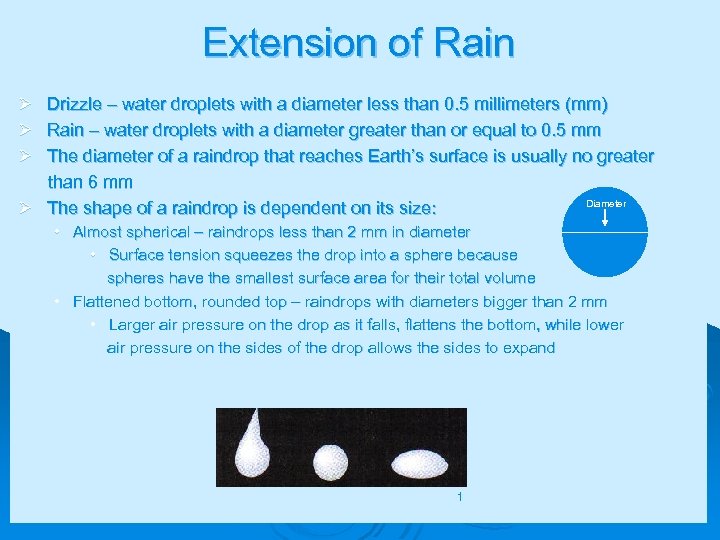 Extension of Rain Ø Drizzle – water droplets with a diameter less than 0. 5 millimeters (mm) Ø Rain – water droplets with a diameter greater than or equal to 0. 5 mm Ø The diameter of a raindrop that reaches Earth’s surface is usually no greater than 6 mm Diameter Ø The shape of a raindrop is dependent on its size: • Almost spherical – raindrops less than 2 mm in diameter • Surface tension squeezes the drop into a sphere because spheres have the smallest surface area for their total volume • Flattened bottom, rounded top – raindrops with diameters bigger than 2 mm • Larger air pressure on the drop as it falls, flattens the bottom, while lower air pressure on the sides of the drop allows the sides to expand 1
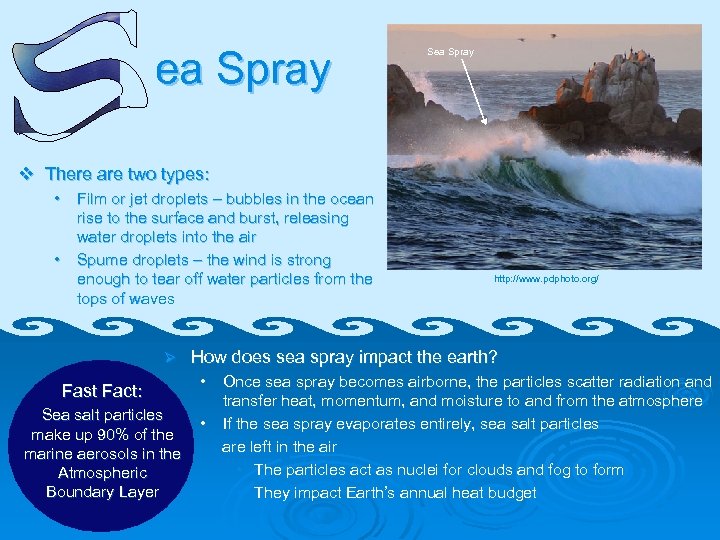 ea Spray Sea Spray v There are two types: • Film or jet droplets – bubbles in the ocean rise to the surface and burst, releasing water droplets into the air • Spume droplets – the wind is strong enough to tear off water particles from the tops of waves Ø Fast Fact: Sea salt particles make up 90% of the marine aerosols in the Atmospheric Boundary Layer http: //www. pdphoto. org/ How does sea spray impact the earth? • Once sea spray becomes airborne, the particles scatter radiation and transfer heat, momentum, and moisture to and from the atmosphere • If the sea spray evaporates entirely, sea salt particles are left in the air • The particles act as nuclei for clouds and fog to form • They impact Earth’s annual heat budget
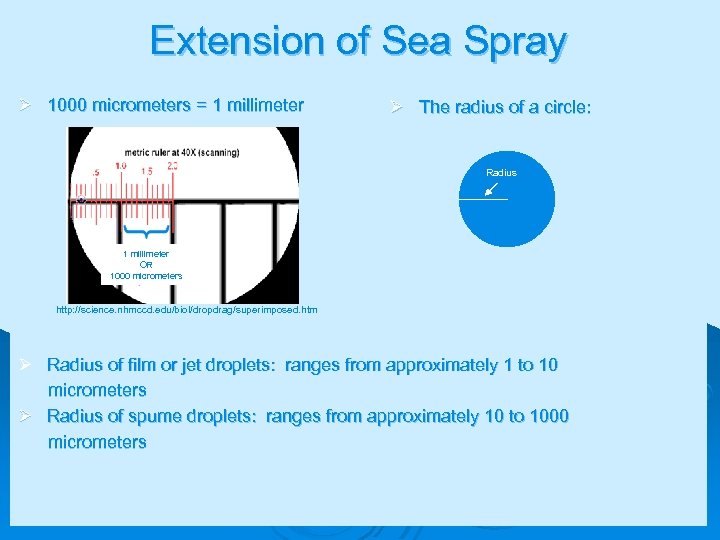 Extension of Sea Spray Ø 1000 micrometers = 1 millimeter Ø The radius of a circle: Radius 1 millimeter OR 1000 micrometers http: //science. nhmccd. edu/biol/dropdrag/superimposed. htm Ø Radius of film or jet droplets: ranges from approximately 1 to 10 micrometers Ø Radius of spume droplets: ranges from approximately 10 to 1000 micrometers
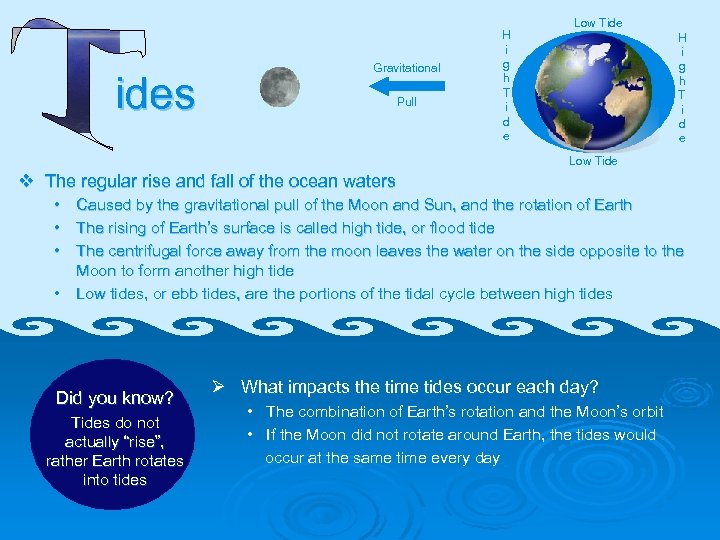 ides Gravitational Pull H i g h T i d e Low Tide v The regular rise and fall of the ocean waters • Caused by the gravitational pull of the Moon and Sun, and the rotation of Earth • The rising of Earth’s surface is called high tide, or flood tide • The centrifugal force away from the moon leaves the water on the side opposite to the Moon to form another high tide • Low tides, or ebb tides, are the portions of the tidal cycle between high tides Did you know? Tides do not actually “rise”, rather Earth rotates into tides Ø What impacts the time tides occur each day? • The combination of Earth’s rotation and the Moon’s orbit • If the Moon did not rotate around Earth, the tides would occur at the same time every day
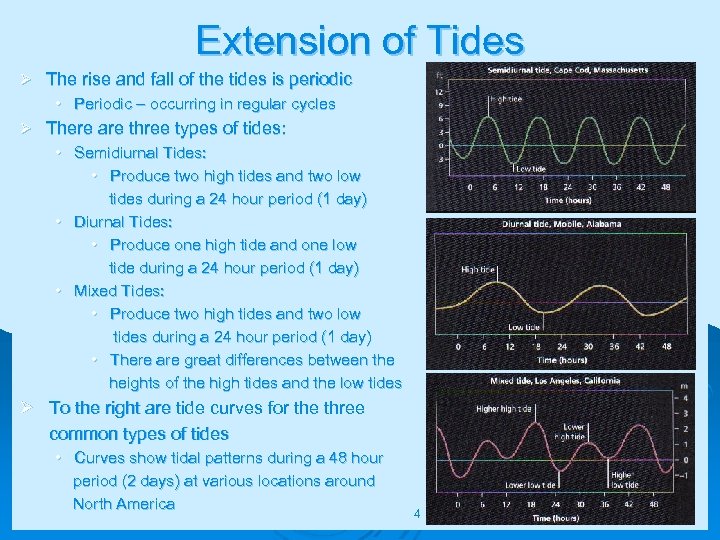 Extension of Tides Ø The rise and fall of the tides is periodic • Periodic – occurring in regular cycles Ø There are three types of tides: • Semidiurnal Tides: • Produce two high tides and two low tides during a 24 hour period (1 day) • Diurnal Tides: • Produce one high tide and one low tide during a 24 hour period (1 day) • Mixed Tides: • Produce two high tides and two low tides during a 24 hour period (1 day) • There are great differences between the heights of the high tides and the low tides Ø To the right are tide curves for the three common types of tides • Curves show tidal patterns during a 48 hour period (2 days) at various locations around North America 4
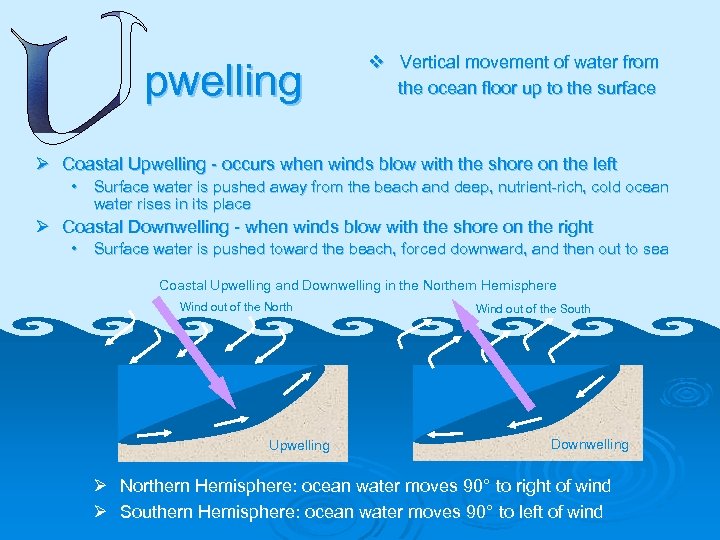 pwelling v Vertical movement of water from the ocean floor up to the surface Ø Coastal Upwelling - occurs when winds blow with the shore on the left • Surface water is pushed away from the beach and deep, nutrient-rich, cold ocean water rises in its place Ø Coastal Downwelling - when winds blow with the shore on the right • Surface water is pushed toward the beach, forced downward, and then out to sea Coastal Upwelling and Downwelling in the Northern Hemisphere Wind out of the North Upwelling Wind out of the South Downwelling Ø Northern Hemisphere: ocean water moves 90° to right of wind Ø Southern Hemisphere: ocean water moves 90° to left of wind
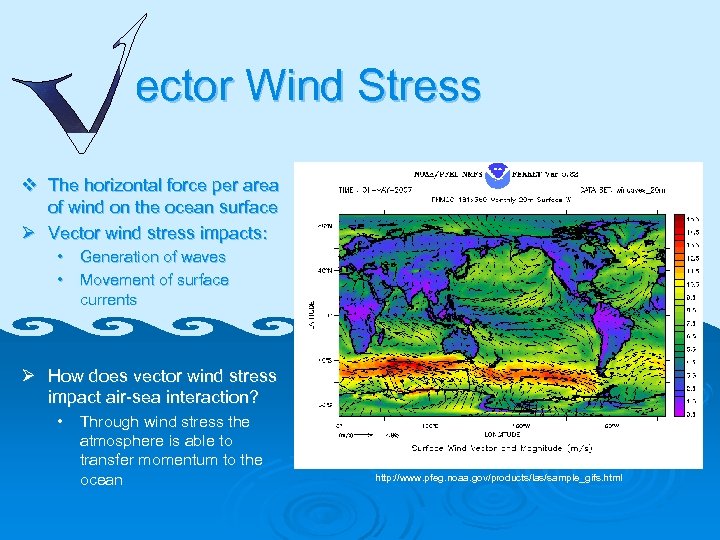 ector Wind Stress v The horizontal force per area of wind on the ocean surface Ø Vector wind stress impacts: • Generation of waves • Movement of surface currents Ø How does vector wind stress impact air-sea interaction? • Through wind stress the atmosphere is able to transfer momentum to the ocean http: //www. pfeg. noaa. gov/products/las/sample_gifs. html
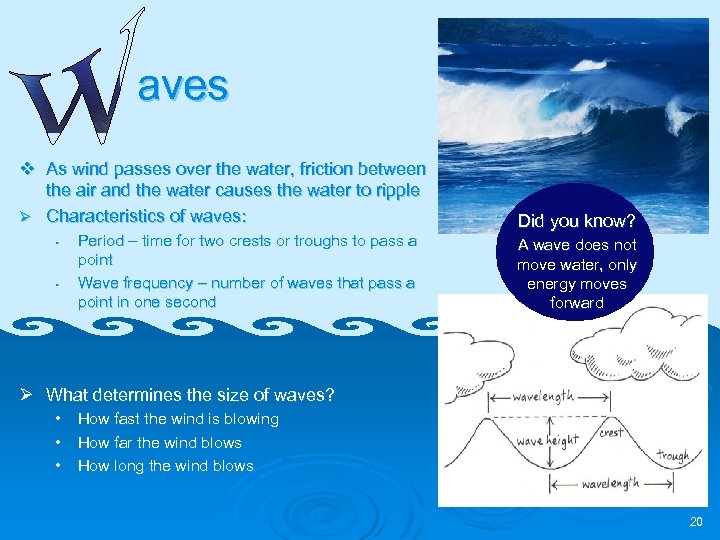 aves v As wind passes over the water, friction between the air and the water causes the water to ripple Ø Characteristics of waves: • • Period – time for two crests or troughs to pass a point Wave frequency – number of waves that pass a point in one second Did you know? A wave does not move water, only energy moves forward Ø What determines the size of waves? • How fast the wind is blowing • How far the wind blows • How long the wind blows 20
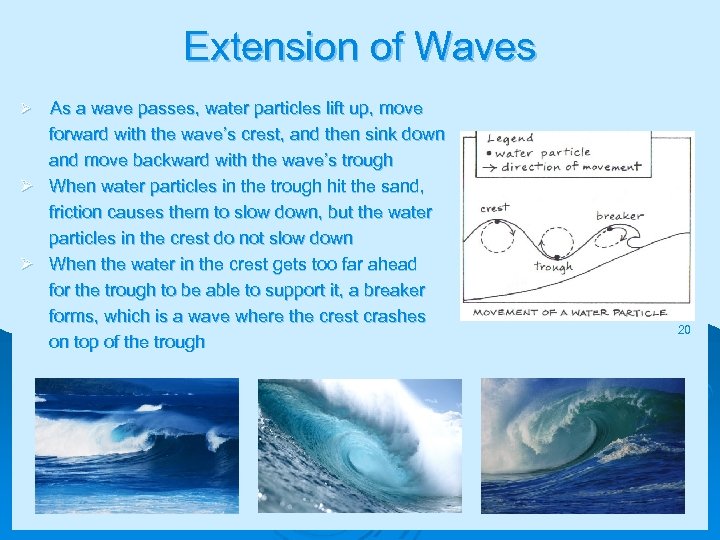 Extension of Waves As a wave passes, water particles lift up, move forward with the wave’s crest, and then sink down and move backward with the wave’s trough Ø When water particles in the trough hit the sand, friction causes them to slow down, but the water particles in the crest do not slow down Ø When the water in the crest gets too far ahead for the trough to be able to support it, a breaker forms, which is a wave where the crest crashes on top of the trough Ø 20
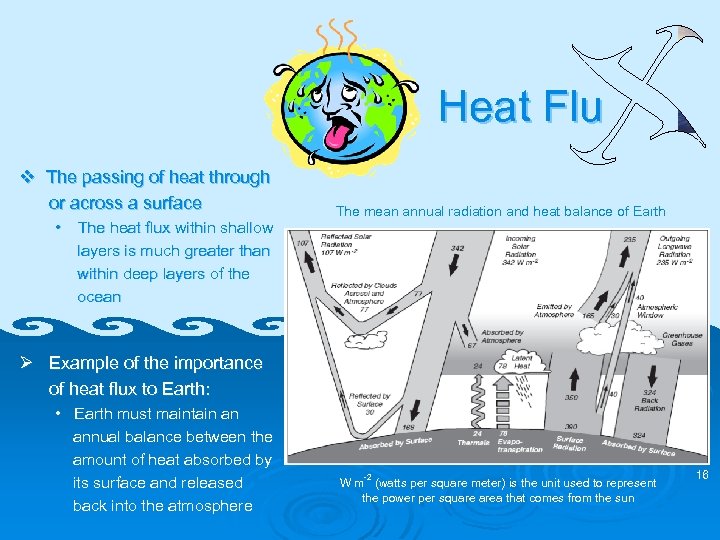 Heat Flu v The passing of heat through or across a surface • The heat flux within shallow layers is much greater than within deep layers of the ocean The mean annual radiation and heat balance of Earth Ø Example of the importance of heat flux to Earth: • Earth must maintain an annual balance between the amount of heat absorbed by its surface and released back into the atmosphere -2 W m (watts per square meter) is the unit used to represent the power per square area that comes from the sun 16
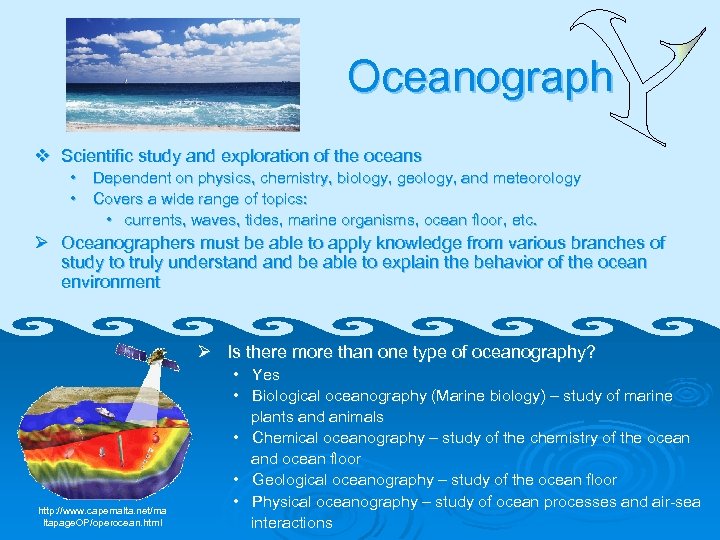 Oceanograph v Scientific study and exploration of the oceans • Dependent on physics, chemistry, biology, geology, and meteorology • Covers a wide range of topics: • currents, waves, tides, marine organisms, ocean floor, etc. Ø Oceanographers must be able to apply knowledge from various branches of study to truly understand be able to explain the behavior of the ocean environment Ø Is there more than one type of oceanography? http: //www. capemalta. net/ma ltapage. OP/operocean. html • Yes • Biological oceanography (Marine biology) – study of marine plants and animals • Chemical oceanography – study of the chemistry of the ocean and ocean floor • Geological oceanography – study of the ocean floor • Physical oceanography – study of ocean processes and air-sea interactions
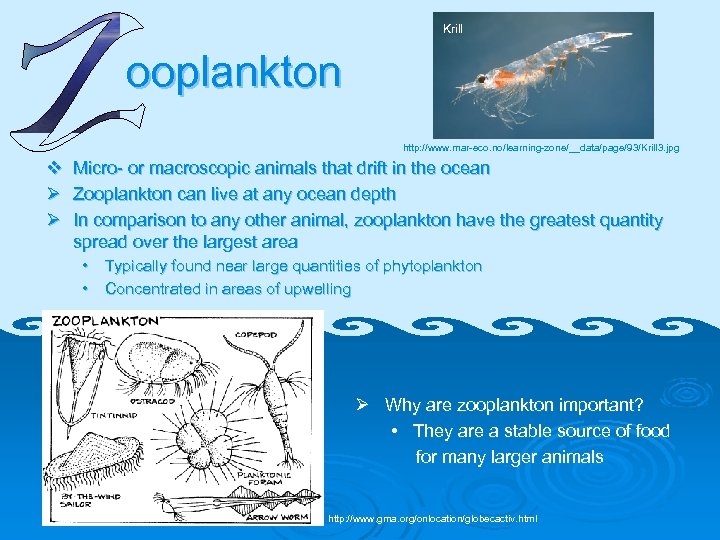 Krill ooplankton http: //www. mar-eco. no/learning-zone/__data/page/93/Krill 3. jpg v Micro- or macroscopic animals that drift in the ocean Ø Zooplankton can live at any ocean depth Ø In comparison to any other animal, zooplankton have the greatest quantity spread over the largest area • Typically found near large quantities of phytoplankton • Concentrated in areas of upwelling Ø Why are zooplankton important? • They are a stable source of food for many larger animals http: //www. gma. org/onlocation/globecactiv. html
 References 1. Ahrens, C. D. (2005). Essentials of Meteorology: An Invitation to the Atmosphere (4 th ed. ). California: Thomson. 2. Feldman, J. C. Ocean Planet: Oceanographic Facts. Smithsonian Institution. Retrieved July 13, 2007, fromhttp: //seawifs. gsfc. nasa. gov/OCEAN_PLANET/HTML/education_ oceanographic_facts. html 3. Greely, T. (1998, Fall). Lesson 1: Why are the Oceans Important? Project Oceanography. Retrieved July 13, 2007, from http: //www. marine. usf. edu/pjocean/packets/ 4. Groves, D. (1989). The Oceans: A Book of Questions and Answers. New York: John Wiley & Sons, Inc. 5. Herring, D. Ocean & Climate: Physical Coupling with the Atmosphere. NASA. Retrieved June 7, 2007, from http: //earthobservatory. nasa. gov/Library/Ocean. Climate/oceanatmos_phys. html. 6. Hutchinson, S. & Hawkins, L. E. (2005). Oceans: A Visual Guide. New York: Firefly Books. 7. Kawasaki, K. (2006, September 5). Mapping the Oceans. NASA. Retrieved June 7, 2007, from http: //sealevel. jpl. nasa. gov/education/jason-game/game-mapping-oceans. pdf 8. Kawasaki, K. (2006, September 5). See How Winds Drive Ocean Currents. NASA. Retrieved June 7, 2007, from http: //sealevel. jpl. nasa. gov/education/jasongame/game-activity 2. pdf 9. Looking at the Sea: Physical Features of the Ocean. (1998). Science Learning Network. Retrieved June 7, 2007, from http: //www. mos. org/oceans/planet/features. html 10. Looking at the Sea: The Water Cycle. (1998). Science Learning Network. Retrieved June 7, 2007, from http: //www. mos. org/oceans/planet/cycle. html
 Extension of References 11. Mueller, J. A. & Veron, F. (2006). A La. Grangian Turbulent Transport Model of Evolving Sea-Spray Droplets over the Ocean. AMS: 14 th Conference on Interaction of the Sea and Atmosphere. (Vol. P 4. 3) 12. Niller, P. (1993). Gulf Stream. In The World Book Encyclopedia (Vol. 8, pp. 462 -463). Chicago: World Book, Inc. 13. Nystuen, J. (2000, June 14). Listening to Raindrops: Using Underwater Microphones to Measure Ocean Rainfall. NASA. Retrieved June 7, 2007, from http: //earthobservatory. nasa. gov/Study/Rain/ 14. Ocean in Motion. (2004, April 7). Office of Naval Research. Retrieved June 8, 2007, from http: //www. onr. navy. mil/focus/ocean/default. htm 15. Program 1: The Who? What? Where? How? And Why’s? of Plankton. (1997, Fall). Project Oceanography. Retrieved July 13, 2007, from http: //www. marine. usf. edu/ pjocean/packets/ 16. Sample, S. (2005, June 21). Climate Variability. NASA. Retrieved June 8, 2007, from http: //science. hq. nasa. gov/oceans/system/climate. html 17. Sample, S. (2005, June 21). Sea Surface Temperature. NASA. Retrieved June 26, 2007, from http: //science. hq. nasa. gov/oceans/physical/SST. html 18. Sample, S. (2005, June 21). The Water Cycle. NASA. Retrieved June 8, 2007, from http: //science. hq. nasa. gov/oceans/system/water. html 19. Stewart, R. H. (2005). An Introduction to Physical Oceanography. Texas: Texas A & M University. 20. Stull, R. B. (1988). An Introduction to Boundary Layer Meteorology. In Atmospheric Sciences Library (Vol. 13). Massachusetts: Kluwer Academic Publishers.
 Extension of References 21. Tarbuck, E. J. & Lutgens, F. K. (2003). Earth Science (10 th ed. ). New Jersey: Pearson Education. 22. The Living Sea. (1998). Science Learning Network. Retrieved June 7, 2007, from http: //www. mos. org/oceans/life/index. html 23. Van. Cleave, J. (1996). Oceans for Every Kid: Easy Activities that Make Learning Science Fun. New York: John Wiley & Sons, Inc. 24. Water on the Move: Current Events. (1998). Science Learning Network. Retrieved June 7, 2007, from http: //www. mos. org/oceans/motion/currents. html 25. Water on the Move: Wind and Waves. (1998). Science Learning Network. Retrieved June 7, 2007, from http: //www. mos. org/oceans/motion/wind. html LEEANNE HAZZARD is a senior at Elizabethtown College, where she is working on her Secondary Mathematics certification. Leeanne created this ABC’s to Oceanography booklet as part of the Oceanography Outreach Project she completed during a REU Summer Internship. Created by Leeanne Hazzard & Fabrice Veron, 2007 Air-Sea Interaction Laboratory College of Marine and Earth Studies University of Delaware