


 Скачать презентацию Estimation for Software Projects 1 Software Project
302c8d4bedfc3ccdfeb9416e6239071f.ppt
- Количество слайдов: 34
 Estimation for Software Projects 1
 Software Project Planning The overall goal of project planning is to establish a pragmatic strategy for controlling, tracking, and monitoring a complex technical project. Why? So the end result gets done on time, with quality! 2
 Project Planning Task Set-I project scope Establish Determine feasibility Analyze risks Define required resources Determine require human resources Define reusable software resources Identify environmental resources 3
 Project Planning Task Set-II Estimate cost and effort Decompose the problem Develop two or more estimates using size, function points, process tasks or use-cases Reconcile the estimates Develop a project schedule Establish a meaningful task set Define a task network Use scheduling tools to develop a timeline chart Define schedule tracking mechanisms 4
 Estimation of resources, cost, and schedule for a software engineering effort requires experience access to good historical information (metrics) the courage to commit to quantitative predictions when qualitative information is all that exists Estimation carries inherent risk and this risk leads to uncertainty 5
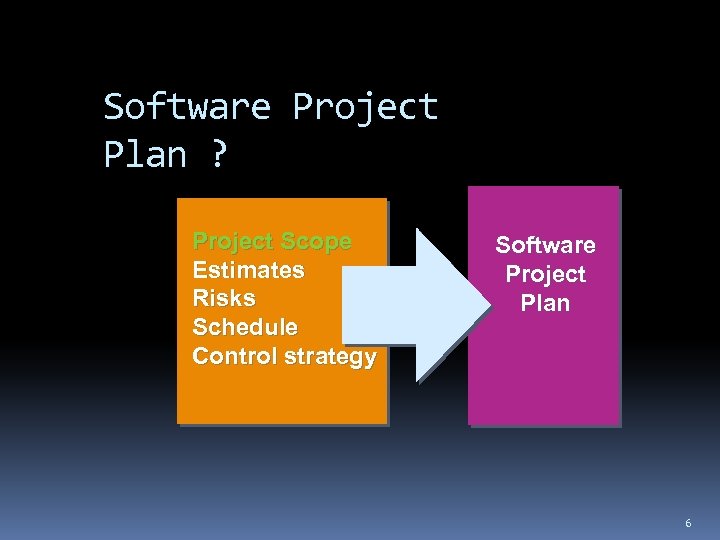 Software Project Plan ? Project Scope Estimates Risks Schedule Control strategy Software Project Plan 6
 To Understand Scope. . . Understand the customers needs understand the business context understand the project boundaries understand the customer’s motivation understand the likely paths for Even when you understand, change nothing is guaranteed! understand that. . . 7
 What is Scope? Software scope describes The functions and features that are to be delivered to end-users The data that are input and output The performance, constraints, interfaces, and reliability that bound the system. Scope is defined using one of two techniques: A narrative description of software scope is developed after communication with all stakeholders. A set of use-cases is developed by end-users. 8
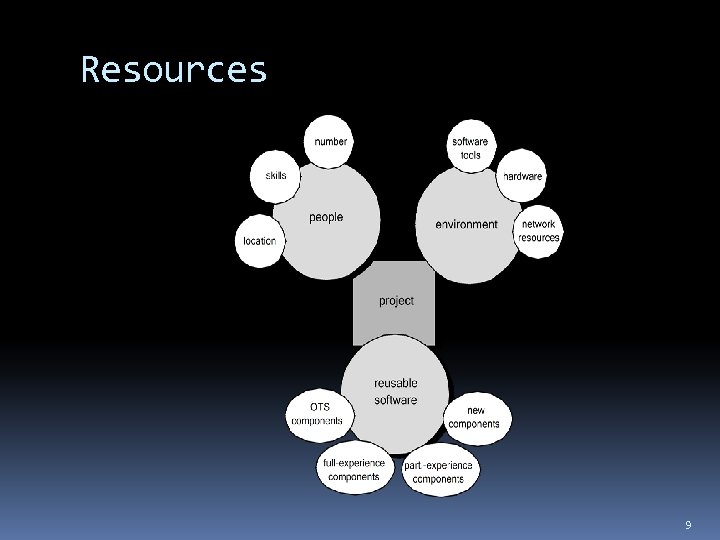 Resources 9
 Project Estimation Project scope must be understood Elaboration (decomposition) is necessary Historical metrics are very helpful At least two different techniques should be used Uncertainty is inherent in the process 10
 Estimation Techniques Past (similar) project experience Conventional estimation techniques task breakdown and effort estimates size (e. g. , FP) estimates Empirical models Automated tools 11
 Estimation Accuracy Based on … the degree to which the planner has properly estimated the size of the product to be built the degree to which the project plan reflects the abilities of the software team the stability of product requirements and the environment that supports the software engineering effort. 12
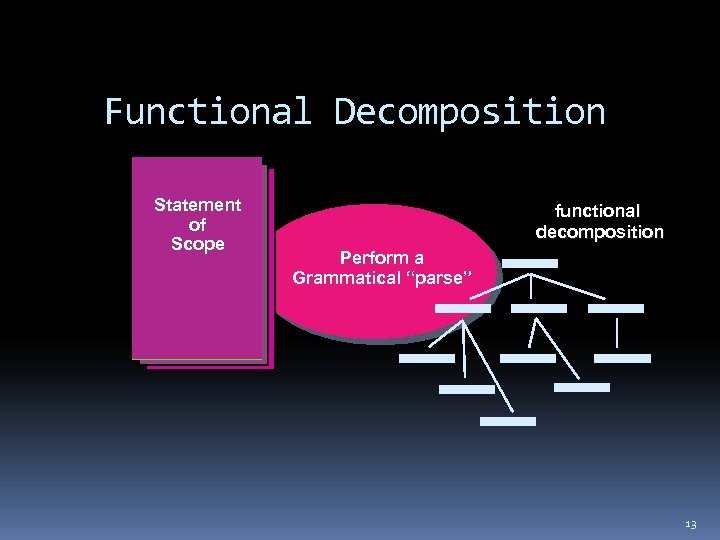 Functional Decomposition Statement of Scope functional decomposition Perform a Grammatical “parse” 13
 Conventional Methods: LOC/FP Approach Compute LOC/FP using estimates of information domain values Use historical data to build estimates for the project 14
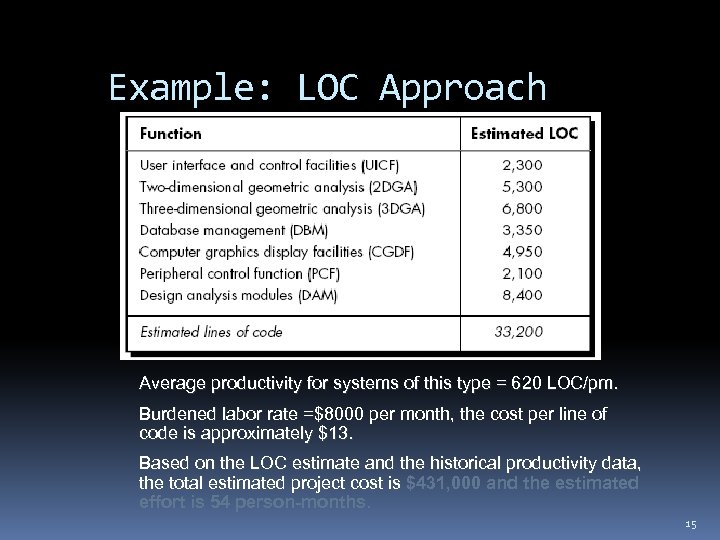 Example: LOC Approach Average productivity for systems of this type = 620 LOC/pm. Burdened labor rate =$8000 per month, the cost per line of code is approximately $13. Based on the LOC estimate and the historical productivity data, the total estimated project cost is $431, 000 and the estimated effort is 54 person-months. 15
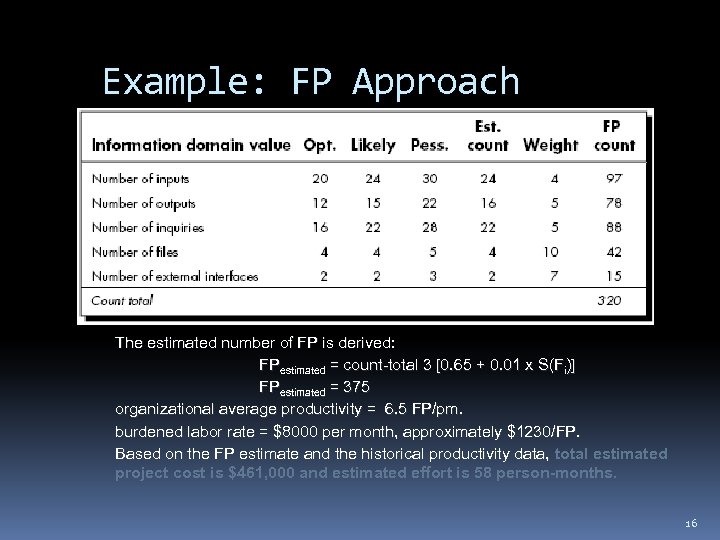 Example: FP Approach The estimated number of FP is derived: FPestimated = count-total 3 [0. 65 + 0. 01 x S(Fi)] FPestimated = 375 organizational average productivity = 6. 5 FP/pm. burdened labor rate = $8000 per month, approximately $1230/FP. Based on the FP estimate and the historical productivity data, total estimated project cost is $461, 000 and estimated effort is 58 person-months. 16
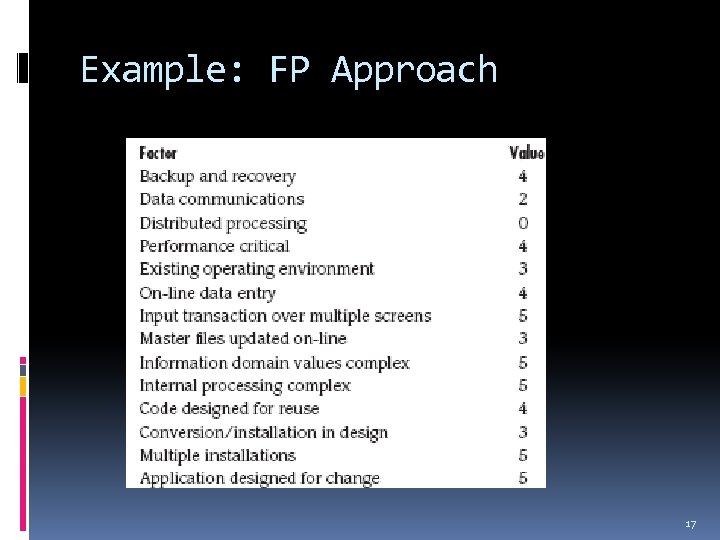 Example: FP Approach 17
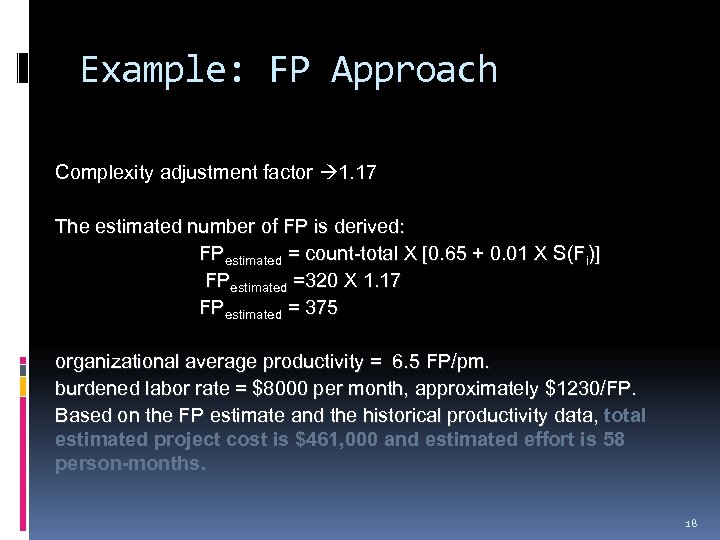 Example: FP Approach Complexity adjustment factor 1. 17 The estimated number of FP is derived: FPestimated = count-total X [0. 65 + 0. 01 X S(Fi)] FPestimated =320 X 1. 17 FPestimated = 375 organizational average productivity = 6. 5 FP/pm. burdened labor rate = $8000 per month, approximately $1230/FP. Based on the FP estimate and the historical productivity data, total estimated project cost is $461, 000 and estimated effort is 58 person-months. 18
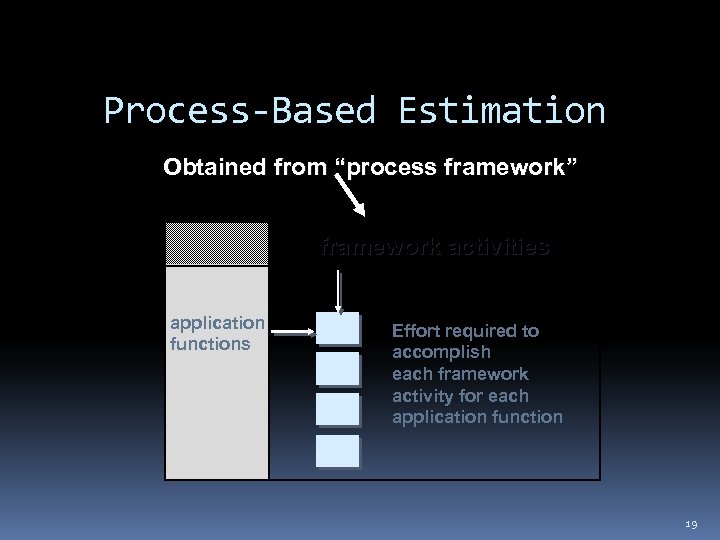 Process-Based Estimation Obtained from “process framework” framework activities application functions Effort required to accomplish each framework activity for each application function 19
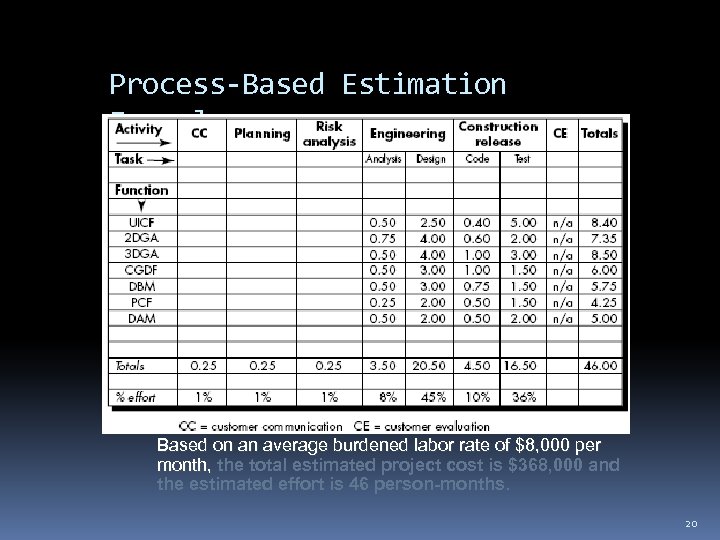 Process-Based Estimation Example Based on an average burdened labor rate of $8, 000 per month, the total estimated project cost is $368, 000 and the estimated effort is 46 person-months. 20
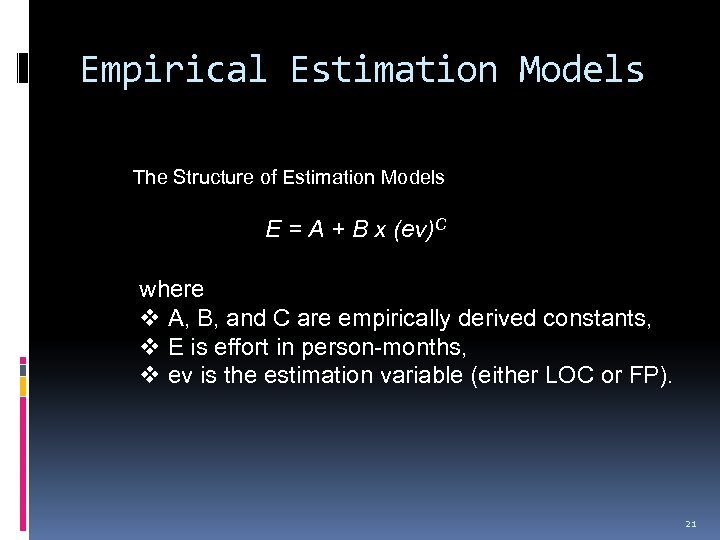 Empirical Estimation Models The Structure of Estimation Models E = A + B x (ev)C where v A, B, and C are empirically derived constants, v E is effort in person-months, v ev is the estimation variable (either LOC or FP). 21
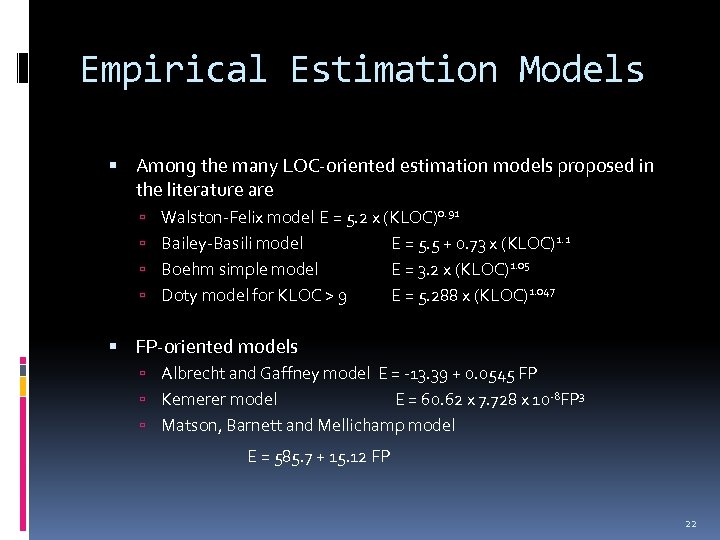 Empirical Estimation Models Among the many LOC-oriented estimation models proposed in the literature are Walston-Felix model E = 5. 2 x (KLOC)0. 91 Bailey-Basili model Boehm simple model Doty model for KLOC > 9 E = 5. 5 + 0. 73 x (KLOC)1. 1 E = 3. 2 x (KLOC)1. 05 E = 5. 288 x (KLOC)1. 047 FP-oriented models Albrecht and Gaffney model E = -13. 39 + 0. 0545 FP Kemerer model E = 60. 62 x 7. 728 x 10 -8 FP 3 Matson, Barnett and Mellichamp model E = 585. 7 + 15. 12 FP 22
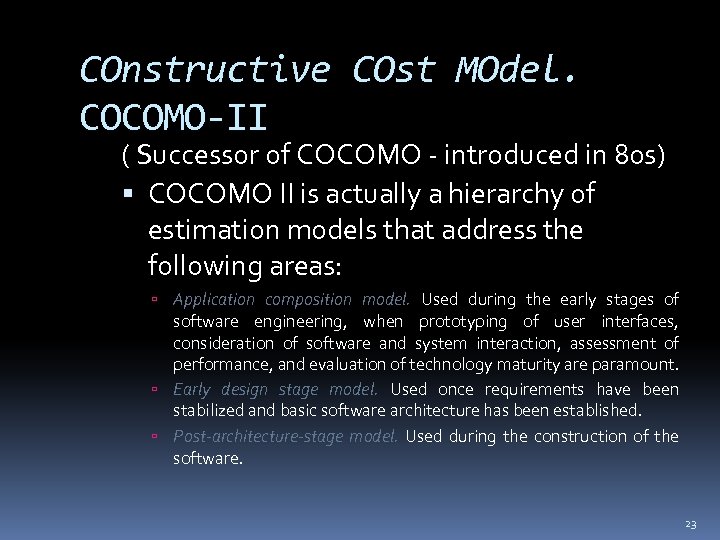 COnstructive COst MOdel. COCOMO-II ( Successor of COCOMO - introduced in 80 s) COCOMO II is actually a hierarchy of estimation models that address the following areas: Application composition model. Used during the early stages of software engineering, when prototyping of user interfaces, consideration of software and system interaction, assessment of performance, and evaluation of technology maturity are paramount. Early design stage model. Used once requirements have been stabilized and basic software architecture has been established. Post-architecture-stage model. Used during the construction of the software. 23
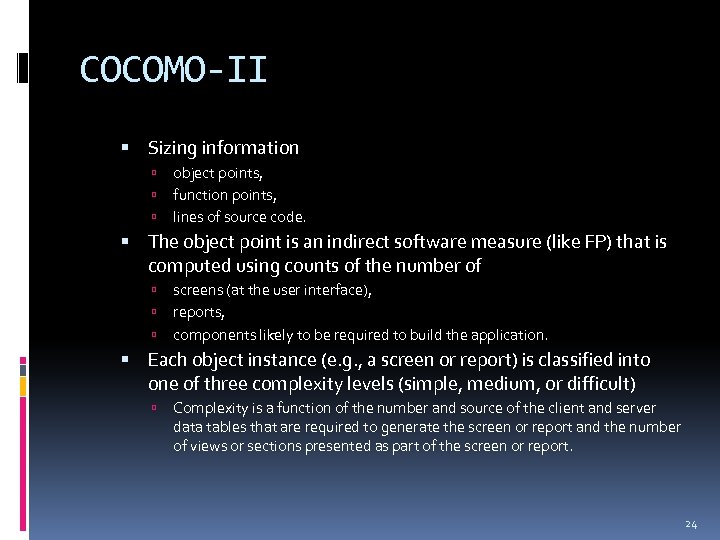 COCOMO-II Sizing information object points, function points, lines of source code. The object point is an indirect software measure (like FP) that is computed using counts of the number of screens (at the user interface), reports, components likely to be required to build the application. Each object instance (e. g. , a screen or report) is classified into one of three complexity levels (simple, medium, or difficult) Complexity is a function of the number and source of the client and server data tables that are required to generate the screen or report and the number of views or sections presented as part of the screen or report. 24
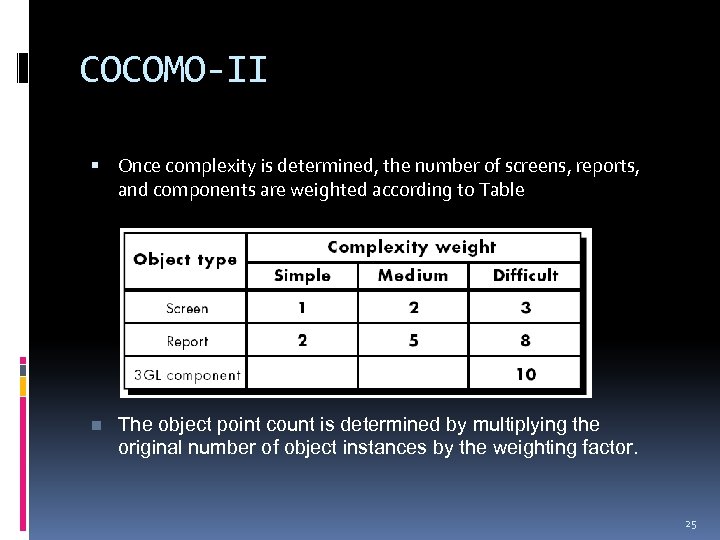 COCOMO-II Once complexity is determined, the number of screens, reports, and components are weighted according to Table n The object point count is determined by multiplying the original number of object instances by the weighting factor. 25
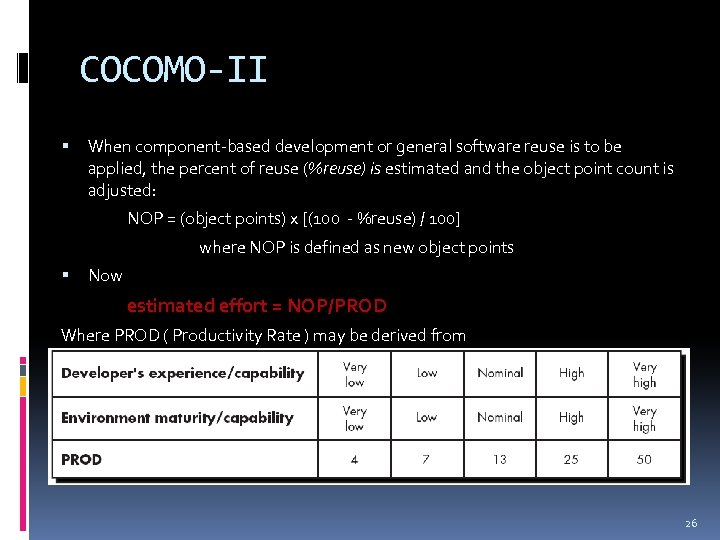 COCOMO-II When component-based development or general software reuse is to be applied, the percent of reuse (%reuse) is estimated and the object point count is adjusted: NOP = (object points) x [(100 - %reuse) / 100] where NOP is defined as new object points Now estimated effort = NOP/PROD Where PROD ( Productivity Rate ) may be derived from 26
![The Software Equation A dynamic multivariable model E = [LOC x B 0. 333/P]3](https://present5.com/presentation/302c8d4bedfc3ccdfeb9416e6239071f/image-27.jpg "The Software Equation A dynamic multivariable model E = [LOC x B 0. 333/P]3") The Software Equation A dynamic multivariable model E = [LOC x B 0. 333/P]3 x (1/t 4) where E = effort in person-months or person-years t = project duration in months or years B = “special skills factor” P = “productivity parameter” that reflects: Overall process maturity and management practices The extent to which good software engineering practices are used The level of programming languages used The state of the software environment The skills and experience of the software team The complexity of the application 27
The Software Equation A dynamic multivariable model E = [LOC x B 0. 333/P]3 x (1/t 4) where E = effort in person-months or person-years t = project duration in months or years B = “special skills factor” P = “productivity parameter” that reflects: Overall process maturity and management practices The extent to which good software engineering practices are used The level of programming languages used The state of the software environment The skills and experience of the software team The complexity of the application 27
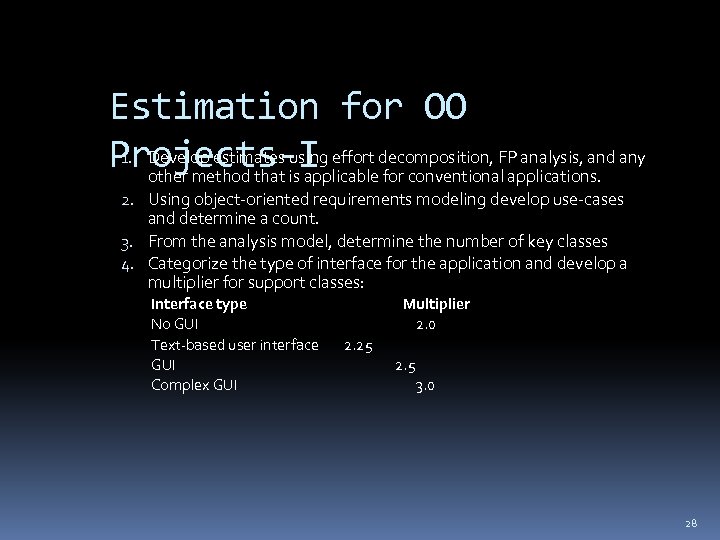 Estimation for OO 1. Develop estimates using Projects-I effort decomposition, FP analysis, and any other method that is applicable for conventional applications. 2. Using object-oriented requirements modeling develop use-cases and determine a count. 3. From the analysis model, determine the number of key classes 4. Categorize the type of interface for the application and develop a multiplier for support classes: Interface type No GUI Text-based user interface GUI Complex GUI Multiplier 2. 0 2. 25 2. 5 3. 0 28
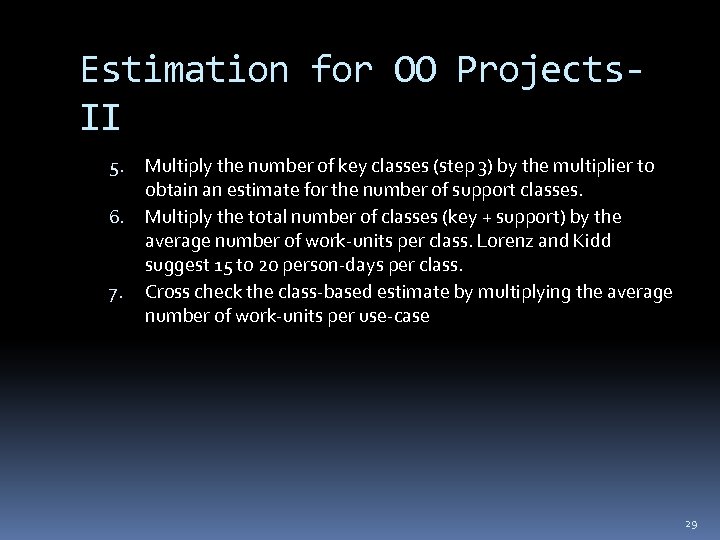 Estimation for OO Projects. II 5. 6. 7. Multiply the number of key classes (step 3) by the multiplier to obtain an estimate for the number of support classes. Multiply the total number of classes (key + support) by the average number of work-units per class. Lorenz and Kidd suggest 15 to 20 person-days per class. Cross check the class-based estimate by multiplying the average number of work-units per use-case 29
 Estimation for Agile Projects Each user scenario (a mini-use-case) is considered separately for estimation purposes. The scenario is decomposed into the set of software engineering tasks that will be required to develop it. Each task is estimated separately. Note: estimation can be based on historical data, an empirical model, or “experience. ” Estimates for each task are summed to create an estimate for the scenario. Alternatively, the ‘volume’ of the scenario can be estimated in LOC, FP or some other volume-oriented measure (e. g. , use-case count). Alternatively, the volume estimate for the scenario is translated into effort using historical data. The effort estimates for all scenarios that are to be implemented for a given software increment are summed to develop the effort estimate for the increment. 30
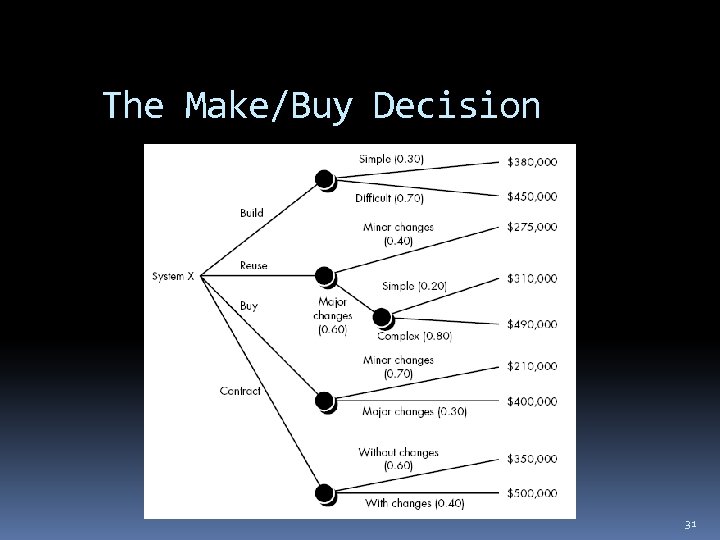 The Make/Buy Decision 31
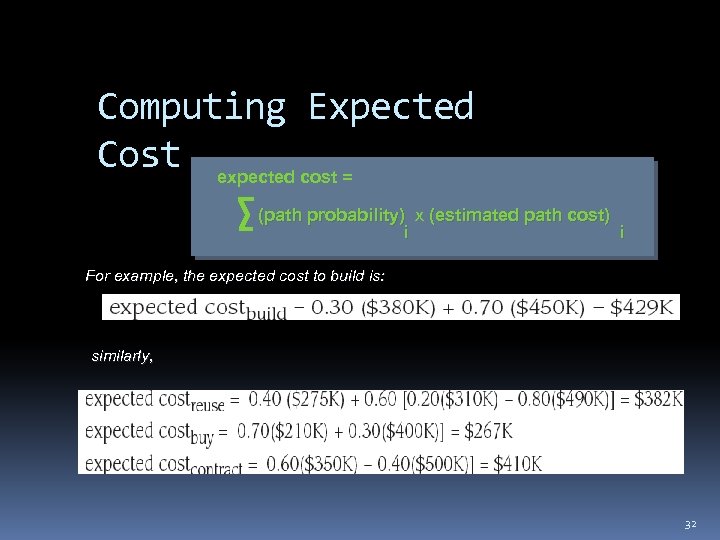 Computing Expected Cost expected cost = (path probability) x (estimated path cost) i i For example, the expected cost to build is: similarly, 32
 __________ 33
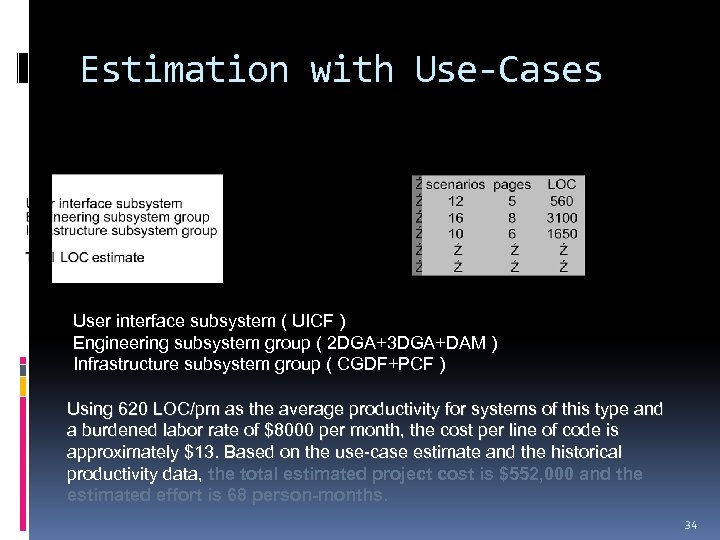 Estimation with Use-Cases User interface subsystem ( UICF ) Engineering subsystem group ( 2 DGA+3 DGA+DAM ) Infrastructure subsystem group ( CGDF+PCF ) Using 620 LOC/pm as the average productivity for systems of this type and a burdened labor rate of $8000 per month, the cost per line of code is approximately $13. Based on the use-case estimate and the historical productivity data, the total estimated project cost is $552, 000 and the estimated effort is 68 person-months. 34