 Скачать презентацию Estimating the Capacity of the Location Based Advertising Channel
fd239ecb3988118149c9a4001da4efe0.ppt
- Количество слайдов: 23



Estimating the Capacity of the Location–Based Advertising Channel Győző Gidófalvi Hans Ravnkjær Larsen Geomatic Ap. S Center for Geoinformatik Torben Bach Pedersen Aalborg University 7/11/2007 ICMB 2007, Toronto, Canada 1
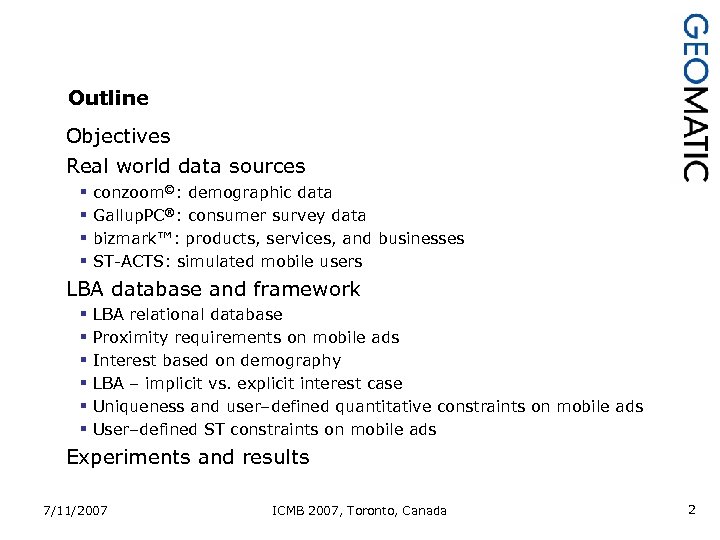
Outline Objectives Real world data sources § § conzoom©: demographic data Gallup. PC®: consumer survey data bizmark™: products, services, and businesses ST-ACTS: simulated mobile users LBA database and framework § § § LBA relational database Proximity requirements on mobile ads Interest based on demography LBA – implicit vs. explicit interest case Uniqueness and user–defined quantitative constraints on mobile ads User–defined ST constraints on mobile ads Experiments and results 7/11/2007 ICMB 2007, Toronto, Canada 2
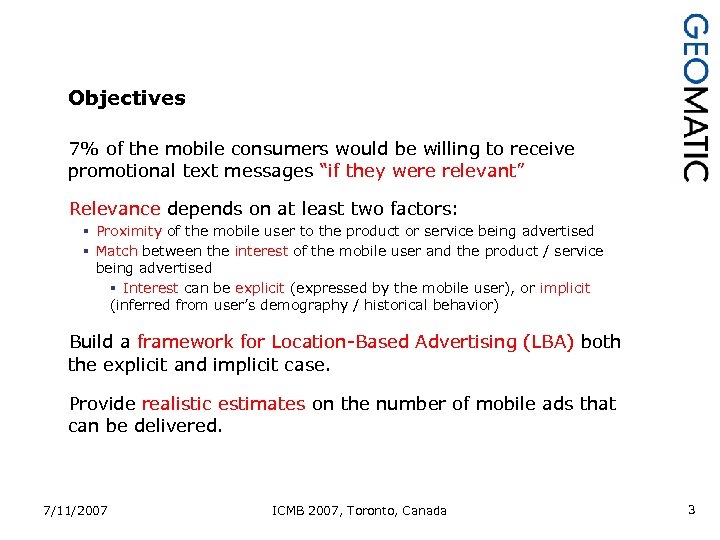
Objectives 7% of the mobile consumers would be willing to receive promotional text messages “if they were relevant” Relevance depends on at least two factors: § Proximity of the mobile user to the product or service being advertised § Match between the interest of the mobile user and the product / service being advertised § Interest can be explicit (expressed by the mobile user), or implicit (inferred from user’s demography / historical behavior) Build a framework for Location-Based Advertising (LBA) both the explicit and implicit case. Provide realistic estimates on the number of mobile ads that can be delivered. 7/11/2007 ICMB 2007, Toronto, Canada 3
Real World Data Sources conzoom©: demographic data Gallup. PC®: consumer survey data bizmark™: products, services, and businesses ST-ACTS: simulated mobile users 7/11/2007 ICMB 2007, Toronto, Canada 4
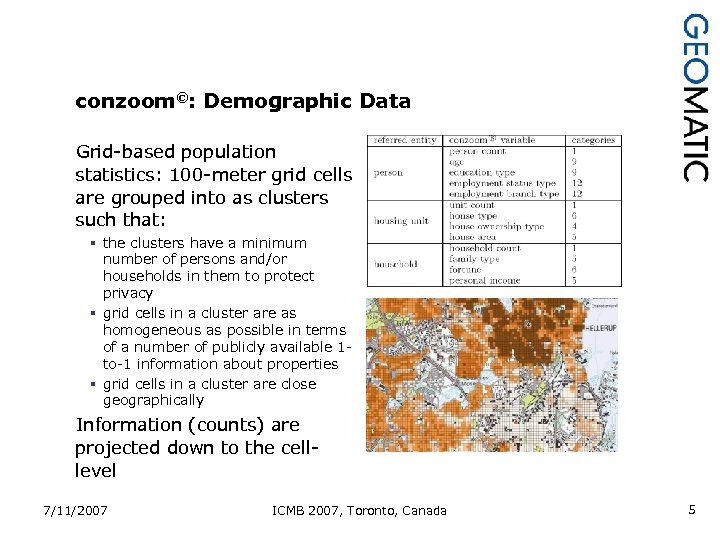
conzoom©: Demographic Data Grid-based population statistics: 100 -meter grid cells are grouped into as clusters such that: § the clusters have a minimum number of persons and/or households in them to protect privacy § grid cells in a cluster are as homogeneous as possible in terms of a number of publicly available 1 to-1 information about properties § grid cells in a cluster are close geographically Information (counts) are projected down to the celllevel 7/11/2007 ICMB 2007, Toronto, Canada 5
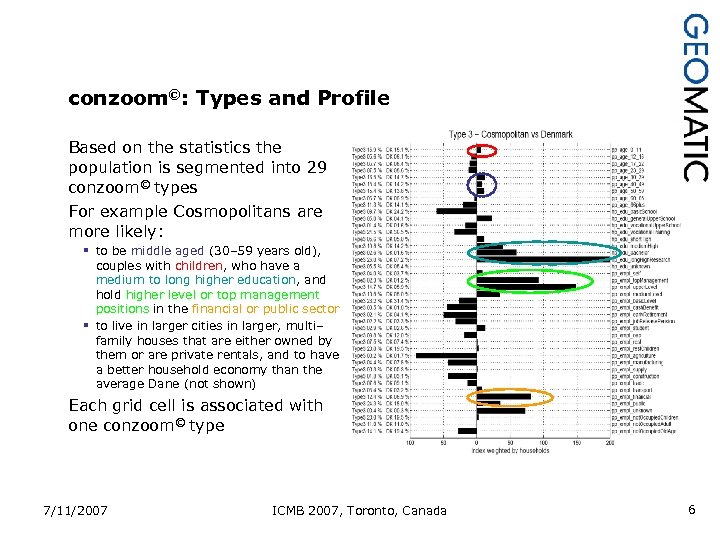
conzoom©: Types and Profile Based on the statistics the population is segmented into 29 conzoom© types For example Cosmopolitans are more likely: § to be middle aged (30– 59 years old), couples with children, who have a medium to long higher education, and hold higher level or top management positions in the financial or public sector § to live in larger cities in larger, multi– family houses that are either owned by them or are private rentals, and to have a better household economy than the average Dane (not shown) Each grid cell is associated with one conzoom© type 7/11/2007 ICMB 2007, Toronto, Canada 6
Gallup. PC®: Consumer Survey Data Answers of approximately 10, 000 subjects to questions about: demographics; interests in culture, hobbies, and sports; purchasing habits, and more… Yes/no question is re–phrased as categorical questions: § Are you interested in fashion? § Possible answer choices: very, rather, somewhat, not very, or not interested Questionnaires are related to conzoom© types using the demographic parts of the questionnaires. 7/11/2007 ICMB 2007, Toronto, Canada 7
bizmark™: Products, Services, and Businesses 1 -to-1 information about businesses: § location, business area size, number of employees, business branch code Identified 40 product and service categories: § § § § § Classical concert; pop/rock concert; discotheque; Art exhibition; museum; cinema; theater; Pharmacy; Bicycle / moped; car; Stereo / HI-FI; CDs / DVDs; computer/internet; new technologies/telecommunication; Do–it–yourself; Fashion; cosmetics / skincare; glasses / contacts; hairdresser; jeweler / watches; Interior design; travel; pets, fast-food; and 14 brand specific supermarkets Businesses are related to product and service categories through international business branch codes 7/11/2007 ICMB 2007, Toronto, Canada 8
ST-ACTS: Important Principles of Social Mobility First Principle: People move from a given location to another location with an objective of performing some activity at the latter location. Second Principle: Not all people are equally likely to perform a given activity. The likelihood of performing an activity depends on the interest of a given person, which in turn depends on a number of demographic variables. Third Principle: The activities performed by a given person are highly context dependent: § § current location of the person set of possible locations where a given activity can be performed the current time recent history of activities that the person has performed Fourth Principle: The locations of facilities, where a given activity can be performed, are not randomly distributed. 7/11/2007 ICMB 2007, Toronto, Canada 9
ST-ACTS: Activity Simulation with Spatio–Temporal Constraints Mandatory activities: workers (students) go to “appropriate” working places (schools) on weekdays at appropriate times. Temporal activity constraint: certain activities are more likely to be performed during some periods than others. Activity duration constraint: not all activities take the same amount of time. Activity repetition constraint: certain time has to pass before a person likely to perform the same activity. Maximum distance constraint: for most activities there is a maximum distance a person is willing to travel. Physical mobility constraints: it takes time to move from one location to another. 7/11/2007 ICMB 2007, Toronto, Canada 10
LBA Database and Framework LBA relational database Proximity requirements on mobile ads Interest based on demography LBA – implicit vs. explicit interest case Uniqueness and user–defined quantitative constraints on mobile ads User–defined ST constraints on mobile ads 7/11/2007 ICMB 2007, Toronto, Canada 11
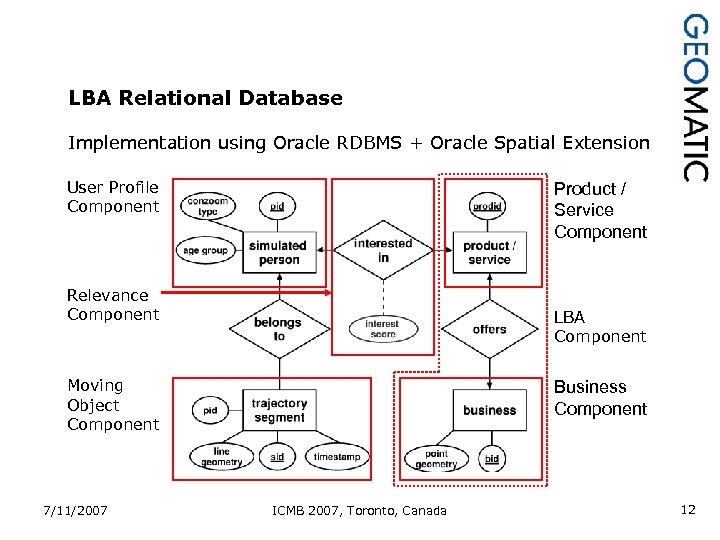
LBA Relational Database Implementation using Oracle RDBMS + Oracle Spatial Extension User Profile Component Product / Service Component Relevance Component LBA Component Moving Object Component 7/11/2007 Business Component ICMB 2007, Toronto, Canada 12
Proximity Requirements on Mobile Ads A mobile add is likely to be relevant only if the current (or near future) location of the user is within a maximum distance, maxdist, to the location of the mobile ad. Buffer the locations of businesses (mobile ads) and test for spatial intersection (join). Index geometries of the trajectory segments and the buffered mobile ads using R-trees to make the spatial join fast. 7/11/2007 ICMB 2007, Toronto, Canada 13
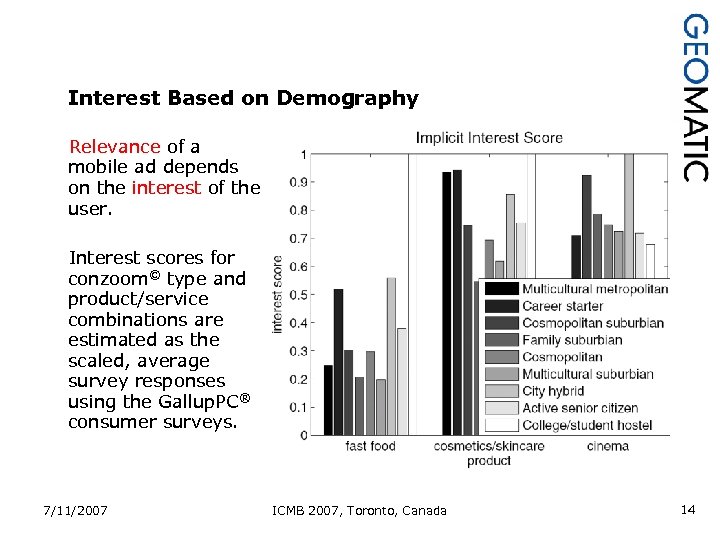
Interest Based on Demography Relevance of a mobile ad depends on the interest of the user. Interest scores for conzoom© type and product/service combinations are estimated as the scaled, average survey responses using the Gallup. PC® consumer surveys. 7/11/2007 ICMB 2007, Toronto, Canada 14
LBA – Implicit vs. Explicit Interest Case Two interest models: § Implicit § Interest is inferred from demographic characteristics or historical user behavior (f. ex. , reaction to previously received ads) § Push marketing § Company-specific interest score functions (using DM and ML) § Represented as a many-to-many relation: interest_score = <conzoom_type, prodid, score> § Explicit § Users can state their interest in certain products / services explicitly § Pull marketing § Represented as a binary relation: interest_score = <pid, prodid> 7/11/2007 ICMB 2007, Toronto, Canada 15
Uniqueness and User–Defined Quantitative Constraints on Mobile Ads Mobile ad delivery is managed through a relation: § mobile_ad_delivery = <pid, bid, prodid, delivery_time> Receiving the same ad multiple times decreases its relevance § Primary key constraints on the first 3 columns guarantee that a mobile ad is delivered at most once to a user. § Optional, delayed redelivery of messages can be controlled by recording the delivery time of mobile ads. As the number of delivered mobile ads increases, the likelihood of users getting annoyed by them increases also. Consequently, relevant ads might be perceived non-relevant by user. § Important for users to be able to control the maximum number of mobile ads received § Top-k queries are an efficient mechanism to provide this user-control 7/11/2007 ICMB 2007, Toronto, Canada 16
User–Defined ST Constraints on Mobile Ads Time and location are important aspects of the context of mobile ads. Need to provide user-control for spatio-temporal constraints on the delivery of mobile ads § Spatio-temporal Mobile Ad Profiles § Spatial + temporal region § Multiple applicable profiles -> select most restrictive as the active profile § Management of profiles can be server- or client-side Spatio-temporal join between mobile ad profiles and mobile ads can provided the control needed. 7/11/2007 ICMB 2007, Toronto, Canada 17
Experimental Setup 4314 businesses offering products and services in 40 product and service categories (6532 mobile ads) Movements of 1000 randomly selected simulated mobile users during the course of a day (3826 trips) Estimate the number of deliverable ads for § Implicit interest case: varying mindist and minscore parameters § Explicit interest case: § Users are probabilistically assigned 1 product / interest category § Varying mindist parameter 7/11/2007 ICMB 2007, Toronto, Canada 18
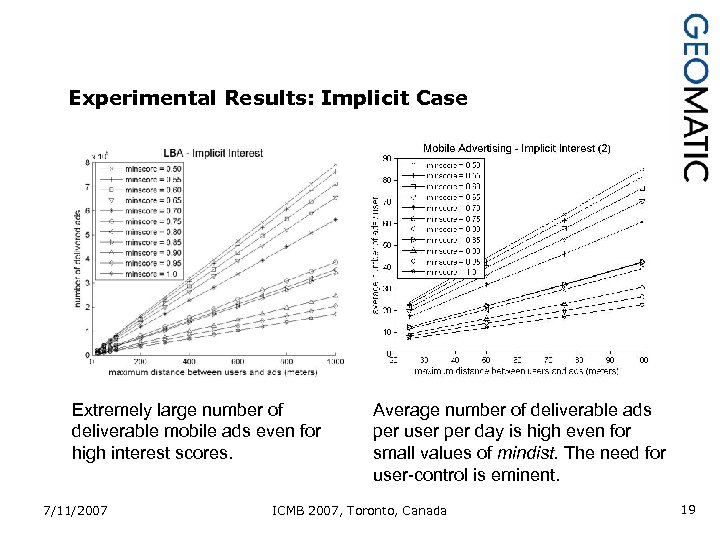
Experimental Results: Implicit Case Extremely large number of deliverable mobile ads even for high interest scores. 7/11/2007 Average number of deliverable ads per user per day is high even for small values of mindist. The need for user-control is eminent. ICMB 2007, Toronto, Canada 19
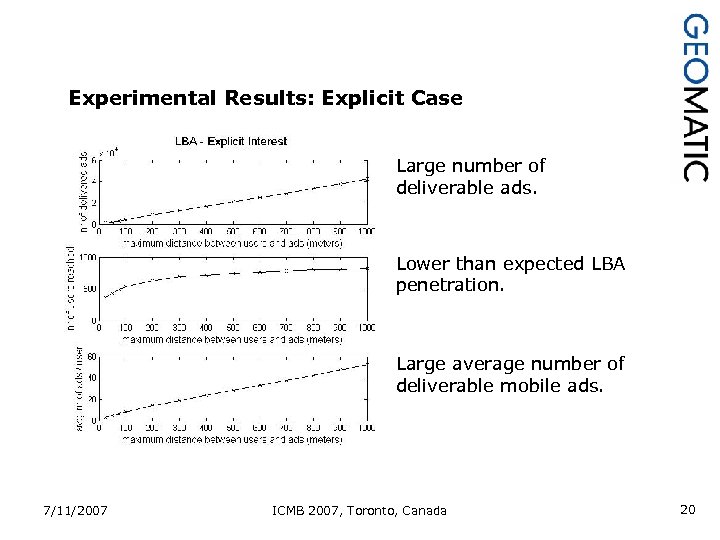
Experimental Results: Explicit Case Large number of deliverable ads. Lower than expected LBA penetration. Large average number of deliverable mobile ads. 7/11/2007 ICMB 2007, Toronto, Canada 20
Conclusions Developed a framework for LBA. § Relevance based on proximity and interest (implicit vs. explicit) Presented a LBA database for the management / delivery of mobile ads. Using a realistically simulated moving user population and real world data sources for mobile ads, estimated the capacity of the LBA channel. § The LBA channel is rather large, which is evidence for a strong business case. § This also indicates the need for adequate user–control on the delivery of mobile ads. § Maximum number of received ads § Spatio-temporal Mobile Ad Profiles 7/11/2007 ICMB 2007, Toronto, Canada 21

Acknowledgements Thanks for the help from co–workers, Esben Taudorf, Kasper Rϋgge, and Lau Kingo Marcussen. 7/11/2007 ICMB 2007, Toronto, Canada 22

Thank you for your attention! Questions? 7/11/2007 ICMB 2007, Toronto, Canada 23
Скачать презентацию Estimating the Capacity of the Location Based Advertising Channel
fd239ecb3988118149c9a4001da4efe0.ppt