 Скачать презентацию Estimating Software Calculating Cost Price and Bid Price
8c805180652465f8373b71db900366bb.ppt
- Количество слайдов: 30



Estimating Software: Calculating Cost, Price, and Bid Price
The Basics • Deciding whether or not to go ahead with a project is a case of comparing a proposed project with the alternatives and deciding whether to proceed with it. • The evaluation will be based on strategic, technical and economic criteria. • The risks involved also need to be evaluated.
The Make-Buy Decision – Software engineering managers are faced with a make/buy decision that can be further complicated by a number of acquisition options: 1. software may be purchased (or licensed) off-theshelf, 2. "full-experience" or "partial-experience" software components may be acquired and then modified and integrated to meet specific needs, or 3. software may be custom built by an outside contractor to meet the purchaser's specifications.
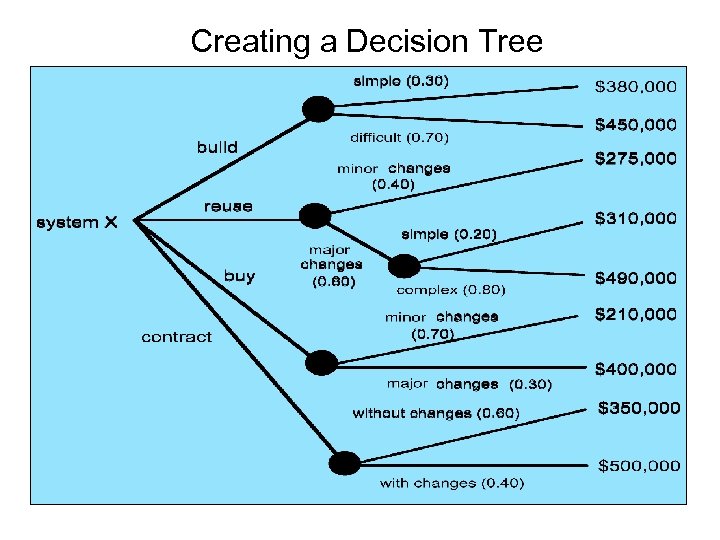
Creating a Decision Tree
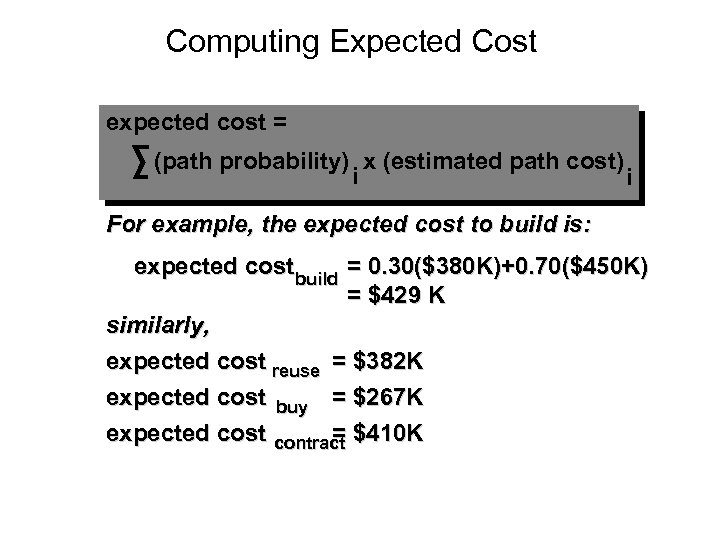
Computing Expected Cost expected cost = (path probability) x (estimated path cost) i i For example, the expected cost to build is: expected cost build = 0. 30($380 K)+0. 70($450 K) = $429 K similarly, expected cost reuse = $382 K expected cost buy = $267 K expected cost contract $410 K =
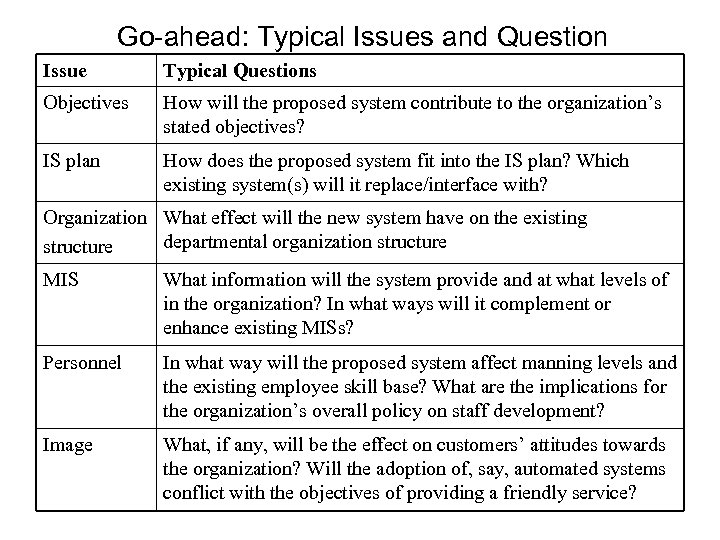
Go-ahead: Typical Issues and Question Issue Typical Questions Objectives How will the proposed system contribute to the organization’s stated objectives? IS plan How does the proposed system fit into the IS plan? Which existing system(s) will it replace/interface with? Organization What effect will the new system have on the existing departmental organization structure MIS What information will the system provide and at what levels of in the organization? In what ways will it complement or enhance existing MISs? Personnel In what way will the proposed system affect manning levels and the existing employee skill base? What are the implications for the organization’s overall policy on staff development? Image What, if any, will be the effect on customers’ attitudes towards the organization? Will the adoption of, say, automated systems conflict with the objectives of providing a friendly service?
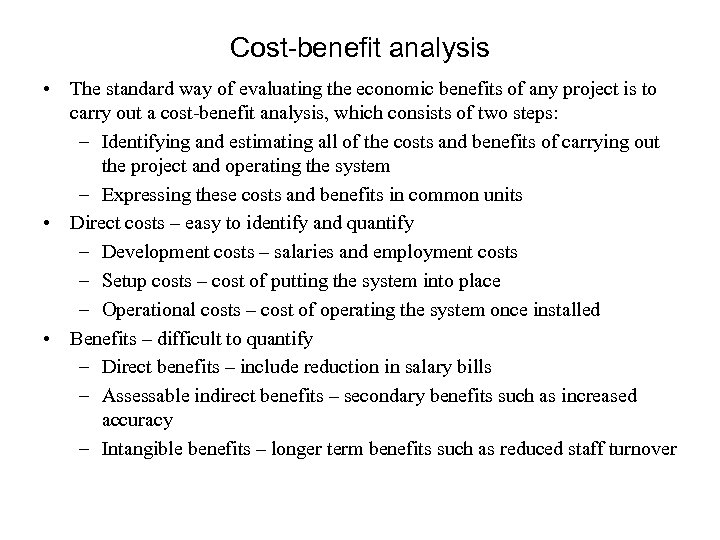
Cost-benefit analysis • The standard way of evaluating the economic benefits of any project is to carry out a cost-benefit analysis, which consists of two steps: – Identifying and estimating all of the costs and benefits of carrying out the project and operating the system – Expressing these costs and benefits in common units • Direct costs – easy to identify and quantify – Development costs – salaries and employment costs – Setup costs – cost of putting the system into place – Operational costs – cost of operating the system once installed • Benefits – difficult to quantify – Direct benefits – include reduction in salary bills – Assessable indirect benefits – secondary benefits such as increased accuracy – Intangible benefits – longer term benefits such as reduced staff turnover
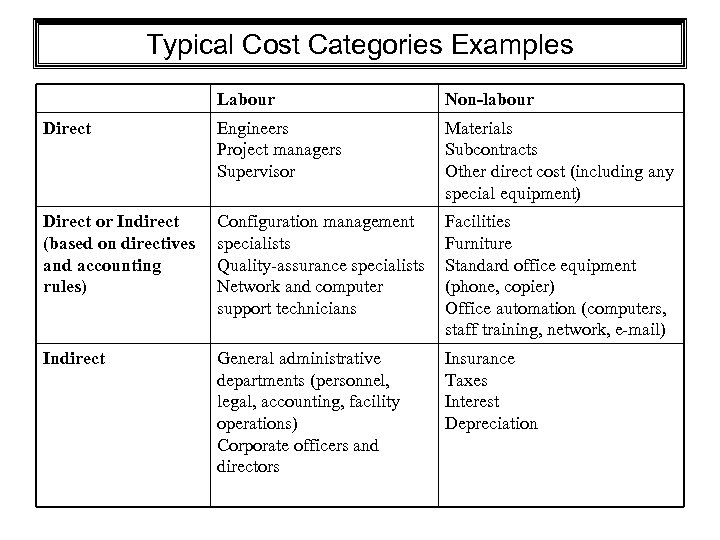
Typical Cost Categories Examples Labour Non-labour Direct Engineers Project managers Supervisor Materials Subcontracts Other direct cost (including any special equipment) Direct or Indirect (based on directives and accounting rules) Configuration management specialists Quality-assurance specialists Network and computer support technicians Facilities Furniture Standard office equipment (phone, copier) Office automation (computers, staff training, network, e-mail) Indirect General administrative departments (personnel, legal, accounting, facility operations) Corporate officers and directors Insurance Taxes Interest Depreciation
Exercise • Carleton University is considering the replacement of the existing payroll service, operated by a third party, with a tailored, offthe-shelf computer-based system. List some of the costs and benefits the university might consider under each of the six headings given above (slide no. 8). For each cost or benefit, explain how, in principle, it might be measured in monetary terms.
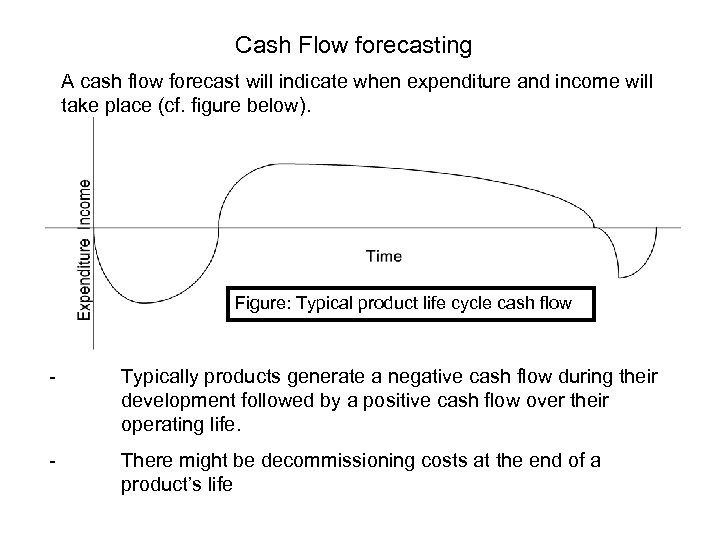
Cash Flow forecasting A cash flow forecast will indicate when expenditure and income will take place (cf. figure below). Figure: Typical product life cycle cash flow - Typically products generate a negative cash flow during their development followed by a positive cash flow over their operating life. - There might be decommissioning costs at the end of a product’s life
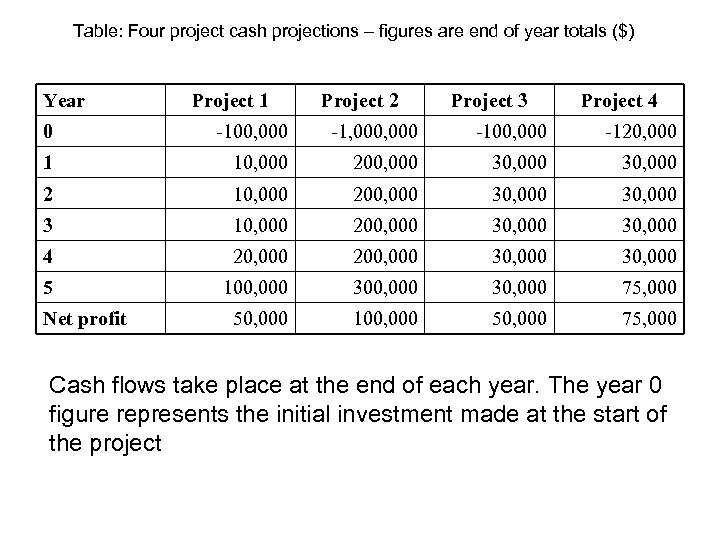
Table: Four project cash projections – figures are end of year totals ($) Year Project 1 Project 2 Project 3 Project 4 0 -100, 000 -1, 000 -100, 000 -120, 000 1 10, 000 200, 000 30, 000 2 10, 000 200, 000 30, 000 3 10, 000 200, 000 30, 000 4 20, 000 200, 000 30, 000 5 100, 000 30, 000 75, 000 50, 000 100, 000 50, 000 75, 000 Net profit Cash flows take place at the end of each year. The year 0 figure represents the initial investment made at the start of the project
Net Profit and Payback Period • The net profit of a project is the difference between the total costs and the total income over the life of the project. • Project 2 in the table (slide 12) shows the greatest net profit but this is at the expense of a large investment. • The payback period is the time taken to break even or pay back the in initial investment. Exercise Consider the four project cash flows given the table (slide 12) and calculate the payback period for each of them.
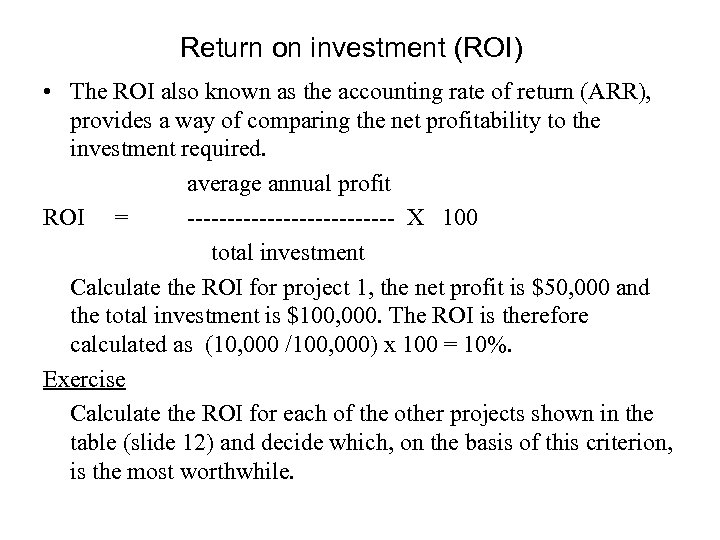
Return on investment (ROI) • The ROI also known as the accounting rate of return (ARR), provides a way of comparing the net profitability to the investment required. average annual profit ROI = ------------- X 100 total investment Calculate the ROI for project 1, the net profit is $50, 000 and the total investment is $100, 000. The ROI is therefore calculated as (10, 000 /100, 000) x 100 = 10%. Exercise Calculate the ROI for each of the other projects shown in the table (slide 12) and decide which, on the basis of this criterion, is the most worthwhile.
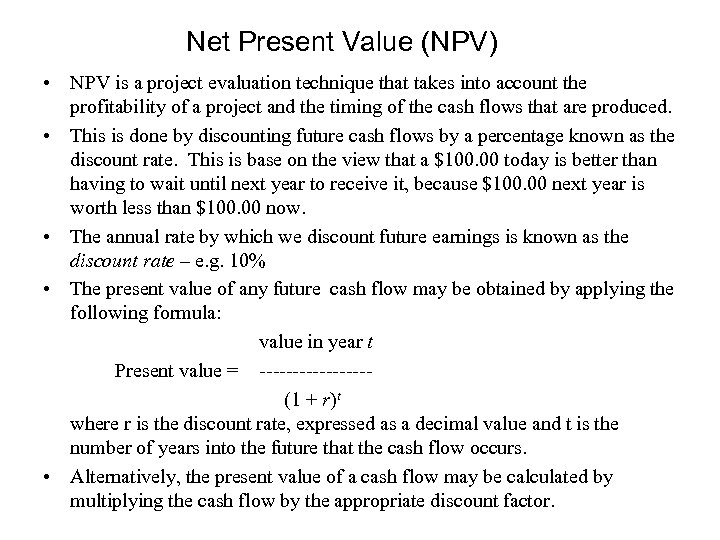
Net Present Value (NPV) • NPV is a project evaluation technique that takes into account the profitability of a project and the timing of the cash flows that are produced. • This is done by discounting future cash flows by a percentage known as the discount rate. This is base on the view that a $100. 00 today is better than having to wait until next year to receive it, because $100. 00 next year is worth less than $100. 00 now. • The annual rate by which we discount future earnings is known as the discount rate – e. g. 10% • The present value of any future cash flow may be obtained by applying the following formula: value in year t Present value = --------(1 + r)t where r is the discount rate, expressed as a decimal value and t is the number of years into the future that the cash flow occurs. • Alternatively, the present value of a cash flow may be calculated by multiplying the cash flow by the appropriate discount factor.
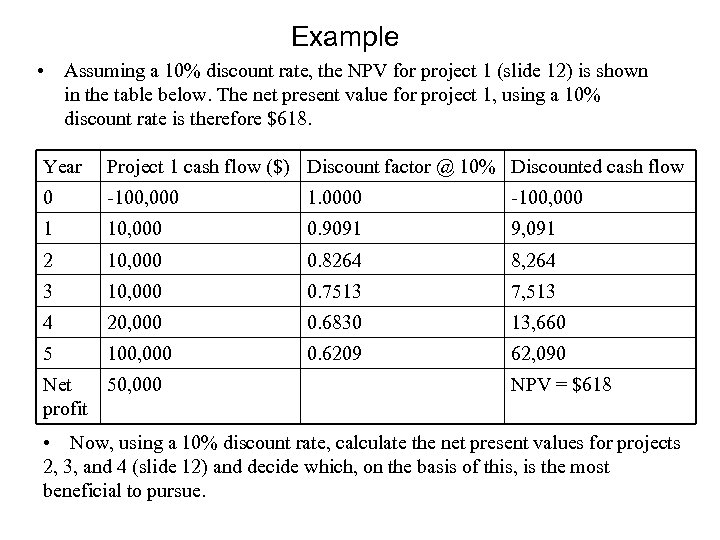
Example • Assuming a 10% discount rate, the NPV for project 1 (slide 12) is shown in the table below. The net present value for project 1, using a 10% discount rate is therefore $618. Year Project 1 cash flow ($) Discount factor @ 10% Discounted cash flow 0 -100, 000 1. 0000 -100, 000 1 10, 000 0. 9091 9, 091 2 10, 000 0. 8264 8, 264 3 10, 000 0. 7513 7, 513 4 20, 000 0. 6830 13, 660 5 100, 000 0. 6209 62, 090 Net 50, 000 profit NPV = $618 • Now, using a 10% discount rate, calculate the net present values for projects 2, 3, and 4 (slide 12) and decide which, on the basis of this, is the most beneficial to pursue.
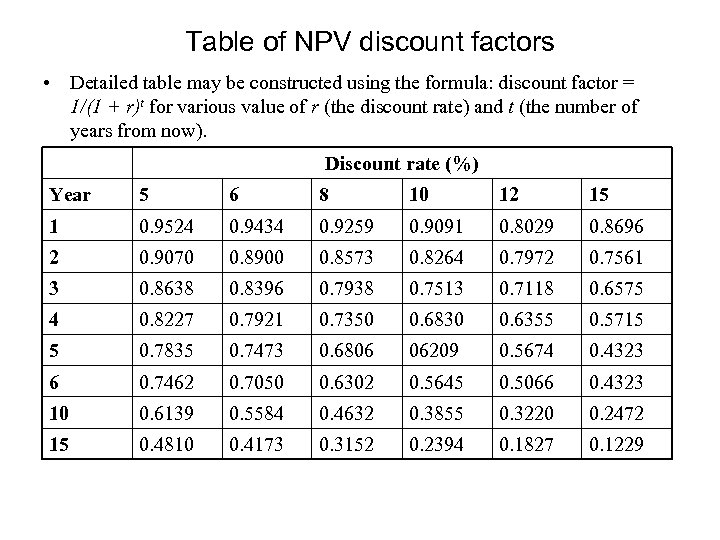
Table of NPV discount factors • Detailed table may be constructed using the formula: discount factor = 1/(1 + r)t for various value of r (the discount rate) and t (the number of years from now). Discount rate (%) Year 5 6 8 10 12 15 1 0. 9524 0. 9434 0. 9259 0. 9091 0. 8029 0. 8696 2 0. 9070 0. 8900 0. 8573 0. 8264 0. 7972 0. 7561 3 0. 8638 0. 8396 0. 7938 0. 7513 0. 7118 0. 6575 4 0. 8227 0. 7921 0. 7350 0. 6830 0. 6355 0. 5715 5 0. 7835 0. 7473 0. 6806 06209 0. 5674 0. 4323 6 0. 7462 0. 7050 0. 6302 0. 5645 0. 5066 0. 4323 10 0. 6139 0. 5584 0. 4632 0. 3855 0. 3220 0. 2472 15 0. 4810 0. 4173 0. 3152 0. 2394 0. 1827 0. 1229
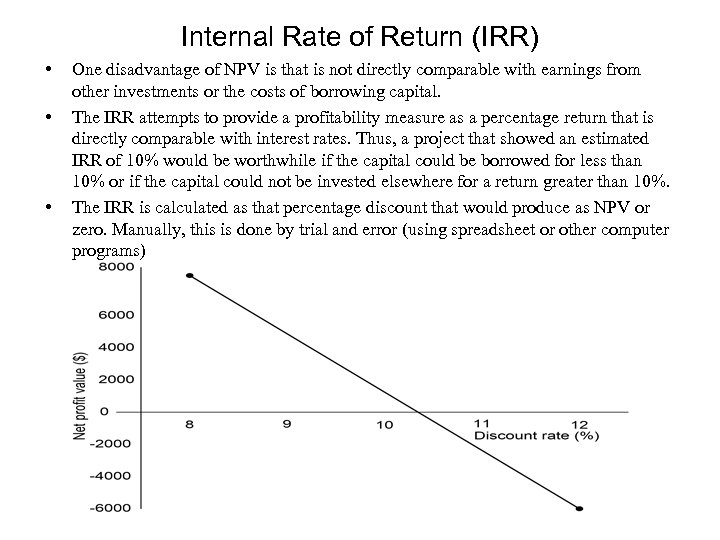
Internal Rate of Return (IRR) • • • One disadvantage of NPV is that is not directly comparable with earnings from other investments or the costs of borrowing capital. The IRR attempts to provide a profitability measure as a percentage return that is directly comparable with interest rates. Thus, a project that showed an estimated IRR of 10% would be worthwhile if the capital could be borrowed for less than 10% or if the capital could not be invested elsewhere for a return greater than 10%. The IRR is calculated as that percentage discount that would produce as NPV or zero. Manually, this is done by trial and error (using spreadsheet or other computer programs)
![Rate Types for [US] Government Contracts • For (US) government contracts, five rates are](https://present5.com/presentation/8c805180652465f8373b71db900366bb/image-18.jpg "Rate Types for [US] Government Contracts • For (US) government contracts, five rates are")
Rate Types for [US] Government Contracts • For (US) government contracts, five rates are typically used to “load” the (base) costs. • A sixth rate, fee, is applied to the loaded cost to compute the profit. • The total price equals the loaded cost plus the (estimated) profit. • Note that some organization use the term “burden cost” instead of “loaded cost. ” • Loaded cost is sum total of direct, direct/indirect, and indirect costs.
![The [US] six rates are: 1. 2. 3. 4. 5. 6. • • Fringe](https://present5.com/presentation/8c805180652465f8373b71db900366bb/image-19.jpg "The [US] six rates are: 1. 2. 3. 4. 5. 6. • • Fringe")
The [US] six rates are: 1. 2. 3. 4. 5. 6. • • Fringe (salary-related taxes, insurance, and benefits) Overhead (facilities, equipment, tools) Materials and subcontracts surcharge (handling costs) General and administrative (corporate infrastructure) Escalation (inflation) Fee (proposed profit) All of these rates represent legitimate costs of activities needed to deliver products and services. These rates are proprietary and vary from one organization to another due to the decision to bill support personnel as direct or indirect, and the need to maintain manufacturing and test facilities.
![Calculating a Bid Price • The two basic equations for a [US] government contract](https://present5.com/presentation/8c805180652465f8373b71db900366bb/image-20.jpg "Calculating a Bid Price • The two basic equations for a [US] government contract")
Calculating a Bid Price • The two basic equations for a [US] government contract are as follows: • Total loaded (burdened) cost = Loaded labor costs + Loaded M & S costs + Loaded ODCs • Bid price = (Total Loaded cost) * (1 + Fee) • ODC = Other Direct Costs • M & S = Materials and Surcharge • These computations depend on the type of customer and specific loading rules of the bidding organization.
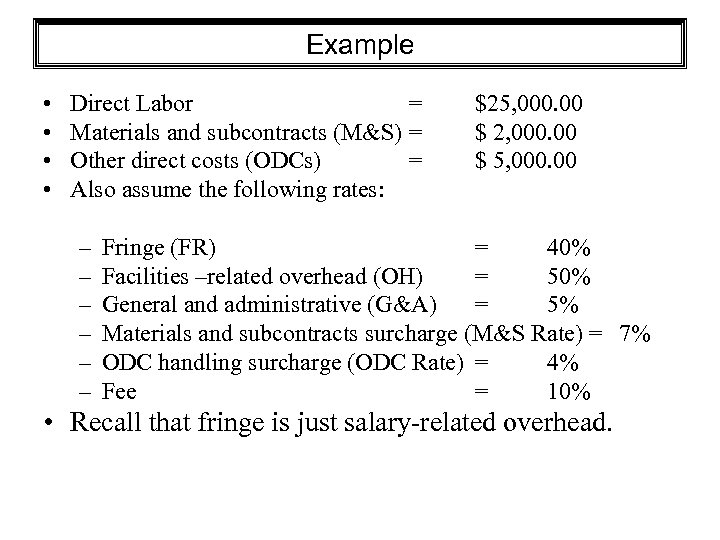
Example • • Direct Labor = Materials and subcontracts (M&S) = Other direct costs (ODCs) = Also assume the following rates: – – – $25, 000. 00 $ 2, 000. 00 $ 5, 000. 00 Fringe (FR) = 40% Facilities –related overhead (OH) = 50% General and administrative (G&A) = 5% Materials and subcontracts surcharge (M&S Rate) = 7% ODC handling surcharge (ODC Rate) = 4% Fee = 10% • Recall that fringe is just salary-related overhead.
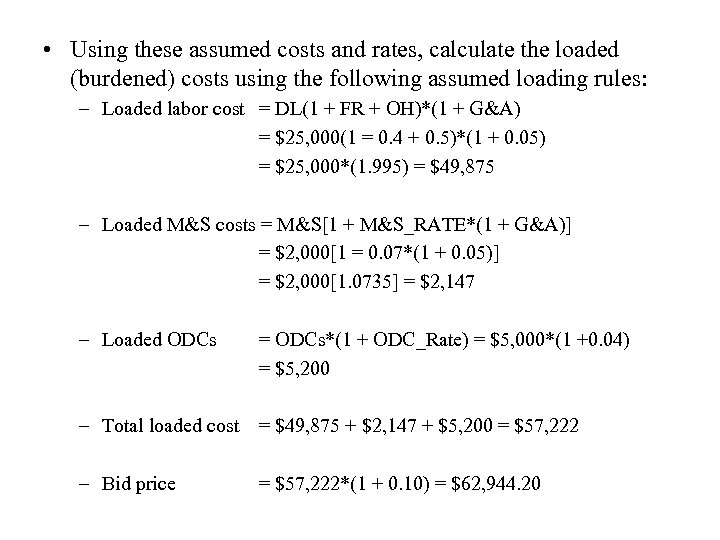
• Using these assumed costs and rates, calculate the loaded (burdened) costs using the following assumed loading rules: – Loaded labor cost = DL(1 + FR + OH)*(1 + G&A) = $25, 000(1 = 0. 4 + 0. 5)*(1 + 0. 05) = $25, 000*(1. 995) = $49, 875 – Loaded M&S costs = M&S[1 + M&S_RATE*(1 + G&A)] = $2, 000[1 = 0. 07*(1 + 0. 05)] = $2, 000[1. 0735] = $2, 147 – Loaded ODCs = ODCs*(1 + ODC_Rate) = $5, 000*(1 +0. 04) = $5, 200 – Total loaded cost = $49, 875 + $2, 147 + $5, 200 = $57, 222 – Bid price = $57, 222*(1 + 0. 10) = $62, 944. 20
![[US] Commercial Bid • The cost and price for commercial bids are computed using](https://present5.com/presentation/8c805180652465f8373b71db900366bb/image-23.jpg "[US] Commercial Bid • The cost and price for commercial bids are computed using")
[US] Commercial Bid • The cost and price for commercial bids are computed using a gross margin rate: • TDC = Total Direct Costs = Labor (loaded with fringe) + Materials + Subcontracts + ODCs • GM = Gross margin (%) = OH + G&A + Fee • Bid price = TDC*(1 + GM) • Using he same values for costs and rates as before: – – – Labor = ($25, 000. 00)*(1. 40) = $35, 000. 00 Materials and subcontracts = $2, 000. 00 Other direct costs = $5, 000. 00 TDC = $35, 000. 00 + $2, 000. 00 + $5, 000. 00 = $42, 000. 00 Gross margin (GM) = OH + G&A + Fee = 0. 50 + 0. 05 + 0. 10 = 0. 65 Bid price = TDC*(1 + GM) - $42, 000. 00*1. 65 = $69, 300. 00 • The commercial price is about higher by $6, 000. 00 because of overhead charges applied to both the materials and subcontracts costs and to the ODCs.
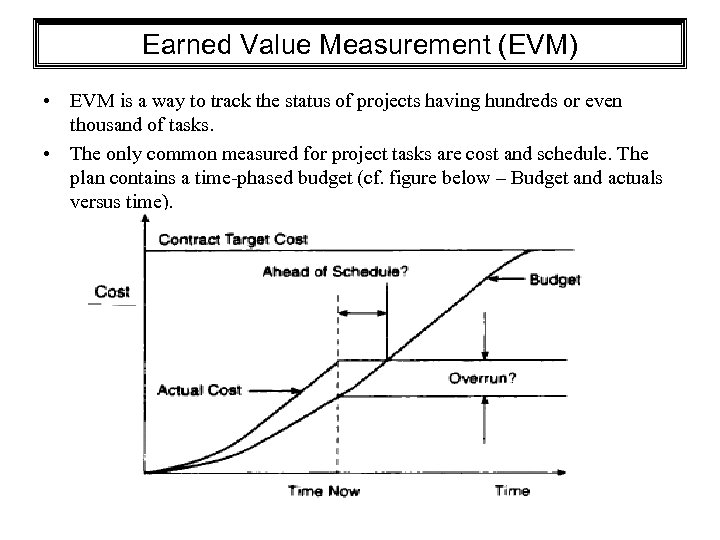
Earned Value Measurement (EVM) • EVM is a way to track the status of projects having hundreds or even thousand of tasks. • The only common measured for project tasks are cost and schedule. The plan contains a time-phased budget (cf. figure below – Budget and actuals versus time).
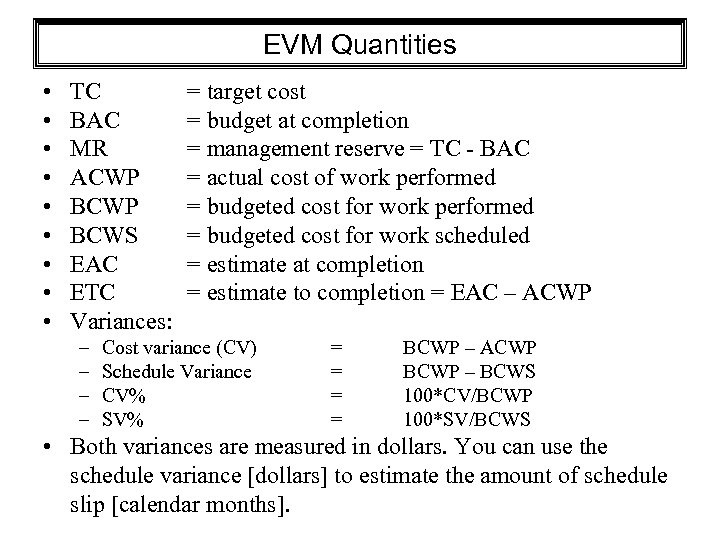
EVM Quantities • • • TC BAC MR ACWP BCWS EAC ETC Variances: – – = target cost = budget at completion = management reserve = TC - BAC = actual cost of work performed = budgeted cost for work scheduled = estimate at completion = estimate to completion = EAC – ACWP Cost variance (CV) Schedule Variance CV% SV% = = BCWP – ACWP BCWP – BCWS 100*CV/BCWP 100*SV/BCWS • Both variances are measured in dollars. You can use the schedule variance [dollars] to estimate the amount of schedule slip [calendar months].
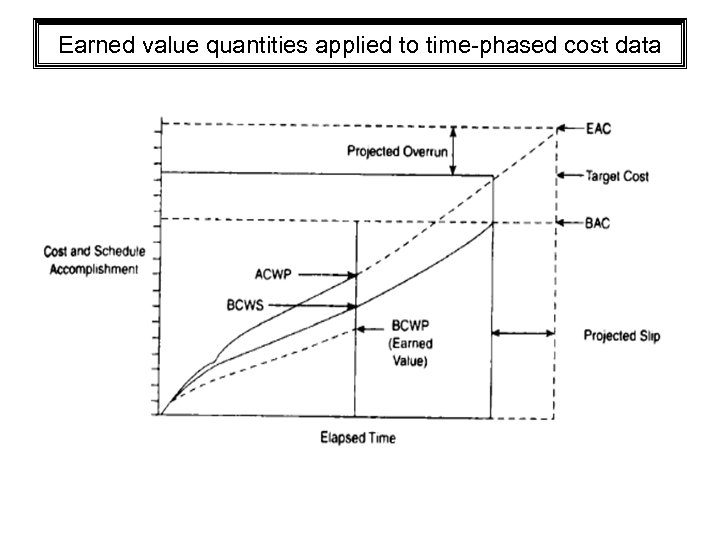
Earned value quantities applied to time-phased cost data
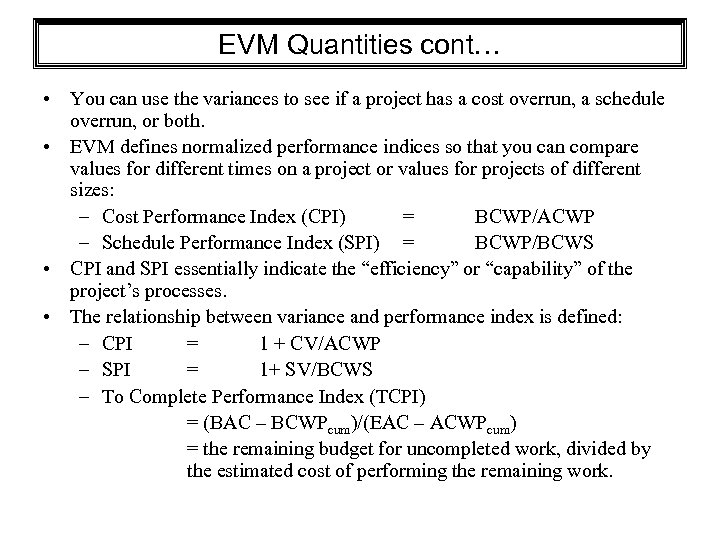
EVM Quantities cont… • You can use the variances to see if a project has a cost overrun, a schedule overrun, or both. • EVM defines normalized performance indices so that you can compare values for different times on a project or values for projects of different sizes: – Cost Performance Index (CPI) = BCWP/ACWP – Schedule Performance Index (SPI) = BCWP/BCWS • CPI and SPI essentially indicate the “efficiency” or “capability” of the project’s processes. • The relationship between variance and performance index is defined: – CPI = 1 + CV/ACWP – SPI = 1+ SV/BCWS – To Complete Performance Index (TCPI) = (BAC – BCWPcum)/(EAC – ACWPcum) = the remaining budget for uncompleted work, divided by the estimated cost of performing the remaining work.
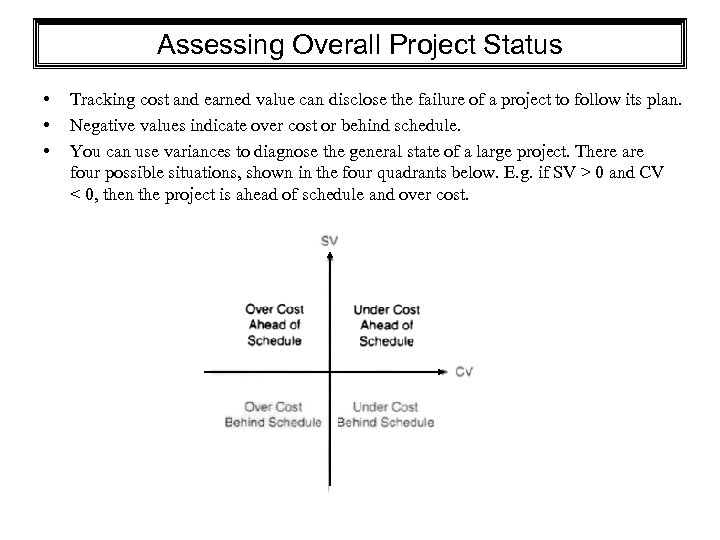
Assessing Overall Project Status • • • Tracking cost and earned value can disclose the failure of a project to follow its plan. Negative values indicate over cost or behind schedule. You can use variances to diagnose the general state of a large project. There are four possible situations, shown in the four quadrants below. E. g. if SV > 0 and CV < 0, then the project is ahead of schedule and over cost.
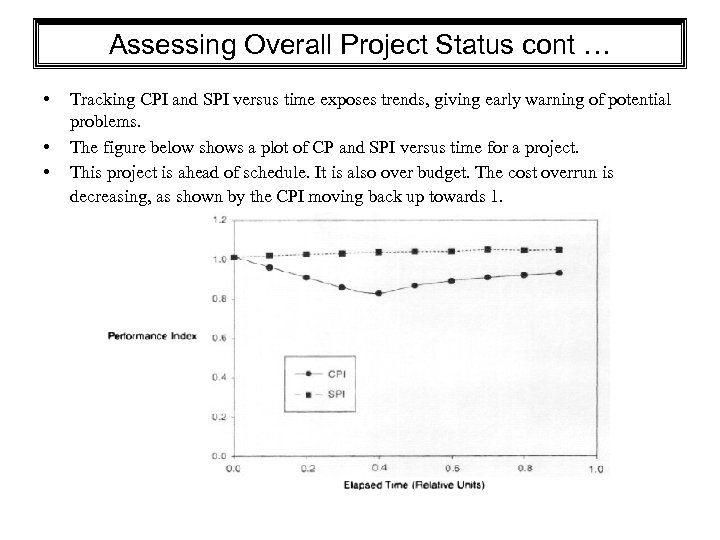
Assessing Overall Project Status cont … • • • Tracking CPI and SPI versus time exposes trends, giving early warning of potential problems. The figure below shows a plot of CP and SPI versus time for a project. This project is ahead of schedule. It is also over budget. The cost overrun is decreasing, as shown by the CPI moving back up towards 1.
Summary • EVM tracks progress with respect to a plan (time-phased budget) and is especially important for large projects having hundreds or thousands of tasks. • EVM compares the amount of progress (BCWP) to the amount of work planned to complete (BCWS) by a given time. • Earned value techniques can identify cost and schedule problems. A task is over budget if ACWP > BCWP. A task is late if BCWS > BCWP. • Further reference: – Richard D. Stutske, Estimating Software-Intensive Systems, ISBN 0201 -70312 -2, 2005, Addison-Wesley, The SEI Series in Software Engineering.
Скачать презентацию Estimating Software Calculating Cost Price and Bid Price
8c805180652465f8373b71db900366bb.ppt