


 Скачать презентацию Estimates of Ground-Water Recharge in Minnesota Research supported
a9186644d5f1d19f15862d5c0edf289c.ppt
- Количество слайдов: 38
 Estimates of Ground-Water Recharge in Minnesota Research supported by the USGS, Office of Ground Water and DNR Waters Dave Lorenz and Geoffrey Delin USGS Water Science Center of Minnesota
 Study Objectives Quantify recharge to unconfined sand gravel aquifers in Minnesota using multiple methods representing different time and spatial scales. Compare and contrast the results.
 Estimation Methods Used Multiple regression analysis relating recharge to precipitation, ET, and soils data (Regional Regression Recharge) Ground-water level fluctuation (watertable fluctuation) Unsaturated-zone water balance (zeroflux plane) Ground-water age dating
 Regional Regression Recharge Method Recharge based on the Rorabaugh method that estimates average recharge in a drainage basin from streamflow records.
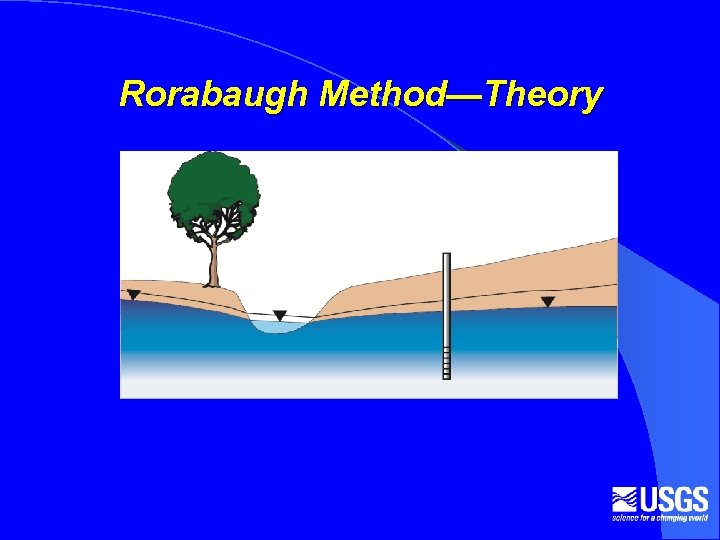 Rorabaugh Method—Theory
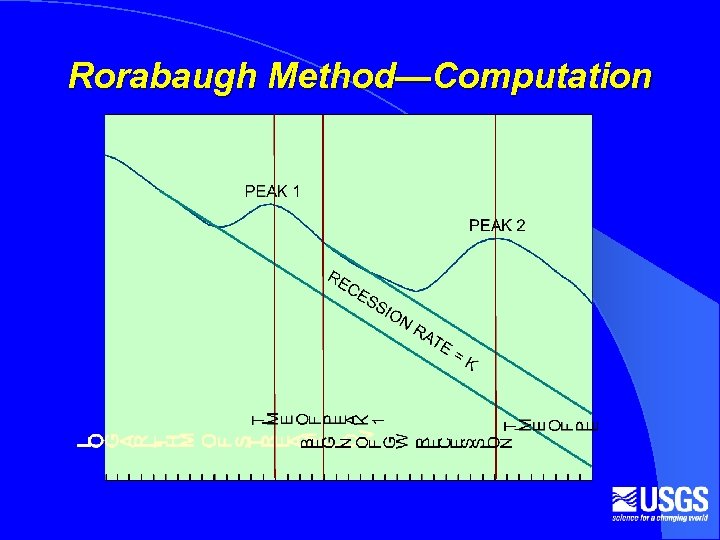 Rorabaugh Method—Computation
 Stream Gaging Station Selection Criteria reviewed: length of record, common periods of record, missing data, size of watershed, (maximum of 3, 000 mi 2), and existence of control structures (dams or diversions). 40 stations selected based on these criteria
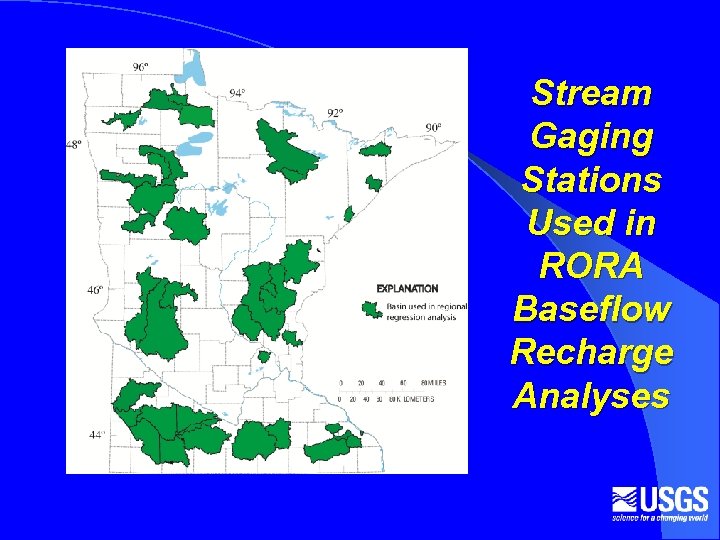 Stream Gaging Stations Used in RORA Baseflow Recharge Analyses
 Landscape Characteristics Several landscape characteristics were considered originally: Soil characteristics; Percent sand, percent clay, porosity, bulk density, permeability, and specific yield. Other landscape characteristics: percent various classes of geologic deposits in basin, basin slope, stream slope, and percent lake area in basin.
 Landscape Characteristics—Final Decided to use specific yield (SY) as the landscape characteristic in the model: Direct measure of the capacity of the material to hold and release water under gravity. This is a linear property. That makes it possible to project back to the land surface. Highly correlated with other properties that affect recharge—permeability and hydraulic conductivity.
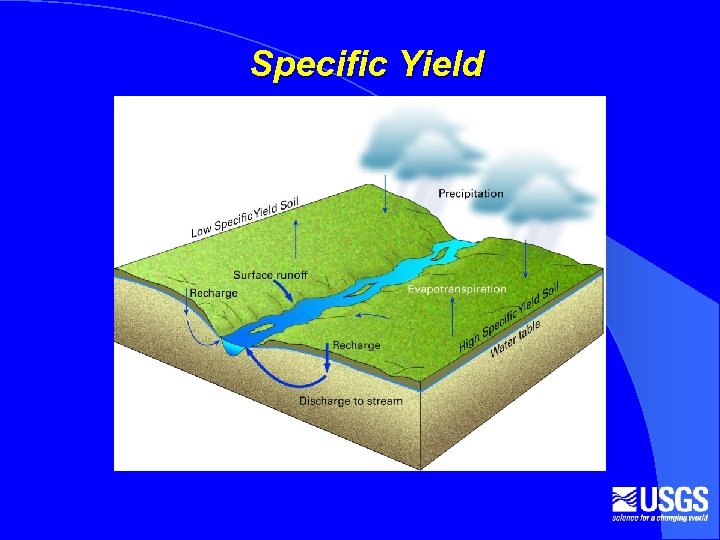 Specific Yield
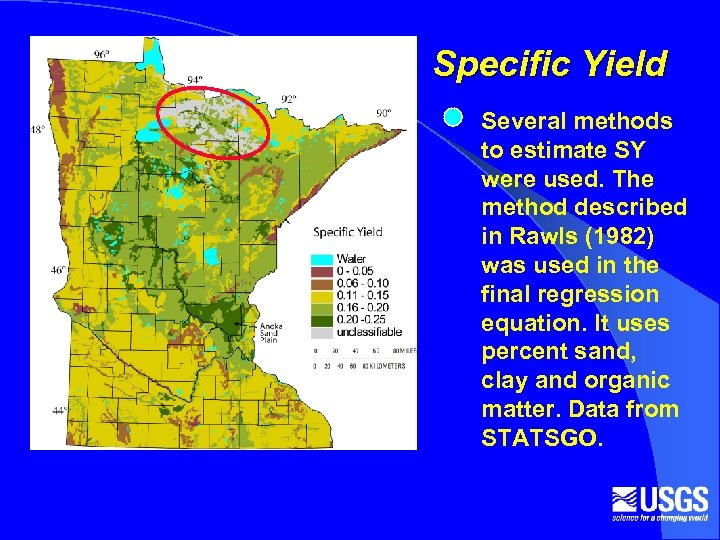 Specific Yield Several methods to estimate SY were used. The method described in Rawls (1982) was used in the final regression equation. It uses percent sand, clay and organic matter. Data from STATSGO.
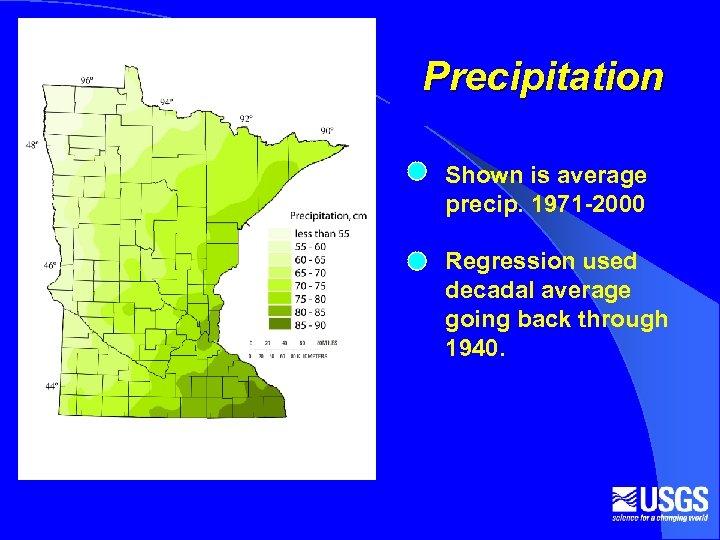 Precipitation Shown is average precip. 1971 -2000 inches Regression used decadal average going back through 1940.
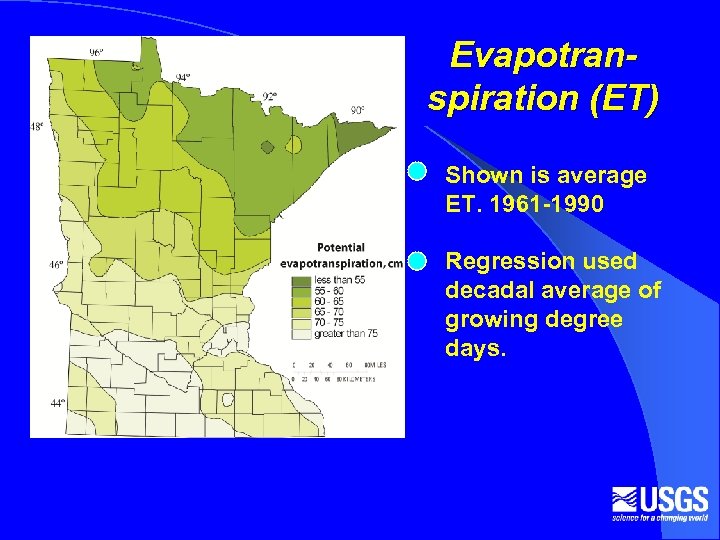 Evapotranspiration (ET) Shown is average ET. 1961 -1990 Regression used decadal average of growing degree days.
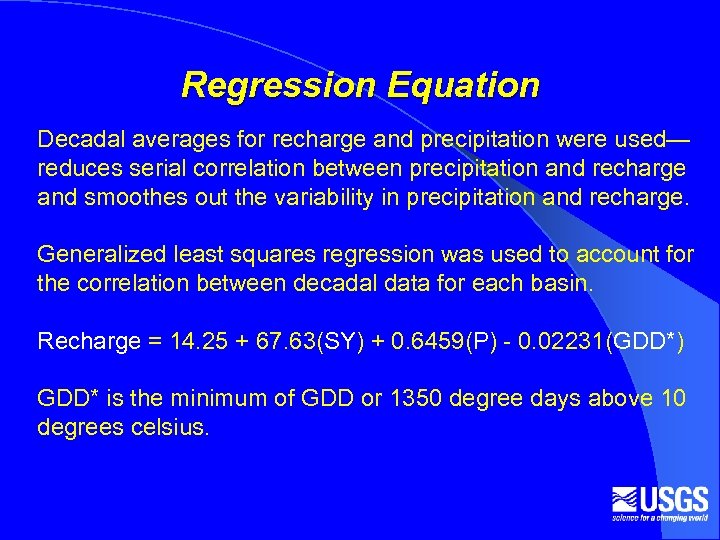 Regression Equation Decadal averages for recharge and precipitation were used— reduces serial correlation between precipitation and recharge and smoothes out the variability in precipitation and recharge. Generalized least squares regression was used to account for the correlation between decadal data for each basin. Recharge = 14. 25 + 67. 63(SY) + 0. 6459(P) - 0. 02231(GDD*) GDD* is the minimum of GDD or 1350 degree days above 10 degrees celsius.
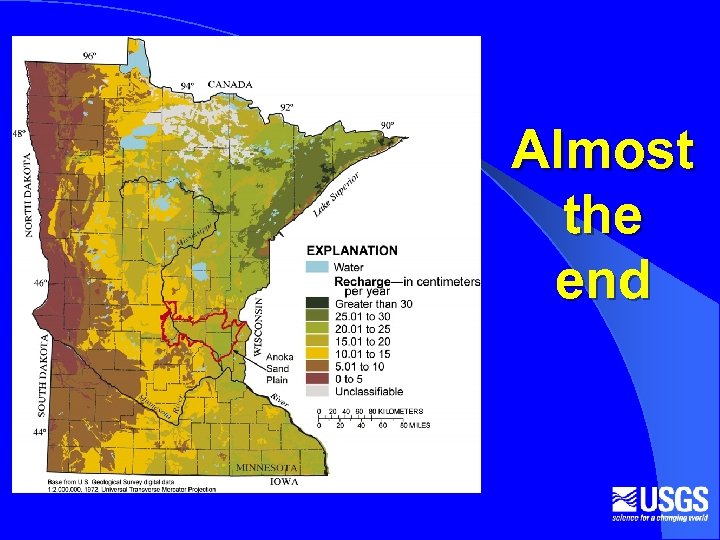
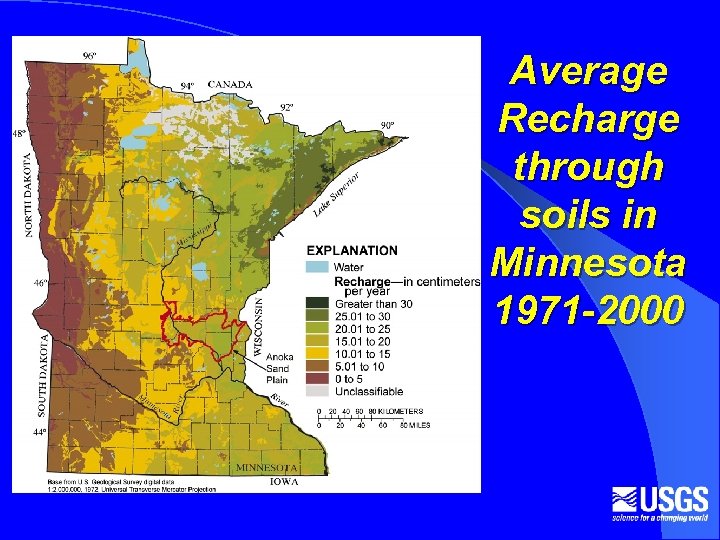 Average Recharge through soils in Minnesota 1971 -2000
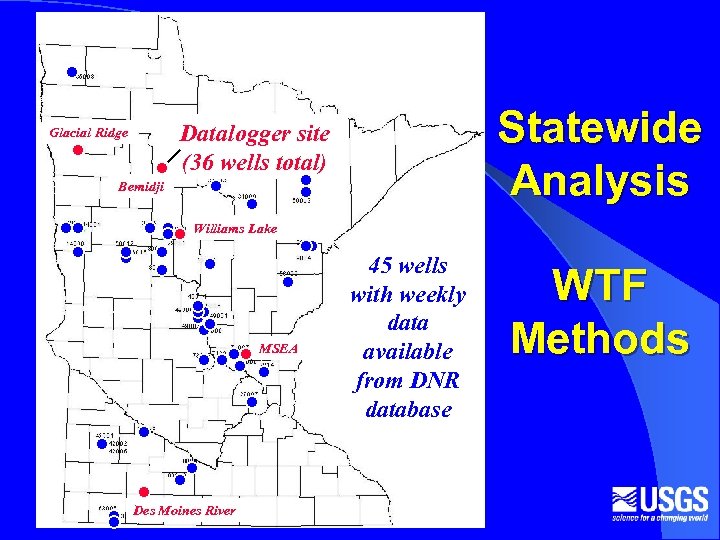
 Water-Table Fluctuation (WTF) Method Data from 38 wells equipped with data loggers at five different sites Temporal variability in recharge
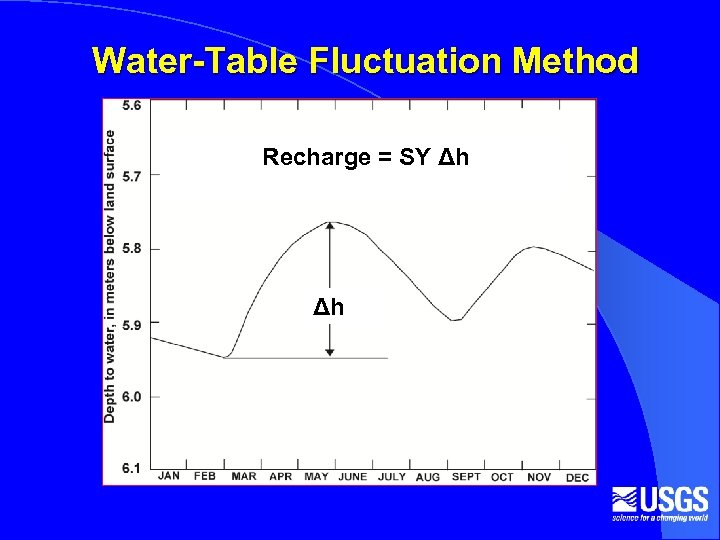 Water-Table Fluctuation Method Recharge = SY Δh Δh
 Multiple WTF Methods Utilized Graphical method RISE program (Rutledge, 2003) Master Recession Curve
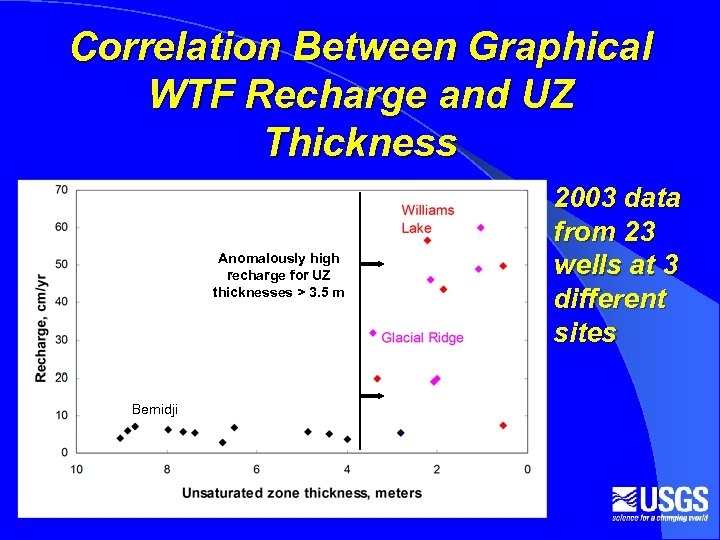 Correlation Between Graphical WTF Recharge and UZ Thickness Anomalously high recharge for UZ thicknesses > 3. 5 m Bemidji 2003 data from 23 wells at 3 different sites
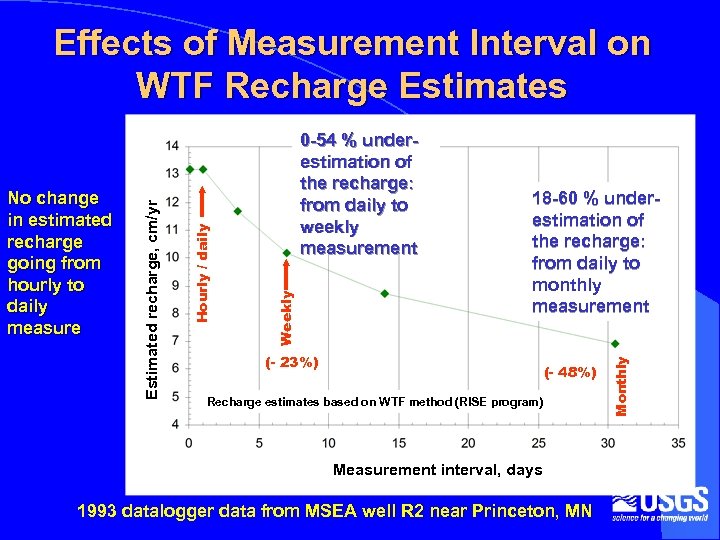 18 -60 % underestimation of the recharge: from daily to monthly measurement (- 23%) (- 48%) Recharge estimates based on WTF method (RISE program) Measurement interval, days 1993 datalogger data from MSEA well R 2 near Princeton, MN Monthly 0 -54 % underestimation of the recharge: from daily to weekly measurement Weekly Hourly / daily No change in estimated recharge going from hourly to daily measure Estimated recharge, cm/yr Effects of Measurement Interval on WTF Recharge Estimates
 Unsaturated-Zone Water Balance (zero-flux plane) Method Bemidji, Williams Lake, and Princeton MSEA sites Temporal variability in recharge
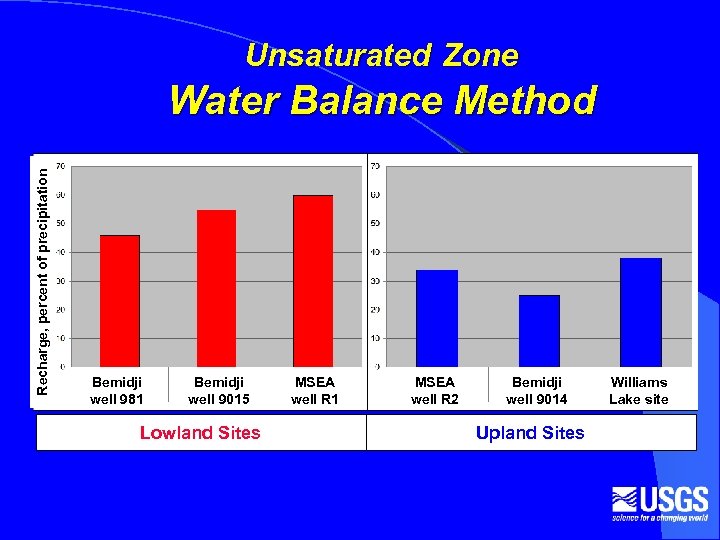 Unsaturated Zone Recharge, percent of precipitation Water Balance Method Bemidji well 981 Bemidji well 9015 Lowland Sites MSEA well R 1 MSEA well R 2 Bemidji well 9014 Upland Sites Williams Lake site
 Ground-Water Age Dating Method Average recharge, spatial variability
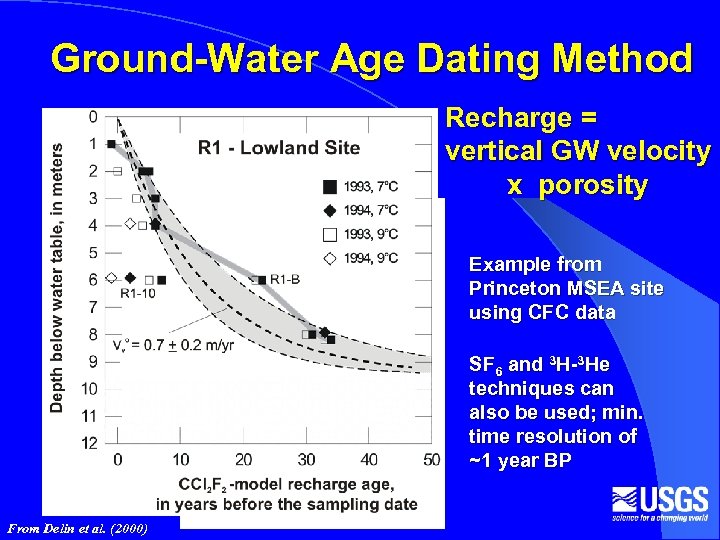 Ground-Water Age Dating Method Recharge = vertical GW velocity x porosity Example from Princeton MSEA site using CFC data SF 6 and 3 H-3 He techniques can also be used; min. time resolution of ~1 year BP From Delin et al. (2000)
 Method Comparison
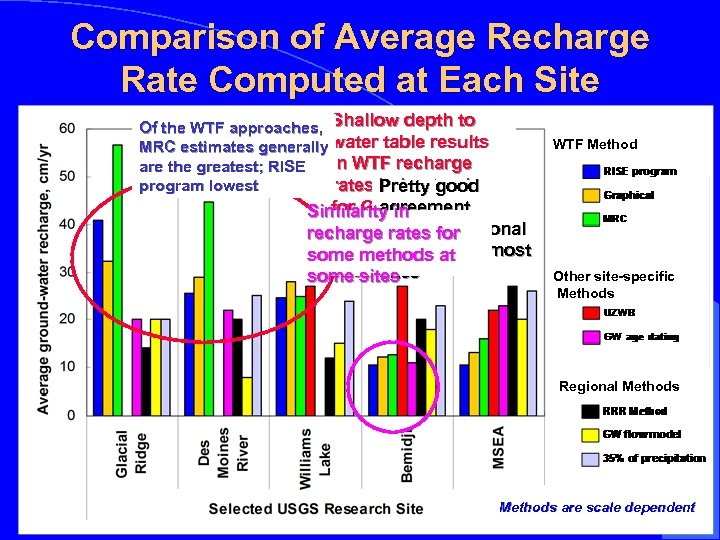 Comparison of Average Recharge Rate Computed at Each Site Of the WTF approaches, Shallow depth to MRC estimates generally water table results in WTF recharge are the greatest; RISE program lowest rates Pretty too large being good for Glacial agreement Similarity in Ridge, Des Moines for between regional recharge rates River, and Williams Lake estimates some methods at at most sites some sites WTF Method Other site-specific Methods Regional Methods are scale dependent
 Almost the end
 Statewide Analysis Datalogger site (36 wells total) Glacial Ridge Bemidji Williams Lake MSEA Des Moines River 45 wells with weekly data available from DNR database WTF Methods
 Graphical Method Manual method for estimating recharge. Developed in the late 1950 s. Baseline recession that would have occurred in the absence of recharge projected to the time of peak in the hydrograph. The value of Δh determined manually.
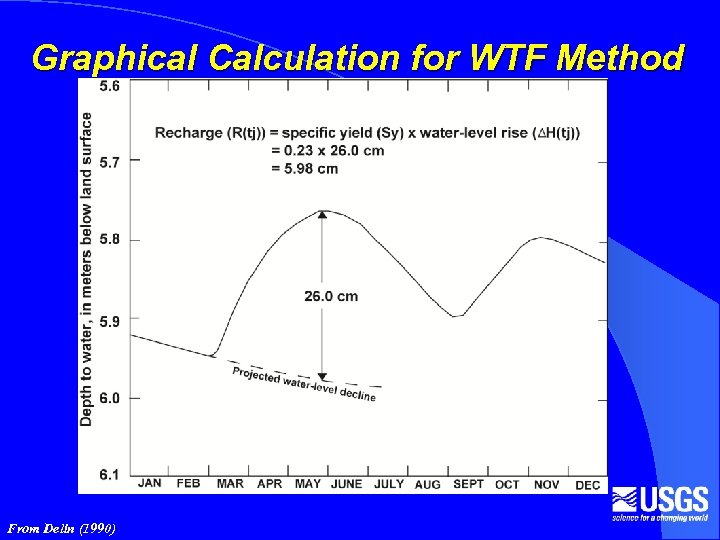 Graphical Calculation for WTF Method From Delin (1990)
 RISE Program Simple program that calculates the daily rise of water level in an observation well. The program makes no allowance for the baseline recession that would have occurred in the absence of recharge. The input data can be read right out of NWIS Web or can be created from data logger files. Rutledge (2003) electronic communication
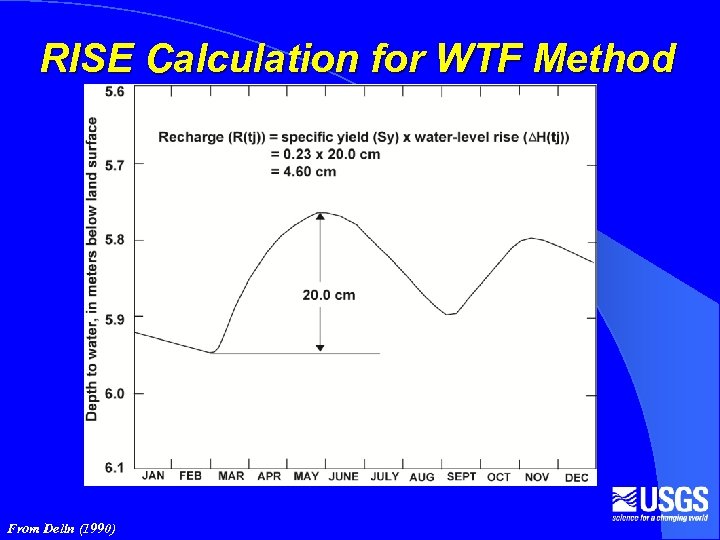 RISE Calculation for WTF Method From Delin (1990)
 Master Recession Curve Method First step is to define a Master Recession Curve from “typical” recessions for a well. This is accomplished by a nonlinear regression that estimates the recession rate and recession asymptote. Other methods for estimating a master recession curve have also been developed. Program calculates the daily recession of water level in an observation well and the rise from the difference between theoretical recession and the actual water level.
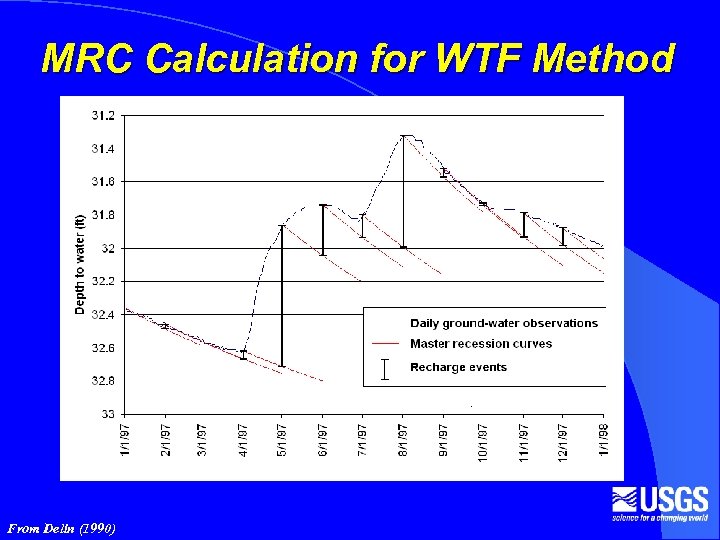 MRC Calculation for WTF Method From Delin (1990)
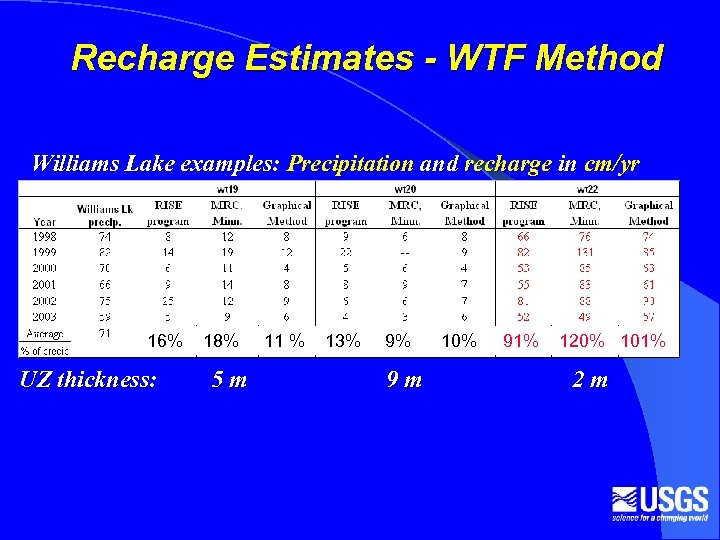 Recharge Estimates - WTF Method Williams Lake examples: Precipitation and recharge in cm/yr 16% UZ thickness: 18% 5 m 11 % 13% 9% 9 m 10% 91% 120% 101% 2 m
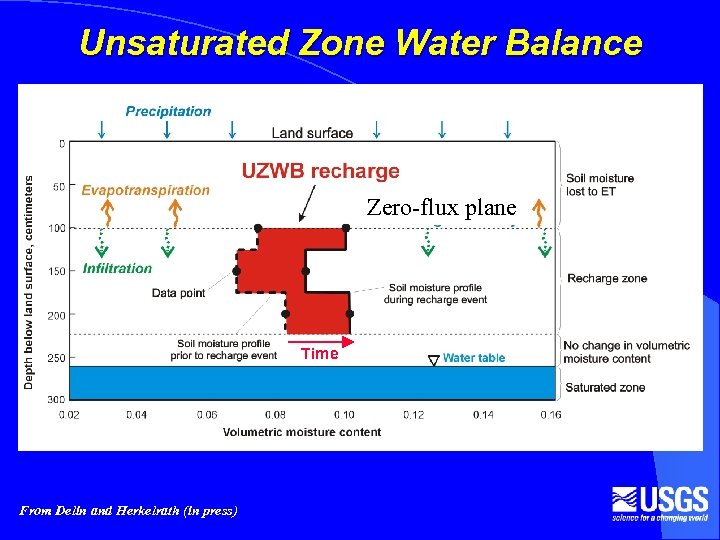 Unsaturated Zone Water Balance Zero-flux plane Time From Delin and Herkelrath (in press)
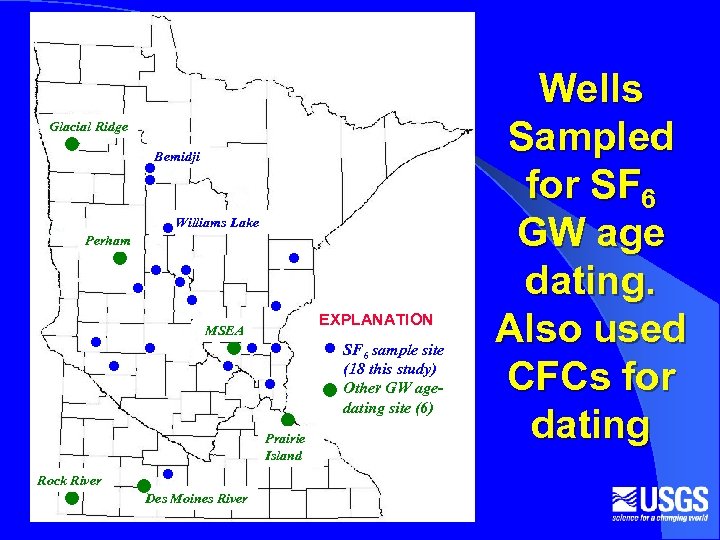 Glacial Ridge Bemidji Williams Lake Perham MSEA Prairie Island Rock River Des Moines River 22 wells sampled site for SF 6 sample SF 6, (18 this study) Other GW ageincluding dating site (6) 2 nests EXPLANATION Wells Sampled for SF 6 GW age dating. Also used CFCs for dating