 Скачать презентацию Establishment and evaluation of garlic collection from Central
517908387b50a2e10031707839a82b81.ppt
- Количество слайдов: 38



Establishment and evaluation of garlic collection from Central Asia for fertility potential and organo-S compounds EU project “Garlic and Health” - Work Package 1 Israel: Rina Kamenetsky and Haim D. Rabinowitch Idit London, Marina Baizerman, Ada Harazy and Amit Shiftan Uzbekistan: Furkat Khassanov and Habibullo Shomuradov The Netherlands: Chris Kik, A. W. van Heusden, R. Vrielink-van Ginkel and K. Burger-Meijer France: Jacques Auger and Ingrid Arnault
Workpackage 1: Genetic Resources Objectives • Construct a large collection of garlic landraces and of close wild relatives, in order to expand the available diversity; • Construction and maintenance of a core collection; • Screening for fertility;
Workpackage 1: Genetic Resources Objective 1 Construct a large collection of garlic landraces and of close wild relatives, in order to expand the available diversity. Israel: Rina Kamenetsky and Haim D. Rabinowitch Idit London, Marina Baizerman, Ada Harazy and Amit Shiftan Uzbekistan: Furkat Khassanov
Rationale Biochemical and molecular studies suggest that the highest level of heterogeneity prevails within the Central Asian cultivar group (Hong, 1999; Maaβ & Klaas, 1993; Pooler & Simon, 1995), which could serve as the most important source for garlic genetic variation and improvement (Etoh & Simon, 2002; Kamenetsky et al. , 2003 a; 2003 b).
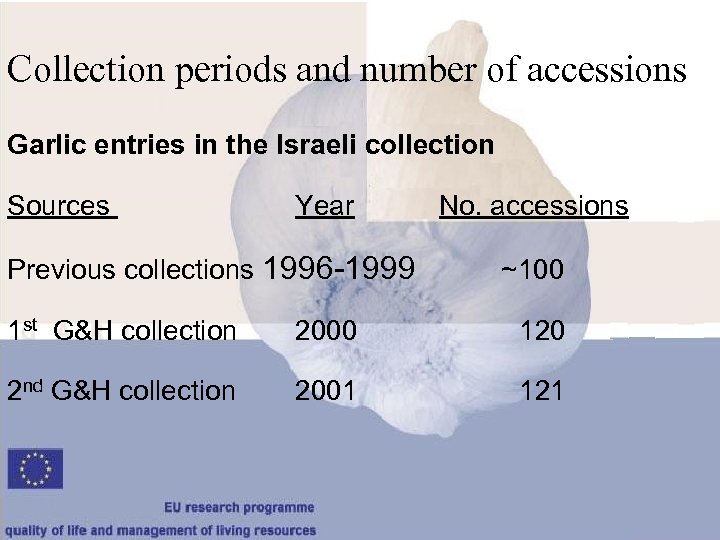
Collection periods and number of accessions Garlic entries in the Israeli collection Sources Year Previous collections 1996 -1999 No. accessions ~100 1 st G&H collection 2000 120 2 nd G&H collection 2001 121
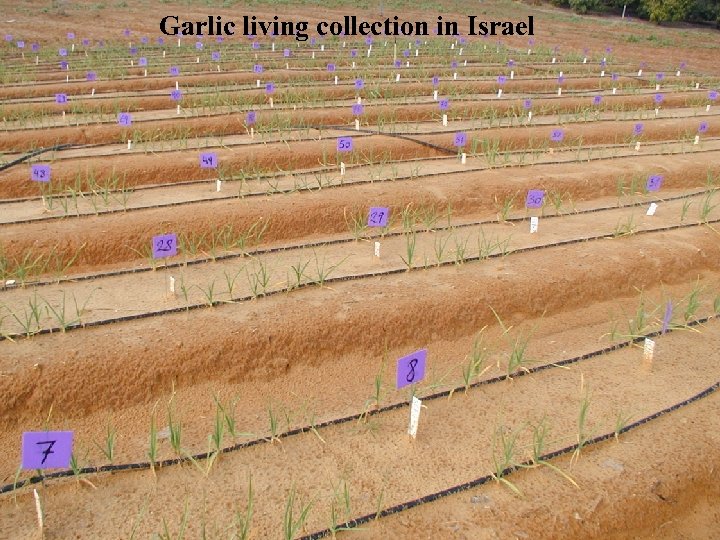
Garlic living collection in Israel
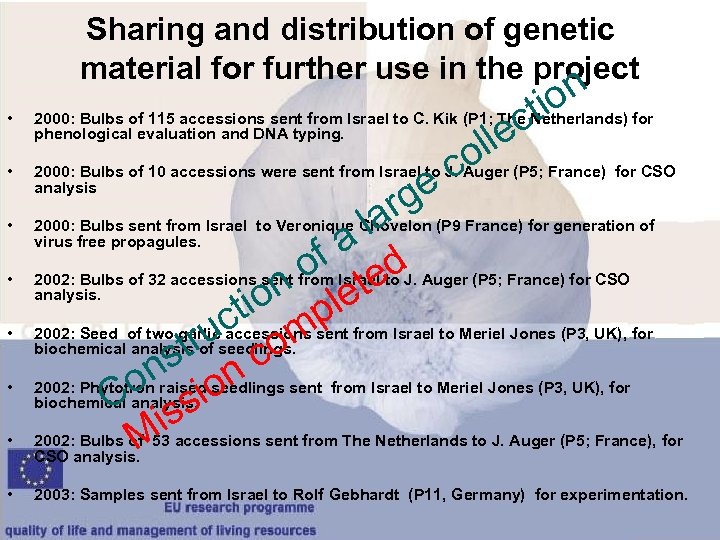
Sharing and distribution of genetic material for further use in the project • • on for ti 2000: Bulbs of 115 accessions sent from Israel to C. Kik (P 1; The Netherlands) phenological evaluation and DNA typing. ec ll 2000: Bulbs of 10 accessions were sent from Israel to J. Auger (P 5; France) for CSO co analysis ge ar 2000: Bulbs sent from Israel to Veronique Chovelon (P 9 France) for generation of l virus free propagules. a f Israel to J. Auger (P 5; France) for CSO o ted 2002: Bulbs of 32 accessions sent from analysis. on ple ti sent from Israel to Meriel Jones (P 3, UK), for 2002: Seed of two garlic c accessions useedlings. m biochemical analysis r t of co ns on sent from Israel to Meriel Jones (P 3, UK), for 2002: Phytotron raised seedlings o biochemical analysis. i C ss i 2002: Bulbs of 53 accessions sent from The Netherlands to J. Auger (P 5; France), for M CSO analysis. 2003: Samples sent from Israel to Rolf Gebhardt (P 11, Germany) for experimentation.
Workpackage 1: Genetic Resources Objective 2 Construction and maintenance of a core collection;
Evaluation of garlic collections from Central Asia for fertility potential and other economic traits EU project “Garlic and Health” Israel: Rina Kamenetsky and Haim D. Rabinowitch Idit London, Marina Baizerman, Ada Harazy and Amit Shiftan Uzbekistan: Furkat Khassanov and Habibullo Shomuradov The Netherlands: Chris Kik, A. W. van Heusden, R. Vrielink-van Ginkel and K. Burger-Meijer France: Jacques Auger and Ingrid Arnault
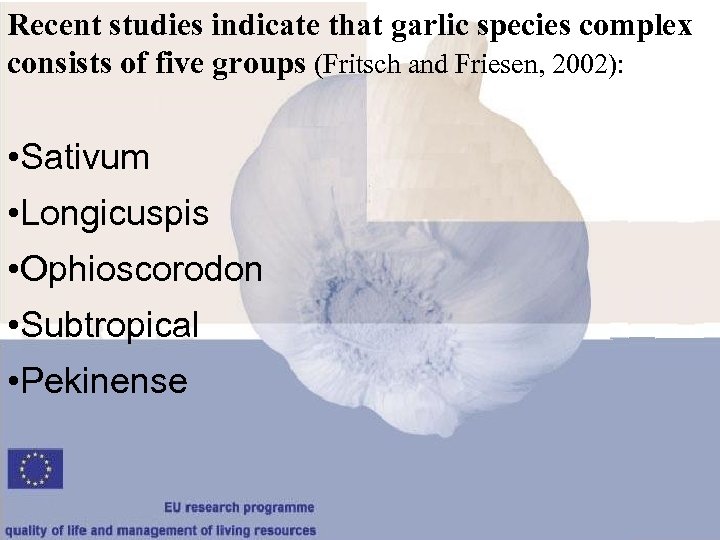
Recent studies indicate that garlic species complex consists of five groups (Fritsch and Friesen, 2002): • Sativum • Longicuspis • Ophioscorodon • Subtropical • Pekinense
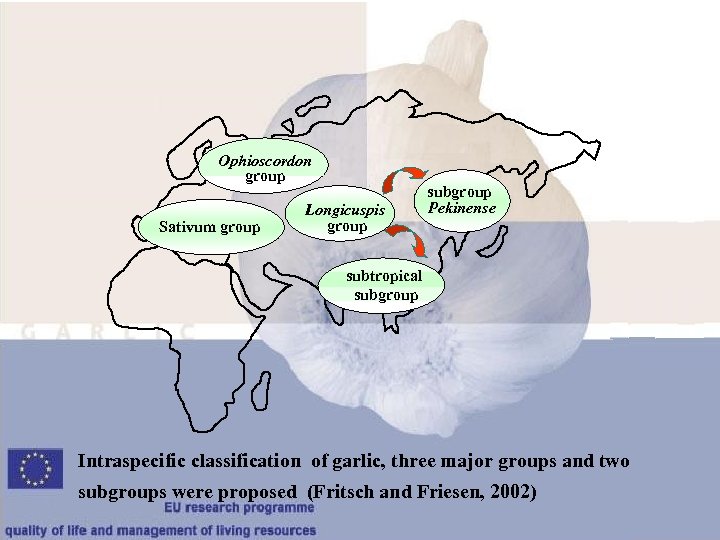
Ophioscordon group Sativum group Longicuspis group subgroup Pekinense subtropical subgroup Intraspecific classification of garlic, three major groups and two subgroups were proposed (Fritsch and Friesen, 2002)
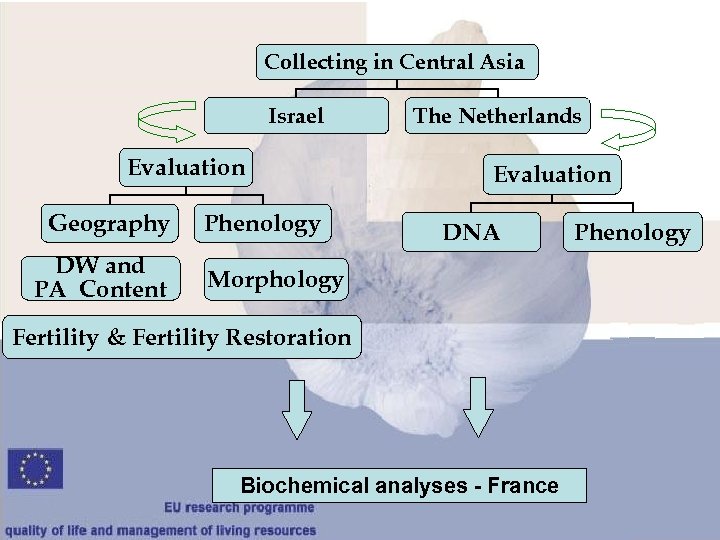
Collecting in Central Asia Israel Evaluation Geography DW and PA Content Phenology The Netherlands Evaluation DNA Morphology Fertility & Fertility Restoration Biochemical analyses - France Phenology
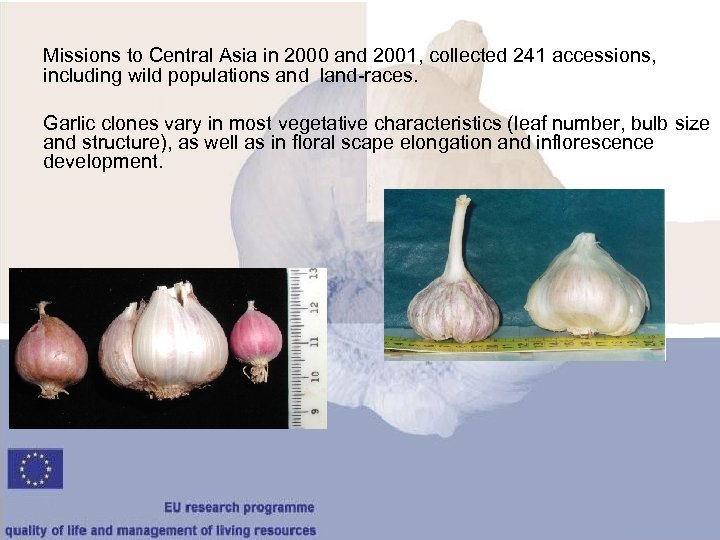
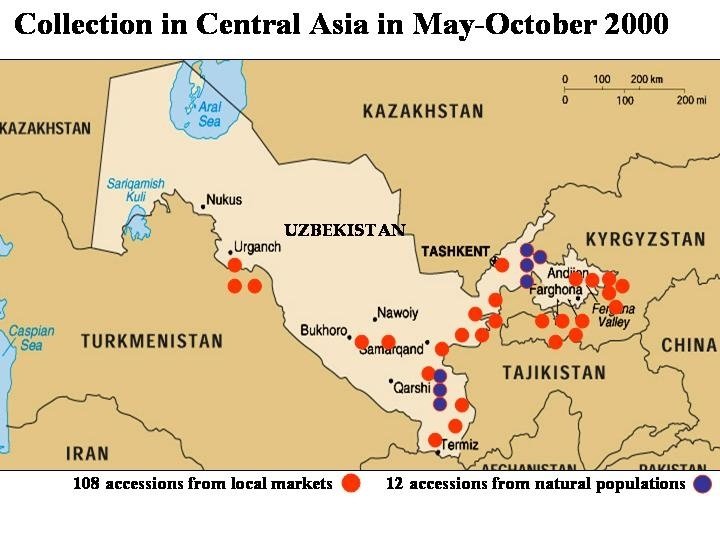
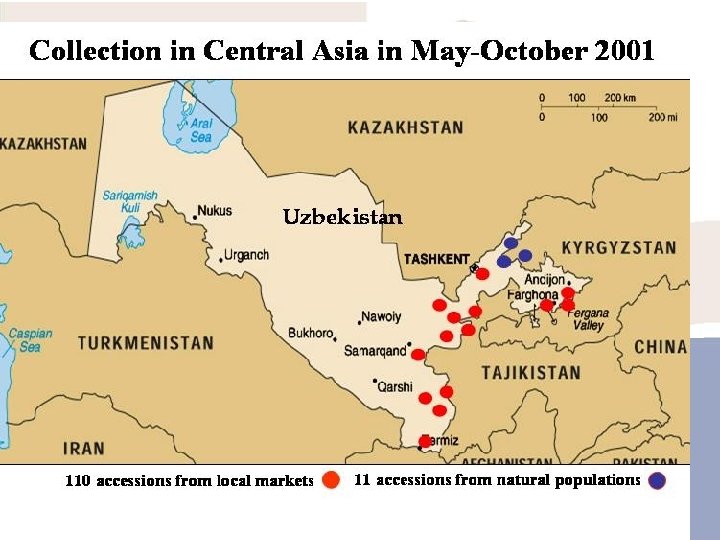
Missions to Central Asia in 2000 and 2001, collected 241 accessions, including wild populations and land-races. Garlic clones vary in most vegetative characteristics (leaf number, bulb size and structure), as well as in floral scape elongation and inflorescence development.
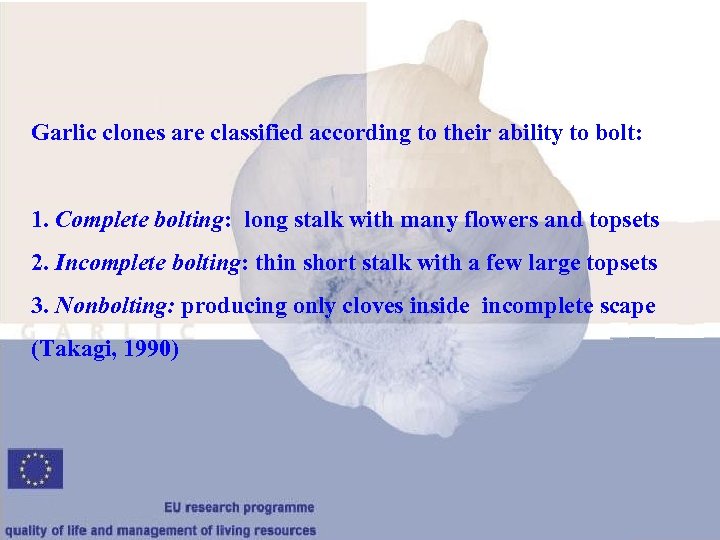
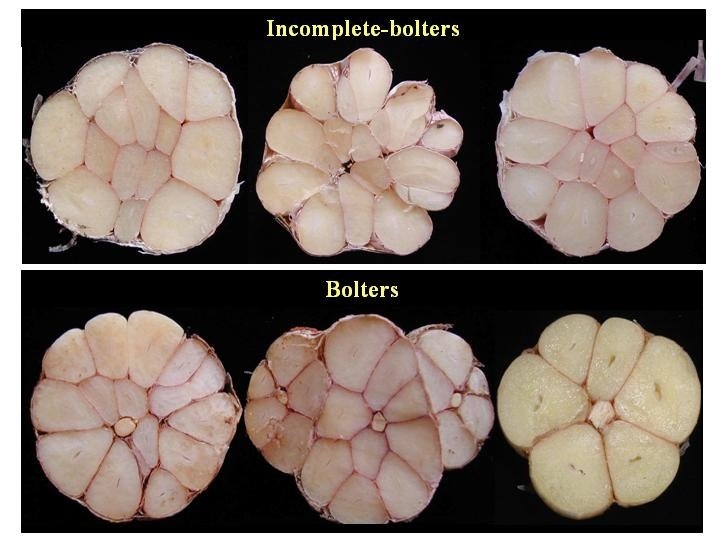
Garlic clones are classified according to their ability to bolt: 1. Complete bolting: long stalk with many flowers and topsets 2. Incomplete bolting: thin short stalk with a few large topsets 3. Nonbolting: producing only cloves inside incomplete scape (Takagi, 1990)
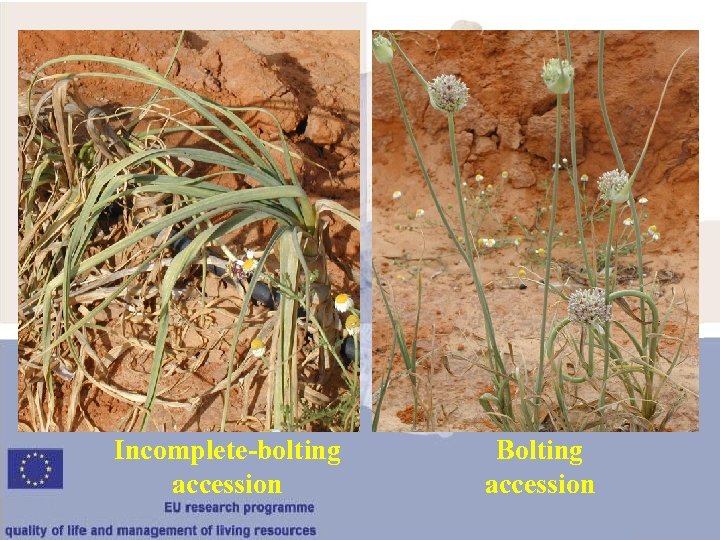
Incomplete-bolting accession Bolting accession
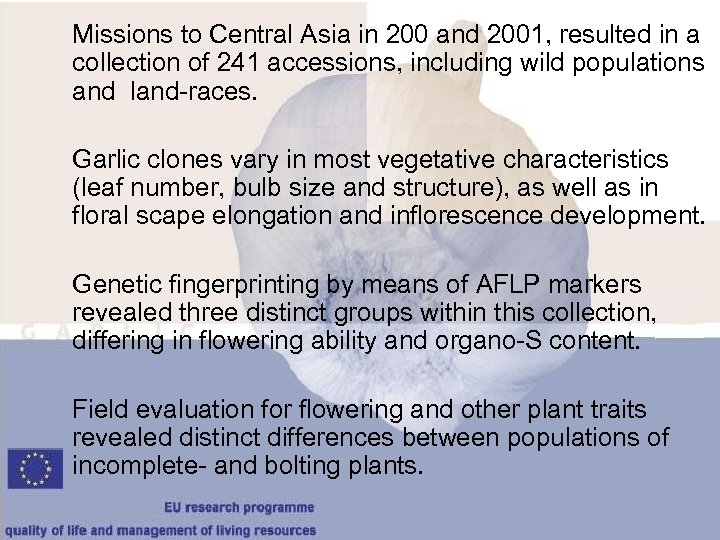
Missions to Central Asia in 200 and 2001, resulted in a collection of 241 accessions, including wild populations and land-races. Garlic clones vary in most vegetative characteristics (leaf number, bulb size and structure), as well as in floral scape elongation and inflorescence development. Genetic fingerprinting by means of AFLP markers revealed three distinct groups within this collection, differing in flowering ability and organo-S content (Chris Kik and co-workers)
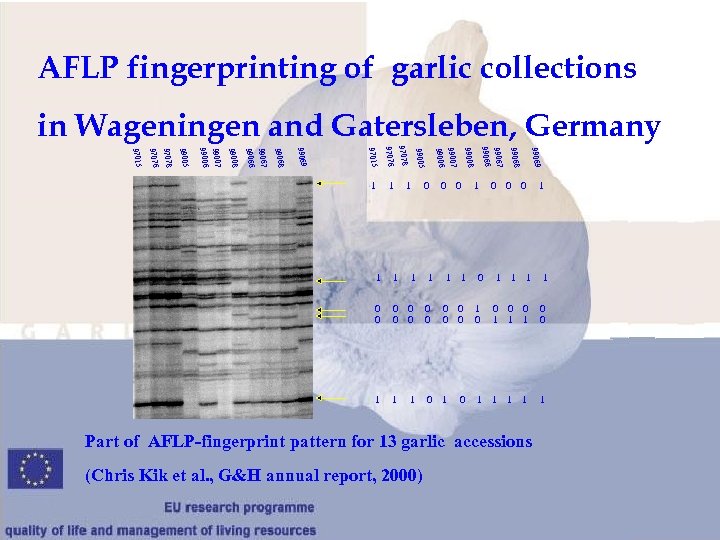
AFLP fingerprinting of garlic collections in Wageningen and Gatersleben, Germany 1 0 99069 0 99068 0 99067 0 99066 1 99008 99007 99006 1 99005 97078 97076 97015 99069 99068 99067 99066 99008 99007 99006 99005 97078 97076 97015 1 0 0 1 1 1 1 0 0 0 0 0 0 1 0 1 0 0 1 1 1 Part of AFLP-fingerprint pattern for 13 garlic accessions (Chris Kik et al. , G&H annual report, 2000)
Based on AFLP fingerprinting and one enzyme primer combination, the collection was subdivided into three distinct groups : Sativum, Longicuspis A and B. The groups differed considerably in AFLP variation: The variation within the Sativum group was significantly low compared to that in the Longicuspis groups.
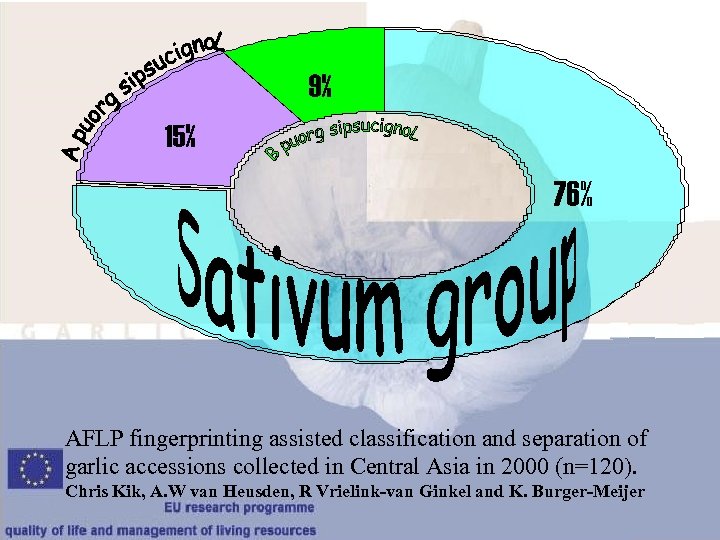
9% 15% 76% AFLP fingerprinting assisted classification and separation of garlic accessions collected in Central Asia in 2000 (n=120). Chris Kik, A. W van Heusden, R Vrielink-van Ginkel and K. Burger-Meijer
Recent studies indicate that garlic species complex consists of five groups (Fritsch and Friesen, 2002): • Sativum • Longicuspis • Ophioscorodon • Subtropical • Pekinense
Missions to Central Asia in 200 and 2001, resulted in a collection of 241 accessions, including wild populations and land-races. Garlic clones vary in most vegetative characteristics (leaf number, bulb size and structure), as well as in floral scape elongation and inflorescence development. Genetic fingerprinting by means of AFLP markers revealed three distinct groups within this collection, differing in flowering ability and organo-S content. Field evaluation for flowering and other plant traits revealed distinct differences between populations of incomplete- and bolting plants.
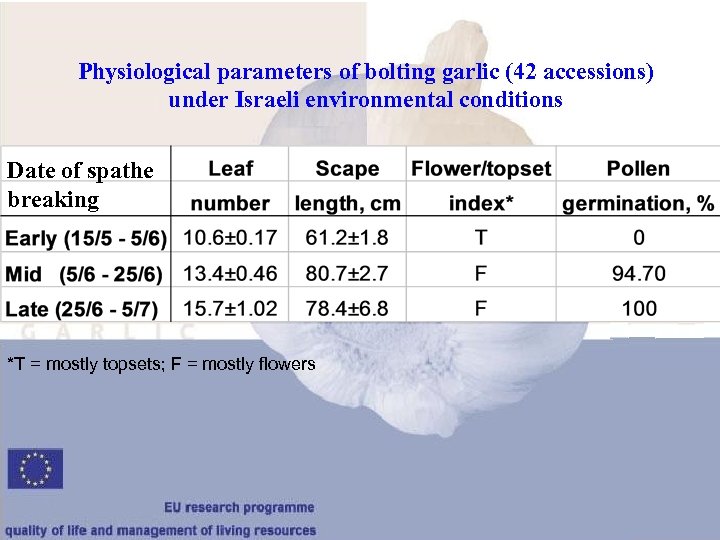
Physiological parameters of bolting garlic (42 accessions) under Israeli environmental conditions Date of spathe breaking *T = mostly topsets; F = mostly flowers
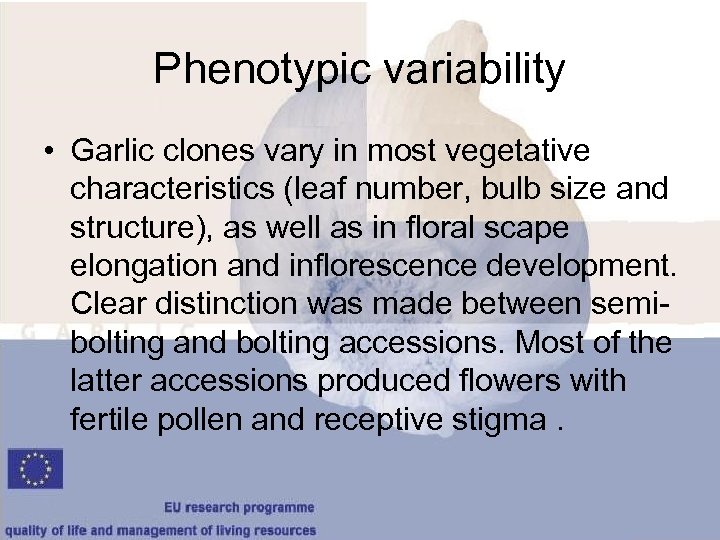
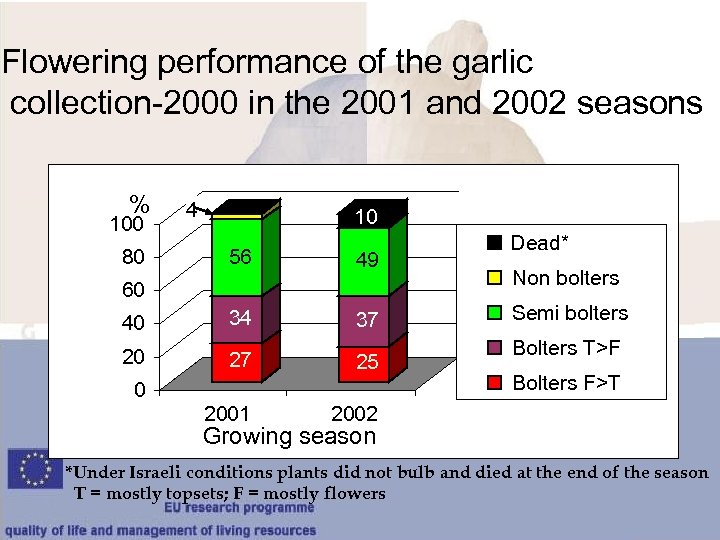
Phenotypic variability • Garlic clones vary in most vegetative characteristics (leaf number, bulb size and structure), as well as in floral scape elongation and inflorescence development. Clear distinction was made between semibolting and bolting accessions. Most of the latter accessions produced flowers with fertile pollen and receptive stigma.
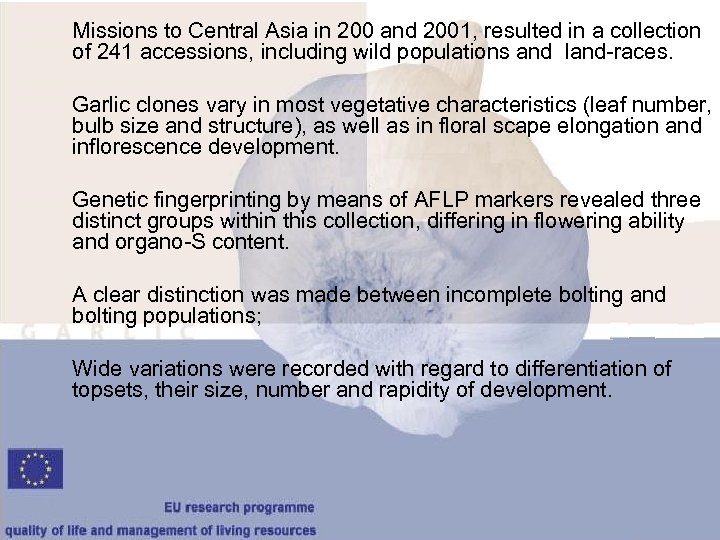
Missions to Central Asia in 200 and 2001, resulted in a collection of 241 accessions, including wild populations and land-races. Garlic clones vary in most vegetative characteristics (leaf number, bulb size and structure), as well as in floral scape elongation and inflorescence development. Genetic fingerprinting by means of AFLP markers revealed three distinct groups within this collection, differing in flowering ability and organo-S content. A clear distinction was made between incomplete bolting and bolting populations; Wide variations were recorded with regard to differentiation of topsets, their size, number and rapidity of development.
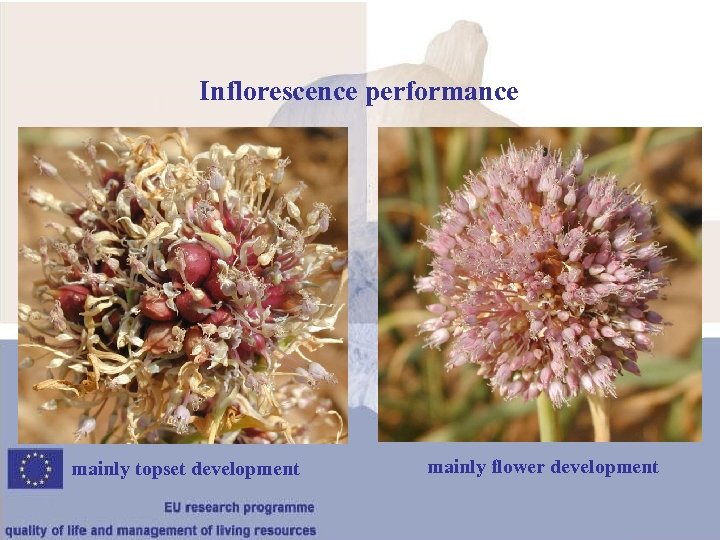
Inflorescence performance mainly topset development mainly flower development
Missions to Central Asia in 200 and 2001, resulted in a collection of 241 accessions, including wild populations and land-races. Garlic clones vary in most vegetative characteristics (leaf number, bulb size and structure), as well as in floral scape elongation and inflorescence development. Genetic fingerprinting by means of AFLP markers revealed three distinct groups within this collection, differing in flowering ability and organo-S content. A clear distinction was made between incomplete bolting and bolting populations; Wide variations were recorded with regard to differentiation of topsets, their size, number and rapidity of development. Significant variation in organo-S compounds (alliin, isoalliin, allicin and related dipeptides) was found within garlic collections and between plants grown under differing environmental conditions.
Raw material: Procedure: Samples raised in the Netherlands and Israel. HPLC-UV analyses. Jacques Auger and Ingrid Arnault
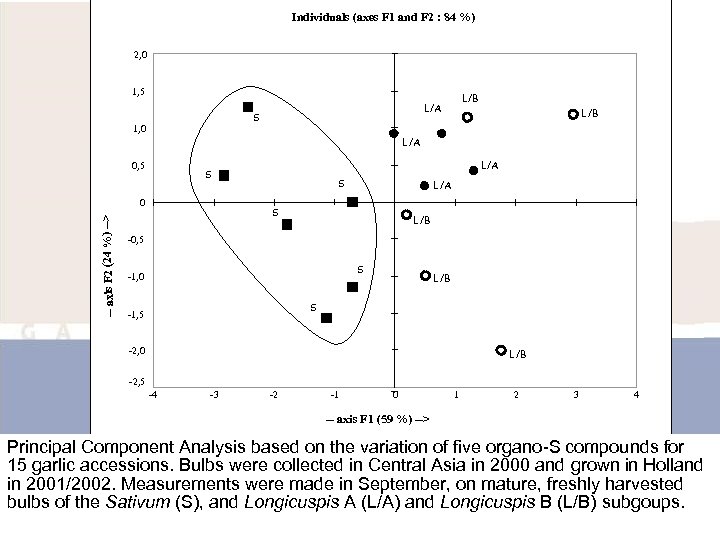
Individuals (axes F 1 and F 2 : 84 %) 2, 0 1, 5 S 1, 0 L/B L/A 0, 5 0 -- axis F 2 (24 %) --> L/A S S L/A S L/B -0, 5 S -1, 0 L/B S -1, 5 -2, 0 L/B -2, 5 -4 -3 -2 -1 0 1 2 3 4 -- axis F 1 (59 %) --> Principal Component Analysis based on the variation of five organo-S compounds for 15 garlic accessions. Bulbs were collected in Central Asia in 2000 and grown in Holland in 2001/2002. Measurements were made in September, on mature, freshly harvested bulbs of the Sativum (S), and Longicuspis A (L/A) and Longicuspis B (L/B) subgoups.
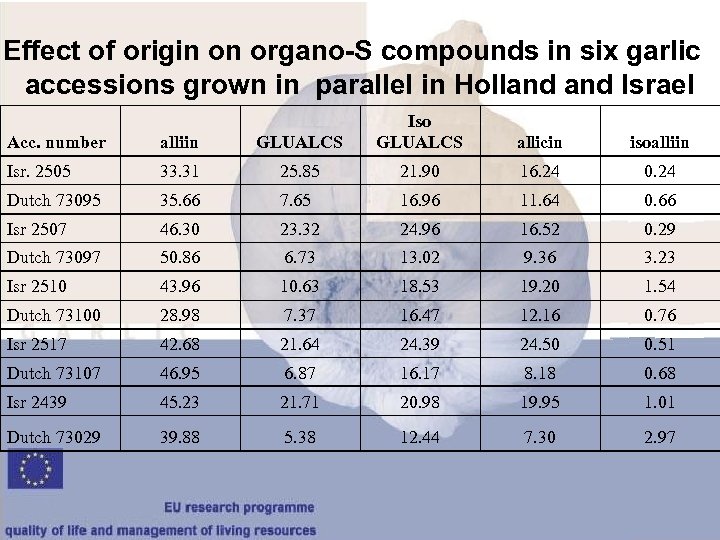
Effect of origin on organo-S compounds in six garlic accessions grown in parallel in Holland Israel Acc. number alliin GLUALCS Iso GLUALCS Isr. 2505 33. 31 25. 85 21. 90 16. 24 0. 24 Dutch 73095 35. 66 7. 65 16. 96 11. 64 0. 66 Isr 2507 46. 30 23. 32 24. 96 16. 52 0. 29 Dutch 73097 50. 86 6. 73 13. 02 9. 36 3. 23 Isr 2510 43. 96 10. 63 18. 53 19. 20 1. 54 Dutch 73100 28. 98 7. 37 16. 47 12. 16 0. 76 Isr 2517 42. 68 21. 64 24. 39 24. 50 0. 51 Dutch 73107 46. 95 6. 87 16. 17 8. 18 0. 68 Isr 2439 45. 23 21. 71 20. 98 19. 95 1. 01 Dutch 73029 39. 88 5. 38 12. 44 7. 30 2. 97 allicin isoalliin
Results: 1) Within the collection, a large quantitative variation in organosulphur compounds: alliin, isoalliin, allicin, and related dipeptides was found. 2) Environmental effects were evident. Jacques Auger and Ingrid Arnault
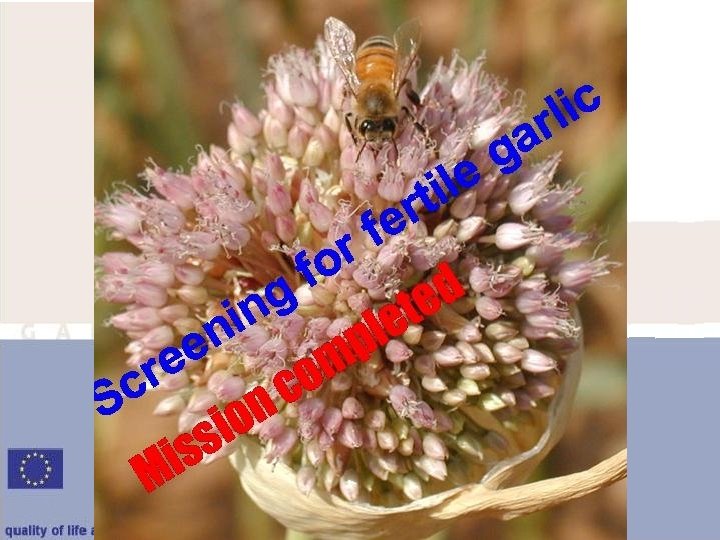
: Main Goalthe ta da f on o ti on llec accessions Evaluation of the collected ti o c c u rof the representative and construction re t ns co o core rcollection c o d f an ary d n s te io es ple at c m lu ne o va e n c E as io b iss M
Workpackage 1: Genetic Resources Objective 3 Screening for fertility;
Flowering performance of the garlic collection-2000 in the 2001 and 2002 seasons % 100 80 4 10 56 49 40 34 37 20 27 25 2001 Dead* 2002 60 0 Non bolters Semi bolters Bolters T>F Bolters F>T Growing season *Under Israeli conditions plants did not bulb and died at the end of the season T = mostly topsets; F = mostly flowers
Publications: • Kamenetsky R, London Shafir I. , Baizerman M, Khassanov F, Kik C. and H. D. Rabinowitch Garlic (Allium sativum L. ) and its wild relatives from Central Asia: evaluation for fertility potential. XXVIth International Horticultural Congress, Toronto, Canada (In press). • Kamenetsky R, London Shafir I. , Khassanov F, Kik C, J. Auger and H. D. Rabinowitch Garlic from Central Asia: genetic resources and fertility potential. 4 th International Symposium on Edible Alliaceae (to be presented in China) • Kamenetsky, R. , London Shafir, I. , Khassanov, F. , Kik, C. , van Heusden, A. W. , Vrielink-van Ginkel, M. , Burger-Meijer, K. , Auger, J. , Arnault, I. and H. D. Rabinowitch Diversity in fertility potential and organo-sulphur compounds among garlics from Central Asia. J. Biodiversity Conservation (In press).
Скачать презентацию Establishment and evaluation of garlic collection from Central
517908387b50a2e10031707839a82b81.ppt