 Скачать презентацию Establishing Specialization in the Interdisciplinary World of Writing
c78932ee6c29e9e7bc5e53f9710b1f83.ppt
- Количество слайдов: 1



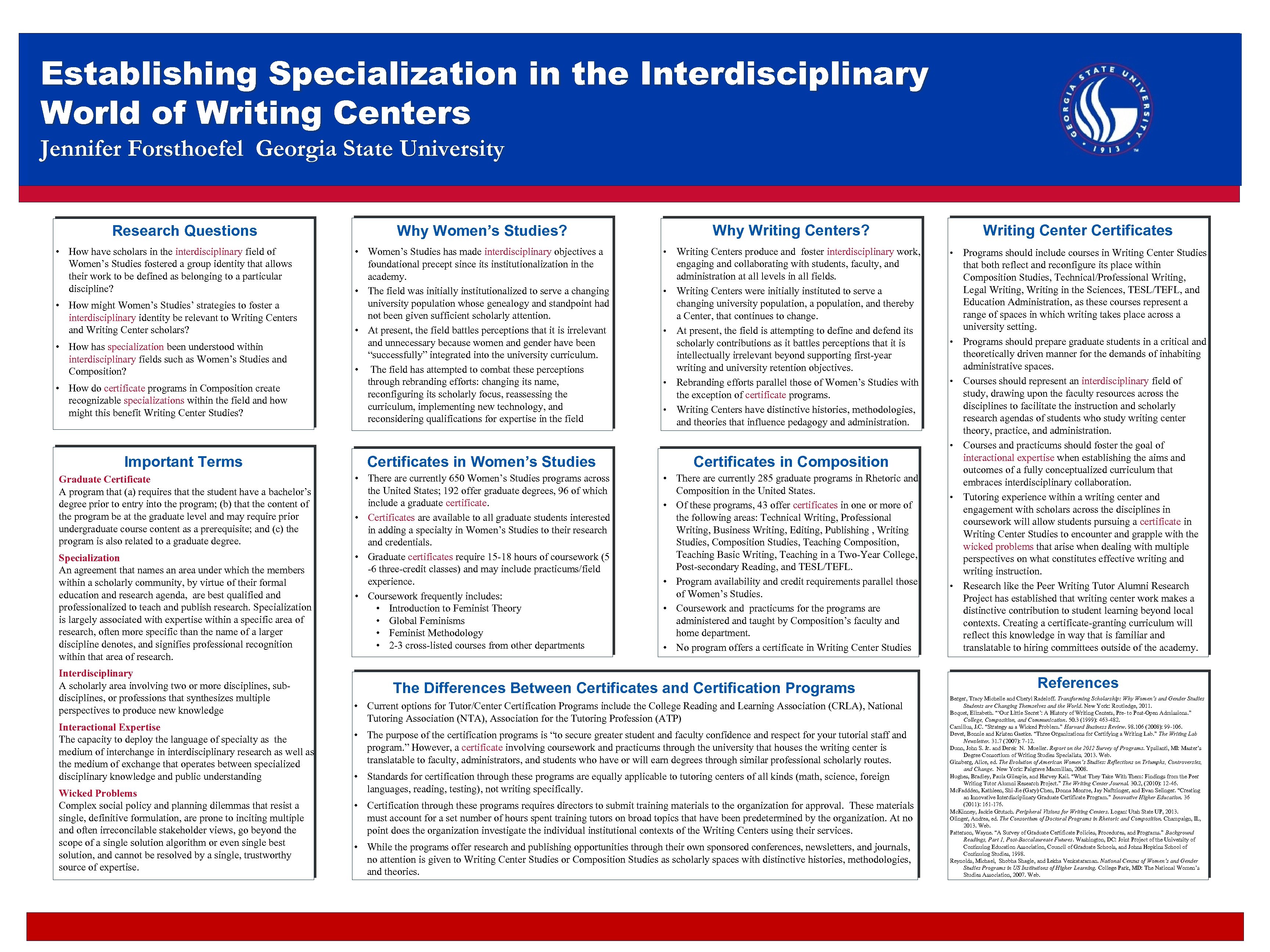
Establishing Specialization in the Interdisciplinary World of Writing Centers Jennifer Forsthoefel Georgia State University Research Questions • How have scholars in the interdisciplinary field of Women’s Studies fostered a group identity that allows their work to be defined as belonging to a particular discipline? • How might Women’s Studies’ strategies to foster a interdisciplinary identity be relevant to Writing Centers and Writing Center scholars? • How has specialization been understood within interdisciplinary fields such as Women’s Studies and Composition? • How do certificate programs in Composition create recognizable specializations within the field and how might this benefit Writing Center Studies? Why Writing Centers? Why Women’s Studies? • Women’s Studies has made interdisciplinary objectives a foundational precept since its institutionalization in the academy. • The field was initially institutionalized to serve a changing university population whose genealogy and standpoint had not been given sufficient scholarly attention. • At present, the field battles perceptions that it is irrelevant and unnecessary because women and gender have been “successfully” integrated into the university curriculum. • The field has attempted to combat these perceptions through rebranding efforts: changing its name, reconfiguring its scholarly focus, reassessing the curriculum, implementing new technology, and reconsidering qualifications for expertise in the field • • • Writing Centers produce and foster interdisciplinary work, engaging and collaborating with students, faculty, and administration at all levels in all fields. Writing Centers were initially instituted to serve a changing university population, and thereby a Center, that continues to change. At present, the field is attempting to define and defend its scholarly contributions as it battles perceptions that it is intellectually irrelevant beyond supporting first-year writing and university retention objectives. Rebranding efforts parallel those of Women’s Studies with the exception of certificate programs. Writing Centers have distinctive histories, methodologies, and theories that influence pedagogy and administration. Writing Center Certificates • • Important Terms Certificates in Women’s Studies Certificates in Composition Graduate Certificate A program that (a) requires that the student have a bachelor’s degree prior to entry into the program; (b) that the content of the program be at the graduate level and may require prior undergraduate course content as a prerequisite; and (c) the program is also related to a graduate degree. • There are currently 650 Women’s Studies programs across the United States; 192 offer graduate degrees, 96 of which include a graduate certificate. • Certificates are available to all graduate students interested in adding a specialty in Women’s Studies to their research and credentials. • Graduate certificates require 15 -18 hours of coursework (5 -6 three-credit classes) and may include practicums/field experience. • Coursework frequently includes: • Introduction to Feminist Theory • Global Feminisms • Feminist Methodology • 2 -3 cross-listed courses from other departments • There are currently 285 graduate programs in Rhetoric and Composition in the United States. • Of these programs, 43 offer certificates in one or more of the following areas: Technical Writing, Professional Writing, Business Writing, Editing, Publishing , Writing Studies, Composition Studies, Teaching Composition, Teaching Basic Writing, Teaching in a Two-Year College, Post-secondary Reading, and TESL/TEFL. • Program availability and credit requirements parallel those of Women’s Studies. • Coursework and practicums for the programs are administered and taught by Composition’s faculty and home department. • No program offers a certificate in Writing Center Studies Specialization An agreement that names an area under which the members within a scholarly community, by virtue of their formal education and research agenda, are best qualified and professionalized to teach and publish research. Specialization is largely associated with expertise within a specific area of research, often more specific than the name of a larger discipline denotes, and signifies professional recognition within that area of research. Interdisciplinary A scholarly area involving two or more disciplines, subdisciplines, or professions that synthesizes multiple perspectives to produce new knowledge Interactional Expertise The capacity to deploy the language of specialty as the medium of interchange in interdisciplinary research as well as the medium of exchange that operates between specialized disciplinary knowledge and public understanding Wicked Problems Complex social policy and planning dilemmas that resist a single, definitive formulation, are prone to inciting multiple and often irreconcilable stakeholder views, go beyond the scope of a single solution algorithm or even single best solution, and cannot be resolved by a single, trustworthy source of expertise. The Differences Between Certificates and Certification Programs • Current options for Tutor/Center Certification Programs include the College Reading and Learning Association (CRLA), National Tutoring Association (NTA), Association for the Tutoring Profession (ATP) • The purpose of the certification programs is “to secure greater student and faculty confidence and respect for your tutorial staff and program. ” However, a certificate involving coursework and practicums through the university that houses the writing center is translatable to faculty, administrators, and students who have or will earn degrees through similar professional scholarly routes. • Standards for certification through these programs are equally applicable to tutoring centers of all kinds (math, science, foreign languages, reading, testing), not writing specifically. • Certification through these programs requires directors to submit training materials to the organization for approval. These materials must account for a set number of hours spent training tutors on broad topics that have been predetermined by the organization. At no point does the organization investigate the individual institutional contexts of the Writing Centers using their services. • While the programs offer research and publishing opportunities through their own sponsored conferences, newsletters, and journals, no attention is given to Writing Center Studies or Composition Studies as scholarly spaces with distinctive histories, methodologies, and theories. • • Programs should include courses in Writing Center Studies that both reflect and reconfigure its place within Composition Studies, Technical/Professional Writing, Legal Writing, Writing in the Sciences, TESL/TEFL, and Education Administration, as these courses represent a range of spaces in which writing takes place across a university setting. Programs should prepare graduate students in a critical and theoretically driven manner for the demands of inhabiting administrative spaces. Courses should represent an interdisciplinary field of study, drawing upon the faculty resources across the disciplines to facilitate the instruction and scholarly research agendas of students who study writing center theory, practice, and administration. Courses and practicums should foster the goal of interactional expertise when establishing the aims and outcomes of a fully conceptualized curriculum that embraces interdisciplinary collaboration. Tutoring experience within a writing center and engagement with scholars across the disciplines in coursework will allow students pursuing a certificate in Writing Center Studies to encounter and grapple with the wicked problems that arise when dealing with multiple perspectives on what constitutes effective writing and writing instruction. Research like the Peer Writing Tutor Alumni Research Project has established that writing center work makes a distinctive contribution to student learning beyond local contexts. Creating a certificate-granting curriculum will reflect this knowledge in way that is familiar and translatable to hiring committees outside of the academy. References Berger, Tracy Michelle and Cheryl Radeloff. Transforming Scholarship: Why Women’s and Gender Studies Students are Changing Themselves and the World. New York: Routledge, 2011. Boquet, Elizabeth. “‘Our Little Secret’: A History of Writing Centers, Pre- to Post-Open Admissions. ” College, Composition, and Communication. 50. 3 (1999): 463 -482. Camillus, J. C. “Strategy as a Wicked Problem. ” Harvard Business Review. 98. 106 (2008): 99 -106. Devet, Bonnie and Kristen Gaetke. “Three Organizations for Certifying a Writing Lab. ” The Writing Lab Newsletter. 31. 7 (2007): 7 -12. Dunn, John S. Jr. and Derek N. Mueller. Report on the 2012 Survey of Programs. Ypsilanti, MI: Master’s Degree Consortium of Writing Studies Specialists, 2013. Web. Ginsberg, Alice, ed. The Evolution of American Women’s Studies: Reflections on Triumphs, Controversies, and Change. New York: Palgrave Macmillan, 2008. Hughes, Bradley, Paula Gilespie, and Harvey Kail. “What They Take With Them: Findings from the Peer Writing Tutor Alumni Research Project. ” The Writing Center Journal. 30. 2, (2010): 12 -46. Mc. Faddden, Kathleen, Shi-Jie (Gary) Chen, Donna Monroe, Jay Naftzinger, and Evan Selinger. “Creating an Innovative Interdisciplinary Graduate Certificate Program. ” Innovative Higher Education. 36 (2011): 161 -176. Mc. Kinney, Jackie Grutsch. Peripheral Visions for Writing Centers. Logan: Utah State UP, 2013. Olinger, Andrea, ed. The Consortium of Doctoral Programs in Rhetoric and Composition. Champaign, IL, 2013. Web. Patterson, Wayne. “A Survey of Graduate Certificate Policies, Procedures, and Programs. ” Background Readings, Part 1, Post-Baccalaureate Futures. Washington, DC: Joint Project of the University of Continuing Education Association, Council of Graduate Schools, and Johns Hopkins School of Continuing Studies, 1998. Reynolds, Michael, Shobha Shagle, and Lekha Venkataraman. National Census of Women’s and Gender Studies Programs in US Institutions of Higher Learning. College Park, MD: The National Women’s Studies Association, 2007. Web.
Скачать презентацию Establishing Specialization in the Interdisciplinary World of Writing
c78932ee6c29e9e7bc5e53f9710b1f83.ppt