 Скачать презентацию Establishing an EM Program Brenda D Phillips Oklahoma
4f4ff70a494556233536092ba75fe413.ppt
- Количество слайдов: 15



Establishing an EM Program Brenda D. Phillips Oklahoma State University Fire and Emergency Management Program 519 Math Sciences Building Stillwater OK 74078 Brendaphillips@prodigy. net 405 -612 -4741 cell
Overview of this presentation n Considerations n Writing a proposal to the state n Issues for the curriculum n Challenges n The academic-practitioner link n n Understanding the faculty role The “Academy” n Professionalization n Views from within higher education n Views from the field
Writing a proposal to the State n Take 6 -12 months minimum. n What are the needs of the state? n Follow the application carefully. Craft the proposal. n Establish a relationship with key person. Obtain external review. Obtain external consultant(s). Revenue streams versus costs. Obtain data. n Competitive programs. n Student market. n Job market projections. n n n
What must we have? n For most accrediting bodies, degrees must have: n A body of “disciplinary” knowledge. n Theory and methodology of the discipline. n For practice-oriented degrees, a link to experiential components. n Accountability n Student outcomes assessment procedures.
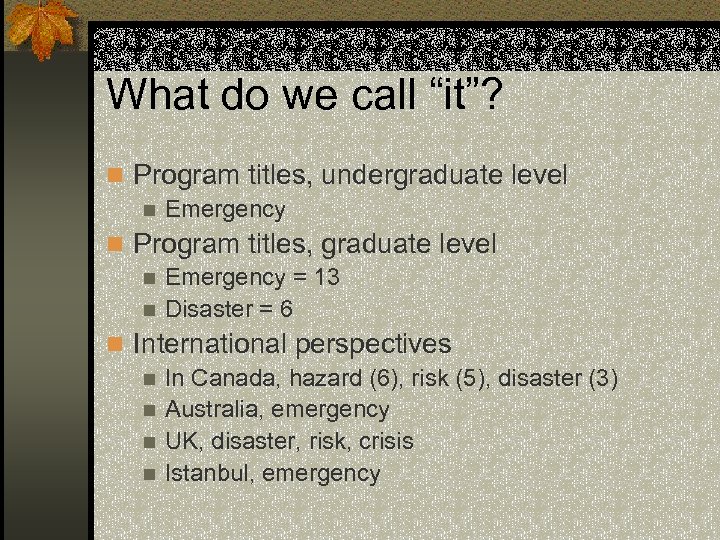
What do we call “it”? n Program titles, undergraduate level n Emergency n Program titles, graduate level n Emergency = 13 n Disaster = 6 n International perspectives n In Canada, hazard (6), risk (5), disaster (3) n Australia, emergency n UK, disaster, risk, crisis n Istanbul, emergency
Defining emergency management n the management of risk in order to protect life and property through a comprehensive effort that involves nonlinear activities tied to mitigation, preparedness, response and recovery.
The implicit core curriculum n Data sources: n Most commonly occurring chapter titles in available introductory texts. n Undergraduate course titles among institutions with highest enrollments. n Findings: n Emphasis on the public EM. n The core is activity-based rather than conceptually or theoretically based. n An Americanized view of emergency management. n Assumes an all-hazards approach. n Impact of the National Governor’s Report.
The debate over core competencies n This is a dynamic field. n The work varies by sector. n Many competencies can be addressed by the general education curriculum (basic science, communication et al. ) n What are the needs of the state? n What is your niche? n Faculty-student advising is key.
Student outcomes assessment n Mission based n Basic data (from the start): n Demographics n Recruitment n Retention/Attrition n Graduation n Employers n Data (from start to alumni/job status) n Papers, projects, portfolios, exams n Interviews, surveys, focus groups
Delivery mode n Traditional n Distance n Internet n Video, Satellite, Polycom n Correspondence/Independent n Mixed
Challenges: linking academics and practitioners n Well done Indiana! n Get to know each other’s organizational “cultures. ” n Respect for the practitioner and their knowledge, valuing their experience. n Grasping the faculty role n Teaching, research, service, practice.
Challenges: the “academy” n Understand that resources are scarce and institutions of higher education are pressed financially. n EM is fairly new, be prepared to explain, justify, convince universities of the academic integrity of the degree. n Turf battles are common, especially over curricula, establishing new programs, interdisciplinary programs. n Where do you put emergency management? n n Strong social science influence on knowledge base. Money will change things.
Professionalization: the bad news n An ongoing battle since 1980 s. n No accreditation bodies for academic programs. n Models: public admin, social work n Image problem: n From air raid wardens to ambulance chasers. n Rodney Dangerfield was right.
Professionalization: the good news n Degree increasingly cited in job announcements. n Students are in good jobs, being promoted, in all sectors. n New respect for the field. n Good questions are being raised. n Degree programs are sound and varied.
What we can all do n Follow academic accreditation standards n n rigorously. Work with the state (EMA, Commission for Higher Education) Work together to develop professional organizations, especially with/for higher education. Share what we know and learn. Advocate for increasing professionalization including higher education programs.
Скачать презентацию Establishing an EM Program Brenda D Phillips Oklahoma
4f4ff70a494556233536092ba75fe413.ppt