


 Скачать презентацию Essentials of Management Topic 2 Management Theories V
EoM_-_Lecture_02_-_Management_Theories.ppt
- Количество слайдов: 21
 Essentials of Management Topic 2: Management Theories V 1. 0 © NCC Education Limited
 Management Theories Topic 2 – 2. 2 Scope and Coverage This topic will cover: • The various management theories that have been developed throughout history • The key contributors to these theories • How these theories impact upon today’s management practices V 1. 0 © NCC Education Limited
 Management Theories Topic 2 – 2. 3 Learning Outcomes By the end of this topic students will be able to: • Explain the basic principles of the management theories that have been developed over time • Discuss the main concepts upon which theories were developed • Evaluate the ways in which the individual theories are impacting upon the management of businesses today V 1. 0 © NCC Education Limited
 Management Theories Topic 2 – 2. 4 Development of Management Theories • • • V 1. 0 Scientific Management General Administrative Theorists Quantitative Approach Organisational Behaviour Systems Approach Contingency Approach © NCC Education Limited
 Management Theories Topic 2 – 2. 5 Scientific Management Frederick W. Taylor’s Principles of Management: • Develop a science for each element of an individual’s work • Select, train, teach and develop the worker • Ensure that work is done in accordance with the principles of the science that has been developed • Divide work and responsibility almost equally between management and workers V 1. 0 © NCC Education Limited
 Management Theories Topic 2 – 2. 6 Applying Scientific Management Today • Analysing basic work tasks to be undertaken • Using time and motion studies to eliminate wasted motions • Designing basic incentive schemes based on output V 1. 0 © NCC Education Limited
 Management Theories Topic 2 – 2. 7 General Administrative Theorists Two most prominent theorists: • Henri Fayol – 14 principles of management • Max Weber - bureaucracy V 1. 0 © NCC Education Limited
 Management Theories Topic 2 – 2. 8 Fayol’s 14 Principles of Management • • • • V 1. 0 Division of work Authority Discipline Unity of command Unity of direction Subordination of individual interests to the general interest Remuneration Centralisation Scalar chain Order Equity Stability of tenure of personnel Initiative Esprit de corps (promoting team spirit) © NCC Education Limited
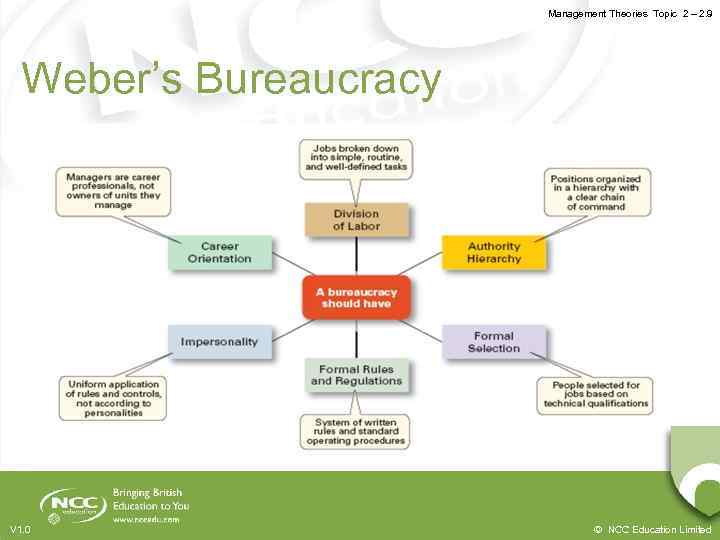 Management Theories Topic 2 – 2. 9 Weber’s Bureaucracy V 1. 0 © NCC Education Limited
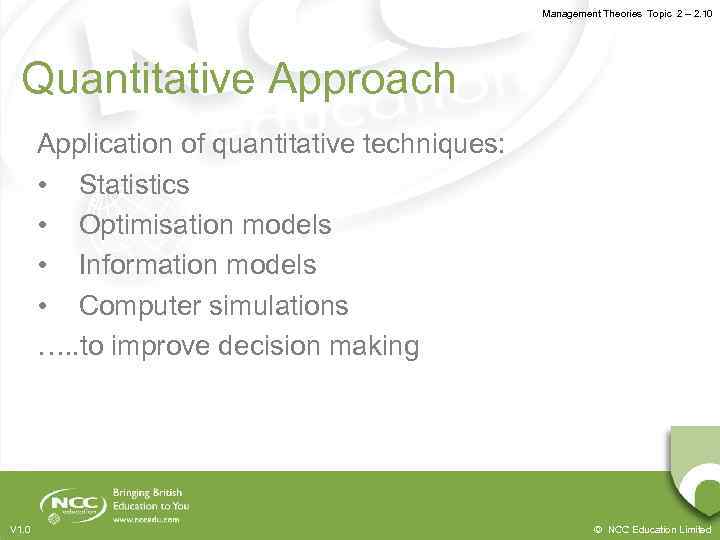 Management Theories Topic 2 – 2. 10 Quantitative Approach Application of quantitative techniques: • Statistics • Optimisation models • Information models • Computer simulations …. . to improve decision making V 1. 0 © NCC Education Limited
 Management Theories Topic 2 – 2. 11 Applying the Quantitative Approach Today • More recently called ‘Operations Research’ or ‘Management Science’ • Contributes to management decision making in planning and control • Helps to interpret the results of software programs in the areas of budgeting, scheduling and quality control V 1. 0 © NCC Education Limited
 Management Theories Topic 2 – 2. 12 Organisational Behaviour Concerned with the actions of people at work • • Robert Owen Hugo Munsterberg Mary Parker Follett Chester Barnard The Hawthorne Studies – provided new insights into individual and group behaviour V 1. 0 © NCC Education Limited
 Management Theories Topic 2 – 2. 13 Applying the Behavioural Approach Today • Helps to design motivating jobs • Used by managers to assist in working with groups and teams • Used to encourage open communication • Provides the foundation for current thinking on motivation, leadership, group behaviour and development V 1. 0 © NCC Education Limited
 Management Theories Topic 2 – 2. 14 The Systems Approach “A system is a set of interrelated and independent parts arranged in a manner that produces a unified whole” • Closed system – systems that are not influenced by their environment • Open system – systems that dynamically interact with their environment V 1. 0 © NCC Education Limited
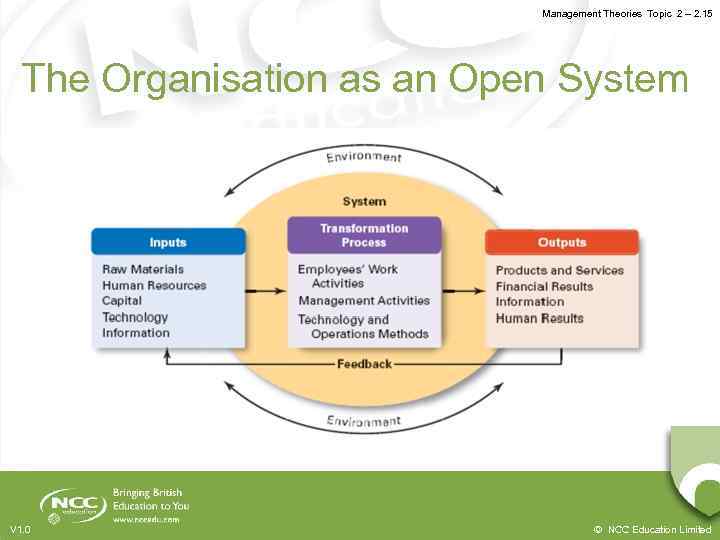 Management Theories Topic 2 – 2. 15 The Organisation as an Open System V 1. 0 © NCC Education Limited
 Management Theories Topic 2 – 2. 16 Using the Systems Approach Today • Assists management in ensuring that independent parts of an organisation work together • Helps to recognise that decisions taken in one department will impact others • Emphasises the fact that organisations are not self-contained V 1. 0 © NCC Education Limited
 Management Theories Topic 2 – 2. 17 The Contingency Approach Key principles: • Organisations are different – size, goals, work etc • They face different situations • Therefore require different approaches to management • No universally applicable management rules that work in all situations V 1. 0 © NCC Education Limited
 Management Theories Topic 2 – 2. 18 Contingency Variables • Organisation size – as size increases so do problems of coordination • Use of technology – different technologies require different structures and control systems • Environmental uncertainty – degree of uncertainty will influence the management process • Individual differences – employees will have different hopes and expectations of their job V 1. 0 © NCC Education Limited
 Management Theories Topic 2 – 2. 19 Summary • A number of management theories have been developed over time • Each theory has its own particular strengths • The focus of theories is primarily upon working with and motivating people • Many of these theories still have a significant impact upon today’s management practices V 1. 0 © NCC Education Limited
 Management Theories Topic 2 – 2. 20 References Slide 2. 9: Management eighth edition by Robbins, S. P. and Coulter, M. (Pearson/Prentice-Hall) IBN: 978 -0131439948 pp 31 Slide 2. 15: Management eighth edition by Robbins, S. P. and Coulter, M. (Pearson/Prentice-Hall) IBN: 978 -0131439948 pp 35 V 1. 0 © NCC Education Limited
 Management Theories Topic 2 - 2. 21 Topic 2 – Management Theories Any Questions? V 1. 0 © NCC Education Limited