


 Скачать презентацию Essentials of HIPAA Security Litigation Risk Planning Richard
b200af659f584e5a9d0ca8fdd4771646.ppt
- Количество слайдов: 42
 Essentials of HIPAA Security Litigation Risk Planning Richard D. Marks Davis Wright Tremaine LLP Washington, D. C. Seattle, Portland, San Francisco, Los Angeles, Anchorage, Honolulu, New York, Shanghai (202) 508 -6611 richardmarks@dwt. com Copyright 2002 Richard D. Marks All Rights Reserved
 “HIPAA Is the Law” RHow do lawyers analyze HIPAA? RHow is that different from how normal people look at HIPAA? RWhat is your institutional exposure to various kinds of legal liability? RHow should you factor legal analysis - the legal perspective - into your business decisions about HIPAA?
 Hypothetical for Analysis ÜUniversity of Washington facts Ü 4, 000 complete records hacked ÜHacker: I did it just to show you how bad your security is - a warning ÜSuppose another hacker attacks you and posts 1, 000 records to the Internet ÜWhat’s the liability? ÜHow could you have limited exposure? ÜHow do you defend? ÜHow do you mitigate?
 Hypothetical for Analysis ÜUniversity of Montana facts ÜNo hospital at University of Montana ÜGrad student in psychology does research at children’s hospital in St. Paul, Minnesota Ü 400 pages of PHI (psych records of 62 children) is sent back and posted on University’s intranet (password protection) ÜSearch engine leads directly to the URL ÜSuppose your researchers do this? ÜWhat’s the liability? ÜHow could you have limited exposure? ÜHow do you defend/ mitigate?
 Hypothetical for Analysis ÜUniversity of Minnesota facts Ü 410 deceased organ donor identities revealed to recipients ÜSecond breach in 90 days ÜSuppose your facility made 2 errors within a short period of time? ÜHow do you defend the second incident? ÜHow do you make improvements?
 Hypothetical for Analysis ÜEli Lilly ÜReleases e-mail addresses of 669 Prozac patients ÜPatients receive e-mail reminding them to take their medication, but in notice to them all addresses disclosed ÜFTC Investigation and Settlement ÜLilly must establish better safeguards ÜSubject to future fines for noncompliance ÜLesson for covered entities?
 Sources of Law °Statutes °Administrative Regulations °Implement statutes °Must be consistent with governing statute °Administrative Procedure Act - “Notice and Comment Rule Making” °Administrative Adjudications °Administrative Guidance °Case Law - cumulative outcomes °Court cases: U. S. District Court > U. S. Court of Appeals > U. S. Supreme Court
 Case to Consider U. S. v. Mead Corp. (U. S. Sup. Ct. No. 99 -1434, June 18, 2002) ¥Customs Service ruling letters about tariff clarifications ¥Question: does Court treat this ruling letter as authoritative - does it have presumptive weight, like a statute or regulation, so that the Court must defer to the agency’s view? (“Chevron deference”) ¥Answer: No - give Chevron deference only to ¥Notice and comment rule makings (formal proceedings) ¥Administrative adjudications ¥Consequence: weight of informal agency guidance depends on how good the reasoning is (persuasive? ) ¥Value of HHS’s informal guidance?
 What Does the Law “Know” About HIPAA? n Statutes and administrative regulations (e. g. , transaction sets, privacy, security rules) are laws n Epidemic of complexity n Ambiguities abound n Initial interpretation of complexity and ambiguity in laws requires legal reasoning n What guidance for the lawyers? n No litigation yet, so no decided cases n Supreme Court in Mead: can’t rely on informal administrative guidance
 What Are the Guideposts? Ü The statute controls the regulations Ü Look out for regulations that may not fit the statute Ü Interpret regulations in light of the statute Ü Factor in other sources of law (e. g. , from criminal and civil litigation) that apply Ü Establish a framework of legal reasoning, and expect some lack of reality Ü Be practical (is there a choice)? Ü Business decisions guided by legal analysis and a refined common sense
![HIPAA - Statutory Standard “Each [covered entity] … who maintains or transmits health information](https://present5.com/presentation/b200af659f584e5a9d0ca8fdd4771646/image-11.jpg "HIPAA - Statutory Standard “Each [covered entity] … who maintains or transmits health information") HIPAA - Statutory Standard “Each [covered entity] … who maintains or transmits health information shall maintain reasonable and appropriate administrative, technical, and physical safeguards -(A) to ensure the integrity and confidentiality of the information; and (B) to protect against any reasonably anticipated (i) threats or hazards to the security or integrity of the information; and (ii) unauthorized uses or disclosures of the information; and (C) otherwise to ensure compliance with this part by the officers and employees of such person. ” (42 USC § 1320 d-2(d)(2); in effect now - does not require final security or privacy rules to become effective)
HIPAA - Statutory Standard “Each [covered entity] … who maintains or transmits health information shall maintain reasonable and appropriate administrative, technical, and physical safeguards -(A) to ensure the integrity and confidentiality of the information; and (B) to protect against any reasonably anticipated (i) threats or hazards to the security or integrity of the information; and (ii) unauthorized uses or disclosures of the information; and (C) otherwise to ensure compliance with this part by the officers and employees of such person. ” (42 USC § 1320 d-2(d)(2); in effect now - does not require final security or privacy rules to become effective)
 HIPAA Context ü Enforcement - litigation-operational perspective (e. g. , malpractice) -- HHS enforcement is least of worries ü Criminal penalties (42 USC § 1320 d-6) - DOJ/ U. S. Attorney u u u Knowingly - 1 year/ $50, 000 False pretenses - 5 years/ $100, 000 Malice, commercial advantage, personal gain - 10 years, $250, 000 ü Private law suits by patients u u u Easier because standard of care is so much higher Statute trumps the regs: “any reasonably anticipated, ” “ensure” Best practices - what is “any reasonable”? References are security processes and technology in defense (and in the financial) industry
 The Ratcheting Legal Standard The T. J. Hooper case New Jersey coast (1928) - storm comes up, tug loses barge and cargo of coal Plaintiff barge owner: captain was negligent because he had no weather radio Learned Hand, J. : Barge owner wins Rationale: to avoid negligence, keep up with technological innovations - they set the standard of care in the industry
 What is the standard of care? The HIPAA security rules were abstracted from the defense establishment. The abstraction is now being imposed on health care. So the industry frame of referenced is the military-industrial complex, where NSA sets the rules. The financial industry also offers a frame of reference. These industries have been working for a long time on security, and have notably different structures and missions from health care.
 What’s Different After Sept. 11? v Security is no longer v in the background vabstract vunfamiliar v In government and industry, executives are placing a priority on reviewing security (threat and response models) v Health care entities, and particularly providers, must contemplate security threat and response models, and their human, business, and legal consequences v You are obligated to think about providers as a potential terrorist delivery system, like airplanes and mail
 Potential Civil Liability - Ratcheting Duty of Care Tort - Negligence Tort - Invasion of Privacy Publication of Private Facts False Light (akin to Defamation ) Unauthorized Commercial Use Tort - Breach of Confidence (Physician-Patient) Tort - Defamation Tort- Fraud Statutory - Consumer Fraud Contract - Breach of Confidentiality Clauses/Policies Contract - Breach of Express or Implied Warranty Contract - Suits by Business Associates Contract - Suits by Vendors/ Customers (& vice versa) Employment -related suits (HIPAA sanctions issues)
![Example: Business Associates ü Privacy Rule, 45 CFR § 164. 504(e) ü“[W]e have eliminated](https://present5.com/presentation/b200af659f584e5a9d0ca8fdd4771646/image-17.jpg "Example: Business Associates ü Privacy Rule, 45 CFR § 164. 504(e) ü“[W]e have eliminated") Example: Business Associates ü Privacy Rule, 45 CFR § 164. 504(e) ü“[W]e have eliminated the requirement that a covered entity actively monitor and ensure protection by its business associates. ” 65 Fed. Reg. 82641. üHowever: “Covered entities cannot avoid responsibility by intentionally ignoring problems with their contractors. ” ü The big question: What about duties under state tort law? üPrudent behavior standard üEnhanced by the HIPAA statutory standard?
Example: Business Associates ü Privacy Rule, 45 CFR § 164. 504(e) ü“[W]e have eliminated the requirement that a covered entity actively monitor and ensure protection by its business associates. ” 65 Fed. Reg. 82641. üHowever: “Covered entities cannot avoid responsibility by intentionally ignoring problems with their contractors. ” ü The big question: What about duties under state tort law? üPrudent behavior standard üEnhanced by the HIPAA statutory standard?
 Administrative Requirements and Risk Management Various administrative requirements (Privacy and Security) u Document all complaints received (process protection) u Apply sanctions to members of workforce who fail to comply (how stringent? ) (suits by workforce members who believe they have been denied fair process; suits by patients who think their complaints were swept under the rug) u Mitigate any harmful effects of violations to extent practicable (extent of this obligation? ) u Implement appropriate policies and procedures (process protection that also looks at outcomes) u “Reasonably designed. . . to ensure compliance, ” taking into account covered entity’s u Size u Type of activities u Note: “This standard is not to be construed to permit or excuse an action that violates any other. . . requirement. . . ”
 Technical Security Mechanisms (Data in Transit) ü For each organization that uses communications or networks ü Protect communications containing health information that are transmitted electronically over open networks, so that they cannot be easily intercepted and interpreted ü Over open networks, some form or encryption required ü integrity controls ü message authentication ü Network controls ** abnormal condition alarm ** audit trail to facilitate a security audit ** irrefutable entity authentication ** event reporting for operational irregularities (selfreporting) ü Why limit encryption to open networks if your greatest threat is internal?
![Risk Management Analysis ü Does meeting the [proposed] regulation satisfy the HIPAA statute (reasonable](https://present5.com/presentation/b200af659f584e5a9d0ca8fdd4771646/image-20.jpg "Risk Management Analysis ü Does meeting the [proposed] regulation satisfy the HIPAA statute (reasonable") Risk Management Analysis ü Does meeting the [proposed] regulation satisfy the HIPAA statute (reasonable and appropriate safeguards to ensure/ protect against any reasonably anticipated threat, hazard, or unauthorized use)? ü Does meeting the [proposed] regulation satisfy state tort law duties of prudent care? ü Examples: internal email; internal storage; remote use policies
Risk Management Analysis ü Does meeting the [proposed] regulation satisfy the HIPAA statute (reasonable and appropriate safeguards to ensure/ protect against any reasonably anticipated threat, hazard, or unauthorized use)? ü Does meeting the [proposed] regulation satisfy state tort law duties of prudent care? ü Examples: internal email; internal storage; remote use policies
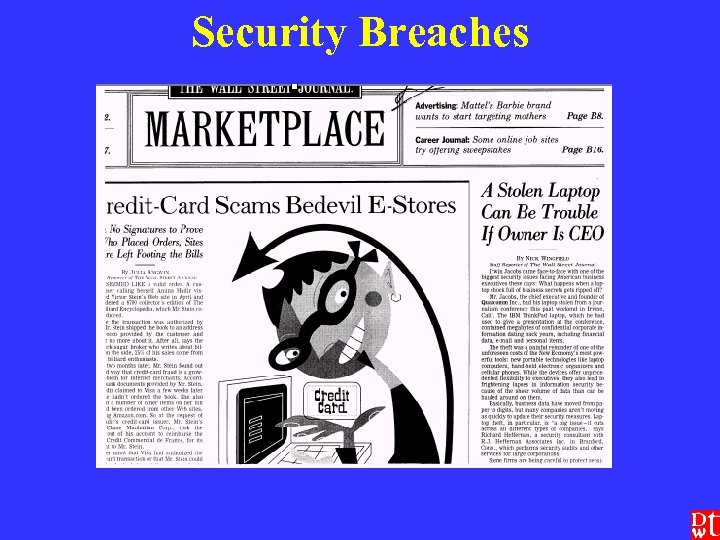 Security Breaches
 HIPAA Compliance Requires Asymmetric Encryption n No other practical way to meet the privacy and security requirements HHS is fully aware the encryption will be necessary HHS may not be aware that n n n “Covered entities” typically interconnect (cobble together? ) disparate systems from a variety of vendors; these are inelegant solutions (“kluges”) “Covered entities” can’t buy an end-to-end computer system solution Adding an encryption layer (with all attendant business process changes) will be difficult, timeconsuming, expensive - and impossible for some legacy systems
 Public Key Infrastructure (PKI) Technology Performs all these functions AUTOMATICALLY, but: Ø Ø Must be engineered for the industry (“technically mature”) Ø E. g. , financial industry Must be PROPERLY IMPLEMENTED (hard to do!) “Currently there are not technically mature techniques…[for] nonrepudiation in an open network environment, in the absence of trusted third parties, other than digital signature-based techniques. ”
 Risk Management Issues in PKI System Creation n Certification Practice Statement n n Certificate Policy n n n Explains CA's digital certificate issuance and revocation policies Specifies conditions of use of a digital certificate Contracts allocating liability among entity, CA, users Insurance and limitation of liability issues Federal law: ESign, GLB State contract law (UCC, UCITA, UETA, etc. ) Legal adequacy of threat and response models and security and privacy policies
 Covered Entity - Vendor/ Business Associate Contract Negotiations Litigation Risk Management Ö A new set of risks for both sides Ö No vendor is “HIPAA compliant, ” because the security is in the implementation. Only covered entities (and business associates) can be HIPAA compliant. Ö Some systems are just easier to engineer into a secure implementation -- and some can’t be engineered that way as a practical matter. Ö Business process + technology = security Ö Health care IT system vendors will ask for indemnification from covered entities against weak implementation. Ö Will the provider community resist or cave in?
 PKI in the Real World of the Hospital ÖVerisign issuance of 3 spoofed certificates for use on MSN. Question: how many others? ÖSame facts at a hospital: ÖCould not trust anything on the system. ÖSafety/ malpractice concern (remember systems integration issue? ) ÖMust you take the whole system down? ÖIf so, how do you function? Dangers? ÖWhat’s the systems answer in managing risk? ÖConstant hot backups? ÖWith ongoing integrity checking and encrypted storage? ÖWhere would you buy that?
 Risk Management Options with Regard to PKI Ø VPNs (Virtual Private Networks) Not as secure as PKI, unless they incorporate PKI Ø Suffice for the moment as an acceptable practice in the industry? Ø Not all VPN’s are equal Ø Ø SSL (Secure Socket Layer) Current prevailing standard? Ø Known vulnerabilities! Ø Litigation trap. Ø Ø Not much else. .
 Authenticating Access is a Separate Set of Risk Management Issues How do you control who is really using the key to which the digital certificate relates? - Password alone fails the industry standard of care - Password (PIN) plus Secure ID? Smart Card? Biometrics (probably part of the eventual answer) - Emergency access: HIPAA v. malpractice How do you pay to administer all this? Industry experience: costs rise steeply well before 1, 000 cards, tokens, or whatever
 Biometrics
 Firewalls and Intrusion/ Anomalous Event Detection Internal Network (location of intrusion/ anomalous event detection + logging) n Firewall n n Proxy firewall Internet (source of threats) n Detection is useless without the ability to analyze attack and respond very fast (“real time”) and effectively n n E. g. , outsourced monitoring service
 Business Associate Agreements BAA between covered entity and BA - BA must: ü Not use or further disclose the PHI other than as ü Permitted in the BAA or ü As required by law ü Use appropriate security safeguards ü Report any improper use or disclosure of which it becomes aware to the covered entity ü “Ensure” its agents (including subcontractors) agree to same restrictions as in the BAA ü Make available to HHS its internal practices and books relating to use and disclosure of PHI ü How much must you -- should you -- know about the security systems of your business associates? ü If you deliberately don’t ask for all details, what legal promises and assurances should you ask for?
 Security When does it apply? What’s its scope? n Wrong answer: 26 months after final security rule appears in Federal Register n Immediate concern: 42 USC § 1320 d-2(d)(2) applies now to “health information” n 45 CFR § 164. 530(c) requires appropriate security measures when the privacy rules are implemented on April 13, 2003 (brings application of the final security rules forward) n Security is the framework for privacy
 Criminal Law - Federal Sentencing/Prosecution Guidelines Relationship to Business Judgment Rule Structured approached - covers organizations Why? Because HIPAA violations can be criminal. Some definitions from Sentencing Guidelines: “High-level personnel of the organization” “Substantial authority personnel” “Condoned” “Willfully ignorant of the offense” “Effective program to prevent and detect violations of law”
 “Effective program to prevent and detect violations of law” ü Establish compliance standards ü High-level personnel must have been assigned overall responsibility ü Due care not to delegate substantial discretionary authority to those with propensity for illegal activity ü Effective communication of standards ü Reasonable steps to achieve compliance with standards ü Standards consistently enforced through appropriate disciplinary mechanisms ü All reasonable steps to respond once an offense is detected (including preventing further similar offenses) ° Same principles as Business Judgment Rule (insulating corporate officers and directors from personal liability)
 Enterprise Compliance Plan for Information Security Achieving a reasonable level of security is a multifaceted task + Initial and on-going threat assessment (outside experts) >> enterprise security process + Computer security + Communications security + Physical security: access to premises, equipment, people, data + Personnel security + Procedural (business process) security + A pervasive security culture
 Initial Steps in Implementing HIPAA Security How do you know where you need to get, i. e. , the level of security you need? Fundamentally a legal question, with these elements: HIPAA statute Regulations: all the elements of security State of art in the [defense/ financial] industry Encryption - PKI Access/ authentication controls biometrics Process controls (including logs/ audit) Total systems implementation Constant surveillance Prevention, detection, response, in all processes, u u not just in technology You need this analysis to guide the consultants! Leads to business risk decisions
 Litigation & Operational Perspective Litigation is likely, so use these criteria: u u u What new operating policies must we prepare? u These policies are legal documents that will be of utmost importance in litigation What records must we keep to u Cooperate with HHS? u Defend ourselves? How do these records requirements translate into audit trails? (Complying with the Privacy and Security rules demands automation. ) Can our installed systems accommodate these audit trail and related access requirements? What are other elements of compliance? Certification (all systems carrying PHI and their interoperation) u Accreditation u White paper -- wedi. org >>SNIP
 A Litigator’s View of “Best” Practices n In security field, “best practices” are at NSA, CIA, etc. n In commercial security field, “best” practices are at banks and other financial institutions, or in defense industry n Health care prevailing industry practices n Not “best” n Superseded by HIPAA statute and regs n Consider “appropriate” or “recommended” practices n Don’t make your expert vulnerable
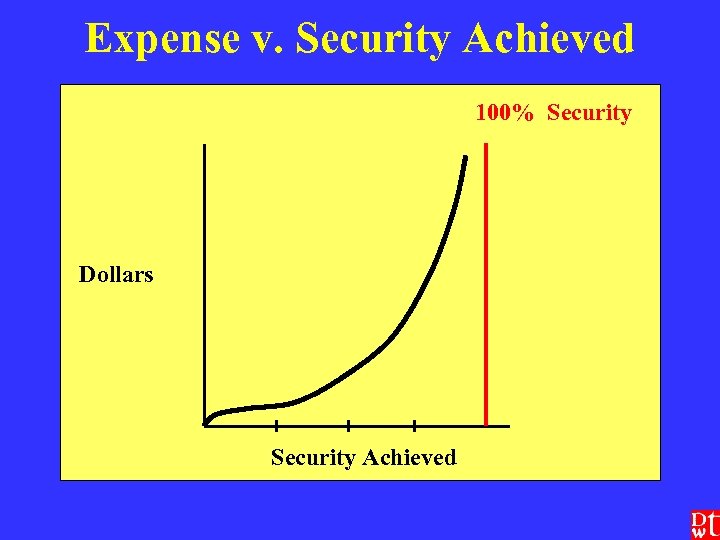
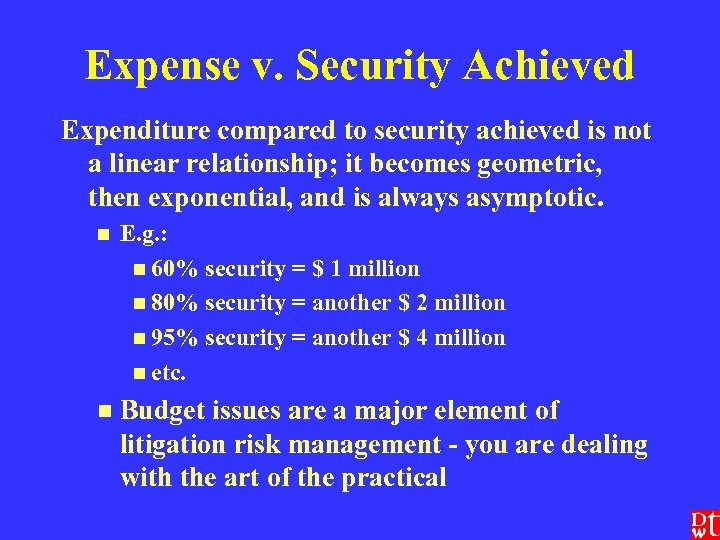 Expense v. Security Achieved Expenditure compared to security achieved is not a linear relationship; it becomes geometric, then exponential, and is always asymptotic. n E. g. : n 60% security = $ 1 million n 80% security = another $ 2 million n 95% security = another $ 4 million n etc. n Budget issues are a major element of litigation risk management - you are dealing with the art of the practical
 Expense v. Security Achieved 100% Security Dollars Security Achieved

 Finally n n Security is a goal, a process, and a state of mind, not a steady state or a product. Technology is but a small part of security - and it must be implemented securely within the institution’s business and clinical processes. Transaction & Code Set and Privacy rules are implemented within the framework of Security. The statute and rules are loaded with ambiguities. n Interpretation of the ambiguities and examination of options can’t be done without legal analysis. n What other “law” bears on the issue? n Litigation risk analysis informs the risk-taking inherent in HIPAA-related business decisions.