


 Скачать презентацию Essentials of Anatomy Physiology 4 th Edition
14_ЛИМФА ИММУНИТЕТ.pptx
- Количество слайдов: 87
 Essentials of Anatomy & Physiology, 4 th Edition Martini / Bartholomew 14 The Lymphatic System and Immunity Power. Point® Lecture Outlines prepared by Alan Magid, Duke University Slides 1 to 87 Copyright © 2007 Pearson Education, Inc. , publishing as Benjamin Cummings
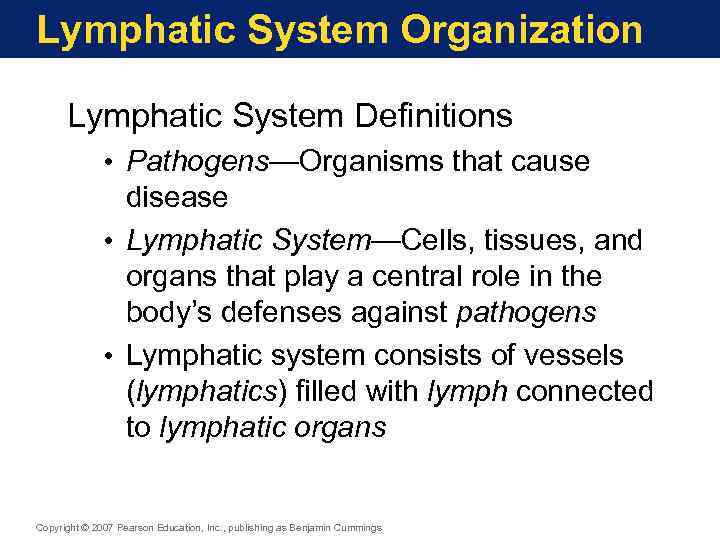 Lymphatic System Organization Lymphatic System Definitions • Pathogens—Organisms that cause disease • Lymphatic System—Cells, tissues, and organs that play a central role in the body’s defenses against pathogens • Lymphatic system consists of vessels (lymphatics) filled with lymph connected to lymphatic organs Copyright © 2007 Pearson Education, Inc. , publishing as Benjamin Cummings
 Lymphatic System Organization The Components of the Lymphatic System Figure 14 -1
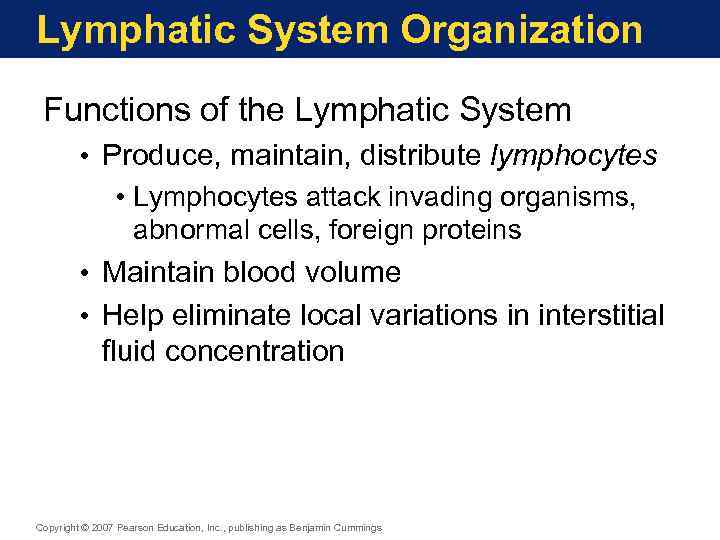 Lymphatic System Organization Functions of the Lymphatic System • Produce, maintain, distribute lymphocytes • Lymphocytes attack invading organisms, abnormal cells, foreign proteins • Maintain blood volume • Help eliminate local variations in interstitial fluid concentration Copyright © 2007 Pearson Education, Inc. , publishing as Benjamin Cummings
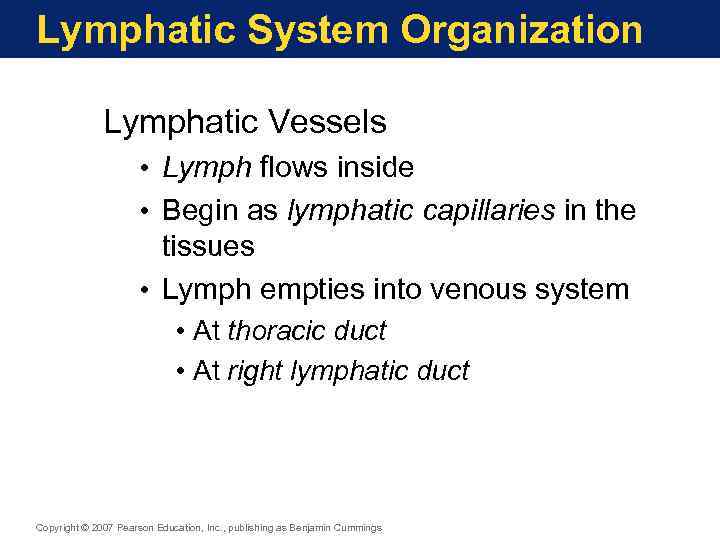 Lymphatic System Organization Lymphatic Vessels • Lymph flows inside • Begin as lymphatic capillaries in the tissues • Lymph empties into venous system • At thoracic duct • At right lymphatic duct Copyright © 2007 Pearson Education, Inc. , publishing as Benjamin Cummings
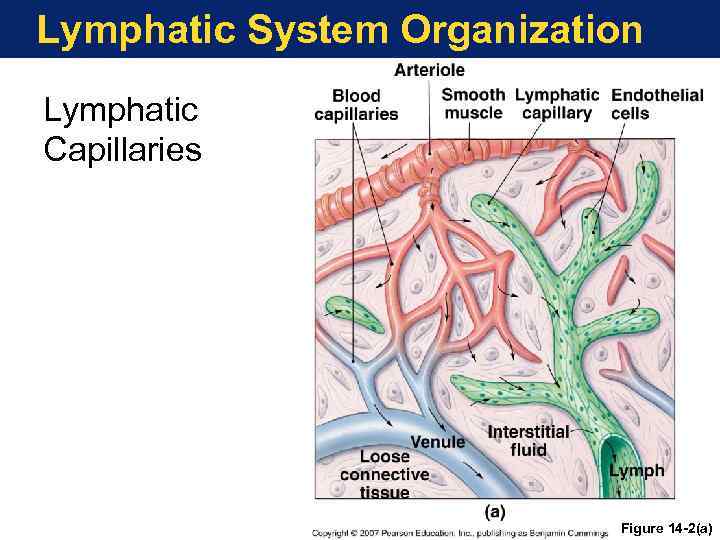 Lymphatic System Organization Lymphatic Capillaries Figure 14 -2(a)
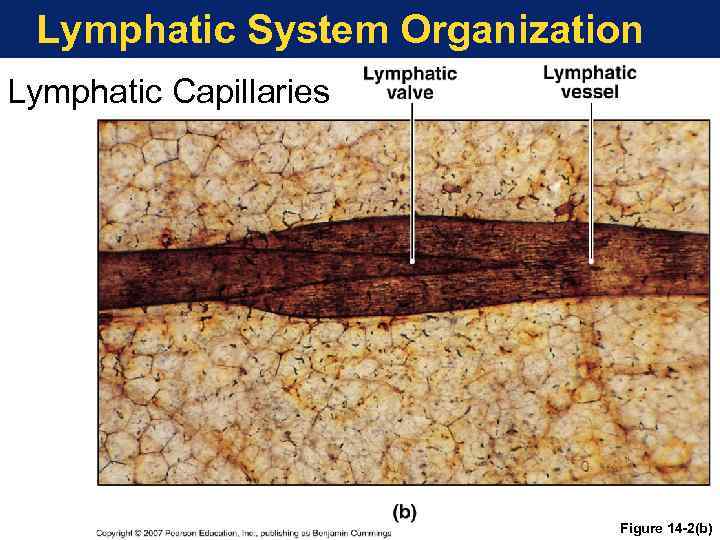 Lymphatic System Organization Lymphatic Capillaries Figure 14 -2(b)
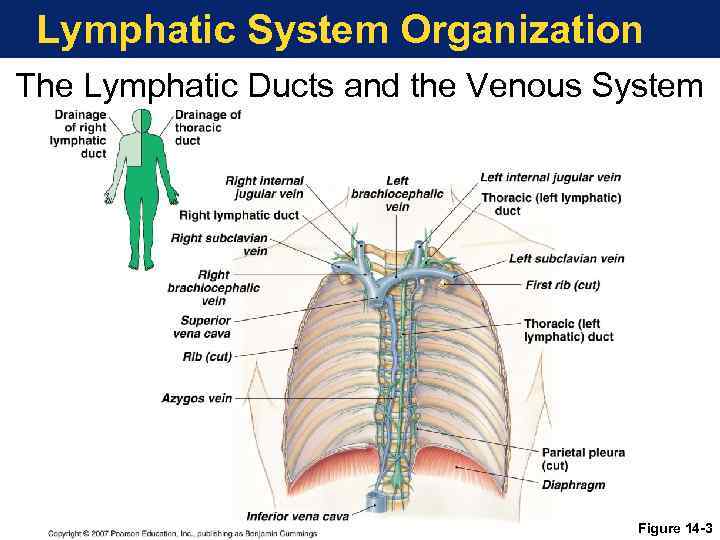 Lymphatic System Organization The Lymphatic Ducts and the Venous System Figure 14 -3
 Lymphatic System Organization Three Classes of Lymphocytes • T cells • Thymus dependent • B cells • Bone marrow derived • NK cells • Natural killer Copyright © 2007 Pearson Education, Inc. , publishing as Benjamin Cummings
 Lymphatic System Organization Types of T Lymphocytes • Cytotoxic T cells • Provide cell-mediated immunity • Attack foreign and virus-infected cells • Regulatory T cells • Helper T cells • Suppressor T cells Copyright © 2007 Pearson Education, Inc. , publishing as Benjamin Cummings
 Lymphatic System Organization B Lymphocytes • Can become plasma cells • Specific to a particular antigen • Produce antibodies that react with that antigen • Antibodies are immunoglobulins • Responsible for humoral or antibody-mediated immunity Copyright © 2007 Pearson Education, Inc. , publishing as Benjamin Cummings
 Lymphatic System Organization NK Lymphocytes • Provide immunological surveillance • Attack cells • Foreign cells • Virally-infected cells • Cancerous cells Copyright © 2007 Pearson Education, Inc. , publishing as Benjamin Cummings
 Lymphatic System Organization Lymphocyte Life Cycle • Continuously migrate between lymphoid tissues and the blood • Production and development (called lymphopoiesis) involves: • Bone marrow • Thymus • Peripheral lymphoid tissues Copyright © 2007 Pearson Education, Inc. , publishing as Benjamin Cummings
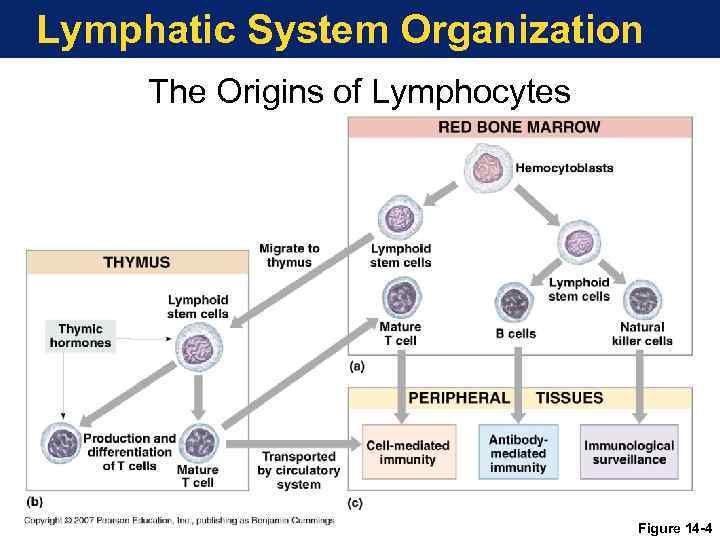 Lymphatic System Organization The Origins of Lymphocytes Figure 14 -4
 Lymphatic System Organization Lymphoid Nodules • Consists of loose connective tissue containing densely packed lymphocytes • Tonsils are lymphoid nodules in the pharynx wall Copyright © 2007 Pearson Education, Inc. , publishing as Benjamin Cummings
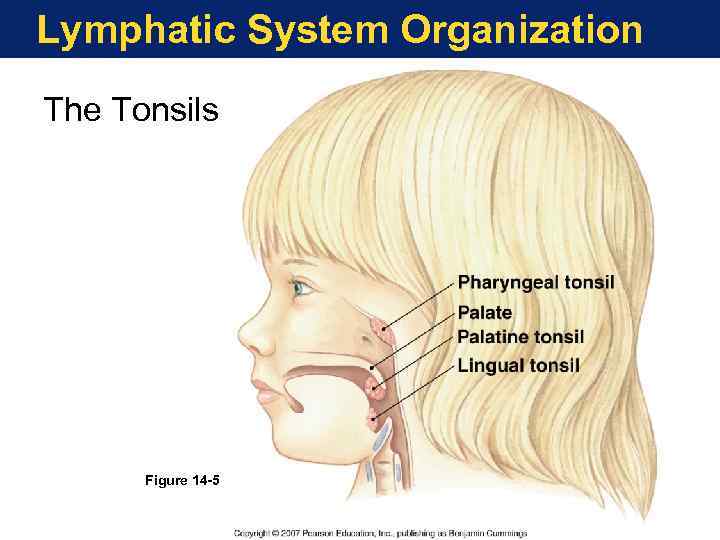 Lymphatic System Organization The Tonsils Figure 14 -5
 Lymphatic System Organization Lymphoid Organs • Important lymphoid organs include: • Lymph nodes • Thymus • Spleen • Located in areas that are vulnerable to pathogens Copyright © 2007 Pearson Education, Inc. , publishing as Benjamin Cummings
 Lymphatic System Organization Lymph Nodes • Encapsulated masses of lymphoid tissue containing lymphocytes • Monitor and filter lymph • Remove antigens • Initiate immune response Copyright © 2007 Pearson Education, Inc. , publishing as Benjamin Cummings
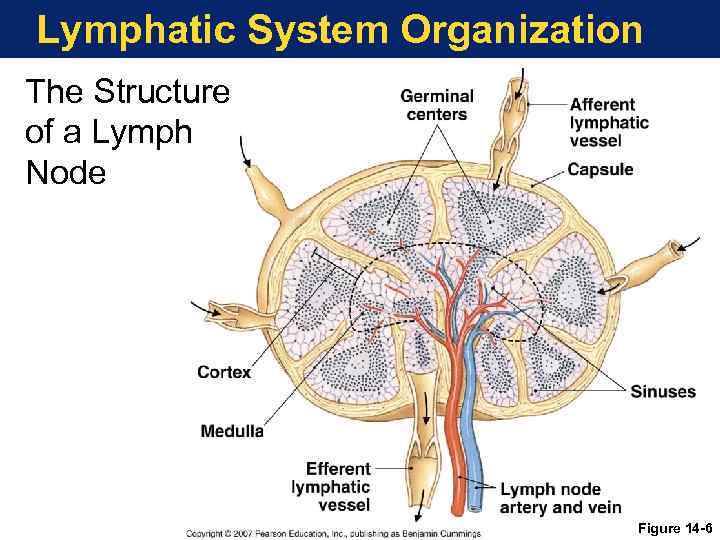 Lymphatic System Organization The Structure of a Lymph Node Figure 14 -6
 Lymphatic System Organization The Thymus • Lies behind sternum • T cells divide and mature there • Shrinks after puberty • Produces thymosins • Hormones that regulate T cell development Copyright © 2007 Pearson Education, Inc. , publishing as Benjamin Cummings
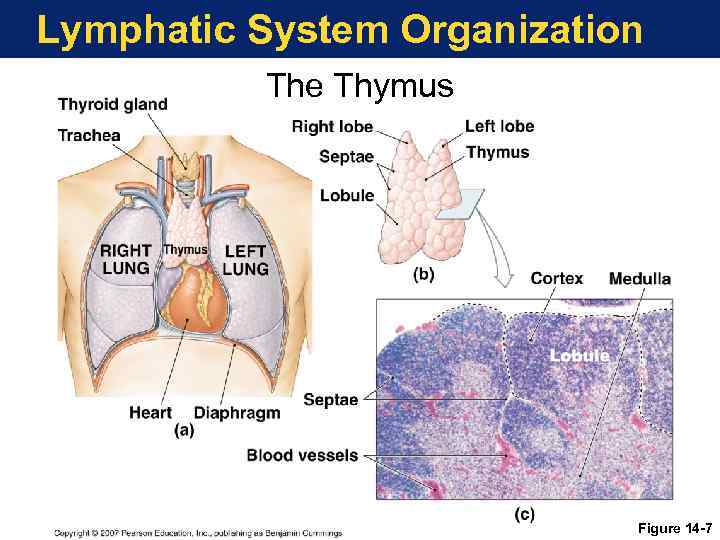 Lymphatic System Organization The Thymus Figure 14 -7
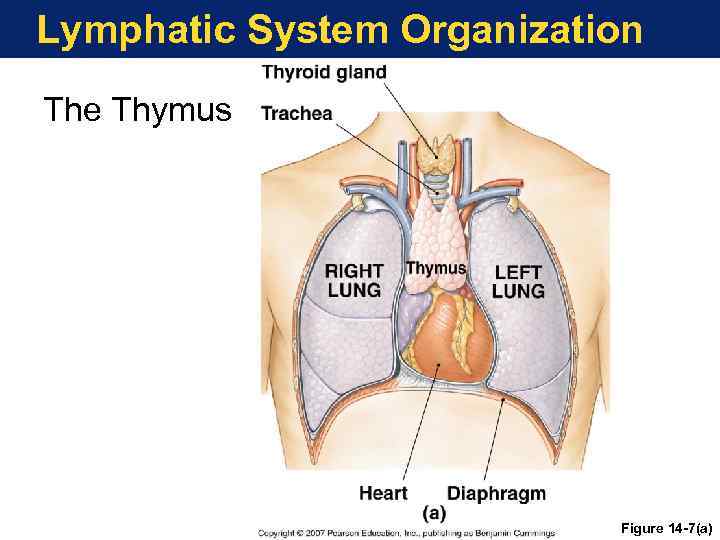 Lymphatic System Organization The Thymus Figure 14 -7(a)
 Lymphatic System Organization The Thymus Figure 14 -7(b)
 Lymphatic System Organization The Thymus Figure 14 -7(c)
 Lymphatic System Organization The Spleen • White pulp • Resembles lymphoid nodules • Removes antigens • Initiates immune response • Red pulp • Contains red blood cells • Recycles damaged or out-dated RBCs • Stores iron from recycled RBCs Copyright © 2007 Pearson Education, Inc. , publishing as Benjamin Cummings
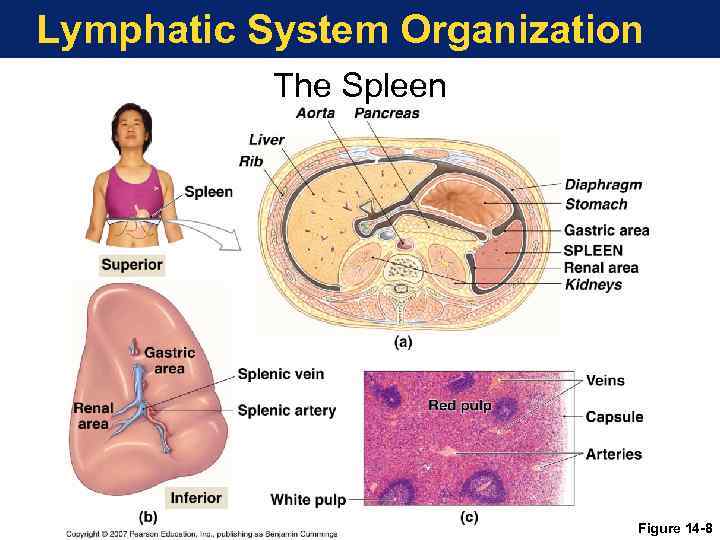 Lymphatic System Organization The Spleen Figure 14 -8
 Lymphatic System Organization The Spleen Figure 14 -8(a)
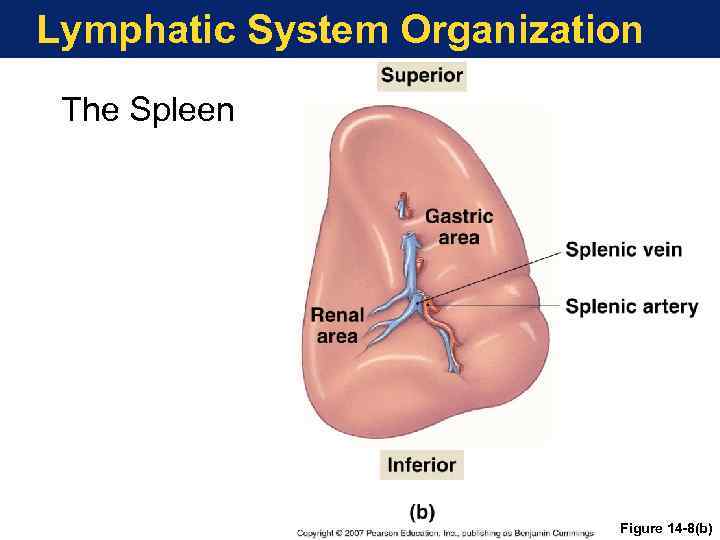 Lymphatic System Organization The Spleen Figure 14 -8(b)
 Lymphatic System Organization Overview of Body’s Defenses • Non-specific defenses • Protect against any threat • Specific defenses • Protect against particular threats • Responds to antigens Copyright © 2007 Pearson Education, Inc. , publishing as Benjamin Cummings
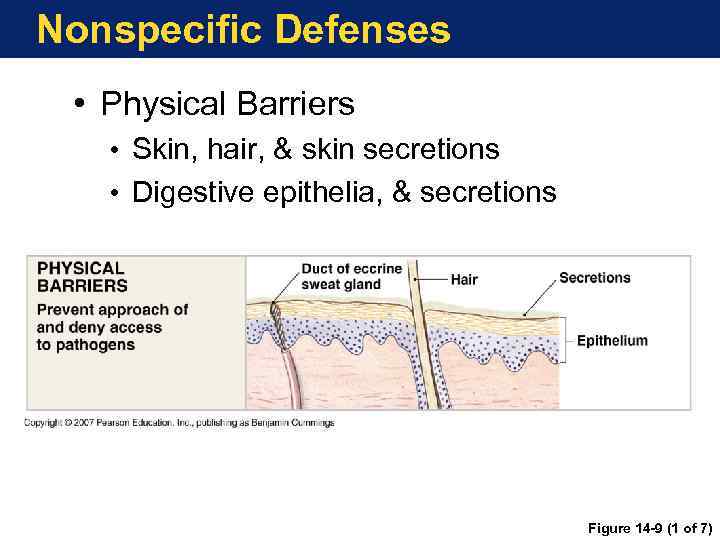 Nonspecific Defenses • Physical Barriers • Skin, hair, & skin secretions • Digestive epithelia, & secretions Figure 14 -9 (1 of 7)
 Nonspecific Defenses • Phagocytes • Microphages (neutrophils, eosinophils) • Macrophages Figure 14 -9 (2 of 7)
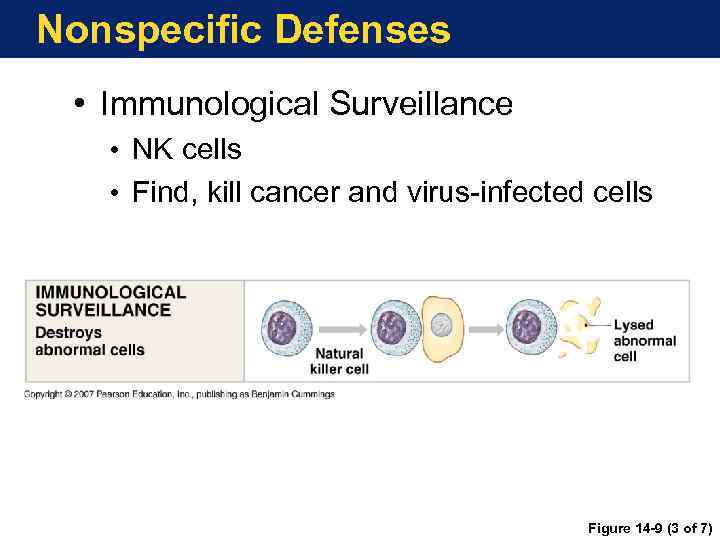 Nonspecific Defenses • Immunological Surveillance • NK cells • Find, kill cancer and virus-infected cells Figure 14 -9 (3 of 7)
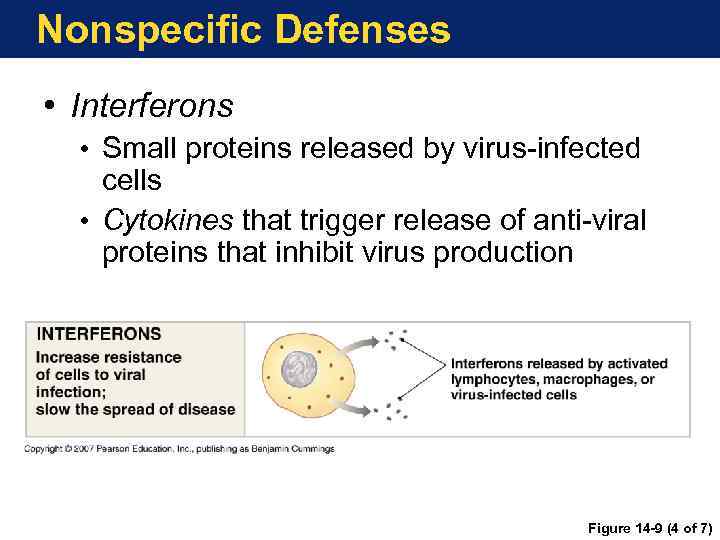 Nonspecific Defenses • Interferons • Small proteins released by virus-infected cells • Cytokines that trigger release of anti-viral proteins that inhibit virus production Figure 14 -9 (4 of 7)
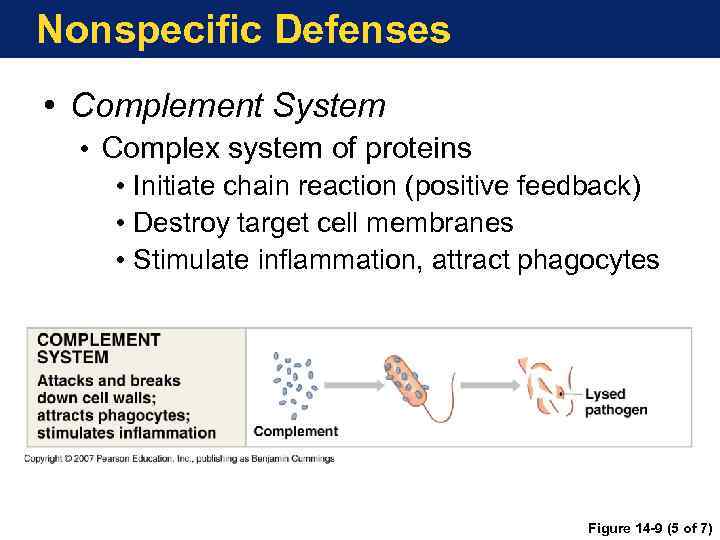 Nonspecific Defenses • Complement System • Complex system of proteins • Initiate chain reaction (positive feedback) • Destroy target cell membranes • Stimulate inflammation, attract phagocytes Figure 14 -9 (5 of 7)
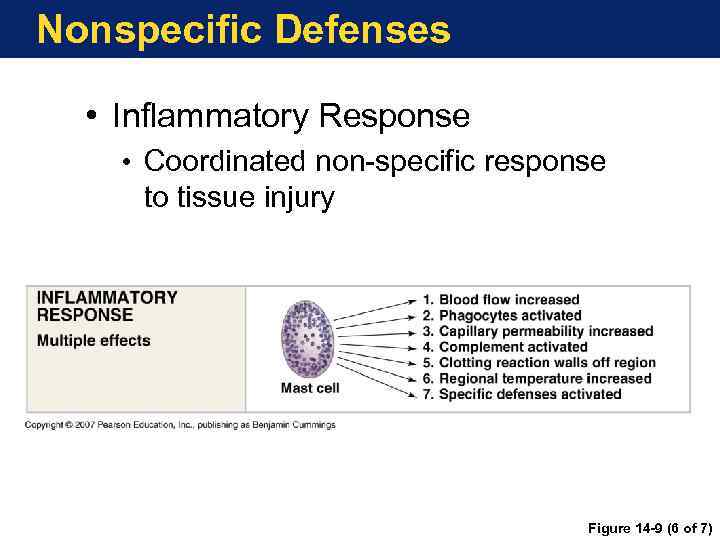 Nonspecific Defenses • Inflammatory Response • Coordinated non-specific response to tissue injury Figure 14 -9 (6 of 7)
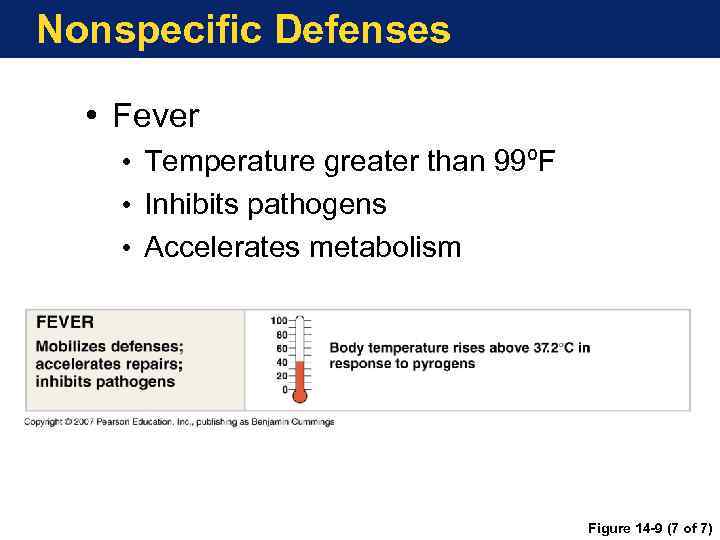 Nonspecific Defenses • Fever • Temperature greater than 99ºF • Inhibits pathogens • Accelerates metabolism Figure 14 -9 (7 of 7)
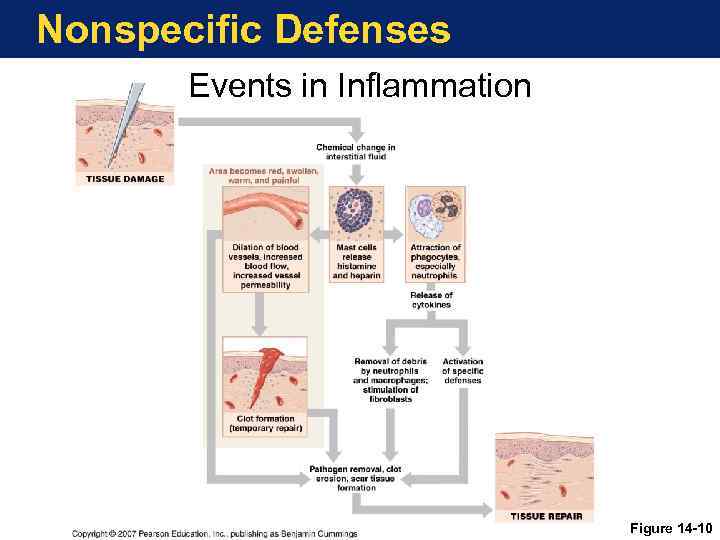 Nonspecific Defenses Events in Inflammation Figure 14 -10
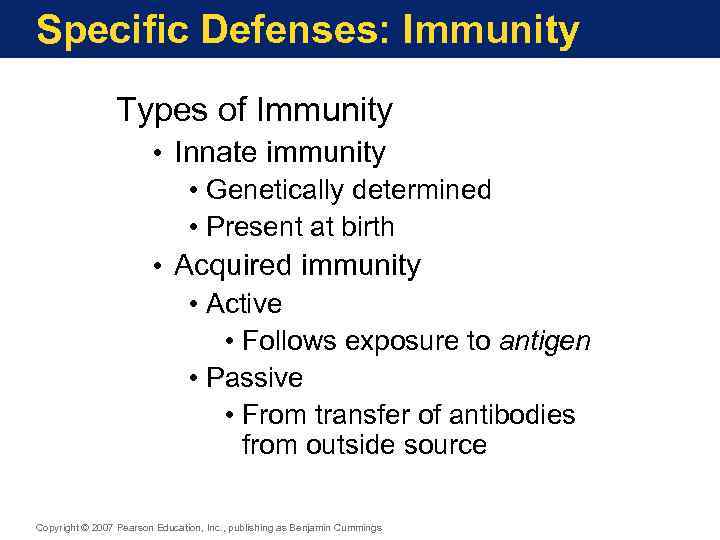 Specific Defenses: Immunity Types of Immunity • Innate immunity • Genetically determined • Present at birth • Acquired immunity • Active • Follows exposure to antigen • Passive • From transfer of antibodies from outside source Copyright © 2007 Pearson Education, Inc. , publishing as Benjamin Cummings
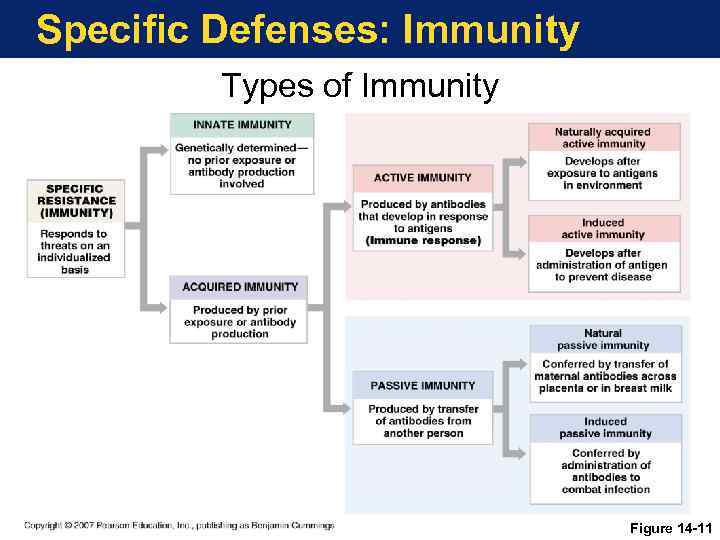 Specific Defenses: Immunity Types of Immunity Figure 14 -11
 Specific Defenses: Immunity Properties of Specific Immunity • Provided by lymphocytes • Four general characteristics • Specificity • Versatility • Memory • Tolerance Copyright © 2007 Pearson Education, Inc. , publishing as Benjamin Cummings
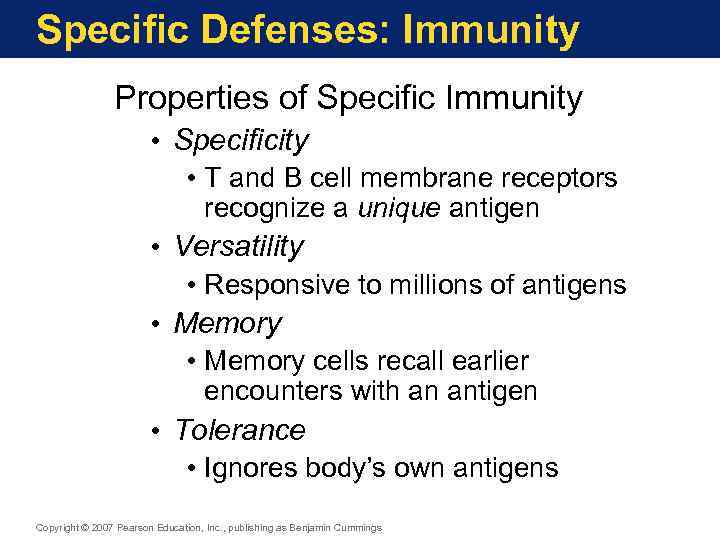 Specific Defenses: Immunity Properties of Specific Immunity • Specificity • T and B cell membrane receptors recognize a unique antigen • Versatility • Responsive to millions of antigens • Memory cells recall earlier encounters with an antigen • Tolerance • Ignores body’s own antigens Copyright © 2007 Pearson Education, Inc. , publishing as Benjamin Cummings
 Specific Defenses: Immunity Overview of the Immune Response • Purpose is to inactivate or destroy: • Pathogens • Abnormal cells • Foreign molecules • Based on activation of lymphocytes by specific antigens by antigen recognition Copyright © 2007 Pearson Education, Inc. , publishing as Benjamin Cummings
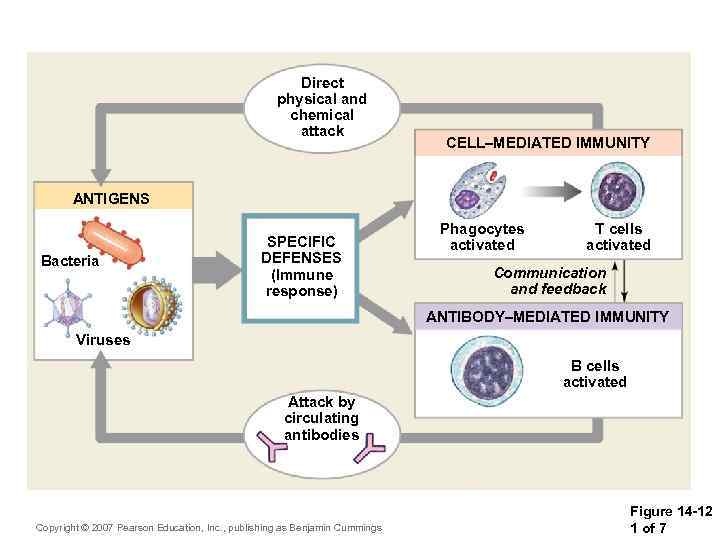 Direct physical and chemical attack CELL–MEDIATED IMMUNITY ANTIGENS Bacteria SPECIFIC DEFENSES (Immune response) Phagocytes activated T cells activated Communication and feedback ANTIBODY–MEDIATED IMMUNITY Viruses B cells activated Attack by circulating antibodies Copyright © 2007 Pearson Education, Inc. , publishing as Benjamin Cummings Figure 14 -12 1 of 7
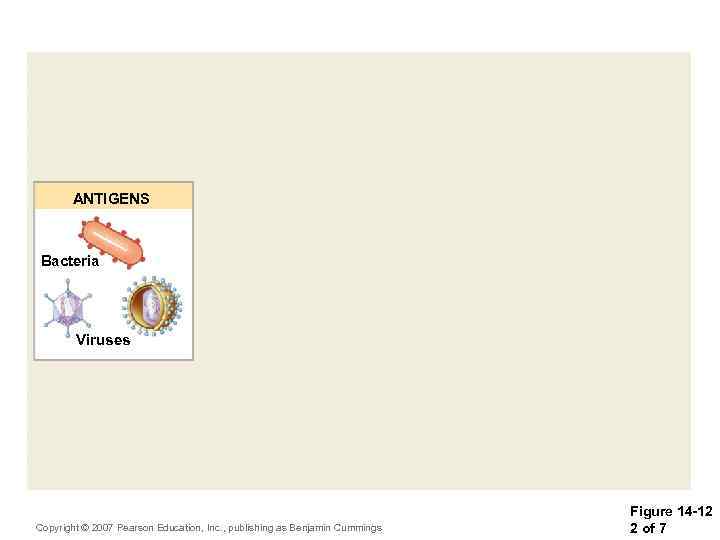 ANTIGENS Bacteria Viruses Copyright © 2007 Pearson Education, Inc. , publishing as Benjamin Cummings Figure 14 -12 2 of 7
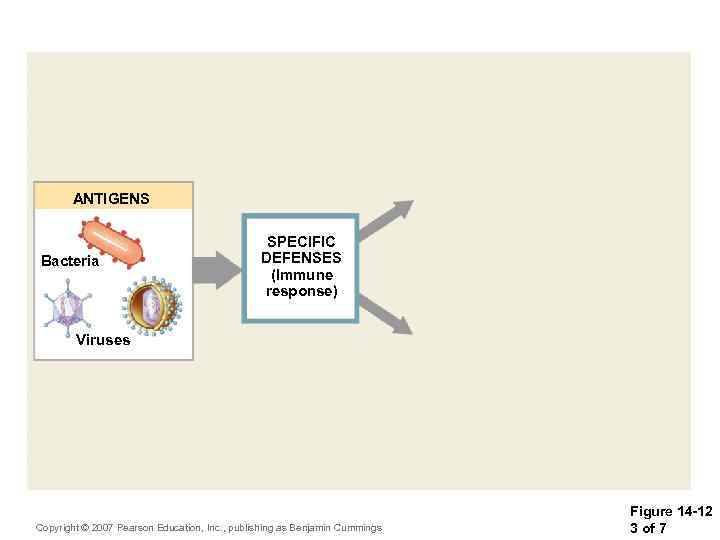 ANTIGENS Bacteria SPECIFIC DEFENSES (Immune response) Viruses Copyright © 2007 Pearson Education, Inc. , publishing as Benjamin Cummings Figure 14 -12 3 of 7
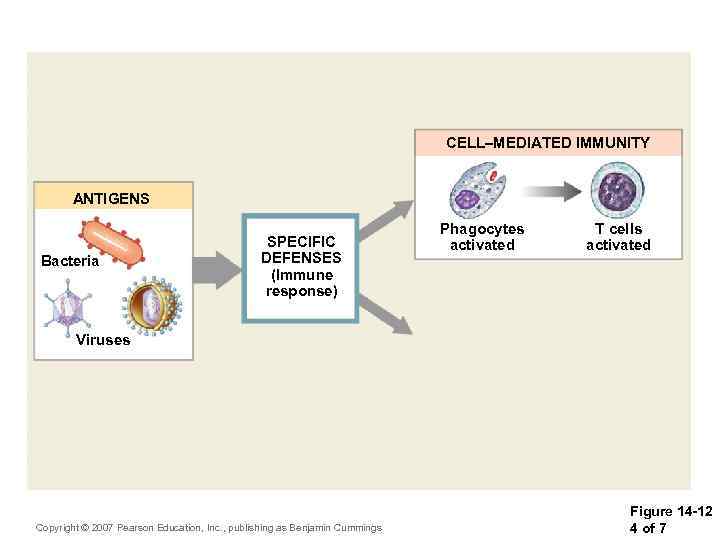 CELL–MEDIATED IMMUNITY ANTIGENS Bacteria SPECIFIC DEFENSES (Immune response) Phagocytes activated T cells activated Viruses Copyright © 2007 Pearson Education, Inc. , publishing as Benjamin Cummings Figure 14 -12 4 of 7
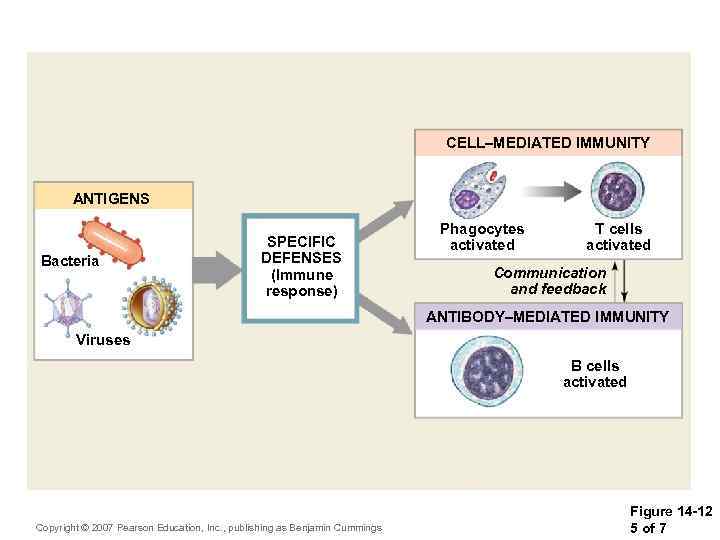 CELL–MEDIATED IMMUNITY ANTIGENS Bacteria SPECIFIC DEFENSES (Immune response) Phagocytes activated T cells activated Communication and feedback ANTIBODY–MEDIATED IMMUNITY Viruses B cells activated Copyright © 2007 Pearson Education, Inc. , publishing as Benjamin Cummings Figure 14 -12 5 of 7
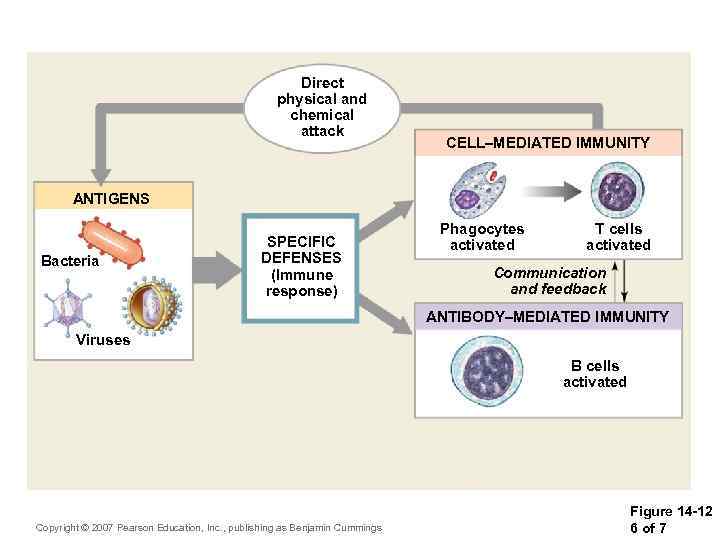 Direct physical and chemical attack CELL–MEDIATED IMMUNITY ANTIGENS Bacteria SPECIFIC DEFENSES (Immune response) Phagocytes activated T cells activated Communication and feedback ANTIBODY–MEDIATED IMMUNITY Viruses B cells activated Copyright © 2007 Pearson Education, Inc. , publishing as Benjamin Cummings Figure 14 -12 6 of 7
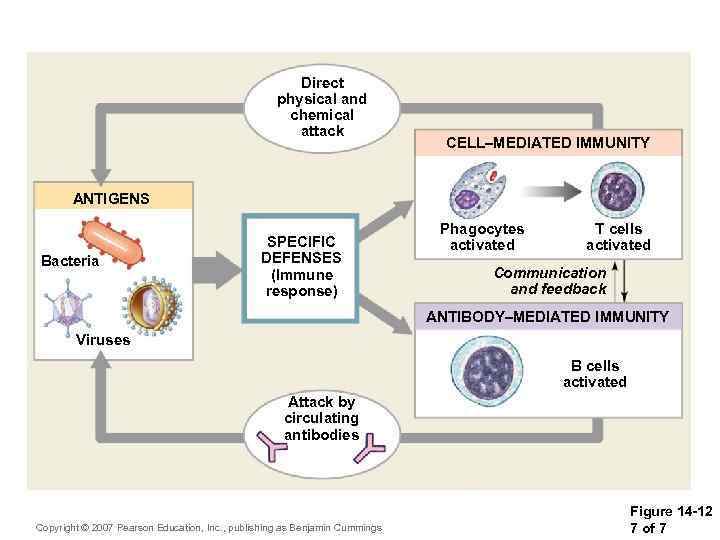 Direct physical and chemical attack CELL–MEDIATED IMMUNITY ANTIGENS Bacteria SPECIFIC DEFENSES (Immune response) Phagocytes activated T cells activated Communication and feedback ANTIBODY–MEDIATED IMMUNITY Viruses B cells activated Attack by circulating antibodies Copyright © 2007 Pearson Education, Inc. , publishing as Benjamin Cummings Figure 14 -12 7 of 7
 Specific Defenses: Immunity T Cell Activation • Antigens processed by macrophages • Fragments form complex with MHC proteins on cell surface • T cell recognizes MHC complex, or • Viral antigens on infected body cells • Activated T cells differentiate further Copyright © 2007 Pearson Education, Inc. , publishing as Benjamin Cummings
 Specific Defenses: Immunity Roles for Activated T Cells • Cytotoxic (killer) T cells • Provide cell-mediated immunity • Memory T cells • Remember the activating antigen • Suppressor T cells • Suppress other T and B cells • Helper T cells • Secrete regulatory cytokines Copyright © 2007 Pearson Education, Inc. , publishing as Benjamin Cummings
 ACTIVATION AND CELL DIVISION Infected cell Viral or bacterial antigen Inactive cytotoxic T cell Class I MHC protein T cell receptor Memory T cells (inactive) Active cytotoxic T cells Lymphotoxin release Disruption of cell metabolism Figure 14 -13 1 of 5 Copyright © 2007 Pearson Education, Inc. , publishing as Benjamin Cummings Lysed cell Cytokine release Perforin release Destruction of cell membrane Stimulation of apoptosis DESTRUCTION OF TARGET CELL
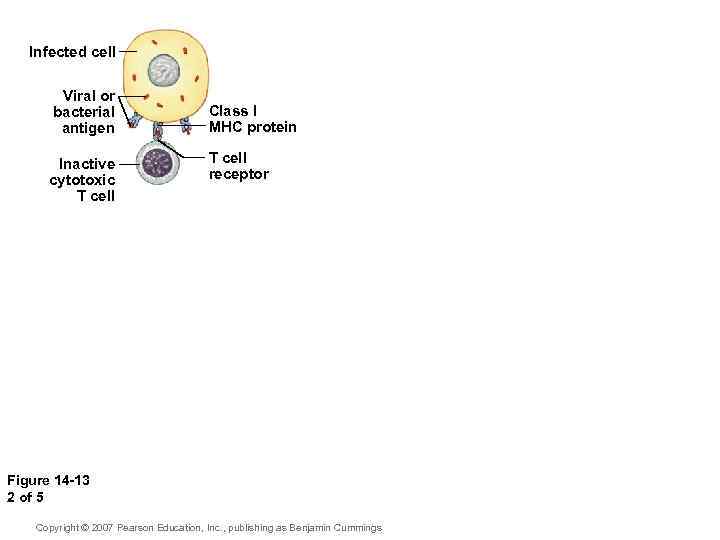 Infected cell Viral or bacterial antigen Inactive cytotoxic T cell Class I MHC protein T cell receptor Figure 14 -13 2 of 5 Copyright © 2007 Pearson Education, Inc. , publishing as Benjamin Cummings
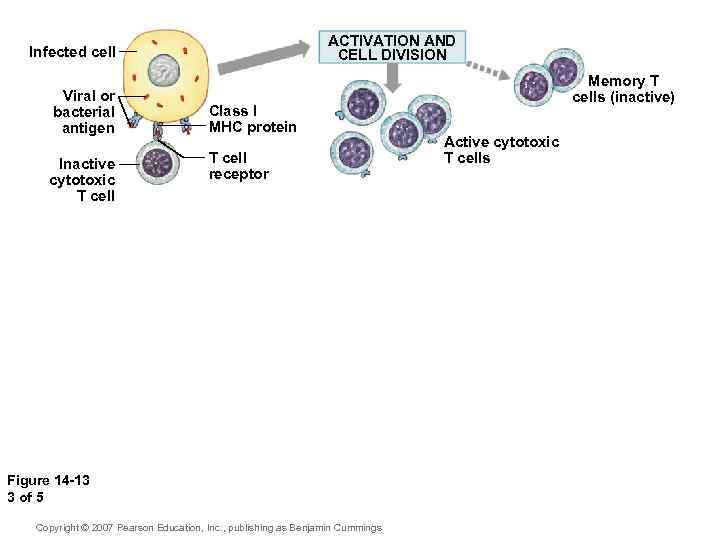 ACTIVATION AND CELL DIVISION Infected cell Viral or bacterial antigen Inactive cytotoxic T cell Class I MHC protein T cell receptor Figure 14 -13 3 of 5 Copyright © 2007 Pearson Education, Inc. , publishing as Benjamin Cummings Memory T cells (inactive) Active cytotoxic T cells
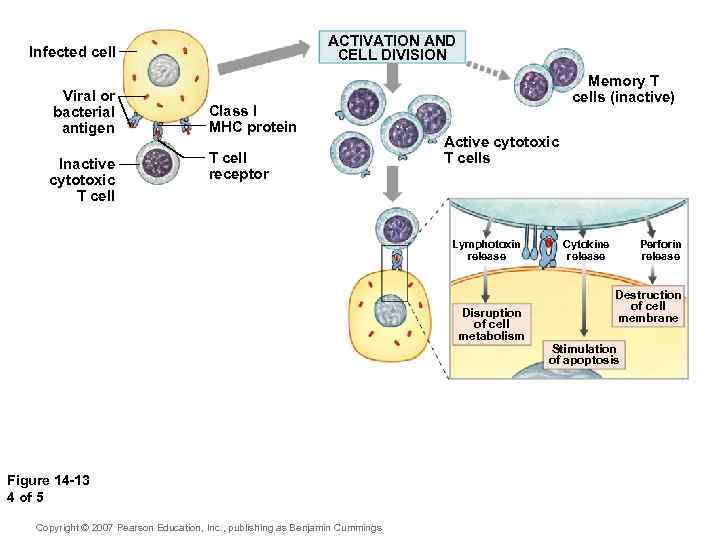 ACTIVATION AND CELL DIVISION Infected cell Viral or bacterial antigen Inactive cytotoxic T cell Class I MHC protein T cell receptor Memory T cells (inactive) Active cytotoxic T cells Lymphotoxin release Disruption of cell metabolism Figure 14 -13 4 of 5 Copyright © 2007 Pearson Education, Inc. , publishing as Benjamin Cummings Cytokine release Perforin release Destruction of cell membrane Stimulation of apoptosis
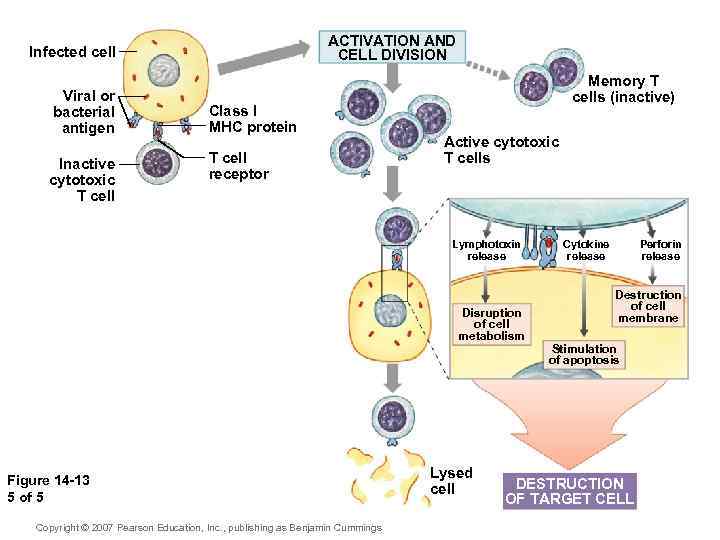 ACTIVATION AND CELL DIVISION Infected cell Viral or bacterial antigen Inactive cytotoxic T cell Class I MHC protein T cell receptor Memory T cells (inactive) Active cytotoxic T cells Lymphotoxin release Disruption of cell metabolism Figure 14 -13 5 of 5 Copyright © 2007 Pearson Education, Inc. , publishing as Benjamin Cummings Lysed cell Cytokine release Perforin release Destruction of cell membrane Stimulation of apoptosis DESTRUCTION OF TARGET CELL
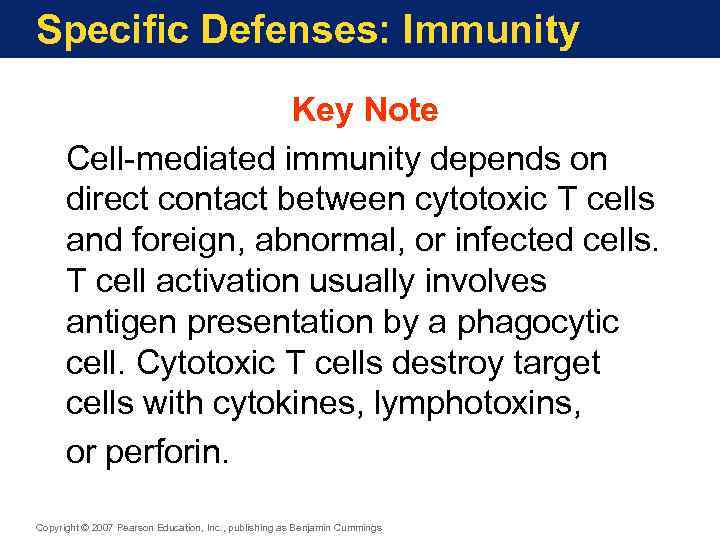 Specific Defenses: Immunity Key Note Cell-mediated immunity depends on direct contact between cytotoxic T cells and foreign, abnormal, or infected cells. T cell activation usually involves antigen presentation by a phagocytic cell. Cytotoxic T cells destroy target cells with cytokines, lymphotoxins, or perforin. Copyright © 2007 Pearson Education, Inc. , publishing as Benjamin Cummings
 Specific Defenses: Immunity B Cells and Antibody-Mediated Immunity • B cells are first sensitized by exposure to “their” antigen • Helper T cells for that antigen then activate those B cells • Activated B cells divide to form: • Plasma cells • Produce antibodies against that antigen • Memory cells Copyright © 2007 Pearson Education, Inc. , publishing as Benjamin Cummings
 Sensitization Antigens Activation Class II MHC Inactive B cell Antigens bound to antibody molecules T cell receptor Antigen Class II MHC Antibodies Division and differentiation B cell ANTIBODY PRODUCTION T cell Stimulation by cytokines Plasma cells Antigen binding Sensitized B cell Helper T cell Sensitized B cell Copyright © 2007 Pearson Education, Inc. , publishing as Benjamin Cummings Activated B cells Memory B cells (inactive) Figure 14 -14 1 of 5
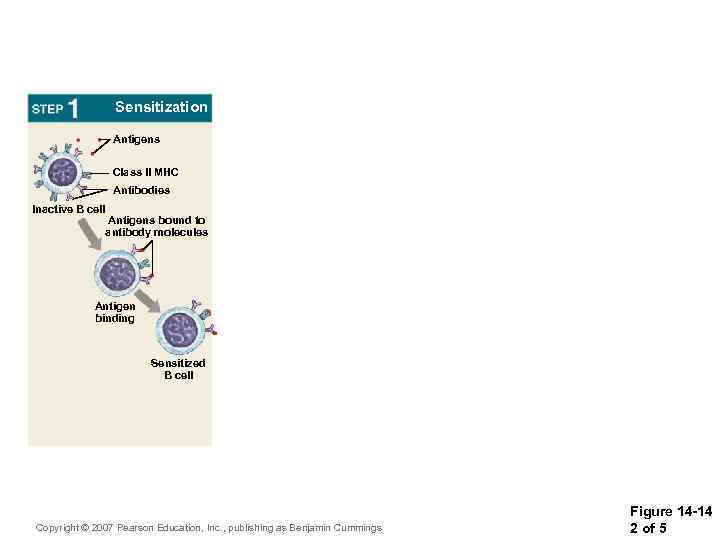 Sensitization Antigens Class II MHC Antibodies Inactive B cell Antigens bound to antibody molecules Antigen binding Sensitized B cell Copyright © 2007 Pearson Education, Inc. , publishing as Benjamin Cummings Figure 14 -14 2 of 5
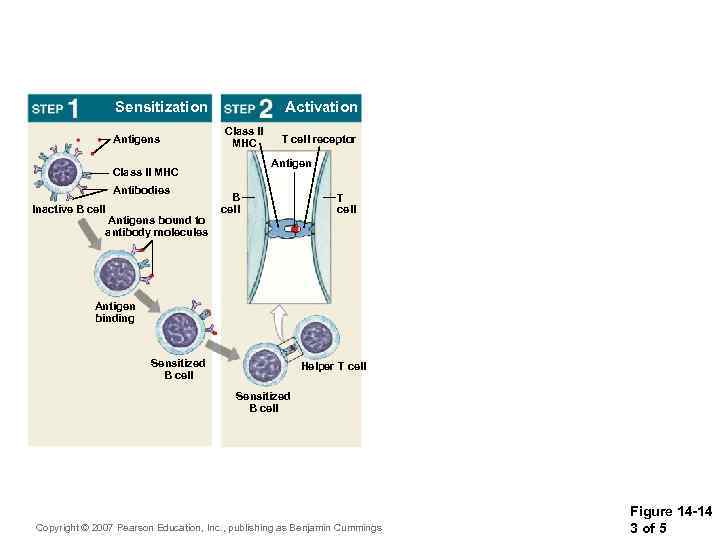 Sensitization Antigens Activation Class II MHC Antigen Class II MHC Antibodies Inactive B cell Antigens bound to antibody molecules T cell receptor B cell T cell Antigen binding Sensitized B cell Helper T cell Sensitized B cell Copyright © 2007 Pearson Education, Inc. , publishing as Benjamin Cummings Figure 14 -14 3 of 5
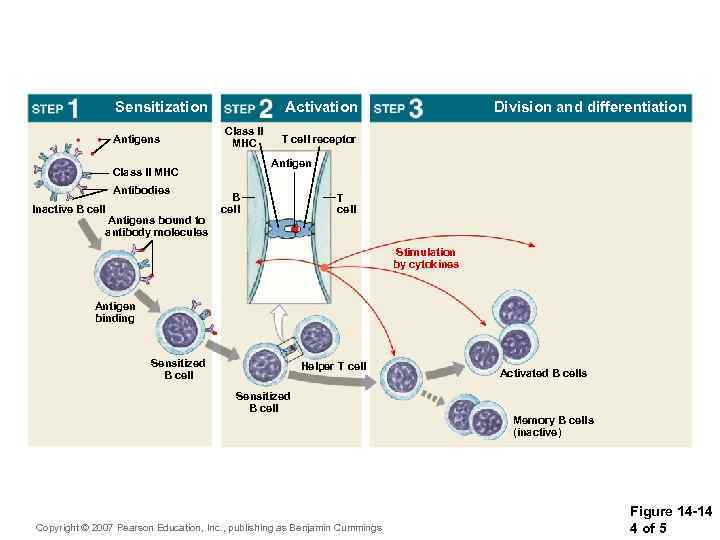 Sensitization Antigens Activation Class II MHC Inactive B cell Antigens bound to antibody molecules T cell receptor Antigen Class II MHC Antibodies Division and differentiation B cell T cell Stimulation by cytokines Antigen binding Sensitized B cell Helper T cell Sensitized B cell Copyright © 2007 Pearson Education, Inc. , publishing as Benjamin Cummings Activated B cells Memory B cells (inactive) Figure 14 -14 4 of 5
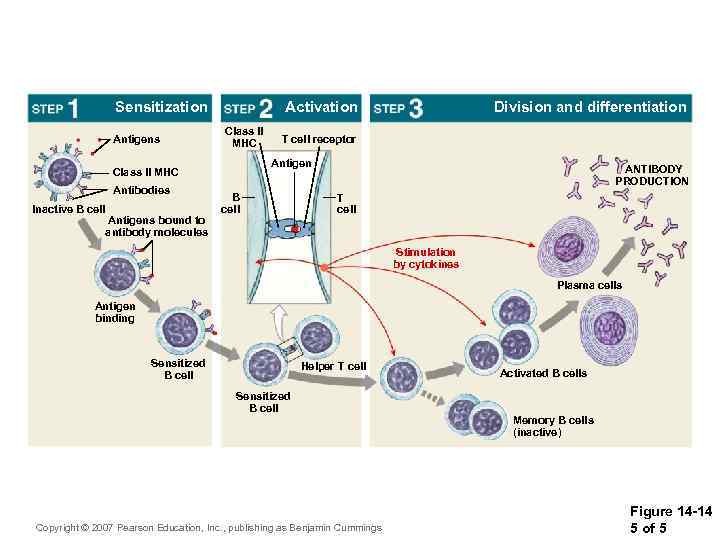 Sensitization Antigens Activation Class II MHC Inactive B cell Antigens bound to antibody molecules T cell receptor Antigen Class II MHC Antibodies Division and differentiation B cell ANTIBODY PRODUCTION T cell Stimulation by cytokines Plasma cells Antigen binding Sensitized B cell Helper T cell Sensitized B cell Copyright © 2007 Pearson Education, Inc. , publishing as Benjamin Cummings Activated B cells Memory B cells (inactive) Figure 14 -14 5 of 5
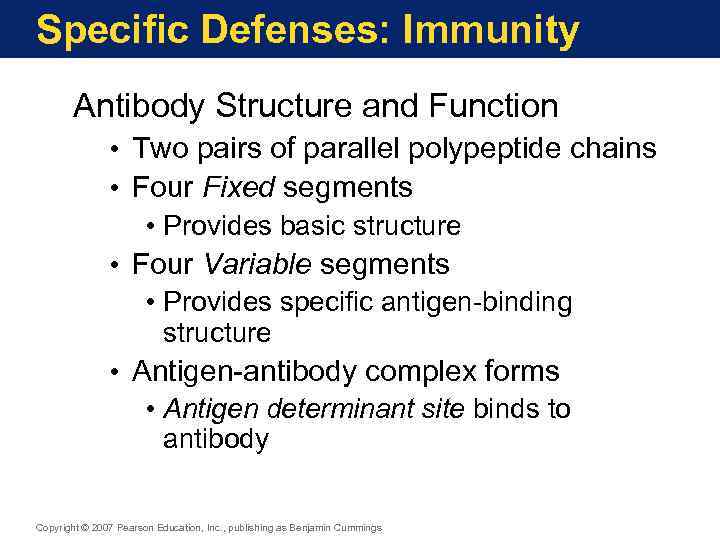 Specific Defenses: Immunity Antibody Structure and Function • Two pairs of parallel polypeptide chains • Four Fixed segments • Provides basic structure • Four Variable segments • Provides specific antigen-binding structure • Antigen-antibody complex forms • Antigen determinant site binds to antibody Copyright © 2007 Pearson Education, Inc. , publishing as Benjamin Cummings
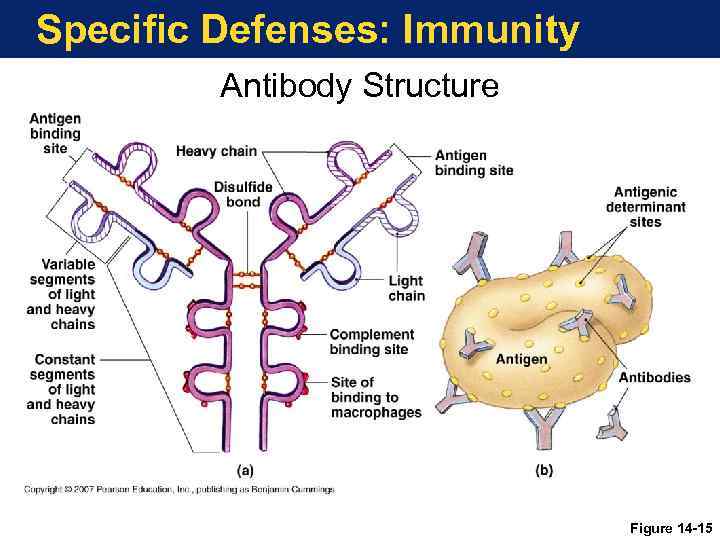 Specific Defenses: Immunity Antibody Structure Figure 14 -15
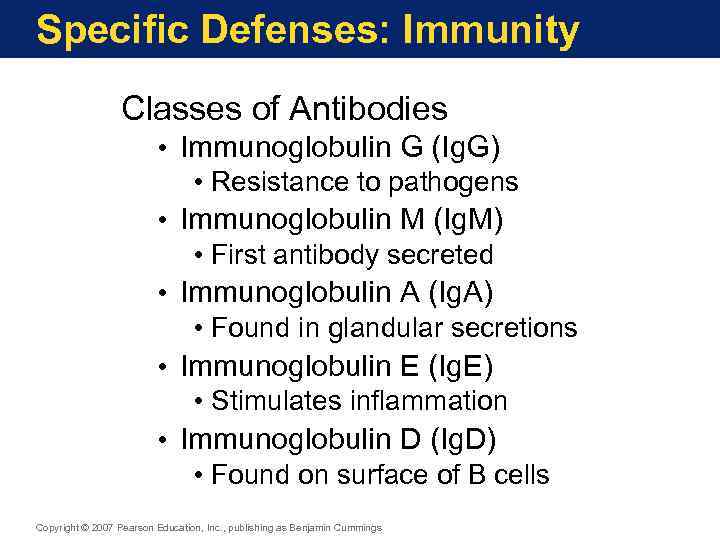 Specific Defenses: Immunity Classes of Antibodies • Immunoglobulin G (Ig. G) • Resistance to pathogens • Immunoglobulin M (Ig. M) • First antibody secreted • Immunoglobulin A (Ig. A) • Found in glandular secretions • Immunoglobulin E (Ig. E) • Stimulates inflammation • Immunoglobulin D (Ig. D) • Found on surface of B cells Copyright © 2007 Pearson Education, Inc. , publishing as Benjamin Cummings
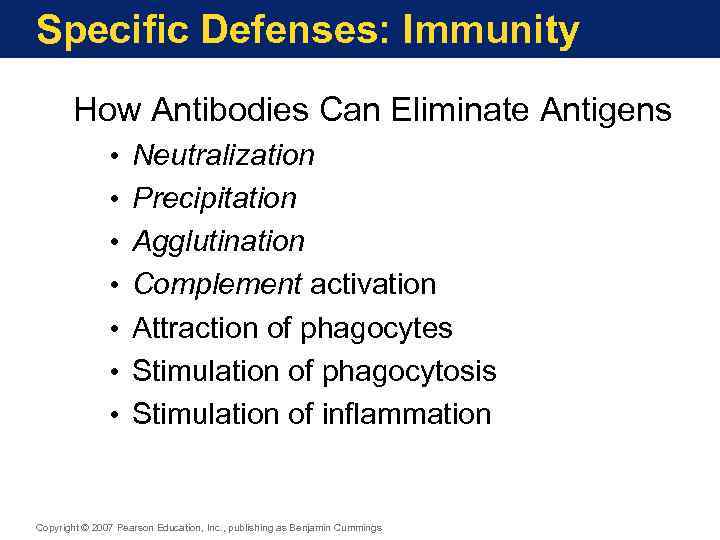 Specific Defenses: Immunity How Antibodies Can Eliminate Antigens • • Neutralization Precipitation Agglutination Complement activation Attraction of phagocytes Stimulation of phagocytosis Stimulation of inflammation Copyright © 2007 Pearson Education, Inc. , publishing as Benjamin Cummings
 Specific Defenses: Immunity Key Note Antibody-mediated immunity depends on specific antibodies from plasma cells derived from activated B cells by (1) antigen recognition, through binding to surface antibodies, and (2) stimulation by a helper T cell activated by the same antigen. The antibodies bind to the target antigen and either inhibit it, destroy it, remove it from solution, or promote its phagocytosis. Copyright © 2007 Pearson Education, Inc. , publishing as Benjamin Cummings
 Specific Defenses: Immunity Primary and Secondary Immune Response • Primary response—Antibodies produced by plasma cells after first exposure to antigen • Secondary response—Maximum antibody levels produced by subsequent exposure to the same antibody Copyright © 2007 Pearson Education, Inc. , publishing as Benjamin Cummings
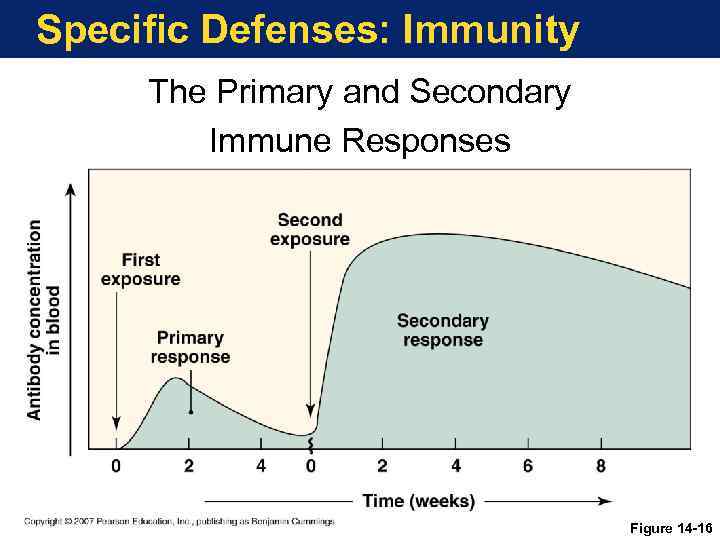 Specific Defenses: Immunity The Primary and Secondary Immune Responses Figure 14 -16
 Specific Defenses: Immunity Key Note Immunization produces a primary response to a specific antigen. If the same antigen is encountered at a later date, it triggers a powerful secondary response that usually prevents infection and disease. Copyright © 2007 Pearson Education, Inc. , publishing as Benjamin Cummings
 Specific Defenses: Immunity Hormones of the Immune System • Interleukins (IL) • Sensitize T cells • Stimulate B cells • Enhance non-specific defenses • Interferons • Slow the spread of viruses locally • Tumor necrosis factors (TNF) • Slows growth, kills tumor cells • Phagocytic regulators Copyright © 2007 Pearson Education, Inc. , publishing as Benjamin Cummings
 Specific Defenses: Immunity Key Note Viruses replicate inside cells, whereas bacteria usually live outside. Antibodies work outside of cells, so they are primarily effective against bacteria rather than viruses. T cells, NK cells, and interferons are the primary defenses against viral infection. Copyright © 2007 Pearson Education, Inc. , publishing as Benjamin Cummings
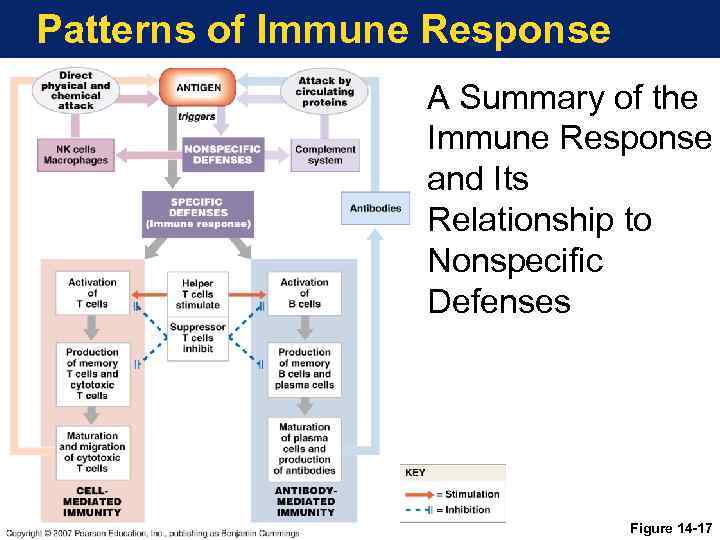 Patterns of Immune Response A Summary of the Immune Response and Its Relationship to Nonspecific Defenses Figure 14 -17
 Patterns of Immune Response Immune Disorders • Autoimmune disorders • Mistaken attack on body’s own tissues • Immunodeficiency disease • Disease (e. g. , AIDS) or a congenital block of immunity • Allergies • Inappropriate or excessive response to allergens • Age-related loss of effectiveness Copyright © 2007 Pearson Education, Inc. , publishing as Benjamin Cummings
 Patterns of Immune Response Types of Allergies • • Immediate hypersensitivity (Type I) Cytotoxic reaction (Type II) Immune complex disorders (Type III) Delayed hypersensitivity (Type IV) Copyright © 2007 Pearson Education, Inc. , publishing as Benjamin Cummings
 The Lymphatic System in Perspective FIGURE 14 -18 Functional Relationships Between the Lymphatic System and Other Systems Copyright © 2007 Pearson Education, Inc. , publishing as Benjamin Cummings Figure 14 -18 1 of 11
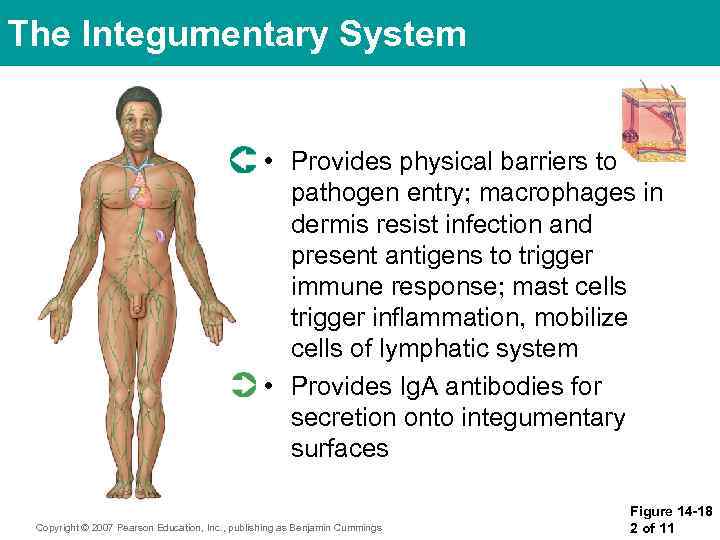 The Integumentary System • Provides physical barriers to pathogen entry; macrophages in dermis resist infection and present antigens to trigger immune response; mast cells trigger inflammation, mobilize cells of lymphatic system • Provides Ig. A antibodies for secretion onto integumentary surfaces Copyright © 2007 Pearson Education, Inc. , publishing as Benjamin Cummings Figure 14 -18 2 of 11
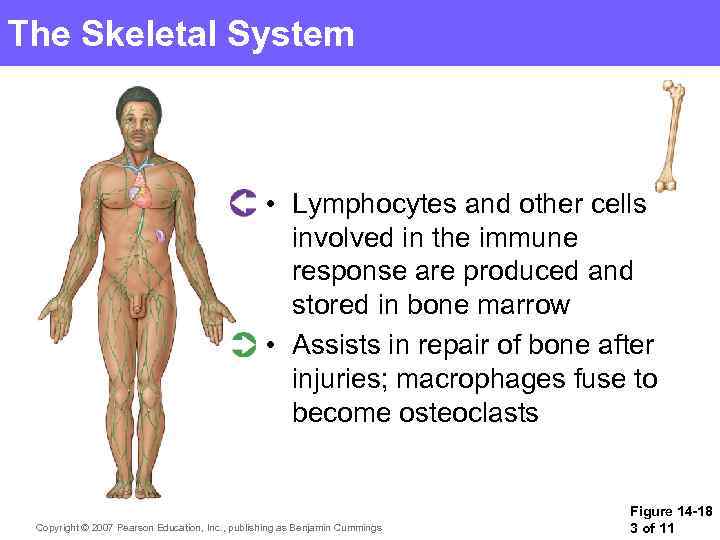 The Skeletal System • Lymphocytes and other cells involved in the immune response are produced and stored in bone marrow • Assists in repair of bone after injuries; macrophages fuse to become osteoclasts Copyright © 2007 Pearson Education, Inc. , publishing as Benjamin Cummings Figure 14 -18 3 of 11
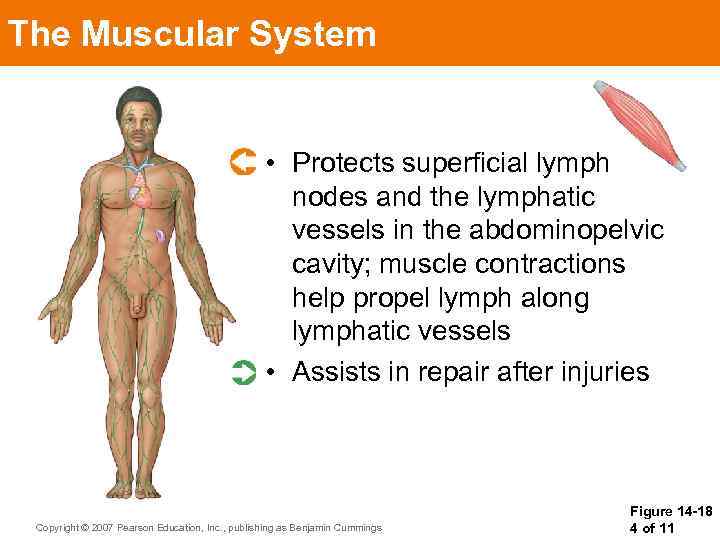 The Muscular System • Protects superficial lymph nodes and the lymphatic vessels in the abdominopelvic cavity; muscle contractions help propel lymph along lymphatic vessels • Assists in repair after injuries Copyright © 2007 Pearson Education, Inc. , publishing as Benjamin Cummings Figure 14 -18 4 of 11
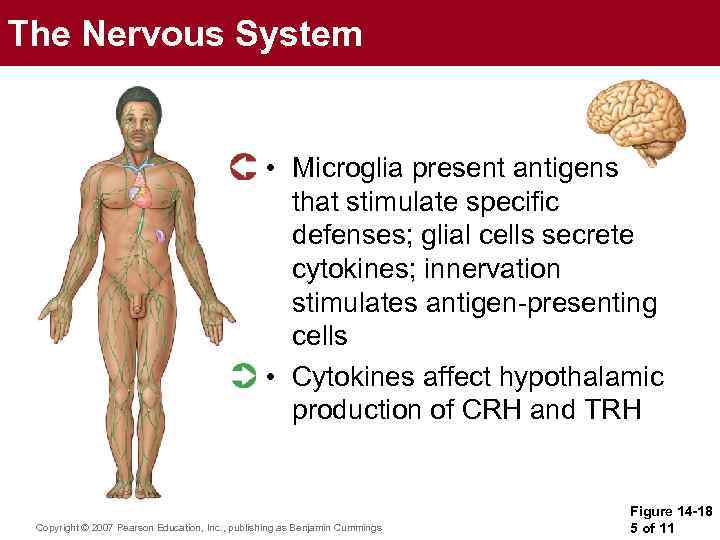 The Nervous System • Microglia present antigens that stimulate specific defenses; glial cells secrete cytokines; innervation stimulates antigen-presenting cells • Cytokines affect hypothalamic production of CRH and TRH Copyright © 2007 Pearson Education, Inc. , publishing as Benjamin Cummings Figure 14 -18 5 of 11
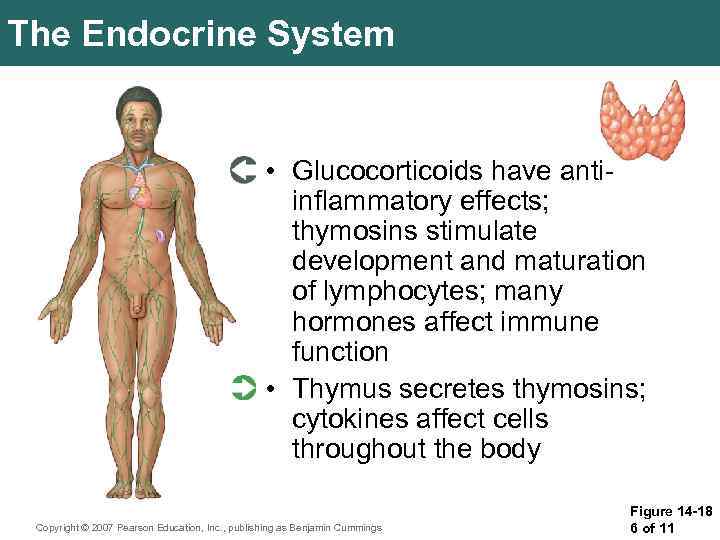 The Endocrine System • Glucocorticoids have antiinflammatory effects; thymosins stimulate development and maturation of lymphocytes; many hormones affect immune function • Thymus secretes thymosins; cytokines affect cells throughout the body Copyright © 2007 Pearson Education, Inc. , publishing as Benjamin Cummings Figure 14 -18 6 of 11
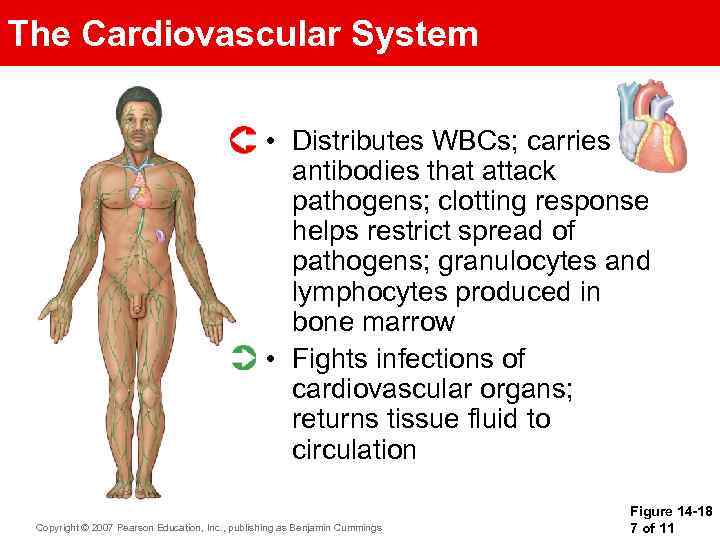 The Cardiovascular System • Distributes WBCs; carries antibodies that attack pathogens; clotting response helps restrict spread of pathogens; granulocytes and lymphocytes produced in bone marrow • Fights infections of cardiovascular organs; returns tissue fluid to circulation Copyright © 2007 Pearson Education, Inc. , publishing as Benjamin Cummings Figure 14 -18 7 of 11
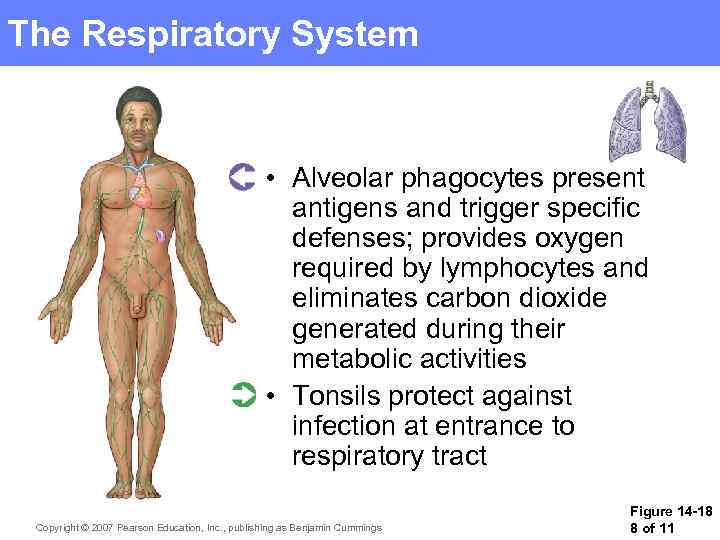 The Respiratory System • Alveolar phagocytes present antigens and trigger specific defenses; provides oxygen required by lymphocytes and eliminates carbon dioxide generated during their metabolic activities • Tonsils protect against infection at entrance to respiratory tract Copyright © 2007 Pearson Education, Inc. , publishing as Benjamin Cummings Figure 14 -18 8 of 11
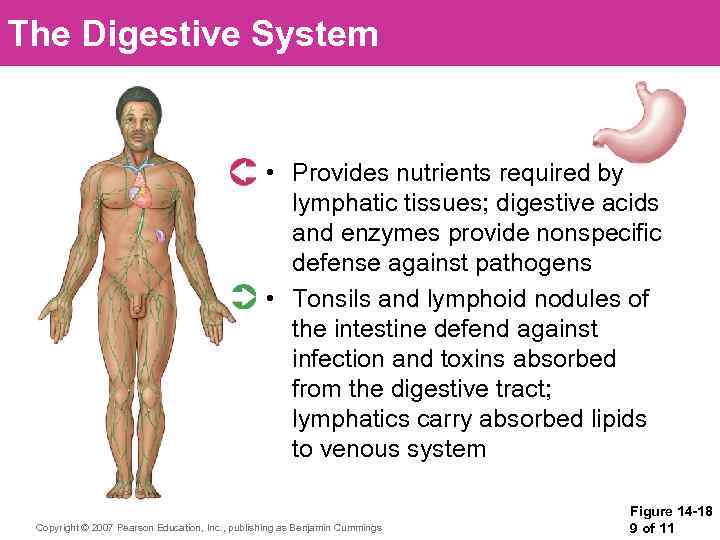 The Digestive System • Provides nutrients required by lymphatic tissues; digestive acids and enzymes provide nonspecific defense against pathogens • Tonsils and lymphoid nodules of the intestine defend against infection and toxins absorbed from the digestive tract; lymphatics carry absorbed lipids to venous system Copyright © 2007 Pearson Education, Inc. , publishing as Benjamin Cummings Figure 14 -18 9 of 11
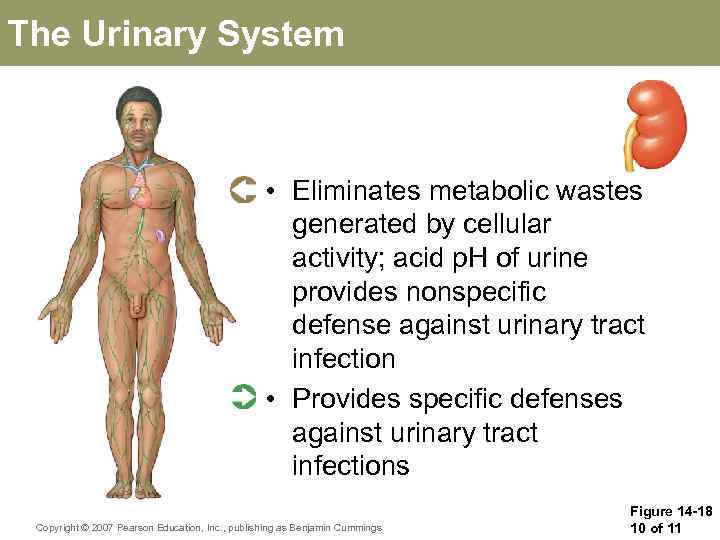 The Urinary System • Eliminates metabolic wastes generated by cellular activity; acid p. H of urine provides nonspecific defense against urinary tract infection • Provides specific defenses against urinary tract infections Copyright © 2007 Pearson Education, Inc. , publishing as Benjamin Cummings Figure 14 -18 10 of 11
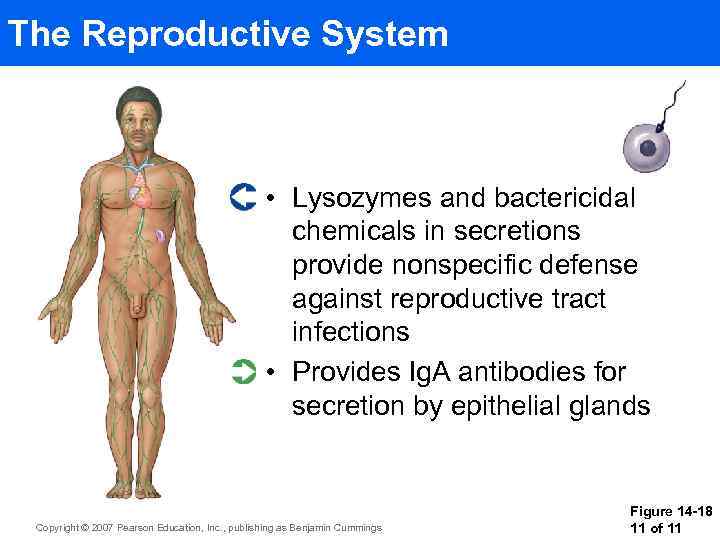 The Reproductive System • Lysozymes and bactericidal chemicals in secretions provide nonspecific defense against reproductive tract infections • Provides Ig. A antibodies for secretion by epithelial glands Copyright © 2007 Pearson Education, Inc. , publishing as Benjamin Cummings Figure 14 -18 11 of 11