


 Скачать презентацию Essential Question In what ways did President
ad7ef1b77d5bb9cef07a5d3433ce7a50.ppt
- Количество слайдов: 29
 ■ Essential Question: –In what ways did President Nixon represent a change towards conservative politics & how did his foreign policy alter the U. S. relationship with USSR & China? ■ Warm-Up Question: –Why was 1968 an important year in American history?
 The Presidency of Richard Nixon ■ By the late 1960 s, citizens had seen enough turmoil in U. S. foreign & domestic affairs: –The economic boom of the 1950 s & 1960 s was starting to come to an end –American prestige in the world was damaged by the failure in Vietnam –Anti-war protests, “hippie” culture, & liberal gov’t programs led many citizens to believe that America was headed for moral decay & economic collapse
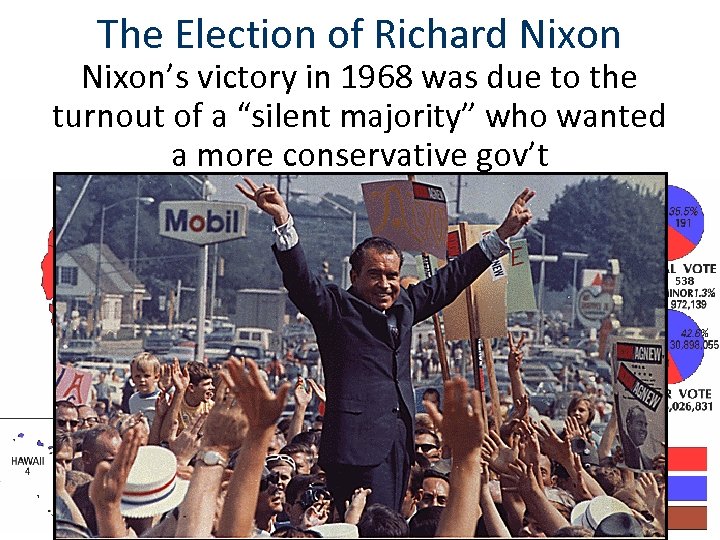 The Election of Richard Nixon’s 1968, Americans elected the victory in 1968 was due to In turnout of a “silent majority” who wanted conservative Republican Richard Nixon a more conservative gov’t
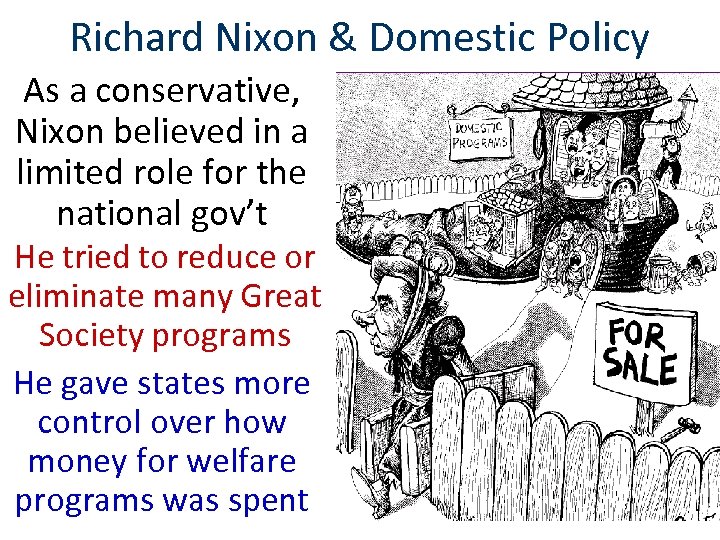 Richard Nixon & Domestic Policy As a conservative, Nixon believed in a limited role for the national gov’t He tried to reduce or eliminate many Great Society programs He gave states more control over how money for welfare programs was spent
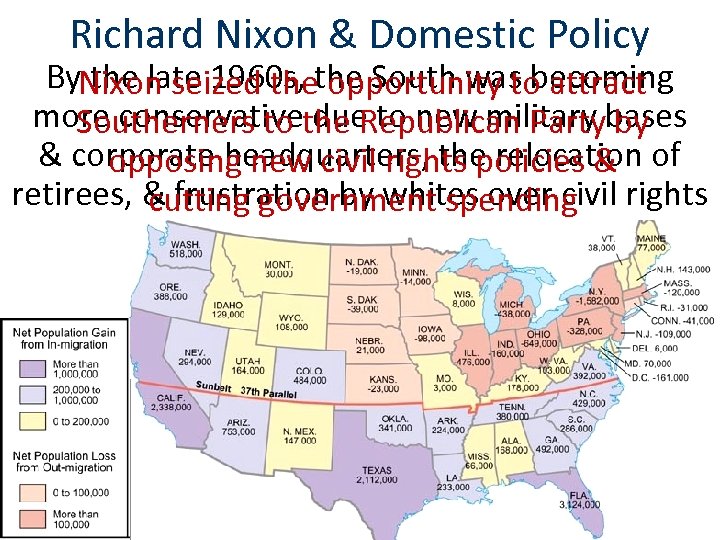 Richard Nixon & Domestic Policy By. Nixon seized thethe South was becoming the late 1960 s, opportunity to attract more conservativethe Republican Partybases Southerners to due to new military by & corporate headquarters, the relocation of opposing new civil rights policies & retirees, & frustration by whites over civil rights cutting government spending
 Richard Nixon & Foreign Policy President Nixon successfully changed U. S. foreign policy Instead of using containment to fight Communism & increase Cold War tensions, Nixon created a policy of détente (to ease tensions) with America’s Cold War enemies
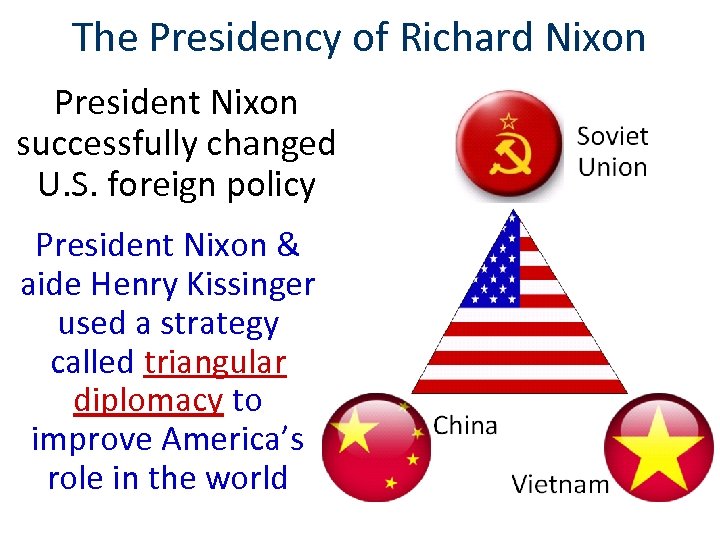 The Presidency of Richard Nixon President Nixon successfully changed U. S. foreign policy President Nixon & aide Henry Kissinger used a strategy called triangular diplomacy to improve America’s role in the world
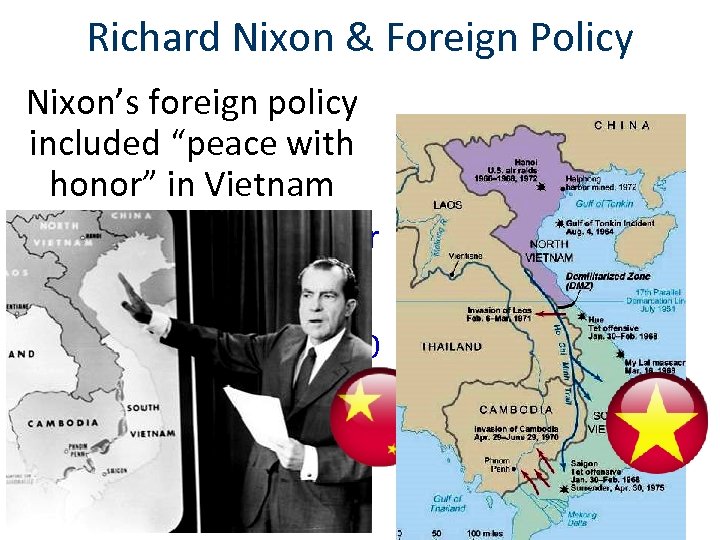 Richard Nixon & Foreign Policy Nixon’s foreign policy included “peace with honor” in Vietnam Nixon discussed plans for “Vietnamization” but secretly bombed Cambodia & Laos in 1970 In 1973, Nixon negotiated a cease fire, withdrew U. S. troops, & ended the Vietnam War
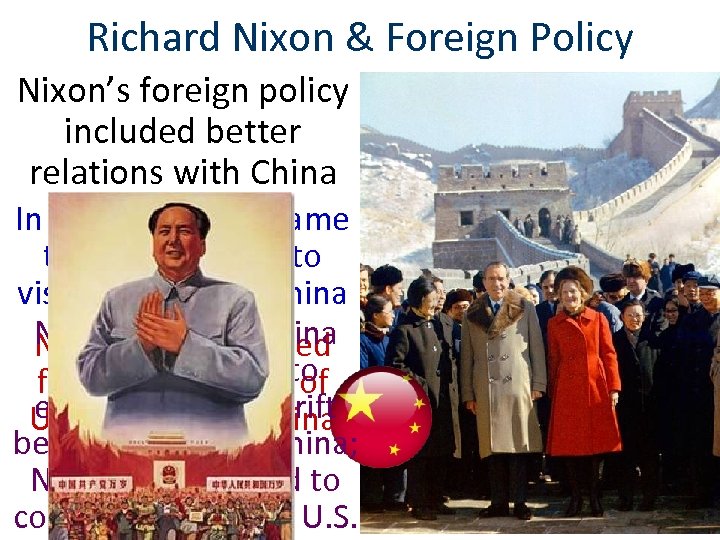 Richard Nixon & Foreign Policy Nixon’s foreign policy included better relations with China In 1972, Nixon became the 1 st president to visit & recognize China Nixon’s visit to China Nixon’s visit allowed was also meant of for the possibilityto exploit a with China U. S. tradegrowing rift between USSR & China; Now the USSR had to cooperate with the U. S.
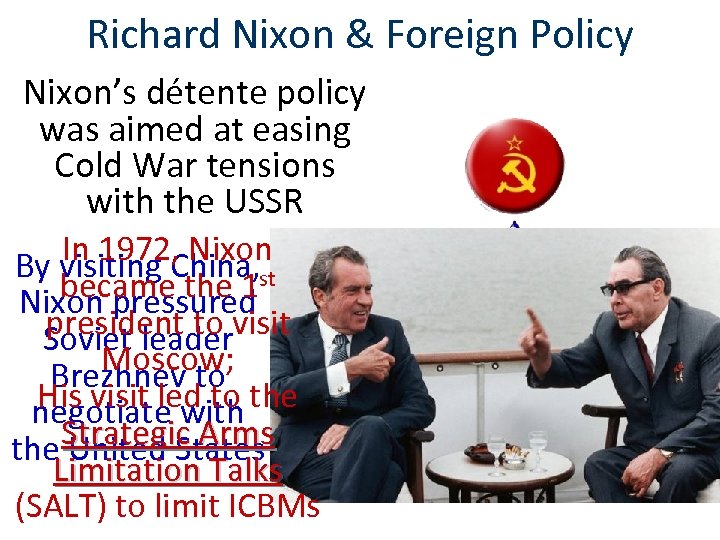 Richard Nixon & Foreign Policy Nixon’s détente policy was aimed at easing Cold War tensions with the USSR In 1972, Nixon By visiting China, st became the 1 Nixon pressured president to visit Soviet leader Moscow; Brezhnev to His visit led to the negotiate with Strategic Arms the United States Limitation Talks (SALT) to limit ICBMs
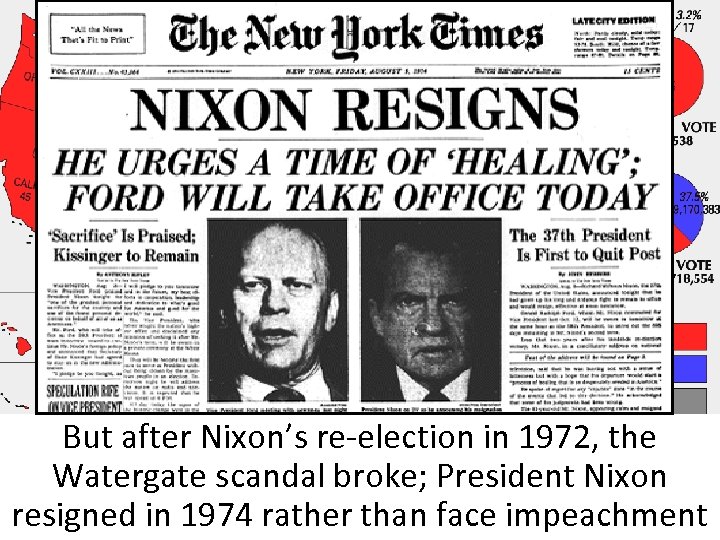 The Presidency of Richard Nixon was a popular president by the end of his 1 st term –His domestic policies reduced gov’t spending & revitalized middle-class, conservative, & Southern voters –His foreign policies led to the end of an unpopular war in Vietnam & eased tensions with America’s two biggest Nixon’s re-election But after Cold War rivals in 1972, the ■ In 1972, Nixon won one of the biggest Watergate scandal broke; President Nixon resigned in 1974 rather than face impeachment landslide victories in presidential history ■
 Closure Activity: Reviewing U. S. Containment Policy Review the Cold War containment policies of the United States from 1945 to 1973 ■ List the Cold War events of each president –Harry Truman (1945 -1953) –Dwight Eisenhower (1953 -1961) –John F Kennedy (1961 -1963) –Lyndon Johnson (1963 -1969) –Richard Nixon (1969 -1974) ■ Rank these presidents from most effective (#1) “Cold Warrior” to least effective (#5) ■
 ■ Essential Question: Question –In what ways did Presidents Ford & Carter fail to meet the needs of America in the late 1970 s? ■ Warm-Up Question: Question –Should Nixon’s presidency be judged more in his foreign policy successes or the Watergate scandal? Why?
 America from 1974 to 1980 ■ In the late 70 s, the U. S. was “overextended” –Americans distrusted their government as a result of Vietnam & Watergate –The economy had entered a recession with high unemployment & inflation –A decline in America’s status in the world –A series of presidents (Ford & Carter) that failed to inspire a sense of hope among the American people
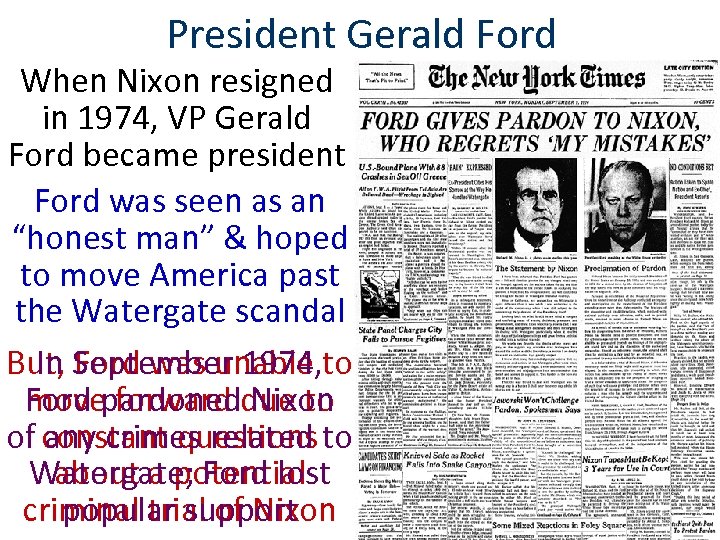 President Gerald Ford When Nixon resigned in 1974, VP Gerald Ford became president Ford was seen as an “honest man” & hoped to move America past the Watergate scandal But, September 1974, to In Ford was unable Ford pardoneddue to move forward Nixon of constant questions to any crimes related Watergate; Ford lost about a potential criminal trial of Nixon popular support
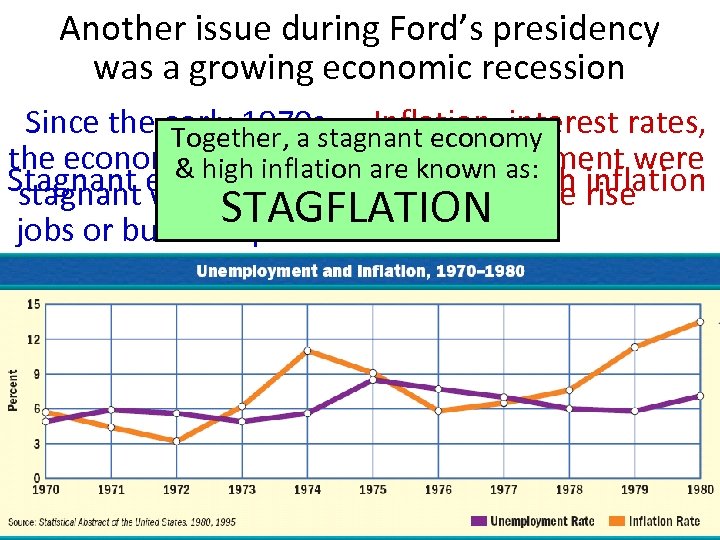 Another issue during Ford’s presidency was a growing economic recession Since the early 1970 s, Inflation, interest rates, Together, a stagnant economy the economy had inflation areunemployment were & high grown & known as: Stagnant economy new High rise inflation stagnant with few all on the STAGFLATION jobs or business profits
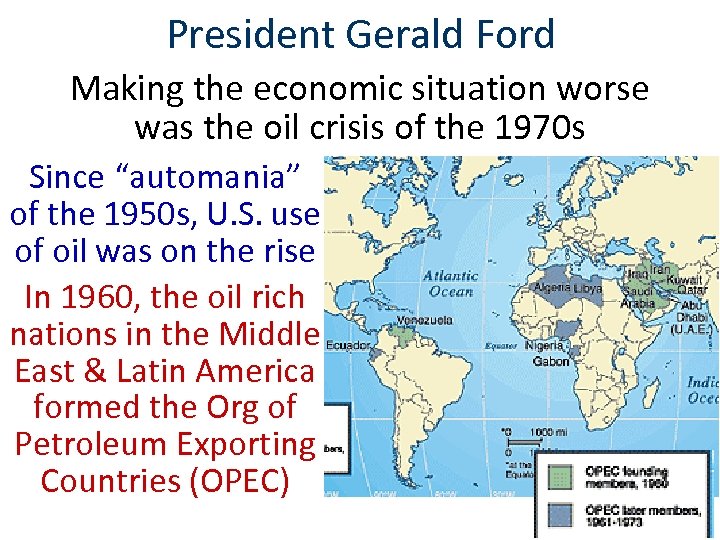 President Gerald Ford Making the economic situation worse was the oil crisis of the 1970 s Since “automania” of the 1950 s, U. S. use of oil was on the rise In 1960, the oil rich nations in the Middle East & Latin America formed the Org of Petroleum Exporting Countries (OPEC)
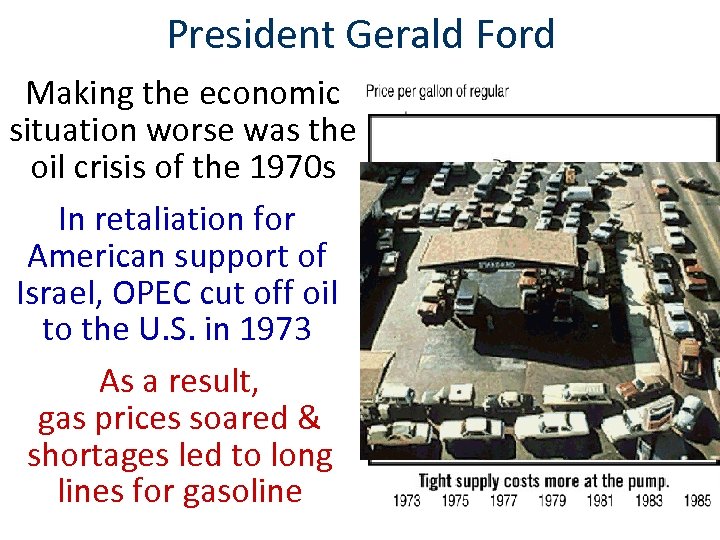 President Gerald Ford Making the economic situation worse was the oil crisis of the 1970 s In retaliation for American support of Israel, OPEC cut off oil to the U. S. in 1973 As a result, gas prices soared & shortages led to long lines for gasoline
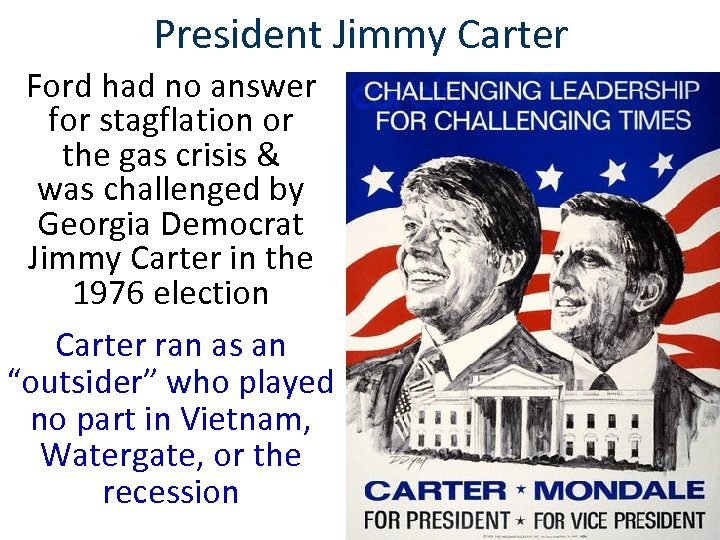 President Jimmy Carter Ford had no answer for stagflation or the gas crisis & was challenged by Georgia Democrat Jimmy Carter in the 1976 election Carter ran as an “outsider” who played no part in Vietnam, Watergate, or the recession
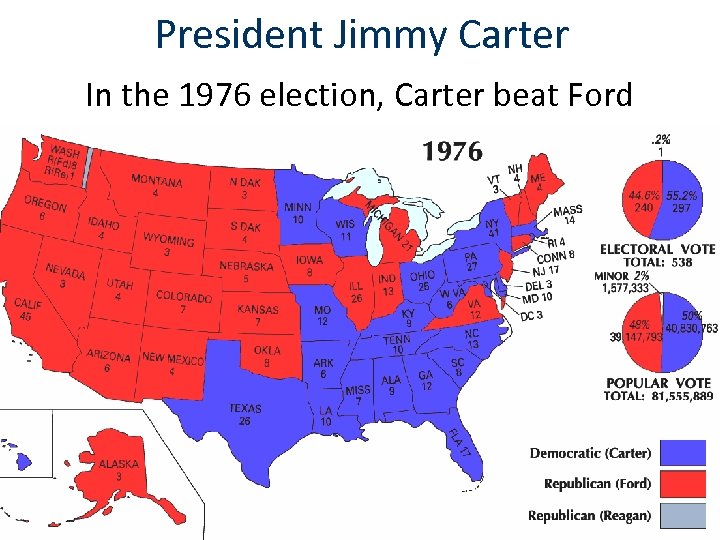 President Jimmy Carter In the 1976 election, Carter beat Ford
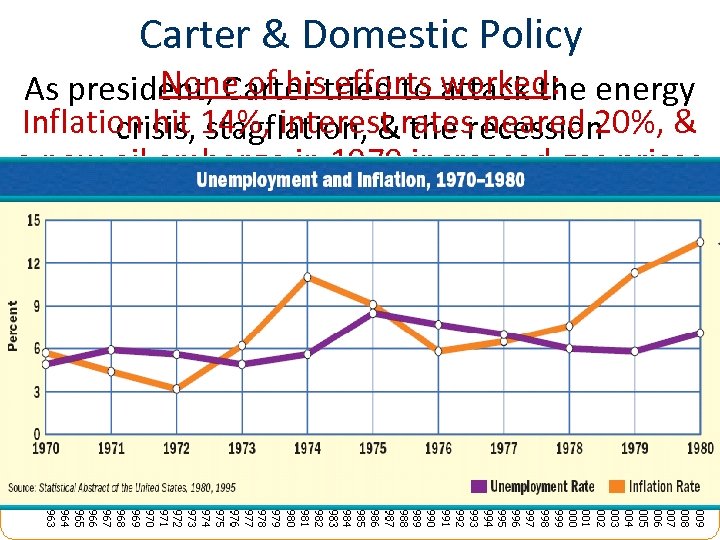 Carter & Domestic Policy None of his efforts worked: As president, Carter tried to attack the energy Inflation hit 14%, interest rates neared 20%, & crisis, stagflation, & the recession a new oil embargo in 1979 increased gas prices
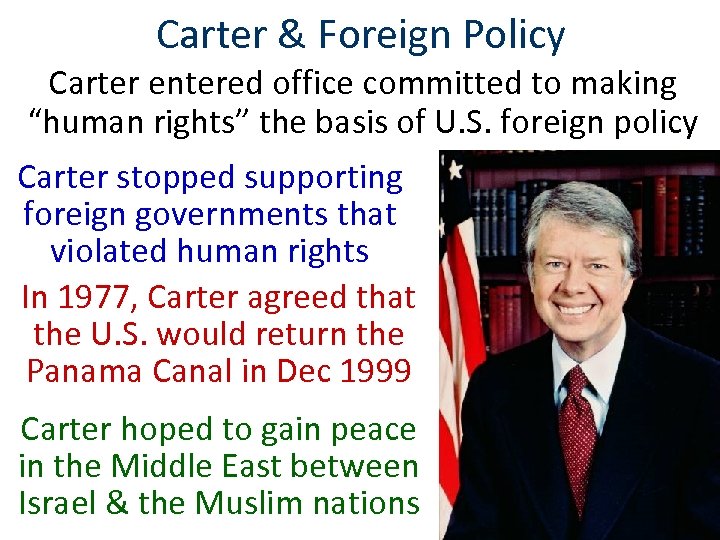 Carter & Foreign Policy Carter entered office committed to making “human rights” the basis of U. S. foreign policy Carter stopped supporting foreign governments that violated human rights In 1977, Carter agreed that the U. S. would return the Panama Canal in Dec 1999 Carter hoped to gain peace in the Middle East between Israel & the Muslim nations
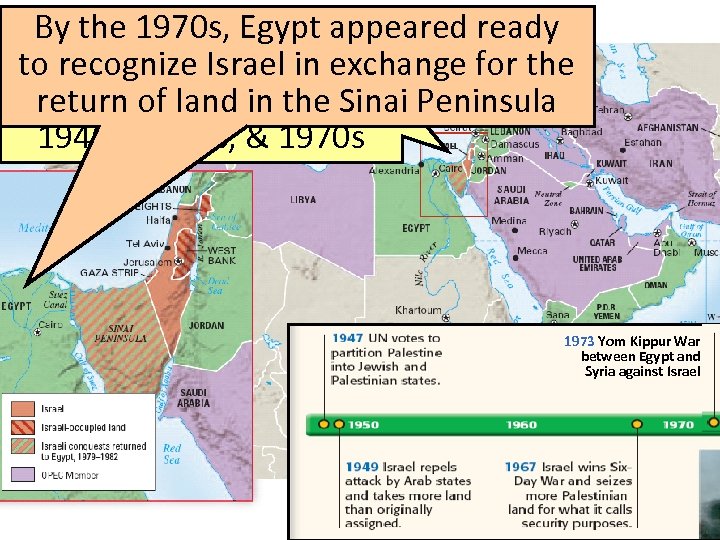 Since its 1970 s, Egypt appeared ready By the creation in 1947, Israel was attackedin exchange for the to recognize Israel by its Muslim of land in thethe Peninsula return neighbors in Sinai 1940 s, 1960 s, & 1970 s 1973 Yom Kippur War between Egypt and Syria against Israel
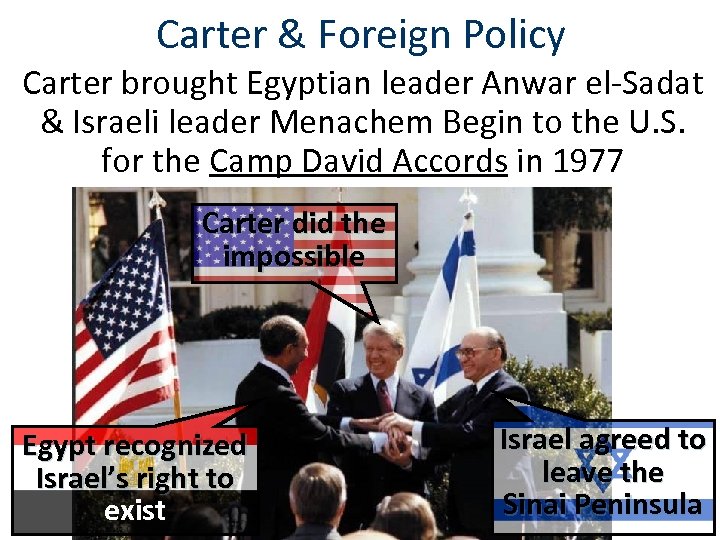 Carter & Foreign Policy Carter brought Egyptian leader Anwar el-Sadat & Israeli leader Menachem Begin to the U. S. for the Camp David Accords in 1977 ? Carter did the impossible ? Egypt recognized Israel’s right to exist Israel agreed to leave the Sinai Peninsula
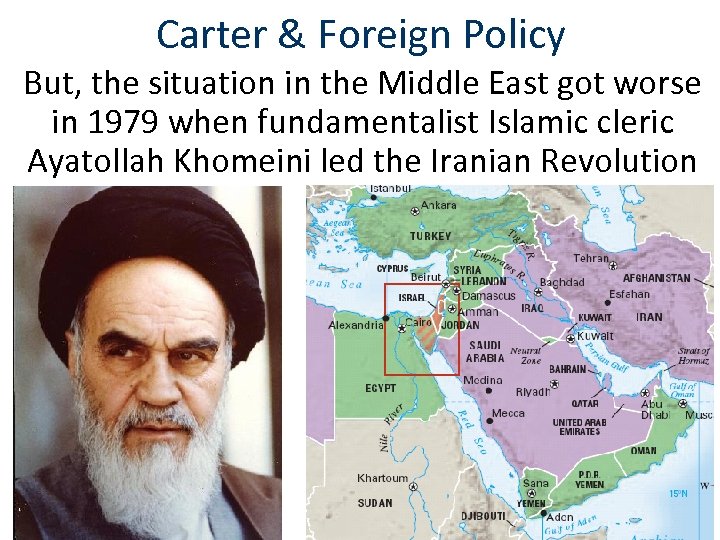 Carter & Foreign Policy But, the situation in the Middle East got worse in 1979 when fundamentalist Islamic cleric Ayatollah Khomeini led the Iranian Revolution
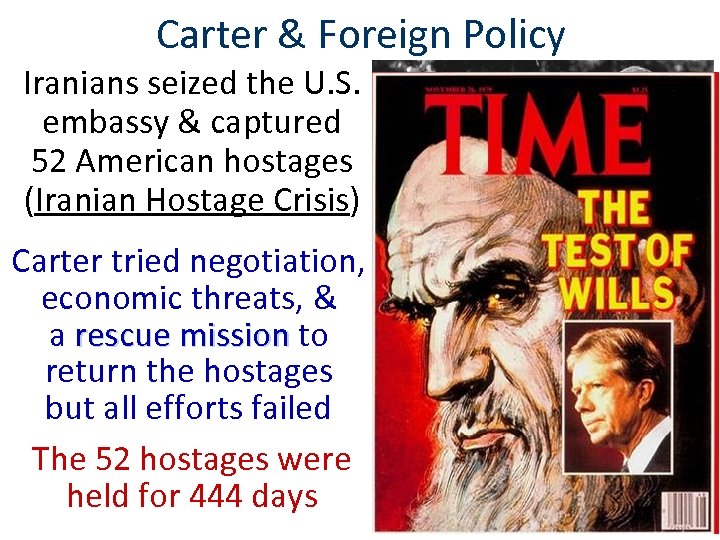 Carter & Foreign Policy Iranians seized the U. S. embassy & captured 52 American hostages (Iranian Hostage Crisis) Carter tried negotiation, economic threats, & a rescue mission to return the hostages but all efforts failed The 52 hostages were held for 444 days
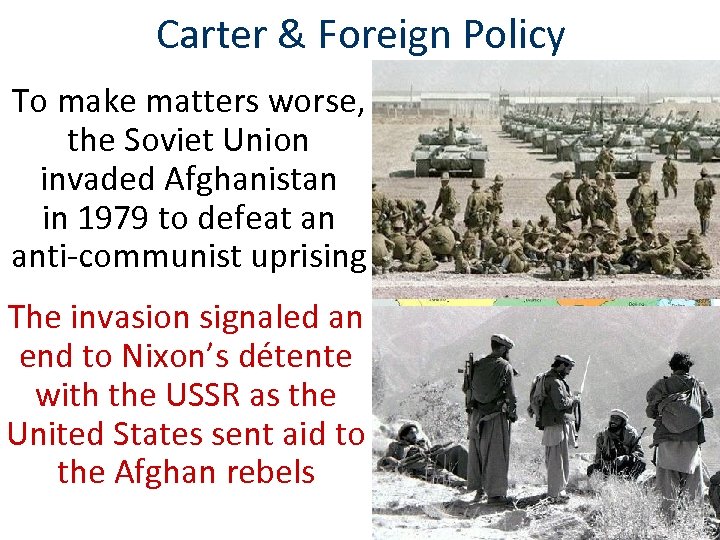 Carter & Foreign Policy To make matters worse, the Soviet Union invaded Afghanistan in 1979 to defeat an anti-communist uprising The invasion signaled an end to Nixon’s détente with the USSR as the United States sent aid to the Afghan rebels
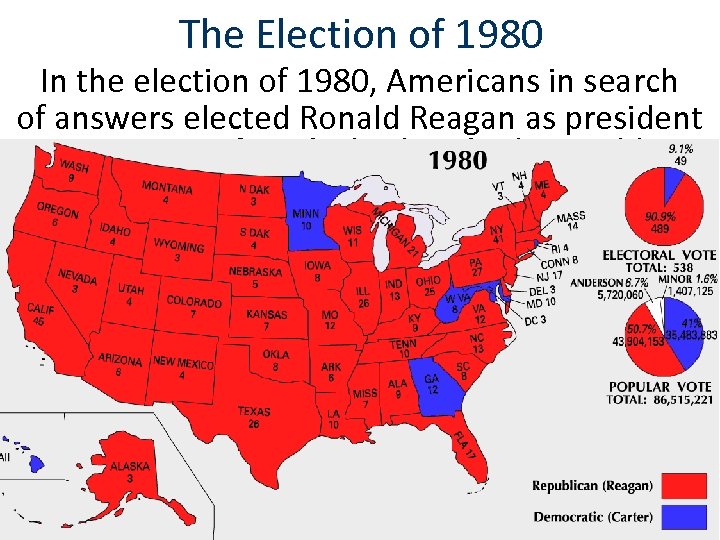 The Election of 1980 In By 1980, Carter 1980, Americans in search the election of had been unable to end stagflation, free Ronald hostages president of answers elected the U. S. Reagan as in Iran, or restore America’s place in the world
 Conclusions ■ By 1980, the USA seemed to be losing its place as the top nation in the world: –The 1970 s presented failures in the Cold War & new problems in the Middle East –The social protests & counter culture seemed to divide liberals & conservatives –Stagflation & the economic recession were growing worse, not better –The failures of Johnson, Nixon, Ford, & Carter left citizens in search of optimism, strong leadership, & conservative policies