


 Скачать презентацию Essential Question Champion of the Common Man OR
3ed7aa0499d7a0d289f01b157f812d47.ppt
- Количество слайдов: 51
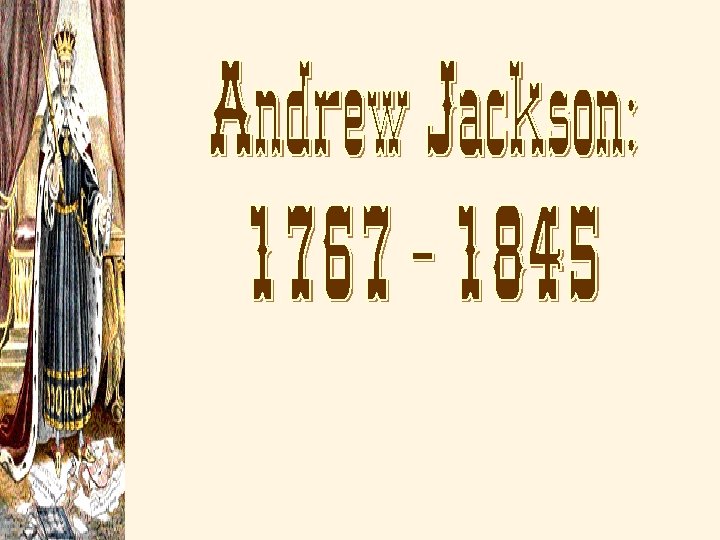
 Essential Question: Champion of the “Common Man”? OR “King” Andrew?

 Voting Requirements in the Early 19 c
 Voter Turnout: 1820 - 1860
 Why Increased Democratization? 3 White male suffrage increased 3 Party nominating committees. 3 Voters chose their state’s slate of Presidential electors. 3 Spoils system. 3 Rise of Third Parties. 3 3 Popular campaigning (parades, rallies, floats, etc. ) Two-party system returned in the 1832 election: § Dem-Reps Natl. Reps. (1828) Whigs (1832) Republicans (1854) § Democrats (1828)

 The “Common Man’s” Presidential Candidate
![Jackson’s Opponents in 1824 Henry Clay [KY] John Quincy Adams [MA] William H. Crawford](https://present5.com/presentation/3ed7aa0499d7a0d289f01b157f812d47/image-9.jpg "Jackson’s Opponents in 1824 Henry Clay [KY] John Quincy Adams [MA] William H. Crawford") Jackson’s Opponents in 1824 Henry Clay [KY] John Quincy Adams [MA] William H. Crawford [GA] John C. Calhoun [SC]
Jackson’s Opponents in 1824 Henry Clay [KY] John Quincy Adams [MA] William H. Crawford [GA] John C. Calhoun [SC]
 Results of the 1824 Election A “Corrupt Bargain? ”

 • • • Issues Slavery National Bank Protective Tariffs Federally funded internal improvements Voting rights for property less workers
 Candidates • John Quincy Adams – National Republican • Andrew Jackson – Democratic
 1828 Election Results
 Jackson’s philosophies of government • Follow Jeffersonian concept of an agrarian society • Believed that a strong central govt. was the enemy of individual liberties - a type of tyranny to be feared and fought • Individualism was key principle under Jackson • Feared concentration of economic power as much as concentrated political power
 Jackson’s Philosophies con’t • Viewed any govt. aid to economy as helping special interest groups • Lashed out against privilege and monopoly • Favored the artisan and yeoman farmer over corporations or planters– Republicanism • Disliked reformers because it called for government intervention and they restricted individual freedoms
 The New “Jackson Coalition” 3 The Planter Elite in the South 3 People on the Frontier 3 State Politicians – spoils 3 Immigrants in the cities. system
 Jackson’s Faith in the “Common Man” 3 3 3 Intense distrust of Eastern “establishment, ” monopolies, & special privilege. His heart & soul was with the “plain folk. ” Belief that the common man was capable of uncommon achievements.
 The Reign of “King Mob”
 Andrew Jackson as President

 1832 Tariff Conflict 3 1828 --> “Tariff of Abomination” 3 1832 --> new tariff 3 South Carolina’s reaction? 3 Jackson’s response ? 3 Clay’s “Compromise” Tariff ?

 The Economies of the North and South • Economy of the North – Fishing, shipbuilding, industry, and naval supplies, trade and port cities – Skilled craftsman, shopkeepers, manufacturing (textiles, tools, metals, building materials, etc) • Economy of the South – Large farms/plantataions, cash crops (tobacco, indigo, rice. , cotton) wood products, small farms – Slavery
 The Debate Over Tariffs • Tariffs are taxes that the government puts on imported goods (Goods brought in from other countries) • Pro: If you were a craftsman or manufacture in the United States, you would like tariffs because your products would not have that additional tax, therefore your products are cheaper than foreign products. People are more likely to buy your products • Con: If your business is agriculture, you need to sell your food and raw materials and buy manufactured goods. You may depend on foreign nations to buy your goods and in return you buy their manufactured goods. You are afraid that tariffs will make foreign goods more expensive. You worry that if you don’t buy their goods, then they won’t buy your farm goods and your economy will suffer
 1828 • Congress passes a controversial high protective tariff • Who do you predict will support this new law and who will oppose this tariff?
 John C. Calhoun • Vice President under Andrew Jackson • Believed the Tariff of 1828 was unconstitutional since it favored the North • Insisted that states had the right to refuse to follow a law if the state felt it violated its rights – States could declare a federal law null and void (nullification) – He and many other Southerners called the 1828 tariff a “ Tariff of Abominations”
 Andrew Jackson • 7 th president of the United States • Believed in persevering the Union and fought nullification • Recommended to Congress to reduce the Tariff of 1828, so they passed another Tariff in 1832
![The Webster-Hayne Debate Sen. Daniel Webster [MA] Sen. Robert Hayne [SC]](https://present5.com/presentation/3ed7aa0499d7a0d289f01b157f812d47/image-29.jpg "The Webster-Hayne Debate Sen. Daniel Webster [MA] Sen. Robert Hayne [SC]") The Webster-Hayne Debate Sen. Daniel Webster [MA] Sen. Robert Hayne [SC]
The Webster-Hayne Debate Sen. Daniel Webster [MA] Sen. Robert Hayne [SC]
 1830 Webster : Liberty and Union, now and forever, one and inseparable. Jackson : Our Federal Union—it must be preserved. Calhoun : The Union, next to our liberty, most dear.
 Nullification Ordinance • South Carolina was not pleased with the new tariff either. They said it was oppressive, so the state passed the Nullification Ordinance in 1832 – Declared the Tariff of 1828 and 1832 null and void – Stated they would secede if the federal government used force to make them comply
 Jackson Response • Claimed secession would be considered treason • Defended the federal government's power to impose tariffs and chastised South Carolina for violating federal law because a state had no right to declare any national law null and void
 Force Bill • Jackson asked Congress to grant him the ability to use force to compel South Carolina to accept and follow the law– The Force Bill • Meanwhile Henry Clay proposed another tariff in Congress that would reduce tariffs significantly over the next ten years– Compromise Tariff • Both of these passed in 1833 and South Carolina repealed its ordinance
 Who Won? • Both sides claim victory • Nationalists said they won because they showed that no state is more powerful than the federal government • South Carolina said that the nullification process allowed them to get what they wanted • What do you think?

 Indian Removal 3 Jackson’s Goal? 3 1830 Indian Removal Act 3 Cherokee Nation v. GA (1831) 3 Worcester v. GA (1832) 3 Jackson: * “domestic dependent nation” John Marshall has made his decision, now let him enforce it!
 The Cherokee Nation After 1820
 Indian Removal
 Trail of Tears (1838 -1839)
 Jackson’s Professed “Love” for Native Americans

 Jackson’s Use of Federal Power VETO 1830 Maysville Road project in KY [state of his political rival, Henry Clay]
 The National Bank Debate Nicholas Biddle President Jackson
 nd B. U. S. Opposition to the 2 “Soft” (paper) $ 3 3 state bankers felt it restrained their banks from issuing bank notes freely. supported rapid economic growth & speculation. “Hard” (specie) $ 3 3 3 felt that coin was the only safe currency. didn’t like any bank that issued bank notes. suspicious of expansion & speculation.
 The Downfall of “Mother Bank”
 An 1832 Cartoon: “King Andrew”?
 1832 Election Results Main Issue ?
 The Specie Circular (1836) 3 “wildcat banks. ” 3 buy future federal land only with gold or silver. 3 Jackson’s goal?
 Results of the Specie Circular $ Banknotes loose their value. $ Land sales plummeted. $ Credit not available. $ Businesses began to fail. $ Unemployment rose. The Panic of 1837!
![The 1836 Election Results Martin Van Buren “Old Kinderhook” [O. K. ]](https://present5.com/presentation/3ed7aa0499d7a0d289f01b157f812d47/image-50.jpg "The 1836 Election Results Martin Van Buren “Old Kinderhook” [O. K. ]") The 1836 Election Results Martin Van Buren “Old Kinderhook” [O. K. ]
The 1836 Election Results Martin Van Buren “Old Kinderhook” [O. K. ]
 The Panic of 1837 Spreads Quickly!