 Скачать презентацию Essential Climate Variables Workshop Introduction and Context Mike
3788c23be04028e602c2b584dd6ad0f2.ppt
- Количество слайдов: 11



Essential Climate Variables Workshop Introduction and Context Mike Manore February 9 -10, 2017
Context • Climate as a grand global challenge • Growing needs for authoritative climate information – International commitments and obligations – Pan Canadian Framework on Climate Change ▪ Canadian Centre for Climate Services – others…. • Diverse applications and user needs – policy, adaptation, monitoring, science, … – international, federal, provincial, local, industry, academia • Global information is required to address national, regional, and local needs Page 2 – 17 March 2018
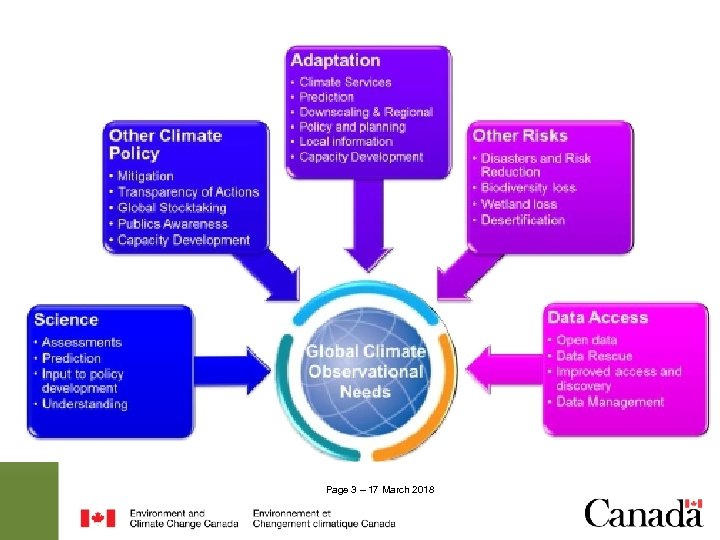
Page 3 – 17 March 2018
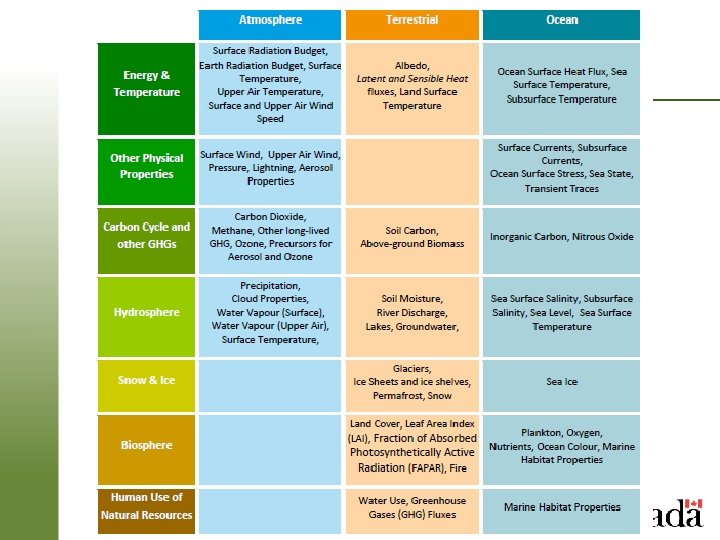
Global Climate Observing System (GCOS) • UNFCC-endorsed global framework for observing and • understanding climate variability and change Composite observing system – contributions from global and national observing capabilities – research and operational systems – in-situ, space components • 2008 – Canadian National GCOS Report • 2015 – Status of GCOS Report • 2016 – Updated GCOS Implementation Plan – – – 53 Essential Climate Variables (ECVs) 128 processed measurements (products) physical, biological, chemical physical parameters atmospheric, terrestrial, oceans and cross-domain relevant, systematic, Page 4 – 17 March 2018 feasible
Page 5 – 17 March 2018
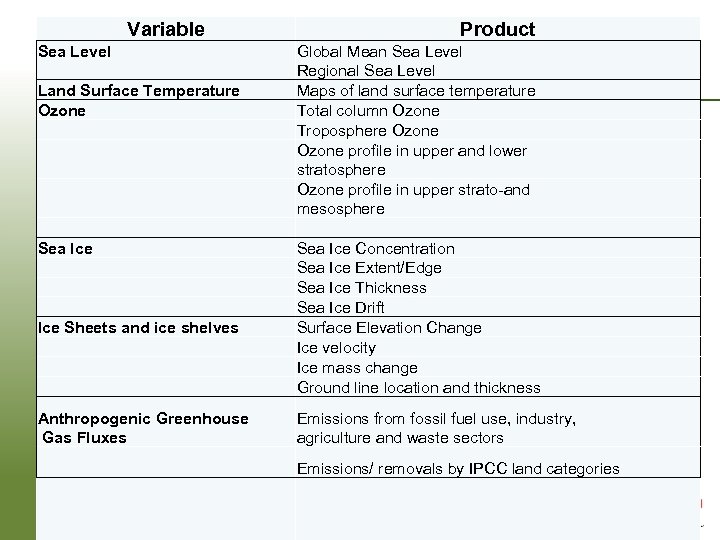
Variable Sea Level Land Surface Temperature Ozone Product Global Mean Sea Level Regional Sea Level Maps of land surface temperature Total column Ozone Troposphere Ozone profile in upper and lower stratosphere Ozone profile in upper strato-and mesosphere Sea Ice Sheets and ice shelves Sea Ice Concentration Sea Ice Extent/Edge Sea Ice Thickness Sea Ice Drift Surface Elevation Change Ice velocity Ice mass change Ground line location and thickness Anthropogenic Greenhouse Gas Fluxes Emissions from fossil fuel use, industry, agriculture and waste sectors Emissions/ removals by IPCC land categories Page 6 – 17 March 2018
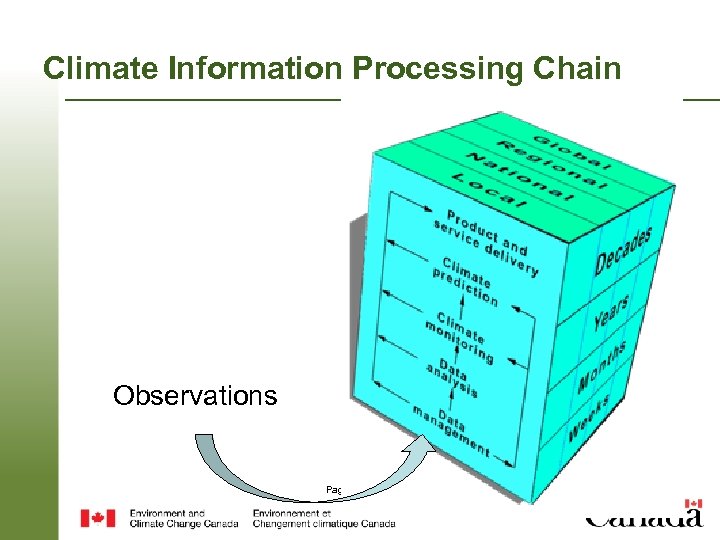
Climate Information Processing Chain Observations Page 7 – 17 March 2018
Page 8 – 17 March 2018
Why this workshop? • Need to understand how climate information needs for Canada are being met (or not) – current and evolving needs – end-to-end chain - observations, processing, data access, use • Be prepared to respond to high priority needs – foundational information for policy and adaptation program design ▪ e. g. , Canadian Climate Services Centre – potential opportunities to address gaps • Desire to improve the overall quality, relevance, access, and use of climate information – – accurate representation of Canada in global picture development of relevant products at regional, local scales ensure last-mile delivery support effective use Page 9 – 17 March 2018
Workshop Objectives • Re-start the discussion • ‘Snap-Shot’ of current status – explore best approach to capture this picture • Identify high-level gaps, barriers, opportunities • Identify next steps • Adjustment of ambitious expectations! – feasible, adaptive – shaped by participants Page 10 – 17 March 2018
Organization of the Workshop • Panel Discussion - Policy Context and Climate Information Needs • Status of ECVs in Canada – overview reports • Breakout 1 – Status of ECVs in Canada – Plenary discussion on approach – breakout by GCOS Domain – Atmosphere, Terrestrial, (Ocean) – Plenary brief out on process, progress, high-level observations • Breakout 2 – Gaps, Opportunities and Actions by Domain (tbc) – review of high-level status – ID of key gaps, barriers, opportunities – recommended actions • Discussion and Next Steps – all Page 11 – 17 March 2018 – review of outcomes, commonalities, recommendation, next steps
Скачать презентацию Essential Climate Variables Workshop Introduction and Context Mike
3788c23be04028e602c2b584dd6ad0f2.ppt