 Скачать презентацию ESSAY WRITING TUTORIAL Table of Contents 1
62c0e89b41724bc8924d3eb3cb4ade08.ppt
- Количество слайдов: 40



ESSAY WRITING TUTORIAL
Table of Contents 1. Unit I Essay Review 2. Top Five Fixes 3. Writing Basics 4. Thesis Statements 5. History Vocab 6. Analysis
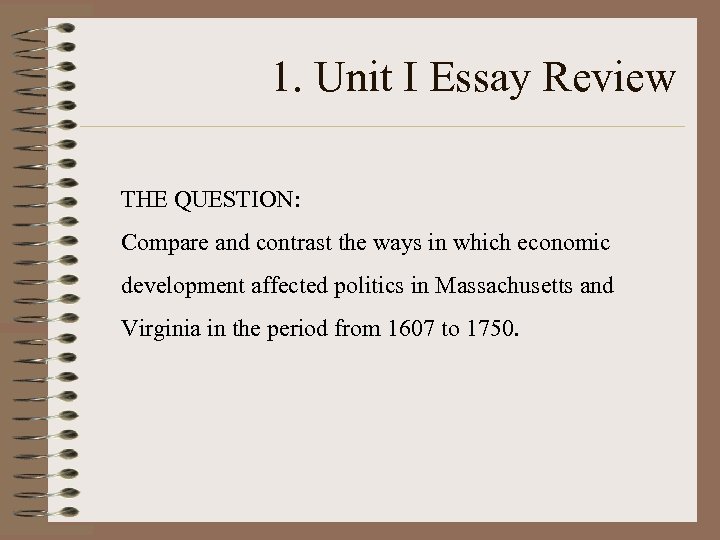
1. Unit I Essay Review THE QUESTION: Compare and contrast the ways in which economic development affected politics in Massachusetts and Virginia in the period from 1607 to 1750.
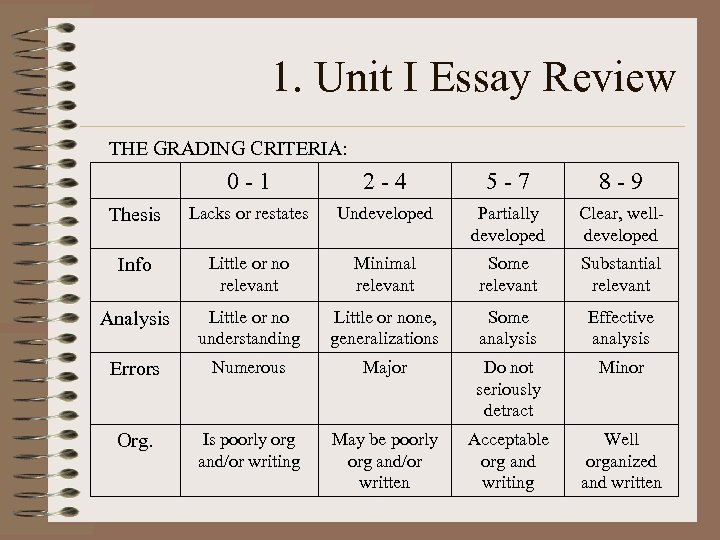
1. Unit I Essay Review THE GRADING CRITERIA: 0 -1 2 -4 5 -7 8 -9 Thesis Lacks or restates Undeveloped Partially developed Clear, welldeveloped Info Little or no relevant Minimal relevant Some relevant Substantial relevant Analysis Little or no understanding Little or none, generalizations Some analysis Effective analysis Errors Numerous Major Do not seriously detract Minor Org. Is poorly org and/or writing May be poorly org and/or written Acceptable org and writing Well organized and written
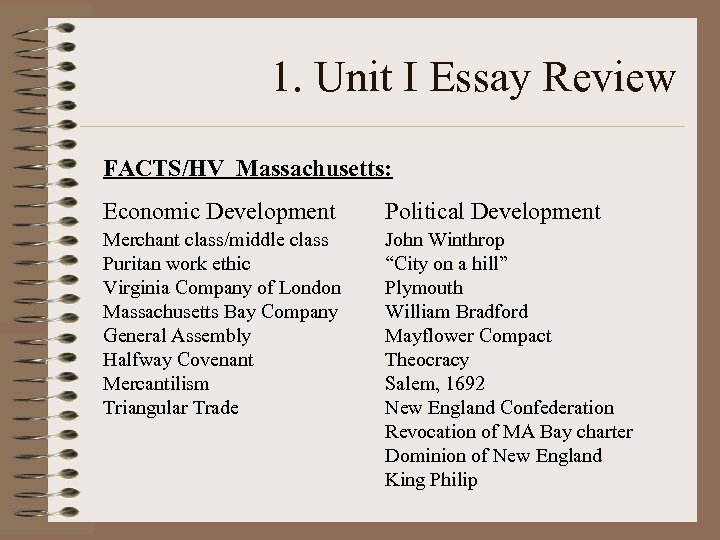
1. Unit I Essay Review FACTS/HV Massachusetts: Economic Development Political Development Merchant class/middle class Puritan work ethic Virginia Company of London Massachusetts Bay Company General Assembly Halfway Covenant Mercantilism Triangular Trade John Winthrop “City on a hill” Plymouth William Bradford Mayflower Compact Theocracy Salem, 1692 New England Confederation Revocation of MA Bay charter Dominion of New England King Philip
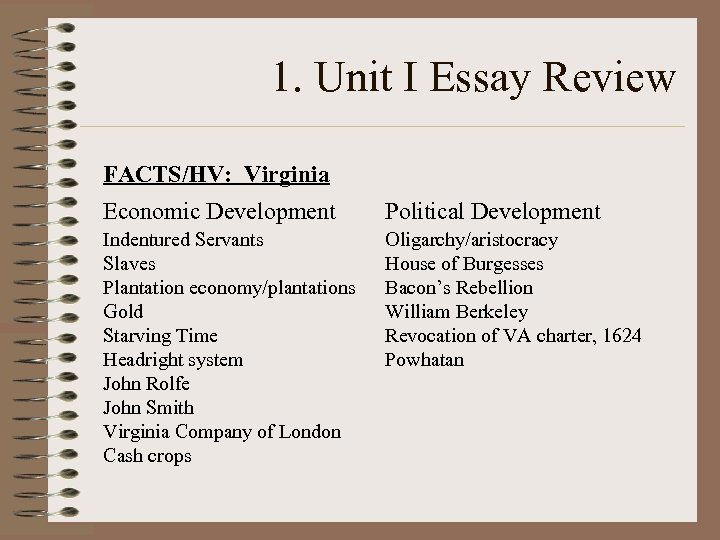
1. Unit I Essay Review FACTS/HV: Virginia Economic Development Political Development Indentured Servants Slaves Plantation economy/plantations Gold Starving Time Headright system John Rolfe John Smith Virginia Company of London Cash crops Oligarchy/aristocracy House of Burgesses Bacon’s Rebellion William Berkeley Revocation of VA charter, 1624 Powhatan
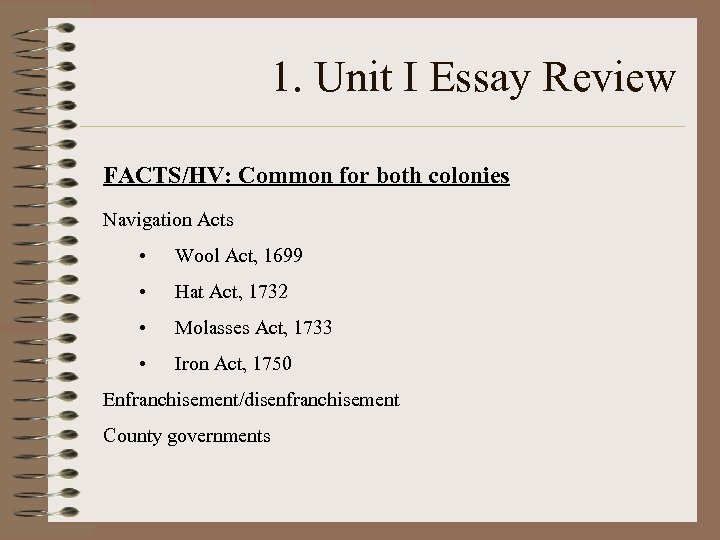
1. Unit I Essay Review FACTS/HV: Common for both colonies Navigation Acts • Wool Act, 1699 • Hat Act, 1732 • Molasses Act, 1733 • Iron Act, 1750 Enfranchisement/disenfranchisement County governments
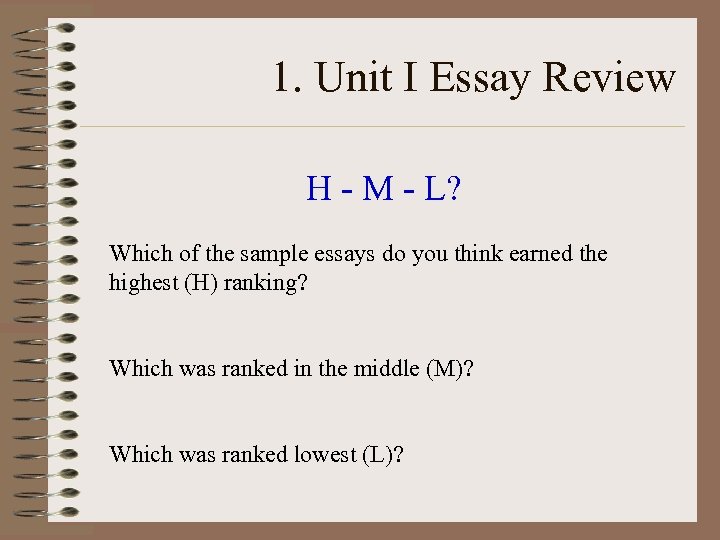
1. Unit I Essay Review H - M - L? Which of the sample essays do you think earned the highest (H) ranking? Which was ranked in the middle (M)? Which was ranked lowest (L)?
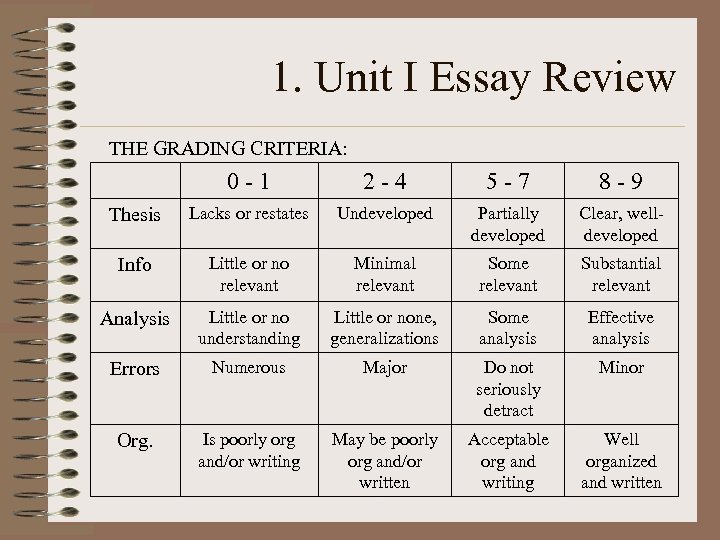
1. Unit I Essay Review THE GRADING CRITERIA: 0 -1 2 -4 5 -7 8 -9 Thesis Lacks or restates Undeveloped Partially developed Clear, welldeveloped Info Little or no relevant Minimal relevant Some relevant Substantial relevant Analysis Little or no understanding Little or none, generalizations Some analysis Effective analysis Errors Numerous Major Do not seriously detract Minor Org. Is poorly org and/or writing May be poorly org and/or written Acceptable org and writing Well organized and written
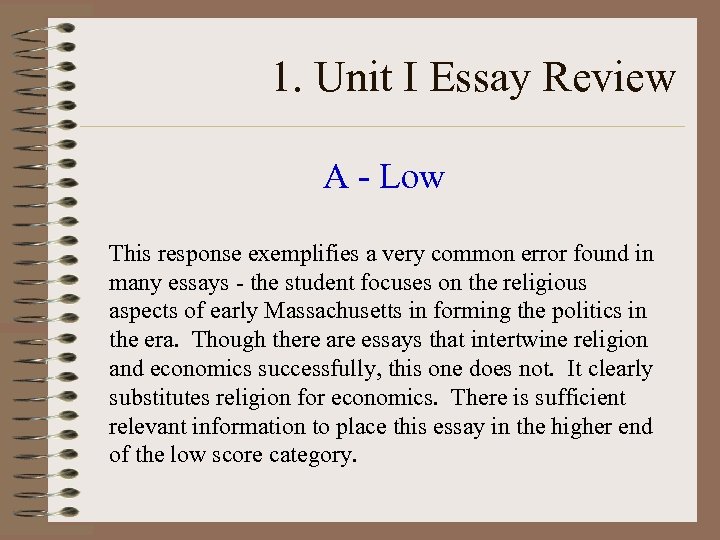
1. Unit I Essay Review A - Low This response exemplifies a very common error found in many essays - the student focuses on the religious aspects of early Massachusetts in forming the politics in the era. Though there are essays that intertwine religion and economics successfully, this one does not. It clearly substitutes religion for economics. There is sufficient relevant information to place this essay in the higher end of the low score category.
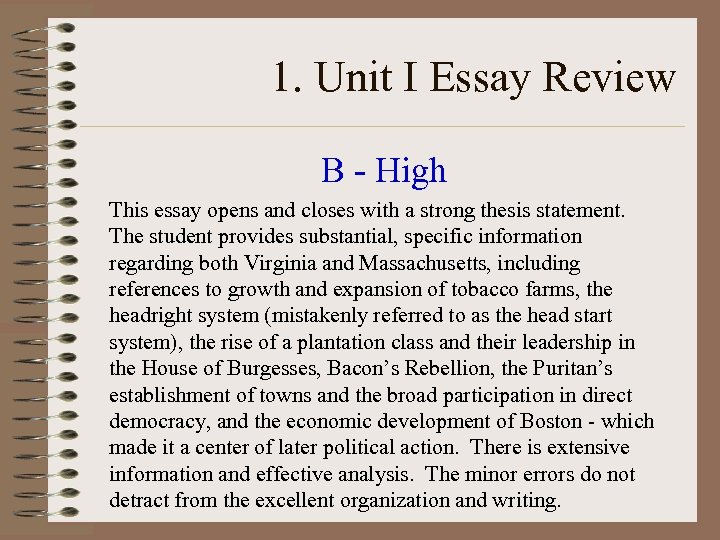
1. Unit I Essay Review B - High This essay opens and closes with a strong thesis statement. The student provides substantial, specific information regarding both Virginia and Massachusetts, including references to growth and expansion of tobacco farms, the headright system (mistakenly referred to as the head start system), the rise of a plantation class and their leadership in the House of Burgesses, Bacon’s Rebellion, the Puritan’s establishment of towns and the broad participation in direct democracy, and the economic development of Boston - which made it a center of later political action. There is extensive information and effective analysis. The minor errors do not detract from the excellent organization and writing.
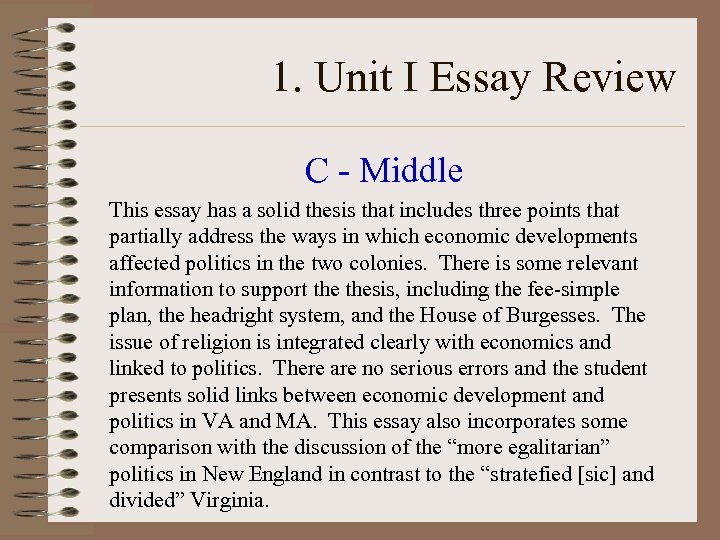
1. Unit I Essay Review C - Middle This essay has a solid thesis that includes three points that partially address the ways in which economic developments affected politics in the two colonies. There is some relevant information to support thesis, including the fee-simple plan, the headright system, and the House of Burgesses. The issue of religion is integrated clearly with economics and linked to politics. There are no serious errors and the student presents solid links between economic development and politics in VA and MA. This essay also incorporates some comparison with the discussion of the “more egalitarian” politics in New England in contrast to the “stratefied [sic] and divided” Virginia.
2. Top Five Fixes ARGUE ONE MAIN POINT. That’s your thesis.
2. Top Five Fixes LINK BACK TO YOUR THESIS CONTINUOUSLY. Follow through.
2. Top Five Fixes REFERENCE SUBSTANTIAL HV. And explain it all.
2. Top Five Fixes RECOGNIZE THE GREY AREAS. Try to ride the fence.
2. Top Five Fixes DOUBLE CHECK. Are you answering the right question? .
3. Writing Basics Essay questions Introductions Transitions Conclusions
3. Writing Basics Types of essay questions: Analyze Assess (the validity) Change over time Cause and effect Compare and contrast Define and identify Evaluate Explain Given framework Interpret Justify
3. Writing Basics Evaluate = Size up To examine; to judge; to appraise In this kind of question, the topic shapes the kind of answer, rather than the question word(s) shaping the kind of answer. Ultimately, you’re being asked to think about the topic, draw some kind of conclusion, and then write about both your thinking and your conclusion(s) in an organized way.
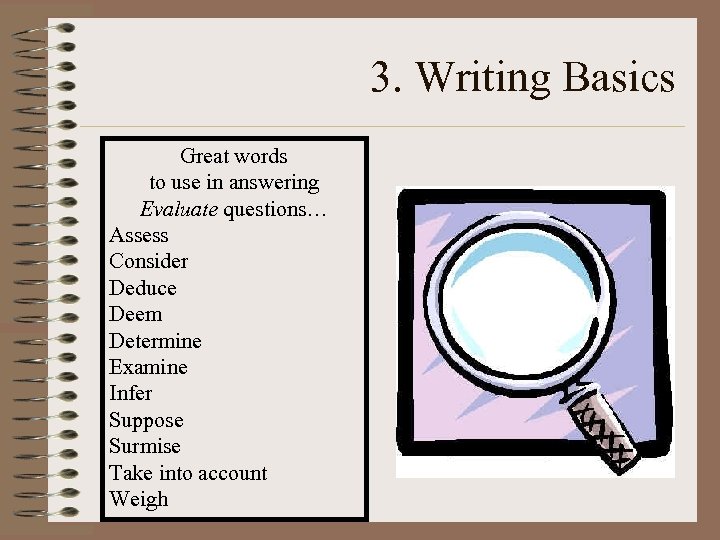
3. Writing Basics Great words to use in answering Evaluate questions… Assess Consider Deduce Deem Determine Examine Infer Suppose Surmise Take into account Weigh
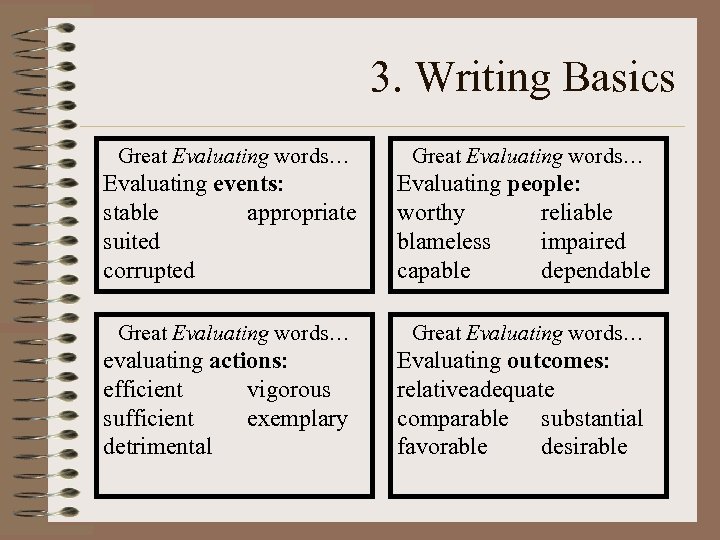
3. Writing Basics Great Evaluating words… Evaluating events: stable appropriate suited corrupted Evaluating people: worthy reliable blameless impaired capable dependable Great Evaluating words… evaluating actions: efficient vigorous sufficient exemplary detrimental Evaluating outcomes: relativeadequate comparable substantial favorable desirable
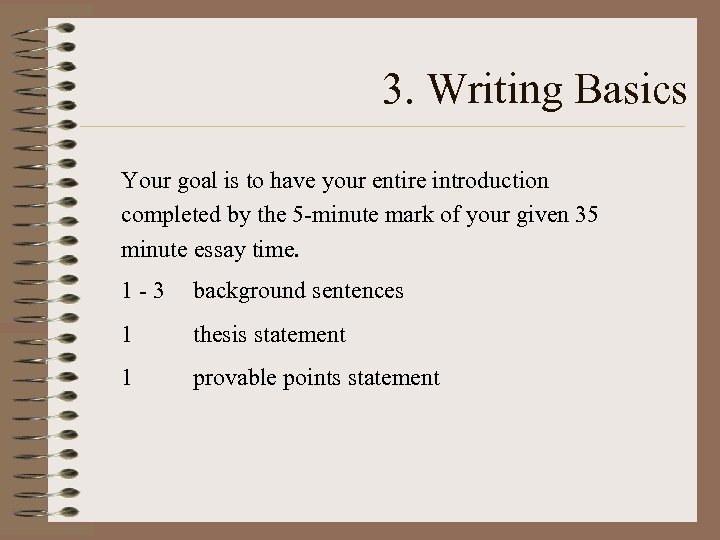
3. Writing Basics Your goal is to have your entire introduction completed by the 5 -minute mark of your given 35 minute essay time. 1 -3 background sentences 1 thesis statement 1 provable points statement
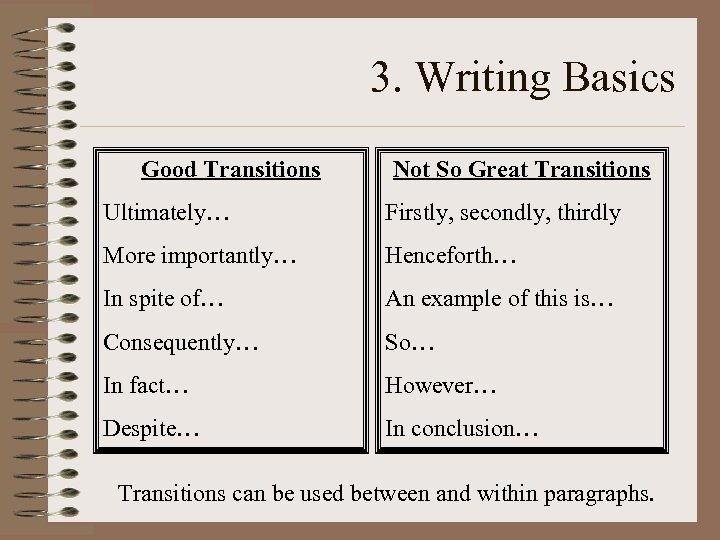
3. Writing Basics Good Transitions Not So Great Transitions Ultimately… Firstly, secondly, thirdly More importantly… Henceforth… In spite of… An example of this is… Consequently… So… In fact… However… Despite… In conclusion… Transitions can be used between and within paragraphs.
3. Writing Basics If you have time for a conclusion, remember that you are restating the significance of your argument - but don't simply repeat things that were in your paper. Pull it all together for the reader. Conclusions to avoid: • The Sherlock Holmes conclusion • The “America the Beautiful”/”We shall overcome” conclusion • The grab bag conclusion
4. Thesis Statements • Argue one main point • Ensure your argument is on topic • Draw your argument throughout your essay • Review your argument in the conclusion
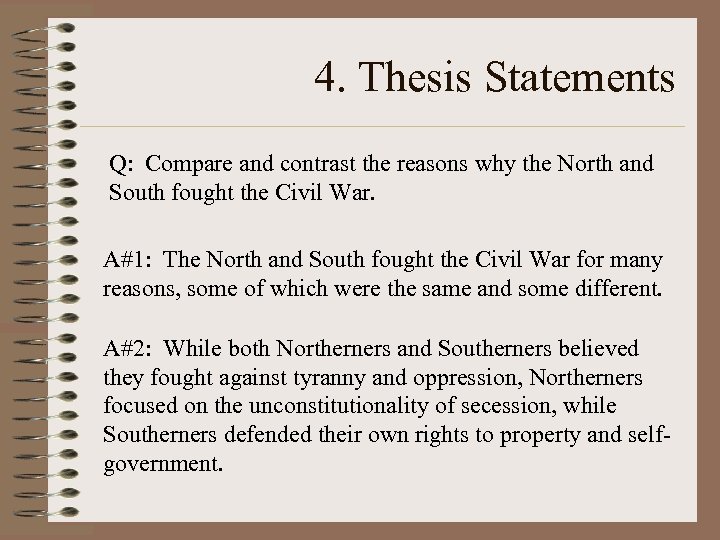
4. Thesis Statements Q: Compare and contrast the reasons why the North and South fought the Civil War. A#1: The North and South fought the Civil War for many reasons, some of which were the same and some different. A#2: While both Northerners and Southerners believed they fought against tyranny and oppression, Northerners focused on the unconstitutionality of secession, while Southerners defended their own rights to property and selfgovernment.
4. Thesis Statements Does your thesis pass the so-what test? Does your thesis pass the specificity test? Does your thesis pass the argument test?
5. Using HV Tips for Brainstorming History Vocab: • Tell the story of the topic. • Think about the HV like cities/suburbs Let’s try it: Topic #1: The Constitution Topic #2: Foreign Policy 1790 - 1820
5. Using HV Tips for Inserting History Vocab: • Use your brainstormed list • Review what you’ve written - is there a name for it? Let’s try it: Although concerned about recent events, the people who came to together to write the Constitution weren’t originally planning to discard what they already had in place.
5. Using HV Tips for Using History Vocab: • Explain it - what is it? • Explain it - so what? Let’s try it: Marshall Court Jay’s Treaty Hartford Convention
6. Analysis 1. a statement giving details of all the constituent elements of something and how they relate to each other 2. the examination of something in detail in order to understand it better or draw conclusions from it 3. an assessment, description or explanation of something, usually based on careful consideration or investigation
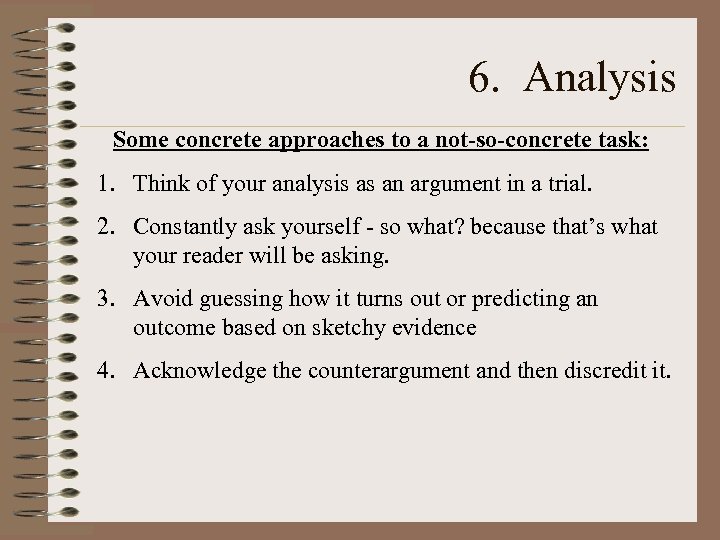
6. Analysis Some concrete approaches to a not-so-concrete task: 1. Think of your analysis as an argument in a trial. 2. Constantly ask yourself - so what? because that’s what your reader will be asking. 3. Avoid guessing how it turns out or predicting an outcome based on sketchy evidence 4. Acknowledge the counterargument and then discredit it.
5. Analysis
5. Analysis
5. Analysis
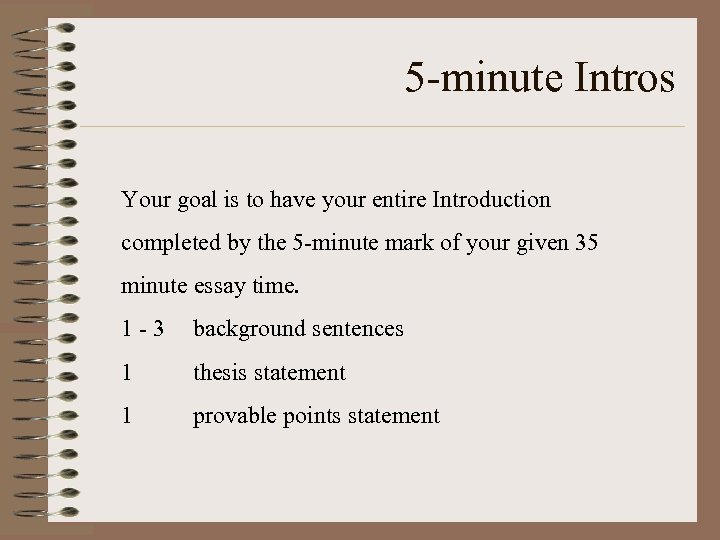
5 -minute Intros Your goal is to have your entire Introduction completed by the 5 -minute mark of your given 35 minute essay time. 1 -3 background sentences 1 thesis statement 1 provable points statement


 Скачать презентацию ESSAY WRITING TUTORIAL Table of Contents 1
62c0e89b41724bc8924d3eb3cb4ade08.ppt