


 Скачать презентацию ESS Open Day Highfield House Hotel Electronics and
843a782eda63cffe1f46ce7ef75cc0c6.ppt
- Количество слайдов: 13
 ESS Open Day: Highfield House Hotel Electronics and Software Systems Conference 16 th June 2014 A Model to Facilitate Effective Blended E -learning within Universities in Developing Countries B. Aguti, R. J. Walters, G. B. Wills Electronics and Computer Science, University of Southampton, SO 17 1 BJ, UK Corresponding author: ba 3 g 11@ecs. soton. ac. uk
 Outline • Introduction: Motivation • Blended E-learning Definition • Challenges with Blended E-learning • Benefits of Blended E-learning • Is Effective Blended E-learning Possible? • Evaluation of E-learning in Universities • Proposed model for facilitating Effective Blended E -learning within Universities in developing countries • Conclusion and Future work
 Introduction Motivation: “We all know what e-learning is about! Right! My research is about how to facilitate sustained use of e-learning technologies within Universities in developing countries. ” • My research study basically seeks to evaluate the factors that impact on the effectiveness of blended e‑learning within Universities in developing countries. • The goal is to develop a model for facilitating effective use of blended e‑learning within Universities; encompassing a well-balanced mix of effective pedagogy in e-learning course design, e-learning readiness and quality e-learning systems.
 Blended E-learning Definition • A combination of improved course delivery strategies, face-to-face classroom teaching with live e-learning, self-paced e-learning facilitated by VLEs (Sharpe et al. 2006) • A mix of media and tools used in an e-learning environment. • A combination of pedagogic approaches, irrespective of learning technology used (Driscoll, 2002)
 Challenges and drivers for using blended e-learning in Universities • Running programmes in multiple campuses in the country, • Inadequate ICT skills amongst the staff and students; • Timidity in embracing new technologies for teaching and learning; • High population of students vis-a-vis limited lecture capacity, • Lack of enthusiasm to sustain the use of e-learning.
 Benefits of Blended E-learning • Effective pedagogy facilitates active student-centred learning, • Facilitates collaborative, interactive learning and discussions amongst students and lecturers regardless of the location, through web 2. 0 technologies, • Easy and quick access to learning resources and content available via VLEs, • Cost effective for distance and virtual learners, • Diversity of virtual learning audiences attracted by institutions
 Is Effective Blended E-learning Possible? • Establish the drivers and effects of blended e-learning within Universities, • Perform a factor analysis to establish the actual factors that influence the effectiveness of blended e-learning, • Generate a structural equation model to establish the factors and their strengths towards achieving effective blended e-learning. • The proposed model indicates the major constructs that are necessary for promoting blended e-learning.
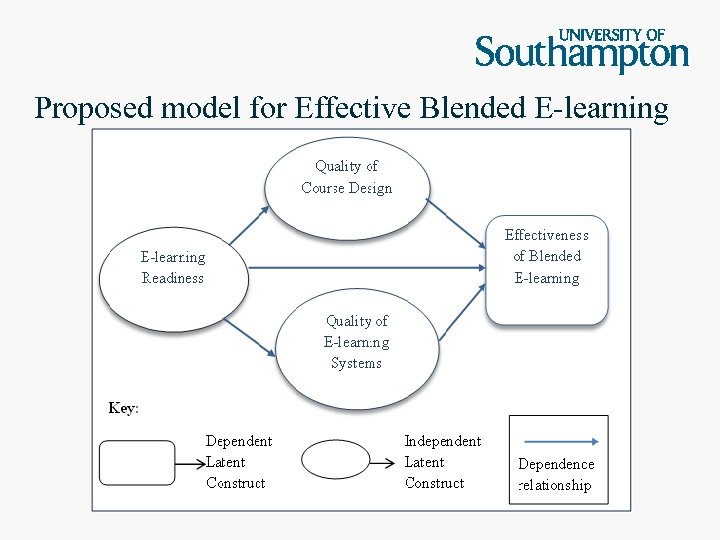 Proposed model for Effective Blended E-learning
 Dimensions for Effective Blended E -learning • The aim of the proposed model is to aid understanding of factors influencing the effectiveness of blended e -learning and measure the level of effectiveness of blended e-learning in Universities. • The relationship between the dimensions, components are illustrated in the model. A total of 67 items, 23 items for Course Module Design Strategies dimension, 24 items for E-learning Readiness dimension, 15 items for Quality E-learning Systems dimension, and 7 items for Effective Blended E-learning were formulated.
 Dimensions for Effective Blended E -learning • E-learning Course Delivery Strategies • • Course module layout, Course module evaluation, Student assessment, Course module planning, • E-learning Readiness • • • Institutional Policies E-learning culture E-learning costs
 Dimensions for Effective Blended E -learning • E-learning Readiness • • E-learning Infrastructure, E-learning support • • Learning management systems Student learning management • Quality E-learning system
 Dimensions for Effective Blended E -learning • Effective Blended E-learning • • Impact on E-learning readiness, quality of e-learning systems, e-learning course module delivery strategies Student retention, Cost effectiveness, Performance od quality of teachers, Academic achievement, Graduation of student Improvement in research and education
 Conclusion and Future Work • The main challenge for HEIs is to find a model to used to facilitate effective blended e-learning within Universities. • SEM will be performed to establish factors which effect on blended e-learning within Universities. • The developed model will act as a benchmarking tool to be used to conduct to inform University administrators, lecturers, e-learning experts, policy makers and Government during their decision making processes regarding blended e-learning.