


 Скачать презентацию ESRF VACUUM SYSTEM R Kersevan Vacuum Group Tech
447bccc04f9d07898574c6964673bdae.ppt
- Количество слайдов: 12
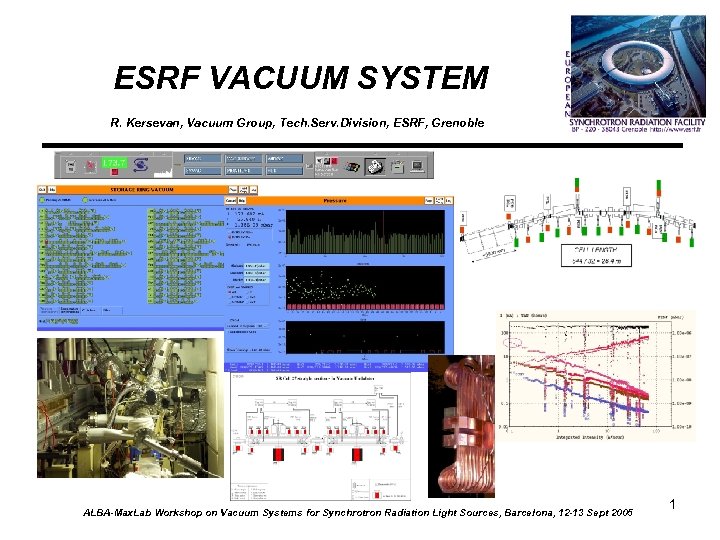 ESRF VACUUM SYSTEM R. Kersevan, Vacuum Group, Tech. Serv. Division, ESRF, Grenoble ALBA-Max. Lab Workshop on Vacuum Systems for Synchrotron Radiation Light Sources, Barcelona, 12 -13 Sept 2005 1
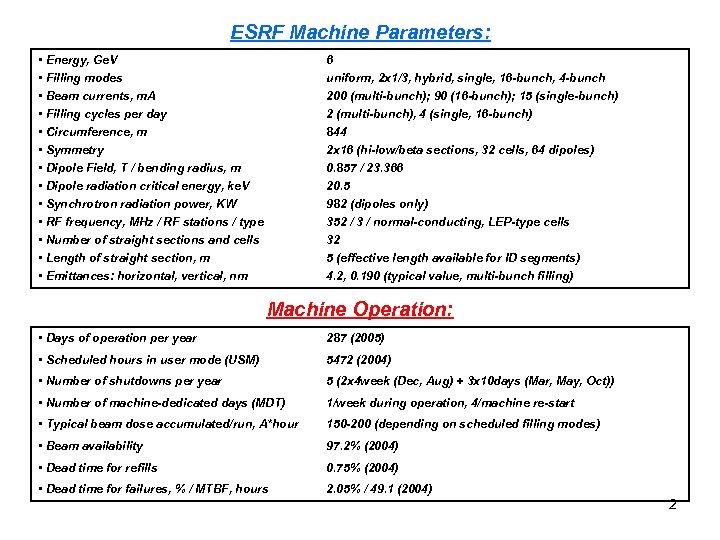 ESRF Machine Parameters: • Energy, Ge. V • Filling modes • Beam currents, m. A • Filling cycles per day • Circumference, m • Symmetry • Dipole Field, T / bending radius, m • Dipole radiation critical energy, ke. V • Synchrotron radiation power, KW • RF frequency, MHz / RF stations / type • Number of straight sections and cells • Length of straight section, m • Emittances: horizontal, vertical, nm 6 uniform, 2 x 1/3, hybrid, single, 16 -bunch, 4 -bunch 200 (multi-bunch); 90 (16 -bunch); 15 (single-bunch) 2 (multi-bunch), 4 (single, 16 -bunch) 844 2 x 16 (hi-low/beta sections, 32 cells, 64 dipoles) 0. 857 / 23. 366 20. 5 982 (dipoles only) 352 / 3 / normal-conducting, LEP-type cells 32 5 (effective length available for ID segments) 4. 2, 0. 190 (typical value, multi-bunch filling) Machine Operation: • Days of operation per year 287 (2005) • Scheduled hours in user mode (USM) 5472 (2004) • Number of shutdowns per year 5 (2 x 4 week (Dec, Aug) + 3 x 10 days (Mar, May, Oct)) • Number of machine-dedicated days (MDT) 1/week during operation, 4/machine re-start • Typical beam dose accumulated/run, A*hour 150 -200 (depending on scheduled filling modes) • Beam availability 97. 2% (2004) • Dead time for refills 0. 75% (2004) • Dead time for failures, % / MTBF, hours 2. 05% / 49. 1 (2004) 2
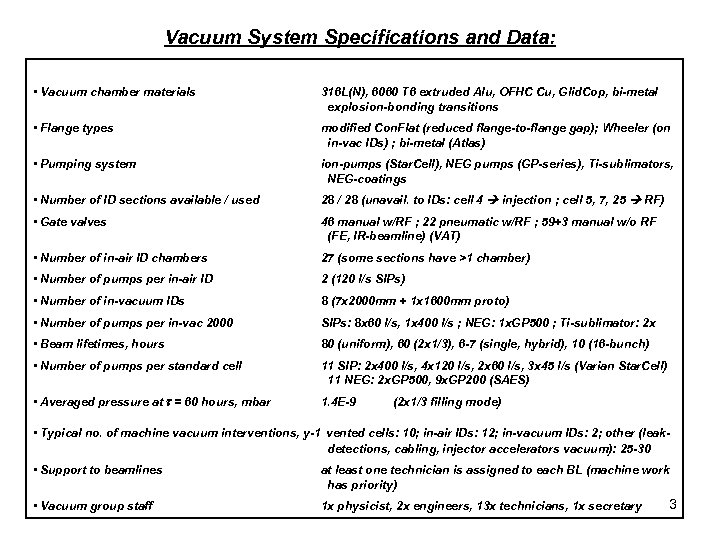 Vacuum System Specifications and Data: • Vacuum chamber materials 316 L(N), 6060 T 6 extruded Alu, OFHC Cu, Glid. Cop, bi-metal explosion-bonding transitions • Flange types modified Con. Flat (reduced flange-to-flange gap); Wheeler (on in-vac IDs) ; bi-metal (Atlas) • Pumping system ion-pumps (Star. Cell), NEG pumps (GP-series), Ti-sublimators, NEG-coatings • Number of ID sections available / used 28 / 28 (unavail. to IDs: cell 4 injection ; cell 5, 7, 25 RF) • Gate valves 46 manual w/RF ; 22 pneumatic w/RF ; 59+3 manual w/o RF (FE, IR-beamline) (VAT) • Number of in-air ID chambers 27 (some sections have >1 chamber) • Number of pumps per in-air ID 2 (120 l/s SIPs) • Number of in-vacuum IDs 8 (7 x 2000 mm + 1 x 1600 mm proto) • Number of pumps per in-vac 2000 SIPs: 8 x 60 l/s, 1 x 400 l/s ; NEG: 1 x. GP 500 ; Ti-sublimator: 2 x • Beam lifetimes, hours 80 (uniform), 60 (2 x 1/3), 6 -7 (single, hybrid), 10 (16 -bunch) • Number of pumps per standard cell 11 SIP: 2 x 400 l/s, 4 x 120 l/s, 2 x 60 l/s, 3 x 45 l/s (Varian Star. Cell) 11 NEG: 2 x. GP 500, 9 x. GP 200 (SAES) • Averaged pressure at t = 60 hours, mbar 1. 4 E-9 (2 x 1/3 filling mode) • Typical no. of machine vacuum interventions, y-1 vented cells: 10; in-air IDs: 12; in-vacuum IDs: 2; other (leakdetections, cabling, injector accelerators vacuum): 25 -30 • Support to beamlines at least one technician is assigned to each BL (machine work has priority) • Vacuum group staff 1 x physicist, 2 x engineers, 13 x technicians, 1 x secretary 3
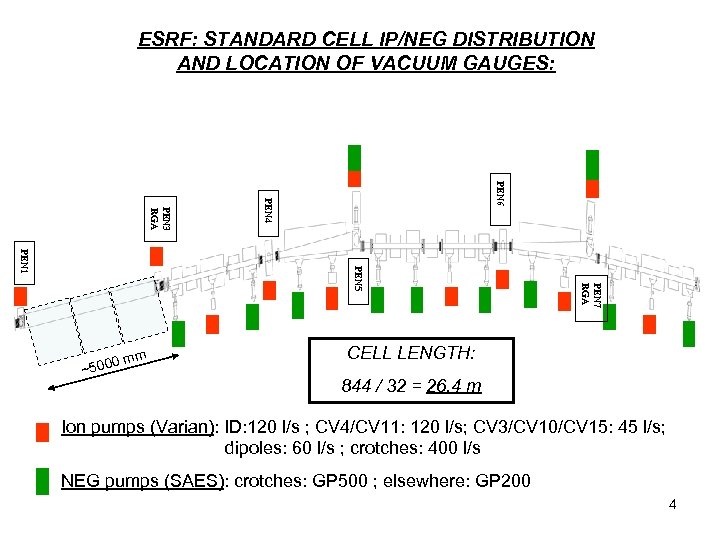 ESRF: STANDARD CELL IP/NEG DISTRIBUTION AND LOCATION OF VACUUM GAUGES: PEN 6 PEN 4 PEN 3 RGA PEN 7 RGA PEN 5 PEN 1 m 0 m ~500 CELL LENGTH: 844 / 32 = 26. 4 m Ion pumps (Varian): ID: 120 l/s ; CV 4/CV 11: 120 l/s; CV 3/CV 10/CV 15: 45 l/s; dipoles: 60 l/s ; crotches: 400 l/s NEG pumps (SAES): crotches: GP 500 ; elsewhere: GP 200 4
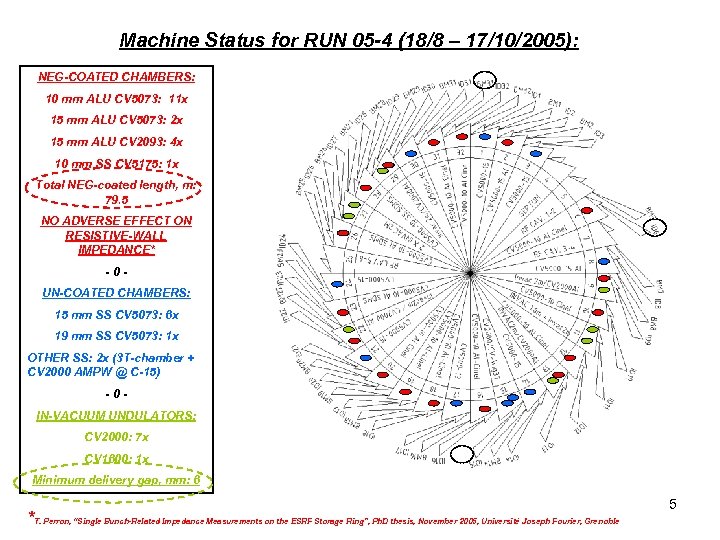 Machine Status for RUN 05 -4 (18/8 – 17/10/2005): NEG-COATED CHAMBERS: 10 mm ALU CV 5073: 11 x 15 mm ALU CV 5073: 2 x 15 mm ALU CV 2093: 4 x 10 mm SS CV 5175: 1 x Total NEG-coated length, m: 79. 5 NO ADVERSE EFFECT ON RESISTIVE-WALL IMPEDANCE* -0 UN-COATED CHAMBERS: 15 mm SS CV 5073: 6 x 19 mm SS CV 5073: 1 x OTHER SS: 2 x (3 T-chamber + CV 2000 AMPW @ C-15) -0 IN-VACUUM UNDULATORS: CV 2000: 7 x CV 1600: 1 x Minimum delivery gap, mm: 6 *T. Perron, “Single Bunch-Related Impedance Measurements on the ESRF Storage Ring", Ph. D thesis, November 2005, Université Joseph Fourier, Grenoble 5
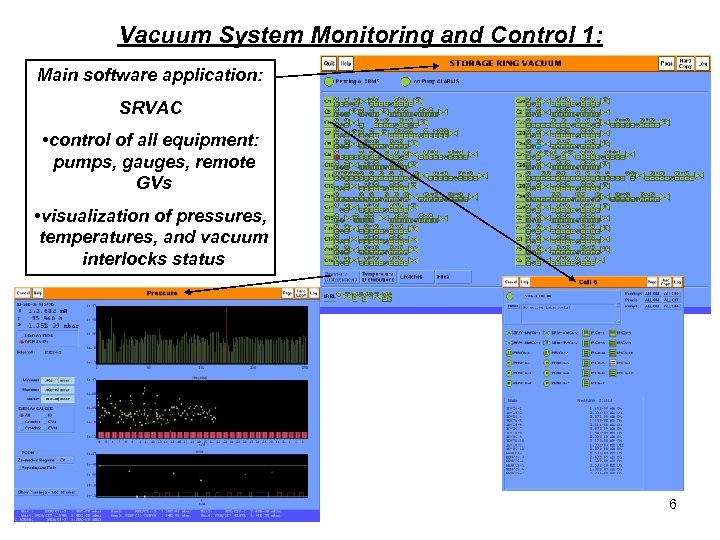 Vacuum System Monitoring and Control 1: Main software application: SRVAC • control of all equipment: pumps, gauges, remote GVs • visualization of pressures, temperatures, and vacuum interlocks status 6
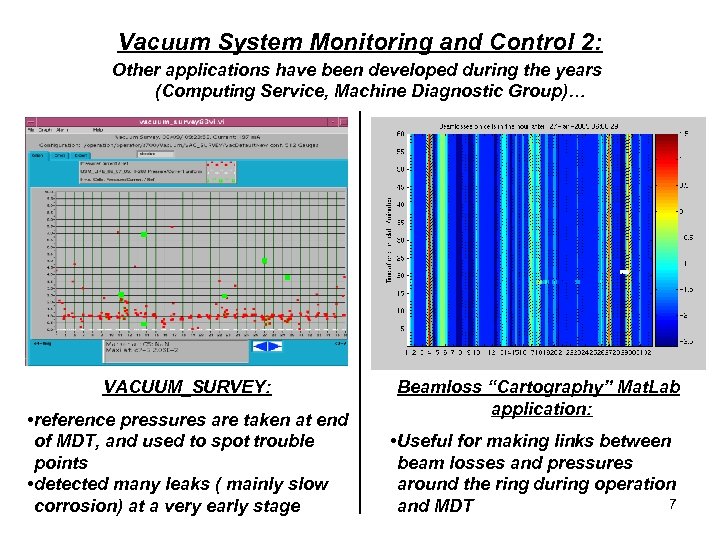 Vacuum System Monitoring and Control 2: Other applications have been developed during the years (Computing Service, Machine Diagnostic Group)… VACUUM_SURVEY: • reference pressures are taken at end of MDT, and used to spot trouble points • detected many leaks ( mainly slow corrosion) at a very early stage Beamloss “Cartography” Mat. Lab application: • Useful for making links between beam losses and pressures around the ring during operation 7 and MDT
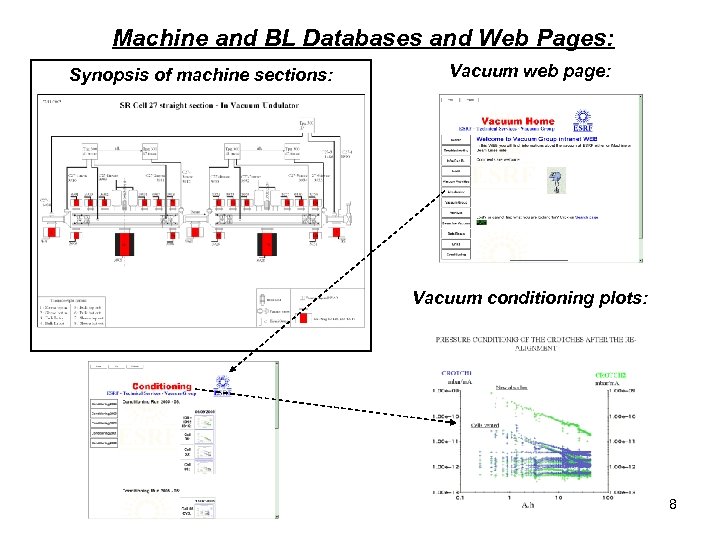 Machine and BL Databases and Web Pages: Synopsis of machine sections: Vacuum web page: Vacuum conditioning plots: 8
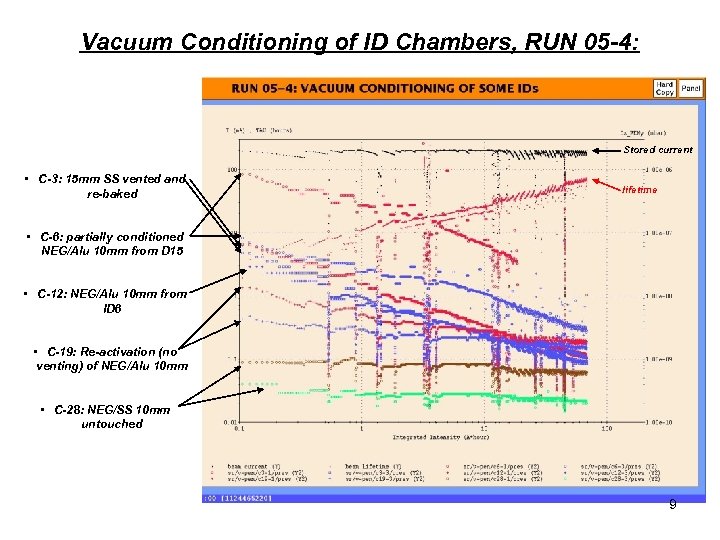 Vacuum Conditioning of ID Chambers, RUN 05 -4: Stored current • C-3: 15 mm SS vented and re-baked lifetime • C-6: partially conditioned NEG/Alu 10 mm from D 15 • C-12: NEG/Alu 10 mm from ID 6 • C-19: Re-activation (no venting) of NEG/Alu 10 mm • C-28: NEG/SS 10 mm untouched 9
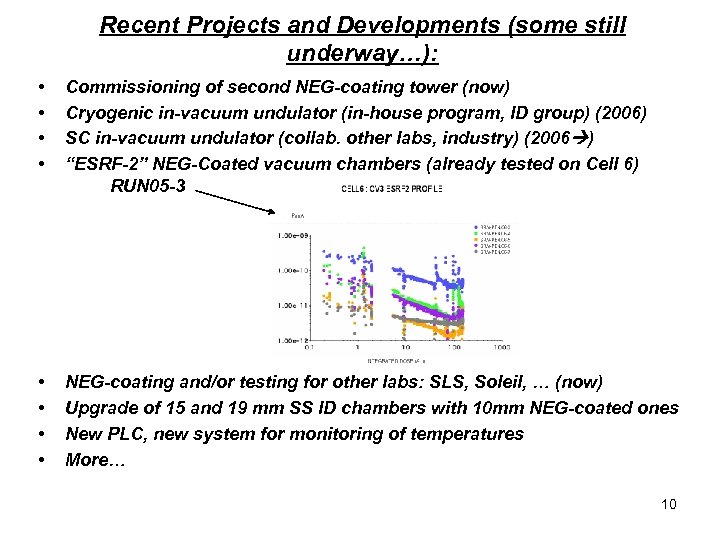 Recent Projects and Developments (some still underway…): • • Commissioning of second NEG-coating tower (now) Cryogenic in-vacuum undulator (in-house program, ID group) (2006) SC in-vacuum undulator (collab. other labs, industry) (2006 ) “ESRF-2” NEG-Coated vacuum chambers (already tested on Cell 6) RUN 05 -3 • • NEG-coating and/or testing for other labs: SLS, Soleil, … (now) Upgrade of 15 and 19 mm SS ID chambers with 10 mm NEG-coated ones New PLC, new system for monitoring of temperatures More… 10
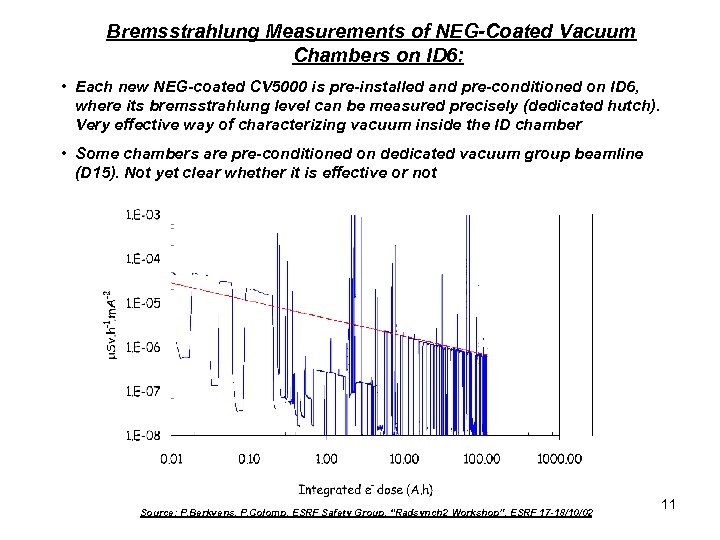 Bremsstrahlung Measurements of NEG-Coated Vacuum Chambers on ID 6: • Each new NEG-coated CV 5000 is pre-installed and pre-conditioned on ID 6, where its bremsstrahlung level can be measured precisely (dedicated hutch). Very effective way of characterizing vacuum inside the ID chamber • Some chambers are pre-conditioned on dedicated vacuum group beamline (D 15). Not yet clear whether it is effective or not Source: P. Berkvens, P. Colomp, ESRF Safety Group, “Radsynch 2 Workshop”, ESRF 17 -18/10/02 11
 Presentation made thanks to contributions and work from all members of the vacuum group, machine and operation groups, safety group, mechanical engineering group. THANK YOU FOR YOUR ATTENTION! 12