


 Скачать презентацию ESnet Status Update ESCC July 2008 William E
9b53c7b1acbe7ea34c6de79331c51d58.ppt
- Количество слайдов: 111
 ESnet Status Update ESCC, July 2008 William E. Johnston, ESnet Department Head and Senior Scientist Joe Burrescia, General Manager Mike Collins, Chin Guok, and Eli Dart Engineering Jim Gagliardi, Operations and Deployment Stan Kluz, Infrastructure and ECS Mike Helm, Federated Trust Dan Peterson, Security Officer Gizella Kapus, Business Manager and the rest of the ESnet Team Energy Sciences Network Lawrence Berkeley National Laboratory wej@es. net, www. es. net This talk is available at www. es. net/ESnet 4 Networking for the Future of Science 1
 DOE Office of Science and ESnet – the ESnet Mission • ESnet’s primary mission is to enable the largescale science that is the mission of the Office of Science (SC) and that depends on: – – – Sharing of massive amounts of data Supporting thousands of collaborators world-wide Distributed data processing Distributed data management Distributed simulation, visualization, and computational steering – Collaboration with the US and International Research and Education community • ESnet provides network and collaboration services to Office of Science laboratories and many other DOE programs in order to accomplish its mission 2
 ESnet Stakeholders and their Role in ESnet • DOE Office of Science Oversight (“SC”) of ESnet – The SC provides high-level oversight through the budgeting process – Near term input is provided by weekly teleconferences between SC and ESnet – Indirect long term input is through the process of ESnet observing and projecting network utilization of its largescale users – Direct long term input is through the SC Program Offices Requirements Workshops (more later) • SC Labs input to ESnet – Short term input through many daily (mostly) email interactions – Long term input through ESCC 3
 ESnet Stakeholders and the Role in ESnet • SC science collaborators input – Through numerous meeting, primarily with the networks that serve the science collaborators 4
 New in ESnet – Advanced Technologies Group / Coordinator • Up to this point individual ESnet engineers have worked in their “spare” time to do the R&D, or to evaluate R&D done by others, and coordinate the implementation and/or introduction of the new services into the production network environment – and they will continue to do so • In addition to this – looking to the future – ESnet has implemented a more formal approach to investigating and coordinating the R&D for the new services needed by science – An ESnet Advanced Technologies Group / Coordinator has been established with a twofold purpose: 1) To provide a unified view to the world of the several engineering development projects that are on-going in ESnet in order to publicize a coherent catalogue of advanced development work going on in ESnet. 2) To develop a portfolio of exploratory new projects, some involving technology developed by others, and some of which will be developed within the context of ESnet. • A highly qualified Advanced Technologies lead – Brian Tierney – has been hired and funded from current ESnet operational funding, and by next year a second staff person will be added. Beyond this, growth of the effort will be driven by new funding obtained specifically for that purpose. 5
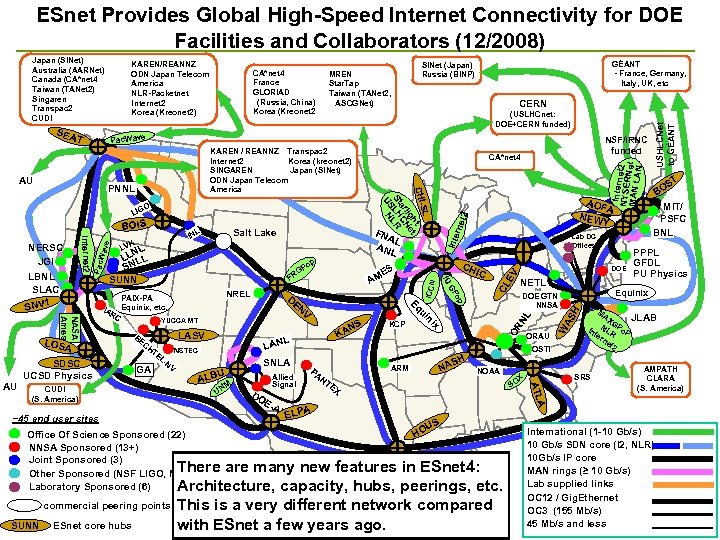 ESnet Provides Global High-Speed Internet Connectivity for DOE Facilities and Collaborators (12/2008) KAREN/REANNZ ODN Japan Telecom America NLR-Packetnet Internet 2 Korea (Kreonet 2) SEA T CA*net 4 France GLORIAD (Russia, China) Korea (Kreonet 2 TE GA LNV NSTEC SNLA U M UN EAL NT Intern NYSERet 2 MAN L Net AN OSTI NOAA EX S OX MIT/ PSFC BNL PPPL GFDL PU Physics Equinix H EV CL NL N ARM PA B LPA E H AS ORAU T S BO MA XG In NLR Po. P te rn et 2 SRS JLAB AMPATH CLARA (S. America) A Office Of Science Sponsored (22) NNSA Sponsored (13+) Joint Sponsored (3) Other Sponsored (NSF LIGO, NOAA) Laboratory Sponsored (6) DO Allied Signal DOE GTN NNSA ATL ALB ~45 end user sites commercial peering points L LAN NETL W AS LASV BE CH KA KCP x NS DOE op YUCCA MT CUDI (S. America) ESnet core hubs EN V ni SDSC UCSD Physics D GP PAIX-PA Equinix, etc. IC ui NASA Ames RC NREL CH ES AM G FR Eq IA p Po IU NL LL LL N S SUNN Lab DC Offices Inte FNA L ANL L LOSA SUNN Salt Lake L IN VK OR Pac Internet 2 Wav e BOIS AOF A NEW Y rne t 2 O ICCN PNNL NSF/IRNC funded CA*net 4 SL CHIht t lig e ar CN St LH LR US N KAREN / REANNZ Transpac 2 Internet 2 Korea (kreonet 2) SINGAREN Japan (SINet) ODN Japan Telecom America LIG AU CERN (USLHCnet: DOE+CERN funded) Pac. Wave AU NERSC JGI LBNL SLAC SNV 1 GÉANT - France, Germany, Italy, UK, etc SINet (Japan) Russia (BINP) MREN Star. Tap Taiwan (TANet 2, ASCGNet) USHLCNet to GÉANT Japan (SINet) Australia (AARNet) Canada (CA*net 4 Taiwan (TANet 2) Singaren Transpac 2 CUDI US HO There are many new features in ESnet 4: Architecture, capacity, hubs, peerings, etc. R&E This is. Specific R&E network peers a very different network compared networks with ESnet. R&Efew years ago. only. Geography is Other a peering points representational International (1 -10 Gb/s) 10 Gb/s SDN core (I 2, NLR) 10 Gb/s IP core MAN rings (≥ 10 Gb/s) Lab supplied links OC 12 / Gig. Ethernet OC 3 (155 Mb/s) 45 Mb/s and less
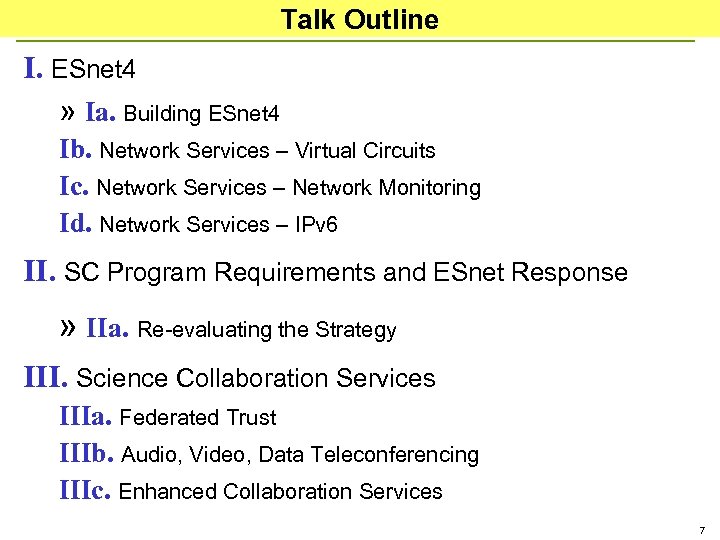 Talk Outline I. ESnet 4 » Ia. Building ESnet 4 Ib. Network Services – Virtual Circuits Ic. Network Services – Network Monitoring Id. Network Services – IPv 6 II. SC Program Requirements and ESnet Response » IIa. Re-evaluating the Strategy III. Science Collaboration Services IIIa. Federated Trust IIIb. Audio, Video, Data Teleconferencing IIIc. Enhanced Collaboration Services 7
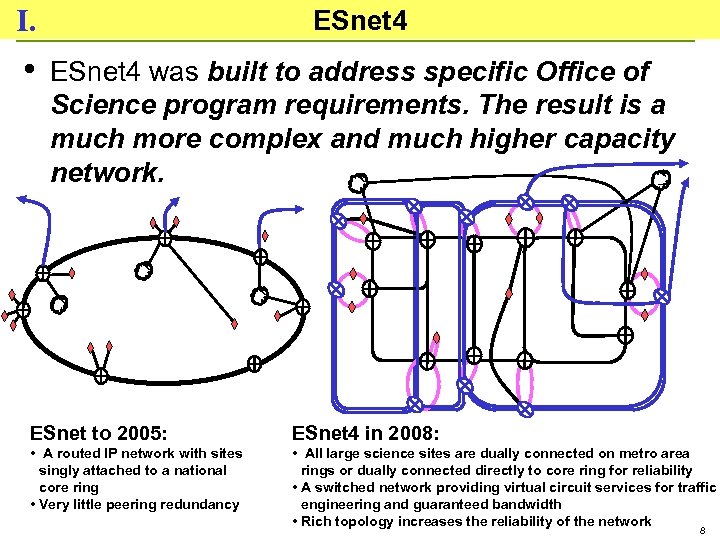 I. ESnet 4 • ESnet 4 was built to address specific Office of Science program requirements. The result is a much more complex and much higher capacity network. ESnet to 2005: ESnet 4 in 2008: • A routed IP network with sites singly attached to a national core ring • Very little peering redundancy • All large science sites are dually connected on metro area rings or dually connected directly to core ring for reliability • A switched network providing virtual circuit services for traffic engineering and guaranteed bandwidth • Rich topology increases the reliability of the network 8
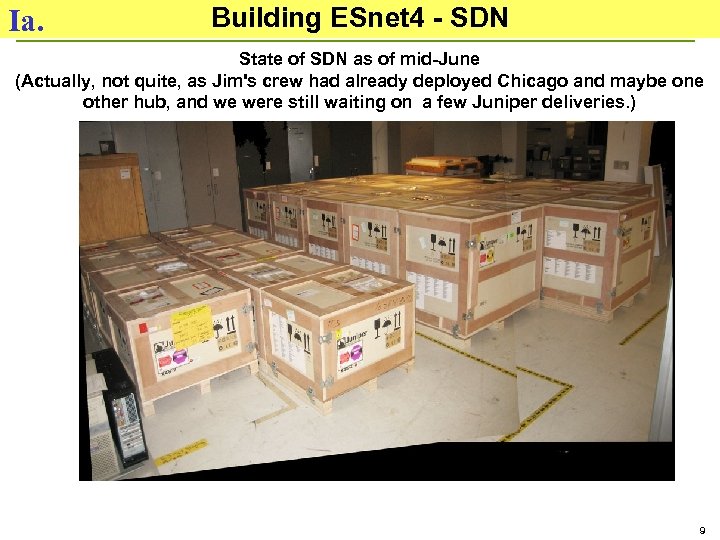 Ia. Building ESnet 4 - SDN State of SDN as of mid-June (Actually, not quite, as Jim's crew had already deployed Chicago and maybe one other hub, and we were still waiting on a few Juniper deliveries. ) 9
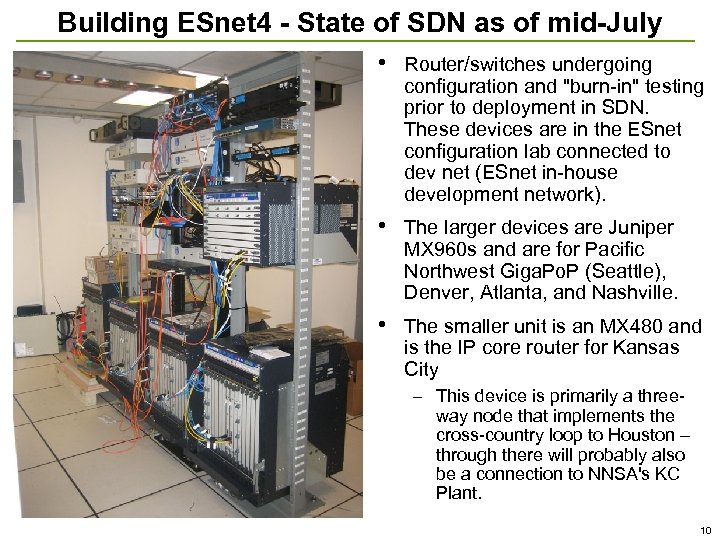 Building ESnet 4 - State of SDN as of mid-July • Router/switches undergoing configuration and "burn-in" testing prior to deployment in SDN. These devices are in the ESnet configuration lab connected to dev net (ESnet in-house development network). • The larger devices are Juniper MX 960 s and are for Pacific Northwest Giga. Po. P (Seattle), Denver, Atlanta, and Nashville. • The smaller unit is an MX 480 and is the IP core router for Kansas City – This device is primarily a threeway node that implements the cross-country loop to Houston – through there will probably also be a connection to NNSA's KC Plant. 10
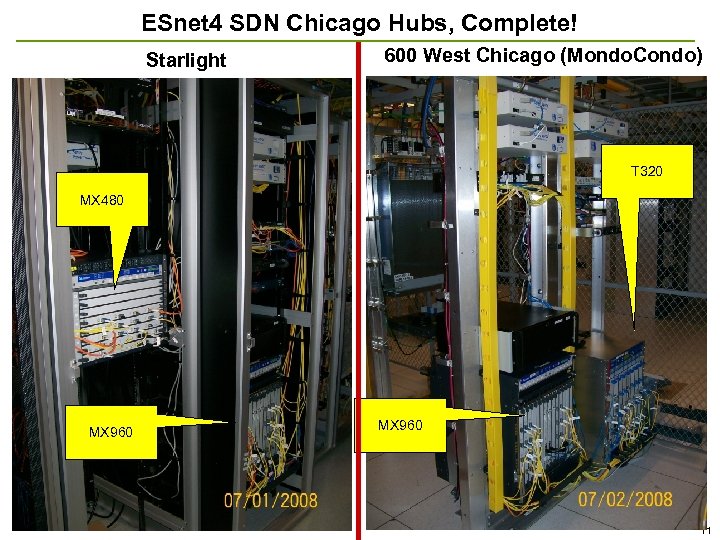 ESnet 4 SDN Chicago Hubs, Complete! Starlight 600 West Chicago (Mondo. Condo) T 320 MX 480 MX 960 11
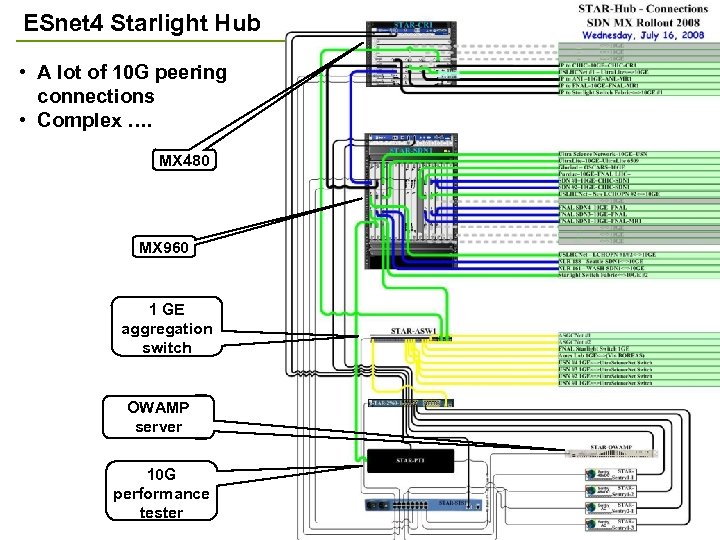 ESnet 4 Starlight Hub • A lot of 10 G peering connections • Complex …. MX 480 MX 960 1 GE aggregation switch OWAMP server 10 G performance tester 12
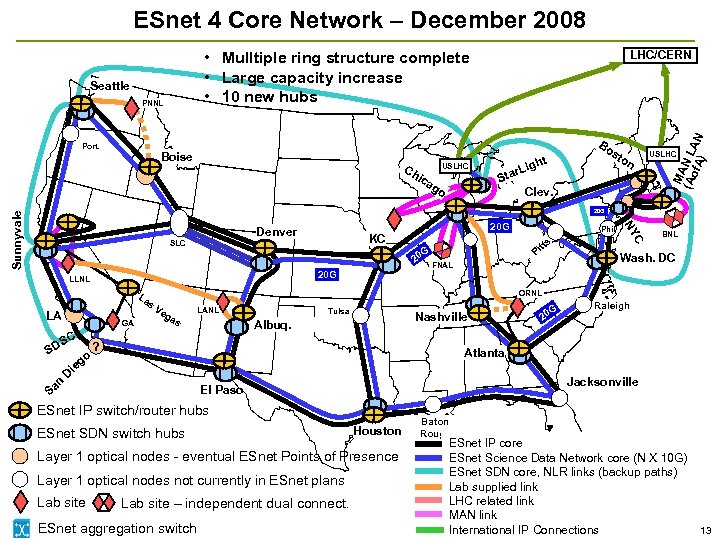 ESnet 4 Core Network – December 2008 PNNL Boise Ch USLHC ica go t Bo st h r. Lig Sta on Clev. MA (Ao N L f. A) AN Seattle Port. LHC/CERN • Mulltiple ring structure complete • Large capacity increase • 10 new hubs USLHC Denver SLC G 20 20 G LLNL La s LA GA SC SD go 20 G KC tt Pi FNAL D Ve ga s LANL Tulsa Nashville Albuq. ? Wash. DC G 20 Raleigh Atlanta Jacksonville El Paso ESnet IP switch/router hubs ESnet SDN switch hubs Houston Layer 1 optical nodes - eventual ESnet Points of Presence Layer 1 optical nodes not currently in ESnet plans Lab site BNL ORNL ie n Sa Phil s. C NY Sunnyvale 20 G Lab site – independent dual connect. ESnet aggregation switch Baton Rouge ESnet IP core ESnet Science Data Network core (N X 10 G) ESnet SDN core, NLR links (backup paths) Lab supplied link LHC related link MAN link International IP Connections 13
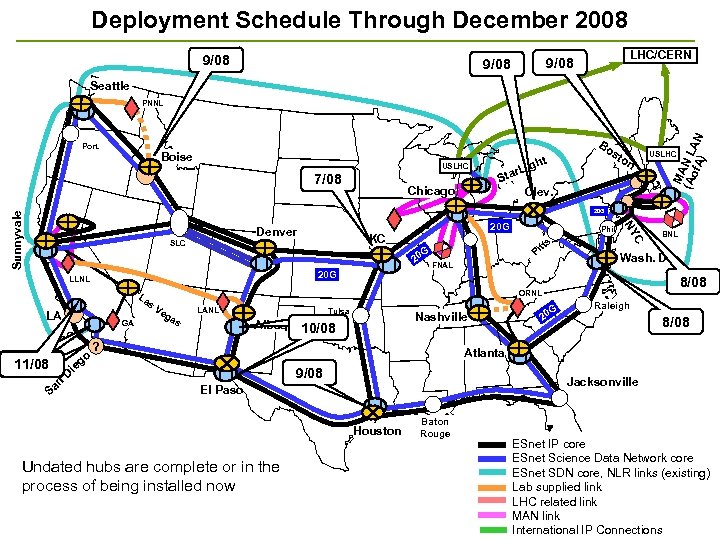 Deployment Schedule Through December 2008 9/08 LHC/CERN 9/08 Seattle Port. Boise USLHC 7/08 Chicago t Bo st h r. Lig Sta on Clev. MA (Ao N L f. A) AN PNNL USLHC Denver SLC G 20 20 G LLNL La s LA GA C S SD 11/08 n Sa go Phil s. tt Pi FNAL Ve ga s LANL Tulsa Nashville Albuq. 10/08 ? G 20 BNL Wash. DC 8/08 ORNL Raleigh 8/08 Atlanta ie D 20 G KC C NY Sunnyvale 20 G 9/08 Jacksonville El Paso Houston Undated hubs are complete or in the process of being installed now Baton Rouge ESnet IP core ESnet Science Data Network core ESnet SDN core, NLR links (existing) Lab supplied link LHC related link MAN link 14 International IP Connections
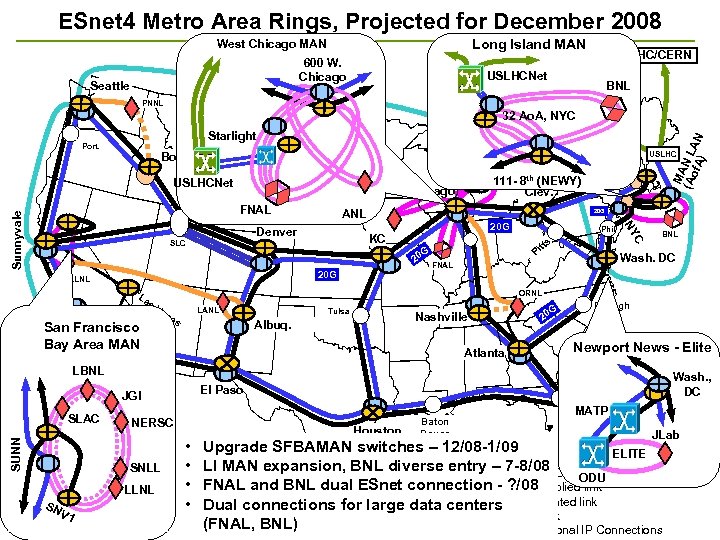 ESnet 4 Metro Area Rings, Projected for December 2008 Long Island MAN West Chicago MAN 600 W. Chicago Seattle LHC/CERN USLHCNet BNL PNNL Starlight Port. Boise USLHCNet Chicago Denver SLC LA Ve LANL ga s Tulsa tt Pi SUNN BNL Wash. DC FNAL Nashville Albuq. Atlanta NERSC SNLL LLNL • • G 20 Raleigh Newport News - Elite Jacksonville El Paso JGI V 1 Phil s. go ie LBNL D SLAC USLHC ORNL GA San Francisco S Bay. C ? MAN SD Area SN 20 G KC 20 G La s on 20 G G 20 LLNL n Sa ANL st C NY Sunnyvale FNAL ht Lig tar 8 th (NEWY) S 111 Clev. Bo MA (Ao N L f. A) AN 32 Ao. A, NYC Houston Baton Rouge Wash. , DC MATP JLab ESnet IP core Upgrade SFBAMAN switches – 12/08 -1/09 ELITE ESnet Science Data Network core LI MAN expansion, BNL diverse entry – 7 -8/08 ESnet SDN core, NLR links (existing) ODU FNAL and BNL dual ESnet connection - ? /08 Lab supplied link Dual connections for large data centers LHC related link MAN link (FNAL, BNL) 15 International IP Connections
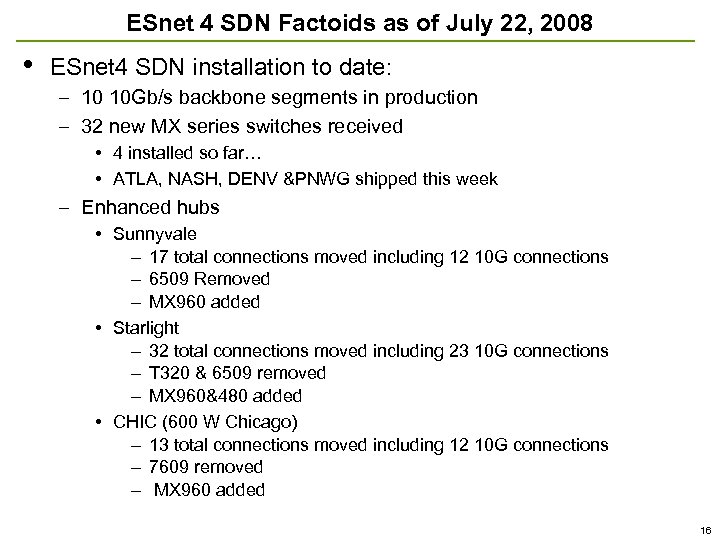 ESnet 4 SDN Factoids as of July 22, 2008 • ESnet 4 SDN installation to date: – 10 10 Gb/s backbone segments in production – 32 new MX series switches received • 4 installed so far… • ATLA, NASH, DENV &PNWG shipped this week – Enhanced hubs • Sunnyvale – 17 total connections moved including 12 10 G connections – 6509 Removed – MX 960 added • Starlight – 32 total connections moved including 23 10 G connections – T 320 & 6509 removed – MX 960&480 added • CHIC (600 W Chicago) – 13 total connections moved including 12 10 G connections – 7609 removed – MX 960 added 16
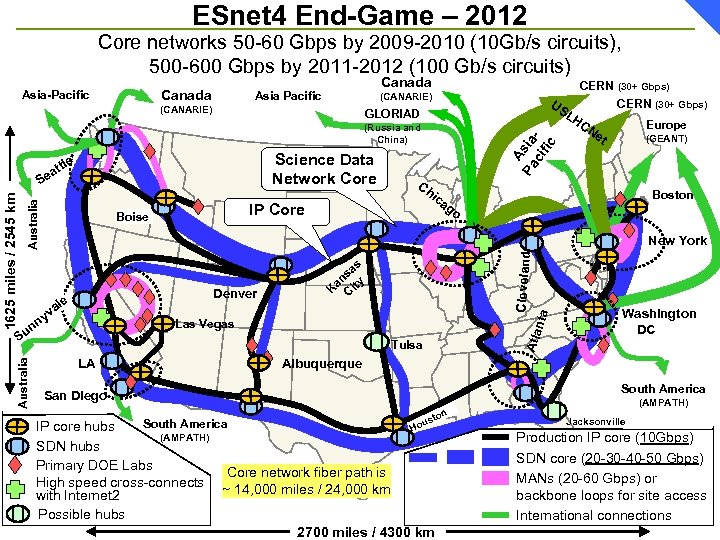 ESnet 4 End-Game – 2012 Core networks 50 -60 Gbps by 2009 -2010 (10 Gb/s circuits), 500 -600 Gbps by 2011 -2012 (100 Gb/s circuits) Canada Asia-Pacific Canada Asia Pacific (CANARIE) US LH GLORIAD Science Data Network Core Australia Europe (GEANT) Boston ag o as ns ty a K Ci nta Denver le va y Cleveland Las Vegas S Atla 1625 miles / 2545 km ic CN et New York n un Australia Ch IP Core Boise A Pa sia ci fic (Russia and China) le att Se CERN (30+ Gbps) Tulsa LA Washington DC Albuquerque South America San Diego (AMPATH) on ust South America IP core hubs Ho (AMPATH) SDN hubs Primary DOE Labs Core network fiber path is High speed cross-connects ~ 14, 000 miles / 24, 000 km with Internet 2 Possible hubs 2700 miles / 4300 km Jacksonville Production IP core (10 Gbps) SDN core (20 -30 -40 -50 Gbps) MANs (20 -60 Gbps) or backbone loops for site access International connections
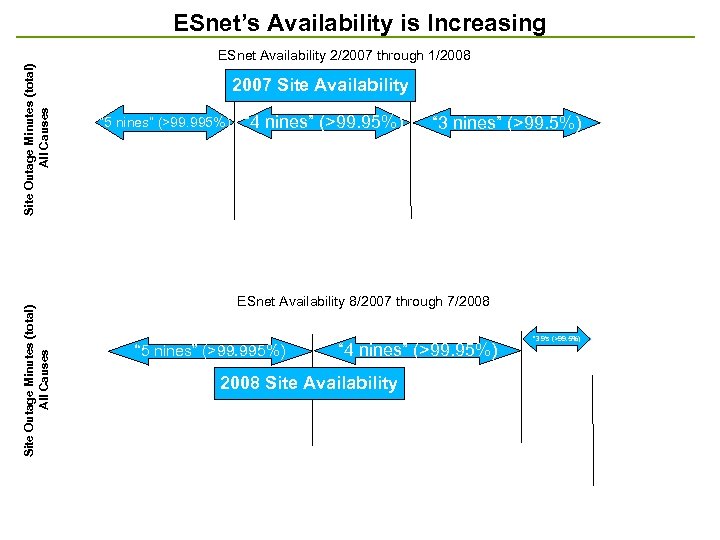 ESnet’s Availability is Increasing Site Outage Minutes (total) All Causes ESnet Availability 2/2007 through 1/2008 2007 Site Availability “ 5 nines” (>99. 995%) “ 4 nines” (>99. 95%) “ 3 nines” (>99. 5%) ESnet Availability 8/2007 through 7/2008 “ 5 nines” (>99. 995%) “ 4 nines” (>99. 95%) 2008 Site Availability “ 3 9’s (>99. 5%)
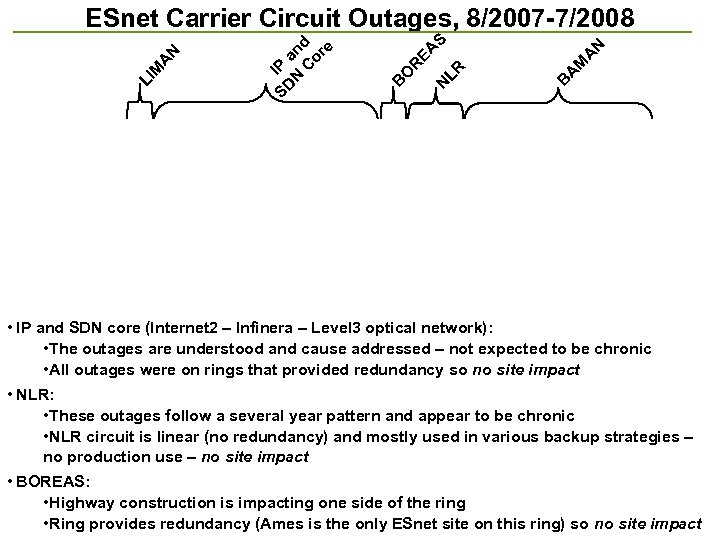 B A M A N S N LR EA R O B SD IP N and C or e LI M A N ESnet Carrier Circuit Outages, 8/2007 -7/2008 • IP and SDN core (Internet 2 – Infinera – Level 3 optical network): • The outages are understood and cause addressed – not expected to be chronic • All outages were on rings that provided redundancy so no site impact • NLR: • These outages follow a several year pattern and appear to be chronic • NLR circuit is linear (no redundancy) and mostly used in various backup strategies – no production use – no site impact • BOREAS: • Highway construction is impacting one side of the ring • Ring provides redundancy (Ames is the only ESnet site on this ring) so no site impact
 Ib. Network Services – Virtual Circuits Fairly consistent requirements are found across the large-scale sciences • Large-scale science uses distributed systems in order to: – Couple existing pockets of code, data, and expertise into “systems of systems” – Break up the task of massive data analysis into elements that are physically located where the data, compute, and storage resources are located - these elements are combined into a system using a “Service Oriented Architecture” approach • Such systems – are data intensive and high-performance, typically moving terabytes a day for months at a time – are high duty-cycle, operating most of the day for months at a time in order to meet the requirements for data movement – are widely distributed – typically spread over continental or inter-continental distances – depend on network performance and availability, but these characteristics cannot be taken for granted, even in well run networks, when the multi-domain network path is considered ØThe system elements must be able to get guarantees from the network that there is adequate bandwidth to accomplish the task at hand ØThe systems must be able to get information from the network that allows graceful failure and auto-recovery and adaptation to unexpected network conditions that are short of outright failure See, e. g. , [ICFA SCIC]
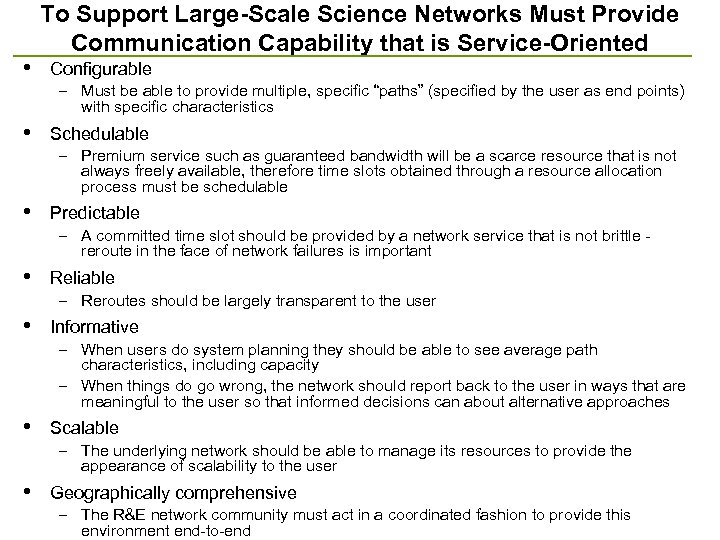 • To Support Large-Scale Science Networks Must Provide Communication Capability that is Service-Oriented Configurable – Must be able to provide multiple, specific “paths” (specified by the user as end points) with specific characteristics • Schedulable – Premium service such as guaranteed bandwidth will be a scarce resource that is not always freely available, therefore time slots obtained through a resource allocation process must be schedulable • Predictable – A committed time slot should be provided by a network service that is not brittle - reroute in the face of network failures is important • Reliable – Reroutes should be largely transparent to the user • Informative – When users do system planning they should be able to see average path characteristics, including capacity – When things do go wrong, the network should report back to the user in ways that are meaningful to the user so that informed decisions can about alternative approaches • Scalable – The underlying network should be able to manage its resources to provide the appearance of scalability to the user • Geographically comprehensive – The R&E network community must act in a coordinated fashion to provide this environment end-to-end
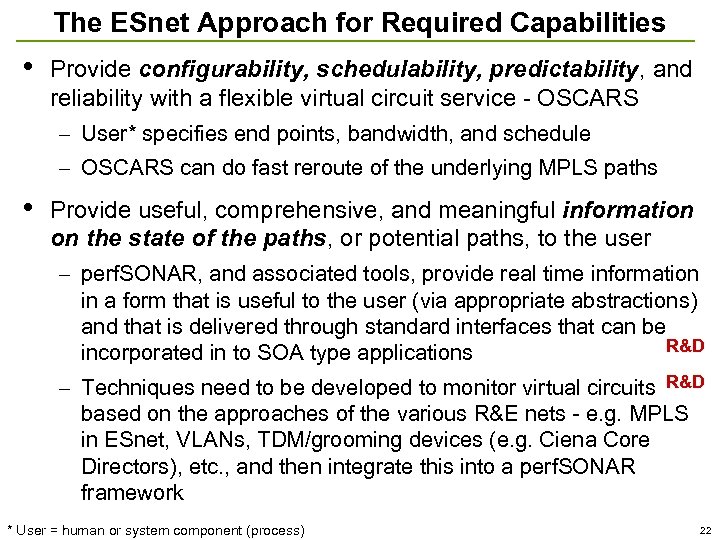 The ESnet Approach for Required Capabilities • Provide configurability, schedulability, predictability, and reliability with a flexible virtual circuit service - OSCARS – User* specifies end points, bandwidth, and schedule – OSCARS can do fast reroute of the underlying MPLS paths • Provide useful, comprehensive, and meaningful information on the state of the paths, or potential paths, to the user – perf. SONAR, and associated tools, provide real time information in a form that is useful to the user (via appropriate abstractions) and that is delivered through standard interfaces that can be R&D incorporated in to SOA type applications – Techniques need to be developed to monitor virtual circuits R&D based on the approaches of the various R&E nets - e. g. MPLS in ESnet, VLANs, TDM/grooming devices (e. g. Ciena Core Directors), etc. , and then integrate this into a perf. SONAR framework * User = human or system component (process) 22
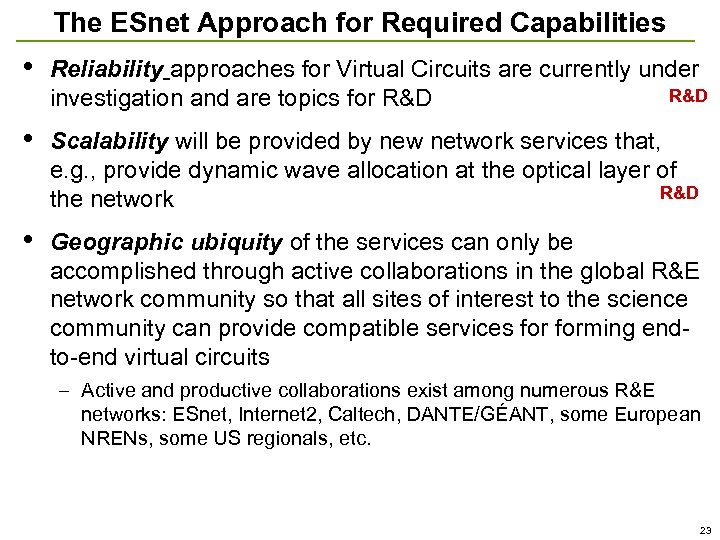 The ESnet Approach for Required Capabilities • Reliability approaches for Virtual Circuits are currently under R&D investigation and are topics for R&D • Scalability will be provided by new network services that, e. g. , provide dynamic wave allocation at the optical layer of R&D the network • Geographic ubiquity of the services can only be accomplished through active collaborations in the global R&E network community so that all sites of interest to the science community can provide compatible services forming endto-end virtual circuits – Active and productive collaborations exist among numerous R&E networks: ESnet, Internet 2, Caltech, DANTE/GÉANT, some European NRENs, some US regionals, etc. 23
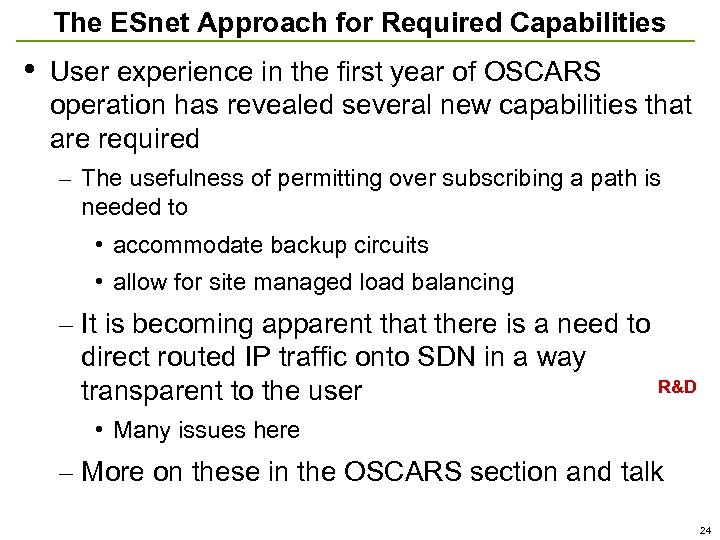 The ESnet Approach for Required Capabilities • User experience in the first year of OSCARS operation has revealed several new capabilities that are required – The usefulness of permitting over subscribing a path is needed to • accommodate backup circuits • allow for site managed load balancing – It is becoming apparent that there is a need to direct routed IP traffic onto SDN in a way R&D transparent to the user • Many issues here – More on these in the OSCARS section and talk 24
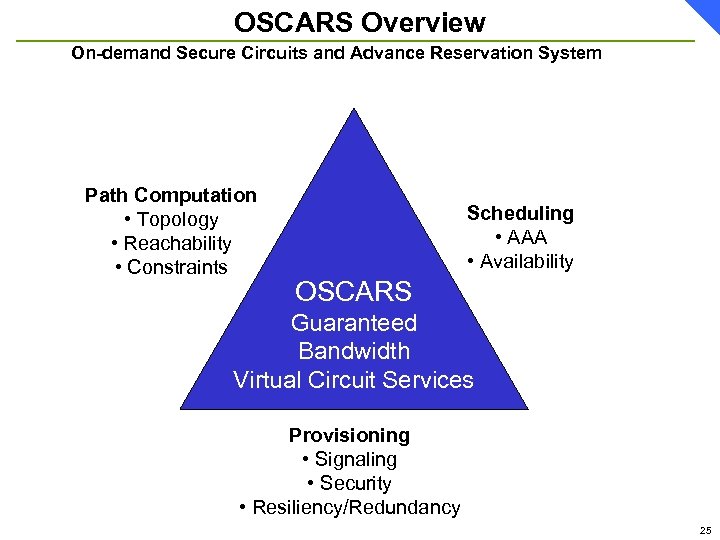 OSCARS Overview On-demand Secure Circuits and Advance Reservation System Path Computation • Topology • Reachability • Constraints Scheduling • AAA • Availability OSCARS Guaranteed Bandwidth Virtual Circuit Services Provisioning • Signaling • Security • Resiliency/Redundancy 25
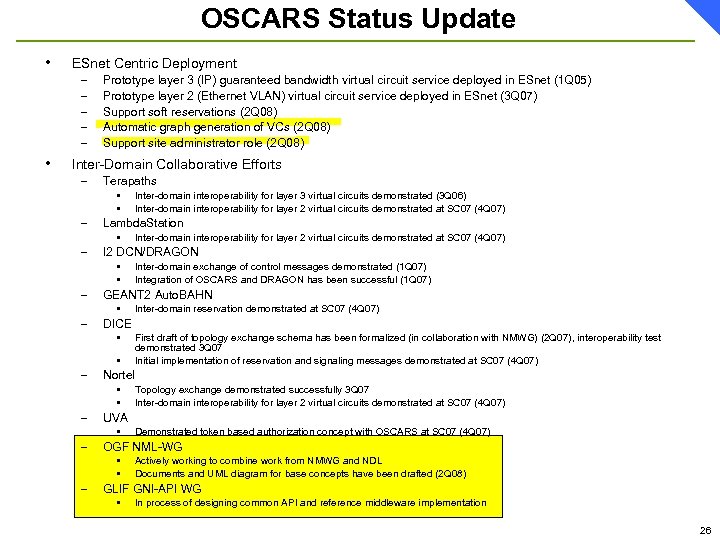 OSCARS Status Update • ESnet Centric Deployment – – – • Prototype layer 3 (IP) guaranteed bandwidth virtual circuit service deployed in ESnet (1 Q 05) Prototype layer 2 (Ethernet VLAN) virtual circuit service deployed in ESnet (3 Q 07) Support soft reservations (2 Q 08) Automatic graph generation of VCs (2 Q 08) Support site administrator role (2 Q 08) Inter-Domain Collaborative Efforts – Terapaths • • – Lambda. Station • – Inter-domain interoperability for layer 3 virtual circuits demonstrated (3 Q 06) Inter-domain interoperability for layer 2 virtual circuits demonstrated at SC 07 (4 Q 07) I 2 DCN/DRAGON • • Inter-domain exchange of control messages demonstrated (1 Q 07) Integration of OSCARS and DRAGON has been successful (1 Q 07) – GEANT 2 Auto. BAHN – DICE • • • – Demonstrated token based authorization concept with OSCARS at SC 07 (4 Q 07) OGF NML-WG • • – Topology exchange demonstrated successfully 3 Q 07 Inter-domain interoperability for layer 2 virtual circuits demonstrated at SC 07 (4 Q 07) UVA • – First draft of topology exchange schema has been formalized (in collaboration with NMWG) (2 Q 07), interoperability test demonstrated 3 Q 07 Initial implementation of reservation and signaling messages demonstrated at SC 07 (4 Q 07) Nortel • • – Inter-domain reservation demonstrated at SC 07 (4 Q 07) Actively working to combine work from NMWG and NDL Documents and UML diagram for base concepts have been drafted (2 Q 08) GLIF GNI-API WG • In process of designing common API and reference middleware implementation 26
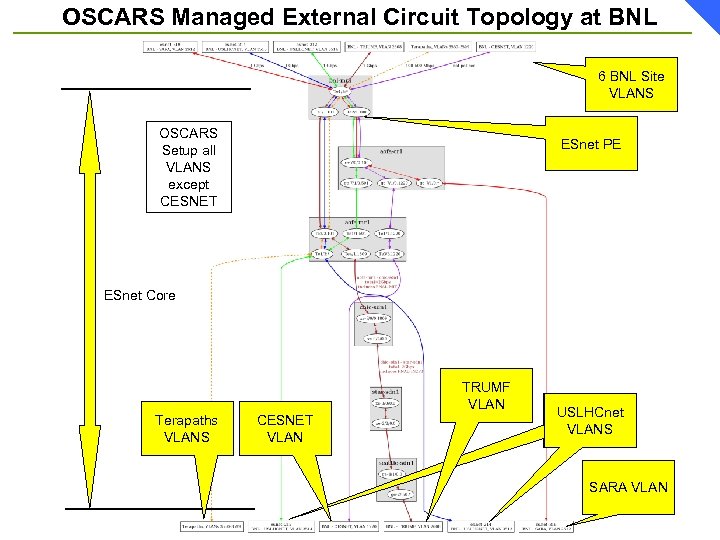 OSCARS Managed External Circuit Topology at BNL 6 BNL Site VLANS OSCARS Setup all VLANS except CESNET ESnet PE ESnet Core TRUMF VLAN Terapaths VLANS CESNET VLAN USLHCnet VLANS SARA VLAN
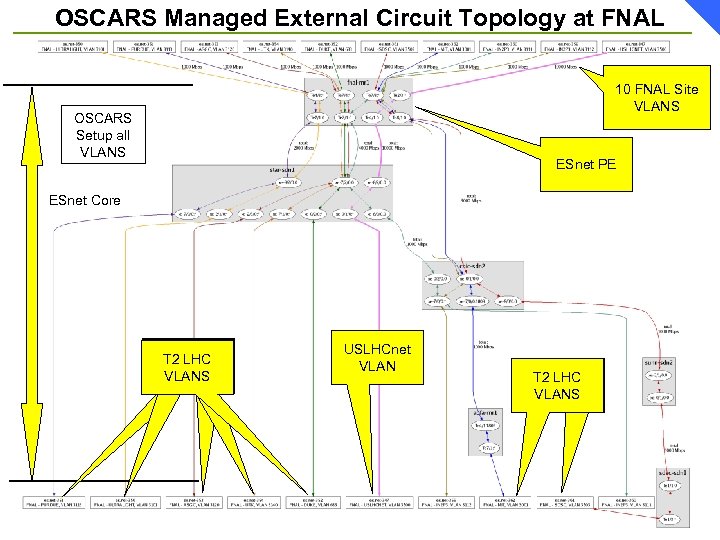 OSCARS Managed External Circuit Topology at FNAL 10 FNAL Site VLANS OSCARS Setup all VLANS ESnet PE ESnet Core USLHCnet T 2 LHC VLANS USLHCnet VLAN T 2 LHC VLANS VLAN
 OSCARS Adapting to User Experience • Original design capabilities – Guaranteed bandwidth VCs • Over-provisioning of the overall SDN path is prevented at reservation request time – i. e. each new reservation request is vetted against available capacity for the entire duration of the reservations dynamic updates of not just the current reserved bandwithd loaded topology, but into the future as well (this is key to ensuring sufficient bandwidth for all VC guarantees) • Over-subscription (once the VC is in use) is prevented by policing (hard drop) at time of use • All reserved VCs configured to transit ESnet as Expedited Forwarding Class traffic 29
 • OSCARS Adapting to User Experience Current updated capabilities – Guaranteed Bandwidth VC with Path Over-Subscription • Over-provisioning of overall path is still prevented at reservation request time • Over-subscription is allowed during VC use – Traffic below policed rate will transit ESnet as Expedited Forwarding Class – Traffic above policed rate is not dropped, but remarked as Scavenger Class (so this traffic only moves of there is unutilized bandwidth on the path) » This allows sites to provision multiple VCs along the same path and manage the use of these locally – Considerations • Implementation of above enhancements are technology specific – not all network implementations have multiple forwarding classes (multiple traffic priorities • End-to-end inter-domain dynamic VCs may not support over-subscription • Multi-lab coordination may be required to effective utilize bandwidth available in Scavenger Class 30
 Ic. • Network Services – Network Measurement ESnet – Goal is to have 10 G testers and latency measuring capabilities at all hubs • About 1/3 of the 10 GE bandwidth test platforms & 1/2 of the latency test platforms for ESnet 4 have been deployed. – 10 GE test systems are being used extensively for acceptance testing and debugging – Structured & ad-hoc external testing capabilities will be enabled soon. – Work is progressing on revamping the ESnet statistics collection, management & publication systems • ESx. SNMP & TSDB & Perf. SONAR Measurement Archive (MA) • Perf. SONAR TS & OSCARS Topology DB • Net. Info being restructured to be Perf. SONAR based • LHC and Perf. SONAR – Perf. SONAR based network measurement pilot for the Tier 1/Tier 2 community is ready for deployment. – A proposal from DANTE to deploy a perf. SONAR based network measurement service across the LHCOPN at all Tier 1 sites is still being evaluated by the Tier 1 centers 31
 Id. • Network Services – IPv 6 ESnet provides production IPv 6 service – IPv 6 fully supported by ESnet NOC and engineering – IPv 6 supported natively by ESnet routers – http: //www. es. net/hypertext/IPv 6/index. html • Network-level IPv 6 services include: – Address allocation for sites • Some sites have already been assigned IPv 6 space • More are welcome! – Full IPv 6 connectivity (default-free IPv 6 routing table) • High-speed R&E peerings with Americas, Europe, Canada, Asia • Numerous commodity Internet IPv 6 peerings as well – Diverse IPv 6 peering with root name servers 32
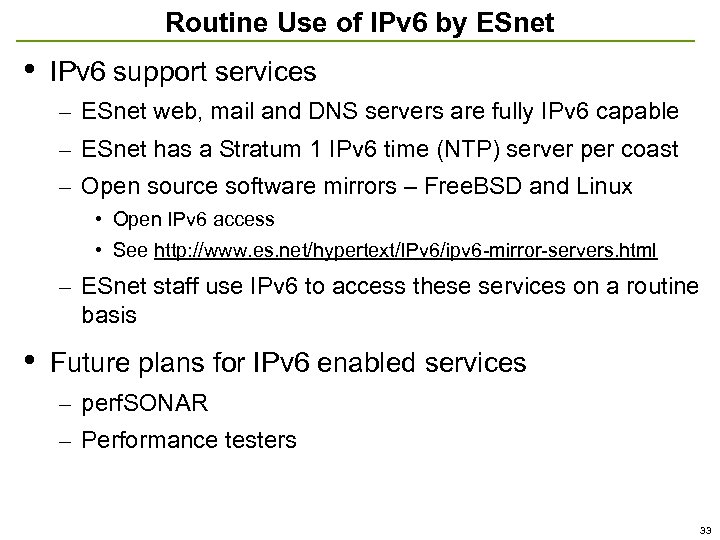 Routine Use of IPv 6 by ESnet • IPv 6 support services – ESnet web, mail and DNS servers are fully IPv 6 capable – ESnet has a Stratum 1 IPv 6 time (NTP) server per coast – Open source software mirrors – Free. BSD and Linux • Open IPv 6 access • See http: //www. es. net/hypertext/IPv 6/ipv 6 -mirror-servers. html – ESnet staff use IPv 6 to access these services on a routine basis • Future plans for IPv 6 enabled services – perf. SONAR – Performance testers 33
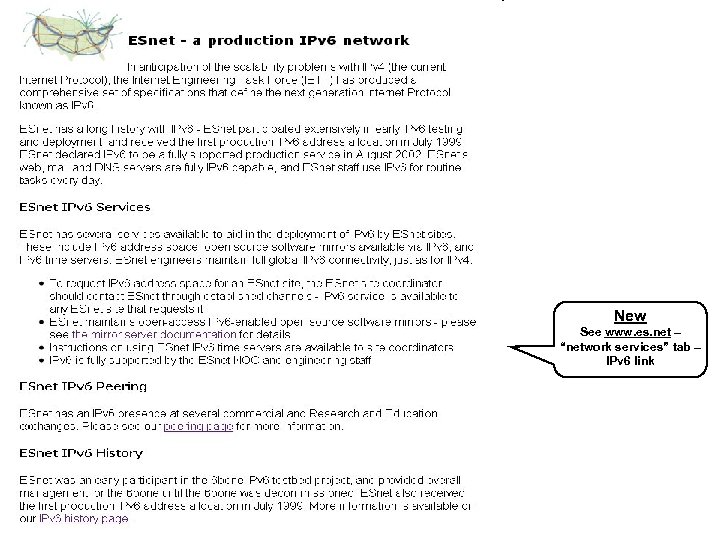 New See www. es. net – “network services” tab – IPv 6 link
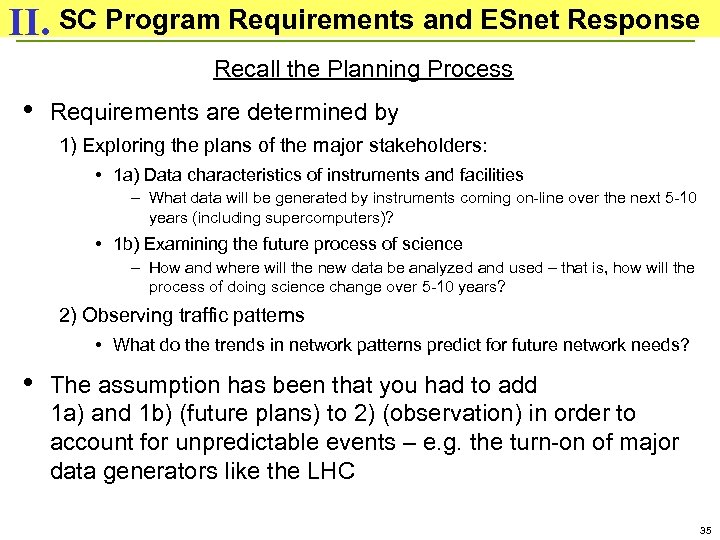 II. SC Program Requirements and ESnet Response Recall the Planning Process • Requirements are determined by 1) Exploring the plans of the major stakeholders: • 1 a) Data characteristics of instruments and facilities – What data will be generated by instruments coming on-line over the next 5 -10 years (including supercomputers)? • 1 b) Examining the future process of science – How and where will the new data be analyzed and used – that is, how will the process of doing science change over 5 -10 years? 2) Observing traffic patterns • What do the trends in network patterns predict for future network needs? • The assumption has been that you had to add 1 a) and 1 b) (future plans) to 2) (observation) in order to account for unpredictable events – e. g. the turn-on of major data generators like the LHC 35
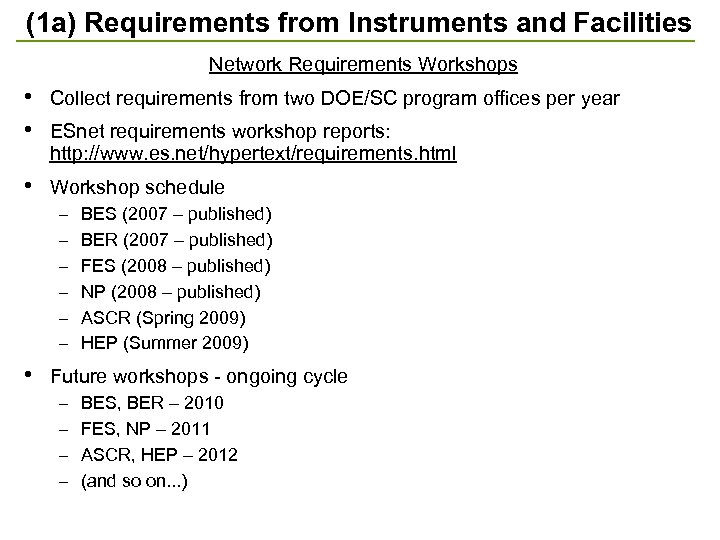 (1 a) Requirements from Instruments and Facilities Network Requirements Workshops • • Collect requirements from two DOE/SC program offices per year • Workshop schedule ESnet requirements workshop reports: http: //www. es. net/hypertext/requirements. html – – – • BES (2007 – published) BER (2007 – published) FES (2008 – published) NP (2008 – published) ASCR (Spring 2009) HEP (Summer 2009) Future workshops - ongoing cycle – – BES, BER – 2010 FES, NP – 2011 ASCR, HEP – 2012 (and so on. . . )
 Requirements from Instruments and Facilities • Typical DOE large-scale facilities are the Tevatron accelerator (FNAL), RHIC accelerator (BNL), SNS accelerator (ORNL), ALS accelerator (LBNL), and the supercomputer centers: NERSC, NCLF (ORNL), Blue Gene (ANL) • These are representative of the ‘hardware infrastructure’ of DOE science • Requirements from these can be characterized as – Bandwidth: Quantity of data produced, requirements for timely movement – Connectivity: Geographic reach – location of instruments, facilities, and users plus network infrastructure involved (e. g. ESnet, Abilene, GEANT) – Services: Guaranteed bandwidth, traffic isolation, etc. ; IP multicast 37
 (1 b) Requirements from Case Studies on Process of Science Case studies on how science involving data is done now, and how the science community sees it as changing, were initially done for a fairly “random, ” but we believe them to be representative, set of facilities and collaborations. • Advanced Scientific Computing Research (ASCR) – NERSC (LBNL) (supercomputer center) – NLCF (ORNL) (supercomputer center) – ACLF (ANL) (supercomputer center) • Basic Energy Sciences – Advanced Light Source • Macromolecular Crystallography • Biological and Environmental – Bioinformatics/Genomics – Climate Science • Fusion Energy Sciences – Magnetic Fusion Energy/ITER • High Energy Physics – LHC • Nuclear Physics – RHIC (heavy ion accelerator) – Chemistry/Combustion – Spallation Neutron Source 38
 Network Requirements Workshops - Findings • Virtual circuit services (traffic isolation, bandwidth guarantees, etc) continue to be requested by scientists – OSCARS service directly addresses these needs • http: //www. es. net/OSCARS/index. html • Successfully deployed in early production today • ESnet will continue to develop and deploy OSCARS • Some user communities have significant difficulties using the network for bulk data transfer – fasterdata. es. net – web site devoted to bulk data transfer, host tuning, etc. established – NERSC and ORNL have made significant progress on improving data transfer performance between supercomputer centers 39
 Network Requirements Workshops - Findings • Some data rate requirements are unknown at this time – Drivers are instrument upgrades that are subject to review, qualification and other decisions that are 6 -12 months away – These will be revisited in the appropriate timeframe 40
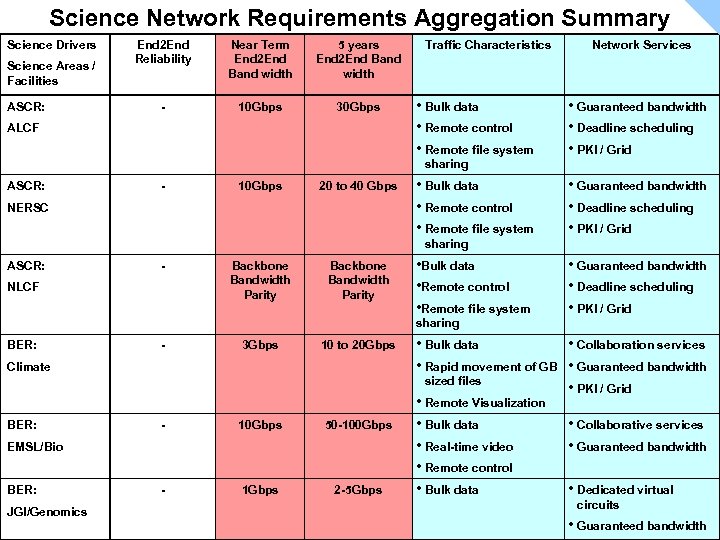 Science Network Requirements Aggregation Summary Science Drivers Science Areas / Facilities ASCR: End 2 End Reliability Near Term End 2 End Band width 5 years End 2 End Band width - 10 Gbps 30 Gbps ALCF Traffic Characteristics • Bulk data • Remote control • Remote file system Network Services • Guaranteed bandwidth • Deadline scheduling • PKI / Grid sharing ASCR: - 10 Gbps 20 to 40 Gbps NERSC • Bulk data • Remote control • Remote file system • Guaranteed bandwidth • Deadline scheduling • PKI / Grid sharing ASCR: - NLCF Backbone Bandwidth Parity • Bulk data • Remote control • Remote file system • Guaranteed bandwidth • Deadline scheduling • PKI / Grid sharing BER: - 3 Gbps 10 to 20 Gbps - 10 Gbps 50 -100 Gbps - 1 Gbps 2 -5 Gbps Climate BER: EMSL/Bio BER: JGI/Genomics • Bulk data • Collaboration services • Rapid movement of GB • Guaranteed bandwidth sized files • PKI / Grid • Remote Visualization • Bulk data • Collaborative services • Real-time video • Guaranteed bandwidth • Remote control • Bulk data • Dedicated virtual circuits • Guaranteed bandwidth
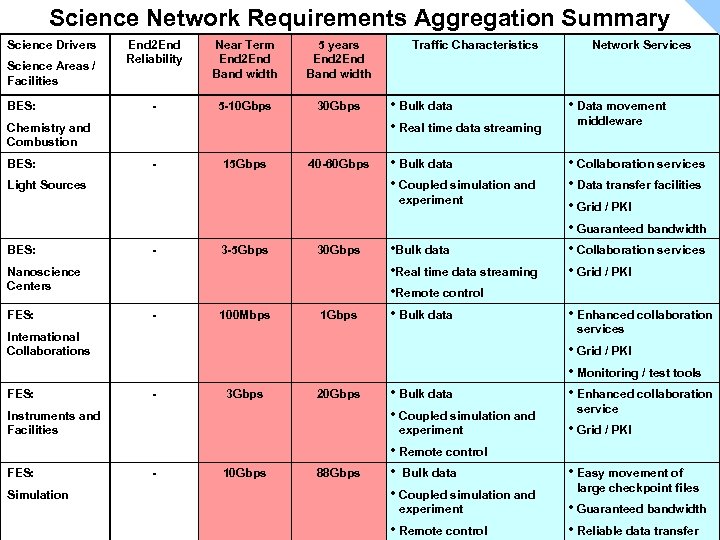 Science Network Requirements Aggregation Summary Science Drivers Science Areas / Facilities BES: End 2 End Reliability Near Term End 2 End Band width 5 years End 2 End Band width - 5 -10 Gbps 30 Gbps Chemistry and Combustion BES: - 15 Gbps 40 -60 Gbps Light Sources Traffic Characteristics • Bulk data • Real time data streaming • Data movement • Bulk data • Coupled simulation and • Collaboration services • Data transfer facilities • Grid / PKI • Guaranteed bandwidth • Collaboration services • Grid / PKI experiment BES: - 3 -5 Gbps 30 Gbps - 100 Mbps 1 Gbps Nanoscience Centers FES: • Bulk data • Real time data streaming • Remote control • Bulk data - 3 Gbps 20 Gbps Instruments and Facilities FES: Simulation middleware • Enhanced collaboration services International Collaborations FES: Network Services • Bulk data • Coupled simulation and experiment - 10 Gbps 88 Gbps • Remote control • Bulk data • Coupled simulation and experiment • Remote control • Grid / PKI • Monitoring / test tools • Enhanced collaboration service • Grid / PKI • Easy movement of large checkpoint files • Guaranteed bandwidth • Reliable data transfer
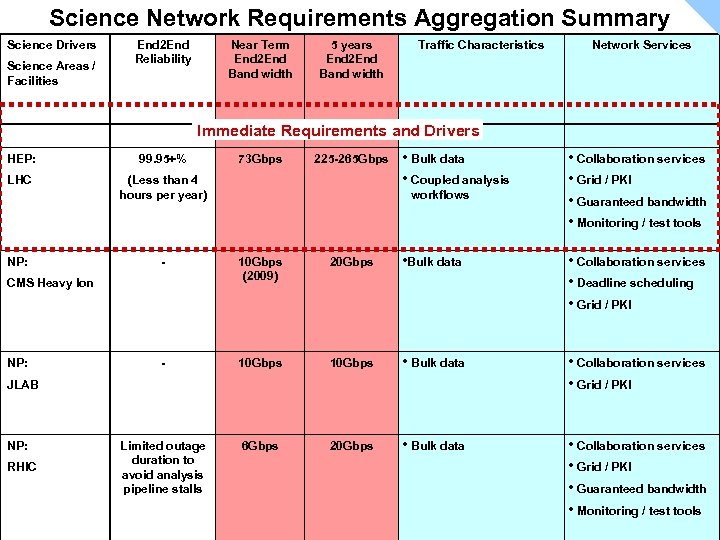 Science Network Requirements Aggregation Summary Science Drivers Science Areas / Facilities End 2 End Reliability Near Term End 2 End Band width 5 years End 2 End Band width Traffic Characteristics Network Services Immediate Requirements and Drivers HEP: 99. 95+% LHC (Less than 4 hours per year) NP: 225 -265 Gbps • Bulk data • Coupled analysis workflows 10 Gbps (2009) 20 Gbps • Bulk data • Collaboration services • Deadline scheduling • Grid / PKI - 10 Gbps • Bulk data • Collaboration services • Grid / PKI Limited outage duration to avoid analysis pipeline stalls 6 Gbps 20 Gbps • Bulk data • Collaboration services • Grid / PKI • Guaranteed bandwidth • Monitoring / test tools JLAB NP: RHIC • Collaboration services • Grid / PKI • Guaranteed bandwidth • Monitoring / test tools - CMS Heavy Ion NP: 73 Gbps
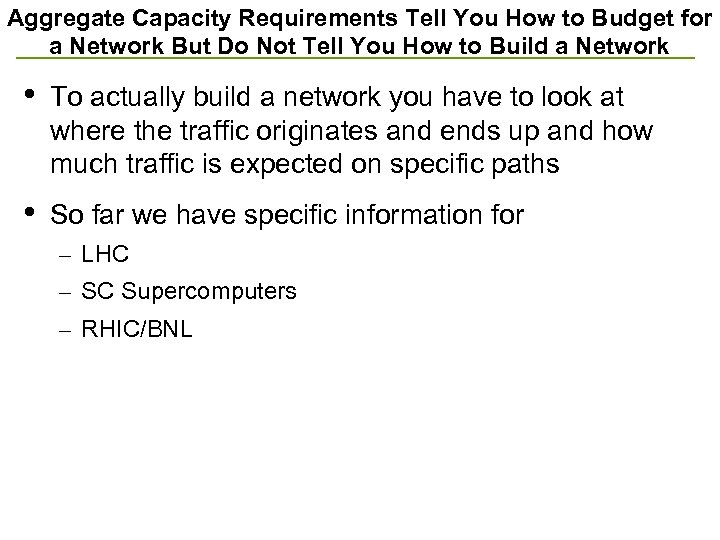 Aggregate Capacity Requirements Tell You How to Budget for a Network But Do Not Tell You How to Build a Network • To actually build a network you have to look at where the traffic originates and ends up and how much traffic is expected on specific paths • So far we have specific information for – LHC – SC Supercomputers – RHIC/BNL
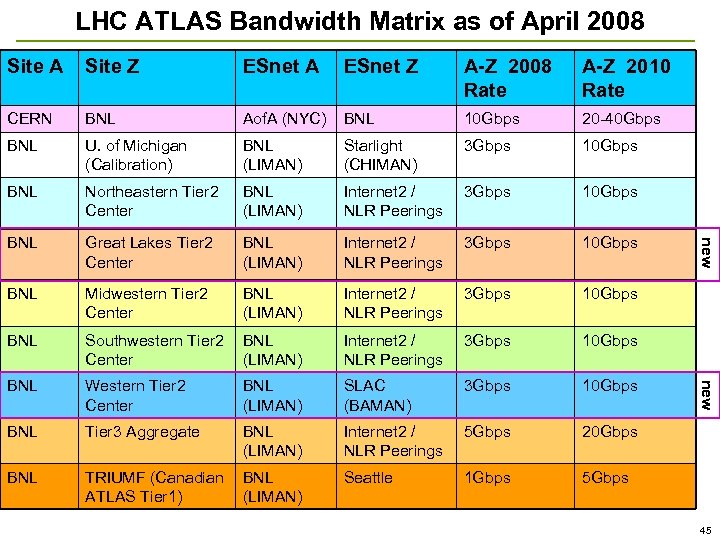 LHC ATLAS Bandwidth Matrix as of April 2008 ESnet A ESnet Z A-Z 2008 Rate A-Z 2010 Rate CERN BNL Aof. A (NYC) BNL 10 Gbps 20 -40 Gbps BNL U. of Michigan (Calibration) BNL (LIMAN) Starlight (CHIMAN) 3 Gbps 10 Gbps BNL Northeastern Tier 2 Center BNL (LIMAN) Internet 2 / NLR Peerings 3 Gbps 10 Gbps BNL Great Lakes Tier 2 Center BNL (LIMAN) Internet 2 / NLR Peerings 3 Gbps 10 Gbps BNL Midwestern Tier 2 Center BNL (LIMAN) Internet 2 / NLR Peerings 3 Gbps 10 Gbps BNL Southwestern Tier 2 BNL Center (LIMAN) Internet 2 / NLR Peerings 3 Gbps 10 Gbps BNL Western Tier 2 Center BNL (LIMAN) SLAC (BAMAN) 3 Gbps 10 Gbps BNL Tier 3 Aggregate BNL (LIMAN) Internet 2 / NLR Peerings 5 Gbps 20 Gbps BNL TRIUMF (Canadian BNL ATLAS Tier 1) (LIMAN) Seattle 1 Gbps 5 Gbps new Site Z new Site A 45
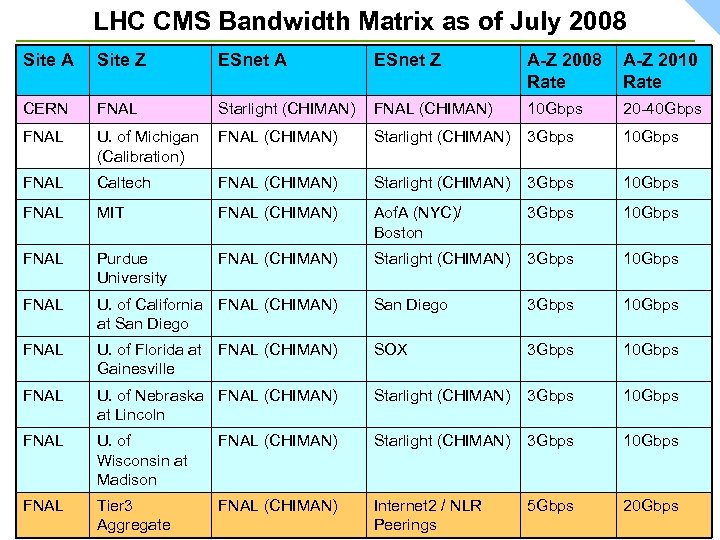 LHC CMS Bandwidth Matrix as of July 2008 Site A Site Z ESnet A ESnet Z A-Z 2008 Rate A-Z 2010 Rate CERN FNAL Starlight (CHIMAN) FNAL (CHIMAN) 10 Gbps 20 -40 Gbps FNAL U. of Michigan FNAL (CHIMAN) (Calibration) Starlight (CHIMAN) 3 Gbps 10 Gbps FNAL Caltech FNAL (CHIMAN) Starlight (CHIMAN) 3 Gbps 10 Gbps FNAL MIT FNAL (CHIMAN) Aof. A (NYC)/ Boston 3 Gbps 10 Gbps FNAL Purdue University FNAL (CHIMAN) Starlight (CHIMAN) 3 Gbps 10 Gbps FNAL U. of California FNAL (CHIMAN) at San Diego 3 Gbps 10 Gbps FNAL U. of Florida at FNAL (CHIMAN) Gainesville SOX 3 Gbps 10 Gbps FNAL U. of Nebraska FNAL (CHIMAN) at Lincoln Starlight (CHIMAN) 3 Gbps 10 Gbps FNAL U. of Wisconsin at Madison FNAL (CHIMAN) Starlight (CHIMAN) 3 Gbps 10 Gbps FNAL Tier 3 Aggregate FNAL (CHIMAN) Internet 2 / NLR Peerings 5 Gbps 20 Gbps 46
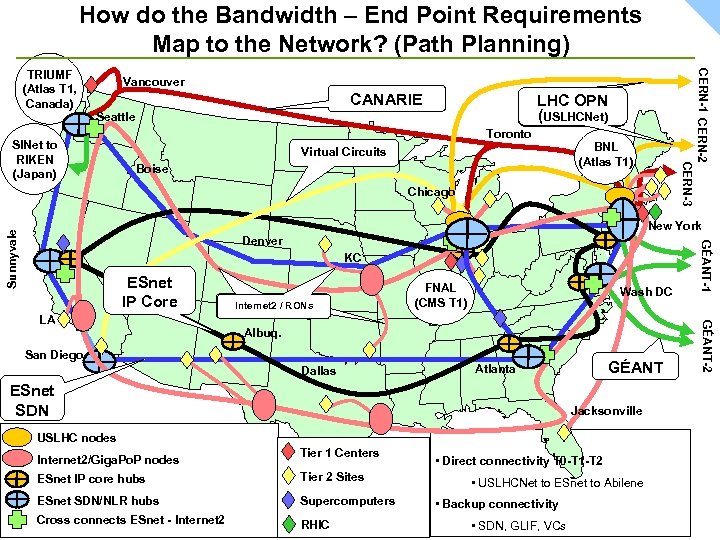 How do the Bandwidth – End Point Requirements Map to the Network? (Path Planning) CERN-1 CERN-2 CERN-3 TRIUMF (Atlas T 1, Canada) Vancouver CANARIE LHC OPN (USLHCNet) Seattle SINet to RIKEN (Japan) Toronto BNL (Atlas T 1) Virtual Circuits Boise Chicago Denver KC ESnet IP Core Internet 2 // RONs Internet 2 RONs Wash DC Albuq. San Diego Dallas GÉANT Atlanta ESnet SDN Jacksonville USLHC nodes Internet 2/Giga. Po. P nodes Tier 1 Centers ESnet IP core hubs Tier 2 Sites ESnet SDN/NLR hubs Supercomputers Cross connects ESnet - Internet 2 RHIC • Direct connectivity T 0 -T 1 -T 2 • USLHCNet to ESnet to Abilene • Backup connectivity • SDN, GLIF, VCs GÉANT-2 LA FNAL (CMS T 1) GÉANT-1 Sunnyvale New York
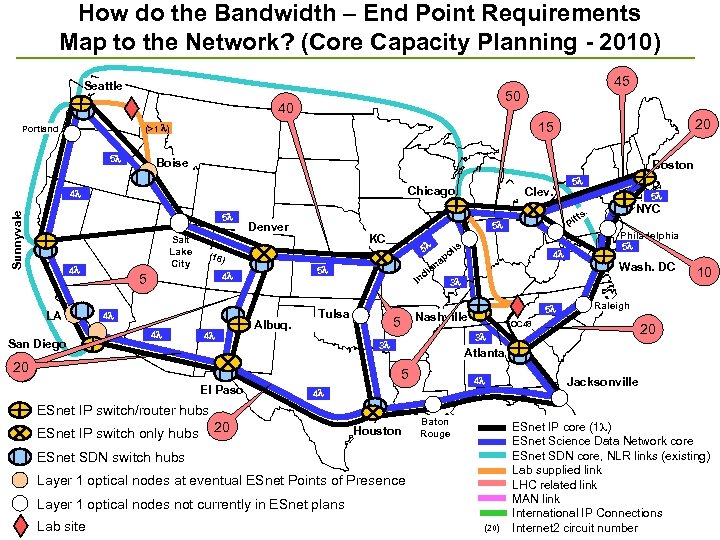 How do the Bandwidth – End Point Requirements Map to the Network? (Core Capacity Planning - 2010) Seattle 50 40 5 Boise Boston Chicago 4 5 Salt Lake City 4 LA San Diego 5 4 4 KC 5 (16 ) 4 Albuq. d In Tulsa po 4 3 5 Wash. DC 10 Raleigh OC 48 20 Atlanta 4 4 20 Philadelphia 5 3 ESnet IP switch/router hubs ESnet IP switch only hubs NYC . 3 5 El Paso 5 tts lis Nashville 5 5 Pi na ia 5 4 Clev. 5 Denver 20 Houston Baton Rouge ESnet SDN switch hubs Layer 1 optical nodes at eventual ESnet Points of Presence Layer 1 optical nodes not currently in ESnet plans Lab site 20 15 (>1 ) Portland Sunnyvale 45 (20) Jacksonville ESnet IP core (1 ) ESnet Science Data Network core ESnet SDN core, NLR links (existing) Lab supplied link LHC related link MAN link International IP Connections Internet 2 circuit number
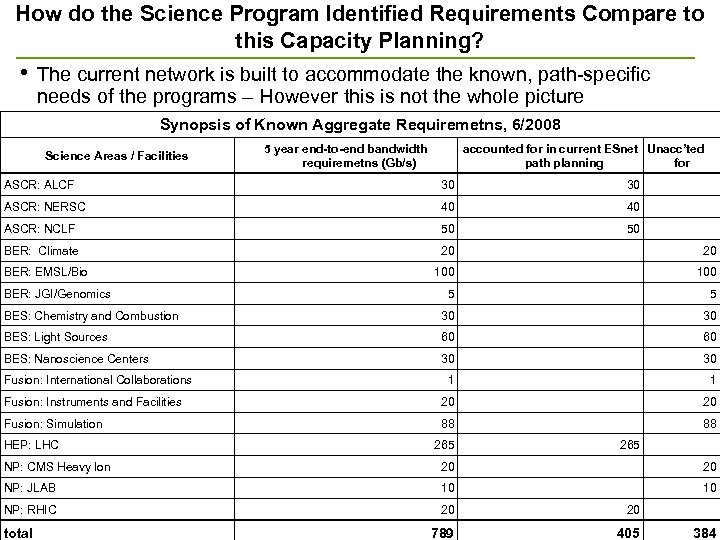 How do the Science Program Identified Requirements Compare to this Capacity Planning? • The current network is built to accommodate the known, path-specific needs of the programs – However this is not the whole picture Synopsis of Known Aggregate Requiremetns, 6/2008 Science Areas / Facilities 5 year end-to-end bandwidth requiremetns (Gb/s) accounted for in current ESnet Unacc’ted path planning for ASCR: ALCF 30 30 ASCR: NERSC 40 40 ASCR: NCLF 50 50 BER: Climate 20 20 100 5 5 BES: Chemistry and Combustion 30 30 BES: Light Sources 60 60 BES: Nanoscience Centers 30 30 1 1 Fusion: Instruments and Facilities 20 20 Fusion: Simulation 88 88 265 NP: CMS Heavy Ion 20 20 NP: JLAB 10 10 NP: RHIC 20 20 789 405 384 BER: EMSL/Bio BER: JGI/Genomics Fusion: International Collaborations HEP: LHC total
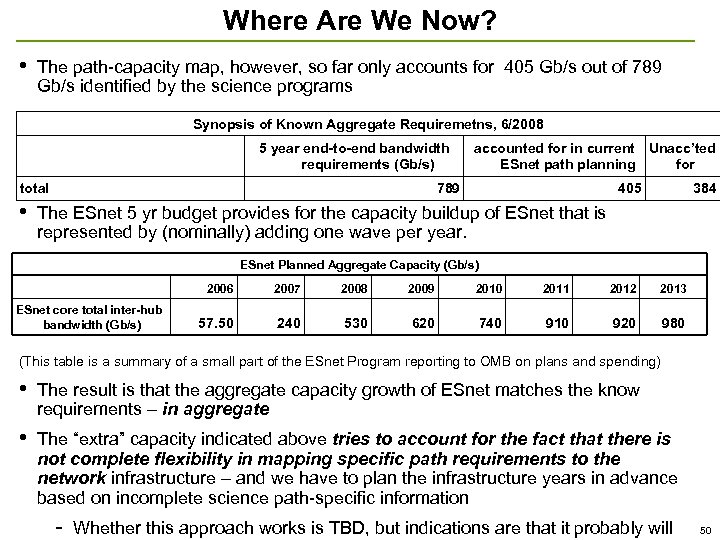 Where Are We Now? • The path-capacity map, however, so far only accounts for 405 Gb/s out of 789 Gb/s identified by the science programs Synopsis of Known Aggregate Requiremetns, 6/2008 5 year end-to-end bandwidth requirements (Gb/s) total • accounted for in current Unacc’ted ESnet path planning for 789 405 384 The ESnet 5 yr budget provides for the capacity buildup of ESnet that is represented by (nominally) adding one wave per year. ESnet Planned Aggregate Capacity (Gb/s) 2006 ESnet core total inter-hub bandwidth (Gb/s) 2007 2008 2009 2010 2011 2012 2013 57. 50 240 530 620 740 910 920 980 (This table is a summary of a small part of the ESnet Program reporting to OMB on plans and spending) • The result is that the aggregate capacity growth of ESnet matches the know requirements – in aggregate • The “extra” capacity indicated above tries to account for the fact that there is not complete flexibility in mapping specific path requirements to the network infrastructure – and we have to plan the infrastructure years in advance based on incomplete science path-specific information - Whether this approach works is TBD, but indications are that it probably will 50
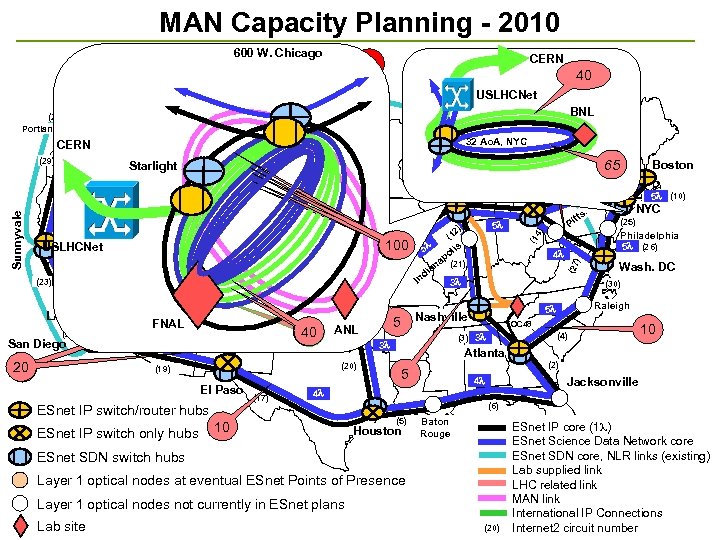 MAN Capacity Planning - 2010 600 W. Chicago CERN 25 40 Seattle BNL 15 (>1 ) ) (8 (28) Portland 32 Ao. A, NYC CERN Boise Starlight 65 Chicago Salt Lake City USLHCNet 4 LA 4 (24) San Diego 20 Denver FNAL 5 4 (22) (0) Tulsa Albuq. 40 ANL (20) El Paso ESnet IP switch/router hubs 5 (1 (17) 5 2) lis 4 Wash. DC OC 48 (4) (3) 3 10 Atlanta (2) 5 4 Jacksonville (6) (5) Houston Baton Rouge ESnet SDN switch hubs Layer 1 optical nodes at eventual ESnet Points of Presence Layer 1 optical nodes not currently in ESnet plans Lab site Philadelphia 5 (26) Raleigh 5 4 10 NYC (25) (30) Nashville 5 . tts Pi po na (21) a di In 3 3 (1) (19) ESnet IP switch only hubs 100 80 80 (16 ) 4 4 KC (15) 5 (23) (13) 5 (10) (27 ) 5 (32) (11) Boston (9) 5 Clev. 4) (7) 4 (1 5 (29) Sunnyvale 20 USLHCNet 25 (20) ESnet IP core (1 ) ESnet Science Data Network core ESnet SDN core, NLR links (existing) Lab supplied link LHC related link MAN link International IP Connections Internet 2 circuit number 51
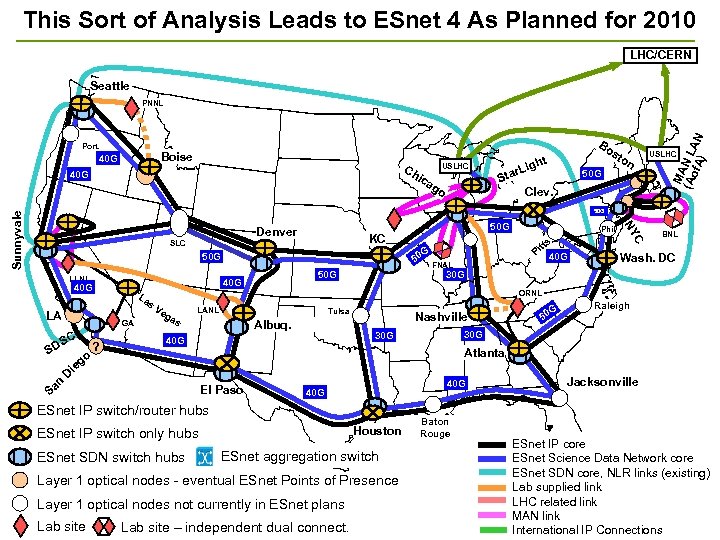 This Sort of Analysis Leads to ESnet 4 As Planned for 2010 LHC/CERN Seattle Port. Boise 40 G Ch 40 G USLHC ica go Bo st t h r. Lig Sta 50 G on Clev. MA (Ao N L f. A) AN PNNL USLHC Denver SLC G 50 50 G LLNL LA SD n Sa La s GA SC o ? 50 G 40 G 50 G s. KC 40 G Wash. DC Phil tt Pi FNAL BNL 30 G ORNL Ve ga s LANL Tulsa Albuq. Nashville G 50 Raleigh 30 G 40 G Atlanta g ie D El Paso 40 G ESnet IP switch/router hubs Houston ESnet IP switch only hubs ESnet SDN switch hubs ESnet aggregation switch Layer 1 optical nodes - eventual ESnet Points of Presence Layer 1 optical nodes not currently in ESnet plans Lab site C NY Sunnyvale 50 G Lab site – independent dual connect. Baton Rouge Jacksonville ESnet IP core ESnet Science Data Network core ESnet SDN core, NLR links (existing) Lab supplied link LHC related link MAN link 52 International IP Connections
 ØIs ESnet Planned Capacity Adequate for LHC? (Maybe so, Maybe not) • Several Tier 2 centers (especially CMS) are capable of 10 Gbps now – Many Tier 2 sites are building their local infrastructure to handle 10 Gbps – This means the 3 Gbps estimates in the table are probably low – We won’t know for sure what the “real” load will look like until the testing stops and the production analysis begins Ø Scientific productivity will follow high-bandwidth access to large data volumes incentive for others to upgrade • Many Tier 3 sites are also building 10 Gbps-capable analysis infrastructures – Most Tier 3 sites do not yet have 10 Gbps of network capacity – It is likely that this will cause a “second onslaught” in 2009 as the Tier 3 sites all upgrade their network capacity to handle 10 Gbps of LHC traffic Ø It is possible that the USA installed base of LHC analysis hardware will consume significantly more network bandwidth than was originally estimated • N. B. Harvey Newman predicted this eventuality years ago 53
 ØObservations on Reliability • Reliability – the customers who talk about reliability are typically the ones building automated wide area workflow systems (LHC and RHIC). – “Transfer a data set” paradigm isn’t as concerned with reliability, other than the annoyance/inconvenience of outages and their effect on a given transfer operation Ø However, prolonged outages can cause cascade failure in automated workflow systems (outage analysis pipeline stall data loss) since the instruments don’t stop and the computing capacity is sized to analyze the data as it arrives – Many of our constituents are talking about moving to this model (e. g. Climate and Fusion) – this will increase demand for high reliability – ESnet’s current strategy (ESnet 4) has significantly improved reliability, and continues to do so – both theory and empirical data support this assertion 54
 IIa. Re-evaluating the Strategy • The current strategy (that lead to the ESnet 4, 2012 plans) was developed primarily as a result of the information gathered in the 2003 and 2003 networkshops, and their updates in 2005 -6 (including LHC, climate, RHIC, SNS, Fusion, the supercomputers, and a few others) [workshops] • So far the more formal requirements workshops have largely reaffirmed the ESnet 4 strategy developed earlier • However – is the whole story? 55
 “Philosophical” Issues for the Future Network • One can qualitatively divide the networking issues into what I will call “old era” and “new era” • In the old era (to about mid-2005) data from scientific instruments did grow exponentially, but the actual used bandwidths involved did not really tax network technology • In the old era there were few, if any, dominate traffic flows – all the traffic could be treated together as a “well behaved” aggregate. 56
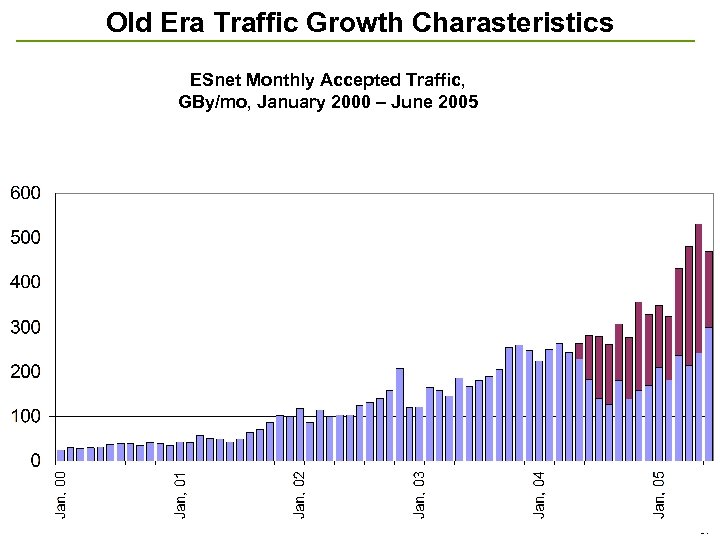 Old Era Traffic Growth Charasteristics ESnet Monthly Accepted Traffic, GBy/mo, January 2000 – June 2005 57
 In New Era Large-Scale Science Traffic Dominates ESnet • Large-scale science – LHC, RHIC, climate, etc. now generate a few thousand flows/month that account for about 90% of all ESnet traffic • When a few large data sources/sinks dominate traffic then overall network usage follows the patterns of the very large users • Managing this to provide good service to large users and not disrupt a lot of small users requires the ability to isolate these flows to a part of the network designed for them (“traffic engineering”) 58
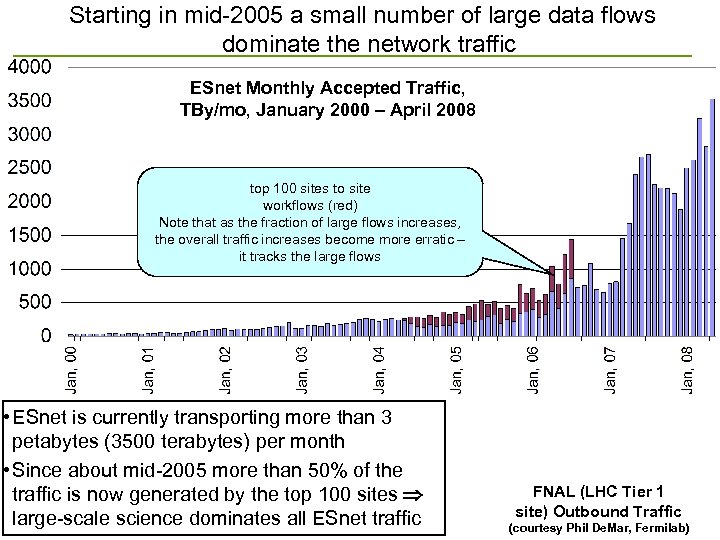 Starting in mid-2005 a small number of large data flows dominate the network traffic ESnet Monthly Accepted Traffic, TBy/mo, January 2000 – April 2008 top 100 sites to site workflows (red) Note that as the fraction of large flows increases, the overall traffic increases become more erratic – it tracks the large flows • ESnet is currently transporting more than 3 petabytes (3500 terabytes) per month • Since about mid-2005 more than 50% of the traffic is now generated by the top 100 sites large-scale science dominates all ESnet traffic FNAL (LHC Tier 1 site) Outbound Traffic (courtesy Phil De. Mar, Fermilab) 59
 Issues for the Future Network– “New Era” Data • Individual Labs now fill 10 G links – Fermilab (an LHC Tier 1 Data Center) has 5 X 10 Gb/s links to ESnet hubs in Chicago and can easily fill one or more of them for sustained periods of time – BNL has plans to host the entire LHC ATLAS dataset (up from 30%) and expects 20 Gb/s sustained traffic 60
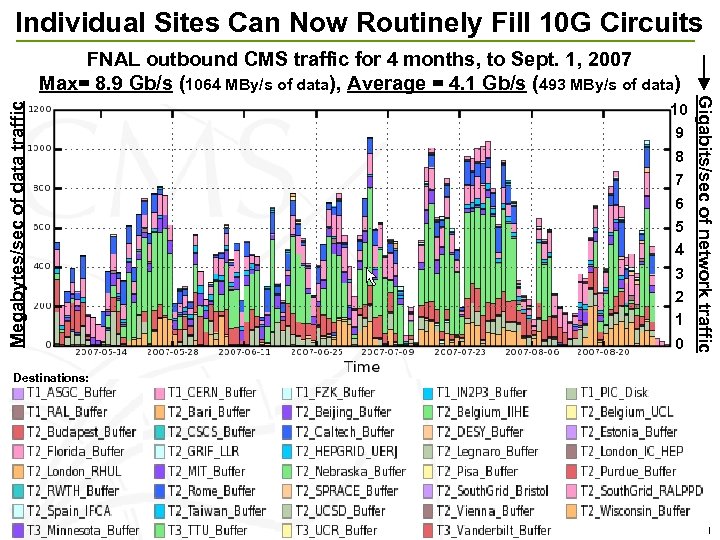 Individual Sites Can Now Routinely Fill 10 G Circuits 10 9 8 7 6 5 4 3 2 1 0 Gigabits/sec of network traffic Megabytes/sec of data traffic FNAL outbound CMS traffic for 4 months, to Sept. 1, 2007 Max= 8. 9 Gb/s (1064 MBy/s of data), Average = 4. 1 Gb/s (493 MBy/s of data) Destinations: 61
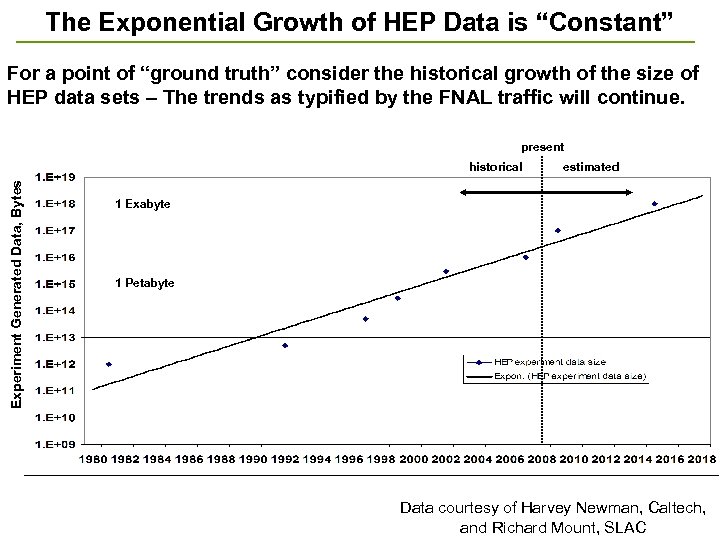 The Exponential Growth of HEP Data is “Constant” For a point of “ground truth” consider the historical growth of the size of HEP data sets – The trends as typified by the FNAL traffic will continue. present Experiment Generated Data, Bytes historical estimated 1 Exabyte 1 Petabyte Data courtesy of Harvey Newman, Caltech, and Richard Mount, SLAC
 Issues for the Future Network • Consider network traffic patterns – More “ground truth” – What do the trends in network patterns predict for future network needs? 63
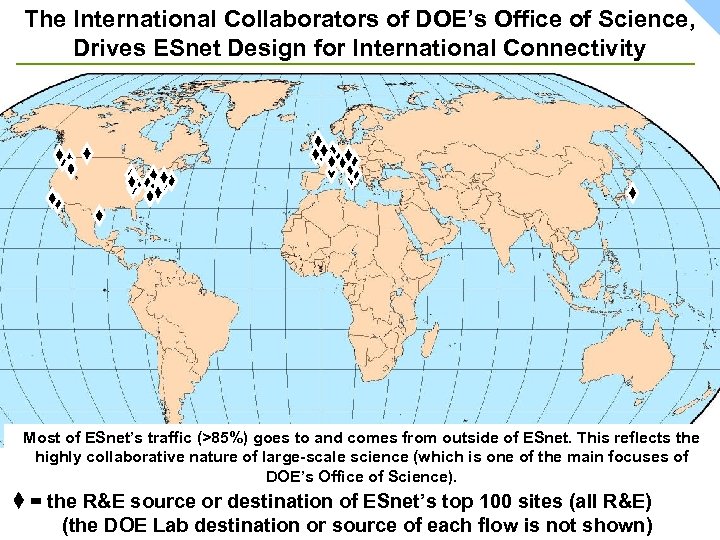 The International Collaborators of DOE’s Office of Science, Drives ESnet Design for International Connectivity Most of ESnet’s traffic (>85%) goes to and comes from outside of ESnet. This reflects the highly collaborative nature of large-scale science (which is one of the main focuses of DOE’s Office of Science). = the R&E source or destination of ESnet’s top 100 sites (all R&E) (the DOE Lab destination or source of each flow is not shown)
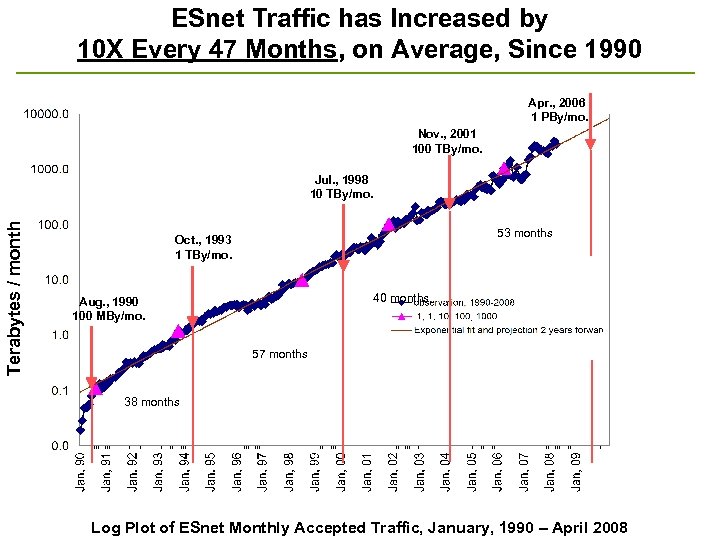 ESnet Traffic has Increased by 10 X Every 47 Months, on Average, Since 1990 Apr. , 2006 1 PBy/mo. Nov. , 2001 100 TBy/mo. Terabytes / month Jul. , 1998 10 TBy/mo. 53 months Oct. , 1993 1 TBy/mo. 40 months Aug. , 1990 100 MBy/mo. 57 months 38 months Log Plot of ESnet Monthly Accepted Traffic, January, 1990 – April 2008
 Requirements from Network Utilization Observation • Every 4 years, we can expect a 10 x increase in traffic over current levels just based on historical trends – Nominal average load on busiest backbone paths in June 2006 was ~1. 5 Gb/s – In 2010 average load will be ~15 Gbps based on current trends and 150 Gb/s in 2014 • Measurements of this type are science-agnostic – It doesn’t matter who the users are, the traffic load is increasing exponentially 66
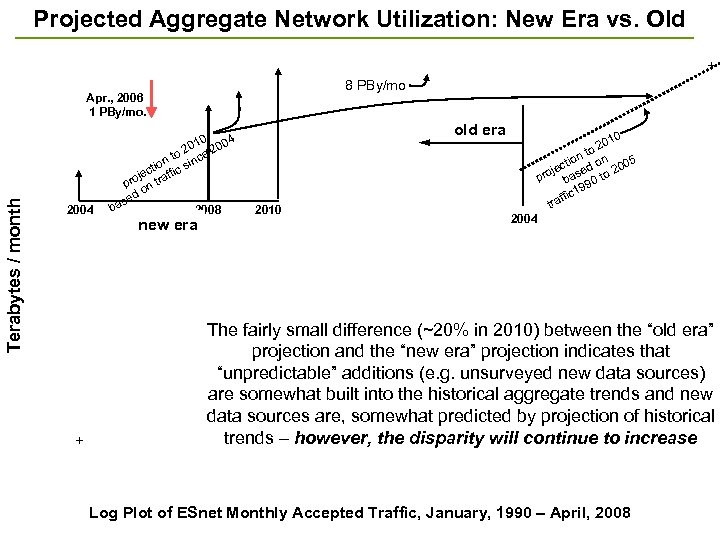 Projected Aggregate Network Utilization: New Era vs. Old + 8 PBy/mo Terabytes / month Apr. , 2006 1 PBy/mo. 2004 + 10 04 20 e 20 o n t nc tio fic si ec roj traf p n d o se ba 2008 new era old era 2010 0 01 o 2 n t ctio ed on 2005 je pro bas 0 to 9 19 ffic tra 2004 The fairly small difference (~20% in 2010) between the “old era” projection and the “new era” projection indicates that “unpredictable” additions (e. g. unsurveyed new data sources) are somewhat built into the historical aggregate trends and new data sources are, somewhat predicted by projection of historical trends – however, the disparity will continue to increase Log Plot of ESnet Monthly Accepted Traffic, January, 1990 – April, 2008
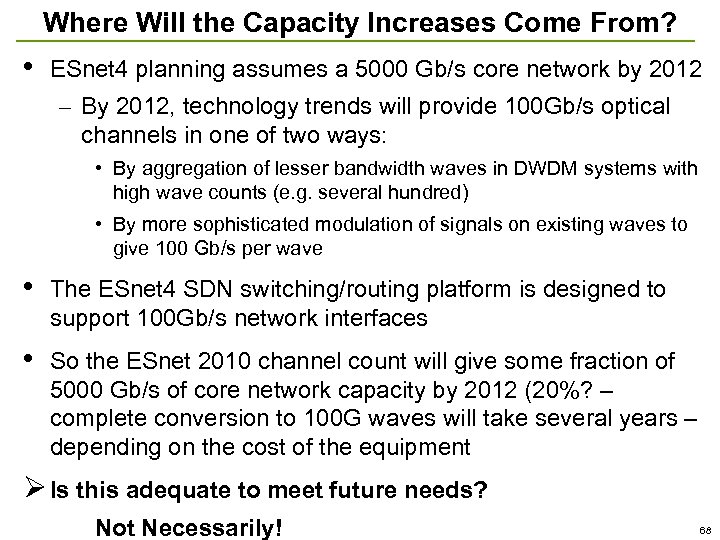 Where Will the Capacity Increases Come From? • ESnet 4 planning assumes a 5000 Gb/s core network by 2012 – By 2012, technology trends will provide 100 Gb/s optical channels in one of two ways: • By aggregation of lesser bandwidth waves in DWDM systems with high wave counts (e. g. several hundred) • By more sophisticated modulation of signals on existing waves to give 100 Gb/s per wave • The ESnet 4 SDN switching/routing platform is designed to support 100 Gb/s network interfaces • So the ESnet 2010 channel count will give some fraction of 5000 Gb/s of core network capacity by 2012 (20%? – complete conversion to 100 G waves will take several years – depending on the cost of the equipment Ø Is this adequate to meet future needs? Not Necessarily! 68
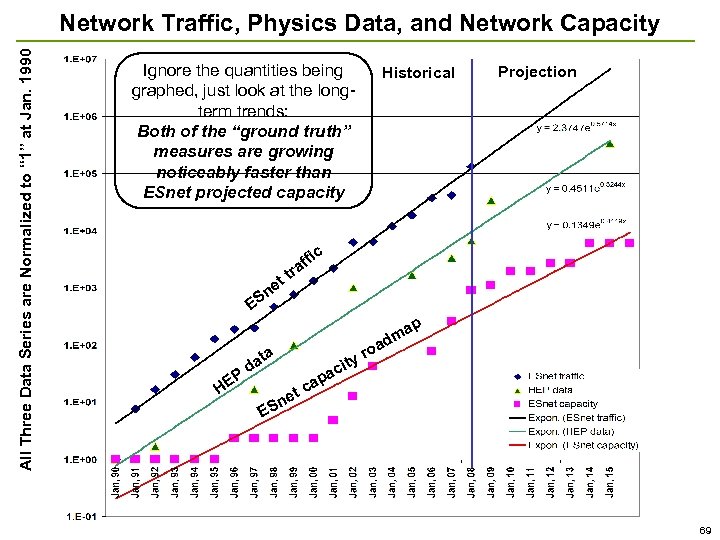 All Three Data Series are Normalized to “ 1” at Jan. 1990 Network Traffic, Physics Data, and Network Capacity Ignore the quantities being graphed, just look at the longterm trends: Both of the “ground truth” measures are growing noticeably faster than ESnet projected capacity Historical Projection c t ne S fi af tr E p P HE a dm a at d roa y cit a t e Sn p ca E 69
 Re: Both of the “ground truth” measures are growing noticeably faster than ESnet projected capacity • The lines are different units - one is rate, one is traffic volume, and one is capacity. These are all normalized to "1" at January 1990 • The only thing of interest here is the rate of growth. Since these are log plots, the significantly higher exponential growth of traffic (total accepted bytes) vs. total capacity (aggregate core bandwidth) means traffic will eventually overwhelm the capacity – “when” cannot be directly deduced from aggregate observations, but if you add this fact • Nominal average load on busiest backbone paths in June 2006 was ~1. 5 Gb/s - In 2010 average load will be ~15 Gbps based on current trends and 150 Gb/s in 2014
 Issues for the Future Network– “New Era” Data • Just looking at the trends in current traffic growth, HEP data growth, and current (through 2010) ESnet capacity projection …. – The “new era” of science data (2010 and beyond) is likely to tax network technology – The “casual” increases in overall network capacity straightforward commercial channel capacity are less likely to easily meet future needs 71
 Aside on Requirements Analysis and Network Planning -1 • It seems clear that the ESnet historical trends have built into them some the “unpredictables, ” that is, projections from historical traffic data appear to represent some of the required total capacity, without reference to data projections from experiment and instrument usage analysis • Does this apparent ability of the projected traffic trends to predict future network capacity requirements mean that we can plan based on aggregate traffic growth projections and dispense with detailed requirements gathering? 72
 Aside on Requirements Analysis and Network Planning -2 • Of course not: 1. The traffic trends provide a very high-level view of the required capacity. Knowing the required aggregate capacity requirement does not tell you how the network must be build in order to be useful. Detailed requirements analysis, such as shown for the LHC, above, tells how the network must be built. 2. Strong coupling of the network requirements planning to the Science Program Offices and science community is absolutely essential for generating the shared sense of urgency that results in the funding required to build the network with the required capacity 73
 Where Do We Go From Here? • The current estimates from the LHC experiments and the supercomputer centers have the currently planned ESnet 2011 configuration operating at capacity and there are several other major instruments that will be generating significant data in that time frame • The significantly higher exponential growth of traffic (total accepted bytes) vs. total capacity (aggregate core bandwidth) means traffic will eventually overwhelm the capacity – “when” cannot be directly deduced from aggregate observations, but if you add this fact • Nominal average load on busiest backbone paths in June 2006 was ~1. 5 Gb/s - In 2010 average load will be ~15 Gbps based on current trends and 150 Gb/s in 2014 My (wej) guess is that problems will start to occur by 2015 -16 unless new technology approaches are found 74
 New Technology Issues • It seems clear that we will have to have both more capacity and the ability to more flexibly map traffic to waves (traffic engineering) in order to make optimum use of the available capacity 75
 So, What Now? • The Internet 2 -ESnet partnership optical network is build on dedicated fiber and optical equipment – The current configuration is configured with 10 10 G waves / fiber path and more waves will be added in groups of 10 • The current wave transport topology is essentially static or only manually configured - our current network infrastructure of routers and switches assumes this Ø We must change this situation and integrate the optical transport with the “network” and provide for dynamism / route flexibility at the optical level • With completely flexible traffic management extending down to the optical transport level we should be able to extend the life of the current infrastructure by moving significant parts of the capacity to the specific routes where it is needed 76
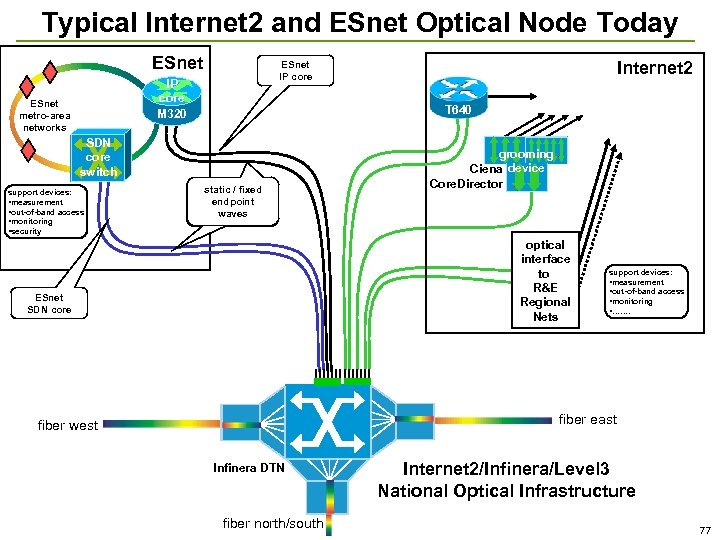 Typical Internet 2 and ESnet Optical Node Today ESnet IP core M 320 ESnet metro-area networks T 640 SDN core switch support devices: • measurement • out-of-band access • monitoring • security Internet 2 ESnet IP core static / fixed endpoint waves grooming Ciena device Core. Director optical interface to R&E Regional Nets ESnet SDN core support devices: • measurement • out-of-band access • monitoring • ……. fiber east fiber west Infinera DTN fiber north/south Internet 2/Infinera/Level 3 National Optical Infrastructure 77
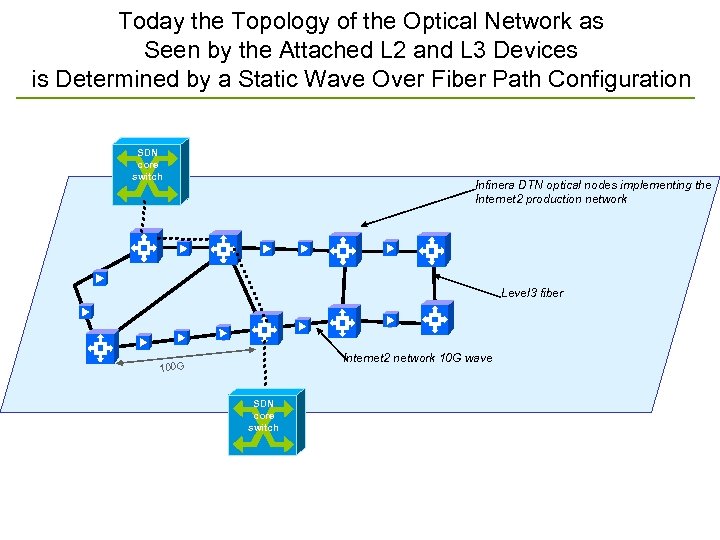 Today the Topology of the Optical Network as Seen by the Attached L 2 and L 3 Devices is Determined by a Static Wave Over Fiber Path Configuration SDN core switch Infinera DTN optical nodes implementing the Internet 2 production network Level 3 fiber Internet 2 network 10 G wave 100 G SDN core switch
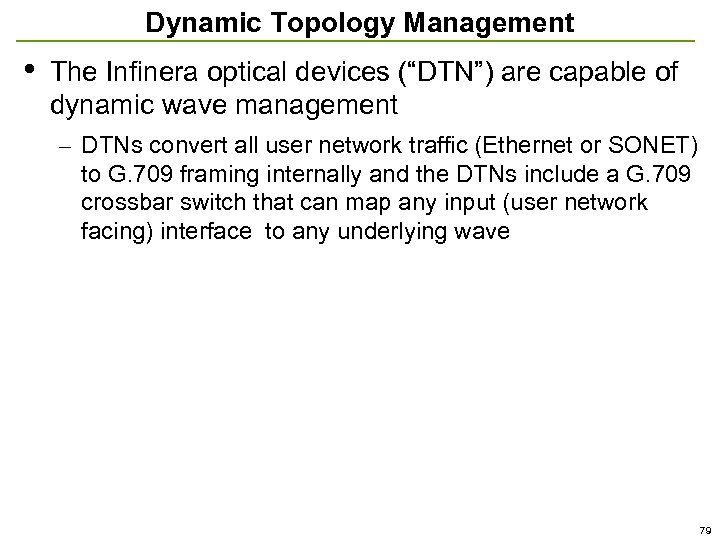 Dynamic Topology Management • The Infinera optical devices (“DTN”) are capable of dynamic wave management – DTNs convert all user network traffic (Ethernet or SONET) to G. 709 framing internally and the DTNs include a G. 709 crossbar switch that can map any input (user network facing) interface to any underlying wave 79
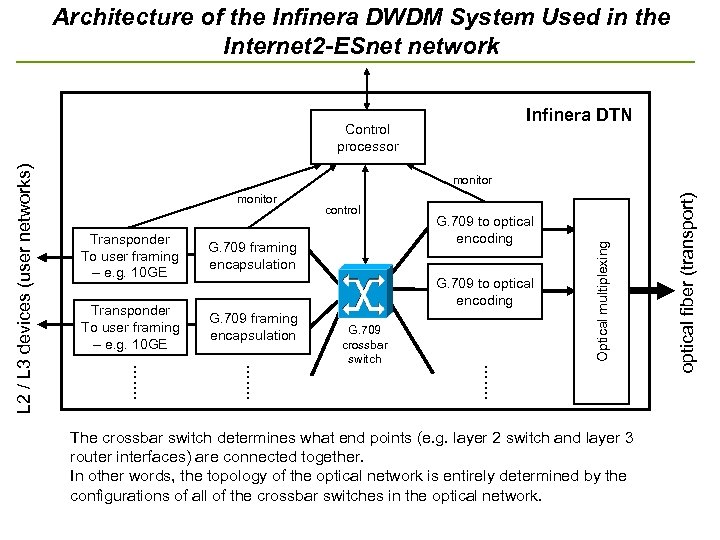 Architecture of the Infinera DWDM System Used in the Internet 2 -ESnet network Infinera DTN Transponder To user framing – e. g. 10 GE G. 709 framing encapsulation control G. 709 to optical encoding ……. G. 709 crossbar switch The crossbar switch determines what end points (e. g. layer 2 switch and layer 3 router interfaces) are connected together. In other words, the topology of the optical network is entirely determined by the configurations of all of the crossbar switches in the optical network. optical fiber (transport) monitor Optical multiplexing monitor ……. L 2 / L 3 devices (user networks) Control processor
 Dynamically Routed Optical Circuits for Traffic Engineering • By adding a layer 1 (optical) control plane that is managed by Internet 2 and ESnet, and that is integrated with the L 2/3 control plane, the underlying topology of the optical network can be changed as needed for traffic engineering (management) • An L 1 control plane approach is in the planning phase and a testbed to do development and testing is needed – It is possible to build such a testbed as an isolated overlay on the production optical network and such a testbed has been proposed • The control plane manager approach currently being considered is based on an extended version of the OSCARS [OSCARS] dynamic circuit manager – but a good deal of R&D is needed for the integrated L 1/2/3 dynamic route management R&D 81
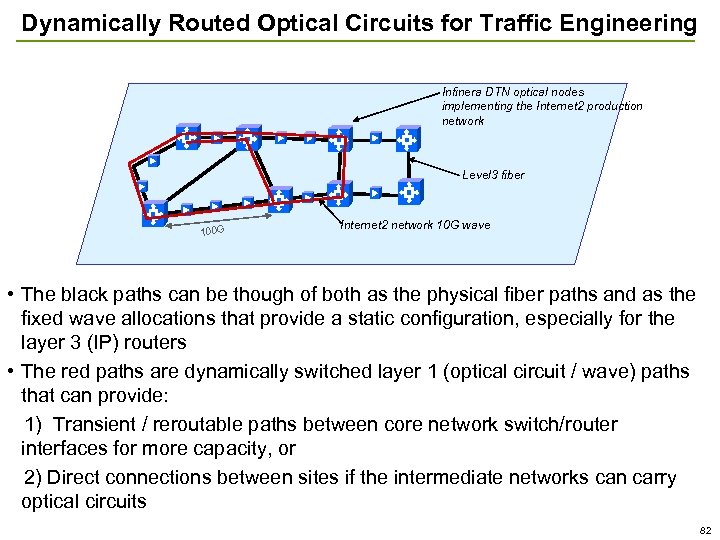 Dynamically Routed Optical Circuits for Traffic Engineering Infinera DTN optical nodes implementing the Internet 2 production network Level 3 fiber 100 G Internet 2 network 10 G wave • The black paths can be though of both as the physical fiber paths and as the fixed wave allocations that provide a static configuration, especially for the layer 3 (IP) routers • The red paths are dynamically switched layer 1 (optical circuit / wave) paths that can provide: 1) Transient / reroutable paths between core network switch/router interfaces for more capacity, or 2) Direct connections between sites if the intermediate networks can carry optical circuits 82
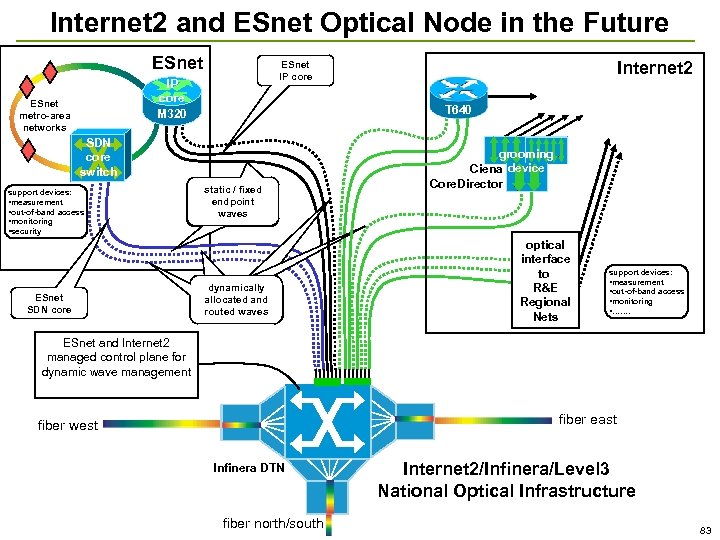 Internet 2 and ESnet Optical Node in the Future ESnet IP core M 320 ESnet metro-area networks T 640 SDN core switch support devices: • measurement • out-of-band access • monitoring • security ESnet SDN core Internet 2 ESnet IP core static / fixed endpoint waves dynamically allocated and routed waves grooming Ciena device Core. Director optical interface to R&E Regional Nets support devices: • measurement • out-of-band access • monitoring • ……. ESnet and Internet 2 managed control plane for dynamic wave management fiber east fiber west Infinera DTN fiber north/south Internet 2/Infinera/Level 3 National Optical Infrastructure 83
 New Capability Requirements for Services • The new service-oriented capabilities of the network, principally related to bandwidth reservation and endto-end monitoring are also very important and have been discussed elsewhere – see, e. g. : • “Network Communication as a Service-Oriented Capability” and • “Intra and Interdomain Circuit Provisioning Using the OSCARS Reservation System. ” • Both are available at http: //www. es. net/pub/esnetdoc/index. html 84
 Federated Trust Services IIIa. • Remote, multi-institutional, identity authentication is critical for distributed, collaborative science in order to permit sharing widely distributed computing and data resources, and other Grid services • Public Key Infrastructure (PKI) is used to formalize the existing web of trust within science collaborations and to extend that trust into cyber space – The function, form, and policy of the ESnet trust services are driven entirely by the requirements of the science community and by direct input from the science community – International scope trust agreements that encompass many organizations are crucial for large-scale collaborations • The service (and community) has matured to the point where it is revisiting old practices and updating and formalizing them 85
 ESnet Grid CA and Federation Strategy • ESnet operates the DOEGrids CA , which provides X. 509 certificates to DOE SC funded (and related collaborators) projects; and actively supports IGTF, world-wide Grid CA federation • Future technology strategies that are on the current ESnet roadmap – Make DOEGrids CA more robust • Multi-site cloned CA server and HSM (key management hardware) – Secure, disaster-resilient non-stop CA service (funded; in development) – Extend ESnet CA infrastructure to support Shibboleth-> X. 509 certificates (Federated Identity CA) • Existing standards and ESnet hardware/software platform will provide X. 509 certificates for DOE SC and related project members (limited funding) • Partnering with LBNL, NERSC, ANL to develop interoperability and policy 86
 • ESnet Grid CA and Federation Strategy Federation – ESnet has joined In. Common (as a service provider or SP) • In. Common is the US-wide academic Shibboleth federation • Enables ESnet to provide services, like CA gateways, using In. Common trust relationship, to sites recognizing In. Common • Studying integration with UCTrust and other regional federations • Usefulness TBD (see below) – Improving standards in IGTF • Grid Trust federation for CAs will recognize CAs providing gateways to Shibboleth federations – Open. ID and Shibboleth service development • Open. ID is a simple, web-based digital identity protocol from industry • Open. ID consumer (clients) and Openid Provider (OP) for DOEGrids under study • “Retrofit” of Shibboleth and Open. ID into existing ESnet services (non -CA) 87
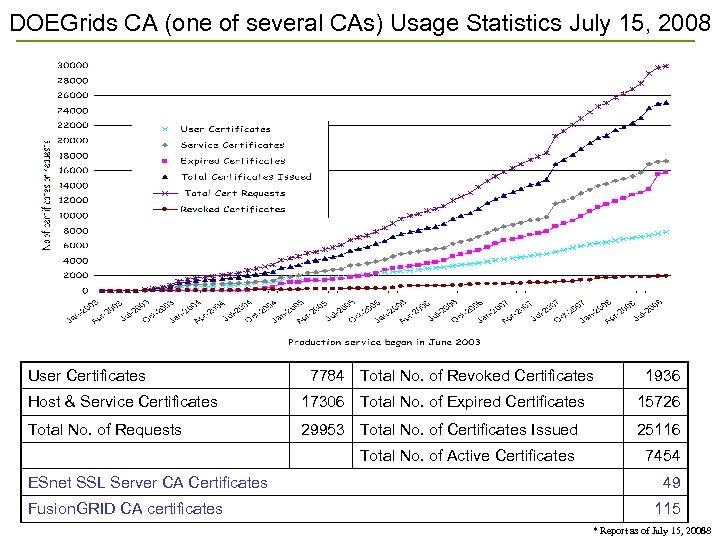 DOEGrids CA (one of several CAs) Usage Statistics July 15, 2008 User Certificates 7784 Total No. of Revoked Certificates 1936 Host & Service Certificates 17306 Total No. of Expired Certificates 15726 Total No. of Requests 29953 Total No. of Certificates Issued 25116 Total No. of Active Certificates 7454 ESnet SSL Server CA Certificates Fusion. GRID CA certificates 49 115 * Report as of July 15, 2008 88
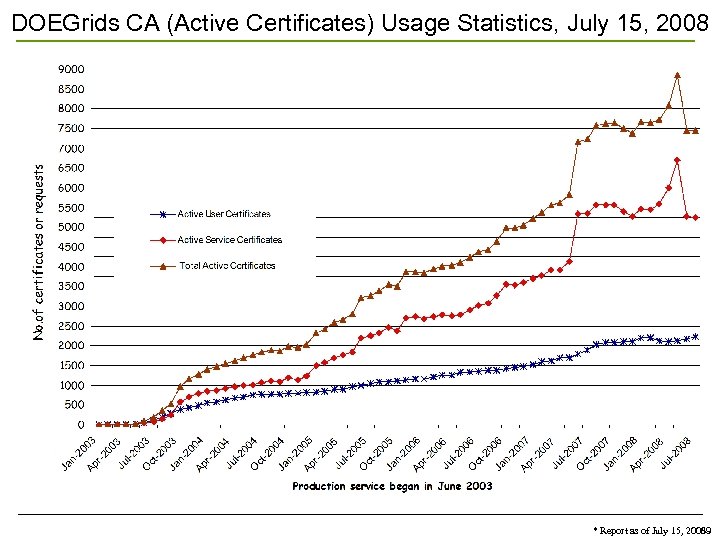 DOEGrids CA (Active Certificates) Usage Statistics, July 15, 2008 * Report as of July 15, 2008 89
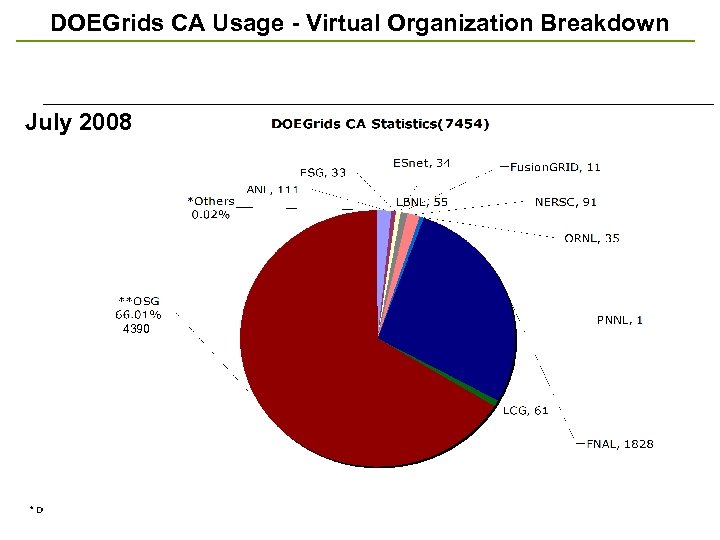 DOEGrids CA Usage - Virtual Organization Breakdown July 2008 4390 * DOE-NSF collab. & Auto renewals ** OSG Includes (BNL, CDF, CIGI, CMS, Comp. Bio. Grid, DES, DOSAR, DZero, Engage, Fermilab, f. MRI, GADU, geant 4, GLOW, GPN, GRASE, Grid. Ex, GUGrid, i 2 u 2, ILC, JLAB, LIGO, mariachi, MIS, nano. HUB, NWICG, NYSGrid, OSGEDU, SBGrid, SDSS, SLAC, STAR & USATLAS) 90
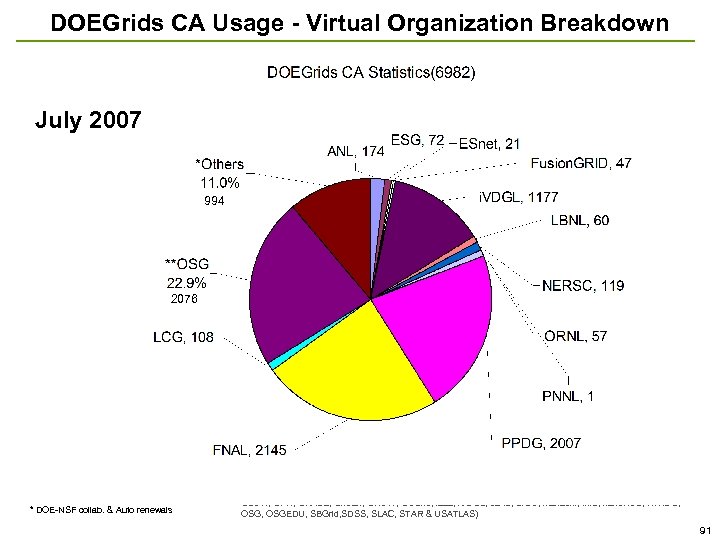 DOEGrids CA Usage - Virtual Organization Breakdown July 2007 994 2076 * DOE-NSF collab. & Auto renewals ** OSG Includes (BNL, CDF, CMS, Comp. Bio. Grid, DES, DOSAR, DZero, Engage, Fermilab, f. MRI, GADU, geant 4, GLOW, GPN, GRASE, Grid. Ex, GROW, GUGrid, i 2 u 2, i. VDGL, JLAB, LIGO, mariachi, MIS, nano. HUB, NWICG, OSG, OSGEDU, SBGrid, SDSS, SLAC, STAR & USATLAS) 91
 DOEGrids CA Audit • Audit was conducted as part of the strategy to strengthen ties between DOEGrids CA and European counterparts • The audit report and response will be available shortly – Will be released through DOEGrids PMA (www. doegrids. org) • Major issues: – US Science ID verification – EU Grid organizations have agreed to accept “peer sponsored” or NFS-allocation as alternative to face-to-face + ID check – Renewals – US Science is resistant to re-verification of IDs. We will address this in part by improving information flow in DOEGrids so RAs have better oversight, but this is only a step in the right direction. NB: Adopting a “federation” approach in the early stages will gradually diminish this issue. – RFC 3647 – we will rewrite (translate) the DOEGrids CPS in RFC 3647 format (our auditors insist, IGTF does not require) – Audit burden – we are organizing our documentation and security management along the lines of NIST SP 800 -53. This will align us with the expectations of auditors from a variety of interested parties. • Other findings: – Largely documentation omissions and errors. We will document our actual practice in a new revision of the DOEGrids CPS (this will appear before the rewrite to RFC 3647). – Update of certificate formats will occur gradually in step with disclosure and quality control checks in our communities • We will schedule another audit perhaps in early 2009. – More focused, with additional institutional by-in 92
 DOEGrids Continuity of Operations • • Also discussed in DOEGrids Audit • Clone and distribute CRL distribution machines Focus on cloning CA and HSM (as noted earlier) to reduce coupling to local (LBNL) infrastructure issues – Waiting on manpower (2 Q 09) • Local (LBNL) Infrastructure – Some improvements have been made to local infrastructure (see elsewhere for details) – A more intelligent power management service is in the planning stages • The initial step of developing criteria for critical/non critical servers has been done, and a first pass at classification 93
 Policy Management Authorities • DOEGrids PMA (DOEGrids. org) – New chairman: John Volmer, ANL – John Volmer is commissioning a “strategy committee” to look at how DOEGrids CA should evolve – DOEGrids has added one new RA: US Philips Research – DOEGrids is about to add one new RA: ESnet (!) • TAGPMA. org (The Americas Grid PMA) – Web site still at CANARIE (this may need to be addressed soon) – Email is stabilized at ESnet (waiting for ESnet mail system transition) – Developing Twiki for PMA use • IGTF. net – “gridpma. org” website has transitioned to igtf. net – gridpma. org/igtf. net email stabilized at ESnet (waiting for ESnet mail system transition) – Wiki waiting on wiki – federation integration 94
 Federation Protocols and Services • Why is ESnet’s In. Common membership interesting? – – – Aligns us with US Academic Shibboleth federation We can offer federation-aware (“Shibbolized”) services to In. Common members, as well as other federations that recognize In. Common What kind of services? • • – – – • DOE laboratories have many collaboration issues and requirements Shibboleth can provide a useful platform for normalizing authentication, reducing burdens on projects, and improving security Federation allows sites to maintain local infrastructure and autonomy Cost and technology barriers are non-existent Want to talk about “DOETrust”? Talk to Mike Helm or Adam Stone Why is Open. ID interesting? – – Open. ID is a simple, small footprint federation protocol Industry response to the problem – one could interpret it as a recasting of Shibboleth/Liberty Alliance • • Network management and resource allocation A-V collaboration services Gateway certification authorities Or …. Yahoo, Microsoft, Google, AOL, Veri. Sign & others support this There is room for PKI-based, Shibboleth-based (really SAML 2 -based), and Open. ID-based services – – NOT mutually exclusive Possibly providing different “levels of assurance” 95
 PGP Key Server • The ESnet PGP key server to be updated – Current service based on PKS – Replace with one based on SKS • SKS is supported better • Update protocol works much better (not email – dependent) – Email service for PGP key server may not be available immediately – Update will allow us to support the service better, and retire some antique equipment 96
 Federation Services: Wikis • Experimenting with Wiki and client cert authentication – Motivation: Eliminate manual registration, scale to a large community – Result: Difficult to manage Apache configuration supporting both client certificate and non-certificate authentication (seems like an esoteric problem but it’s an issue at ESnet). – Result: client cert authentication is sometimes too limiting (not everyone has a usable certificate). – Result: We often want more than yes/no: we want groups, roles. We need an Id. P that can serve up more attributes. • Experimenting with Federation protocols and services – Shibboleth and Open. ID – Jan Durand (our summer intern) is building an Open. ID Provider for us • Open. ID 2. 0; also studying interoperability issues with Open. ID 1. 0 • Integration with DOEGrids certificates and other Id. Ps – Plan to use this as an OP for a wiki service, perhaps for one of the PMAs 97
 Federation Services: ECS • Exploring applicability of Federation Services to ECS – Client certificates, Open. ID, Shibboleth, or ? – About 21% of the ECS audio bridge registrants appear to have DOEGrids certificates – Use cases and comprehensive coverage are difficult – ECS is technology driven (AAI necessarily has to follow hardware/architecture choices). Questions? Consult Stan Kluz or Mike Helm 98
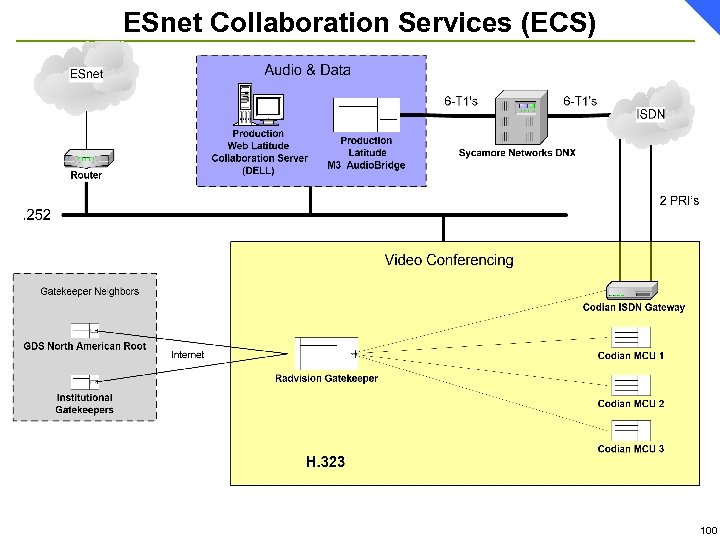
 ESnet Conferencing Service (ECS) IIIb. • An ESnet Science Service that provides audio, video, and data teleconferencing service to support human collaboration of DOE science – Usage is a little higher than last year – ECS video serves about 1800 DOE researchers and collaborators worldwide at 270 institutions • Videoconferences - 3900 port hours per month, year average • Data conferencing - about 230 port hours per month – ECS audio serves about 800 DOE researchers and collaborators worldwide at 170 institutions • Audio conferencing - about 2500 port hours per month – Web-based, automated registration and scheduling for all of these services 99
 ESnet Collaboration Services (ECS) 100
 ECS Video Collaboration Service • • High Quality videoconferencing over IP and ISDN • • 3 Codian MCUs with Web Conferencing Options • 384 k access for video conferencing systems using ISDN protocol • Access to audio portion of video conferences through the Codian ISDN Gateway Reliable, appliance based architecture Ad-Hoc H. 323 and H. 320 multipoint meeting creation Web Streaming options on 3 Codian MCU’s using Quicktime or Real 120 total ports of video conferencing on each MCU (40 ports per MCU) 101
 ECS Voice and Data Collaboration • 144 usable ports – Actual conference ports readily available on the system. • 144 overbook ports – Number of ports reserved to allow for scheduling beyond the number of conference ports readily available on the system. • 108 Floater Ports – Designated for unexpected port needs. – Floater ports can float between meetings, taking up the slack when an extra person attends a meeting that is already full and when ports that can be scheduled in advance are not available. • • Audio Conferencing and Data Collaboration using Cisco Meeting. Place • • Web-based user registration Data Collaboration = Web. Ex style desktop sharing and remote viewing of content Web-based scheduling of audio / data conferences Email notifications of conferences and conference changes 800+ users registered to schedule meetings (not including guests) 102
 ECS Futures • ESnet is still on-track (funds budgeted) to upgrade the teleconferencing hardware currently located at LBNL and provide a replicate at a different location (FNAL) – though this is somewhat delayed – Video bridge upgrade is waiting on Tandberg/Codian high port density model which has now been announced (Model 8000) and will be available by Q 4 2008 / Q 1 2009 – Once the model 8000 is installed at LBNL, the 3 existing MCUs and the gatekeeper, plus maybe ISDN/Pots gateway, will go to FNAL – This will provide for redundant operation and, if California is cut off from the rest of the world, people still can use 3 MCUs at Fermi • The new equipment is intended to provide at least comparable service to the current (upgraded) ECS system – Also intended to provide some level of backup to the current system – A new Web based registration and scheduling portal may also come out of this 103
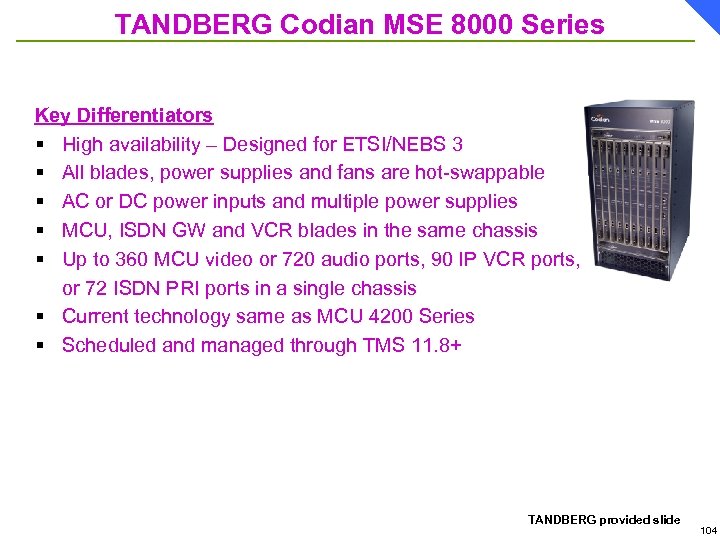 TANDBERG Codian MSE 8000 Series Key Differentiators § High availability – Designed for ETSI/NEBS 3 § All blades, power supplies and fans are hot-swappable § AC or DC power inputs and multiple power supplies § MCU, ISDN GW and VCR blades in the same chassis § Up to 360 MCU video or 720 audio ports, 90 IP VCR ports, or 72 ISDN PRI ports in a single chassis § Current technology same as MCU 4200 Series § Scheduled and managed through TMS 11. 8+ TANDBERG provided slide 104
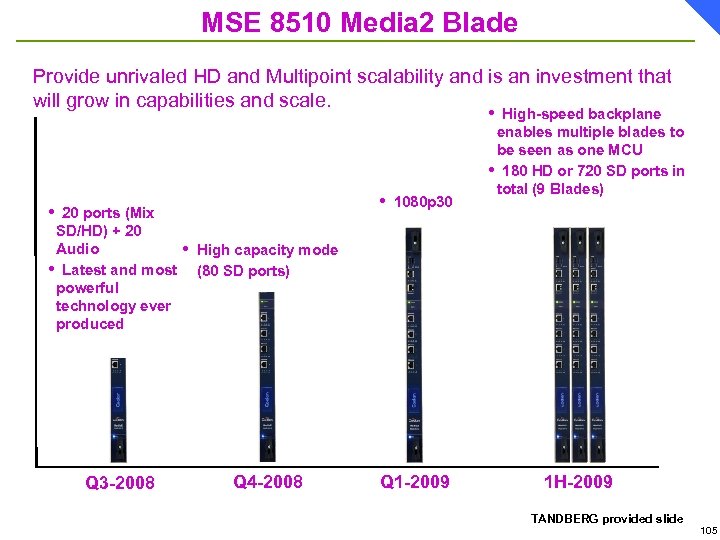 MSE 8510 Media 2 Blade Provide unrivaled HD and Multipoint scalability and is an investment that will grow in capabilities and scale. • High-speed backplane • • 20 ports (Mix SD/HD) + 20 Audio • Latest and most powerful technology ever produced Q 3 -2008 • 1080 p 30 enables multiple blades to be seen as one MCU • 180 HD or 720 SD ports in total (9 Blades) High capacity mode (80 SD ports) Q 4 -2008 Q 1 -2009 1 H-2009 TANDBERG provided slide 105
 ECS Service Level • • ESnet Operations Center is open for service 24 x 7 x 365. • • Trouble ticket is closed when the problem is resolved. A trouble ticket is opened within 15 to 30 minutes and assigned to the appropriate group for investigation. ECS support is provided Monday to Friday, 8 AM to 5 PM Pacific Time excluding LBNL holidays – Reported problems are addressed within 1 hour from receiving a trouble ticket during ECS support period – ESnet does NOT provide a real time (during-conference) support service 106
 Real Time ECS Support • A number of user groups have requested “real-time” conference support (monitoring of conferences while in-session) • Limited Human and Financial resources currently prohibit ESnet from: A) Making real time information available to the public on the systems status (network, ECS, etc) This information is available only on some systems to our support personnel B) 24 x 7 x 365 real-time support C) Addressing simultaneous trouble calls as in a real time support environment. • This would require several people addressing multiple problems simultaneously 107
 Real Time ECS Support • Solution – A fee-for-service arrangement for real-time conference support – Available from TKO Video Communications, ESnet’s ECS service contractor – Service offering could provide: • • Testing and configuration assistance prior to your conference Creation and scheduling of your conferences on ECS Hardware Preferred port reservations on ECS video and voice systems Connection assistance and coordination with participants Endpoint troubleshooting Live phone support during conferences Seasoned staff and years of experience in the video conferencing industry • ESnet community pricing 108
 IIIc. • Enhanced Collaboration Services The Fusion community has outlined the need for significant advances in collaboration technology – The challenge is to effectively collaborate with a remote Tokamak control room – Current Tokamak control rooms (e. g. DIII-D at General Atomics) already employ any technology they can get their hands on – VRVS, H. 323, Instant Messaging, Access Grid, Skype, etc. – PIs still travel to the instrument to run experiments • current remote collaboration technology still not good enough • ITER assumes this will be solved – there is no plan for a large central control room for ITER – Collaboration tools need to be integrated with a federated security framework R&D – This defines a clear and present research priority 109
 ØSummary • Transition to ESnet 4 is going smoothly – New network services to support large-scale science are progressing – OSCARS virtual circuit service is being used, and the service functionality is adapting to unforeseen user needs – Measurement infrastructure is rapidly becoming widely enough deployed to be very useful • Revaluation of the 5 yr strategy indicates that the future will not be qualitatively the same as the past – and this must be addressed – R&D, testbeds, planning, new strategy, etc. • New ESC hardware and service contract are working well – Plans to deploy replicate service are delayed to early CY 2009 • Federated trust - PKI policy and Certification Authorities – Service continues to pick up users at a pretty steady rate – Maturing of service - and PKI use in the science community generally 110
![References [OSCARS] For more information contact Chin Guok (chin@es. net). Also see - http:](https://present5.com/presentation/9b53c7b1acbe7ea34c6de79331c51d58/image-111.jpg "References [OSCARS] For more information contact Chin Guok (chin@es. net). Also see - http:") References [OSCARS] For more information contact Chin Guok (chin@es. net). Also see - http: //www. es. net/oscars [Workshops] see http: //www. es. net/hypertext/requirements. html [LHC/CMS] http: //cmsdoc. cern. ch/cms/aprom/phedex/prod/Activity: : Rate. Plots? view =global [ICFA SCIC] “Networking for High Energy Physics. ” International Committee for Future Accelerators (ICFA), Standing Committee on Inter-Regional Connectivity (SCIC), Professor Harvey Newman, Caltech, Chairperson. - http: //monalisa. caltech. edu: 8080/Slides/ICFASCIC 2007/ [E 2 EMON] Geant 2 E 2 E Monitoring System –developed and operated by JRA 4/WI 3, with implementation done at DFN http: //cnmdev. lrz-muenchen. de/e 2 e/html/G 2_E 2 E_index. html http: //cnmdev. lrz-muenchen. de/e 2 e/lhc/G 2_E 2 E_index. html [Tr. Viz] ESnet Perf. SONAR Traceroute Visualizer https: //performance. es. net/cgi-bin/level 0/perfsonar-trace. cgi 111
References [OSCARS] For more information contact Chin Guok (chin@es. net). Also see - http: //www. es. net/oscars [Workshops] see http: //www. es. net/hypertext/requirements. html [LHC/CMS] http: //cmsdoc. cern. ch/cms/aprom/phedex/prod/Activity: : Rate. Plots? view =global [ICFA SCIC] “Networking for High Energy Physics. ” International Committee for Future Accelerators (ICFA), Standing Committee on Inter-Regional Connectivity (SCIC), Professor Harvey Newman, Caltech, Chairperson. - http: //monalisa. caltech. edu: 8080/Slides/ICFASCIC 2007/ [E 2 EMON] Geant 2 E 2 E Monitoring System –developed and operated by JRA 4/WI 3, with implementation done at DFN http: //cnmdev. lrz-muenchen. de/e 2 e/html/G 2_E 2 E_index. html http: //cnmdev. lrz-muenchen. de/e 2 e/lhc/G 2_E 2 E_index. html [Tr. Viz] ESnet Perf. SONAR Traceroute Visualizer https: //performance. es. net/cgi-bin/level 0/perfsonar-trace. cgi 111