


 Скачать презентацию ESI 6417 Linear Programming and Network Optimization Fall
9b576802ed49b0f8b85c8510b7f5ec83.ppt
- Количество слайдов: 18
 ESI 6417 Linear Programming and Network Optimization Fall 2003 Ravindra K. Ahuja 370 Weil Hall, Dept. of ISE ahuja@ufl. edu 352 -392 -3615
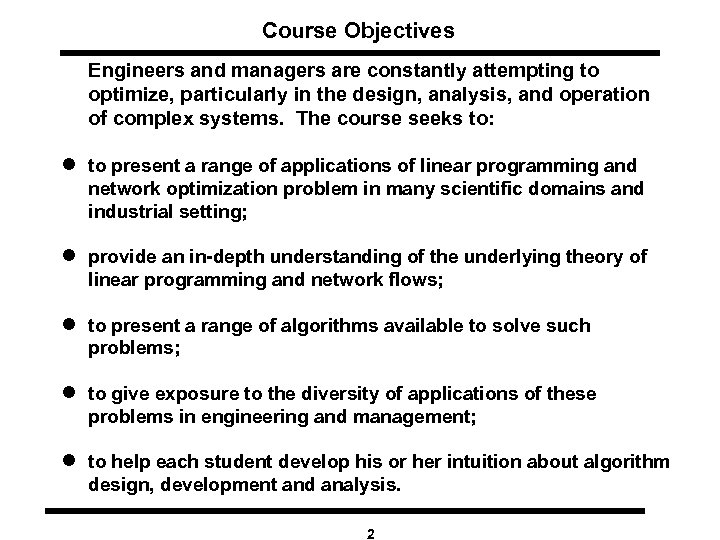 Course Objectives Engineers and managers are constantly attempting to optimize, particularly in the design, analysis, and operation of complex systems. The course seeks to: l to present a range of applications of linear programming and network optimization problem in many scientific domains and industrial setting; l provide an in-depth understanding of the underlying theory of linear programming and network flows; l to present a range of algorithms available to solve such problems; l to give exposure to the diversity of applications of these problems in engineering and management; l to help each student develop his or her intuition about algorithm design, development and analysis. 2
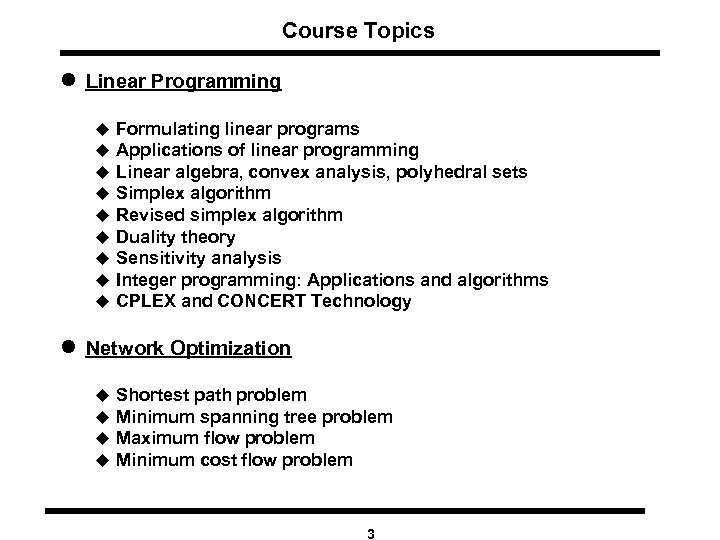 Course Topics l Linear Programming u u u u u Formulating linear programs Applications of linear programming Linear algebra, convex analysis, polyhedral sets Simplex algorithm Revised simplex algorithm Duality theory Sensitivity analysis Integer programming: Applications and algorithms CPLEX and CONCERT Technology l Network Optimization u u Shortest path problem Minimum spanning tree problem Maximum flow problem Minimum cost flow problem 3
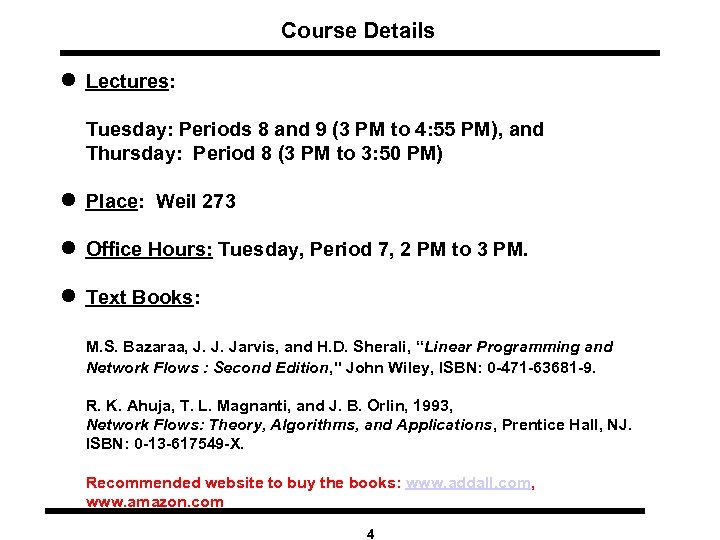 Course Details l Lectures: Tuesday: Periods 8 and 9 (3 PM to 4: 55 PM), and Thursday: Period 8 (3 PM to 3: 50 PM) l Place: Weil 273 l Office Hours: Tuesday, Period 7, 2 PM to 3 PM. l Text Books: M. S. Bazaraa, J. J. Jarvis, and H. D. Sherali, “Linear Programming and Network Flows : Second Edition, " John Wiley, ISBN: 0 -471 -63681 -9. R. K. Ahuja, T. L. Magnanti, and J. B. Orlin, 1993, Network Flows: Theory, Algorithms, and Applications, Prentice Hall, NJ. ISBN: 0 -13 -617549 -X. Recommended website to buy the books: www. addall. com, www. amazon. com 4
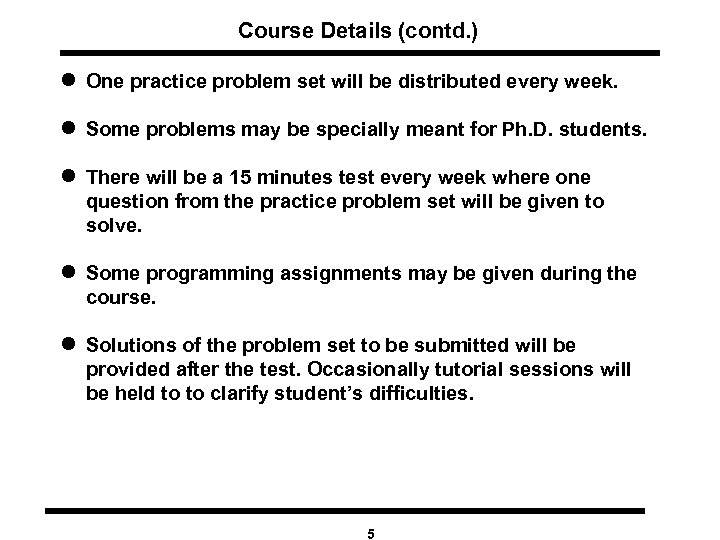 Course Details (contd. ) l One practice problem set will be distributed every week. l Some problems may be specially meant for Ph. D. students. l There will be a 15 minutes test every week where one question from the practice problem set will be given to solve. l Some programming assignments may be given during the course. l Solutions of the problem set to be submitted will be provided after the test. Occasionally tutorial sessions will be held to to clarify student’s difficulties. 5
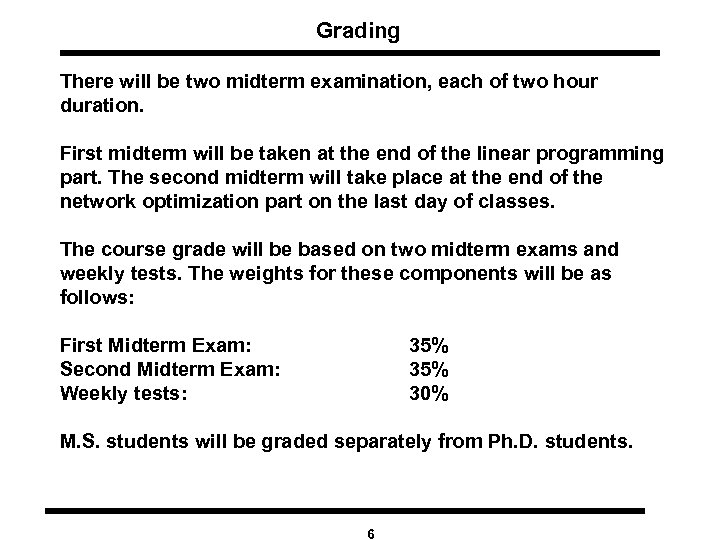 Grading There will be two midterm examination, each of two hour duration. First midterm will be taken at the end of the linear programming part. The second midterm will take place at the end of the network optimization part on the last day of classes. The course grade will be based on two midterm exams and weekly tests. The weights for these components will be as follows: First Midterm Exam: Second Midterm Exam: Weekly tests: 35% 30% M. S. students will be graded separately from Ph. D. students. 6
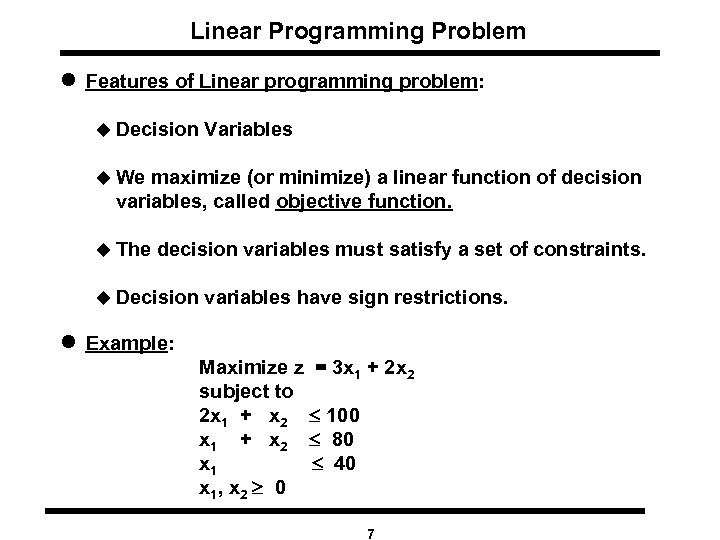 Linear Programming Problem l Features of Linear programming problem: u Decision Variables u We maximize (or minimize) a linear function of decision variables, called objective function. u The decision variables must satisfy a set of constraints. u Decision variables have sign restrictions. l Example: Maximize z subject to 2 x 1 + x 2 x 1 , x 2 0 = 3 x 1 + 2 x 2 100 80 40 7
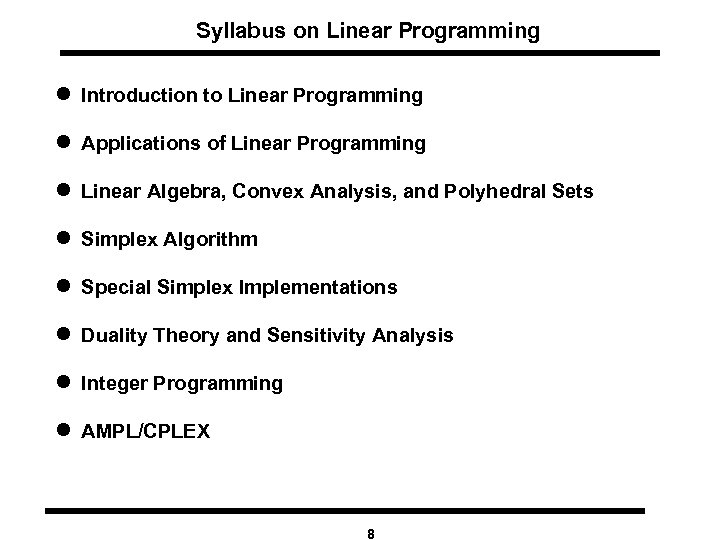 Syllabus on Linear Programming l Introduction to Linear Programming l Applications of Linear Programming l Linear Algebra, Convex Analysis, and Polyhedral Sets l Simplex Algorithm l Special Simplex Implementations l Duality Theory and Sensitivity Analysis l Integer Programming l AMPL/CPLEX 8
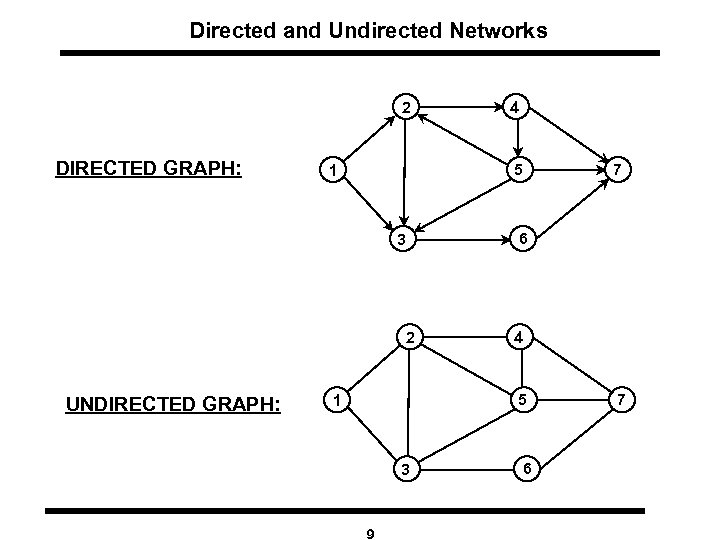 Directed and Undirected Networks 2 DIRECTED GRAPH: 5 1 7 6 3 2 UNDIRECTED GRAPH: 4 4 5 1 3 9 6 7
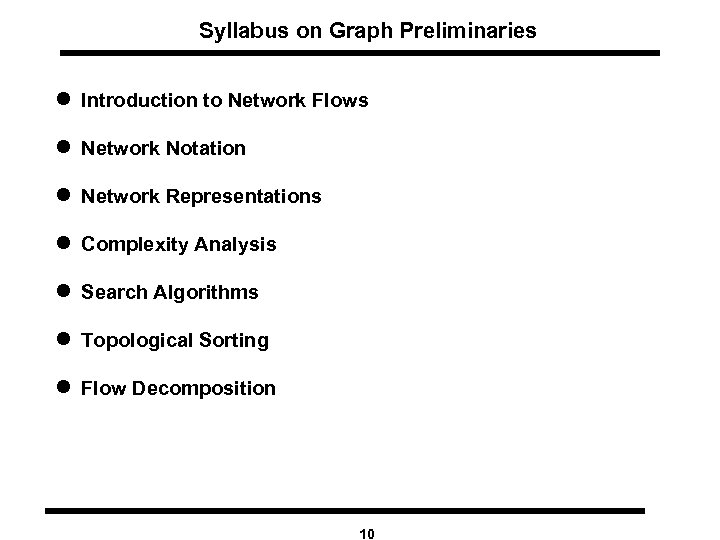 Syllabus on Graph Preliminaries l Introduction to Network Flows l Network Notation l Network Representations l Complexity Analysis l Search Algorithms l Topological Sorting l Flow Decomposition 10
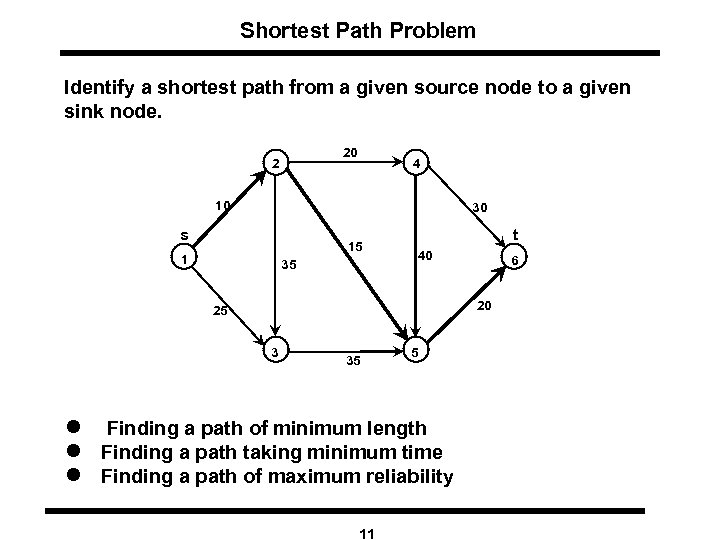 Shortest Path Problem Identify a shortest path from a given source node to a given sink node. 20 2 4 10 30 s 15 1 35 t 40 6 20 25 3 35 5 l Finding a path of minimum length l Finding a path taking minimum time l Finding a path of maximum reliability 11
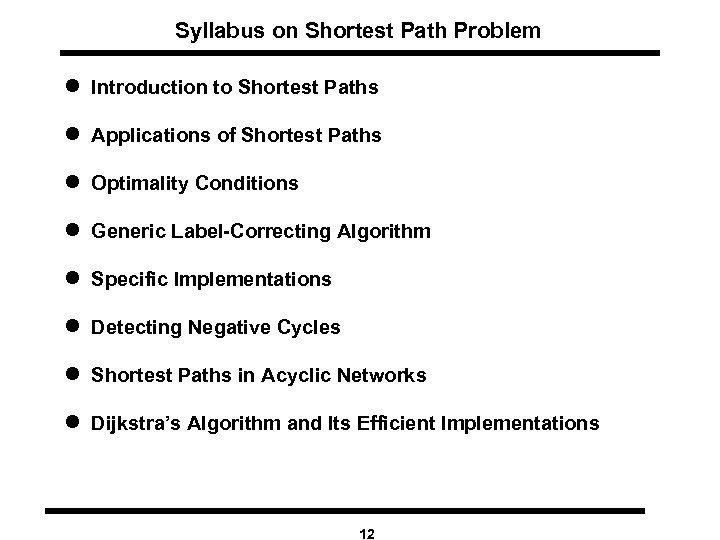 Syllabus on Shortest Path Problem l Introduction to Shortest Paths l Applications of Shortest Paths l Optimality Conditions l Generic Label-Correcting Algorithm l Specific Implementations l Detecting Negative Cycles l Shortest Paths in Acyclic Networks l Dijkstra’s Algorithm and Its Efficient Implementations 12
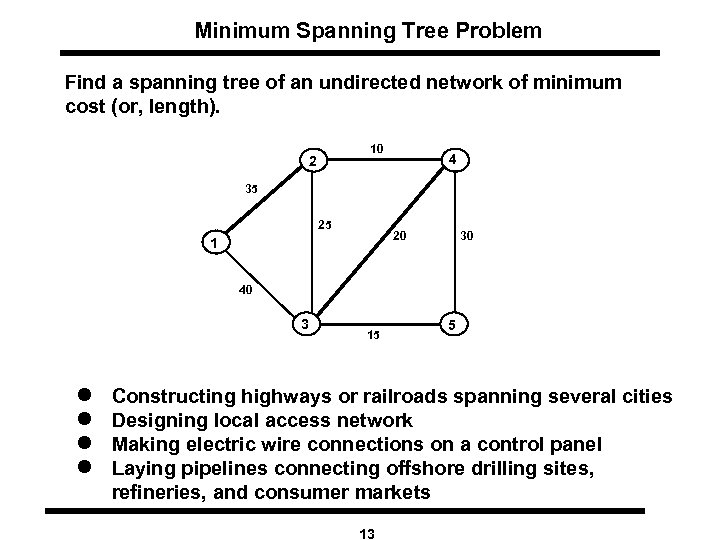 Minimum Spanning Tree Problem Find a spanning tree of an undirected network of minimum cost (or, length). 10 2 4 35 25 20 1 30 40 3 l l 15 5 Constructing highways or railroads spanning several cities Designing local access network Making electric wire connections on a control panel Laying pipelines connecting offshore drilling sites, refineries, and consumer markets 13
 Syllabus on Minimum Spanning Tree Problem l Introduction to Minimum Spanning Trees l Applications of Minimum Spanning Trees l Optimality Conditions l Kruskal's Algorithm l Prim's Algorithm l Sollin's Algorithm 14
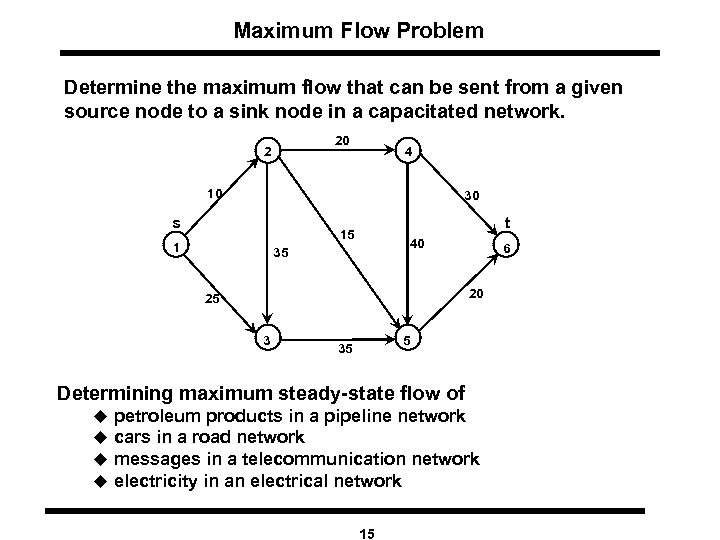 Maximum Flow Problem Determine the maximum flow that can be sent from a given source node to a sink node in a capacitated network. 20 2 4 10 30 s t 15 1 40 35 6 20 25 3 5 35 Determining maximum steady-state flow of u u petroleum products in a pipeline network cars in a road network messages in a telecommunication network electricity in an electrical network 15
 Syllabus on Maximum Flow Problem l Introduction to Maximum Flows l Introduction to Minimum Cuts l Applications of Maximum Flows l Flows and Cuts l Generic Augmenting Path Algorithm l Max-Flow Min-Cut Theorem l Capacity Scaling Algorithm l Generic Preflow-Push Algorithm l Specific Preflow-Push Algorithms 16
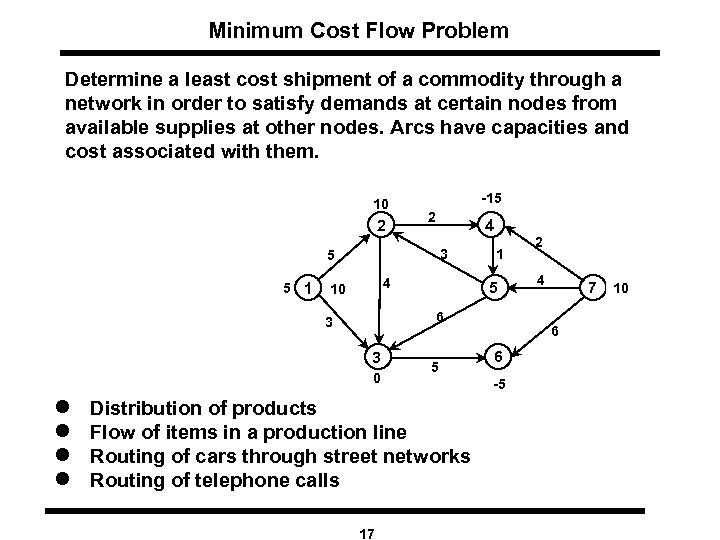 Minimum Cost Flow Problem Determine a least cost shipment of a commodity through a network in order to satisfy demands at certain nodes from available supplies at other nodes. Arcs have capacities and cost associated with them. 10 2 -15 2 4 3 5 5 1 4 10 5 6 3 3 0 l l 1 5 Distribution of products Flow of items in a production line Routing of cars through street networks Routing of telephone calls 17 2 4 7 6 6 -5 10
 Syllabus on Minimum Cost Flow Problem l Introduction to Minimum Cost Flows l Applications of Minimum Cost Flows l Structure of the Basis l Optimality Conditions l Obtaining Primal and Dual Solutions l Network Simplex Algorithms l Strongly Feasible Basis 18