


 Скачать презентацию ESE Einführung in Software Engineering 11 Software Quality
9bac38bee3c8fd7dce3634d9b9295cac.ppt
- Количество слайдов: 47
 ESE Einführung in Software Engineering 11. Software Quality Prof. O. Nierstrasz
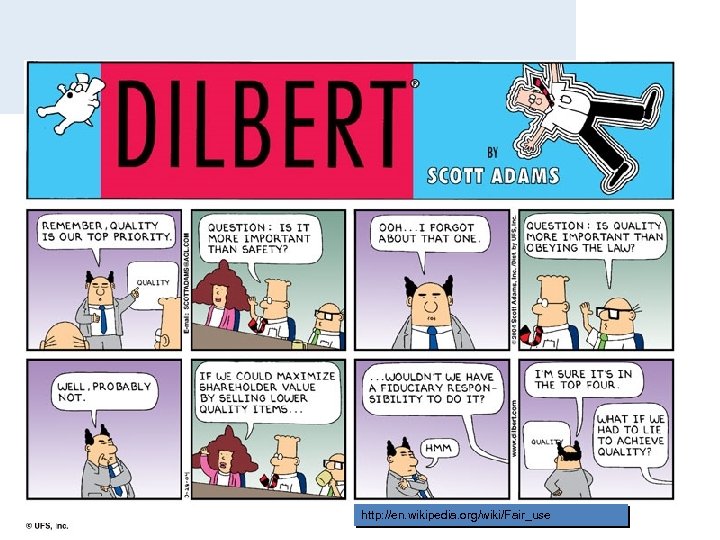 © Oscar Nierstrasz ESE — Software Quality http: //en. wikipedia. org/wiki/Fair_use ESE 11. 2
 Roadmap • • What is quality? Quality Attributes Quality Assurance: Planning and Reviewing Quality System and Standards © Oscar Nierstrasz ESE — Software Quality ESE 11. 3
 Sources • Software Engineering, I. Sommerville, 7 th Edn. , 2004. • Software Engineering — A Practitioner’s Approach, R. Pressman, Mc-Graw Hill, 5 th Edn. , 2001. • Fundamentals of Software Engineering, C. Ghezzi, M. Jazayeri, D. Mandroli, Prentice-Hall 1991 © Oscar Nierstrasz ESE — Software Quality ESE 11. 4
 Roadmap • • What is quality? Quality Attributes Quality Assurance: Planning and Reviewing Quality System and Standards © Oscar Nierstrasz ESE — Software Quality ESE 11. 5
 What is Quality? Software Quality is conformance to: • explicitly stated functional and performance requirements, • explicitly documented development standards, • implicit characteristics that are expected of all professionally developed software. © Oscar Nierstrasz ESE — Software Quality ESE 11. 6
 Problems with Software Quality • Software specifications are usually incomplete and often inconsistent • There is tension between: – customer quality requirements (efficiency, reliability, etc. ) – developer quality requirements (maintainability, reusability, etc. ) • Some quality requirements are hard to specify in an unambiguous way – directly measurable qualities (e. g. , errors/KLOC), – indirectly measurable qualities (e. g. , usability). Quality management is not just about reducing defects! © Oscar Nierstrasz ESE — Software Quality ESE 11. 7
 Roadmap • • What is quality? Quality Attributes Quality Assurance: Planning and Reviewing Quality System and Standards © Oscar Nierstrasz ESE — Software Quality ESE 11. 8
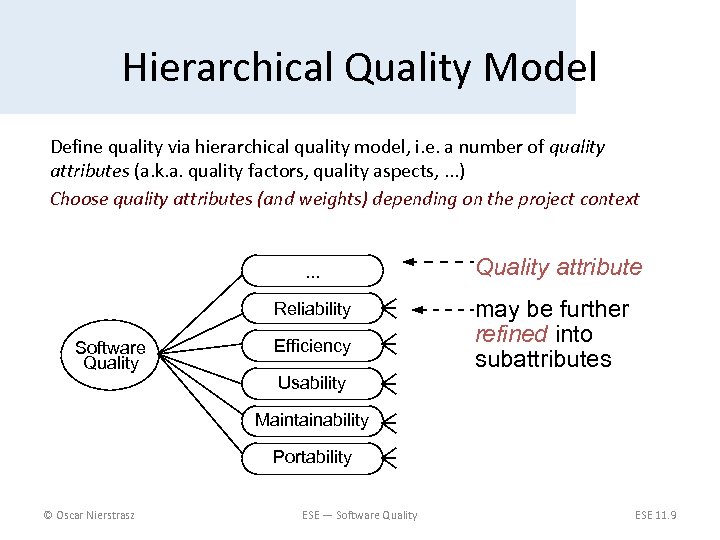 Hierarchical Quality Model Define quality via hierarchical quality model, i. e. a number of quality attributes (a. k. a. quality factors, quality aspects, . . . ) Choose quality attributes (and weights) depending on the project context . . . Reliability Software Quality Efficiency Quality attribute may be further refined into subattributes Usability Maintainability Portability © Oscar Nierstrasz ESE — Software Quality ESE 11. 9
 Quality Attributes Quality attributes apply both to the product and the process. • product: delivered to the customer • process: produces the software product • resources: (both the product and the process require resources) – Underlying assumption: a quality process leads to a quality product (cf. metaphor of manufacturing lines) © Oscar Nierstrasz ESE — Software Quality ESE 11. 10
 Quality Attributes. . . Quality attributes can be external or internal. • External: Derived from the relationship between the environment and the system (or the process). (To derive, the system or process must run) – e. g. Reliability, Robustness • Internal: Derived immediately from the product or process description (To derive, it is sufficient to have the description) – Underlying assumption: internal quality leads to external quality (cfr. metaphor manufacturing lines) – e. g. Efficiency © Oscar Nierstrasz ESE — Software Quality ESE 11. 11
 Correctness, Reliability, Robustness Correctness • A system is correct if it behaves according to its specification – An absolute property (i. e. , a system cannot be “almost correct”) –. . . in theory and practice undecidable Reliability • The user may rely on the system behaving properly • Reliability is the probability that the system will operate as expected over a specified interval – A relative property (a system has a mean time between failure of 3 weeks) Robustness • A system is robust if it behaves reasonably even in circumstances that were not specified • A vague property (once you specify the abnormal circumstances they become part of the requirements) © Oscar Nierstrasz ESE — Software Quality ESE 11. 12
 Efficiency, Usability Efficiency (Performance) • Use of resources such as computing time, memory – Affects user-friendliness and scalability – Hardware technology changes fast! – First do it, then do it right, then do it fast • For process, resources are manpower, time and money – relates to the “productivity” of a process © Oscar Nierstrasz ESE — Software Quality ESE 11. 13
 Efficiency, Usability. . . Usability (User Friendliness, Human Factors) • The degree to which the human users find the system (process) both “easy to use” and useful – Depends a lot on the target audience (novices vs. experts) – Often a system has various kinds of users (end-users, operators, installers) – Typically expressed in “amount of time to learn the system” © Oscar Nierstrasz ESE — Software Quality ESE 11. 14
 Maintainability • External product attributes (evolvability also applies to process) Maintainability • How easy it is to change a system after its initial release – software entropy maintainability gradually decreases over time © Oscar Nierstrasz ESE — Software Quality ESE 11. 15
 Maintainability. . . Is often refined to. . . Repairability • How much work is needed to correct a defect Evolvability (Adaptability) • How much work is needed to adapt to changing requirements (both system and process) Portability • How much work is needed to port to new environment or platforms © Oscar Nierstrasz ESE — Software Quality ESE 11. 16
 Verifiability, Understandability • Internal (and external) product attribute Verifiability • How easy it is to verify whether desired attributes are there? – internally: e. g. , verify requirements, code inspections – externally: e. g. , testing, efficiency Understandability • How easy it is to understand the system – internally: contributes to maintainability – externally: contributes to usability © Oscar Nierstrasz ESE — Software Quality ESE 11. 17
 Productivity, Timeliness, Visibility • External process attribute (visibility also internal) Productivity • Amount of product produced by a process for a given number of resources – productivity among individuals varies a lot – often: productivity (∑ individuals) < ∑ productivity (individuals) © Oscar Nierstrasz ESE — Software Quality ESE 11. 18
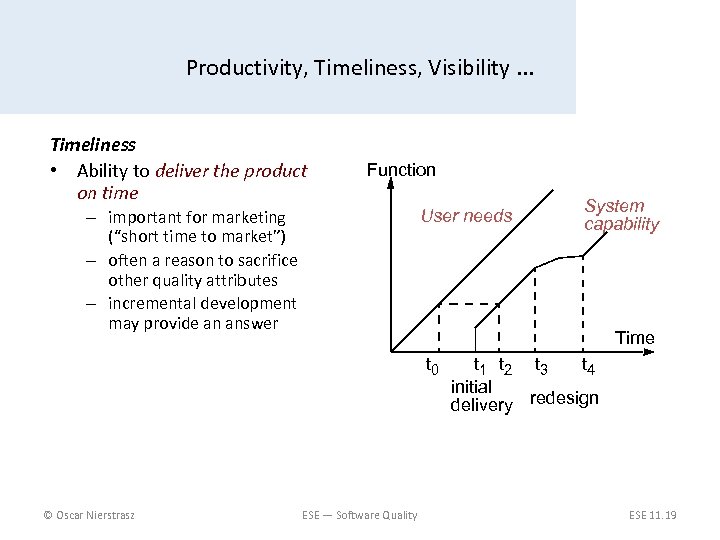 Productivity, Timeliness, Visibility. . . Timeliness • Ability to deliver the product on time Function User needs – important for marketing (“short time to market”) – often a reason to sacrifice other quality attributes – incremental development may provide an answer Time t 0 © Oscar Nierstrasz System capability ESE — Software Quality t 1 t 2 t 3 t 4 initial delivery redesign ESE 11. 19
 Productivity, Timeliness, Visibility. . . Visibility (Transparency) • Current process steps and project status are accessible – important for management – also deal with staff turn-over © Oscar Nierstrasz ESE — Software Quality ESE 11. 20
 Roadmap • • What is quality? Quality Attributes Quality Assurance: Planning and Reviewing Quality System and Standards © Oscar Nierstrasz ESE — Software Quality ESE 11. 21
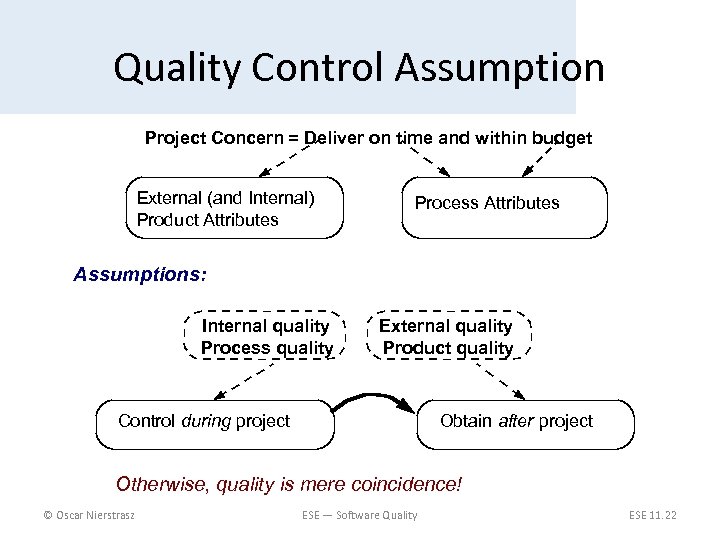 Quality Control Assumption Project Concern = Deliver on time and within budget External (and Internal) Product Attributes Process Attributes Assumptions: Internal quality Process quality External quality Product quality Control during project Obtain after project Otherwise, quality is mere coincidence! © Oscar Nierstrasz ESE — Software Quality ESE 11. 22
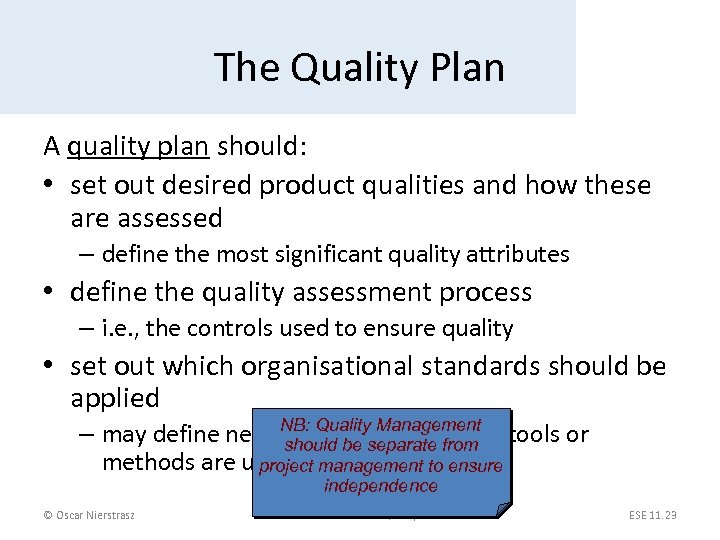 The Quality Plan A quality plan should: • set out desired product qualities and how these are assessed – define the most significant quality attributes • define the quality assessment process – i. e. , the controls used to ensure quality • set out which organisational standards should be applied NB: Quality Management – may define new standards, i. e. , if new tools or should be separate from methods are used management to ensure project independence © Oscar Nierstrasz ESE — Software Quality ESE 11. 23
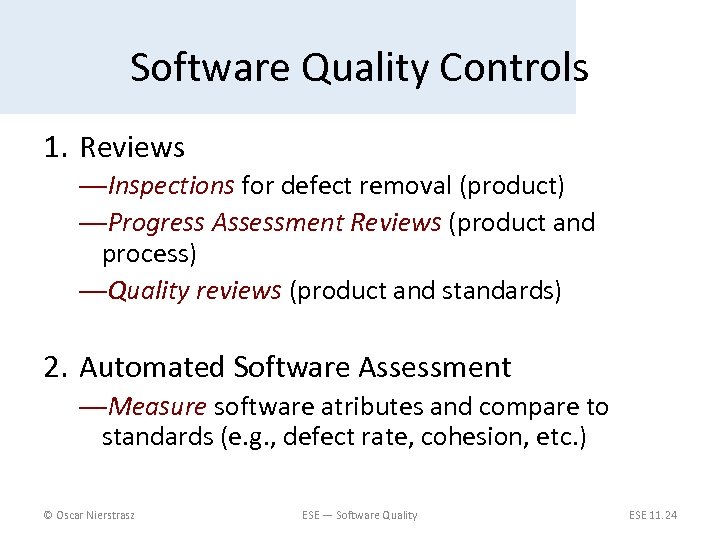 Software Quality Controls 1. Reviews —Inspections for defect removal (product) —Progress Assessment Reviews (product and process) —Quality reviews (product and standards) 2. Automated Software Assessment —Measure software atributes and compare to standards (e. g. , defect rate, cohesion, etc. ) © Oscar Nierstrasz ESE — Software Quality ESE 11. 24
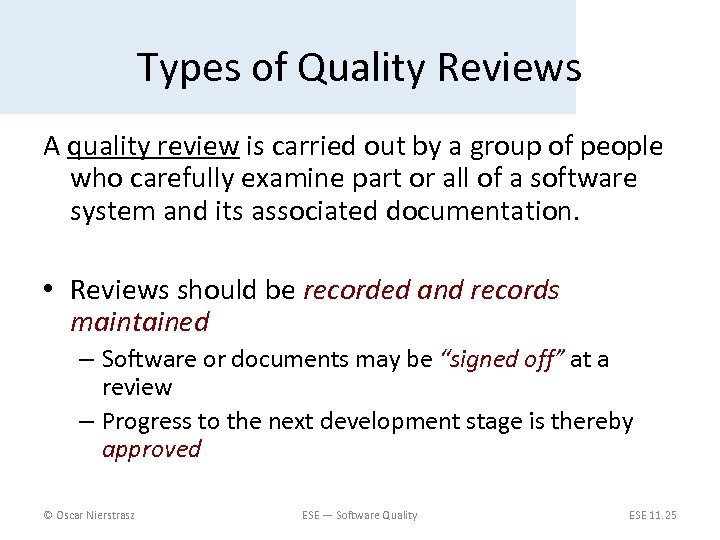 Types of Quality Reviews A quality review is carried out by a group of people who carefully examine part or all of a software system and its associated documentation. • Reviews should be recorded and records maintained – Software or documents may be “signed off” at a review – Progress to the next development stage is thereby approved © Oscar Nierstrasz ESE — Software Quality ESE 11. 25
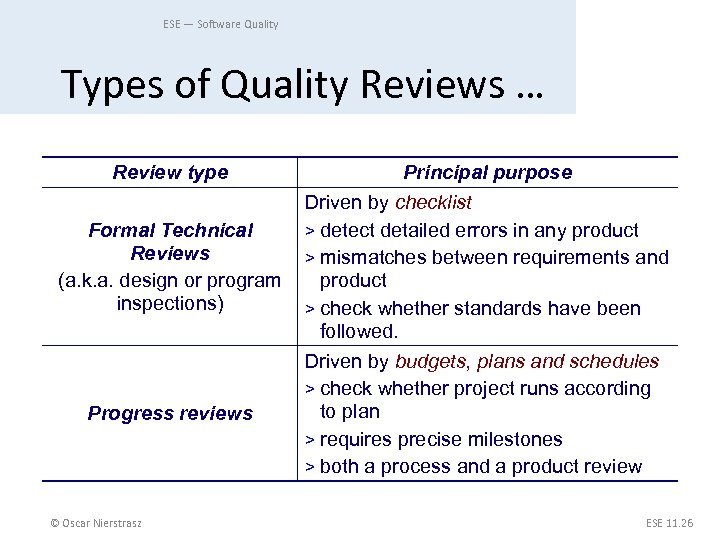 ESE — Software Quality Types of Quality Reviews … Review type Formal Technical Reviews (a. k. a. design or program inspections) Progress reviews © Oscar Nierstrasz Principal purpose Driven by checklist > detect detailed errors in any product > mismatches between requirements and product > check whether standards have been followed. Driven by budgets, plans and schedules > check whether project runs according to plan > requires precise milestones > both a process and a product review ESE 11. 26
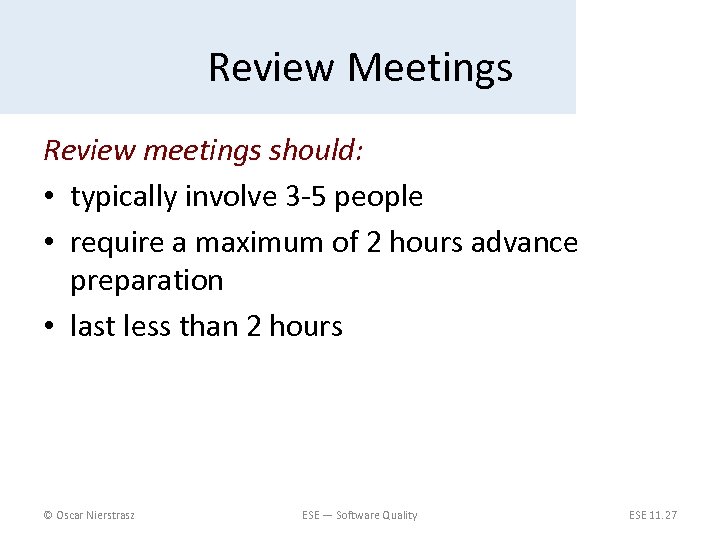 Review Meetings Review meetings should: • typically involve 3 -5 people • require a maximum of 2 hours advance preparation • last less than 2 hours © Oscar Nierstrasz ESE — Software Quality ESE 11. 27
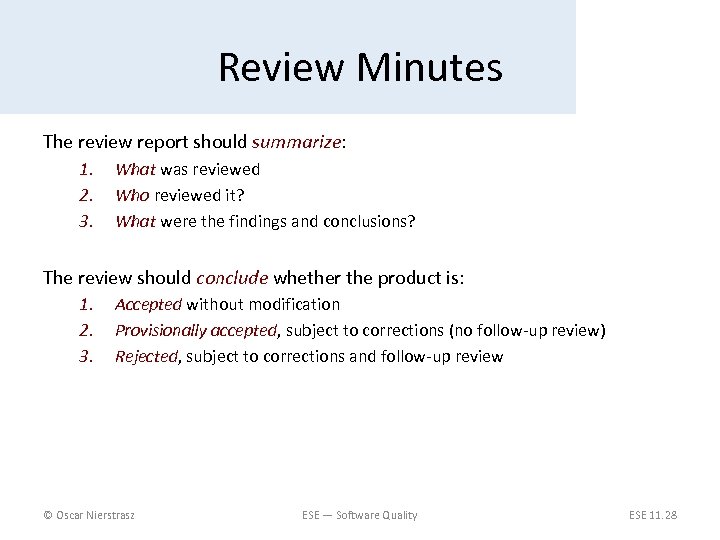 Review Minutes The review report should summarize: 1. 2. 3. What was reviewed Who reviewed it? What were the findings and conclusions? The review should conclude whether the product is: 1. 2. 3. Accepted without modification Provisionally accepted, subject to corrections (no follow-up review) Rejected, subject to corrections and follow-up review © Oscar Nierstrasz ESE — Software Quality ESE 11. 28
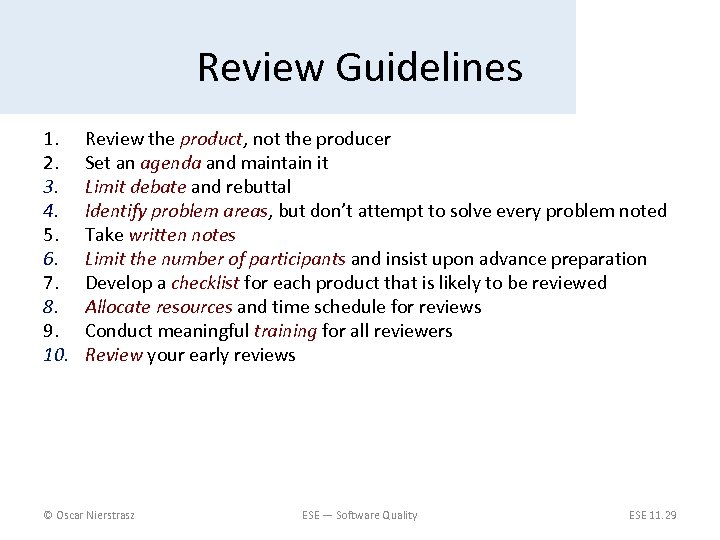 Review Guidelines 1. 2. 3. 4. 5. 6. 7. 8. 9. 10. Review the product, not the producer Set an agenda and maintain it Limit debate and rebuttal Identify problem areas, but don’t attempt to solve every problem noted Take written notes Limit the number of participants and insist upon advance preparation Develop a checklist for each product that is likely to be reviewed Allocate resources and time schedule for reviews Conduct meaningful training for all reviewers Review your early reviews © Oscar Nierstrasz ESE — Software Quality ESE 11. 29
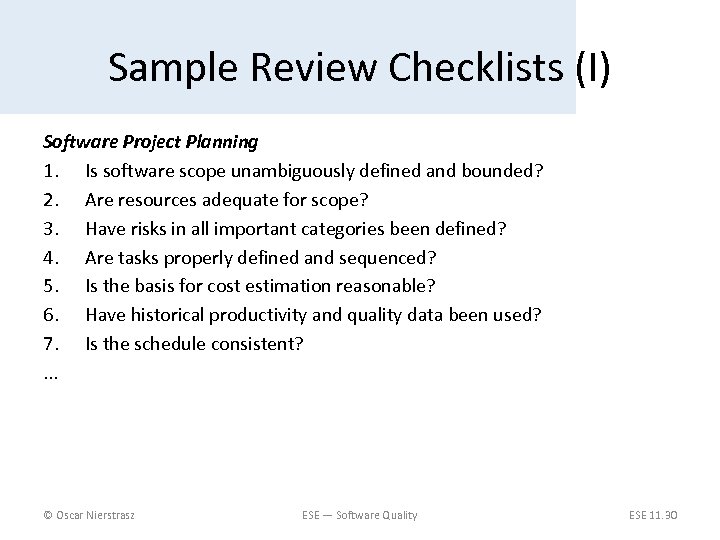 Sample Review Checklists (I) Software Project Planning 1. Is software scope unambiguously defined and bounded? 2. Are resources adequate for scope? 3. Have risks in all important categories been defined? 4. Are tasks properly defined and sequenced? 5. Is the basis for cost estimation reasonable? 6. Have historical productivity and quality data been used? 7. Is the schedule consistent? . . . © Oscar Nierstrasz ESE — Software Quality ESE 11. 30
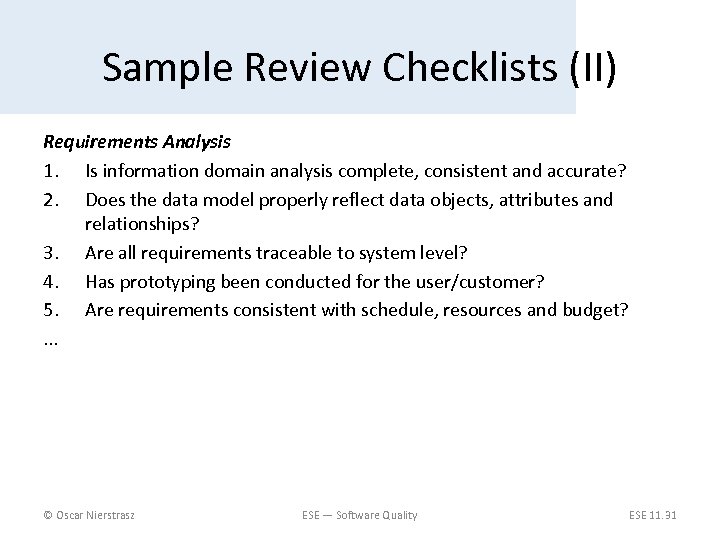 Sample Review Checklists (II) Requirements Analysis 1. Is information domain analysis complete, consistent and accurate? 2. Does the data model properly reflect data objects, attributes and relationships? 3. Are all requirements traceable to system level? 4. Has prototyping been conducted for the user/customer? 5. Are requirements consistent with schedule, resources and budget? . . . © Oscar Nierstrasz ESE — Software Quality ESE 11. 31
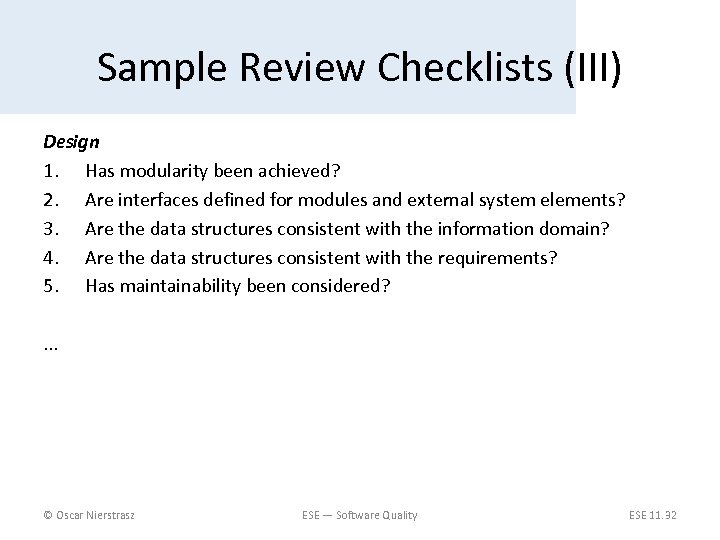 Sample Review Checklists (III) Design 1. Has modularity been achieved? 2. Are interfaces defined for modules and external system elements? 3. Are the data structures consistent with the information domain? 4. Are the data structures consistent with the requirements? 5. Has maintainability been considered? . . . © Oscar Nierstrasz ESE — Software Quality ESE 11. 32
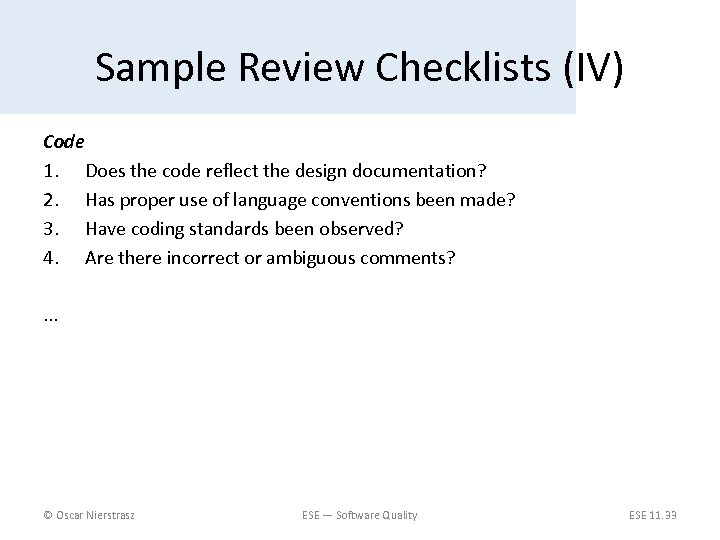 Sample Review Checklists (IV) Code 1. Does the code reflect the design documentation? 2. Has proper use of language conventions been made? 3. Have coding standards been observed? 4. Are there incorrect or ambiguous comments? . . . © Oscar Nierstrasz ESE — Software Quality ESE 11. 33
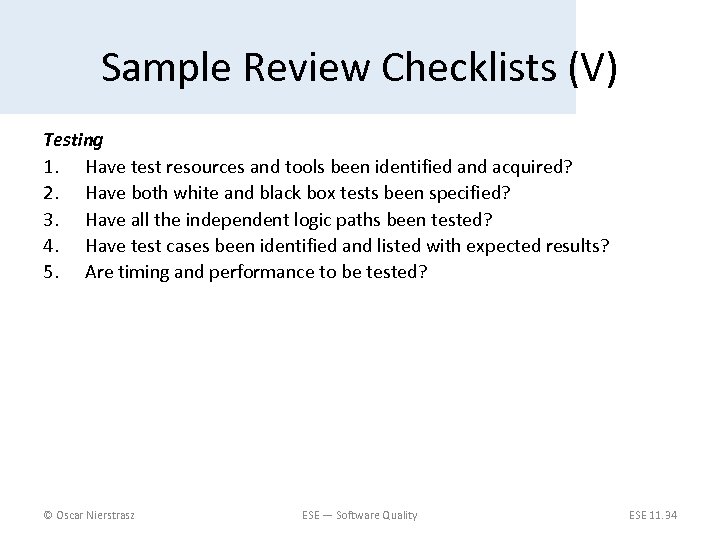 Sample Review Checklists (V) Testing 1. Have test resources and tools been identified and acquired? 2. Have both white and black box tests been specified? 3. Have all the independent logic paths been tested? 4. Have test cases been identified and listed with expected results? 5. Are timing and performance to be tested? © Oscar Nierstrasz ESE — Software Quality ESE 11. 34
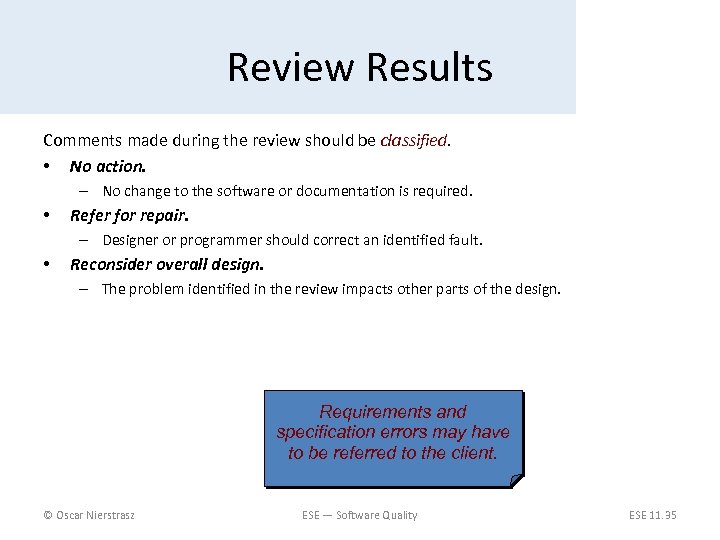 Review Results Comments made during the review should be classified. • No action. – No change to the software or documentation is required. • Refer for repair. – Designer or programmer should correct an identified fault. • Reconsider overall design. – The problem identified in the review impacts other parts of the design. Requirements and specification errors may have to be referred to the client. © Oscar Nierstrasz ESE — Software Quality ESE 11. 35
 Roadmap • • What is quality? Quality Attributes Quality Assurance: Planning and Reviewing Quality System and Standards © Oscar Nierstrasz ESE — Software Quality ESE 11. 36
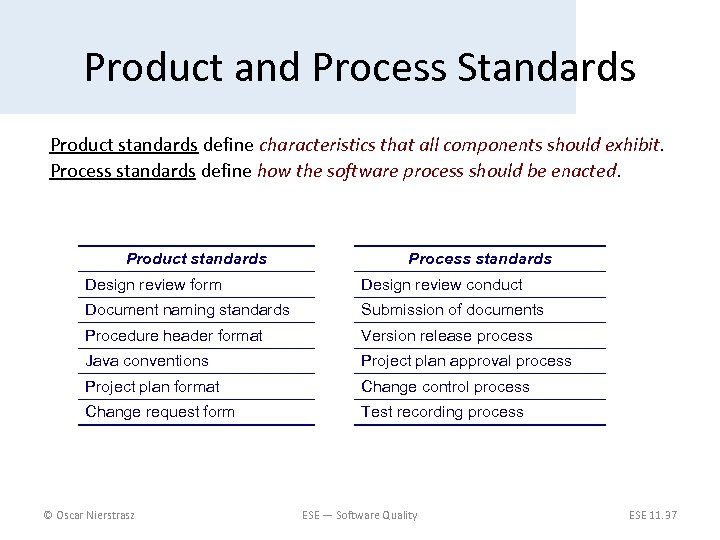 Product and Process Standards Product standards define characteristics that all components should exhibit. Process standards define how the software process should be enacted. Product standards Process standards Design review form Design review conduct Document naming standards Submission of documents Procedure header format Version release process Java conventions Project plan approval process Project plan format Change control process Change request form Test recording process © Oscar Nierstrasz ESE — Software Quality ESE 11. 37
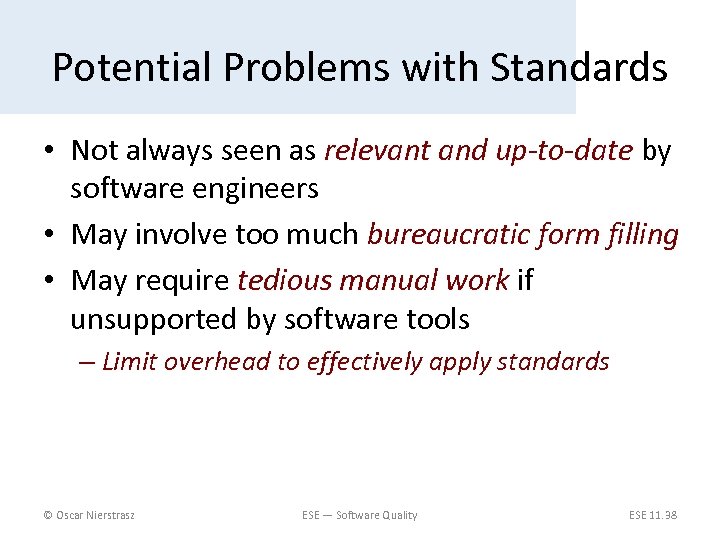 Potential Problems with Standards • Not always seen as relevant and up-to-date by software engineers • May involve too much bureaucratic form filling • May require tedious manual work if unsupported by software tools – Limit overhead to effectively apply standards © Oscar Nierstrasz ESE — Software Quality ESE 11. 38
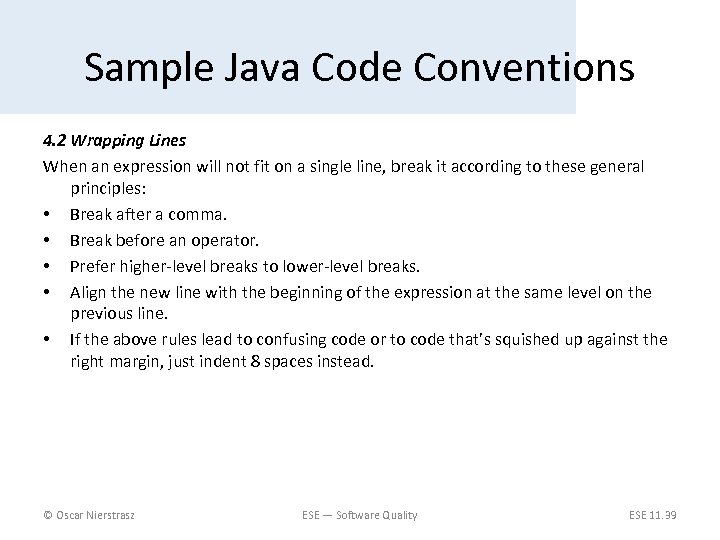 Sample Java Code Conventions 4. 2 Wrapping Lines When an expression will not fit on a single line, break it according to these general principles: • Break after a comma. • Break before an operator. • Prefer higher-level breaks to lower-level breaks. • Align the new line with the beginning of the expression at the same level on the previous line. • If the above rules lead to confusing code or to code that’s squished up against the right margin, just indent 8 spaces instead. © Oscar Nierstrasz ESE — Software Quality ESE 11. 39
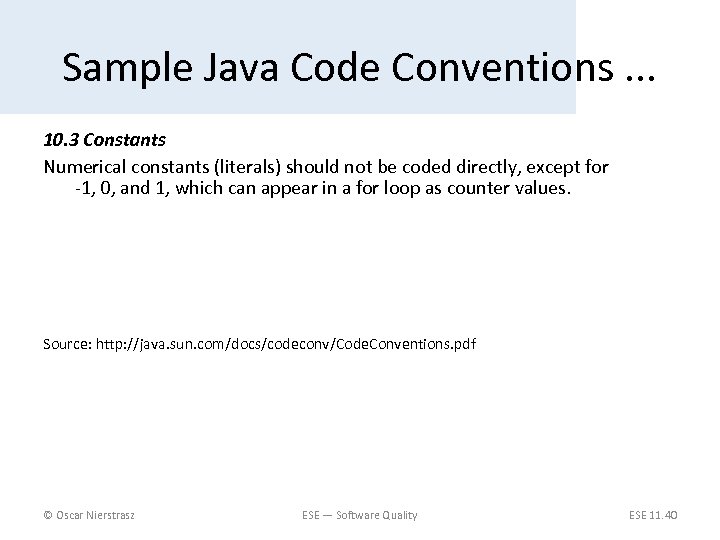 Sample Java Code Conventions. . . 10. 3 Constants Numerical constants (literals) should not be coded directly, except for -1, 0, and 1, which can appear in a for loop as counter values. Source: http: //java. sun. com/docs/codeconv/Code. Conventions. pdf © Oscar Nierstrasz ESE — Software Quality ESE 11. 40
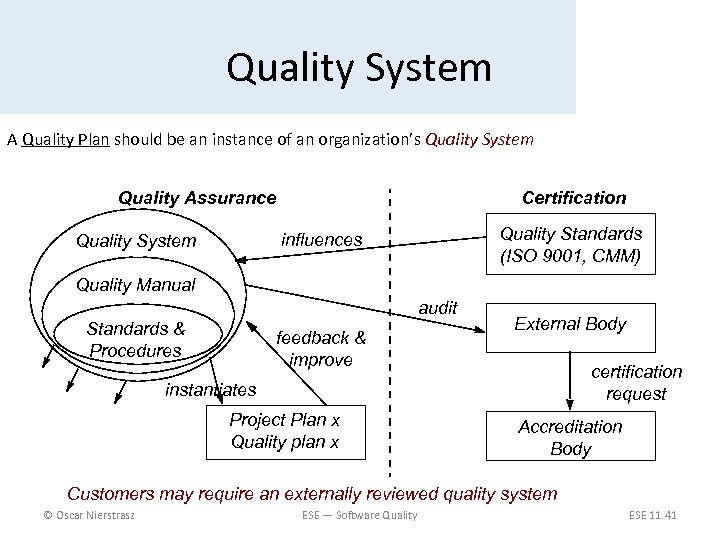 Quality System A Quality Plan should be an instance of an organization’s Quality System Quality Assurance Certification Quality Standards (ISO 9001, CMM) influences Quality System Quality Manual audit Standards & Procedures feedback & improve External Body certification request instantiates Project Plan x Quality plan x Accreditation Body Customers may require an externally reviewed quality system © Oscar Nierstrasz ESE — Software Quality ESE 11. 41
 ISO 9000 is an international set of standards for quality management applicable to a range of organisations from manufacturing to service industries. ISO 9001 is a generic model of the quality process, applicable to organisations whose business processes range all the way from design and development, to production, installation and servicing; • ISO 9001 must be instantiated for each organisation • ISO 9000 -3 interprets ISO 9001 for the software developer ISO = International Organisation for Standardization • • ISO main site: http: //www. iso. ch/ ISO 9000 main site: http: //www. tc 176. org/ © Oscar Nierstrasz ESE — Software Quality ESE 11. 42
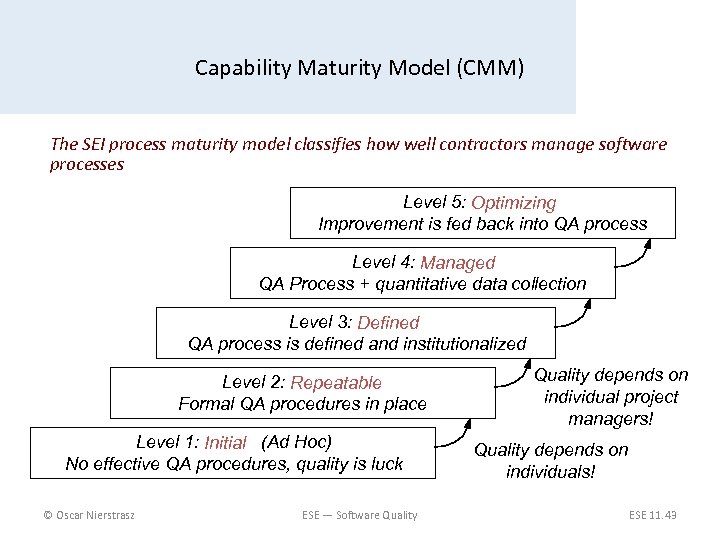 Capability Maturity Model (CMM) The SEI process maturity model classifies how well contractors manage software processes Level 5: Optimizing Improvement is fed back into QA process Level 4: Managed QA Process + quantitative data collection Level 3: Defined QA process is defined and institutionalized Level 2: Repeatable Formal QA procedures in place Level 1: Initial (Ad Hoc) No effective QA procedures, quality is luck © Oscar Nierstrasz ESE — Software Quality depends on individual project managers! Quality depends on individuals! ESE 11. 43
 © Oscar Nierstrasz ESE — Software Quality http: //en. wikipedia. org/wiki/Fair_use ESE 11. 44
 What you should know! • Can a correctly functioning piece of software still have poor quality? • What’s the difference between an external and an internal quality attribute? • And between a product and a process attribute? • Why should quality management be separate from project management? • How should you organize and run a review meeting? • What information should be recorded in the review minutes? © Oscar Nierstrasz ESE — Software Quality ESE 11. 45
 Can you answer the following questions? • Why does a project need a quality plan? • Why are coding standards important? • What would you include in a documentation review checklist? • How often should reviews be scheduled? • Would you trust software developed by an ISO 9000 certified company? • And if it were CMM level 5? © Oscar Nierstrasz ESE — Software Quality ESE 11. 46
 License • http: //creativecommons. org/licenses/by-sa/2. 5/ Attribution-Share. Alike 2. 5 You are free: • to copy, distribute, display, and perform the work • to make derivative works • to make commercial use of the work Under the following conditions: Attribution. You must attribute the work in the manner specified by the author or licensor. Share Alike. If you alter, transform, or build upon this work, you may distribute the resulting work only under a license identical to this one. • For any reuse or distribution, you must make clear to others the license terms of this work. • Any of these conditions can be waived if you get permission from the copyright holder. © Oscar Nierstrasz Your fair use and other rights are in no way affected by the above. ESE — Software Quality ESE 11. 47