


 Скачать презентацию ESA s Planetary Science Archive PSA Ensuring The Long-term
05d85da020de1451cf513694e981ccf7.ppt
- Количество слайдов: 22
 ESA’s Planetary Science Archive (PSA): Ensuring The Long-term Usability Of Data PV 2009 Conference, 1 -3 December, ESAC David J. Heather (1), M. Barthelemy (2), N. Manaud (2), S. Martinez (2), H. Metselaar (2), M. Szumlas (2), J. Kissi-Ameyaw (1), and the PSA Development Team (2) (1) (ESA/ESTEC), (2) (ESA/ESAC) dheather@rssd. esa. int
 Outline Definition and Aim - what is the PSA? Standards Used - The PDS Planetary archiving at ESA - PSA top-level processes Archive Development The Review Cycle Verification and validation procedures The PSA Dictionary Checking syntax and consistency (PVV and PVS) Linking to the User Interfaces Query definition - the User Interfaces Searching and Retrieving Data Current data and future Plans
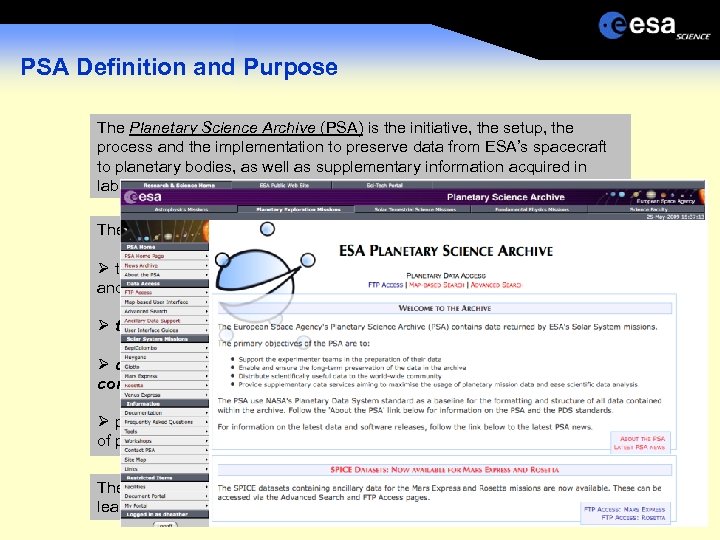 PSA Definition and Purpose The Planetary Science Archive (PSA) is the initiative, the setup, the process and the implementation to preserve data from ESA’s spacecraft to planetary bodies, as well as supplementary information acquired in laboratories or ground-based observatories. The main objectives of the PSA are: Ø to support the experimenter teams in the preparation for the spacecraft and ground-based long-term archives Ø to enable and ensure the long-term preservation of these archives Ø distribution of scientific useful data to the world wide scientific community Ø provision of supplementary data services aiming to maximize the usage of planetary mission data and ease the scientific data analysis. The PSA will be advised by a PSA Scientific Advisory Group that meets at least yearly.
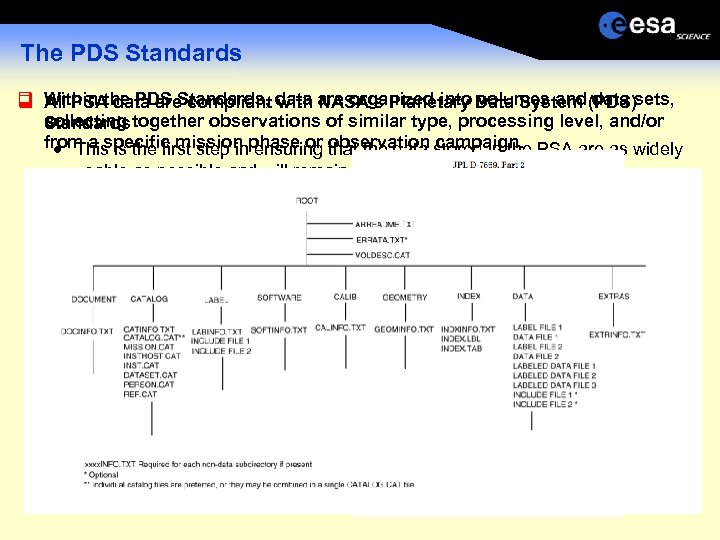 The PDS Standards Within the PDS Standards, with NASA’s Planetary volumes and data All PSA data are compliant data are organized into Data System (PDS)sets, collecting together observations of similar type, processing level, and/or Standards from a specific mission phase or that the data stored in the PSA are as widely This is the first step in ensuring observation campaign. usable as possible and will remain so for many years to come Widely accepted and understood within the planetary science community Standards available online and downloadable as a ‘Standards Reference’ pdf file.
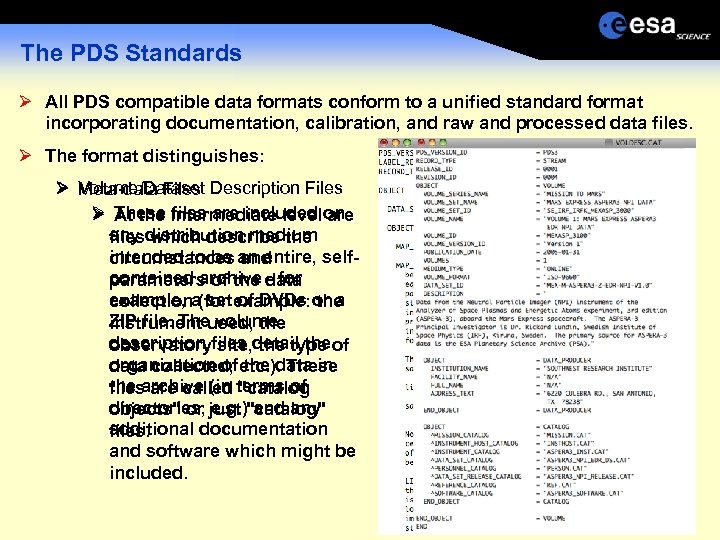 The PDS Standards Ø All PDS compatible data formats conform to a unified standard format incorporating documentation, calibration, and raw and processed data files. Ø The format distinguishes: Volume/Dataset Ø Meta-data Files Description Files Ø These intermediate level on At the files are included are any which describe the filesdistribution medium intended to be an entire, selfcircumstances and contained archive - for parameters of the data example, set of DVDs the collectiona(for example: or a ZIP file. Theused, the instrument volume description site, the type observatoryfiles detail the of organization of etc. ). These data collected, the data in the archive (in "catalog files are called terms of directories, e. g. ) and any objects" or just "catalog" additional documentation files. and software which might be included.
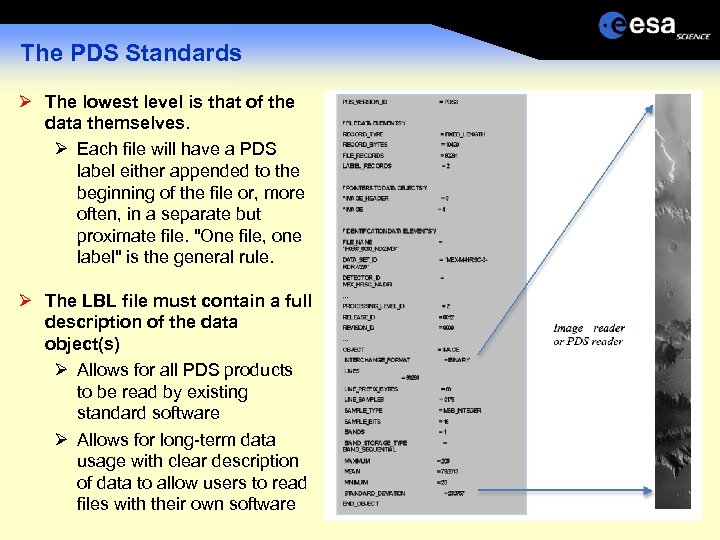 The PDS Standards Ø The lowest level is that of the data themselves. Ø Each file will have a PDS label either appended to the beginning of the file or, more often, in a separate but proximate file. "One file, one label" is the general rule. Ø The LBL file must contain a full description of the data object(s) Ø Allows for all PDS products to be read by existing standard software Ø Allows for long-term data usage with clear description of data to allow users to read files with their own software
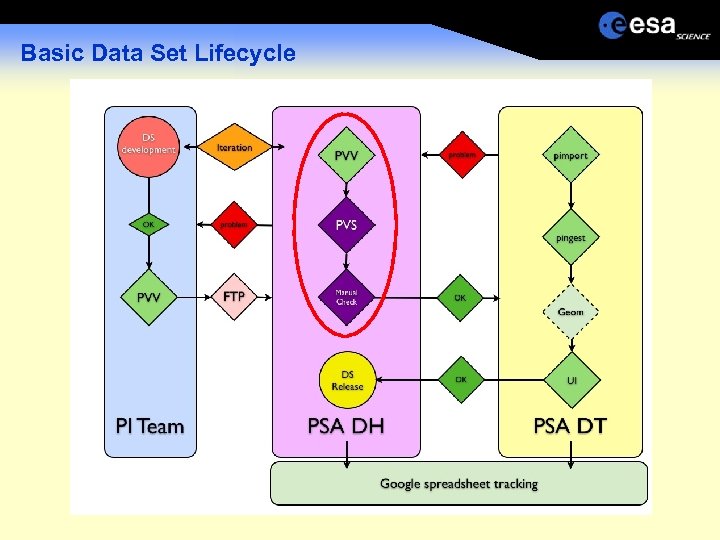
 Planetary Archiving at ESA Top-level processes and procedures followed by PSA o Consultation during data product, documentation and data set development – typically through ‘Feedback Document’ o Independent reviews co-ordination and support o Handling the science data delivered by the PI teams, completing checks and validation on all data prior to ingestion o o o Documentation checks PVV QBTool PVS Spot checks o Data sets proprietary access management after ingestion
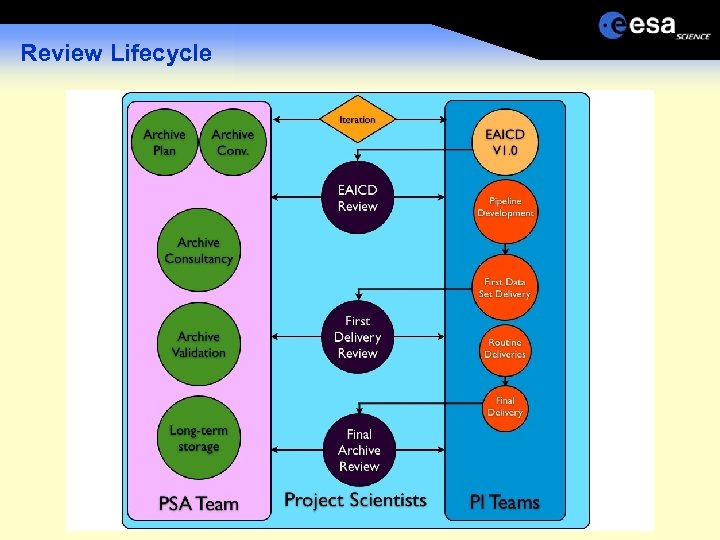
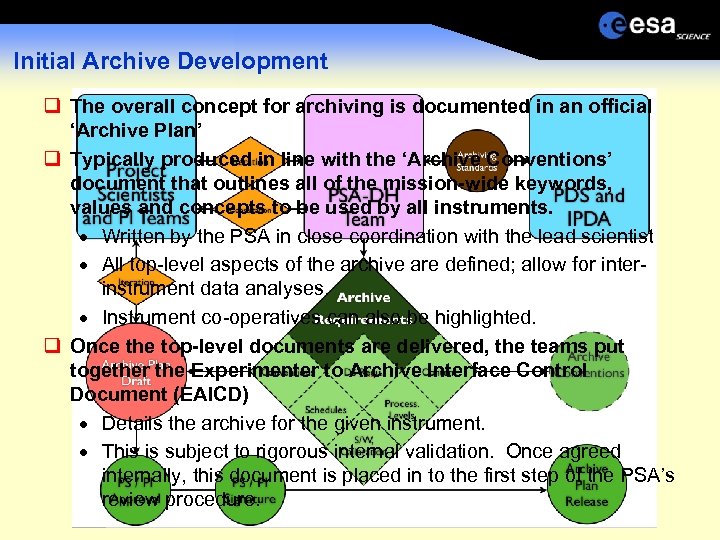 Initial Archive Development The overall concept for archiving is documented in an official ‘Archive Plan’ Typically produced in line with the ‘Archive Conventions’ document that outlines all of the mission-wide keywords, values and concepts to be used by all instruments. Written by the PSA in close coordination with the lead scientist All top-level aspects of the archive are defined; allow for interinstrument data analyses. Instrument co-operatives can also be highlighted. Once the top-level documents are delivered, the teams put together the Experimenter to Archive Interface Control Document (EAICD) Details the archive for the given instrument. This is subject to rigorous internal validation. Once agreed internally, this document is placed in to the first step of the PSA’s review procedure.
 Review Lifecycle
 Review Cycle Details Typically, reviews have been split into three main phases for the planetary missions o EAICD review: Internal review of documentation o First Delivery Review: Independent review of first data delivered for release to public. o For long ‘multi-flyby’ missions (e. g. Rosetta), reviews are held at each major milestone / flyby. o Final mission archive Review: Independent review of full mission archive, preparing for deep archiving. Data are NOT released in PSA until the independent review is fully closed.
 Basic Data Set Lifecycle
 Standard Validation Tools /Checks All data delivered to the PSA are subjected to a set of rigorous validation procedures. PVV Syntax validation: ensures syntax and the presence of all required keywords. No data can be ingested without full PVV compliance. PVS: completes more qualitative checks and ensures keyword values are consistent with the data themselves. Manual Checks: a series of spot-checks are made on all data deliveries to ensure data can be read and are useable. These vary greatly between the different instruments delivering data. The validation requirements are drawn from all archive documentation These are input primarily via the ‘PSA Dictionary’ and are then verified automatically by the PSA Volume Verifier (PVV) and PSA Validation System (PVS) tools.
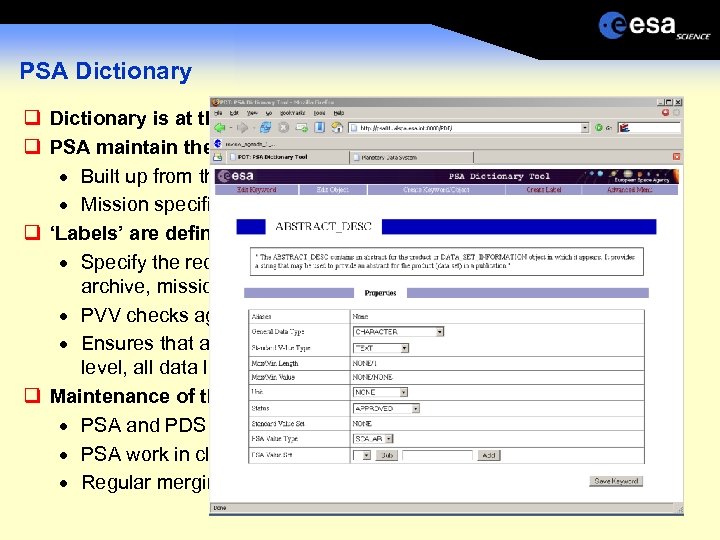 PSA Dictionary is at the heart of the validation PSA maintain their own ‘PSA Data Dictionary’ Built up from the PDS version. Mission specific ‘local data dictionaries’ defined. ‘Labels’ are defined at all levels within the archive Specify the required keywords for all labels belonging to a given archive, mission, instrument or sensor. PVV checks against these labels Ensures that all critical keywords are provided, and that at the firstlevel, all data labels in a given data set are identical. Maintenance of the dictionary PSA and PDS dictionaries have diverged as missions developed PSA work in close collaboration with the PDS Regular merging of dictionaries
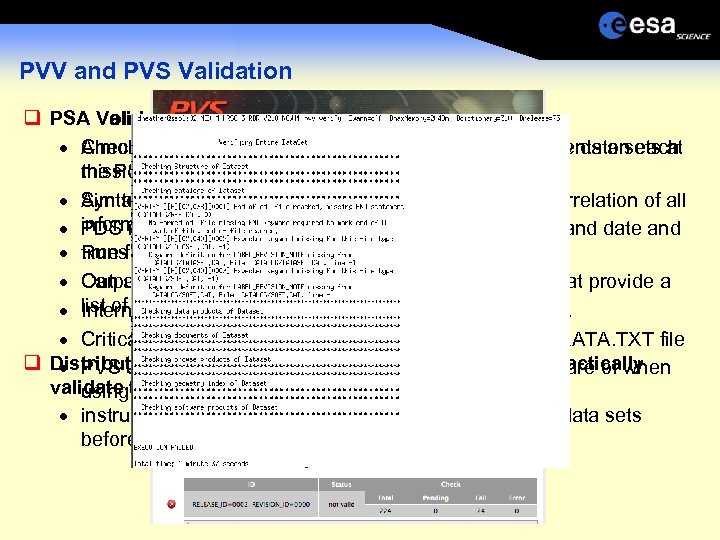 PVV and PVS Validation PSA Volume Verifier (PVV) Validation System (PVS) Checks qualitative validation conventions and requirements on each A more compliance with the step is completed on many data sets at the PSA mission / instrument, and with the PDS Standards Syntactic requirements of all labels and catalog files correlation of all Aim to ensure correctness, completeness and cross information, label and data content, within a data set. and date and PDS requirements such as line lengths for ASCII files, time formats. Runs within IDL Can alsoabe used to create the standard INDEX files that provide a Outputs report that can be visualized via a website. list of all. PSA tool and there are no plans for distribution. Internal data and browse products in a data set. Critical aspects of the report can be included in an ERRATA. TXT file Distributed toto flag issues that an allowing them to syntactically PVS used all data providers, end-user should be aware of when validate their data at all phases using the data. instrument teams are required to run the PVV on their data sets before delivering to the PSA.
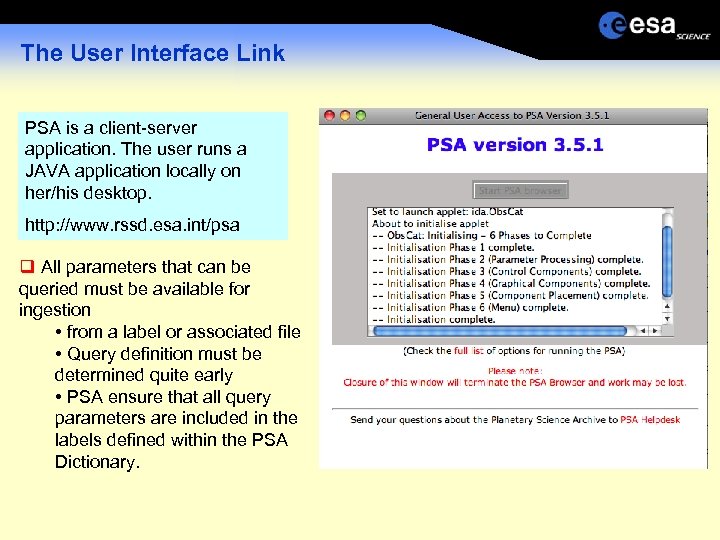 The User Interface Link PSA is a client-server application. The user runs a JAVA application locally on her/his desktop. http: //www. rssd. esa. int/psa All parameters that can be queried must be available for ingestion • from a label or associated file • Query definition must be determined quite early • PSA ensure that all query parameters are included in the labels defined within the PSA Dictionary.
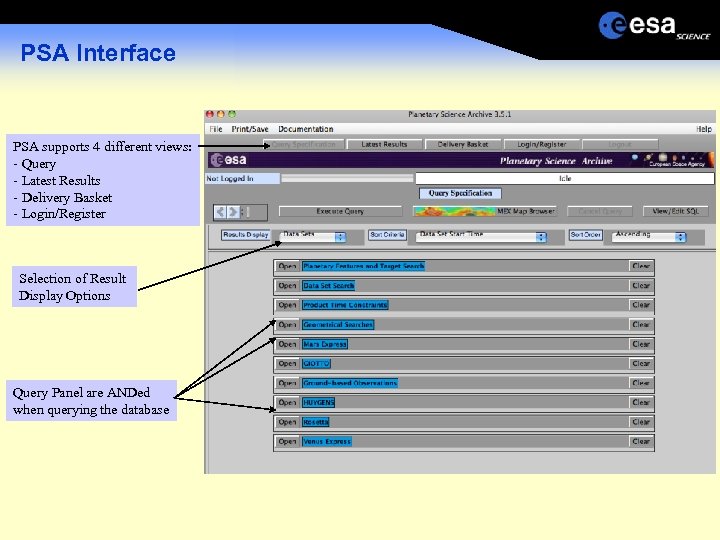 PSA Interface PSA supports 4 different views: - Query - Latest Results - Delivery Basket - Login/Register Selection of Result Display Options Query Panel are ANDed when querying the database
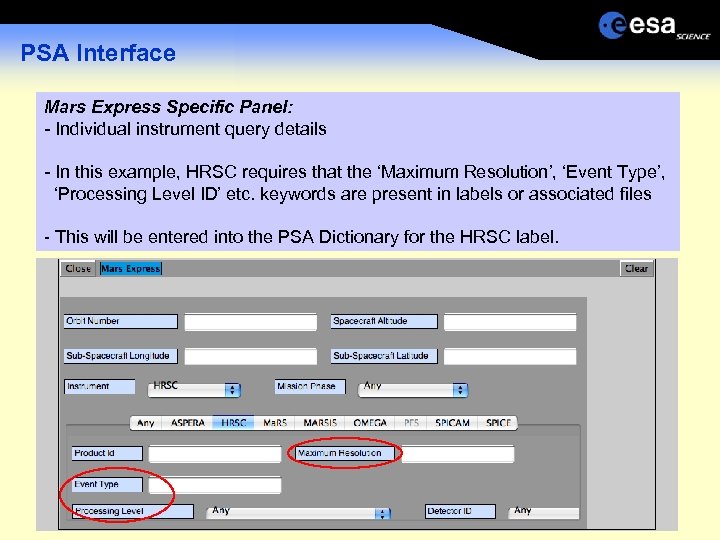 PSA Interface Mars Express Specific Panel: - Individual instrument query details - In this example, HRSC requires that the ‘Maximum Resolution’, ‘Event Type’, ‘Processing Level ID’ etc. keywords are present in labels or associated files - This will be entered into the PSA Dictionary for the HRSC label.
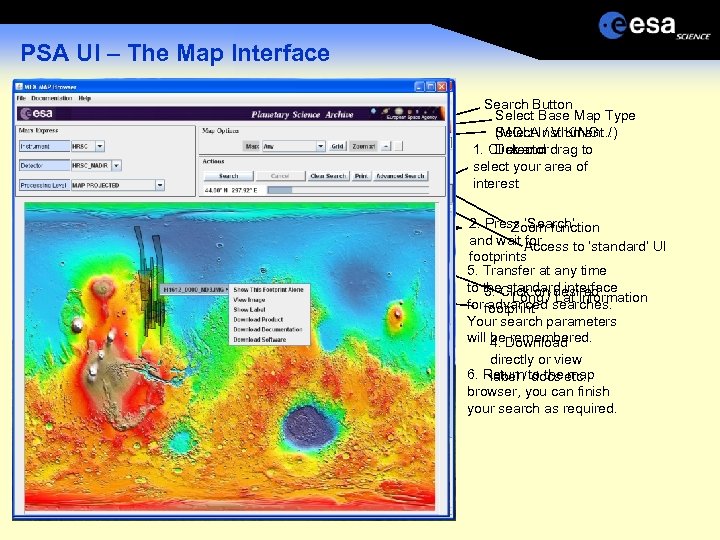 PSA UI – The Map Interface Search Button Select Base Map Type (MOLAInstrument / Select / VIKING…) Detector 1. Click and drag to select your area of interest 2. Press ‘Search’ Zoom function and wait Access to ‘standard’ UI for footprints 5. Transfer at any time to the. Click on desired 3. standard interface Long / Lat information for footprint searches. advanced Your search parameters will 4. Download be remembered. directly or view 6. Return/ to the etc. label docs map browser, you can finish your search as required.
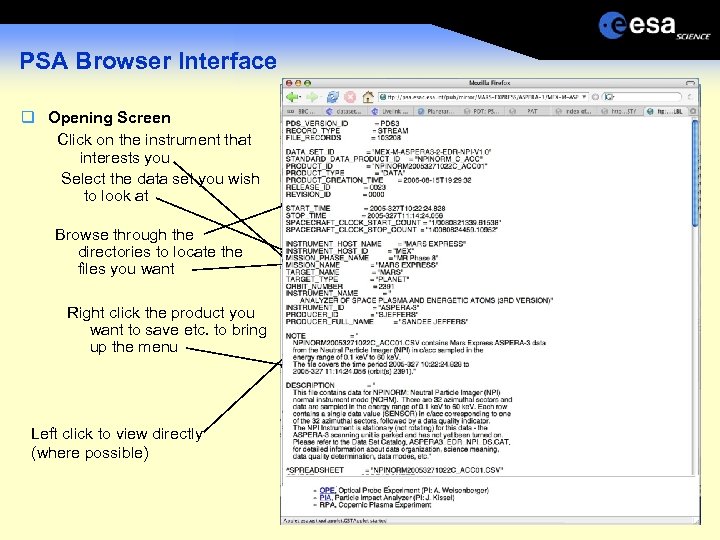 PSA Browser Interface Opening Screen Click on the instrument that interests you Select the data set you wish to look at Browse through the directories to locate the files you want Right click the product you want to save etc. to bring up the menu Left click to view directly (where possible)
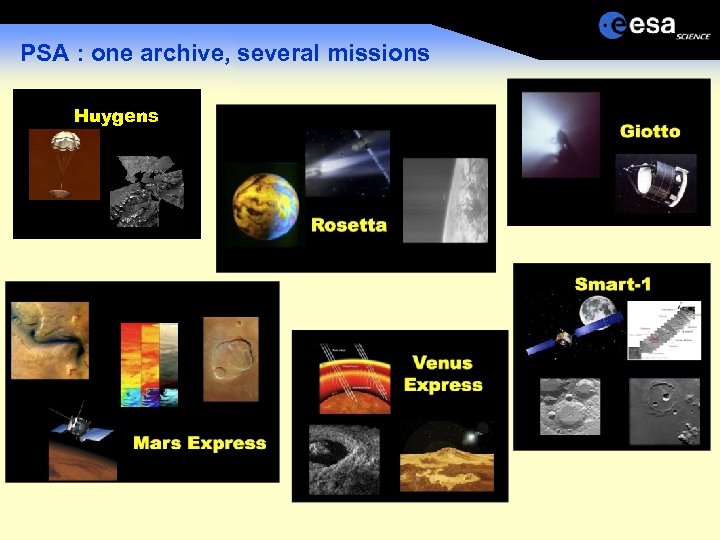 PSA : one archive, several missions Huygens
 Current Status, Available Datasets Ø Ø Ø Ø GIOTTO data from comet Halley and Gripp-Skellerup Comet Halley ground-based observations (Halley-Watch) Comet Wirtanen ground-based observations Mars Express instrument and auxiliary data (ongoing) Venus Express instrument and auxiliary data (ongoing) Smart-1 instrument and auxiliary data (pending) Rosetta instrument and auxiliary data (ongoing , Peer Reviews in progress ) Ø Huygens (complete) Ø Bepi. Colombo data handling and archive support – in preparation Ø ESA supported instruments on Chandrayaan 1 – pipeline development and support from PSA
 IPDA and the Future The PSA work very closely with experts at NASA’s PDS as the Standards continue to develop. Archiving experts from all major countries involved in planetary exploration form the International Planetary Data Alliance (IPDA). One of the main objectives of this group is to try to develop data and archives that are inter-operable. Validation of data to allow for this interoperability will be a future requirement in addition to the standard validations already discussed The validation system is designed to ensures that all of ESA’s planetary data will be available and useful to the community for many years after the mission has ended, and that they will be as compatible with as many other planetary archive data as possible. Time will tell!. . .