 Скачать презентацию ESA Project Evolution 2012 2016 Mateete Bekunda
cafeb237670c748192b45076ccfb55ac.ppt
- Количество слайдов: 19



ESA Project Evolution: 2012 – 2016 Mateete Bekunda AR-ESA Phase 1 Legacy Meeting 30 June , 2016 Dar es Salaam Tanzania
The presentation §Project evolution §Management evolution §Implementation evolution §Lessons learned
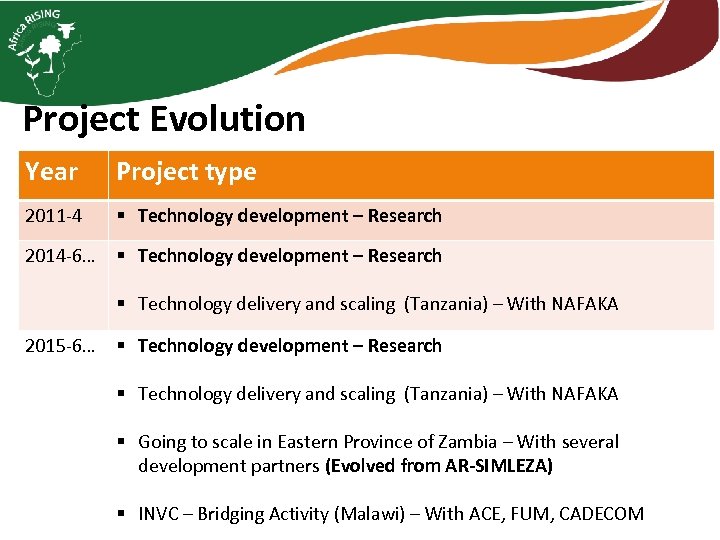
Project Evolution Year Project type 2011 -4 § Technology development – Research 2014 -6… § Technology development – Research § Technology delivery and scaling (Tanzania) – With NAFAKA 2015 -6… § Technology development – Research § Technology delivery and scaling (Tanzania) – With NAFAKA § Going to scale in Eastern Province of Zambia – With several development partners (Evolved from AR-SIMLEZA) § INVC – Bridging Activity (Malawi) – With ACE, FUM, CADECOM
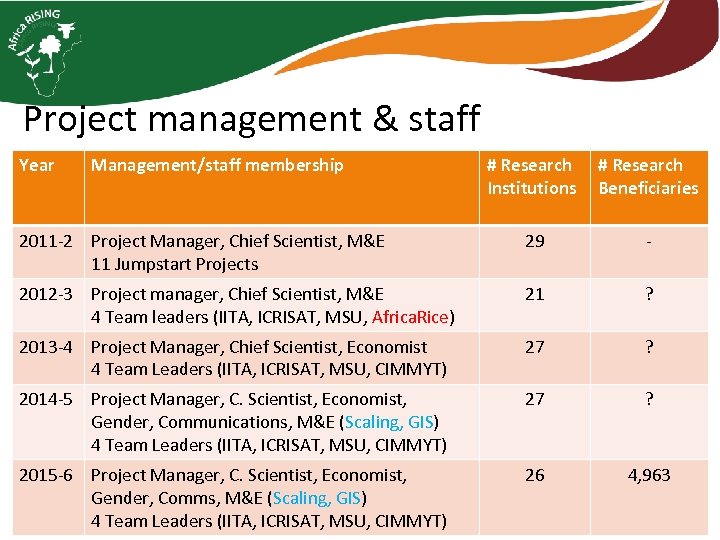
Project management & staff Year Management/staff membership # Research Institutions # Research Beneficiaries 2011 -2 Project Manager, Chief Scientist, M&E 11 Jumpstart Projects 29 - 2012 -3 Project manager, Chief Scientist, M&E 4 Team leaders (IITA, ICRISAT, MSU, Africa. Rice) 21 ? 2013 -4 Project Manager, Chief Scientist, Economist 4 Team Leaders (IITA, ICRISAT, MSU, CIMMYT) 27 ? 2014 -5 Project Manager, C. Scientist, Economist, Gender, Communications, M&E (Scaling, GIS) 4 Team Leaders (IITA, ICRISAT, MSU, CIMMYT) 27 ? 2015 -6 Project Manager, C. Scientist, Economist, Gender, Comms, M&E (Scaling, GIS) 4 Team Leaders (IITA, ICRISAT, MSU, CIMMYT) 26 4, 963
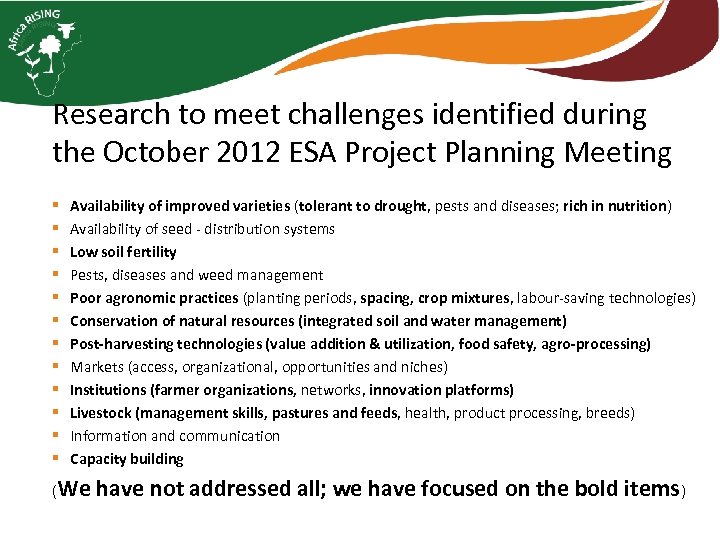
Research to meet challenges identified during the October 2012 ESA Project Planning Meeting § § § Availability of improved varieties (tolerant to drought, pests and diseases; rich in nutrition) Availability of seed - distribution systems Low soil fertility Pests, diseases and weed management Poor agronomic practices (planting periods, spacing, crop mixtures, labour-saving technologies) Conservation of natural resources (integrated soil and water management) Post-harvesting technologies (value addition & utilization, food safety, agro-processing) Markets (access, organizational, opportunities and niches) Institutions (farmer organizations, networks, innovation platforms) Livestock (management skills, pastures and feeds, health, product processing, breeds) Information and communication Capacity building (We have not addressed all; we have focused on the bold items)
Research to meet challenges identified by baseline studies § Most work packages conducted baseline studies that guided entry and refinement of the research designs (Three publications) § ARBES by IFPRI (presentation from IFPRI on typologies) § Farming Systems Analyses – farm diversity & choice of innovations.
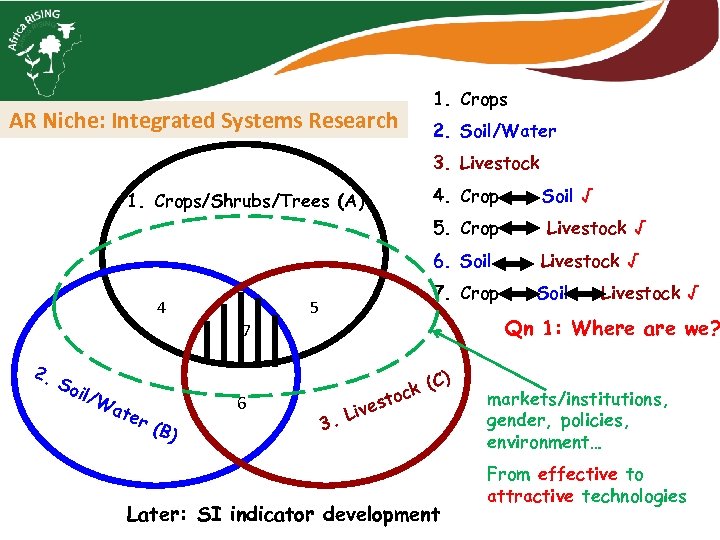
AR Niche: Integrated Systems Research 1. Crops 2. Soil/Water 3. Livestock 4. Crop Soil √ 5. Crop 1. Crops/Shrubs/Trees (A) Livestock √ 6. Soil 5 4 Livestock √ 7. Crop Soil Qn 1: Where are we? 7 2. So il/W ate r (B) 6 Livestock √ (C) ck sto ive. L 3 Later: SI indicator development markets/institutions, gender, policies, environment… From effective to attractive technologies
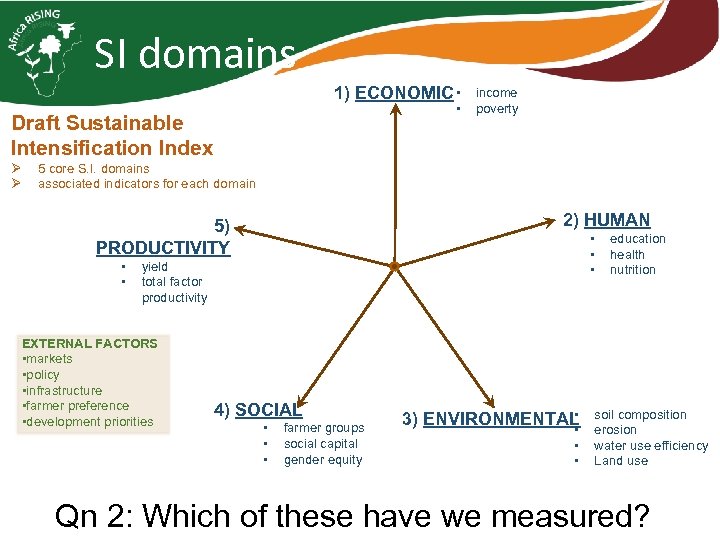
SI domains 1) ECONOMIC • • Draft Sustainable Intensification Index Ø Ø income poverty 5 core S. I. domains associated indicators for each domain 2) HUMAN 5) PRODUCTIVITY • • • yield total factor productivity EXTERNAL FACTORS • markets • policy • infrastructure • farmer preference • development priorities 4) SOCIAL • • • farmer groups social capital gender equity • 3) ENVIRONMENTAL • • • education health nutrition soil composition erosion water use efficiency Land use Qn 2: Which of these have we measured?
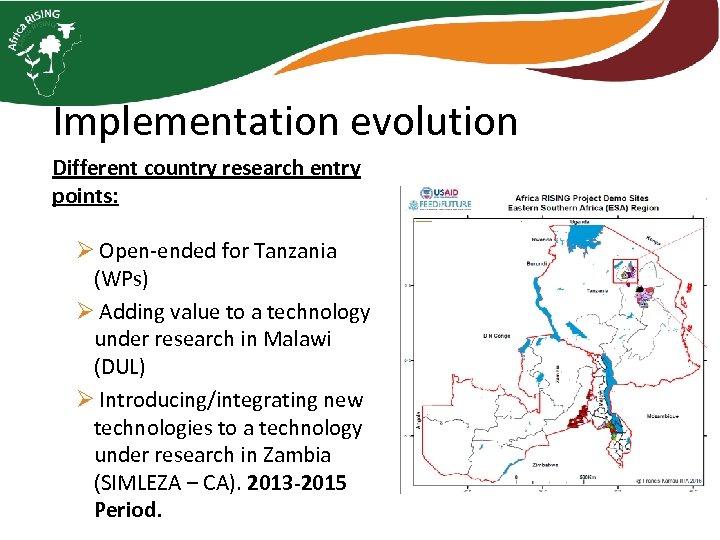
Implementation evolution Different country research entry points: Ø Open-ended for Tanzania (WPs) Ø Adding value to a technology under research in Malawi (DUL) Ø Introducing/integrating new technologies to a technology under research in Zambia (SIMLEZA – CA). 2013 -2015 Period. .
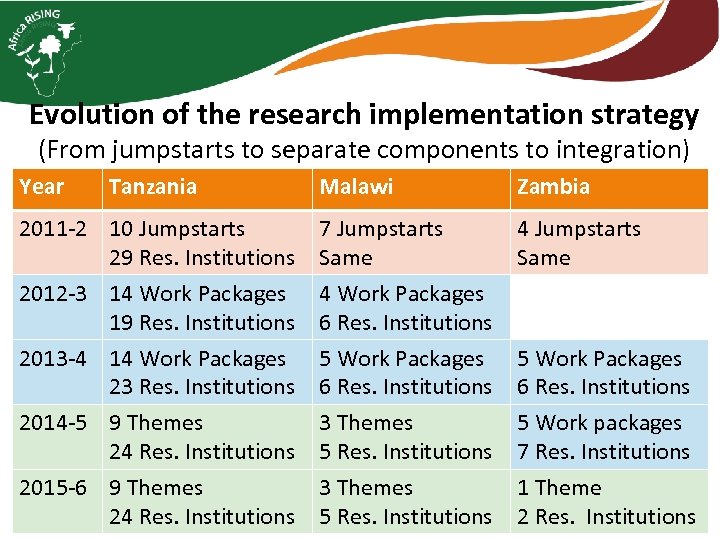
Evolution of the research implementation strategy (From jumpstarts to separate components to integration) Year Tanzania 2011 -2 10 Jumpstarts 29 Res. Institutions 2012 -3 14 Work Packages 19 Res. Institutions 2013 -4 14 Work Packages 23 Res. Institutions 2014 -5 9 Themes 24 Res. Institutions 2015 -6 9 Themes 24 Res. Institutions Malawi Zambia 7 Jumpstarts Same 4 Work Packages 6 Res. Institutions 5 Work Packages 6 Res. Institutions 3 Themes 5 Res. Institutions 4 Jumpstarts Same 5 Work Packages 6 Res. Institutions 5 Work packages 7 Res. Institutions 1 Theme 2 Res. Institutions
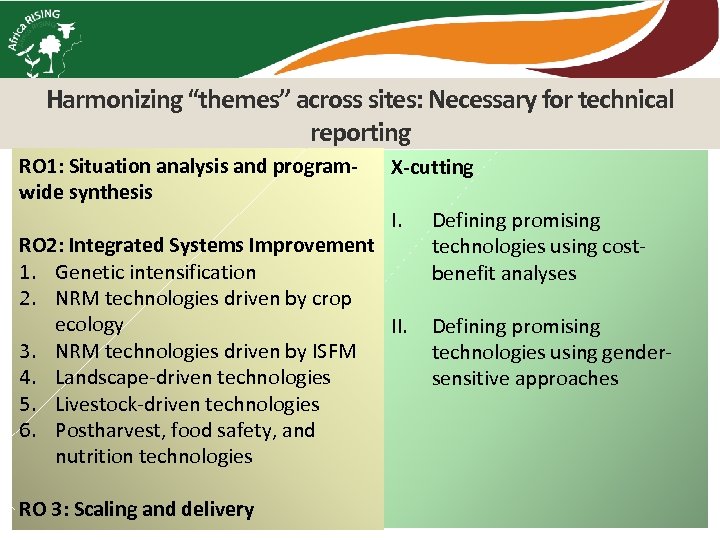
Harmonizing “themes” across sites: Necessary for technical reporting RO 1: Situation analysis and programwide synthesis X-cutting I. RO 2: Integrated Systems Improvement 1. Genetic intensification 2. NRM technologies driven by crop ecology II. 3. NRM technologies driven by ISFM 4. Landscape-driven technologies 5. Livestock-driven technologies 6. Postharvest, food safety, and nutrition technologies RO 3: Scaling and delivery Defining promising technologies using costbenefit analyses Defining promising technologies using gendersensitive approaches
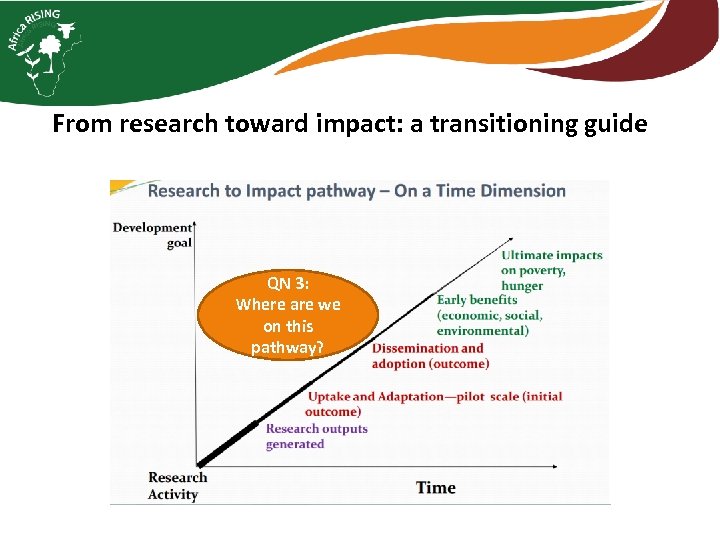
From research toward impact: a transitioning guide QN 3: Where are we on this pathway?
Lessons learned Promises are not necessarily debts! This is not the first writeshop! We commit but do not refer back to this in guiding our progress (framework, logframe…) We set targets and mainly under-achieve (2015: Ft. F Target 8474; actual 1793! – 30 514) Meeting timelines is a challenge. Requires whips! Partnerships Functional partnership formation takes time, and requires one’s time commitment Thinking out of the box is difficult for researchers (disciplinary, rather than multidisciplinary) Available expertise has focused on production issues; other aspects of the value chain (input-output markets, processing, nutrition) have not received attention.
Lessons learned Implementation There are high expectations for a complex project with limited funds (sometimes we set them ourselves!) Complex efforts like those in Tanzania, do not yield immediate results; difficult to visualise by evaluators (including M&E) Scaling so far is more about component technologies not about a systems approach But we are getting there…
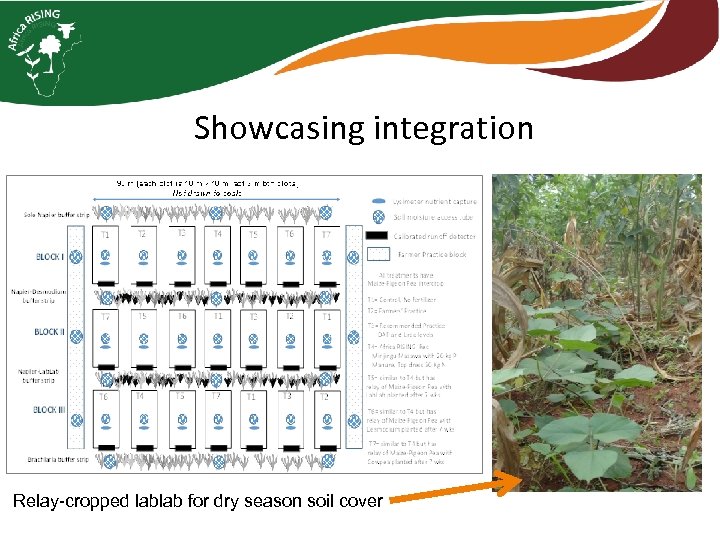
Showcasing integration Relay-cropped lablab for dry season soil cover
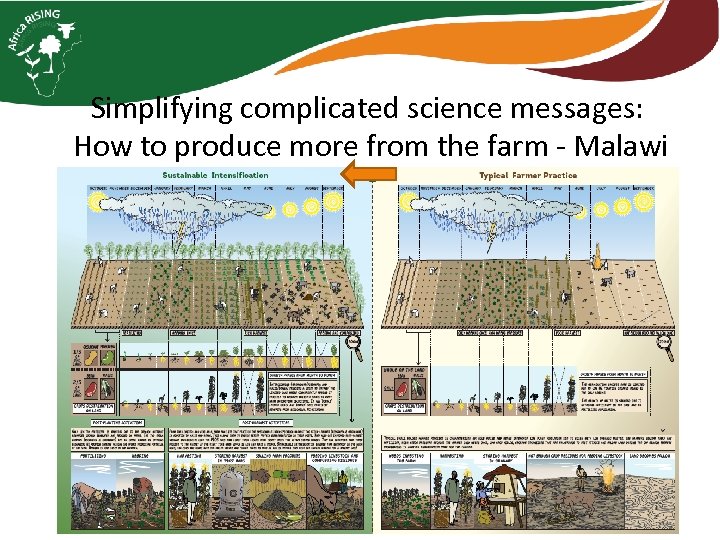
Simplifying complicated science messages: How to produce more from the farm - Malawi
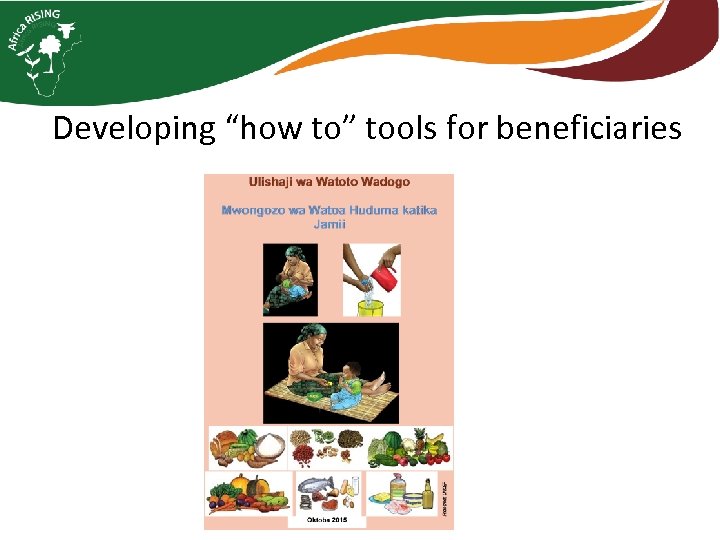
Developing “how to” tools for beneficiaries
International Conference on Climate Change and Multi-dimensional Sustainability in African Agriculture June 3 – 5, 2015 Sustainable intensification in Mixed Crop -Livestock Agro-Ecosystems in the face of Climate Change: The Case for Tanzania Strong Africa RISING Identity AFRICA RISING TEAM TANZANIA JUNE 3 -6, 2015 HILUX HOTEL, MOROGORO, TANZANIA
Thank you
Скачать презентацию ESA Project Evolution 2012 2016 Mateete Bekunda
cafeb237670c748192b45076ccfb55ac.ppt