


 Скачать презентацию ERROR RECOGNITION IMAGE ANALYSIS Ed Fomalont NRAO
1c5d6799ed70f80a5aded6f813cba7de.ppt
- Количество слайдов: 57
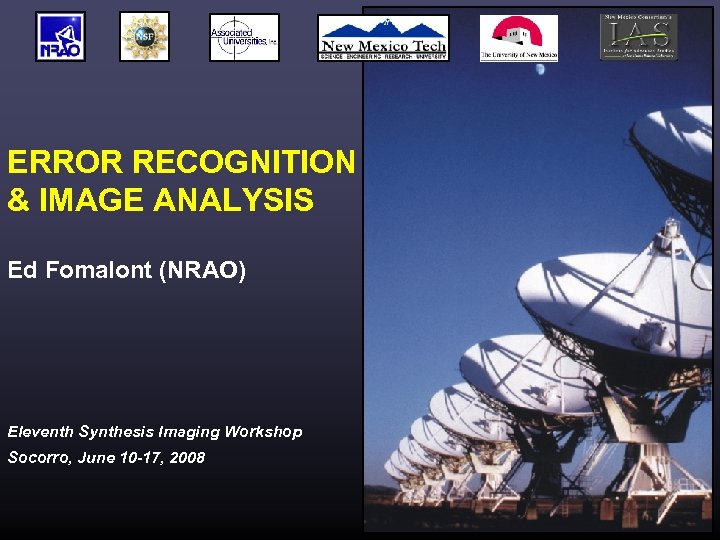 ERROR RECOGNITION & IMAGE ANALYSIS Ed Fomalont (NRAO) Eleventh Synthesis Imaging Workshop Socorro, June 10 -17, 2008
 PREMABLE TO ERROR RECOGNITION and IMAGE ANALYSIS • Why are these two topics in the same lecture? -- Error recognition is used to determine defects in the data and image during and after the ‘best’ calibration, editing, etc. -- Image analysis describes the almost infinite ways in which useful insight, information and parameters can be extracted from the image. • Perhaps the two topics are related to the reaction one has when looking at an image after ‘good’ calibration, editing, self-calibration, etc. • If the reaction is: Eleventh Synthesis Imaging Workshop, June 10 -17, 2008 2
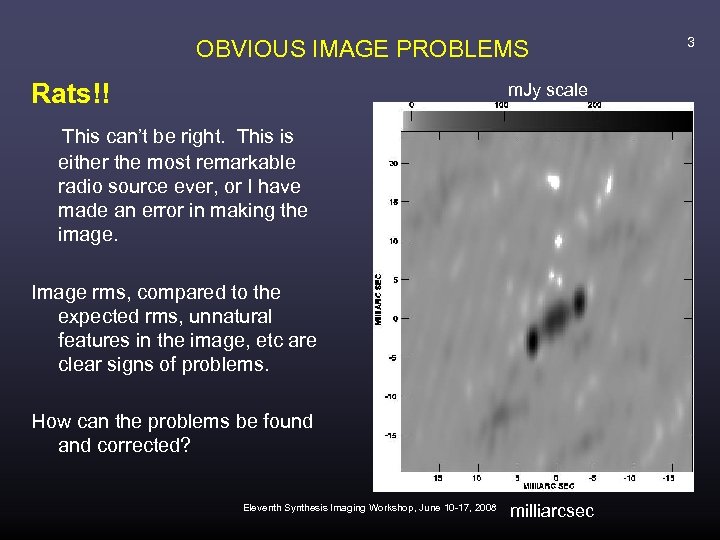 OBVIOUS IMAGE PROBLEMS Rats!! m. Jy scale This can’t be right. This is either the most remarkable radio source ever, or I have made an error in making the image. Image rms, compared to the expected rms, unnatural features in the image, etc are clear signs of problems. How can the problems be found and corrected? Eleventh Synthesis Imaging Workshop, June 10 -17, 2008 milliarcsec 3
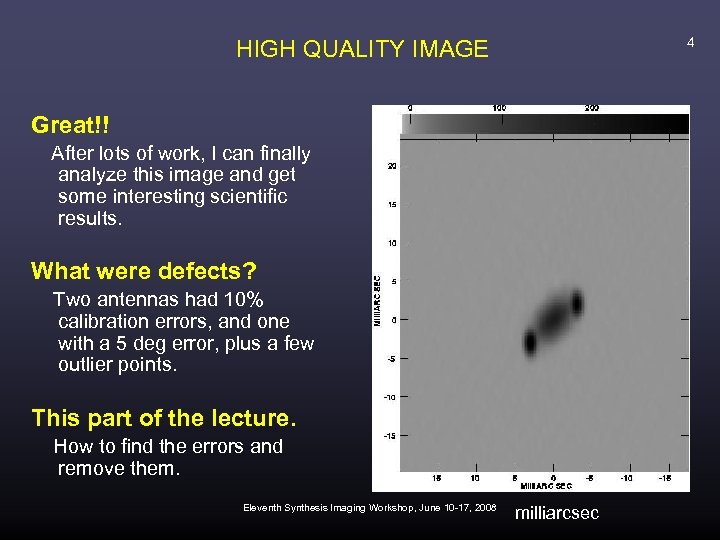 4 HIGH QUALITY IMAGE Great!! After lots of work, I can finally analyze this image and get some interesting scientific results. What were defects? Two antennas had 10% calibration errors, and one with a 5 deg error, plus a few outlier points. This part of the lecture. How to find the errors and remove them. Eleventh Synthesis Imaging Workshop, June 10 -17, 2008 milliarcsec
 GENERAL PROCEDURE Assuming that the data have been edited and calibrated reasonably successfully (earlier lectures). Self-calibration is usually necessary. So, the first serious display of an image leads one-to inspect again and clean-up the data with repetition of some or all of the previous reduction steps. to image analysis and obtaining scientific results from the image. But, first a digression on data and image display. Eleventh Synthesis Imaging Workshop, June 10 -17, 2008 5
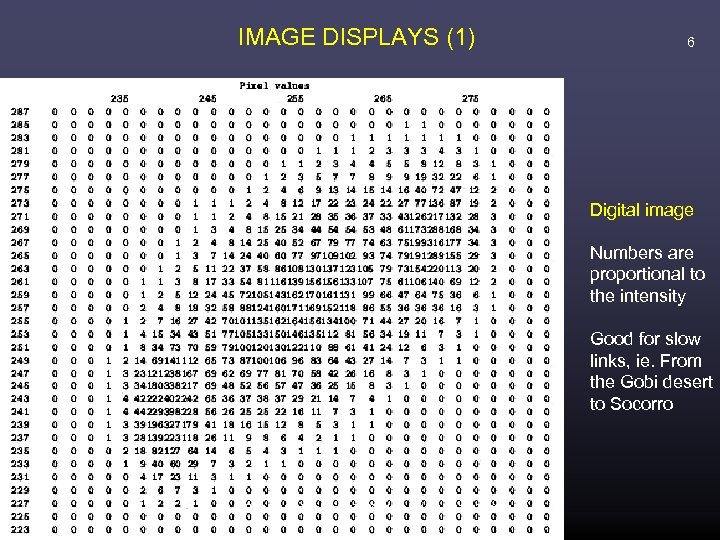 IMAGE DISPLAYS (1) 6 Digital image Numbers are proportional to the intensity Good for slow links, ie. From the Gobi desert to Socorro Eleventh Synthesis Imaging Workshop, June 10 -17, 2008
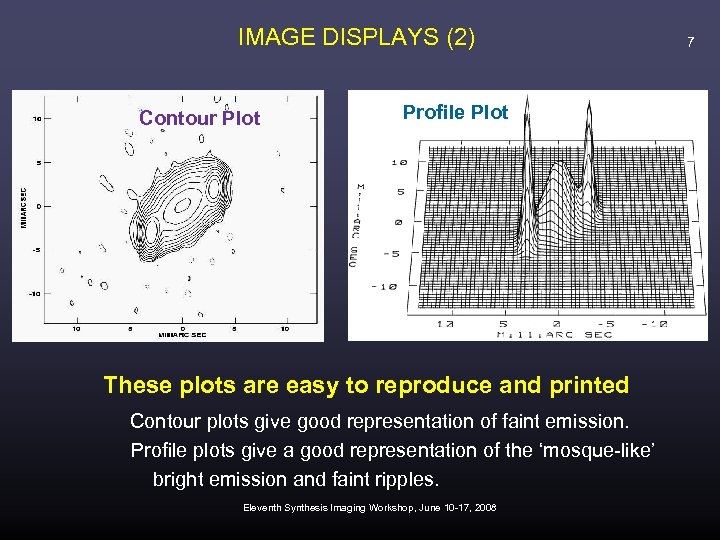 IMAGE DISPLAYS (2) Contour Plot Profile Plot These plots are easy to reproduce and printed Contour plots give good representation of faint emission. Profile plots give a good representation of the ‘mosque-like’ bright emission and faint ripples. Eleventh Synthesis Imaging Workshop, June 10 -17, 2008 7
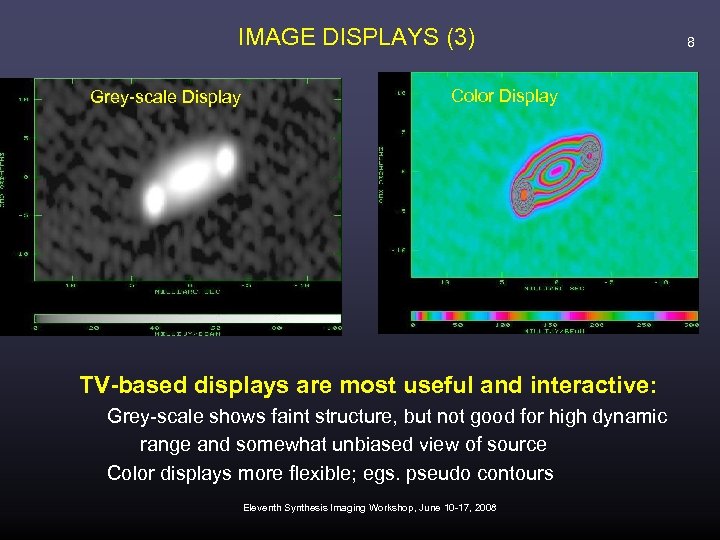 IMAGE DISPLAYS (3) Grey-scale Display Profile Plot Contour Plot Color Display TV-based displays are most useful and interactive: Grey-scale shows faint structure, but not good for high dynamic range and somewhat unbiased view of source Color displays more flexible; egs. pseudo contours Eleventh Synthesis Imaging Workshop, June 10 -17, 2008 8
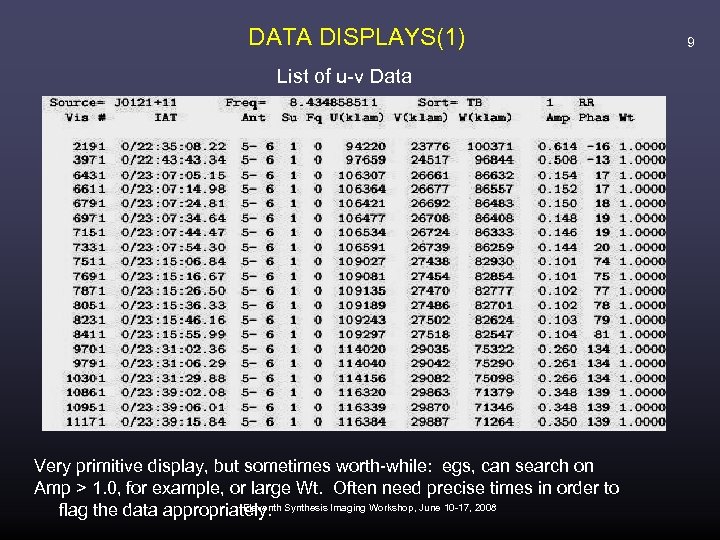 DATA DISPLAYS(1) List of u-v Data Very primitive display, but sometimes worth-while: egs, can search on Amp > 1. 0, for example, or large Wt. Often need precise times in order to Eleventh flag the data appropriately. Synthesis Imaging Workshop, June 10 -17, 2008 9
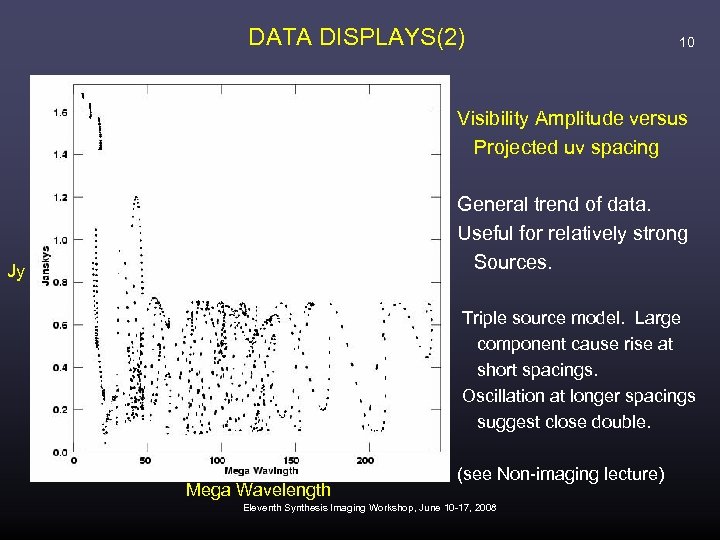 DATA DISPLAYS(2) 10 Visibility Amplitude versus Projected uv spacing General trend of data. Useful for relatively strong Sources. Jy Triple source model. Large component cause rise at short spacings. Oscillation at longer spacings suggest close double. Mega Wavelength (see Non-imaging lecture) Eleventh Synthesis Imaging Workshop, June 10 -17, 2008
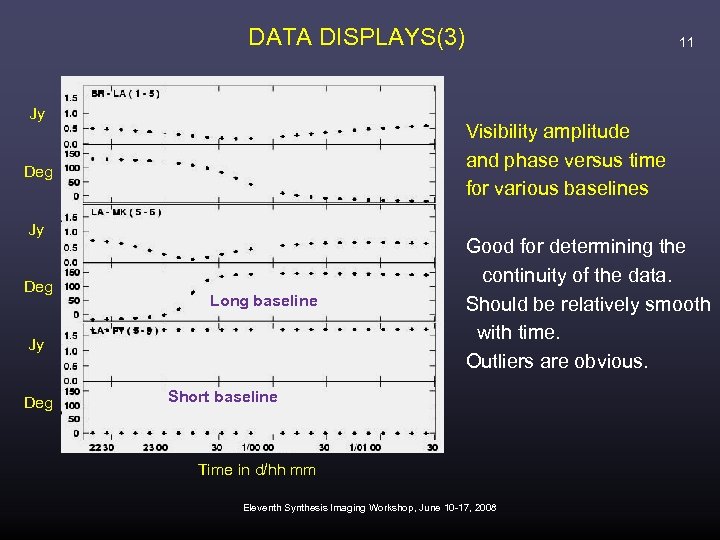 DATA DISPLAYS(3) Jy Visibility amplitude and phase versus time for various baselines Deg Jy Deg Long baseline Jy Deg 11 Good for determining the continuity of the data. Should be relatively smooth with time. Outliers are obvious. Short baseline Time in d/hh mm Eleventh Synthesis Imaging Workshop, June 10 -17, 2008
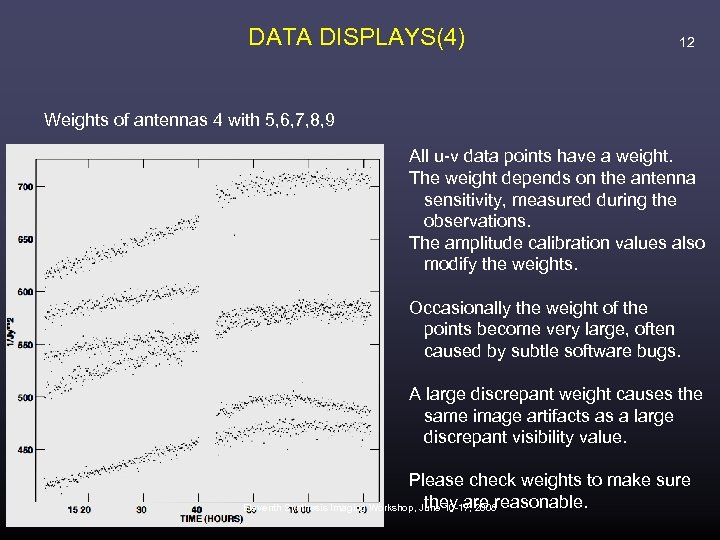 DATA DISPLAYS(4) 12 Weights of antennas 4 with 5, 6, 7, 8, 9 All u-v data points have a weight. The weight depends on the antenna sensitivity, measured during the observations. The amplitude calibration values also modify the weights. Occasionally the weight of the points become very large, often caused by subtle software bugs. A large discrepant weight causes the same image artifacts as a large discrepant visibility value. Please check weights to make sure they are reasonable. Eleventh Synthesis Imaging Workshop, June 10 -17, 2008
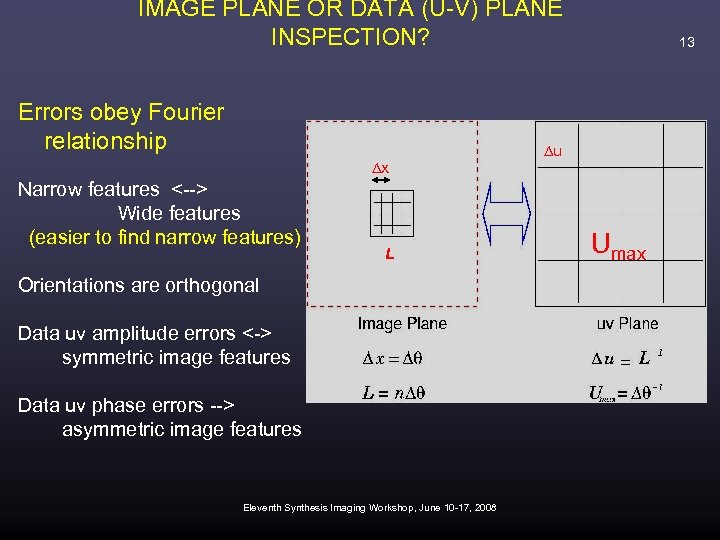 IMAGE PLANE OR DATA (U-V) PLANE INSPECTION? Errors obey Fourier relationship x Narrow features <--> Wide features (easier to find narrow features) L Orientations are orthogonal Data uv amplitude errors <-> symmetric image features Data uv phase errors --> asymmetric image features Eleventh Synthesis Imaging Workshop, June 10 -17, 2008 13 u Umax
 GOLDEN RULE OF FINDING ERRORS ---Obvious outlier data (u-v) points: 100 bad points in 100, 000 data points gives an 0. 1% image error (unless the bad data points are 1 million Jy) LOOK at DATA to find gross problem (but don’t go overboard) FURTHER OPPORTUNITIES TO FIND BAD DATA! ---Persistent small data errors: egs a 5% antenna gain calibration error is difficult to see in (u-v) data (not an obvious outlier), but will produce a 1% effect in image with specific characteristics (more later). USE IMAGE to discover problem ---Non-Data Problems: Perfect data but unstable algorithms. Common but difficult to discern Eleventh Synthesis Imaging Workshop, June 10 -17, 2008 14
 ERROR RECOGNITION IN THE U-V PLANE Editing obvious errors in the u-v plane ---Mostly consistency checks assume that the visibility cannot change much over a small change in u-v spacing ---Also, double check gains and phases from calibration processes. These values should be relatively stable. See Summer school lecture notes in 2002 by Myers See ASP Vol 180, Ekers, Lecture 15, p 321 Eleventh Synthesis Imaging Workshop, June 10 -17, 2008 15
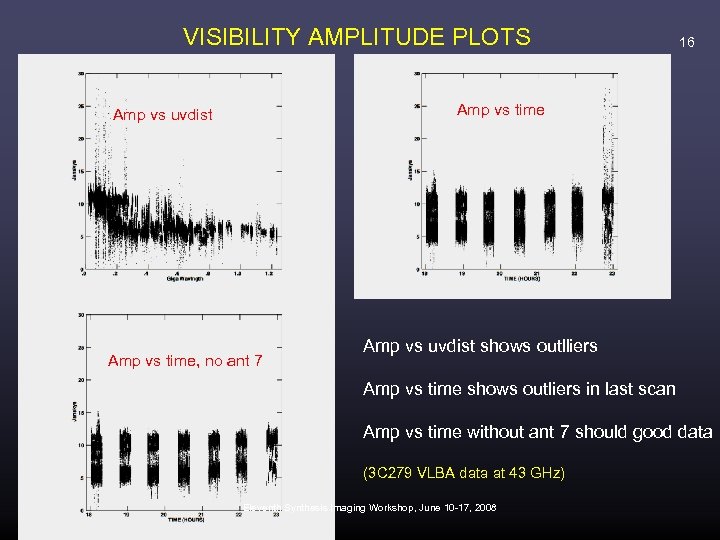 VISIBILITY AMPLITUDE PLOTS 16 Amp vs time Amp vs uvdist Amp vs time, no ant 7 Amp vs uvdist shows outlliers Amp vs time shows outliers in last scan Amp vs time without ant 7 should good data (3 C 279 VLBA data at 43 GHz) Eleventh Synthesis Imaging Workshop, June 10 -17, 2008
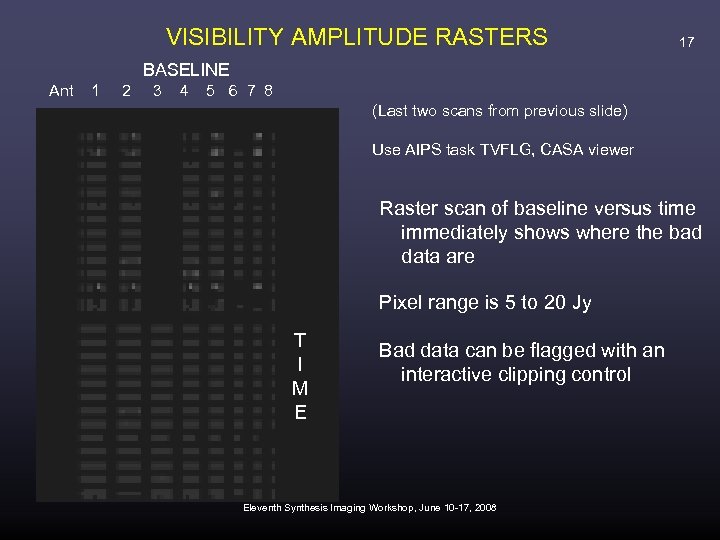 VISIBILITY AMPLITUDE RASTERS 17 BASELINE Ant 1 2 3 4 5 6 7 8 (Last two scans from previous slide) Use AIPS task TVFLG, CASA viewer Raster scan of baseline versus time immediately shows where the bad data are Pixel range is 5 to 20 Jy T I M E Bad data can be flagged with an interactive clipping control Eleventh Synthesis Imaging Workshop, June 10 -17, 2008
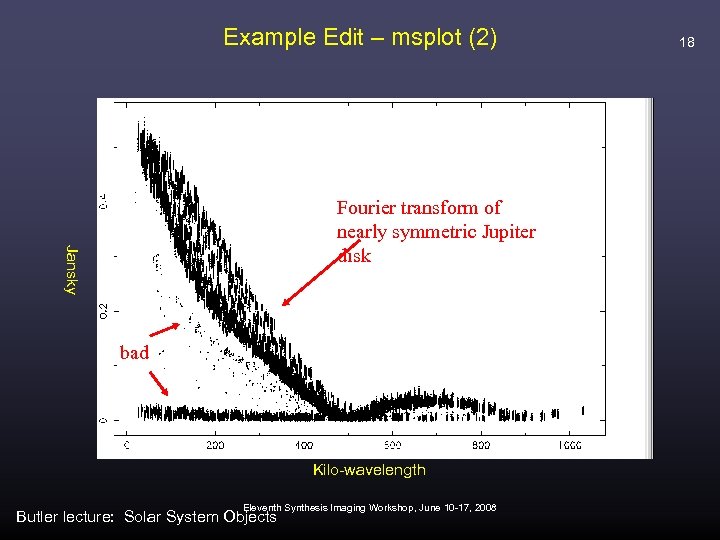 Example Edit – msplot (2) Jansky Fourier transform of nearly symmetric Jupiter disk bad Kilo-wavelength Eleventh Synthesis Imaging Workshop, June 10 -17, 2008 Butler lecture: Solar System Objects 18
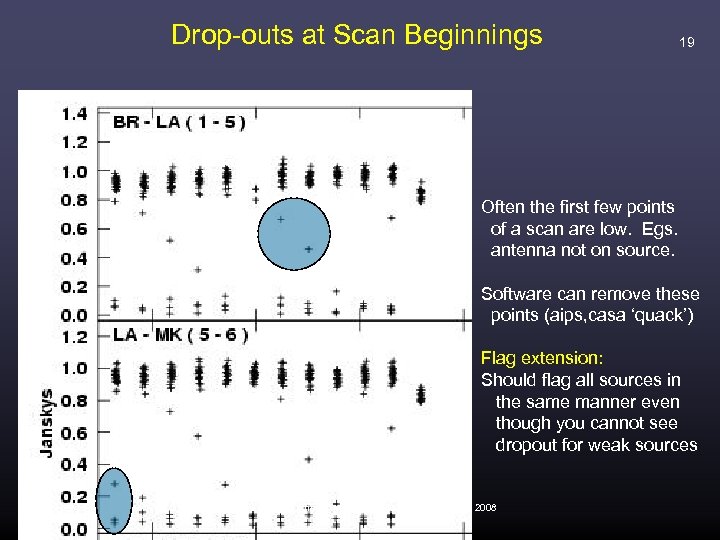 Drop-outs at Scan Beginnings 19 Often the first few points of a scan are low. Egs. antenna not on source. Software can remove these points (aips, casa ‘quack’) Flag extension: Should flag all sources in the same manner even though you cannot see dropout for weak sources Eleventh Synthesis Imaging Workshop, June 10 -17, 2008
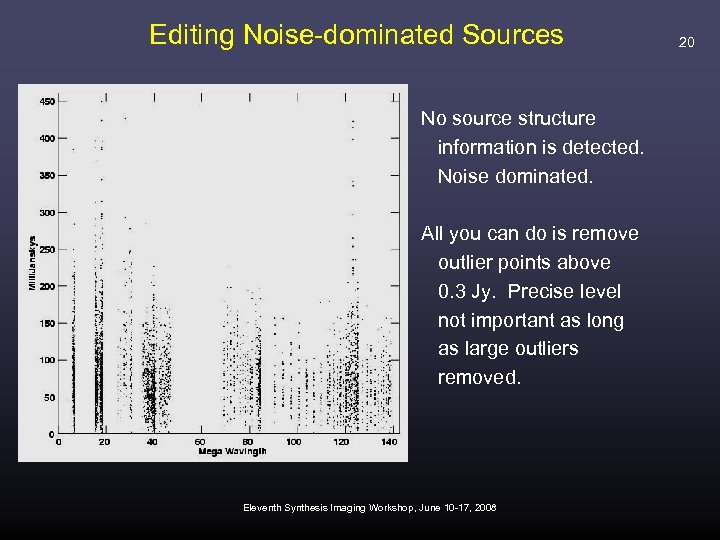 Editing Noise-dominated Sources No source structure information is detected. Noise dominated. All you can do is remove outlier points above 0. 3 Jy. Precise level not important as long as large outliers removed. Eleventh Synthesis Imaging Workshop, June 10 -17, 2008 20
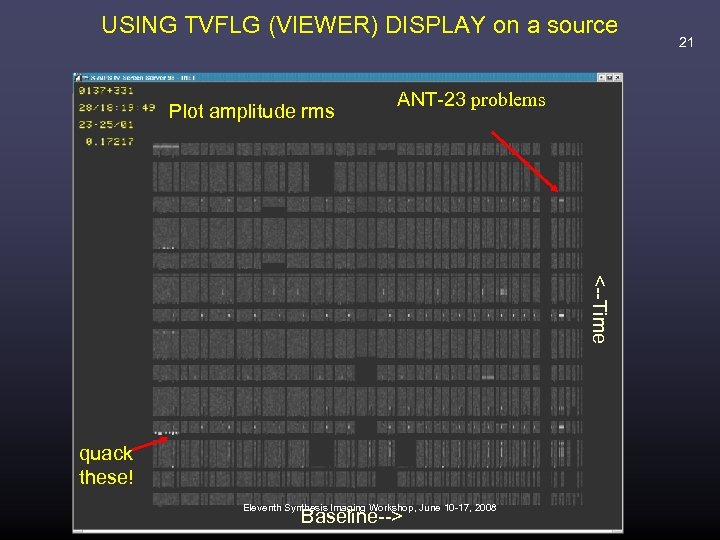 USING TVFLG (VIEWER) DISPLAY on a source Plot amplitude rms ANT-23 problems <--Time quack these! Eleventh Synthesis Imaging Workshop, June 10 -17, 2008 Baseline--> 21
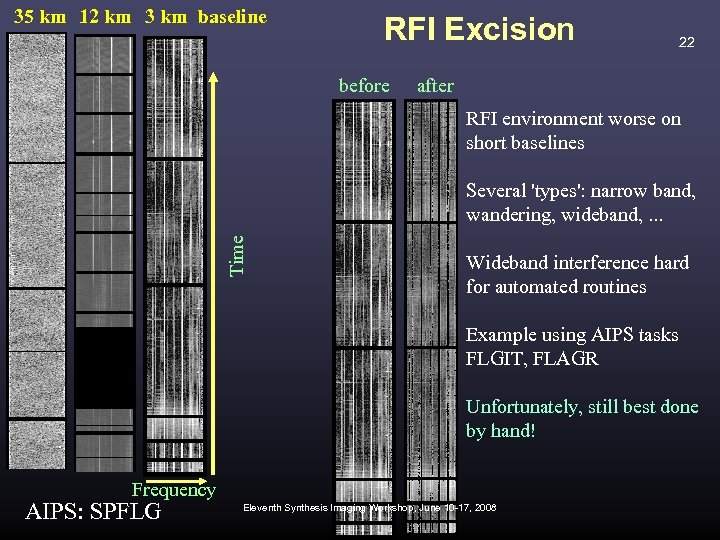 35 km 12 km 3 km baseline RFI Excision before 22 after RFI environment worse on short baselines Time Several 'types': narrow band, wandering, wideband, . . . Wideband interference hard for automated routines Example using AIPS tasks FLGIT, FLAGR Unfortunately, still best done by hand! Frequency AIPS: SPFLG Eleventh Synthesis Imaging Workshop, June 10 -17, 2008
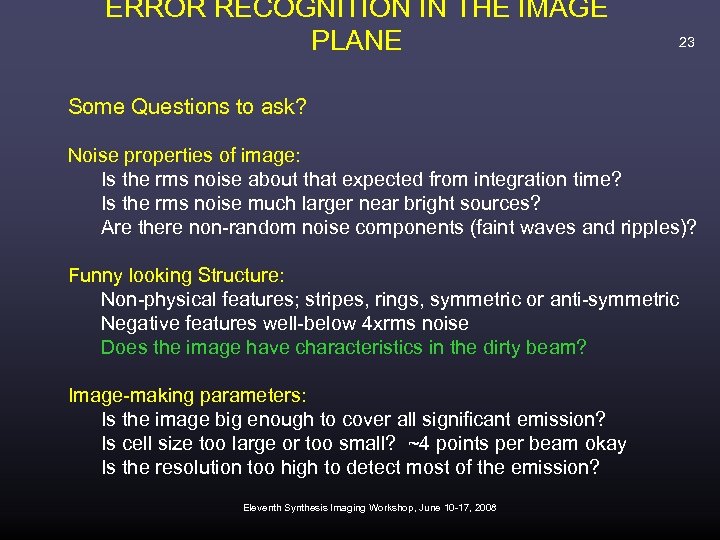 ERROR RECOGNITION IN THE IMAGE PLANE 23 Some Questions to ask? Noise properties of image: Is the rms noise about that expected from integration time? Is the rms noise much larger near bright sources? Are there non-random noise components (faint waves and ripples)? Funny looking Structure: Non-physical features; stripes, rings, symmetric or anti-symmetric Negative features well-below 4 xrms noise Does the image have characteristics in the dirty beam? Image-making parameters: Is the image big enough to cover all significant emission? Is cell size too large or too small? ~4 points per beam okay Is the resolution too high to detect most of the emission? Eleventh Synthesis Imaging Workshop, June 10 -17, 2008
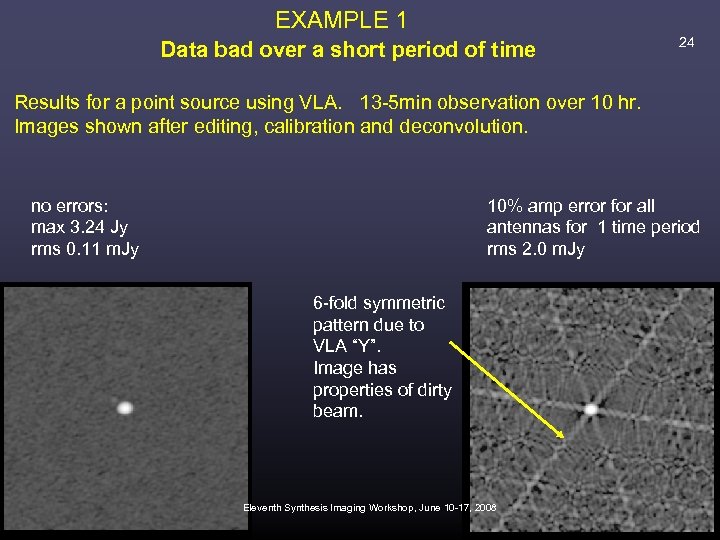 EXAMPLE 1 Data bad over a short period of time 24 Results for a point source using VLA. 13 -5 min observation over 10 hr. Images shown after editing, calibration and deconvolution. no errors: max 3. 24 Jy rms 0. 11 m. Jy 10% amp error for all antennas for 1 time period rms 2. 0 m. Jy 6 -fold symmetric pattern due to VLA “Y”. Image has properties of dirty beam. Eleventh Synthesis Imaging Workshop, June 10 -17, 2008
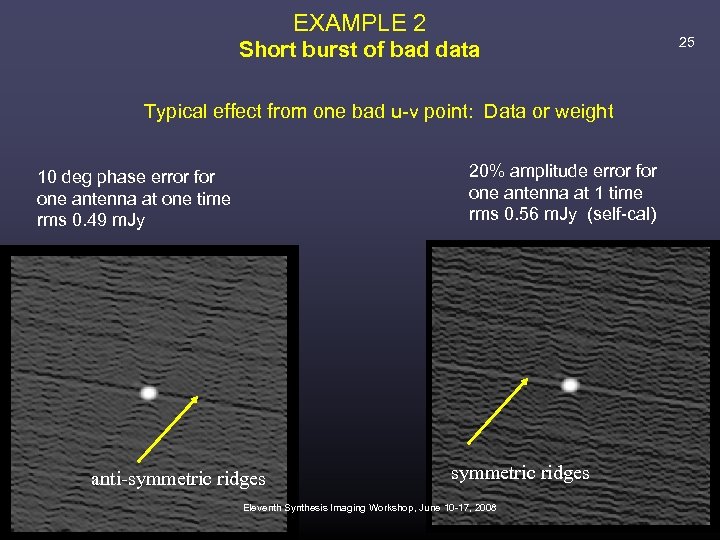 EXAMPLE 2 Short burst of bad data Typical effect from one bad u-v point: Data or weight 20% amplitude error for one antenna at 1 time rms 0. 56 m. Jy (self-cal) 10 deg phase error for one antenna at one time rms 0. 49 m. Jy anti-symmetric ridges Eleventh Synthesis Imaging Workshop, June 10 -17, 2008 25
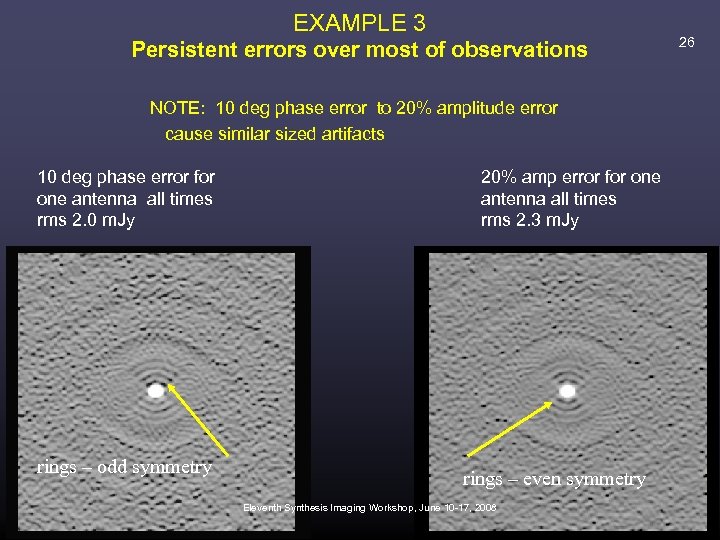 EXAMPLE 3 Persistent errors over most of observations NOTE: 10 deg phase error to 20% amplitude error cause similar sized artifacts 10 deg phase error for one antenna all times rms 2. 0 m. Jy rings – odd symmetry 20% amp error for one antenna all times rms 2. 3 m. Jy rings – even symmetry Eleventh Synthesis Imaging Workshop, June 10 -17, 2008 26
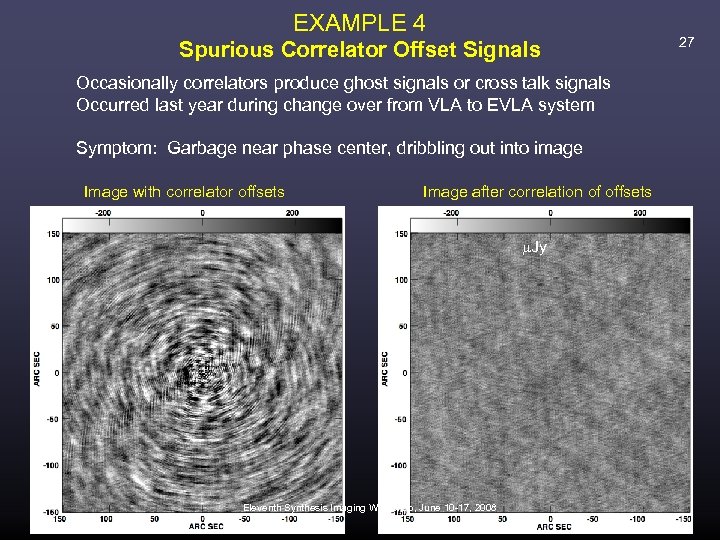 EXAMPLE 4 Spurious Correlator Offset Signals Occasionally correlators produce ghost signals or cross talk signals Occurred last year during change over from VLA to EVLA system Symptom: Garbage near phase center, dribbling out into image Image with correlator offsets Image after correlation of offsets Jy Eleventh Synthesis Imaging Workshop, June 10 -17, 2008 27
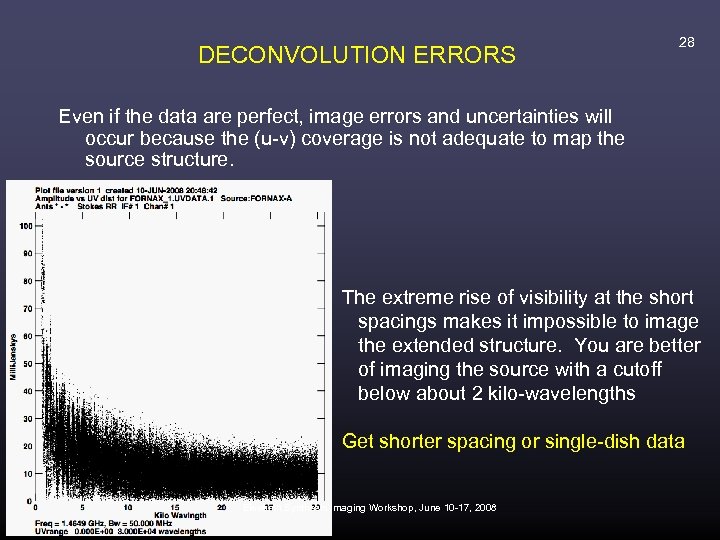 DECONVOLUTION ERRORS 28 Even if the data are perfect, image errors and uncertainties will occur because the (u-v) coverage is not adequate to map the source structure. The extreme rise of visibility at the short spacings makes it impossible to image the extended structure. You are better of imaging the source with a cutoff below about 2 kilo-wavelengths Get shorter spacing or single-dish data Eleventh Synthesis Imaging Workshop, June 10 -17, 2008
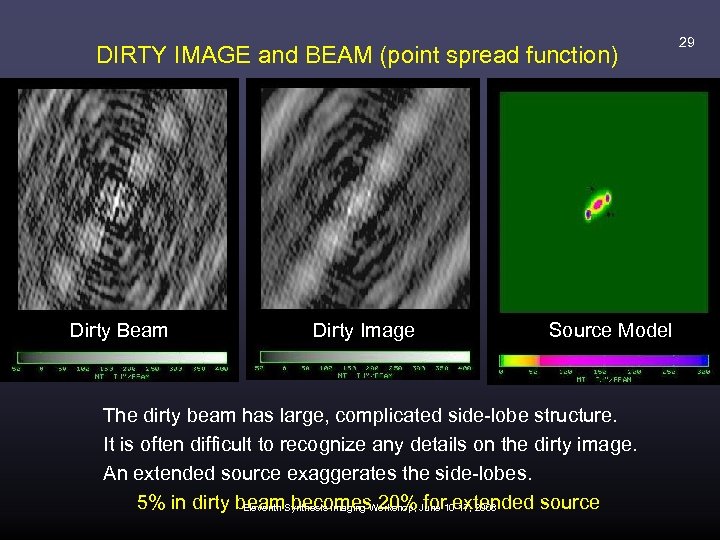 DIRTY IMAGE and BEAM (point spread function) Dirty Beam Dirty Image Source Model The dirty beam has large, complicated side-lobe structure. It is often difficult to recognize any details on the dirty image. An extended source exaggerates the side-lobes. 5% in dirty beam. Synthesis Imaging Workshop, June 10 -17, 2008 Eleventh becomes 20% for extended source 29
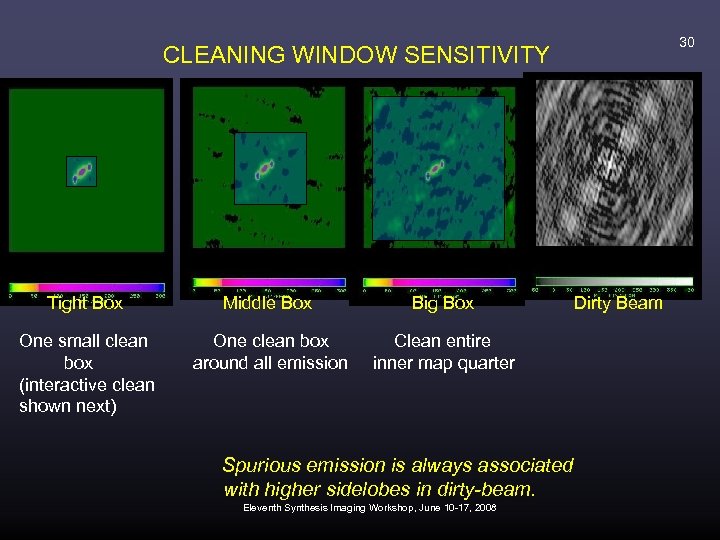 30 CLEANING WINDOW SENSITIVITY Tight Box Middle Box Big Box One small clean box (interactive clean shown next) One clean box around all emission Clean entire inner map quarter Spurious emission is always associated with higher sidelobes in dirty-beam. Eleventh Synthesis Imaging Workshop, June 10 -17, 2008 Dirty Beam
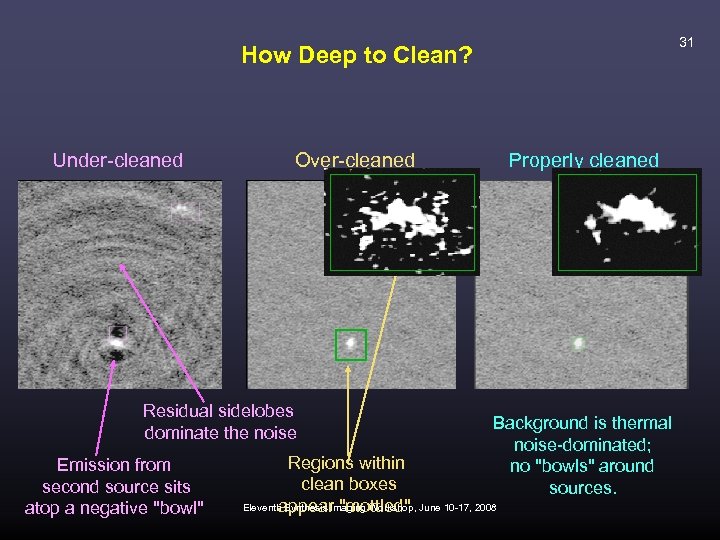 31 How Deep to Clean? Under-cleaned Over-cleaned Residual sidelobes dominate the noise Emission from second source sits atop a negative "bowl" Properly cleaned Background is thermal noise-dominated; no "bowls" around sources. Regions within clean boxes Eleventh Synthesis Imaging Workshop, June 10 -17, 2008 appear "mottled"
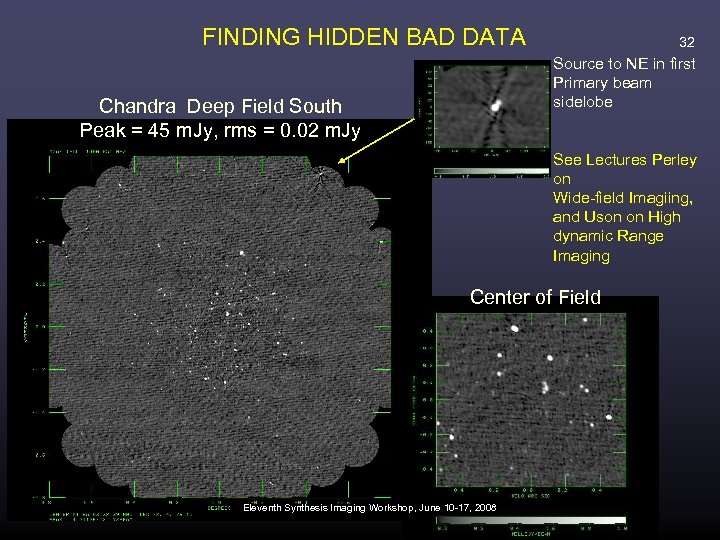 FINDING HIDDEN BAD DATA 32 Source to NE in first Primary beam sidelobe Chandra Deep Field South Chandra Deep Field 45 m. Jy, rms = 0. 02 m. Jy Peak = South See Lectures Perley on Wide-field Imagiing, and Uson on High dynamic Range Imaging Center of Field Eleventh Synthesis Imaging Workshop, June 10 -17, 2008
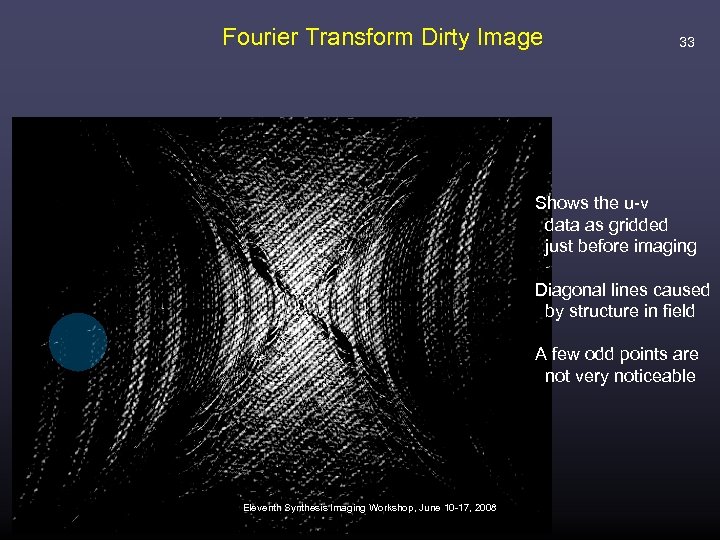 Fourier Transform Dirty Image 33 Shows the u-v data as gridded just before imaging Diagonal lines caused by structure in field A few odd points are not very noticeable Eleventh Synthesis Imaging Workshop, June 10 -17, 2008
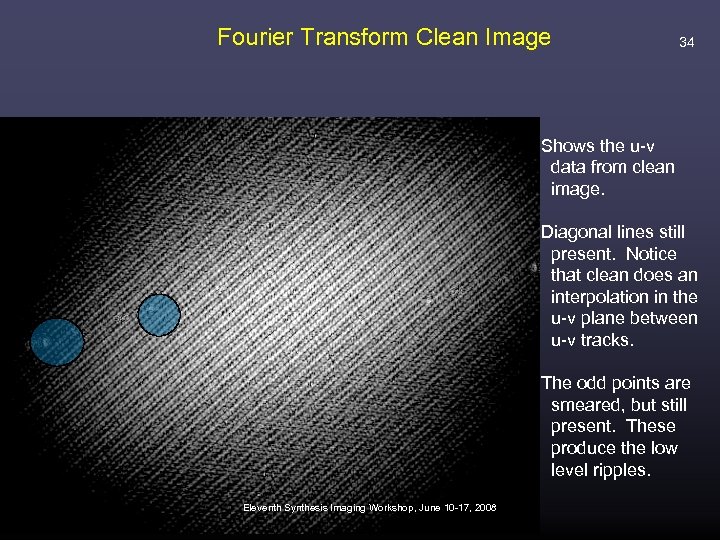 Fourier Transform Clean Image 34 Shows the u-v data from clean image. Diagonal lines still present. Notice that clean does an interpolation in the u-v plane between u-v tracks. The odd points are smeared, but still present. These produce the low level ripples. Eleventh Synthesis Imaging Workshop, June 10 -17, 2008
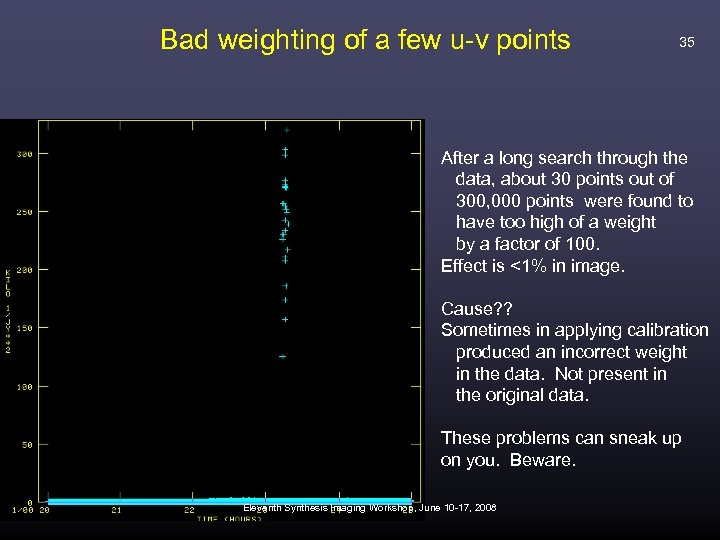 Bad weighting of a few u-v points 35 After a long search through the data, about 30 points out of 300, 000 points were found to have too high of a weight by a factor of 100. Effect is <1% in image. Cause? ? Sometimes in applying calibration produced an incorrect weight in the data. Not present in the original data. These problems can sneak up on you. Beware. Eleventh Synthesis Imaging Workshop, June 10 -17, 2008
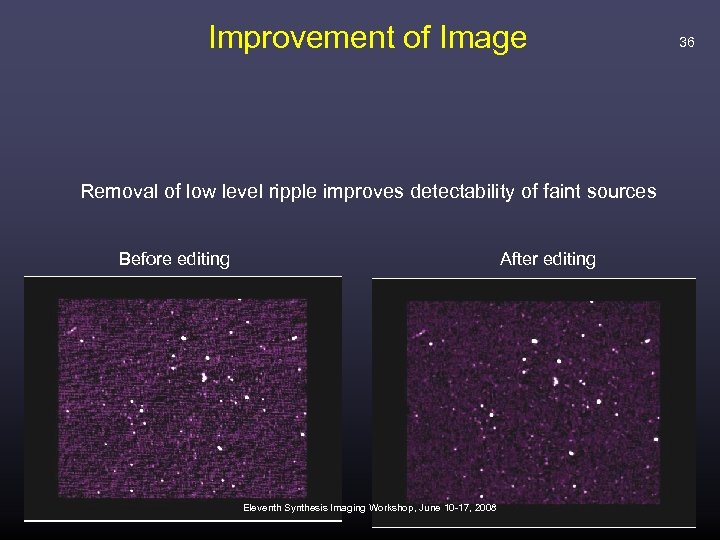 Improvement of Image Removal of low level ripple improves detectability of faint sources Before editing After editing Eleventh Synthesis Imaging Workshop, June 10 -17, 2008 36
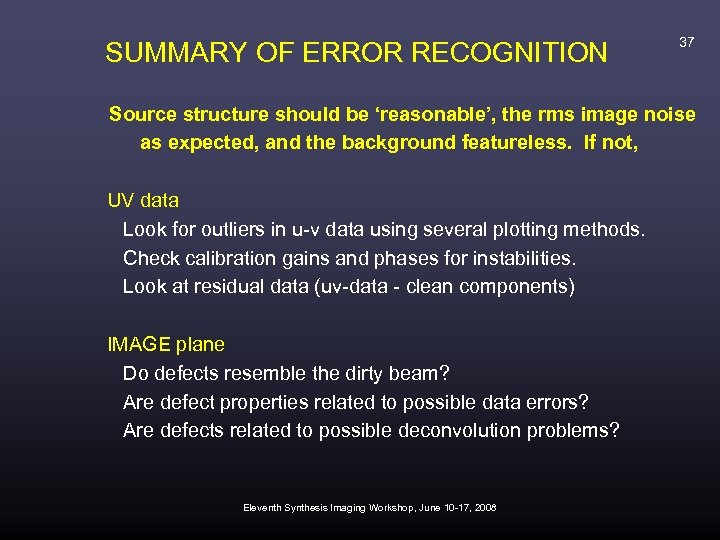 SUMMARY OF ERROR RECOGNITION 37 Source structure should be ‘reasonable’, the rms image noise as expected, and the background featureless. If not, UV data Look for outliers in u-v data using several plotting methods. Check calibration gains and phases for instabilities. Look at residual data (uv-data - clean components) IMAGE plane Do defects resemble the dirty beam? Are defect properties related to possible data errors? Are defects related to possible deconvolution problems? Eleventh Synthesis Imaging Workshop, June 10 -17, 2008
 IMAGE ANALYSIS Ed Fomalont Eleventh Synthesis Imaging Workshop Socorro, June 10 -17, 2008
 IMAGE ANALYSIS • Input: Well-calibrated data-base producing a high quality image • Output: Parameterization and interpretation of image or a set of images This is very open-ended Depends on source emission complexity Depends on the scientific goals Examples and ideas are given. Many software packages, besides AIPS and Casa (eg. IDL, DS-9) are available. Eleventh Synthesis Imaging Workshop, June 10 -17, 2008 39
 IMAGE ANALYSIS OUTLINE • • • Multi-Resolution of radio source. Parameter Estimation of Discrete Components Polarization Data Image Comparisons Positional Registration Eleventh Synthesis Imaging Workshop, June 10 -17, 2008 40
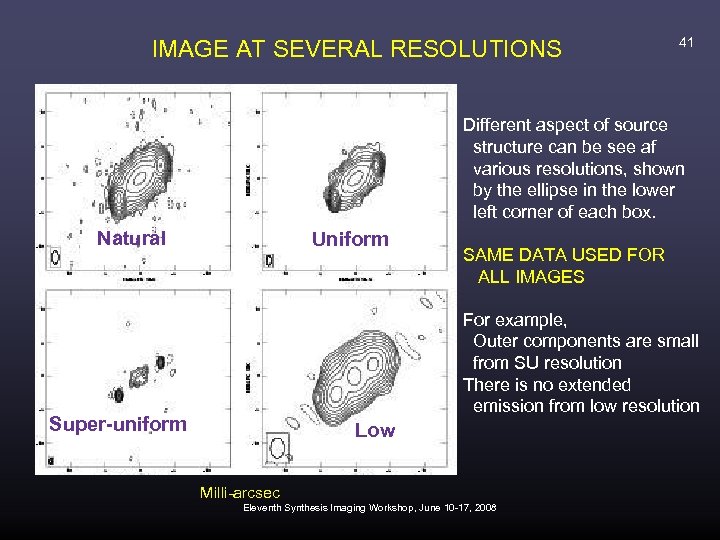 IMAGE AT SEVERAL RESOLUTIONS 41 Different aspect of source structure can be see af various resolutions, shown by the ellipse in the lower left corner of each box. Natural Uniform SAME DATA USED FOR ALL IMAGES For example, Outer components are small from SU resolution There is no extended emission from low resolution Super-uniform Low Milli-arcsec Eleventh Synthesis Imaging Workshop, June 10 -17, 2008
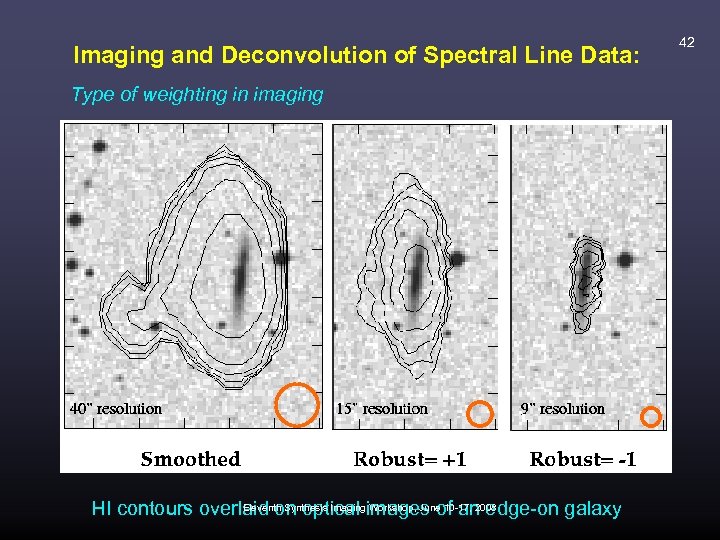 Imaging and Deconvolution of Spectral Line Data: Type of weighting in imaging Eleventh Synthesis Imaging Workshop, June 10 -17, 2008 HI contours overlaid on optical images of an edge-on galaxy 42
 PARAMETER ESTIMATION Parameters associated with discrete components • Fitting in the image – Assume source components are Gaussian-shaped – Deep cleaning restores image intensity with Gaussian-beam – True size * Beam size = Image size, if Gaussian-shaped. Hence, estimate of true size is relatively simple. • Fitting in (u-v) plane – Better estimates for small-diameter sources – Can fit to any source model (egs ring, disk) (see non-imaging analysis) • Error estimates of parameters – Simple ad-hoc error estimates – Estimates from fitting programs Eleventh Synthesis Imaging Workshop, June 10 -17, 2008 43
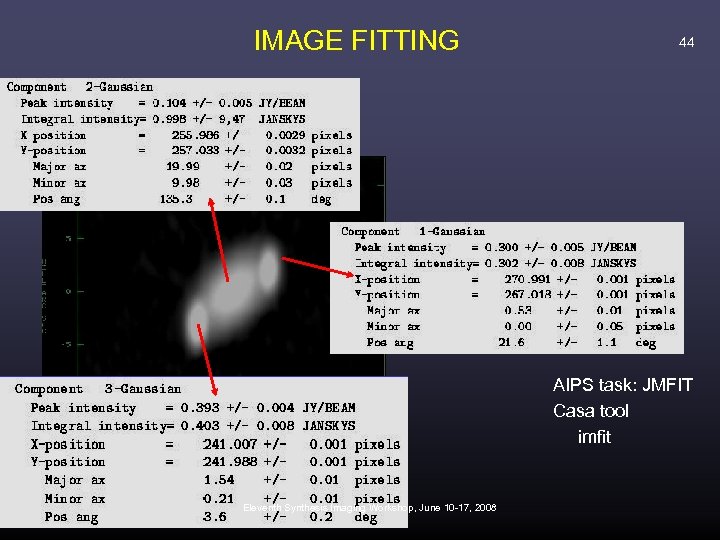 IMAGE FITTING 44 AIPS task: JMFIT Casa tool imfit Eleventh Synthesis Imaging Workshop, June 10 -17, 2008
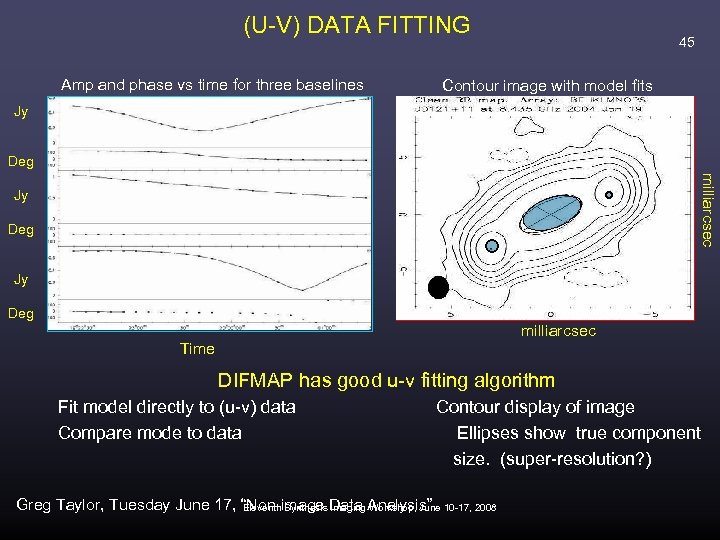 (U-V) DATA FITTING Amp and phase vs time for three baselines 45 Contour image with model fits Jy Deg milliarcsec Time DIFMAP has good u-v fitting algorithm Fit model directly to (u-v) data Compare mode to data Contour display of image Ellipses show true component size. (super-resolution? ) Greg Taylor, Tuesday June 17, “Non-image Data Analysis” 10 -17, 2008 Eleventh Synthesis Imaging Workshop, June
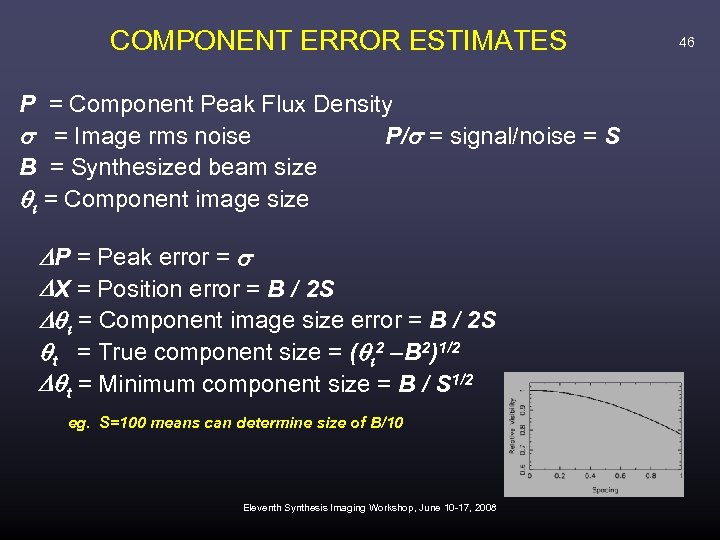 COMPONENT ERROR ESTIMATES P = Component Peak Flux Density s = Image rms noise P/s = signal/noise = S B = Synthesized beam size qi = Component image size DP = Peak error = s DX = Position error = B / 2 S Dqi = Component image size error = B / 2 S qt = True component size = (qi 2 –B 2)1/2 Dqt = Minimum component size = B / S 1/2 eg. S=100 means can determine size of B/10 Eleventh Synthesis Imaging Workshop, June 10 -17, 2008 46
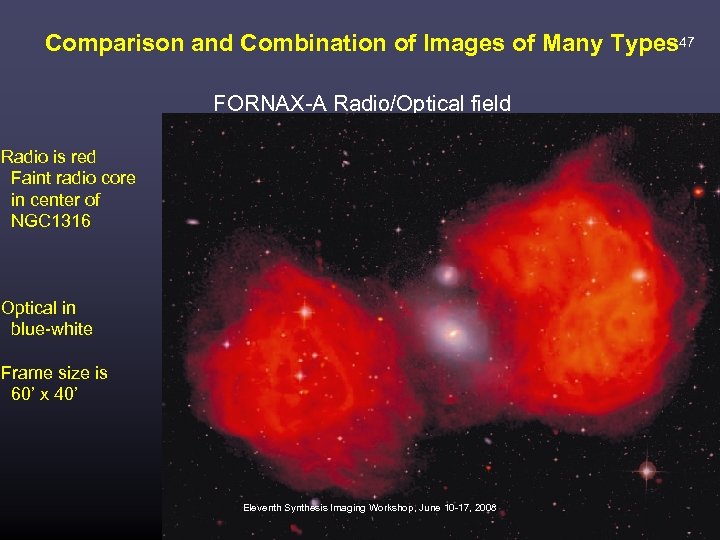 Comparison and Combination of Images of Many Types 47 FORNAX-A Radio/Optical field Radio is red Faint radio core in center of NGC 1316 Optical in blue-white Frame size is 60’ x 40’ Eleventh Synthesis Imaging Workshop, June 10 -17, 2008
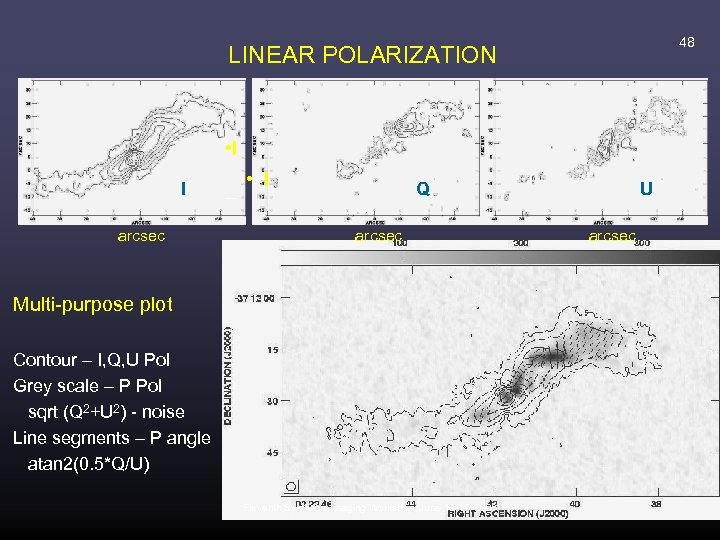 48 LINEAR POLARIZATION • I I arcsec – • I Q arcsec Multi-purpose plot Contour – I, Q, U Pol Grey scale – P Pol sqrt (Q 2+U 2) - noise Line segments – P angle atan 2(0. 5*Q/U) Eleventh Synthesis Imaging Workshop, June 10 -17, 2008 U arcsec
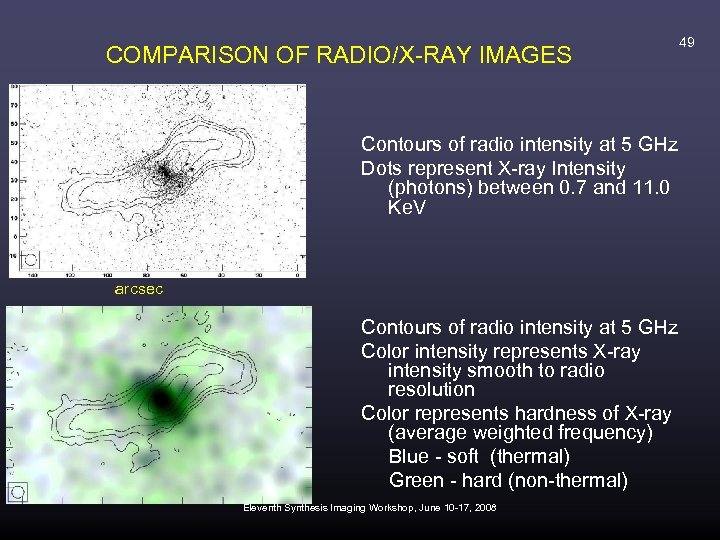 COMPARISON OF RADIO/X-RAY IMAGES Contours of radio intensity at 5 GHz Dots represent X-ray Intensity (photons) between 0. 7 and 11. 0 Ke. V arcsec Contours of radio intensity at 5 GHz Color intensity represents X-ray intensity smooth to radio resolution Color represents hardness of X-ray (average weighted frequency) Blue - soft (thermal) Green - hard (non-thermal) Eleventh Synthesis Imaging Workshop, June 10 -17, 2008 49
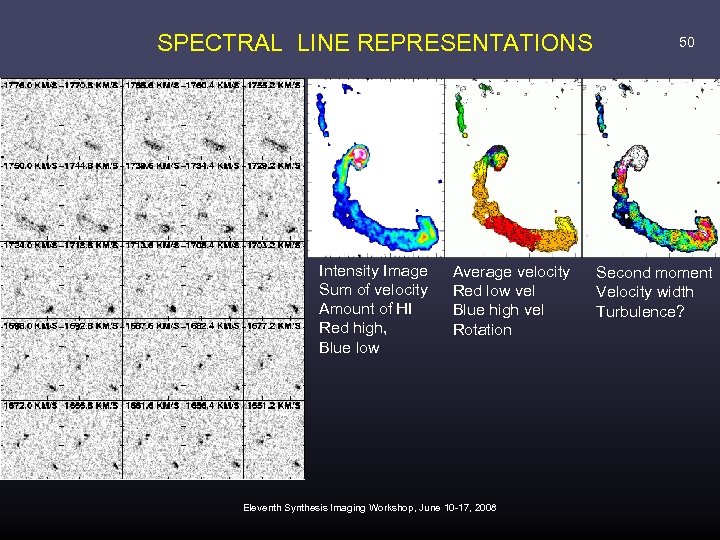 SPECTRAL LINE REPRESENTATIONS Intensity Image Sum of velocity Amount of HI Red high, Blue low Average velocity Red low vel Blue high vel Rotation Eleventh Synthesis Imaging Workshop, June 10 -17, 2008 50 Second moment Velocity width Turbulence?
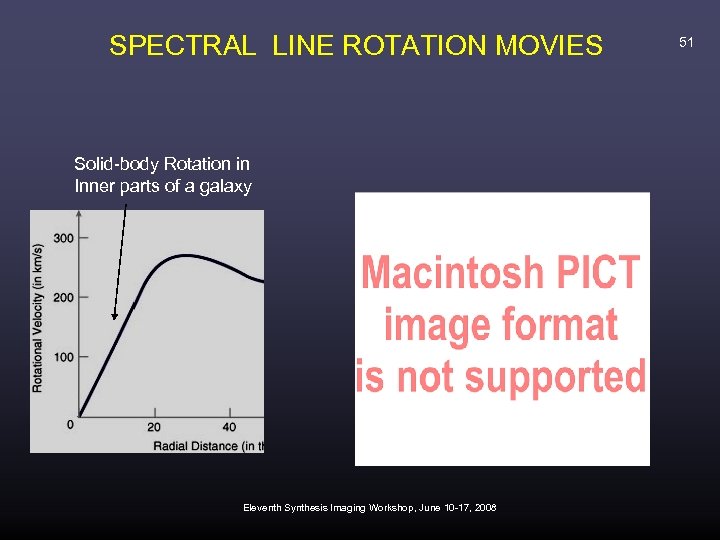 SPECTRAL LINE ROTATION MOVIES Solid-body Rotation in Inner parts of a galaxy Eleventh Synthesis Imaging Workshop, June 10 -17, 2008 51
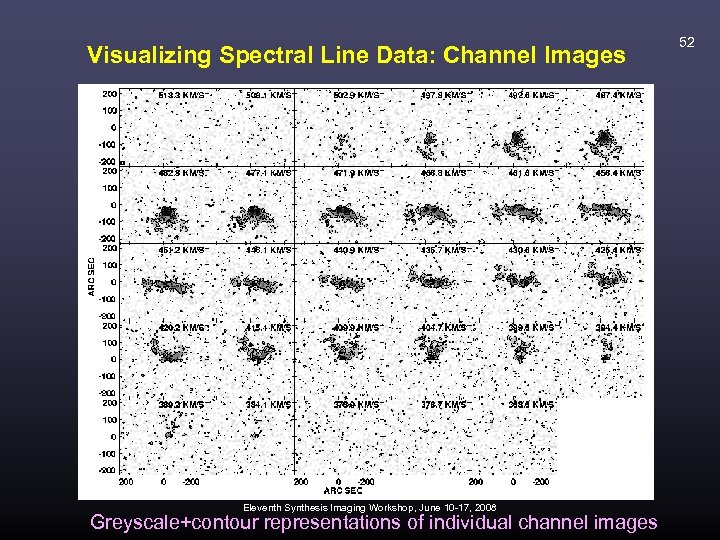 Visualizing Spectral Line Data: Channel Images Eleventh Synthesis Imaging Workshop, June 10 -17, 2008 Greyscale+contour representations of individual channel images 52
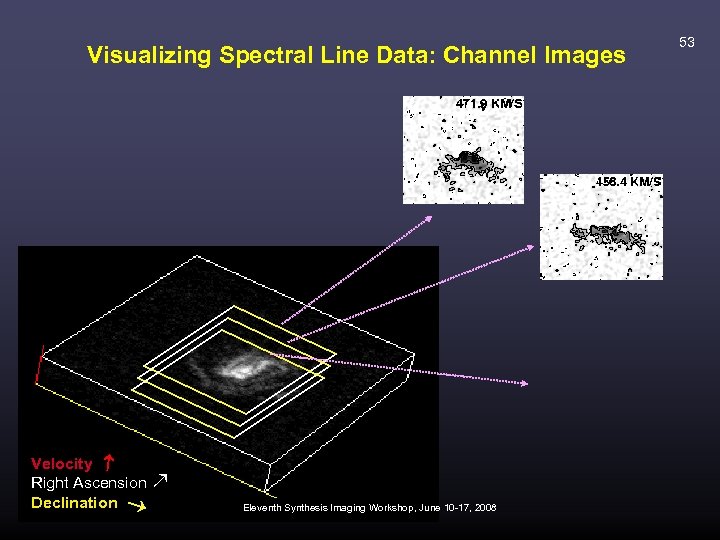 Visualizing Spectral Line Data: Channel Images Velocity Right Ascension Declination Eleventh Synthesis Imaging Workshop, June 10 -17, 2008 53
 IMAGE REGISTRATION AND ACCURACY • Separation Accuracy of Components on One Image: Limited by signal to noise to 1% of resolution. Position errors of 1: 10000 for wide fields, i. e. 0. 1” over 1. 4 GHz PB • Images at Different Frequencies: Multi-frequency. Use same calibrator for all frequencies. Watch out at frequencies < 2 GHz when ionosphere can produce displacement. Minimize calibrator-target separation • Images at Different Times (different configuration): Use same calibrator for all observations. Daily troposphere changes can produce position changes up to 25% of the resolution. • Radio versus non-Radio Images: Header-information of non-radio images often much less accurate than that for radio. For accuracy <1”, often have to align using coincident objects. Eleventh Synthesis Imaging Workshop, June 10 -17, 2008 54
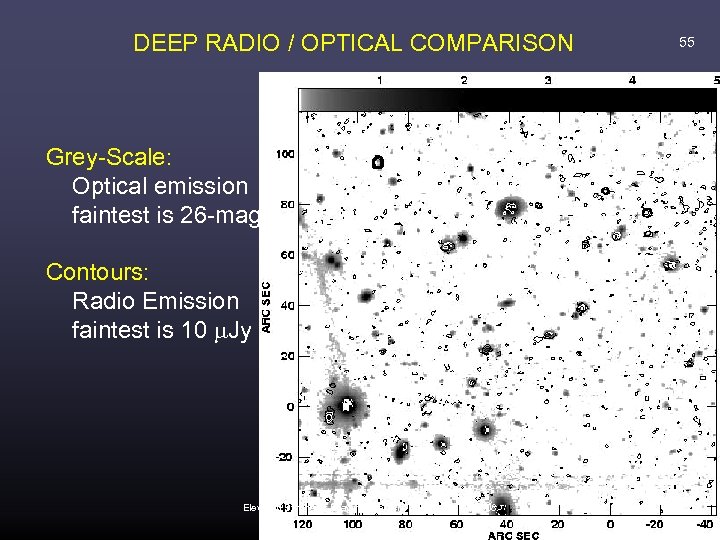 DEEP RADIO / OPTICAL COMPARISON Grey-Scale: Optical emission faintest is 26 -mag Contours: Radio Emission faintest is 10 Jy Eleventh Synthesis Imaging Workshop, June 10 -17, 2008 55
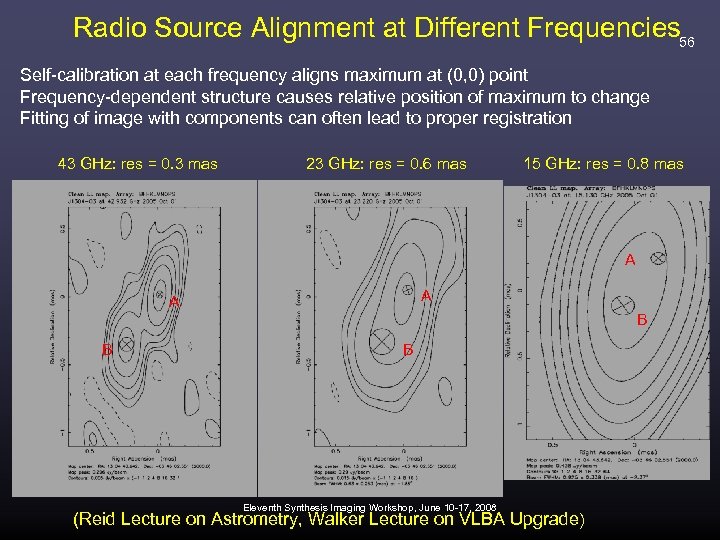 Radio Source Alignment at Different Frequencies 56 Self-calibration at each frequency aligns maximum at (0, 0) point Frequency-dependent structure causes relative position of maximum to change Fitting of image with components can often lead to proper registration 43 GHz: res = 0. 3 mas 23 GHz: res = 0. 6 mas 15 GHz: res = 0. 8 mas A A A B B B Eleventh Synthesis Imaging Workshop, June 10 -17, 2008 (Reid Lecture on Astrometry, Walker Lecture on VLBA Upgrade)
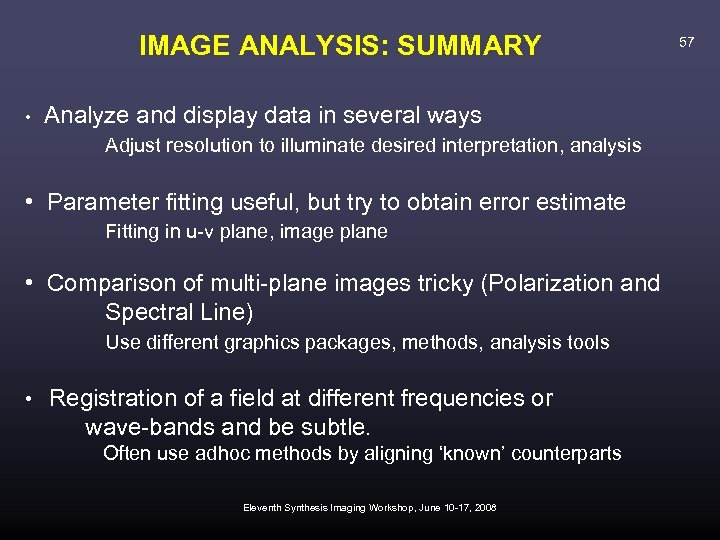 IMAGE ANALYSIS: SUMMARY • Analyze and display data in several ways Adjust resolution to illuminate desired interpretation, analysis • Parameter fitting useful, but try to obtain error estimate Fitting in u-v plane, image plane • Comparison of multi-plane images tricky (Polarization and Spectral Line) Use different graphics packages, methods, analysis tools • Registration of a field at different frequencies or wave-bands and be subtle. Often use adhoc methods by aligning ‘known’ counterparts Eleventh Synthesis Imaging Workshop, June 10 -17, 2008 57